
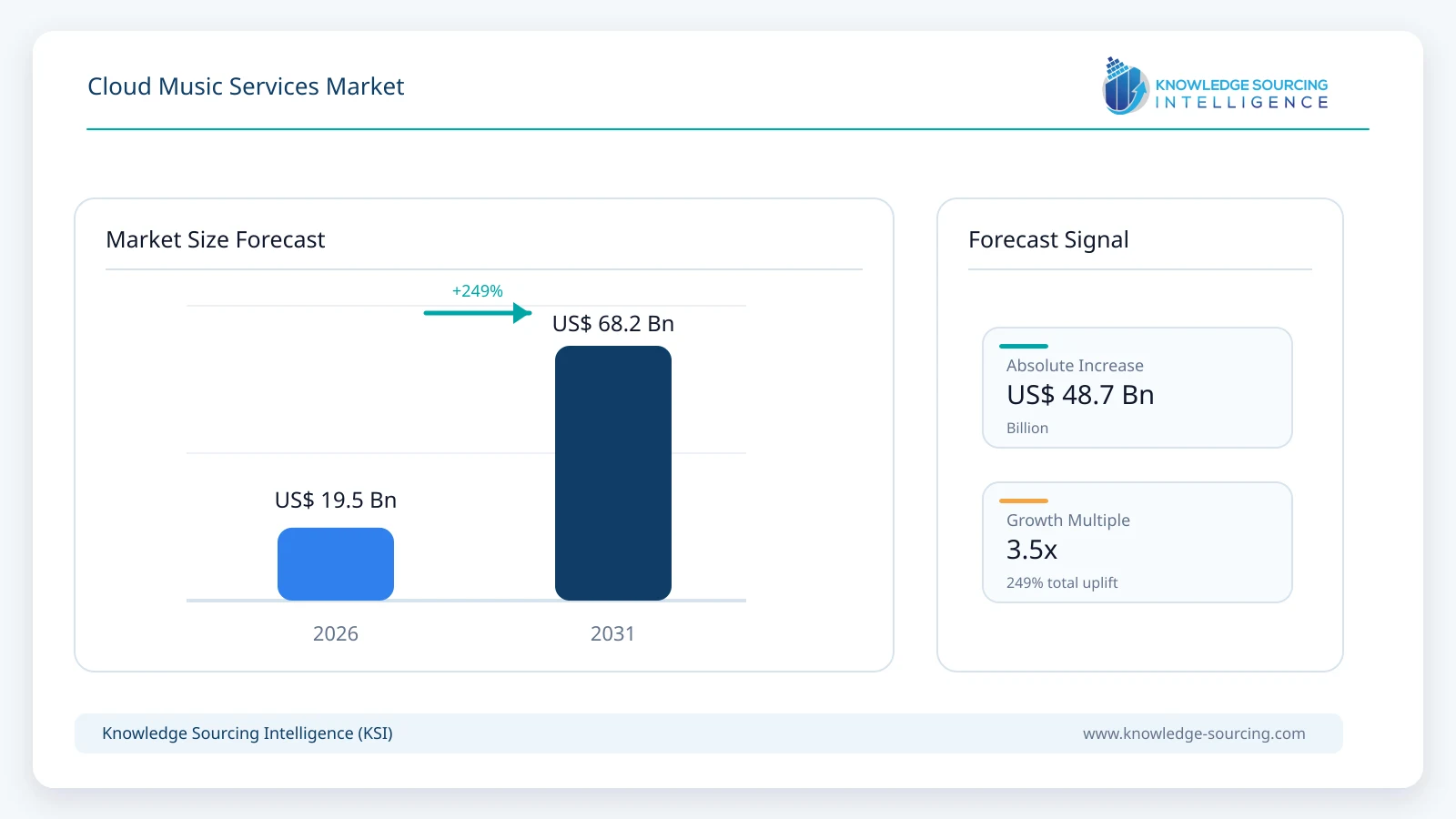
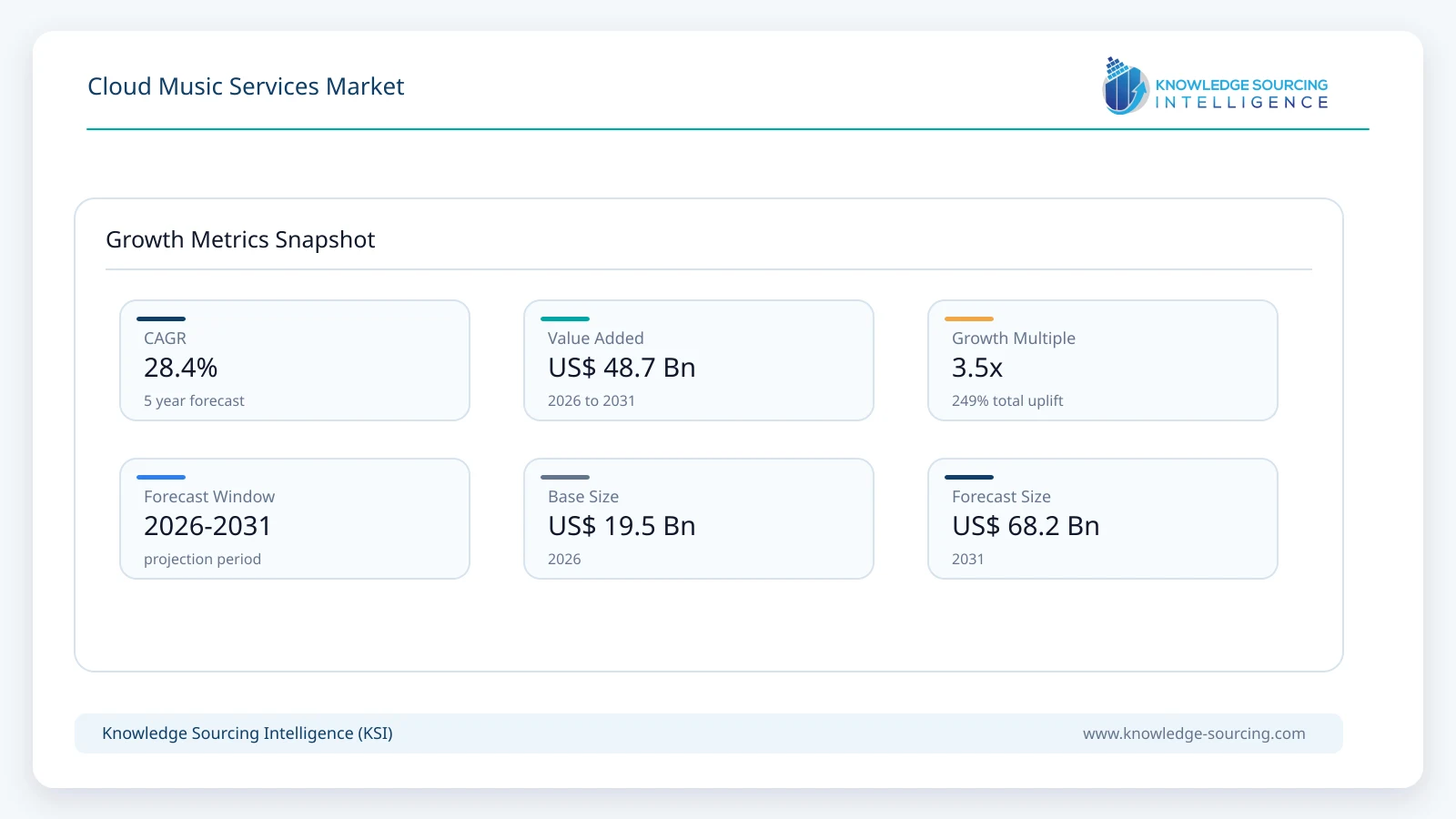
The Cloud Music Services Market is forecast to grow at a CAGR of 28.44%, reaching USD 68.22 billion in 2031 from USD 19.52 billion in 2026.
Highlights:
- 1Rising smartphone adoption and affordable mobile broadband continue to support demand for cloud-based music consumption.
- 2Subscription streaming remains the most commercially influential service category due to recurring revenue generation and customer retention.
- 3Asia Pacific presents substantial expansion opportunities driven by regional language content and growing digital payment adoption.
- 4Artificial intelligence is improving music discovery, playlist personalization, recommendation accuracy, and listener engagement.
- 5Copyright enforcement, royalty transparency, and digital licensing frameworks continue to influence platform operations across major markets.
- 6Competition increasingly centers on ecosystem integration, exclusive content, creator engagement, and premium audio experiences.
Cloud music services refer to digital platforms that store, distribute, and stream music libraries through cloud-based infrastructure, allowing users to access content across multiple connected devices without maintaining extensive local storage. The market encompasses subscription-based streaming services, downloadable cloud music libraries, and hybrid platforms that combine offline access with internet-based synchronization. Customers include individual consumers seeking on-demand entertainment and enterprises such as hotels, restaurants, fitness centers, retail chains, broadcasters, and commercial venues requiring licensed music solutions.
The commercial foundation of the cloud music services market is built on recurring subscription revenue, advertising-supported listening, premium audio offerings, and value-added ecosystem services. Consumer purchasing decisions increasingly emphasize audio quality, personalized recommendations, seamless cross-device synchronization, offline playback, exclusive content availability, and compatibility with smart televisions, smartphones, connected vehicles, gaming consoles, and voice-enabled home devices. Enterprise customers evaluate providers based on licensing compliance, playlist management capabilities, commercial usage rights, reliability, and integration with digital signage and customer engagement platforms.
Demand continues to expand as mobile broadband coverage improves, smartphone penetration increases, and consumers shift from ownership-based music consumption toward access-based listening models. Cloud infrastructure has lowered distribution costs while enabling providers to deliver extensive music catalogs, real-time content updates, and personalized listening experiences supported by artificial intelligence and machine learning algorithms. Continuous investments in recommendation engines, spatial audio technologies, multilingual content libraries, and creator monetization tools further reinforce platform competitiveness.
The industry structure includes global subscription platforms, regional streaming providers, telecommunications-backed music ecosystems, and integrated technology companies that bundle music services with broader digital offerings. Competition extends beyond catalog size to include exclusive podcasts, artist engagement tools, recommendation accuracy, pricing flexibility, family plans, student subscriptions, and partnerships with telecom operators and consumer electronics manufacturers. Revenue generation increasingly depends on customer retention rather than user acquisition alone, making engagement metrics and listening time important commercial indicators.
Music labels, independent artists, publishers, telecommunications companies, device manufacturers, payment providers, and advertising networks collectively shape the industry's value chain. Licensing negotiations, royalty management, cloud infrastructure investments, and local content acquisition remain central operational priorities. Regional music preferences, language diversity, and copyright regulations significantly influence catalog development and commercialization strategies across different countries.
Market Drivers
Expansion of subscription-based digital entertainment
Consumers increasingly prefer subscription services that provide unlimited access to extensive music libraries without requiring individual purchases. Household spending on digital entertainment continues to shift toward recurring payment models as consumers seek convenience, predictable pricing, and continuous access across devices. Service providers respond by introducing flexible pricing tiers, family subscriptions, student discounts, bundled telecommunications offers, and premium audio features. This business model generates recurring revenue while improving customer lifetime value and supporting sustained investment in content acquisition.
Growth in connected devices and mobile ecosystems
Smartphones remain the primary gateway for cloud music consumption, but listening increasingly extends to smart speakers, wearable devices, connected vehicles, gaming systems, and smart televisions. Buyers expect uninterrupted synchronization across these platforms, encouraging providers to optimize cloud infrastructure and application performance. Technology companies strengthen ecosystem integration to increase user engagement and reduce subscriber churn. This interconnected environment creates additional monetization opportunities through premium services and ecosystem bundling.
Rising demand for localized and multilingual content
Regional music preferences strongly influence subscriber acquisition and retention. Consumers increasingly seek local artists, regional languages, cultural playlists, and independent music alongside international catalogs. Streaming platforms therefore invest in regional licensing agreements, local editorial teams, and artist development initiatives. These investments improve platform relevance in emerging markets while expanding advertising inventory and subscription opportunities among previously underserved audiences.
Artificial intelligence enhances user engagement
Recommendation systems supported by machine learning improve music discovery by analyzing listening history, behavioral patterns, contextual preferences, and user interactions. More accurate recommendations encourage longer listening sessions and improve subscription retention. Companies continue investing in automated playlist generation, voice search optimization, mood-based recommendations, and personalized notifications to differentiate their services and increase engagement without substantially expanding marketing expenditure.
Market Restraints and Challenges
Complex royalty and licensing structures
Music licensing involves negotiations among record labels, publishers, collecting societies, and independent rights holders across multiple jurisdictions. Royalty calculations vary by territory, subscription model, and commercial usage, increasing operational complexity. Smaller platforms often face higher administrative costs and reduced negotiating power, limiting profitability. Many providers invest in automated royalty management systems and expanded rights administration capabilities to improve efficiency.
Subscriber acquisition costs and pricing pressure
Competition among established global platforms and regional providers has intensified customer acquisition spending. Promotional pricing, bundled subscriptions, and free trial campaigns reduce short-term profitability. Consumers also demonstrate limited willingness to maintain multiple music subscriptions, increasing competition for household entertainment budgets. Providers increasingly emphasize exclusive content, personalized experiences, and ecosystem integration to improve retention rather than relying solely on price competition.
Copyright infringement and unauthorized distribution
Despite improvements in digital rights management, unauthorized content distribution remains a concern in several markets. Piracy affects royalty collections and reduces incentives for legitimate subscription adoption. Regulatory enforcement, automated content identification systems, and cooperation between platforms, copyright owners, and government authorities remain essential to protecting commercial value across the digital music ecosystem.
Infrastructure disparities across developing markets
Reliable broadband connectivity, mobile network performance, and digital payment accessibility differ considerably between countries. Consumers in regions with inconsistent connectivity often prefer offline listening features or lower-bandwidth streaming options. Service providers address these limitations through adaptive streaming technologies, compressed audio formats, offline downloads, and partnerships with telecommunications operators offering bundled data packages.
Major Segment Analysis
Subscription Services
Subscription services represent the most commercially influential segment because they generate recurring monthly revenue while supporting predictable financial planning for platform operators. Unlike advertising-supported listening, subscription models provide greater revenue visibility and stronger customer engagement metrics, enabling sustained investment in content licensing, recommendation technologies, and exclusive programming.
Consumer demand increasingly favors uninterrupted listening, offline downloads, higher audio quality, cross-device synchronization, and personalized recommendations. Family plans, student subscriptions, and bundled mobile service offerings have broadened the addressable customer base while reducing acquisition costs through strategic partnerships with telecommunications providers.
Competition within the subscription segment extends beyond catalog size. Providers differentiate through recommendation quality, exclusive artist content, podcasts, spatial audio capabilities, multilingual libraries, and seamless integration with smartphones, connected vehicles, smart speakers, and wearable devices. Retention has become a more important commercial objective than subscriber acquisition alone, encouraging continued investment in customer experience and personalized engagement.
As recurring revenue expands, subscription services also provide stronger financial support for royalty payments, infrastructure investments, and content partnerships, reinforcing their central position within the cloud music services industry.
Regional Analysis
North America remains one of the largest revenue contributors due to mature subscription adoption, widespread broadband availability, established digital payment infrastructure, and high consumer spending on digital entertainment. Buyers increasingly value premium audio quality, podcast integration, and ecosystem compatibility across multiple connected devices. Competition remains intense among established international platforms supported by continuous technology investments.
Europe demonstrates stable demand supported by comprehensive copyright frameworks, widespread digital literacy, and extensive broadband infrastructure. Consumers show strong interest in multilingual catalogs, local artists, and premium subscription plans. Regulatory attention toward digital competition, consumer privacy, and copyright transparency continues to shape platform operations throughout the region.
Asia Pacific represents the most commercially attractive expansion region due to growing smartphone ownership, affordable mobile data, expanding digital payment ecosystems, and increasing consumption of regional language music. Telecommunications partnerships, localized content strategies, and affordable subscription pricing remain important competitive factors. Diverse consumer preferences require significant investment in regional licensing and localized recommendation systems.
Middle East and Africa continue experiencing gradual digital entertainment adoption supported by improving broadband infrastructure and expanding smartphone penetration. Younger populations increasingly consume music through mobile-first platforms, although payment accessibility and licensing consistency remain important commercial considerations. Partnerships with mobile operators help improve affordability and subscriber acquisition.
South America benefits from expanding internet access and strong consumer engagement with regional music genres. Economic fluctuations influence subscription affordability, encouraging providers to offer flexible pricing structures and advertising-supported services alongside premium subscriptions. Local content remains an important differentiator for regional customer acquisition.
Competitive Landscape
The cloud music services market combines global technology companies, dedicated streaming platforms, telecommunications-backed providers, and regional digital music specialists. Competition centers on subscription retention, content exclusivity, recommendation quality, catalog diversity, user experience, and ecosystem integration rather than price alone.
Companies including Apple Inc., Spotify Technology S.A., Amazon.com, Inc., Pandora Media, LLC, SoundCloud, KKBOX, YouTube Music (Google LLC), Deezer S.A., JioSaavn, Gaana, Qobuz, TIDAL, Napster, Wynk Music (Airtel Digital Ltd.), and NetEase Cloud Music Inc. continue expanding multilingual content libraries, improving recommendation technologies, strengthening creator partnerships, and integrating music services across consumer electronics and connected digital ecosystems. Strategic collaborations with telecommunications providers, automotive manufacturers, and smart device companies remain important channels for subscriber acquisition and long-term customer retention.
Recent Developments
July 2026: Deezer announced that AI-generated music surpassed 50% of all newly uploaded tracks on its platform, highlighting accelerating AI adoption and expanding AI detection capabilities across its cloud music streaming service.
June 2026: Spotify introduced beta support for direct full-length video uploads for artists, allowing creators to publish official music videos directly on Spotify and strengthening its cloud-based multimedia streaming platform.
March 2026: Spotify Technology S.A. expanded its audiobook and premium content offerings across additional international markets. The initiative strengthens subscriber engagement and broadens recurring revenue opportunities.
February 2026: YouTube Music introduced expanded artificial intelligence-powered playlist personalization and discovery capabilities for premium subscribers. The enhancement improves user retention and listening duration.
October 2025: Deezer S.A. expanded its AI-generated content identification technology to improve transparency between human-created and synthetic audio. The development supports copyright integrity and strengthens user confidence in content authenticity.
Regulatory and Policy Environment
Cloud music service providers operate within complex copyright, licensing, privacy, and consumer protection frameworks. Copyright legislation governs music reproduction, distribution, streaming, and public performance, requiring platforms to negotiate licensing agreements with rights holders across multiple jurisdictions. Collective management organizations continue playing an important role in royalty administration and rights management.
Data privacy regulations influence recommendation systems and customer analytics by establishing requirements for user consent, data processing, and information security. Compliance with frameworks such as the European Union's General Data Protection Regulation (GDPR) shapes platform design and data governance practices. Consumer protection laws governing subscription transparency, automatic renewals, and cancellation processes also affect commercial operations.
Governments continue supporting digital infrastructure expansion through broadband investment programs, indirectly improving cloud music accessibility in underserved regions. Meanwhile, copyright enforcement initiatives and digital piracy controls contribute to a more sustainable commercial environment for licensed streaming services.
Outlook and Strategic Implications
Commercial opportunities over the next five years will depend on sustained subscription retention, localized content investments, artificial intelligence-enabled personalization, and continued integration across connected consumer ecosystems. Buyers are expected to prioritize convenience, personalized listening experiences, premium audio quality, multilingual catalogs, and seamless interoperability across multiple devices.
Investment activity is likely to concentrate on recommendation technologies, creator monetization tools, cloud infrastructure optimization, and regional licensing capabilities. Strategic partnerships with telecommunications companies, automotive manufacturers, and consumer electronics producers are expected to remain important customer acquisition channels.
Competition will increasingly reflect platform engagement rather than catalog scale alone. Providers capable of combining differentiated content, advanced recommendation systems, transparent royalty management, and efficient subscriber retention strategies will be better positioned to strengthen long-term commercial performance. At the same time, regulatory developments concerning copyright, artificial intelligence, and digital privacy will continue influencing investment priorities and operating models across the global cloud music services market.
Cloud Music Services Market Scope
| Report Metric | Details |
|---|---|
| Total Market Size in 2026 | USD 19.52 billion |
| Total Market Size in 2031 | USD 68.22 billion |
| Forecast Unit | Billion |
| Growth Rate | 28.44% |
| Study Period | 2021 to 2031 |
| Historical Data | 2021 to 2024 |
| Base Year | 2025 |
| Forecast Period | 2026 – 2031 |
| Segmentation | Type, Platform, End-User, Geography |
| Companies |
|
Market Segmentation
By Type
- Downloadable
- Subscription
- Streaming
By Platform
- Mobile Device
- Web-Based
By End-User
- Individual
- Business
By Geography
- North America
- United States
- Canada
- Mexico
- South America
- Brazil
- Argentina
- Others
- Europe
- United Kingdom
- Germany
- France
- Italy
- Spain
- Others
- Middle East and Africa
- Saudi Arabia
- United Arab Emirates
- Israel
- Others
- Asia Pacific
- China
- Japan
- India
- South Korea
- Australia
- Indonesia
- Thailand
- Taiwan
- Others
Table of Contents
1. INTRODUCTION
1.1. Market Overview
1.2. Market Definition
1.3. Scope of the Study
1.4. Market Segmentation
1.5. Currency
1.6. Assumptions
1.7. Base and Forecast Years Timeline
1.8. Key Benefits for Stakeholders
2. RESEARCH METHODOLOGY
2.1. Research Design
2.2. Research Process
3. EXECUTIVE SUMMARY
3.1. Key Findings
4. MARKET DYNAMICS
4.1. Market Drivers
4.2. Market Restraints
4.3. Porter's Five Forces Analysis
4.3.1. Bargaining Power of Suppliers
4.3.2. Bargaining Power of Buyers
4.3.3. Threat of New Entrants
4.3.4. Threat of Substitutes
4.3.5. Competitive Rivalry in the Industry
4.4. Industry Value Chain Analysis
4.5. Analyst View
5. CLOUD MUSIC SERVICES MARKET BY TYPE
5.1. Introduction
5.2. Downloadable
5.3. Subscription
5.4. Streaming
6. CLOUD MUSIC SERVICES MARKET BY PLATFORM
6.1. Introduction
6.2. Mobile Device
6.3. Web-Based
7. CLOUD MUSIC SERVICES MARKET BY END-USER
7.1. Introduction
7.2. Individual
7.3. Business
8. CLOUD MUSIC SERVICES MARKET BY GEOGRAPHY
8.1. Introduction
8.2. North America
8.2.1. By Type
8.2.2. By Platform
8.2.3. By End-User
8.2.4. By Country
8.2.4.1. United States
8.2.4.2. Canada
8.2.4.3. Mexico
8.3. South America
8.3.1. By Type
8.3.2. By Platform
8.3.3. By End-User
8.3.4. By Country
8.3.4.1. Brazil
8.3.4.2. Argentina
8.3.4.3. Others
8.4. Europe
8.4.1. By Type
8.4.2. By Platform
8.4.3. By End-User
8.4.4. By Country
8.4.4.1. United Kingdom
8.4.4.2. Germany
8.4.4.3. France
8.4.4.4. Italy
8.4.4.5. Spain
8.4.4.6. Others
8.5. Middle East and Africa
8.5.1. By Type
8.5.2. By Platform
8.5.3. By End-User
8.5.4. By Country
8.5.4.1. Saudi Arabia
8.5.4.2. United Arab Emirates
8.5.4.3. Israel
8.5.4.4. Others
8.6. Asia Pacific
8.6.1. By Type
8.6.2. By Platform
8.6.3. By End-User
8.6.4. By Country
8.6.4.1. China
8.6.4.2. Japan
8.6.4.3. India
8.6.4.4. South Korea
8.6.4.5. Australia
8.6.4.6. Indonesia
8.6.4.7. Thailand
8.6.4.8. Taiwan
8.6.4.9. Others
9. COMPETITIVE ENVIRONMENT AND ANALYSIS
9.1. Major Players and Strategy Analysis
9.2. Emerging Players and Market Lucrativeness
9.3. Mergers, Acquisitions, Agreements, and Collaborations
9.4. Competitive Dashboard
10. COMPANY PROFILES
10.1. Apple Inc.
10.2. Spotify Technology S.A.
10.3. Amazon.com, Inc.
10.4. Pandora Media, LLC
10.5. SoundCloud
10.6. KKBOX
10.7. YouTube Music (Google LLC)
10.8. Deezer S.A.
10.9. JioSaavn
10.10. Gaana
10.11. Qobuz
10.12. TIDAL
10.13. Napster
10.14. Wynk Music (Airtel Digital Ltd.)
10.15. NetEase Cloud Music Inc.
Navigate
Trusted by the world's leading organizations











