
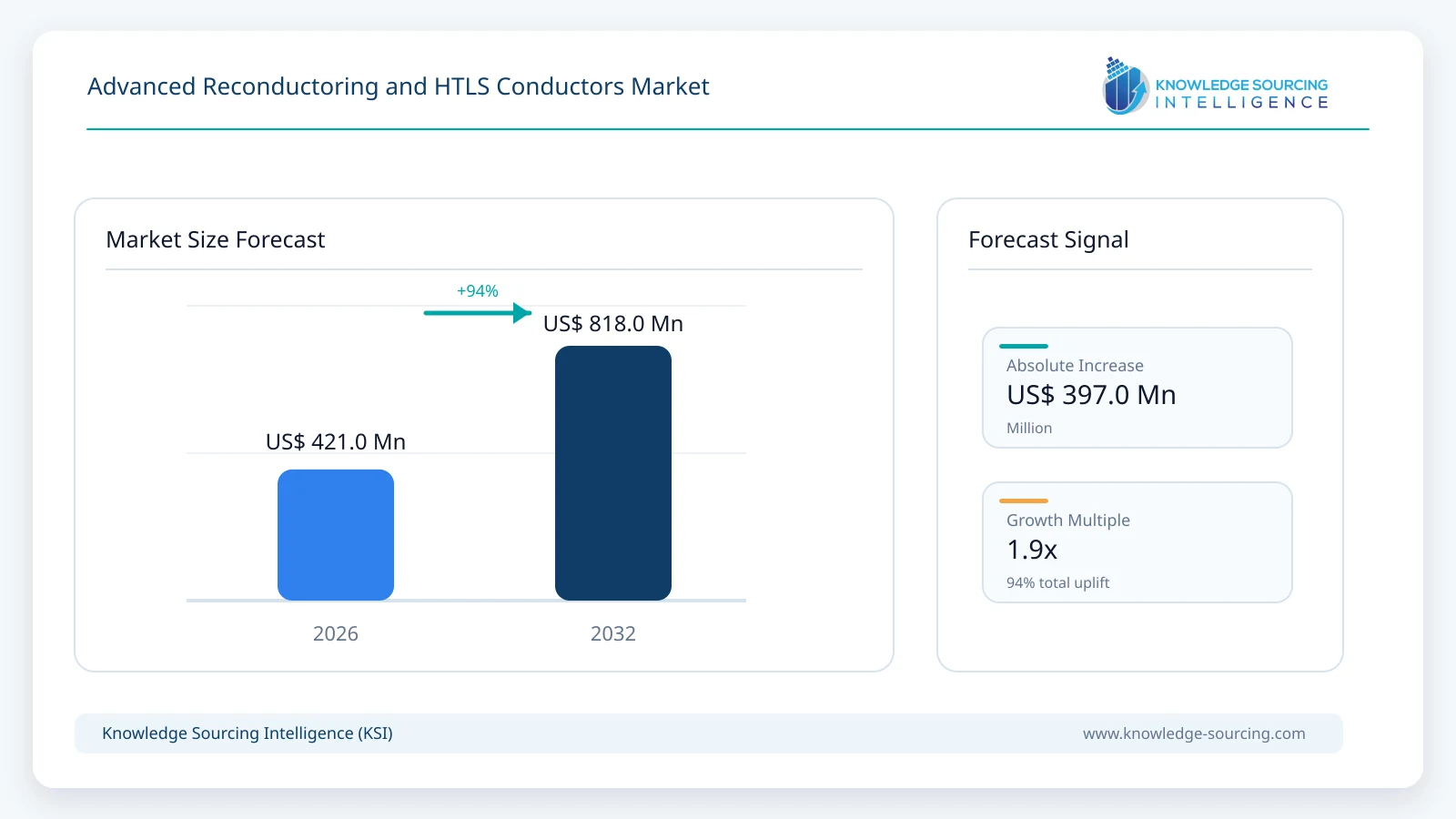
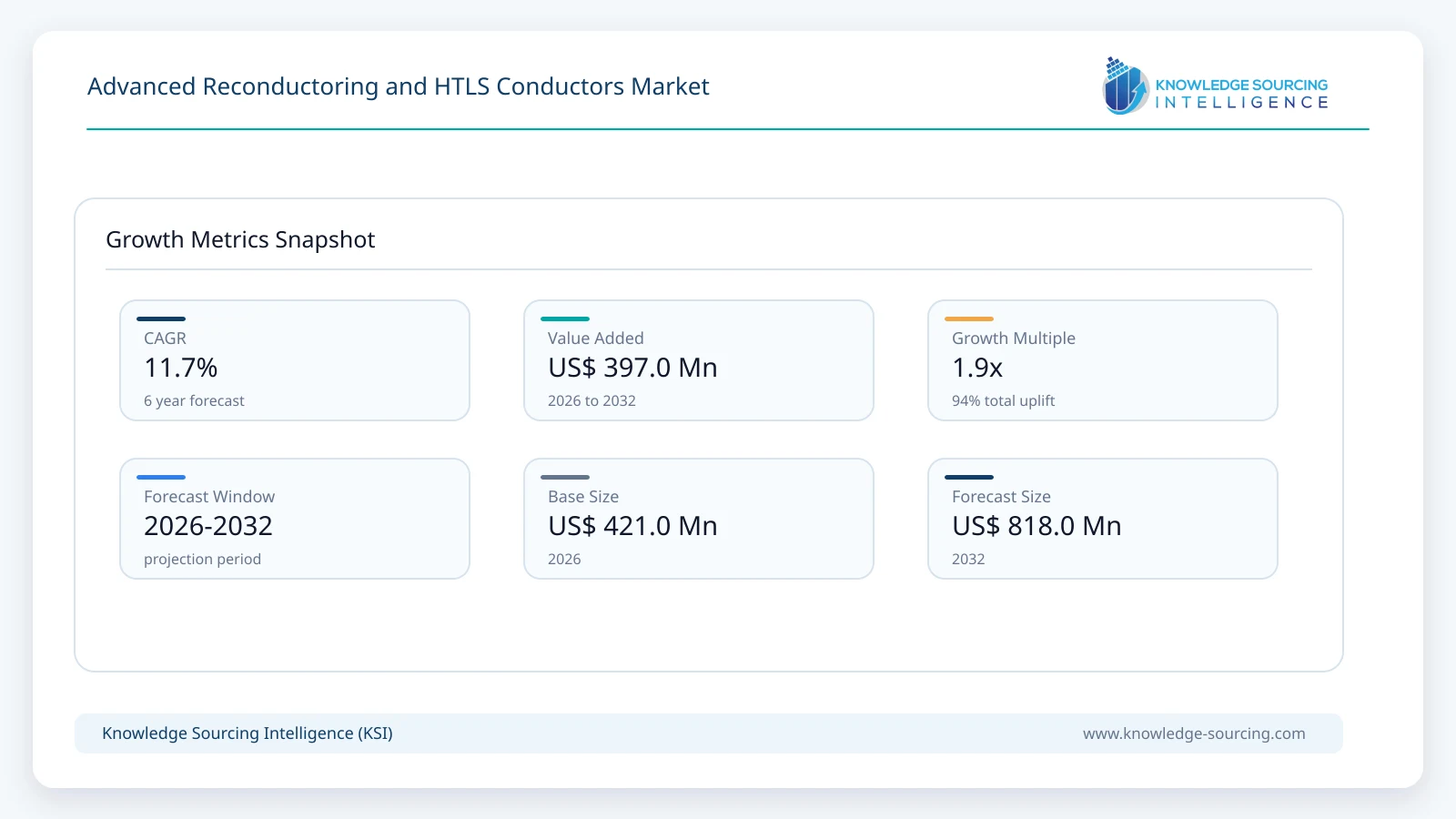
The global advanced-reconductoring conductor market is estimated at USD 421 million in 2026 and is projected to reach USD 818 million by 2032, representing a 11.7% CAGR during the forecast period
Key Highlights
• The IEA identifies a 50–100% line-capacity increase as technically achievable on suitable reconductoring projects, with a typical implementation window of three to four years versus seven or more years for a new high-voltage line.
• U.S. SPARK selections announced in September 2026 encompass 31 projects and USD 5.25 billion in proposed combined federal and recipient spending across reconductoring, rebuilding and other grid technologies.
• Elia’s Massenhoven–Van Eyck upgrade used approximately 600 km of ACCC conductor across an approximately 92 km 380 kV corridor, illustrating the difference between physical conductor demand and route length.
• Composite-core designs improve the economics of constrained corridors when lower sag and stronger core performance avoid substantial tower and clearance modifications.
• ACSS, GAP and invar-core conductors remain competitive where established installation procedures and utility qualification requirements outweigh the performance premium of a composite core.
• Mechanical qualification, emergency operating temperature, local procurement capability and remaining bottlenecks at substations determine whether a theoretical ampacity increase becomes deliverable network capacity.
• New digital verification methods allow contractors to check composite-core integrity during manufacturing, delivery and stringing, reducing the acceptance risk for long-life transmission assets.
Market Overview
Overhead transmission lines are limited by a combination of conductor temperature, ground clearance, mechanical tension, terminal equipment ratings and the behaviour of the surrounding network. Upgrading the conductor only addresses the first part of this constraint. At higher current, conventional aluminum conductor steel-reinforced (ACSR) designs heat and elongate, increasing sag. Advanced HTLS constructions change that trade-off through annealed or heat-resistant aluminum, lower-expansion cores, trapezoidal stranding or combinations of these features. Depending on the original line design, utilities can secure higher current ratings while limiting changes to the mechanical envelope.
A conductor’s cost is only one component of the investment decision. The U.S. Department of Energy’s Advanced Conductor Scan Report draws on a 230 kV engineering benchmark in which standard ACSR accounts for approximately 1.3% of new-line cost and ACCC for 4.8%. The same reference places reconductoring at around USD 340,000 per mile, compared with USD 1.7 million per mile for rebuilding. These are project benchmarks, not universal bids. They explain why utilities can justify a large material-price premium if the alternative requires substantial tower or civil works and a longer delivery schedule.
Reconductoring is already a commercial practice rather than an untested technology. Lamifil and CTC Global report more than 200,000 km of ACCC conductor installed cumulatively worldwide. That figure represents physical conductor length across many years and is not equivalent to transmission route-kilometres or to annual new demand. Other suppliers provide ACSS, thermal-resistant alloy, invar, GAP and composite-core alternatives. Local manufacturing and utility approval lists therefore influence competitive outcomes as much as headline ampacity specifications.
The capacity gained on one line cannot automatically be interpreted as additional deliverable power at the receiving node. A higher-ampacity span can shift the binding constraint to an adjoining circuit, transformer, switchgear or stability limit. Utilities increasingly evaluate reconductoring through contingency power-flow studies, annual congestion-cost savings, losses, outage windows and the option value of retaining an existing corridor. Projects with major terminal upgrades can still proceed, but their economics and commissioning sequence differ substantially from a conductor-only intervention.
Market Drivers
Large-load interconnection and thermal headroom
Transmission planners face sharper local capacity requirements from data centres, manufacturing sites, electric transport and new generation. When the constrained element is a conductor on a usable right of way, reconductoring can advance service dates without a parallel-line permit. The IEA estimates a 50–100% thermal-capacity uplift for suitable projects. That uplift is conditional on tower geometry and system limits and does not imply that every corridor can double firm transfer capability. For utilities, the investment priority is therefore the difference between additional load deliverable after contingency studies and the cost of the remaining equipment upgrades.
Avoiding corridor construction and foundation expenditure
The commercial attraction is strongest where land acquisition, environmental approvals and structure replacement are disproportionately expensive. A high-performance conductor can carry substantially more current within existing spans, allowing part of a reinforcement budget to be redirected from civil works toward conductor technology, fittings and planned outages. Because conductor material typically represents a modest proportion of an entirely new transmission build, the cost premium is often less decisive than whether tower reinforcement can be avoided. Operators still require mechanical checks for ice, wind, broken-wire loads and foundations before making that assumption.
Renewable integration and constrained interconnectors
Output from remote wind, solar and storage assets can concentrate flows on an already heavily loaded segment. Reconductoring can raise the thermal ceiling of that segment, but actual benefit depends on generation patterns and the capacity of surrounding network elements. Elia’s Massenhoven–Van Eyck project demonstrates the scale of infrastructure involved: approximately 600 km of conductor were supplied to reinforce an approximately 92 km 380 kV connection. That distinction matters to both procurement budgets and comparisons across utility programmes.
Conductor losses and lifecycle economics
Higher-conductivity aluminum content and lower operating resistance can reduce line losses compared with an older conductor of similar external dimensions, creating additional economic value beyond nameplate ampacity. The benefit is not uniform: it depends on annual loading, temperature, energy prices and operating hours. Procurement teams that evaluate only price per tonne risk selecting a lower-cost wire that forces earlier structural work or higher network losses. Lifecycle valuation is most relevant on persistently loaded transmission corridors rather than seldom-used contingency paths.
Market Restraints
Qualification and installation risk
Utilities approve line materials for assets expected to remain in service for decades. Composite-core handling, clamping, splicing, fatigue behaviour, lightning exposure, corrosion and long-term creep can require supplier-specific tests and installer certification. A damaged core may not be evident from a visual inspection, creating a measurable commissioning and liability risk. Nexans and Epsilon Composite validated CORECHECK on TenneT’s 380 kV network in July 2026, demonstrating an approach that checks structural integrity at successive stages of manufacture, transport and installation. The verification process helps address this procurement barrier but is not a substitute for each operator’s engineering acceptance.
System bottlenecks beyond the wire
New conductors cannot by themselves increase a corridor’s short-circuit limits, transformer ratings or network stability margins. Higher thermal loading may bring additional losses, elevated connector temperatures or protection changes. When bay upgrades and multiple adjacent circuits also need reinforcement, outage coordination can determine the critical path. The benefit of a faster conductor replacement is diluted if new substations or transformer capacity remain years away.
Supply-chain and project sequencing
Utility demand is concentrated in large orders for specific geometries, hardware packages and qualification regimes. A technology proven in one country may require different fittings, certifications or local production in another. Reconductoring also requires planned line outages, qualified crews and the management of parallel circuits that must remain energised. These practical constraints can delay equipment conversion from awarded contract to recognised conductor sales even where a utility has already approved the capital budget.
Segmentation Analysis
By conductor technology
The market comprises composite-core conductors; ACSS and ACSS/TW; invar-core products; GAP-type HTLS; and other thermally resistant aluminum-alloy and low-sag designs. Composite-core conductors offer the clearest opportunity on structurally constrained high-value lines because a low-expansion core and high aluminum fill can combine increased ampacity with limited changes to sag and loading. Their commercial advantage is conditional on the cost of fittings, core qualification, handling, conductor diameter and the risk of requiring new structures. The rapid growth of ACCC supply partnerships and the development of TS Conductor’s AECC and Southwire’s C7 show that competition is expanding beyond conventional ACSR replacement.
Steel-supported ACSS and ACSS/TW are attractive where utilities favour familiar installation procedures and high-temperature conductor operation within accepted designs. Invar and GAP constructions offer other combinations of temperature tolerance, thermal expansion and mechanical performance. They cannot be ranked on temperature rating alone: allowable tension, tower loads, wind and ice cases, electrical resistance and available outage duration vary materially by corridor. Suppliers able to provide both high-performance conductors and validated installation methods are better positioned for repeat utility awards.
By voltage class
Sub-220 kV corridors include numerous short and medium-length lines constrained by cities, industrial loads and older structures. The 220–345 kV category is significant for regional transmission relief, while 400–500 kV and above-500 kV programmes consume more conductor per route-kilometre when they use bundled phases. High-voltage projects may therefore generate larger material orders despite fewer corridor projects; however, they also require more extensive sag-tension engineering, installation logistics and network studies.
By capacity uplift and project driver
Capacity-uplift categories comprise below 50%, 50–100% and above 100%, measured against the replaced conductor’s specified thermal rating rather than delivered electricity. The study also covers load-growth relief, renewable and storage connection, congestion reduction, clearance correction, reliability and planned conductor replacement with additional capacity. The strongest purchasing trigger is a specific bottleneck that a conductor change can remove. The capacity-uplift percentage is therefore a project-characterisation measure, not a proxy for segment revenue or a guarantee of dispatchable transfer capacity.
By utility and owner type
Transmission system operators, investor-owned utilities, state transmission companies, vertically integrated networks and private industrial grid operators have different procurement cycles. Large regulated operators normally require extensive technical qualification and multi-year outage coordination. Smaller utilities and industrial systems can move faster on contained corridors but may be more sensitive to unit pricing, installation availability and spare-parts support. Local production capacity, warranty commitments and the availability of approved stringing contractors remain critical purchasing criteria.
Regional Analysis
North America
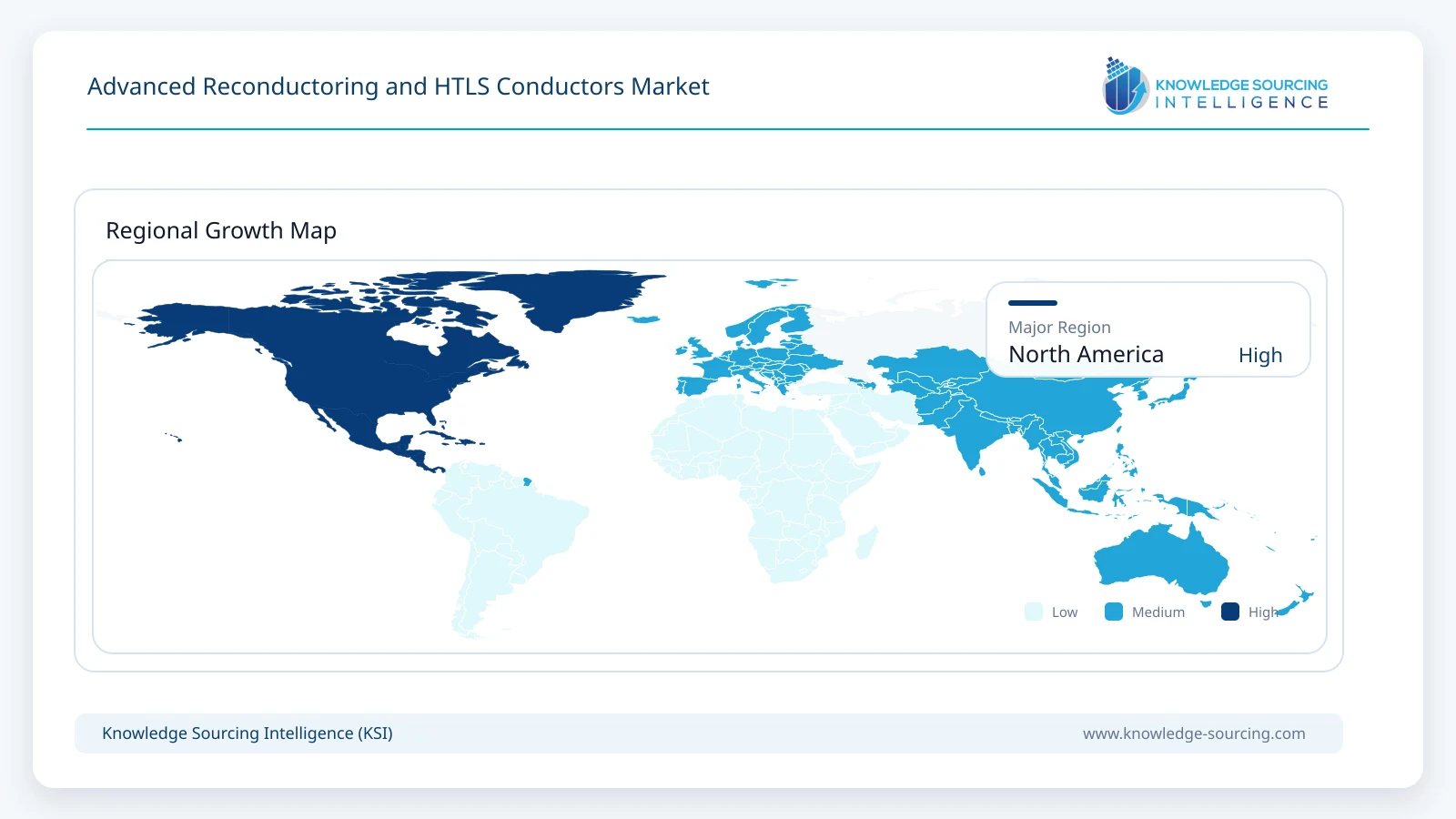
North America is a major near-term demand centre because legacy transmission assets must accommodate higher loads while permitting and new-line delivery remain slow. In September 2026, the U.S. Department of Energy announced intended funding support for 31 SPARK projects in 26 states, representing USD 1.9 billion of federal support and USD 3.35 billion in recipient cost share. The selected programmes envisage reconductoring or rebuilding more than 1,500 route miles and deploying other grid-enhancing technologies across almost 21,000 miles. These are prospective multi-technology capital programmes, not completed advanced-conductor sales; their material conversion depends on design choices, final awards and construction schedules.
Reconductoring competes with rebuilding, dynamic line rating, topology optimisation and new corridors. Its advantage increases where an existing route is secure and tower loading is acceptable. The relative economics are illustrated by the DOE engineering benchmark in which reconductoring a 230 kV route was estimated at roughly one-fifth of a rebuild cost. For manufacturers, qualification by large utilities, domestic delivery capability and experienced installation partners can determine order conversion. TS Conductor opened a USD 134 million South Carolina facility in May 2026 to expand domestic advanced-conductor manufacturing, while established groups such as Prysmian and Southwire supply multiple conductor architectures.
The key commercial risk is overstating the addressable installed base. Not every congested line is a reconductoring candidate: some routes are limited by structures or terminal equipment, while others require new rights of way to deliver the required topology. Consequently, near-term revenue is driven by utility-approved circuit programmes and the volume of conductor actually purchased, not by applying a standard percentage to the total North American transmission network.
Competitive and Technology Landscape
Competition is divided between advanced-core developers and direct conductor manufacturers. CTC Global supplies ACCC core technology through licensed manufacturers; TS Conductor offers aluminum-encapsulated composite-core products; and Epsilon Composite supports composite-core solutions and field integrity verification. Manufacturers including Prysmian, Nexans, Lamifil, Southwire, APAR Industries, Sterlite Electric, Sumitomo Electric, Taihan Cable & Solution, ZTT and Midal Cables compete through their HTLS conductor portfolios, local certifications, conductor geometries and installed project records.
Product breadth matters more than inclusion in a generic cable-industry list. Prysmian’s range covers ACSS, ACCC and E3X-enhanced overhead conductors; Southwire offers C7 composite-supported products; Sumitomo Electric supplies GAP and invar designs; and Taihan and ZTT market high-temperature/low-sag variants directly. A company with only conventional ACSR or underground cable exposure is not treated as a core reconductoring competitor. Core developers and their licensed manufacturing partners are differentiated in the report to avoid counting the same installed conductor volumes twice.
Recent Developments
• September 2026: The U.S. Department of Energy announced its intention to support 31 SPARK grid projects in 26 states, combining intended federal and recipient investment across line reconstruction, reconductoring and additional grid technologies.
• August 2026: CTC Global introduced ACCC Plus as an additional composite-core option between its standard and higher-strength product configurations.
• August 2026: Lamifil reported that cumulative global ACCC deployments had exceeded 200,000 physical conductor kilometres across a multi-decade programme; this is a cumulative installed figure, not annual route length.
• July 2026: Nexans and Epsilon Composite announced successful CORECHECK field validation on a TenneT-operated 380 kV line in the Netherlands.
• May 2026: TS Conductor opened its USD 134 million South Carolina manufacturing facility for aluminum-encapsulated composite-core advanced conductors.
• January 2026: Lamifil confirmed supply of 600 km of ACCC conductor for Elia’s approximately 92 km Massenhoven–Van Eyck 380 kV transmission upgrade.
Advanced Reconductoring and HTLS Conductors Market Scope:
| Report Metric | Details |
|---|---|
| Total Market Size in 2026 | USD 421 million |
| Total Market Size in 2032 | USD 818 million |
| Forecast Unit | USD Million |
| Growth Rate | 11.7% |
| Study Period | 2021 to 2032 |
| Historical Data | 2021 to 2024 |
| Base Year | 2025 |
| Forecast Period | 2026 – 2032 |
| Segmentation | Conductor Technology, Voltage Class, Capacity Uplift, Project Driver, Utility / Owner Type, Geography |
| Companies |
|
Market Segmentation
By Conductor Technology
Composite-Core Conductors
ACSS and ACSS/TW
Invar-Core Designs
GAP-Type Conductors
Thermal-Resistant Aluminum-Alloy Products
Other High-Performance/Low-Sag Conductors
By Voltage Class
Below 220 kV
220–345 kV
400–500 kV
Above 500 kV
By Capacity Uplift
Below 50% Rated Thermal Uplift
50–100% Rated Thermal Uplift
Above 100% Rated Thermal Uplift
By Project Driver
Load and Large-Customer Interconnection
Renewable and Energy-Storage Integration
Congestion and Curtailment Reduction
Reliability, Resilience and Thermal Clearances
Lifecycle Replacement with Uprating
By Utility / Owner Type
Transmission System Operators
Investor-Owned and Vertically Integrated Utilities
State/Public Transmission Companies
Industrial and Private-Grid Owners
By Geography
North America
Europe
Asia Pacific Excluding China
China
Middle East and Rest of World
Table of Contents
1. EXECUTIVE SUMMARY
1.1. Market opportunity and key findings
1.2. Advanced reconductoring demand and global outlook
1.3. Commercial economics and strategic implications
2. RESEARCH SCOPE AND METHODOLOGY
2.1. Market definition and revenue boundaries
2.2. Conductor technology qualification
2.3. Circuit-km and physical conductor-length conversion
2.4. Conductor material revenue per circuit-km
2.5. Forecast assumptions and validation
3. RECONDUCTORING ENGINEERING AND EQUIPMENT
3.1. Transmission thermal limits and conductor sag
3.2. Existing ACSR and conventional design baseline
3.3. Composite-core architectures
3.4. ACSS, GAP, invar and thermal-alloy technologies
3.5. Mechanical compatibility and clearances
3.6. Fittings, splices and installation methods
3.7. Testing, monitoring and integrity verification
4. MARKET SIZE AND FORECAST, 2026–2032
4.1. Global advanced-reconductoring conductor revenue
4.2. Annual transmission circuit-kilometres upgraded
4.3. Physical conductor length and bundle requirements
4.4. Equipment material content and price environment
4.5. Conductor adoption and replacement scenarios
5. MARKET BY CONDUCTOR TECHNOLOGY
5.1. Composite-core conductors
5.2. ACSS and ACSS/TW
5.3. Invar-core designs
5.4. GAP-type conductors
5.5. Thermal-resistant aluminum-alloy products
5.6. Other high-performance/low-sag conductors
6. MARKET BY VOLTAGE CLASS
6.1. Below 220 kV
6.2. 220–345 kV
6.3. 400–500 kV
6.4. Above 500 kV
7. MARKET BY CAPACITY UPLIFT
7.1. Below 50% rated thermal uplift
7.2. 50–100% rated thermal uplift
7.3. Above 100% rated thermal uplift
7.4. Delivered transfer capacity versus conductor ampacity
8. MARKET BY PROJECT DRIVER
8.1. Load and large-customer interconnection
8.2. Renewable and energy-storage integration
8.3. Congestion and curtailment reduction
8.4. Reliability, resilience and thermal clearances
8.5. Lifecycle replacement with uprating
9. MARKET BY UTILITY / OWNER TYPE
9.1. Transmission system operators
9.2. Investor-owned and vertically integrated utilities
9.3. State/public transmission companies
9.4. Industrial and private-grid owners
10. REGIONAL MARKET
10.1. North America
10.2. Europe
10.3. Asia Pacific excluding China
10.4. China
10.5. Middle East and Rest of World
11. PROJECT ECONOMICS AND UTILITY DECISION FRAMEWORK
11.1. Conductor premium versus installed project cost
11.2. Tower reinforcement and foundation avoidance
11.3. Outage, labour and stringing costs
11.4. Losses, congestion and dispatchability benefits
11.5. Comparison with rebuilds and new corridors
11.6. System constraints and upgrade sequencing
12. TECHNOLOGY AND COMMERCIALIZATION OUTLOOK
12.1. Improved core strength and thermal performance
12.2. Trapezoidal aluminum and alloy development
12.3. Surface coatings and line-loss reduction
12.4. Integrity monitoring and digital verification
12.5. Utility qualification and approved installer networks
12.6. Manufacturing localisation and material security
13. COMPETITIVE LANDSCAPE
13.1. Core technology developers and licensing models
13.2. Integrated and regional HTLS manufacturers
13.3. Conductor product qualification and differentiation
13.4. Project delivery and installation partnerships
14. COMPANY PROFILES
14.1. CTC Global
14.2. TS Conductor
14.3. Nexans
14.4. Prysmian
14.5. Southwire
14.6. Lamifil
14.7. APAR Industries
14.8. Sterlite Electric
14.9. Sumitomo Electric
14.10. Taihan Cable & Solution
14.11. ZTT Group
14.12. Midal Cables
14.13. Epsilon Composite
15. APPENDIX
Navigate
Trusted by the world's leading organizations











