
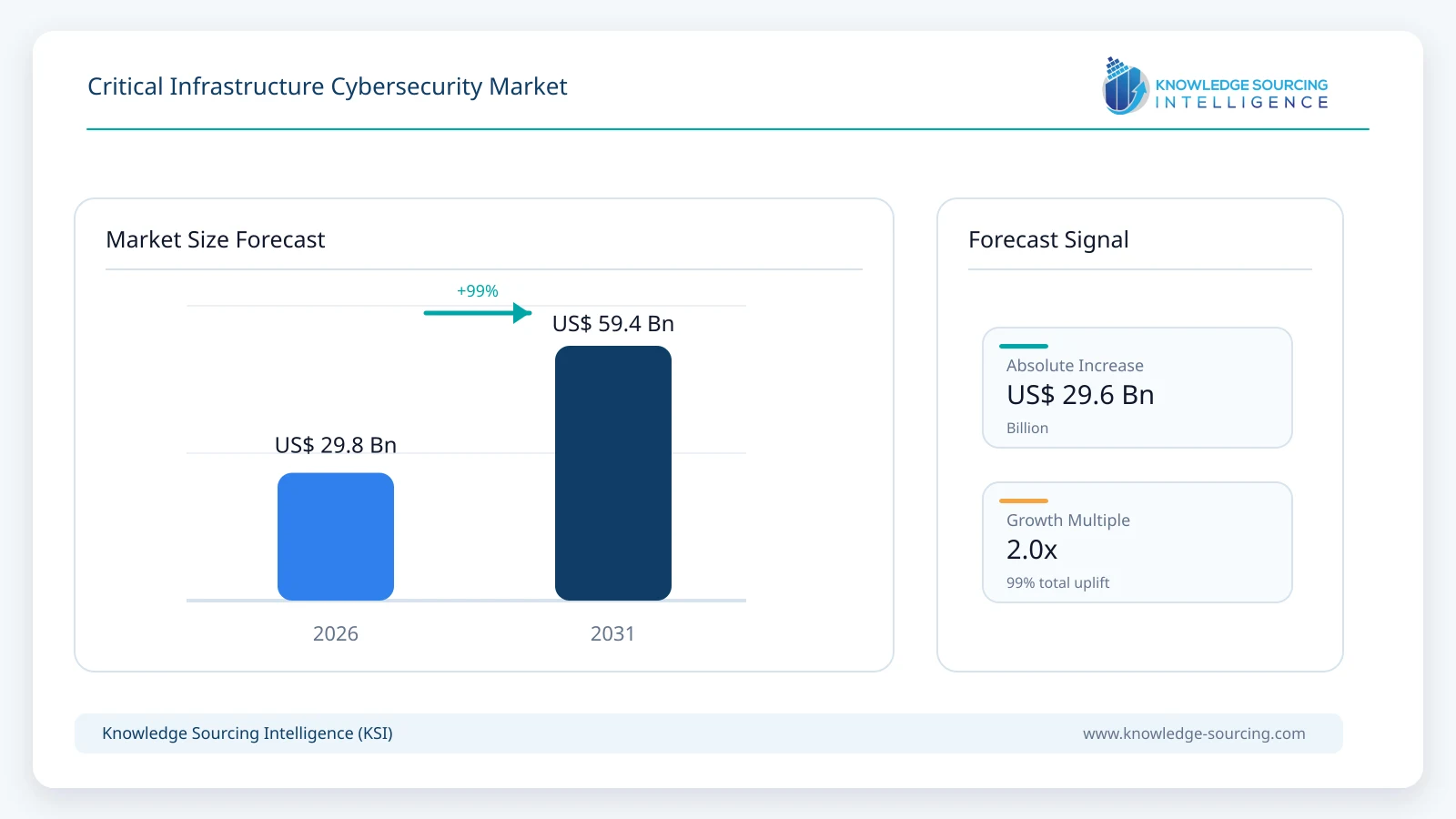
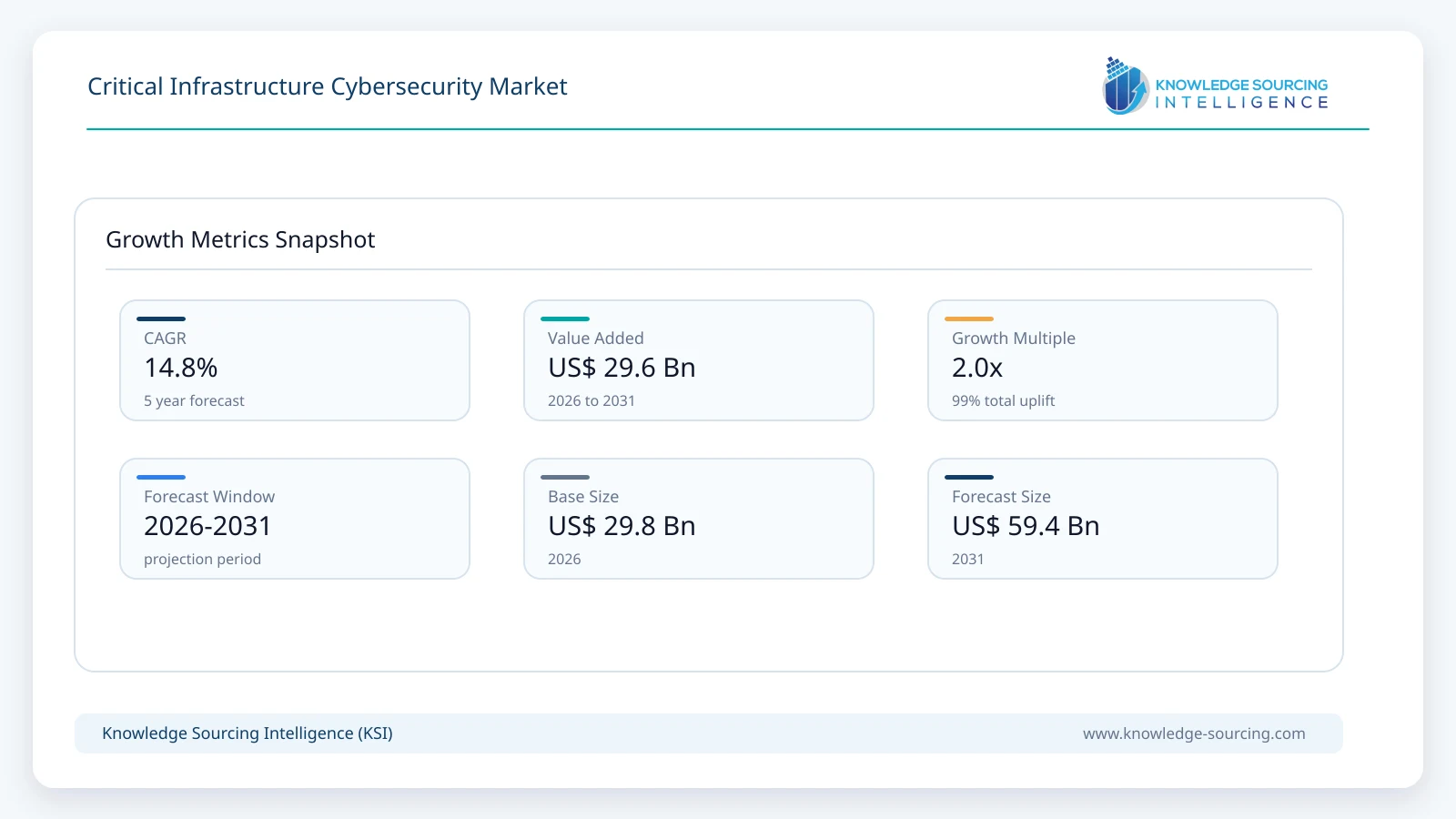
The Critical Infrastructure Cybersecurity Market is forecast to grow at a CAGR of 14.8%, reaching USD 59.4 billion in 2031 from USD 29.8 billion in 2026.
Highlights:
- 1Market-leading offeringSolutions remain at the forefront of the Critical Infrastructure Cybersecurity Market, commanding 52.0% of the 2026 market with a value of USD 15.50 billion.
- 2Growth hotspotAsia Pacific stands out as the fastest-growing regional market, registering a 17.3% CAGR through 2031 as governments and infrastructure operators strengthen cyber resilience.
- 3Energy security surgeThe Energy & Utilities segment is projected to reach USD 18.30 billion by 2031, growing its share to 30.8% as connected infrastructure creates greater cybersecurity requirements.
- 4On-premise preferenceOn-Premise deployment leads the deployment landscape at USD 17.88 billion in 2026, capturing a substantial 60.0% share of the market.
Operational technology (OT) security, which includes industrial control systems (ICS), SCADA, and cyber-physical systems in particular, is expanding at a faster rate, with several analysts forecasting it will hit about USD 25 billion by 2026 and continue to grow with a compound annual growth rate (CAGR) in the mid-teens as traditional air gapped assumptions are coming to a crashing end across energy, manufacturing, and utility sectors.
Critical infrastructure cybersecurity includes the security of energy systems, oil and gas pipelines, water and wastewater, transportation systems, healthcare delivery systems, defense-industrial systems and telecommunications infrastructure from cyber and cyber-physical threats. Conventional enterprise IT security is not an appropriate fit for critical infrastructure cybersecurity because legacy systems are ICSs that were never built with security in mind, uptime and safety requirements make it difficult for applying many of the same patching and monitoring techniques you would apply to enterprise IT, and the number of IoT and IIoT sensors is growing faster than security teams can keep track of.
In February 2025, Gartner released its inaugural Magic Quadrant for Cyber-Physical Systems Protection Platforms, which marked a pivotal moment by evaluating 17 vendors based on four criteria: asset discovery, threat detection, vulnerability management, and secure remote access.In February 2025, Gartner released its first Magic Quadrant for Cyber-Physical Systems Protection Platforms, which highlighted a milestone in the evaluation of 17 vendors across four categories: asset discovery, threat detection, vulnerability management, and secure remote access, with Claroty, Dragos, Microsoft, Armis, and Nozomi Networks being named Leaders. In the past, most companies using CPS were a minority that used to only have generic IT security platforms used in OT; however, by 2027, Gartner predicts that 75% of such companies will have CPS protection platforms.
Market Dynamics
Market Drivers
The energy, water and manufacturing industries are filling with internet-connected sensors and devices for the industrial internet of things (IIoT), and the influx of those devices is outpacing the ability of legacy air-gapped security models. This means that the need for constant asset discovery and network monitoring tailored for industrial protocols is rising.
Ransomware and Nation-State targeting of industrial operators are continuing to rise sharply. In January 2025, ransomware attacks against industrial operators documented a 46% surge, necessitating prompt investments in OT detection and incident response capabilities.
Internationally, the EU's NIS2 Directive, the U.S. NERC CIP-015 requirements, and the ISA/IEC 62443 standards and pipeline and rail TSA security directives are transforming cybersecurity from being an optional investment to a mandatory budget item that has clear deadlines and financial consequences for non-compliance.
Market Restraints & Opportunities
Skilled cybersecurity workforce shortage, the high implementation and integration costs of AI-native security platforms, and potential adversarial manipulation of AI detection models (including AI-powered attacks targeting AI defenses) are major challenges to AI adoption, especially for SMBs.
However, continued enterprise investment in security automation, the market's evolution of autonomous SOC operations with agentic AI platforms, increasing regulatory requirements for AI risk management open the door to significant long-term potential, with cloud security, identity protection and critical-infrastructure markets like energy, healthcare and financial services leading the way.
Key Developments
August 2026: Fortinet joined Project Watershed 250, launched with U.S. government and industry leaders to strengthen cybersecurity and resilience across water and wastewater infrastructure.
August 2026: Cisco launched Sovereign Critical Infrastructure in Canada, offering on-premises and air-gapped networking, security, compute, collaboration, and Splunk capabilities for critical organizations.
August 2026: Palo Alto Networks introduced its Frontier AI Critical Defense Program, coordinating OT and technology partners to deploy network-level virtual patches against AI-driven exploits.
Market Segmentation
By Offering: Solutions
Solutions claim the largest offering share at 52.4% in 2031, reaching USD 31.1 billion and expanding at a 15.0% CAGR, driven by asset discovery, network monitoring, threat detection, vulnerability management, and secure remote access for industrial environments.
Claroty provides comprehensive cyber-physical systems protection, supporting use cases across healthcare, manufacturing, and critical infrastructure with broad OT security capabilities.
Dragos delivers industrial threat intelligence and incident response through deep protocol-level analysis of industrial control system traffic, supporting electric utilities, oil and gas, and public sector operators.
Nozomi Networks provides large-scale visibility and AI-driven analytics for OT and IoT environments, helping operators monitor and secure distributed industrial locations.
By Security Type: Operational Technology (OT) / ICS Security
The OT and industrial control system security segment holds a 34.0% share in 2026, valued at USD 10.13 billion, and is projected to reach a 38.8% share by 2031, driven by IT-OT convergence, expanding cyber threats, and demand for specialized monitoring tools.
Microsoft Defender for IoT supports unified security operations, enabling organizations using the Microsoft security stack to improve asset visibility across OT environments without adopting a separate platform.
Armis provides agentless asset intelligence across converged IT, OT, and IoT environments, helping operators maximize visibility without deploying endpoint agents.
By End-User Vertical: Energy & Utilities
Energy and utilities is one of the top end-user verticals as compliance with NERC CIP requirements in North America and the NIS2 requirements in Europe remain a priority, and there is a persistent interest from nation-states in disrupting the electrical grid and pipelines.
Increasing use in water and wastewater systems brought on by federal and state requirements after major water system intrusions at municipal water systems are projected to see good vertical growth over the forecast period.
Regional Analysis
North America Market Analysis
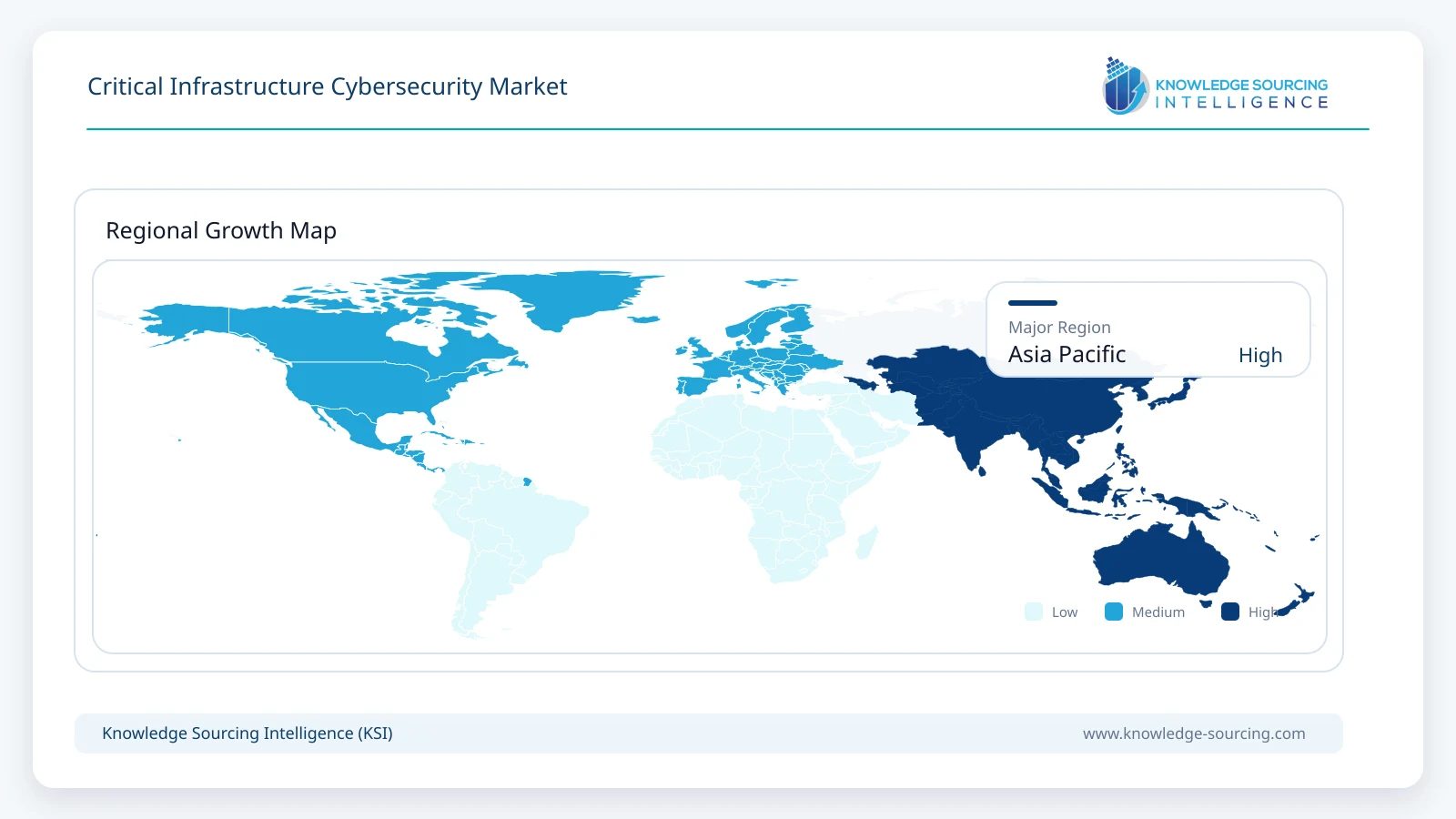
North America accounts for the highest regional market share, with the segment growing at a 13.3% CAGR, driven by binding NERC CIP requirements, CISA procurement guidance, and leading OT security vendors.
Europe Market Analysis
The minimum cybersecurity measures and penalty regime enforced by the NIS2 Directive are creating a binding shape for Europe's market, with the Nordics, Germany and France being the top three countries investing in enterprise and public sector deployment of NIS2-compliant industrial security platforms.
Asia-Pacific Market Analysis
Asia-Pacific is projected to experience the highest growth, reaching a 27.9% share in 2031, driven by infrastructure modernization, rising cyber attacks, and expanding regulatory frameworks across China, India, Japan, and Southeast Asia.
Middle East and Africa Market Analysis
Energy-system digitization and the development of smart cities are driving increased investment in the region’s critical infrastructure cybersecurity, especially in UAE and Saudi Arabia.
South America Market Analysis
South America is an emerging market for critical infrastructure cybersecurity adoption, with increased investment in critical infrastructure security monitoring in energy and water sector markets in Brazil.
List of Companies
Claroty
Dragos
Nozomi Networks
Microsoft
Armis
Tenable
Cisco
Fortinet
Palo Alto Networks
Honeywell
Competitive Landscape
Claroty
Claroty's cyber-physical systems protection platform extends from discovery of assets to detection of threats, management of vulnerabilities, and secure access, and in particular in healthcare, manufacturing and critical infrastructure deployments, is a Leader on Gartner's first-ever CPS Protection Platforms Magic Quadrant.
Dragos
Industrial threat intelligence and incident response is Dragos' forte, with deep protocol-level visibility into electric utilities, oil and gas and public-sector OT environments.
Nozomi Networks
Nozomi Networks provides OT and IoT visibility and AI-based anomaly detection at scale, for large, distributed industrial operators that need to be monitored across a large number of sites.
Analyst View
The Critical Infrastructure Cybersecurity market is shifting from point-solution IT security extended into OT environments toward unified cyber-physical systems protection platforms purpose-built for industrial contexts. Binding regulation, particularly the EU's NIS2 Directive and NERC's CIP-015 internal network monitoring requirement, is converting cybersecurity from a discretionary investment into a compliance-driven budget line with real financial consequences for inaction. Vendors that combine deep OT protocol expertise, broad asset visibility across converged IT/OT/IoT environments, and managed-service delivery models suited to resource-constrained municipal and utility operators are best positioned to lead the next phase of market growth.
Critical Infrastructure Cybersecurity Market Scope:
| Report Metric | Details |
|---|---|
| Total Market Size in 2026 | USD 29.8 billion |
| Total Market Size in 2031 | USD 59.4 billion |
| Forecast Unit | Billion |
| Growth Rate | 14.8% |
| Study Period | 2021 to 2031 |
| Historical Data | 2021 to 2024 |
| Base Year | 2025 |
| Forecast Period | 2026 – 2031 |
| Segmentation | Offering, Security Type, Deployment, End-User Vertical, Geography |
| Companies |
|
Market Segmentation
By Offering
Solutions
Services
Hardware
By Security Type
Information Technology (IT) Security
Operational Technology (OT) / ICS Security
Identity & Access Management
Physical-Cyber Security Convergence
Others
By Deployment
On-Premise
Cloud-Based
By End-User Vertical
Energy & Utilities
Water & Wastewater
Transportation
Government & Defense
Healthcare
BFSI
Others
By Geography
North America
USA
Canada
Mexico
Europe
Germany
France
United Kingdom
Others
Asia Pacific
China
India
Japan
South Korea
Others
Middle East and Africa
UAE
Saudi Arabia
Others
South America
Brazil
Others
Table of Contents
1. EXECUTIVE SUMMARY
2. MARKET SNAPSHOT
2.1. Market Overview
2.2. Market Definition
2.3. Scope of the Study
2.4. Market Segmentation
3. BUSINESS LANDSCAPE
3.1. Market Drivers
3.2. Market Restraints
3.3. Market Opportunities
3.4. Porter's Five Forces Analysis
3.5. Industry Value Chain Analysis
3.6. Policies and Regulations
3.7. Strategic Recommendations
4. TECHNOLOGICAL OUTLOOK
4.1. Cyber-Physical Systems (CPS) Protection Platforms
4.2. AI-Driven Anomaly Detection for Industrial Protocols
4.3. Identity-Based Microsegmentation for OT Networks
4.4. Managed OT Security Services
5. CRITICAL INFRASTRUCTURE CYBERSECURITY MARKET BY OFFERING
5.1. Introduction
5.2. Solutions
5.3. Services
5.4. Hardware
6. CRITICAL INFRASTRUCTURE CYBERSECURITY MARKET BY SECURITY TYPE
6.1. Introduction
6.2. Information Technology (IT) Security
6.3. Operational Technology (OT) / ICS Security
6.4. Identity & Access Management
6.5. Physical-Cyber Security Convergence
6.6. Others
7. CRITICAL INFRASTRUCTURE CYBERSECURITY MARKET BY DEPLOYMENT
7.1. Introduction
7.2. On-Premise
7.3. Cloud-Based
8. CRITICAL INFRASTRUCTURE CYBERSECURITY MARKET BY END-USER VERTICAL
8.1. Introduction
8.2. Energy & Utilities
8.3. Water & Wastewater
8.4. Transportation
8.5. Government & Defense
8.6. Healthcare
8.7. BFSI
8.8. Others
9. CRITICAL INFRASTRUCTURE CYBERSECURITY MARKET BY GEOGRAPHY
9.1. Introduction
9.2. North America
9.2.1. USA
9.2.2. Canada
9.2.3. Mexico
9.3. Europe
9.3.1. Germany
9.3.2. France
9.3.3. United Kingdom
9.3.4. Others
9.4. Asia Pacific
9.4.1. China
9.4.2. India
9.4.3. Japan
9.4.4. South Korea
9.4.5. Others
9.5. Middle East and Africa
9.5.1. UAE
9.5.2. Saudi Arabia
9.5.3. Others
9.6. South America
9.6.1. Brazil
9.6.2. Others
10. COMPETITIVE ENVIRONMENT AND ANALYSIS
10.1. Major Players and Strategy Analysis
10.2. Market Share Analysis
10.3. Mergers, Acquisitions, Agreements, and Collaborations
10.4. Competitive Dashboard
11. COMPANY PROFILES
11.1. Claroty
11.2. Dragos
11.3. Nozomi Networks
11.4. Microsoft
11.5. Armis
11.6. Tenable
11.7. Cisco
11.8. Fortinet
11.9. Palo Alto Networks
11.10. Honeywell
12. APPENDIX
12.1. Currency
12.2. Assumptions
12.3. Base and Forecast Years Timeline
12.4. Key Benefits for the Stakeholders
12.5. Research Methodology
12.6. Abbreviations
Navigate
Trusted by the world's leading organizations











