
The Export-Controlled Electronic Warfare Technologies Market is projected to register a strong CAGR during the forecast period (2026-2031).
Highlights:
- 1The changing contours of the electronic warfare market are being affected by the simultaneous factors of the growth in the demand for these technologies and the resulting tightening of the rules regulating their exports. The global demand for electronic warfare capabilities is being driven by military modernization and the rise in cyber-related threats.
- 2Many countries are expanding or diversifying domestic production of electronic warfare systems to lessen their reliance on foreign suppliers, thereby facilitating the successful execution of export governance.
- 3The growth in collaborative defense partnerships among countries is enabling allied nations to develop and share electronic warfare technologies using secured agreements to facilitate the controlled dissemination of these technologies.
- 4Manufacturers are producing both downgraded or export-compliant versions of electronic warfare technologies, enabling access to international markets due to government export regulations.
Export-controlled electronic warfare technology encompasses a variety of weapon systems that use technology to disrupt enemy communications. Examples include radar jamming systems, intelligence-gathering equipment, and other types of cyber-electromagnetic systems. These technologies may be subject to many restrictions and international traffic laws. These include the International Traffic in Arms Regulations (ITAR) of the United States, EU dual-use regulations, and other countries' national security regulations.
Export-Controlled Electronic Warfare Technologies Market Analysis
Growth Drivers
Increasing geopolitical tensions and defence spending: As more countries become involved in international military conflicts, governments are increasingly focused on investing in next-generation electronic warfare systems to achieve their national objective of electronic spectrum dominance. Governments continue to procure more advanced electronic warfare technologies to gain a competitive and strategic advantage over adversaries despite the continued presence of export restrictions.
Expansion of Cyber-Electronic Warfare: The interrelationship between the various modes of modern warfare continues to blur as more and more modern military operations employ both cyber and electronic means of continuing their effective means for offensive use against an adversary.
Government Policies and Export Regulations: Strict export control policies are shaping market dynamics by limiting global trade of sensitive technologies. These regulations encourage domestic innovation, strengthen national security, and promote the development of indigenous EW capabilities, while also influencing supply chain strategies and international defence collaborations.
Growing Demand for Secure Supply Chains: Export restrictions and geopolitical uncertainties are pushing countries to develop resilient and secure supply chains. Governments are prioritising trusted suppliers and local manufacturing to ensure uninterrupted access to critical EW technologies, driving investments in domestic defence industries.
Challenges and Opportunities
The electronic warfare (EW) market faces challenges, including limited international trade, numerous compliance requirements, and restricted access to advanced components. In addition to these challenges, there are opportunities for growth through local indigenous innovation, modular building and design of systems, and the establishment of defense alliances (and joint technology-sharing agreements) enabling controlled sharing of research and development technologies and long-term investment in sustainable market development.
Market Segmentation
The market is segmented by technology type, platform, application and geography.
By Technology Type: Electronic Support (ES) Systems
The core segment of ES systems is used to detect, intercept and analyse electromagnetic emissions from enemy systems. They provide situational awareness in real-time and allow for early identification of a threat without disclosing one's own position. In 2025, wideband receivers and advanced AI-driven signal processing will improve overall detection accuracy and speed even further. There are many forms of military platforms that deploy ES systems; therefore, they are critical for intelligence collection and decision-making in environments with export restrictions.
By Platform: Airborne
Airborne platforms provide the ability to cover a wide area quickly and respond in a rapid time. Airborne fighter jets, surveillance aircraft and unmanned aerial vehicles (UAVs) integrate export-controlled EW technologies to provide real-time detection of threats and countermeasures. As unmanned aerial vehicles continue to rapidly deploy lightweight and modular EW systems, the trend for their implementation has increased. Due to export limitations, many systems will not be able to achieve full capabilities and will be modified or tailored to meet the needs of allied nations. Airborne systems remain significant for current electronic warfare capabilities and for strategic efforts to defend our nations.
By Application: Signal Intelligence
The collection and analysis of communication and radar signals (SIGNIT) is one of the most important applications of EW technologies. Enveloping EW technologies are heavily deployed in the collection of intelligence to monitor adversary activity and also support military activities and operations through the deployment of SIGINT. In 2025, artificial intelligence-based analysis applications will significantly improve overall intelligence collection. Export limitations on the ability to collect and have SIGINT capabilities are very controlled and restricted therefore disallowing many countries to possess them, making them one of the most strategically prized and valuable applications of EW technologies.
Regional Analysis
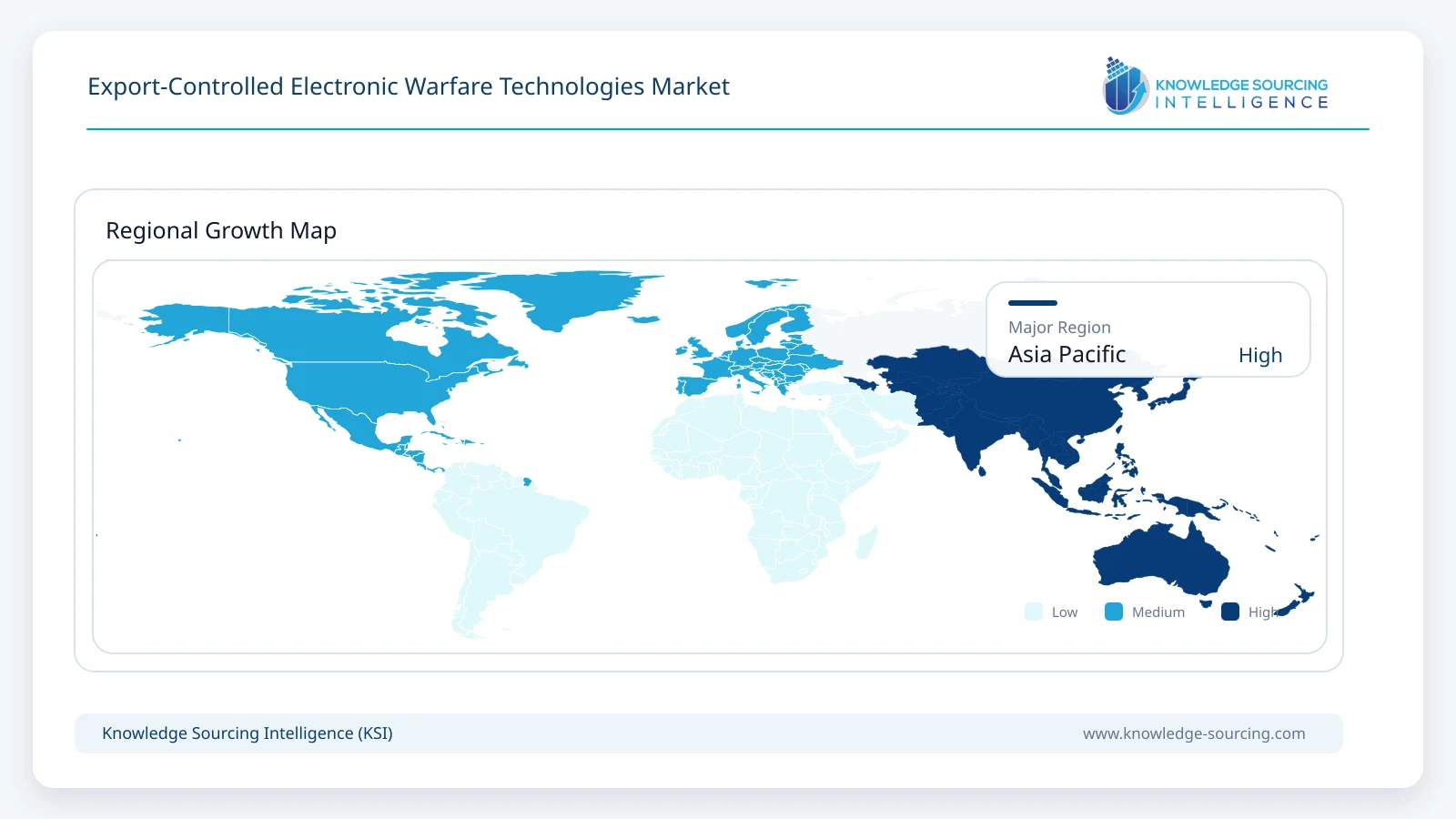
North America Market Analysis
North America has the leading position in the EW market. This leadership arises from the presence of strong regulatory regimes (e.g., ITAR), the largest defence budgets in the world, and a concentration of defence contractors and R&D centres. The primary driver of US defence budgets is domestic manufacturing. The US maintains strategic superiority over its allies by not permitting the export of critical EW technologies outside of the US. In 2025, the reshoring of semiconductor and defence supply chains will accelerate, and increased levels of controlled agreements with allied nations to share technology will appear. The establishment and continued success of large prime defence contractors and advanced R&D centres in the North American region create a foundation for the continued leadership of the North American region in future export-controlled EW technologies.
South America Market Analysis
While South America continues to grow steadily, nations throughout this region are improving their defence capabilities with respect to existing regulations. Limited access to advanced export-controlled technology has encouraged partnerships with foreign defence companies and firms. More and more companies in this region will also begin investing in local manufacturing, as well as obtaining technologies through acquisition, in an effort to enhance their military readiness while reducing their reliance on imports.
Europe Market Analysis
Europe is working toward establishing autonomous defence systems by increasing the strategic autonomy of EW technology. The establishment of export control regulations (i.e., EU regulations) is having a direct impact on the market and shaping behaviours that support local sourcing and intra-regional collaboration. Countries, such as France, Germany, and the UK, are investing in the evolution of domestic EW capabilities. The collaboration between countries through the establishment of joint defence programs and partnerships between NATO member states is facilitating a controlled exchange of technology while simultaneously ensuring regulatory compliance.
Middle East and Africa Market Analysis
MEA represents a significant area for defence spending and security concerns; thus, the majority of these nations have turned to foreign countries for advanced EW systems that are highly restricted by overly strict export controls. By developing strategic alliances with Western nations, MEA nations can better access these restricted technologies from foreign sources. Although many African nations are slowly adopting these systems, they are now making progress due to their continued collaboration with international partners and modernization efforts.
Asia Pacific Market Analysis
The Asia-Pacific region is experiencing rapid growth in EW due to the increasing level of defence spending by nations within the region and the need to respond to regional security issues. The focus of nations such as China, India, Japan, and South Korea, is to develop indigenous EW systems because they are unable to access export-controlled EW technology.
Key Development
August 2026: L3Harris announced Peru selected its Viper Shield electronic warfare system for the country’s F-16 Block 70 aircraft, extending advanced digital protection capabilities to Peru’s future fighter fleet.
July 2026: BAE Systems received a Boeing contract to supply AN/ALQ-250 EPAWSS electronic warfare systems for Republic of Korea Air Force F-15K fighter jets, enhancing threat detection and self-defense capabilities.
May 2026: BAE Systems was awarded the U.S. Army’s Soft Kill Active Protection System program of record, deploying ROOK electronic warfare capabilities against unmanned aerial systems and guided missiles.
May 2025: L3Harris Technologies was awarded a U.S. government contract to develop enhanced security solutions for global communication systems, strengthening secure data transmission and supporting electronic warfare and signal intelligence operations under export-controlled frameworks
List of Companies
Lockheed Martin
Northrop Grumman
BAE Systems
Thales Group
Raytheon Technologies
L3Harris Technologies
Saab AB
Elbit Systems
Leonardo S.p.A.
Rohde & Schwarz
Lockheed Martin
Lockheed Martin is a major defence contractor offering advanced EW sensor systems integrated into airborne and naval platforms. The company focuses on AI-enabled electronic warfare and multi-domain integration, supporting next-generation military capabilities.
Northrop Grumman
Northrop Grumman specialises in electronic warfare and sensor technologies, providing advanced ESM, radar warning, and signal intelligence systems. Its innovations in autonomous and cognitive EW strengthen its leadership in defence electronics.
Export-Controlled Electronic Warfare Technologies Market Scope:
| Report Metric | Details |
|---|---|
| Forecast Unit | Billion |
| Study Period | 2021 to 2031 |
| Historical Data | 2021 to 2024 |
| Base Year | 2025 |
| Forecast Period | 2026 – 2031 |
| Segmentation | Technology, Platform, Application, Geography |
| Companies |
|
Market Segmentation
By Technology
By Platform
By Application
By Geography
Table of Contents
1. EXECUTIVE SUMMARY
2. MARKET SNAPSHOT
2.1. Market Overview
2.2. Market Definition
2.3. Scope of the Study
2.4. Market Segmentation
3. BUSINESS LANDSCAPE
3.1. Market Drivers
3.2. Market Restraints
3.3. Market Opportunities
3.4. Porter’s Five Forces Analysis
3.5. Industry Value Chain Analysis
3.6. Policies and Regulations
3.7. Strategic Recommendations
3.8. Product Pipeline Analysis
3.9. Incidence and Prevalence Analysis
3.10. Patent Analysis
4. TECHNOLOGICAL OUTLOOK
5. EXPORT-CONTROLLED ELECTRONIC WARFARE TECHNOLOGIES MARKET BY TECHNOLOGY
5.1. Introduction
5.2 Electronic Support (ES) Systems
5.3. Electronic Attack (EA) Systems
5.4. Electronic Protection (EP) Systems
5.5. Communication Intelligence (COMINT) Sensors
6. NEXT-GENERATION EW SENSORS MARKET BY PLATFORM
6.1. Introduction
6.2. Airborne
6.3. Naval
6.4. Land-Based
7. EXPORT-CONTROLLED ELECTRONIC WARFARE TECHNOLOGIES MARKET BY APPLICATION
7.1. Introduction
7.2. Signal Intelligence (SIGINT)
7.3. Threat Detection & Identification
7.4. Electronic Surveillance
7.5. Combat Operations Support
8. EXPORT-CONTROLLED ELECTRONIC WARFARE TECHNOLOGIES MARKET BY GEOGRAPHY
8.1. Introduction
8.2. North America
8.2.1. USA
8.2.2. Canada
8.2.3. Mexico
8.3. South America
8.3.1. Brazil
8.3.2. Argentina
8.3.3. Others
8.4. Europe
8.4.1. United Kingdom
8.4.2. Germany
8.4.3. France
8.4.4. Spain
8.4.5. Others
8.5. Middle East and Africa
8.5.1. Saudi Arabia
8.5.2. UAE
8.5.3. Others
8.6. Asia Pacific
8.6.1. China
8.6.2. India
8.6.3. Japan
8.6.4. South Korea
8.6.5. Indonesia
8.6.6. Thailand
8.6.7. Others
9. COMPETITIVE ENVIRONMENT AND ANALYSIS
9.1. Major Players and Strategy Analysis
9.2. Market Share Analysis
9.3. Mergers, Acquisitions, Agreements, and Collaborations
9.4. Competitive Dashboard
10. COMPANY PROFILES
10.1. Lockheed Martin
10.2. Northrop Grumman
10.3. BAE Systems
10.4. Thales Group
10.5. Raytheon Technologies
10.6. L3Harris Technologies
10.7. Saab AB
10.8. Elbit Systems
10.9. Leonardo S.p.A.
10.10. Rohde & Schwarz
11. APPENDIX
11.1. Currency
11.2. Assumptions
11.3. Base and Forecast Years Timeline
11.4. Key benefits for the stakeholders
11.5. Research Methodology
11.6. Abbreviations
Navigate
Trusted by the world's leading organizations











