
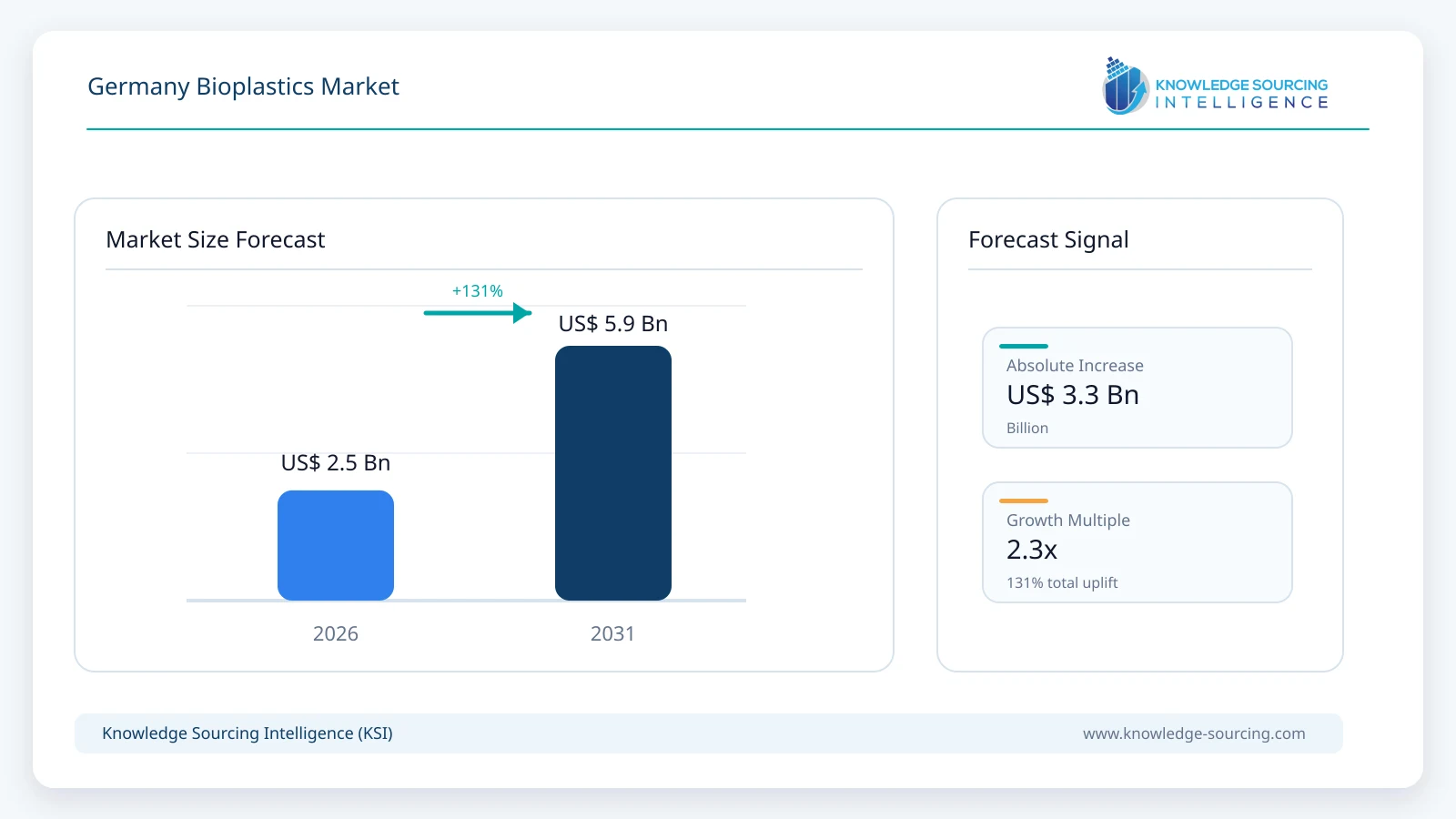
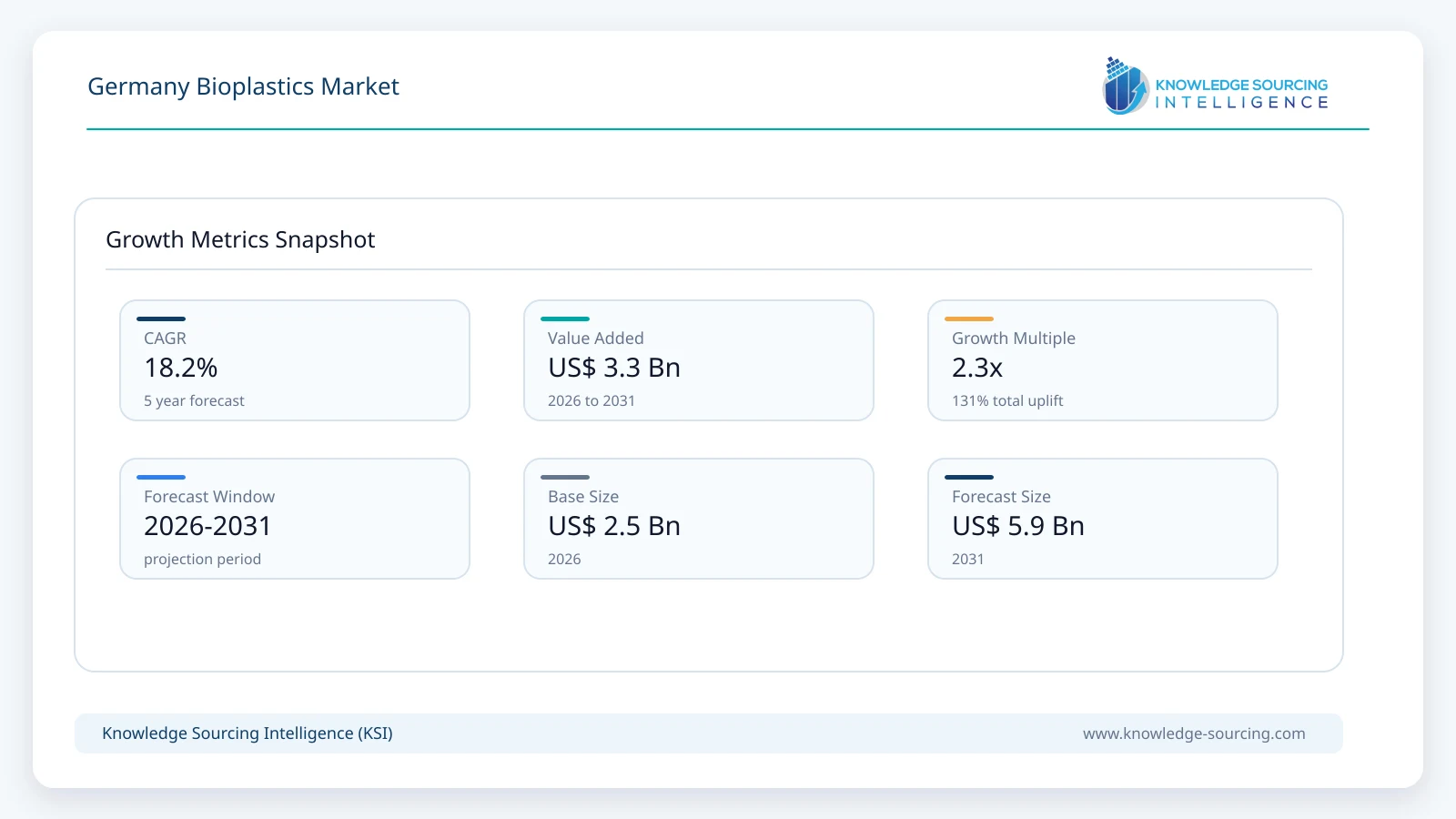
Germany Bioplastics Market is forecasted to grow at a CAGR of 18.2%, reaching USD 5.87 billion in 2031 from USD 2.54 billion in 2026.
Highlights:
- 1Upstream regulatory compliance mandates are driving industrial converters to phase out traditional polyethylene, increasing the direct market procurement of certified polylactic acid formulations for food contact applications.
- 2Escalating landfill tipping fees across European municipal territories are creating a permanent commercial dependency on certified soil-biodegradable mulch films within the agricultural sector.
- 3Global automotive original equipment manufacturers located in Germany are actively replacing engineering plastics with bio-polyamides to satisfy strict vehicle end-of-life recycling quotas.
- 4Retail supply chains are systematically restructuring consumer transport bags toward starch-blend alternatives, shifting the structural demand away from conventional fossil-derived flexible films.
Demand drivers are reshaping the industrial procurement landscape across Germany as manufacturing entities decouple production loops from petrochemical volatile supply lines. Industrial consumers are demonstrating a growing dependency on domestically stable, agricultural-feedstock derivatives to mitigate geopolitical supply disruptions in upstream oil refining. Regulatory influence acts as a primary catalyst, with the German packaging Act (VerpackG) imposing financial penalties on non-recyclable materials, thereby forcing commercial packaging lines to integrate biodegradable resins. The strategic importance of these material shifts expands beyond corporate compliance, functioning as a critical pillar for achieving national carbon neutrality targets within industrial manufacturing zones.
Market Dynamics
Drivers
Strict national carbon accounting frameworks are forcing commercial consumer packaged goods brands to integrate bio-based resins to lower scope three supply chain emissions.
Ongoing technological advancements in structural compounding are allowing bio-polymers to match the high-thermal resistance thresholds required by electronic component enclosures.
Major chemical manufacturing entities are rapidly expanding localized biorefinery infrastructures, ensuring a stable, localized volume supply of bio-succinic acid for technical polymer syntheses.
Rising consumer consciousness within metropolitan retail centers is pressuring large-scale grocery distribution networks to demand compostable barrier films for fresh produce presentation.
Restraints and Opportunities
Upstream arable land allocation challenges restrict the continuous domestic cultivation of primary industrial starch crops, creating temporary feedstock constraints for biopolymer synthesis plants.
Existing municipal waste management sorting facilities cannot easily differentiate between conventional polymers and biopolymers, leading to structural sorting inefficiencies in local recycling streams.
The accelerating commercial scaling of marine-degradable polyhydroxyalkanoates provides an immediate expansion path for water-resistant maritime logistics applications.
Developing high-barrier bio-synthetic coatings presents an immediate opportunity for replacing per- and polyfluoroalkyl substances within universal food-service paperboard packaging loops.
Supply Chain Analysis
The supply chain for bioplastics in Germany relies on a complex, multi-tiered structural framework connecting agricultural cultivation to advanced chemical conversion. Primary agricultural producers supply industrial-grade starches, beta-cultivated sugars, and vegetable oils directly to localized biorefineries for initial fermentation. These biorefineries convert crude biomass inputs into essential chemical building blocks, including lactic acid, bio-ethylene, and specialized diols. Chemical synthesis plants compound these monomers into standardized pelletized resins, which are then distributed to industrial plastic converters. Converters utilize conventional injection molding and blow-extrusion machinery to fabricate final consumer and industrial products. Logistics providers transport these finished units to major retail, automotive, and agricultural distributors across central European trade corridors. Industrial end-users generate structural waste volumes, which pass into specialized organic recycling frameworks or industrial composting facilities. Structural bottlenecks occur frequently at the recycling stage due to inadequate separation infrastructure for municipal bio-waste streams. Disruptions in agricultural yields directly affect downstream resin availability, forcing compounders to diversify chemical inputs.
Government Regulations
Regulation Name | Issuing Body | Market Impact |
German Packaging Act (VerpackG) | Zentrale Stelle Verpackungsregister (ZSVR) | Imposes financial penalties on non-recyclable packaging materials while providing direct structural incentives for integrating certified bio-based, recyclable alternatives into commercial production lines. |
EU Single-Use Plastics Directive | European Parliament and Council | Prohibits the commercial distribution of specific single-use plastic items, directly forcing retail supply chains to adopt certified compostable biopolymer alternatives. |
German Climate Action Act | Federal Ministry for Economic Affairs and Climate Action | Establishes binding carbon reduction pathways for industrial manufacturing sectors, driving automotive and consumer electronics manufacturers to source low-carbon bio-resins. |
Key Developments
August 2026: FKuR announced BioROOTGUARD, a German-funded project developing biodegradable plastic film to protect young tree roots from cockchafer damage while biodegrading completely in forest soil.
June 2026: Covestro launched Bio4PURConti, an EU-funded project targeting the first continuous production process for bio-based aniline, with semi-industrial demonstration planned at Leverkusen and Ghent.
April 2026: German chemical giant BASF expanded its ecovio® biopolymer line, launching a new portfolio of certified home-compostable grades for flexible packaging with adjustable grease and moisture barriers.
April 2026: BASF expanded its ecovio® biopolymer portfolio with new certified compostable grades enabling flexible packaging barriers, supporting paper recycling, organic recycling, and home-compostable applications.
November 2025: elm-plastic launches the world’s first commercial bioplastic pharmaceutical pipette – German packaging manufacturer elm-plastic introduced a bioplastic pipette for pharmaceutical and healthcare applications. Developed with Biovox and Ultrapolymers, the product uses medical-grade biopolymers and replaces conventional fossil-based plastic alternatives.
October 2025: Biopolymer manufacturer Braskem unveiled an advanced generation of sustainable materials at the K 2025 trade fair in Düsseldorf, including a new ultra-soft bio-based ethylene-vinyl acetate.
September 2025: Fraunhofer IAP presented around 20 new polybutylene succinate (PBS) bioplastic grades for injection molding, extrusion, thermoforming, and nonwovens. Produced from plant-based residues, the materials target packaging, consumer goods, and textile applications.
Market Segmentation
By Type
Biodegradable Bioplastic
Biodegradable bioplastics represent a critical regulatory response mechanism for addressing post-consumer municipal solid waste accumulation across municipal zones. Polylactic Acid (PLA) formulations are absorbing significant capital investment because commercial rigid packaging lines require transparent, high-tensile materials for fresh food preservation containers. Industrial converters utilize continuous extrusion processes to form structural PLA sheets, which retail distributors employ to maintain product visibility while meeting sustainability goals. Polyhydroxyalkanoates (PHA) are capturing industrial interest because maritime logistics infrastructure requires materials capable of natural degradation in marine environments without forming toxic micro-residues. Starch blends are expanding through high-volume retail carriage lines, where low-cost flexible films provide immediate alternatives to conventional low-density polyethylene carrier sheets. Polyester-based biodegradable options support technical compounding workflows, acting as structural elastomeric modifiers that increase impact resistance in brittle polymer matrices. Cellulose esters solve specialized optical film requirements within electronic displays, presenting a high-clarity alternative to fossil-derived acetate coatings.
Non-Biodegradable Bioplastic
Non-biodegradable bioplastics provide durable mechanical performance characteristics while significantly reducing the long-term carbon footprint of mass-manufactured components. Bio-PE (polyethylene) enables high-volume blow-molding packaging operations to substitute conventional ethylene feedstocks directly without requiring any capital-intensive modifications to existing machinery. Consumer brands utilize bio-PE containers for cosmetic packaging arrays, maintaining standard drop-test resistance profiles while satisfying corporate bio-based content metrics. Bio-PET (polyethylene terephthalate) serves high-pressure beverage bottling operations, allowing carbonated drink distributors to integrate bio-sourced mono-ethylene glycol into centralized bottling loops. Bio-PA (polyamide) addresses the demanding thermal and mechanical performance thresholds established by heavy industrial equipment and automotive engine compartments. Heavy industrial manufacturers incorporate bio-PA into structural gear housings, utilizing the high abrasion resistance of castor-oil derived polymers to replace petroleum-based nylon components.
By Application
Packaging
Packaging networks represent the largest operational destination for bioplastic resins due to intense regulatory oversight regarding extended producer responsibility. Industrial food processing entities are shifting toward compostable barrier structures to streamline organic waste collection inside urban commercial environments. Flexible packaging lines utilize multi-layer co-extruded bio-films to preserve food shelf-life while allowing entire packages to undergo industrial composting alongside organic food scraps. Rigid packaging structures utilize bio-PET and PLA formulations for protective electronic enclosures and structural shipping trays, eliminating hazardous secondary material sorting phases at end-of-life collection points.
Automotive
Automotive assembly plants are incorporating functional bio-resins within interior cabin environments to comply with modern vehicle manufacturing sustainability indices. Structural design groups utilize bio-PA and reinforced PLA composites to mold glovebox assemblies, door panel trims, and dashboard support brackets. These materials match the structural load-bearing parameters of traditional ABS resins while providing significant weight reduction advantages that improve overall vehicle energy efficiency. The high vibration-damping characteristics of bio-based polyurethane foams drive their implementation within acoustic insulation wraps and seating assemblies, reducing total volatile organic compound emissions inside passenger cabins.
Agriculture
Agricultural operations are deploying certified soil-biodegradable bioplastics to eliminate post-harvest clean-up costs and prevent plastic residue build-up in arable soil. Cultivation networks utilize biodegradable mulch films to suppress weed growth and regulate soil moisture levels across large-scale vegetable production zones. These specialized films degrade naturally through soil microbial activity after the harvest cycle, removing the labor-intensive removal and specialized cleaning processes required by conventional polyethylene films. Bio-based irrigation piping and seed propagation trays provide a durable operational life during the active growing season while blending into standard agricultural waste recycling streams without creating specialized processing bottlenecks.
FMCG
Fast-moving consumer goods brands are executing strategic material conversions to establish long-term differentiation within hyper-competitive retail segments. Personal care manufacturers utilize bio-based resins for high-volume toothbrush handles, cosmetic applicators, and shaving razor housings, reducing their total reliance on fossil polymers. Liquid soap and detergent brands deploy bio-PE bottles across major retail supply loops to ensure their products remain fully recyclable within existing structural municipal sorting channels. This structural shift towards renewable enclosures supports regional consumer retention strategies by providing verifiable bio-content transparency on retail shelving displays.
Construction
The construction sector utilizes high-durability bioplastic composites to replace traditional timber and fossil-polymeric structural elements in architectural projects. Building contractors install bio-based insulation boards and weatherproofing membranes within modern residential projects to achieve high energy efficiency ratings under green building frameworks. Bio-composites containing natural fiber reinforcements provide structural exterior decking solutions that resist ultraviolet degradation and fungal rot without requiring toxic chemical sealants. Cable conduits and architectural piping networks utilize bio-PVC alternatives to maintain standard fire-retardant properties while drastically lowering the embedded carbon footprint of commercial building foundations.
Textile
Textile manufacturing facilities are adapting polymer processing equipment to run bio-derived synthetic fibers as apparel brands seek alternatives to polyester. Synthetic yarn producers spin high-purity PLA and bio-PA resins into high-strength fibers for performance sportswear and industrial filtration fabrics. These bio-synthetic threads provide comparable moisture-wicking and tensile characteristics to petroleum-derived fibers while reducing micro-fiber pollution risks during washing cycles. Industrial carpet manufacturers utilize bio-PA tufting faces to deliver high wear resistance in commercial office installations, enabling complete product recovery through closed-loop mechanical recycling programs.
Competitive Landscape
BASF
Corbion
NatureWorks LLC
Braskem
Novamont S.p.A
Cardia Bioplastics
Biome Bioplastics
Company Profiles
BASF
BASF is strategically distinct due to its high-volume chemical integration model that utilizes biomass balancing within existing Verbund production infrastructures. The company manufactures specialized certified compostable biopolymers that provide high-barrier properties for industrial flexible film applications, allowing converters to run bio-resins on standard equipment lines without encountering processing stability failures.
Corbion
Corbion is strategically distinct due to its global leadership in lactic acid fermentation technology and extensive bio-monomer purification capabilities. The entity provides high-purity polylactic acid precursors designed for technical medical applications and high-heat industrial engineering compounding, ensuring strict material consistency across complex international manufacturing supply networks.
NatureWorks LLC
NatureWorks LLC is strategically distinct due to its large-scale dedicated manufacturing infrastructure optimized exclusively for polylactic acid production. The enterprise converts greenhouse gases and renewable plant sugars into functional Ingeo-branded biopolymers, delivering highly consistent structural resins optimized for specialized three-dimensional printing filaments and rigid commercial thermoforming processes.
Analyst View
The German bioplastics market is undergoing a structural transition as chemical conversion plants integrate bio-monomers directly into established industrial supply networks. Manufacturing entities must prioritize drop-in bio-resins to bypass capital constraints associated with machinery retooling while securing long-term compliance under evolving European packaging regulations.
Germany Bioplastics Market Scope:
| Report Metric | Details |
|---|---|
| Total Market Size in 2026 | USD 2.54 billion |
| Total Market Size in 2031 | USD 5.87 billion |
| Forecast Unit | Billion |
| Growth Rate | 18.2% |
| Study Period | 2021 to 2031 |
| Historical Data | 2021 to 2024 |
| Base Year | 2025 |
| Forecast Period | 2026 – 2031 |
| Segmentation | Type, Application |
| Companies |
|
Market Segmentation
By Type
- Biodegradable bioplastics
- Polyester
- Polylactic Acid (PLA)
- Polyhydroxyalkanoates (PHA)
- Starch Blends
- Others (Cellulose Esters and others)
- Non-Biodegradable bioplastics
- Bio-PE (polyethylene)
- Bio-PET (polythene terephthalate)
- Bio-PA (polyamide)
- Others
By Application
- Construction
- Packaging
- Agriculture
- Textile
- Automotive
- FMCG
- Others
Table of Contents
1. INTRODUCTION
2. RESEARCH METHODOLOGY
3. EXECUTIVE SUMMARY
4. MARKET DYNAMICS
4.1. Market Overview and Segmentations
4.2. Drivers
4.3. Restraints
4.4. Opportunities
4.5. Porter's Five Forces
4.6. Supplier Outlook
4.7. Industry Outlook
4.8. Industry Value Chain Analysis
4.9. Scenario Analysis
5. GERMANY BIOPLASTICS MARKET FORECAST BY TYPE
5.1. Biodegradable bioplastic
5.1.1. Polyester
5.1.2. Polylactic Acid (PLA)
5.1.3. Polyhydroxyalkanoates (PHA)
5.1.4. Starch Blends
5.1.5. Others (Cellulose Esters and others)
5.2. Non-Biodegradable bioplastic
5.2.1. Bio-PE (polyethylene)
5.2.2. Bio-PET (polythene terephthalate)
5.2.3. Bio-PA (polyamide)
5.2.4. Others
6. GERMANY BIOPLASTICS MARKET FORECAST BY APPLICATION
6.1. Construction
6.2. Packaging
6.3. Agriculture
6.4. Textile
6.5. Automotive
6.6. FMCG
6.7. Others
7. COMPETITIVE INTELLIGENCE
7.1. Market Share of Key Players
7.2. Investment Analysis
7.3. Recent Deals
7.4. Strategies of Key Players
8. COMPANY PROFILES
8.1. BASF
8.2. Corbion
8.3. NatureWorks LLC
8.4. Braskem
8.5. Novamont S.p.A.
8.6. Cardia Bioplastics
8.7. Biome Bioplastics
List of Figures
List of Tables
Navigate
Trusted by the world's leading organizations











