
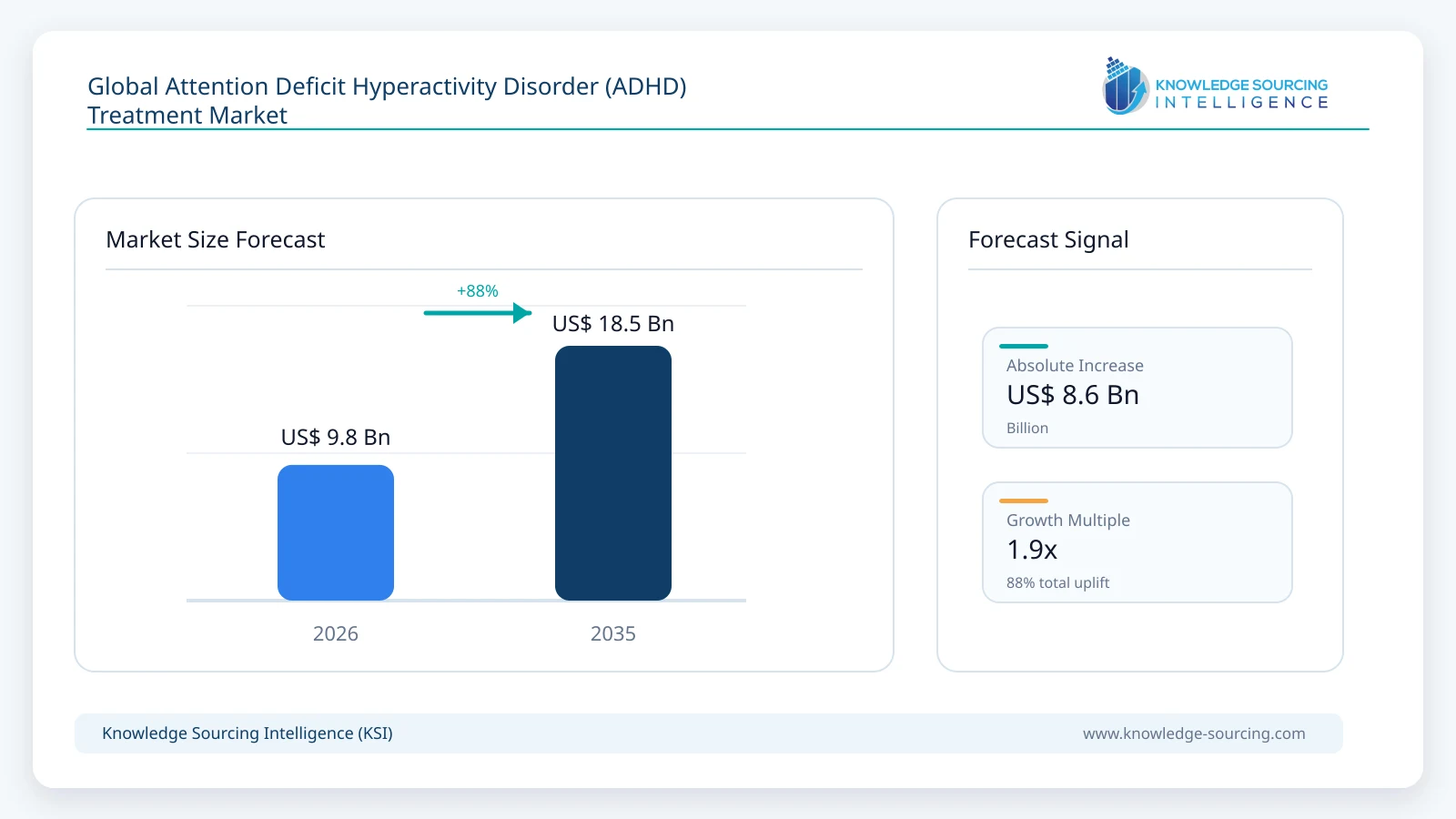
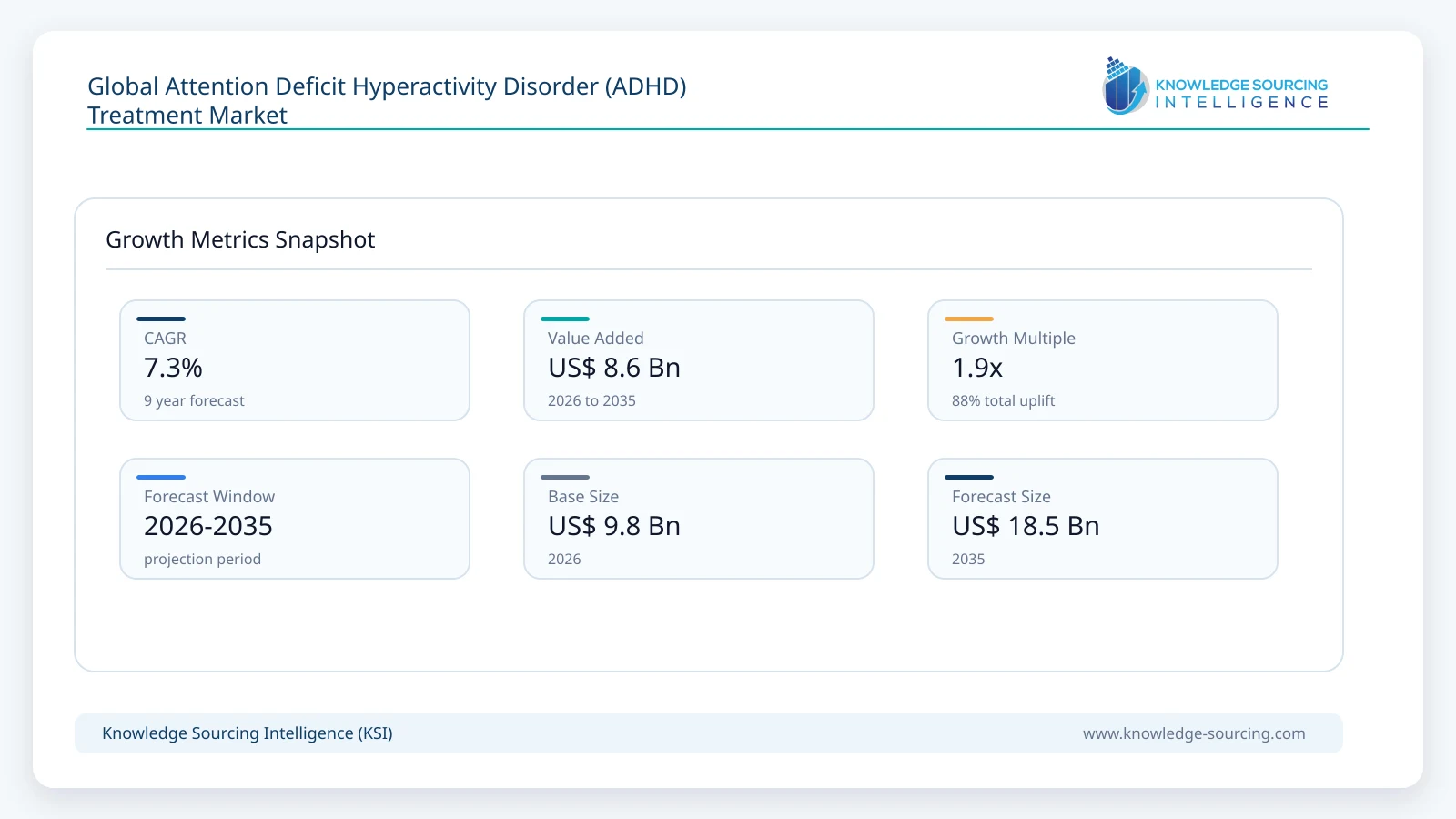
The Global Attention Deficit Hyperactivity Disorder (ADHD) Treatment Landscape is projected to grow at a CAGR of 7.3% during the forecast period, increasing from USD 9.85 billion in 2026 to USD 18.49 billion by 2035.
Highlights:
- 1Rising ADHD diagnosis rates are increasing long-term medication demand and expanding the treated patient population.
- 2Growth in adult ADHD recognition is creating demand for extended-release therapies that support workplace productivity and adherence.
- 3Concerns regarding stimulant misuse are increasing interest in non-stimulant drugs and novel mechanisms.
- 4Digital treatment platforms are gaining attention because healthcare providers are seeking complementary behavioral interventions.
ADHD represents one of the most prevalent neurodevelopmental disorders worldwide and requires long-term management strategies. Treatment demand rises as diagnosis rates increase and awareness improves across pediatric and adult populations.
The market relies primarily on stimulant therapies because they provide rapid symptom control and extensive clinical evidence. Demand is simultaneously increasing for non-stimulant agents since physicians are treating patients who do not tolerate stimulants or require lower abuse-risk alternatives.
Regulatory agencies are influencing treatment adoption through pediatric safety requirements, abuse-deterrence measures, and post-marketing surveillance. These frameworks encourage sponsors to invest in differentiated formulations and long-acting therapies.
Strategic importance is increasing because healthcare systems are recognizing the socioeconomic burden associated with untreated ADHD, including reduced academic performance, impaired occupational outcomes, and psychiatric comorbidities.
Market Dynamics
Market Drivers
Increasing ADHD Diagnosis Rates: ADHD remains one of the most common neurodevelopmental disorders globally. Diagnosis rates are increasing as screening programs expand and awareness improves among parents, educators, and healthcare providers. This trend places pressure on healthcare systems to improve access to treatment. Pharmaceutical companies are expanding portfolios and geographic reach to address rising demand. The outcome is a broader and more diversified treatment market.
Growing Preference for Long-Acting Therapies: Treatment adherence represents a major challenge in ADHD management. Patients and caregivers are increasingly preferring once-daily therapies because they simplify administration and reduce symptom fluctuations. This shift creates demand for extended-release stimulants and non-stimulants. Manufacturers are investing in modified-release technologies and differentiated delivery systems. The result is an expanding premium therapy segment.
Expanding Adult ADHD Treatment: Adult ADHD constitutes an increasingly recognized clinical condition. Healthcare providers are diagnosing more adults as awareness campaigns and updated clinical guidelines improve recognition. Adult patients require therapies that support sustained cognitive performance and workplace functioning. Drug developers are introducing therapies designed for prolonged efficacy and improved tolerability. This evolution broadens the addressable patient population.
Market Restraints
Controlled substance regulations limit stimulant prescribing flexibility and create supply-chain challenges.
Treatment discontinuation remains common because adverse effects and adherence issues affect long-term outcomes.
Diagnostic disparities across regions restrict treatment uptake and delay patient access.
Market Opportunities
Emerging Non-Stimulant Therapies: Non-stimulant therapies provide alternatives for patients with stimulant intolerance or abuse concerns. Demand is increasing as physicians seek therapies with differentiated safety profiles. Traditional treatment limitations encourage innovation in neurotransmitter modulation and receptor-selective approaches. Companies are advancing novel candidates with improved efficacy expectations. The market gains a more balanced treatment ecosystem.
Digital Therapeutics Integration: Behavioral interventions remain an important part of ADHD management. Healthcare systems are integrating digital tools because remote treatment and cognitive training are becoming more accessible. This shift supports complementary care models that combine medication with behavioral support. Technology developers are collaborating with healthcare providers to expand adoption. The outcome is a more comprehensive treatment approach.
Geographic Expansion: Emerging markets remain underpenetrated in ADHD diagnosis and treatment. Awareness is increasing while mental health infrastructure is expanding across developing regions. Limited specialist availability constrains access to care. Pharmaceutical companies are expanding distribution networks and educational programs. The result is broader treatment accessibility.
Disease & Epidemiology Analysis
ADHD is characterized by persistent inattention, hyperactivity, and impulsivity that impair social, educational, or occupational functioning. The disorder typically begins in childhood, although symptoms frequently persist into adulthood.
Disease burden is increasing because diagnosis rates continue to rise across developed markets. Healthcare providers are identifying more patients through improved screening and awareness programs. Diagnostic expansion increases demand for pharmacological and behavioral interventions. Healthcare systems are allocating additional resources toward pediatric mental health. The outcome is greater treatment penetration.
CDC data indicate that approximately 10.5% of U.S. children had current ADHD in 2022, while 58.1% of diagnosed children experienced moderate-to-severe disease severity. Nearly 77.9% had at least one coexisting disorder, highlighting the complexity of long-term management.
Treatment Guidelines Landscape
Organization | Recommendation |
American Academy of Pediatrics | Behavioral therapy first for children under 6 years |
American Academy of Pediatrics | Medication plus behavioral therapy for children aged 6 years and older |
American Academy of Child and Adolescent Psychiatry | Stimulants remain the first-line pharmacological therapy. |
National Institute for Health and Care Excellence (NICE) | Medication is recommended after environmental and behavioral interventions |
Market Segmentation
By Treatment Type
Stimulants remain the dominant treatment category because they deliver rapid symptom control and extensive clinical evidence. Demand is shifting toward long-acting methylphenidate and amphetamine formulations as patients seek consistent symptom management throughout the day. Abuse concerns limit growth potential for some products. Manufacturers are introducing differentiated release technologies and improved formulations. The segment maintains its leadership position while non-stimulants and emerging therapies continue expanding.
By End User
Specialty clinics and hospitals constitute the primary treatment settings because diagnosis often requires specialist evaluation. Demand is increasing for home-based care as awareness grows and telemedicine expands. Access limitations create disparities across regions. Healthcare providers are integrating digital monitoring and remote consultations to improve continuity of care. The treatment ecosystem becomes increasingly decentralized.
By Distribution Channel
Retail pharmacies dominate ADHD medication distribution because they provide broad geographic access. Online pharmacies are gaining importance as digital healthcare adoption increases. Regulatory controls limit distribution flexibility for controlled substances. Healthcare systems are improving prescription monitoring and digital dispensing infrastructure. The result is a more integrated distribution network.
Regional Analysis
North America Market Analysis
North America represents the largest ADHD treatment market because diagnosis rates remain high and healthcare access is well established. Demand is increasing as adult ADHD recognition expands and pediatric screening programs improve. Controlled substance regulations create prescribing complexities that influence treatment selection. Pharmaceutical companies are developing differentiated therapies and long-acting formulations to address these challenges. The region maintains strong innovation capacity and extensive clinical research activity.
The United States drives regional demand because awareness remains high and reimbursement coverage supports treatment access. Healthcare providers increasingly recognize adult ADHD, which expands the patient pool.
Europe Market Analysis
European demand centers on evidence-based prescribing and long-term disease management. Treatment adoption is increasing as mental health awareness improves and healthcare systems expand neurodevelopmental disorder services. Reimbursement restrictions influence product uptake and favor clinically differentiated therapies. Pharmaceutical companies are strengthening regional portfolios and investing in post-marketing studies. The market remains highly regulated and clinically driven. Western European countries dominate regional demand because specialist access and reimbursement structures are more developed.
Asia Pacific Market Analysis
Asia Pacific represents a high-growth region because diagnosis rates remain below those of Western countries while awareness continues rising. Demand is increasing as educational institutions and healthcare providers improve screening practices. Limited specialist availability constrains early diagnosis in several countries. Pharmaceutical companies are expanding regional footprints and strengthening local partnerships. The market gradually transitions from underdiagnosis toward broader treatment adoption.
Japan remains an important market because approved therapies and clinical awareness support treatment uptake. China and India are increasing investments in pediatric mental health services. These developments broaden future commercial opportunities.
Rest of the World
The Rest of the World remains comparatively underpenetrated but offers long-term growth opportunities. Demand is increasing as governments recognize mental health as a public health priority. Diagnostic limitations and healthcare access disparities constrain treatment adoption. Pharmaceutical companies are investing in education and market expansion strategies. The region gradually improves treatment availability and awareness.
Latin America is strengthening psychiatric care networks, while Middle Eastern countries are increasing investments in mental health infrastructure. These initiatives support long-term market expansion.
Regulatory Landscape
Regulatory agencies emphasize safety, efficacy, and abuse-risk mitigation in ADHD treatment approvals. Stimulant therapies remain subject to controlled substance regulations because misuse potential requires strict monitoring. These frameworks influence prescribing practices and commercial strategies. Companies are investing in abuse-deterrence technologies and long-acting formulations to differentiate products.
Pediatric clinical requirements remain a central component of regulatory review because ADHD primarily affects children and adolescents. Sponsors are conducting age-specific studies and long-term safety evaluations to satisfy regulatory expectations. These requirements increase development timelines but strengthen clinical evidence.
Digital therapeutics face evolving regulatory pathways as agencies evaluate software-based interventions. Regulatory clarity continues improving, which may support future commercialization opportunities.
Pipeline Analysis
Pipeline activity increasingly focuses on differentiated mechanisms and improved delivery technologies. Traditional stimulants remain commercially important, although developers are pursuing therapies that address adherence challenges and abuse concerns. Companies are prioritizing extended-release systems, alternative dosing technologies, and novel pharmacological approaches.
Several candidates remain in clinical development across stimulant and non-stimulant categories. Development programs are emphasizing sustained efficacy and improved tolerability because physicians seek individualized treatment options. Regulatory scrutiny remains high, particularly for controlled substances.
In June 2026, the FDA issued a complete response letter for Cingulate's CTx-1301 due to manufacturing concerns, although the agency did not identify efficacy or safety issues. This event highlights the importance of manufacturing quality in ADHD drug development.
Reimbursement Landscape
Reimbursement frameworks strongly influence ADHD treatment adoption because long-term therapy creates substantial healthcare expenditures. Public and private payers generally cover established stimulant and non-stimulant medications, although formulary restrictions vary by country.
Demand is increasing for therapies that demonstrate improved adherence and clinical outcomes because payers are emphasizing value-based care. These requirements encourage manufacturers to generate real-world evidence and long-term effectiveness data. The reimbursement environment increasingly rewards differentiated products with measurable patient benefits.
Competitive Landscape
Johnson & Johnson
Johnson & Johnson established a strong presence through Concerta and remains influential in the history of ADHD treatment. The company benefits from brand recognition and extensive neuroscience expertise. Lifecycle management strategies support continued market relevance despite competitive pressures.
Takeda Pharmaceutical Company
Takeda remains strategically distinct because it owns major stimulant brands, including Vyvanse. The company focuses on maintaining leadership in ADHD while expanding neuroscience capabilities. Demand for long-acting stimulants supports portfolio stability, although generic competition influences lifecycle management strategies. Takeda continues emphasizing differentiated formulations and global commercial reach.
Supernus Pharmaceuticals
Supernus differentiates itself through non-stimulant innovation and CNS specialization. The company markets Qelbree and positions the product as an alternative to traditional stimulants. Demand is increasing among patients seeking non-controlled therapies. Supernus continues investing in portfolio expansion and clinical evidence generation.
Noven Pharmaceuticals
Noven specializes in transdermal delivery technologies and differentiates itself through Daytrana. The company addresses adherence challenges through alternative administration routes. Demand is increasing among pediatric patients who require flexible treatment options. Noven continues emphasizing delivery innovation.
Azurity Pharmaceuticals
Azurity focuses on patient-friendly formulations and maintains a diversified ADHD portfolio, including Cotempla XR-ODT, Adzenys XR-ODT, and Dyanavel XR. The company targets convenience and pediatric adherence. Demand is increasing for orally disintegrating and liquid formulations. Azurity continues expanding specialized dosage technologies.
Teva Pharmaceutical Industries
Teva leverages extensive generic capabilities and broad CNS expertise. The company benefits from manufacturing scale and global distribution infrastructure. Demand for affordable ADHD therapies remains stable. Teva continues optimizing portfolio value through lifecycle management and market expansion.
Key Developments
June 2026: Shionogi launched ENDEAVORRIDE, a digital therapeutic app for adjunctive treatment of pediatric ADHD in Japan, marking the company's first digital therapy offering for ADHD. The app-based intervention provides a non-pharmacological treatment option for children with ADHD as part of a comprehensive treatment approach.
January 2026: Neuraxpharm launched two new ADHD treatments in Europe, Tuzulby (methylphenidate) prolonged-release chewable tablets, the first and only once-daily prolonged-release chewable methylphenidate tablet for children and adolescents aged 6–17 years, and Paxneury (guanfacine) prolonged-release tablets with higher dose strengths (5mg, 6mg, and 7mg) for individualized dosing in patients where stimulants are not suitable or effective.
Strategic Insights and Future Market Outlook
The ADHD treatment landscape is transitioning from a stimulant-dominated market toward a more diversified ecosystem. Physicians increasingly require therapies that balance efficacy, safety, and convenience because patient populations are becoming more heterogeneous. This shift encourages investment in differentiated non-stimulants, digital therapeutics, and advanced delivery systems.
Regulatory oversight remains strong, although innovation continues to accelerate across multiple treatment categories. Companies are strengthening portfolios through lifecycle management and targeted pipeline investments. These strategies improve competitive positioning while expanding treatment choices.
Long-term growth depends on broader diagnosis, improved awareness, and better access to care. Healthcare systems increasingly recognize ADHD as a chronic condition requiring sustained management. This recognition supports continued innovation and reinforces the strategic importance of ADHD therapies across global pharmaceutical markets.
Market Segmentation
By Geography
Key Countries Analysis
Regulatory & Policy Landscape
Table of Contents
1. EXECUTIVE SUMMARY
1.1 Report Scope and Objectives
1.2 Key Findings
1.3 ADHD Treatment Market Snapshot
1.4 Major Approved Therapies Overview
1.5 Emerging Treatment Trends
1.6 Strategic Recommendations
1.7 Future Market Outlook
2. DISEASE & EPIDEMIOLOGY ANALYSIS
2.1 Introduction to Attention Deficit Hyperactivity Disorder (ADHD)
2.1.1 Definition and Clinical Characteristics
2.1.2 Disease Burden and Unmet Needs
2.1.3 Disease Progression and Long-Term Outcomes
2.2 Etiology and Risk Factors
2.2.1 Genetic Factors
2.2.2 Neurobiological Mechanisms
2.2.3 Environmental and Prenatal Risk Factors
2.3 Pathophysiology
2.3.1 Dopaminergic Dysfunction
2.3.2 Noradrenergic Dysfunction
2.3.3 Brain Structural and Functional Changes
2.4 Disease Classification
2.4.1 Predominantly Inattentive Presentation
2.4.2 Predominantly Hyperactive-Impulsive Presentation
2.4.3 Combined Presentation
2.5 Diagnosis and Screening
2.5.1 Diagnostic Criteria
2.5.2 Clinical Assessment Tools
2.5.3 Neuropsychological Evaluation
2.5.4 Differential Diagnosis
2.6 Epidemiology Analysis
2.6.1 Global Prevalence
2.6.2 Incidence Trends
2.6.3 Age-wise Distribution
2.6.4 Gender-wise Distribution
2.6.5 Adult versus Pediatric ADHD Prevalence
2.6.6 Diagnosed and Treated Patient Population
3. MARKET DYNAMICS
3.1 Market Overview
3.2 Market Drivers
3.2.1 Rising ADHD Awareness and Diagnosis Rates
3.2.2 Expanding Adult ADHD Diagnosis
3.2.3 Growing Availability of Novel Therapies
3.2.4 Increasing Healthcare Expenditure
3.3 Market Restraints
3.3.1 Drug Abuse and Misuse Concerns
3.3.2 Regulatory Restrictions on Controlled Substances
3.3.3 Side Effects and Safety Concerns
3.3.4 Generic Competition
3.4 Market Opportunities
3.4.1 Non-Stimulant Innovations
3.4.2 Digital Therapeutics Integration
3.4.3 Personalized Medicine Approaches
3.4.4 Expansion in Emerging Markets
3.5 Porter’s Five Forces Analysis
3.5.1 Threat of New Entrants
3.5.2 Bargaining Power of Suppliers
3.5.3 Bargaining Power of Buyers
3.5.4 Threat of Substitutes
3.5.5 Competitive Rivalry
4. COMMERCIAL & MARKET ACCESS
4.1 Pricing Analysis
4.2 Reimbursement Landscape
4.3 Commercialization Models
4.4 Patient Assistance Programs
4.5 Market Access Challenges
4.6 Prescription Trends
4.7 Generic Penetration Analysis
5. INNOVATION & PIPELINE LANDSCAPE
5.1 Innovation Overview
5.2 Emerging Treatment Modalities
5.2.1 Novel Stimulants
5.2.2 Non-Stimulant Therapies
5.2.3 Extended-Release Formulations
5.2.4 Digital Therapeutics
5.2.5 Combination Therapies
5.3 Pipeline Analysis by Development Stage
5.3.1 Discovery Stage
5.3.2 Preclinical Stage
5.3.3 Phase I Pipeline
5.3.4 Phase II Pipeline
5.3.5 Phase III Pipeline
5.4 Pipeline Analysis by Mechanism of Action
5.4.1 Dopamine Reuptake Inhibitors
5.4.2 Norepinephrine Reuptake Inhibitors
5.4.3 Monoamine Modulators
5.4.4 Multimodal Mechanisms
5.5 Pipeline Analysis by Modality
5.5.1 Small Molecules
5.5.2 Digital Therapeutics
5.5.3 Combination Products
5.6 Clinical Trial Landscape
5.6.1 Active Clinical Trials
5.6.2 Completed Clinical Trials
5.6.3 Trial Distribution by Phase
5.6.4 Trial Distribution by Geography
6. TREATMENT LANDSCAPE
6.1 Current Treatment Algorithm
6.2 Pharmacological Treatment Overview
6.2.1 Stimulant Therapies
6.2.1.1 Methylphenidate-Based Products
6.2.1.2 Amphetamine-Based Products
6.2.2 Non-Stimulant Therapies
6.2.2.1 Atomoxetine
6.2.2.2 Guanfacine Extended Release
6.2.2.3 Clonidine Extended Release
6.2.2.4 Viloxazine Extended Release
6.3 Non-Pharmacological Therapies
6.3.1 Behavioral Therapy
6.3.2 Cognitive Behavioral Therapy
6.3.3 Parent Training Programs
6.3.4 Educational Interventions
6.4 Digital Therapeutics and Emerging Technologies
6.5 Treatment Guidelines Review
6.5.1 Pediatric Guidelines
6.5.2 Adult ADHD Guidelines
6.5.3 Treatment Sequencing Approaches
7. GLOBAL ATTENTION DEFICIT HYPERACTIVITY DISORDER (ADHD) TREATMENT LANDSCAPE REPORT SIZE & FORECAST
7.1 Global Market Size Analysis
7.2 Historical Market Analysis
7.3 Market Forecast
7.4 Market Forecast by Treatment Type
7.5 Market Forecast by Indication
7.6 Market Forecast by Route of Administration
7.7 Market Forecast by Distribution Channel
7.8 Market Forecast by End User
8. GLOBAL ATTENTION DEFICIT HYPERACTIVITY DISORDER (ADHD) TREATMENT LANDSCAPE REPORT SEGMENTATION
8.1 By Treatment Type
8.1.1 Stimulants
8.1.1.1 Methylphenidate
8.1.1.2 Amphetamine
8.1.2 Non-Stimulants
8.1.2.1 Norepinephrine
8.1.2.2 Alpha-2 Adrenergic Agonists
8.1.3 Emerging & Novel Therapies
8.1.4 Digital Therapeutics
8.3 By Indication
8.3.1 Pediatric & Adolescent ADHD
8.3.2 Adult ADHD
8.4 By Route of Administration
8.4.1 Oral
8.4.2 Transdermal
8.5 By End User
8.5.1 Hospitals
8.5.2 Specialty Clinics
8.5.3 Homecare Settings
8.6 By Distribution Channel
8.6.1 Hospital Pharmacies
8.6.2 Retail Pharmacies
8.6.3 Online Pharmacies
9. GEOGRAPHICAL ANALYSIS
9.1 North America
9.1.1 Market Size and Growth
9.1.2 Demand Drivers
9.1.3 Regional Regulatory Overview
9.1.4 Competitive Intensity
9.2 Europe
9.2.1 Market Size and Growth
9.2.2 Demand Drivers
9.2.3 Regional Regulatory Overview
9.2.4 Competitive Intensity
9.3 Asia-Pacific
9.3.1 Market Size and Growth
9.3.2 Demand Drivers
9.3.3 Regional Regulatory Overview
9.3.4 Competitive Intensity
9.4 Latin America
9.4.1 Market Size and Growth
9.4.2 Demand Drivers
9.4.3 Regional Regulatory Overview
9.4.4 Competitive Intensity
9.5 Middle East & Africa
9.5.1 Market Size and Growth
9.5.2 Demand Drivers
9.5.3 Regional Regulatory Overview
9.5.4 Competitive Intensity
10. KEY COUNTRIES ANALYSIS
10.1 United States
10.2 Canada
10.3 Germany
10.4 United Kingdom
10.5 France
10.6 Italy
10.7 Spain
10.8 China
10.9 Japan
10.10 India
10.11 South Korea
10.12 Australia
10.13 Brazil
10.14 Mexico
10.15 Saudi Arabia
10.16 South Africa
11. REGULATORY & POLICY LANDSCAPE
11.1 Global Regulatory Overview
11.2 United States Regulatory Framework (FDA)
11.3 European Regulatory Framework (EMA)
11.4 Japan Regulatory Framework (PMDA)
11.5 India Regulatory Framework (CDSCO)
11.6 China Regulatory Framework (NMPA)
11.7 Controlled Substance Regulations
11.8 Drug Safety and Pharmacovigilance Requirements
11.9 Intellectual Property and Patent Landscape
12. COMPETITIVE LANDSCAPE
12.1 Market Share Analysis
12.2 Competitive Benchmarking
12.3 Product Portfolio Comparison
12.4 Pipeline Competitiveness Analysis
12.5 Recent Approvals and Launches
12.6 Licensing and Collaboration Activities
12.7 Merger and Acquisition Activities
12.8 SWOT Analysis
13. COMPANY PROFILES
13.1 Takeda Pharmaceutical Company
13.1.1 Company Overview
13.1.2 Approved Drugs: Vyvanse (lisdexamfetamine), Adderall XR (mixed amphetamine salts)
13.1.3 Key Indications
13.1.4 ADHD Portfolio Strategy
13.1.5 Verified Pipeline Assets
13.2 Supernus Pharmaceuticals
13.2.1 Company Overview
13.2.2 Approved Drugs: Qelbree (viloxazine extended-release)
13.2.3 Key Indications
13.2.4 ADHD Portfolio Strategy
13.2.5 Verified Pipeline Assets
13.3 Johnson & Johnson
13.3.1 Company Overview
13.3.2 Approved Drugs: Concerta (methylphenidate extended-release)
13.3.3 Key Indications
13.3.4 Lifecycle Management
13.3.5 Verified Pipeline Assets
13.4 Noven Pharmaceuticals
13.4.1 Company Overview
13.4.2 Approved Drugs: Daytrana (methylphenidate transdermal system)
13.4.3 Key Indications
13.4.4 Product Strategy
13.4.5 Verified Pipeline Assets
13.5 Azurity Pharmaceuticals
13.5.1 Company Overview
13.5.2 Approved Drugs: Cotempla XR-ODT, Adzenys XR-ODT, Dyanavel XR
13.5.3 Key Indications
13.5.4 Product Strategy
13.5.5 Verified Pipeline Assets
13.6 Teva Pharmaceutical
13.6.1 Company Overview
13.6.2 Approved Drugs: Strattera (atomoxetine)
13.6.3 Key Indications
13.6.4 Lifecycle Management
13.6.5 Verified Pipeline Assets
13.7 Shionogi & Co., Ltd.
13.7.1 Company Overview
13.7.2 Approved Drugs: Intuniv (guanfacine extended-release in Japan)
13.7.3 Key Indications
13.7.4 Regional Strategy
13.7.5 Verified Pipeline Assets
13.8 Novartis AG
13.8.1 Company Overview
13.8.2 Approved Drugs Portfolio
13.8.3 Key Indications
13.8.4 CNS Business Strategy
13.8.5 Verified Pipeline Assets
13.9 Tris Pharma
13.9.1 Company Overview
13.9.2 Approved Drugs: Quillivant XR, Quillichew ER
13.9.3 Key Indications
13.9.4 Product Strategy
13.9.5 Verified Pipeline Assets
13.10 Arbor Pharmaceuticals
13.10.1 Company Overview
13.10.2 Approved Drugs: Evekeo, Evekeo ODT
13.10.3 Key Indications
13.10.4 Commercial Strategy
13.10.5 Verified Pipeline Assets
14. FUTURE OUTLOOK
14.1 Future Treatment Paradigm
14.2 Emerging Technologies
14.3 Opportunities in Adult ADHD
14.4 Advances in Non-Stimulant Therapies
14.5 Digital Therapeutics Potential
14.6 Market Growth Projections
14.7 Strategic Recommendations
15. METHODOLOGY
15.1 Research Objectives
15.2 Secondary Research Methodology
15.3 Primary Research Methodology
15.4 Epidemiology Modeling Approach
15.5 Market Forecasting Methodology
15.6 Data Validation and Triangulation
15.7 Assumptions and Limitations
15.8 Abbreviations and Definitions
Navigate
Trusted by the world's leading organizations











