
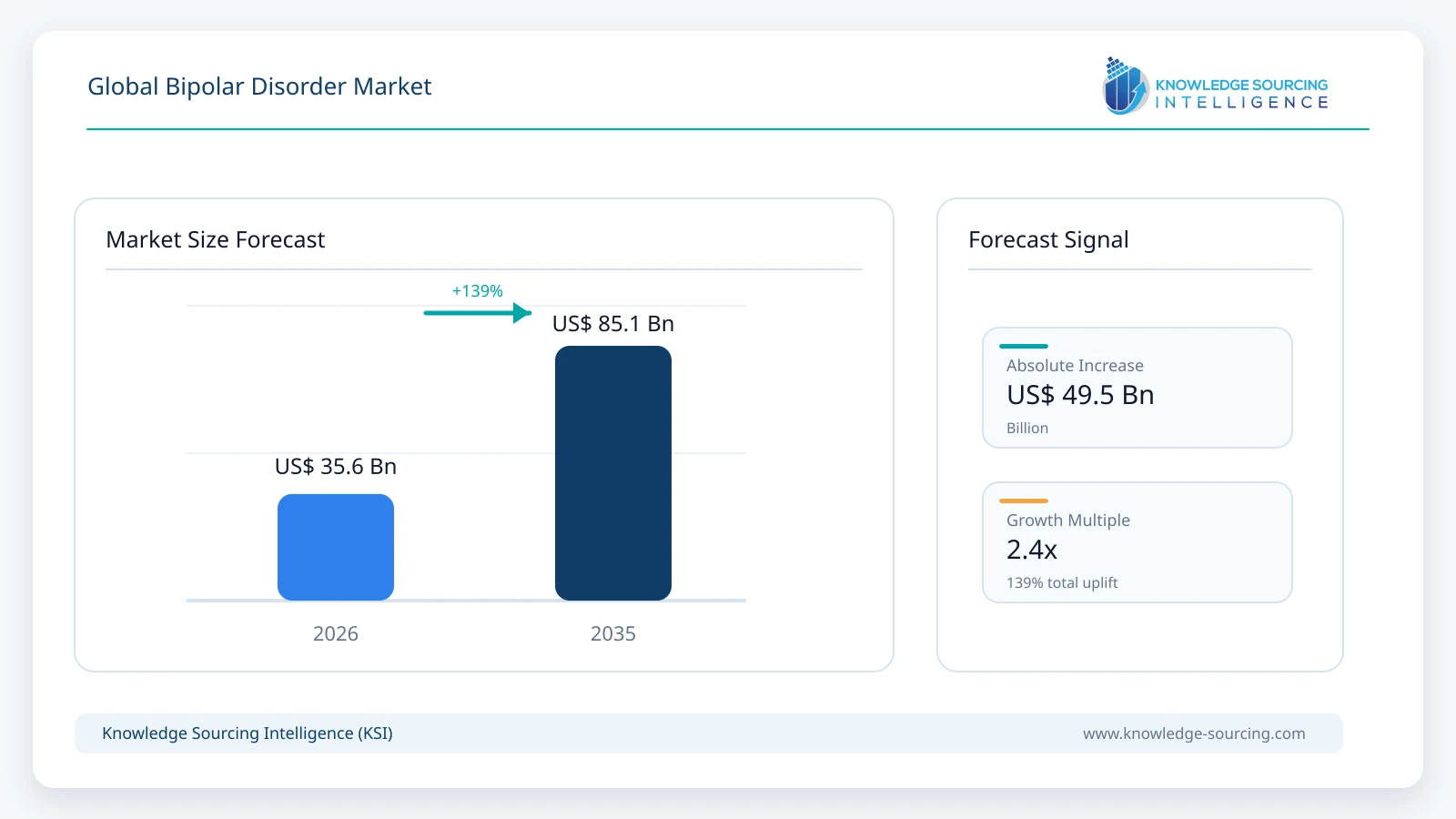
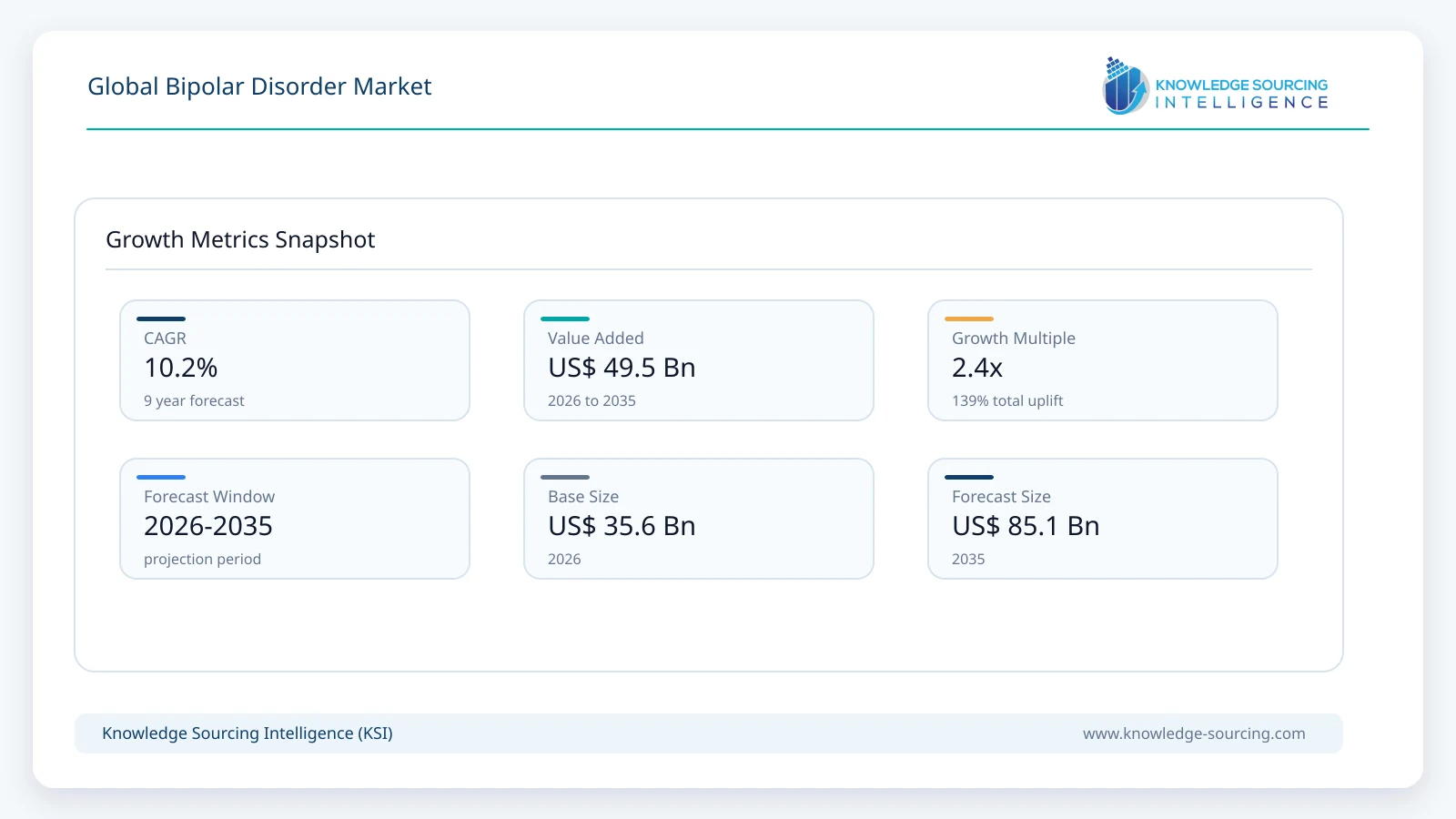
The Global Bipolar Disorder Market is forecast to grow at a CAGR of 10.2%, reaching USD 85.13 billion in 2035 from USD 35.62 billion in 2026.
Highlights:
- 1Growing recognition of bipolar depression burden is increasing demand for therapies that provide sustained antidepressant efficacy without triggering manic episodes.
- 2Expanding understanding of neuroplasticity mechanisms is accelerating development of novel assets targeting synaptic function and neural network regulation.
- 3Ongoing limitations of current antipsychotic therapies are driving investment toward differentiated safety profiles and improved tolerability.
- 4Increasing emphasis on relapse prevention is strengthening demand for long-duration treatment strategies capable of reducing hospitalization risk.
- 5Regulatory focus on functional outcomes is encouraging sponsors to incorporate broader efficacy measures beyond symptom reduction.
- 6Precision psychiatry approaches are gaining attention because heterogeneous treatment responses continue limiting therapeutic optimization.
Bipolar disorder remains a chronic psychiatric condition characterized by recurrent episodes of mania, hypomania, depression, and mixed states. The treatment landscape depends heavily on mood stabilizers, atypical antipsychotics, and adjunctive therapies because long-term disease management requires sustained symptom control.
Clinical demand is shifting toward therapies that address bipolar depression because depressive episodes account for a substantial proportion of disease burden. Existing treatment limitations create persistent demand for assets capable of improving efficacy without increasing metabolic, neurological, or cardiovascular risks.
Regulatory expectations continue evolving as agencies seek more robust evidence regarding functional outcomes and relapse prevention. Developers are increasingly designing trials that evaluate broader measures of patient well-being because healthcare stakeholders are emphasizing long-term disease management rather than short-term symptom reduction.
The strategic importance of pipeline innovation continues increasing because healthcare systems face substantial economic burdens associated with hospitalization, disability, lost productivity, and recurrent treatment failure. As scientific understanding advances, investment is moving toward biologically differentiated therapies capable of delivering clinically meaningful improvements across multiple disease domains.
Market Dynamics
Market Drivers
Rising Unmet Need in Bipolar Depression: Bipolar depression remains the most challenging component of disease management because available therapies often provide incomplete symptom control. Clinical demand is increasing for therapies capable of delivering rapid and durable antidepressant effects. Treatment limitations create significant development opportunities for novel mechanisms. Sponsors are expanding investment in differentiated psychiatric assets. The result is a growing pipeline focused on depressive symptom improvement.
Expansion of Neurobiological Research: Scientific understanding of bipolar disorder continues evolving beyond traditional monoamine theories. Research activity is increasingly identifying pathways related to glutamate signaling, neuroplasticity, circadian regulation, and inflammation. This expanding knowledge base creates opportunities for novel therapeutic approaches. Developers are advancing programs against previously unexplored targets. The outcome is a more diversified clinical pipeline.
Growing Focus on Functional Outcomes: Long-term patient functioning remains a critical determinant of treatment success. Healthcare providers are increasingly emphasizing cognitive performance, social functioning, and occupational recovery. Traditional symptom-focused assessments create limitations in measuring real-world benefit. Clinical developers are incorporating broader endpoints into development programs. This trend strengthens demand for therapies demonstrating comprehensive patient improvement.
Market Restraints
High placebo response rates in psychiatric clinical trials continue complicating efficacy assessment and increasing development risk.
Biological heterogeneity across patient populations limits predictable treatment responses and reduces trial success probabilities.
Long-term safety requirements increase development timelines and create significant clinical and regulatory burdens.
Market Opportunities
Precision Psychiatry Development: Treatment variability remains a major challenge because bipolar disorder encompasses diverse biological profiles. Biomarker research is increasingly identifying patient subgroups with distinct therapeutic responses. Clinical uncertainty creates demand for more targeted interventions. Developers are integrating precision medicine tools into development programs. This approach may improve future treatment selection.
Neuroplasticity-Focused Therapeutics: Synaptic dysfunction increasingly appears central to disease progression. Research activity is expanding around mechanisms that promote neural adaptability and network restoration. Existing therapies often fail to address these underlying processes. Sponsors are advancing neuroplasticity-targeting assets through clinical development. This area represents a significant source of future innovation.
Digital Biomarker Integration: Disease monitoring remains difficult because symptom fluctuations often occur outside clinical settings. Digital technologies are increasingly enabling continuous assessment of behavioral and functional changes. Traditional monitoring approaches create information gaps. Developers are incorporating digital tools into clinical programs. Enhanced monitoring may improve treatment evaluation and patient management.
Disease & Epidemiology Analysis
Bipolar disorder represents one of the leading causes of psychiatric disability worldwide because recurrent mood episodes substantially impair daily functioning. Epidemiological studies generally estimate lifetime prevalence between 1% and 3% depending on diagnostic definitions and population characteristics. Diagnostic complexity contributes to delayed recognition because symptom presentation often overlaps with major depressive disorder and other psychiatric conditions.
The diagnosed population is increasing as mental health awareness expands and healthcare systems improve access to psychiatric evaluation. Earlier identification remains important because delayed diagnosis often leads to inappropriate treatment exposure and poorer long-term outcomes. Healthcare providers are strengthening screening efforts across primary care and specialist settings. This trend supports greater demand for effective therapeutic interventions.
Disease burden remains concentrated among working-age adults because symptom onset commonly occurs during adolescence or early adulthood. Functional impairment creates substantial social and economic consequences. Healthcare systems are increasingly recognizing these long-term impacts. The result is growing emphasis on early intervention and sustained disease management.
Suicide risk remains significantly elevated among individuals with bipolar disorder. This burden increases pressure for therapies capable of reducing depressive symptoms and preventing relapse. Clinical development therefore continues prioritizing interventions that provide durable disease stabilization.
Treatment Guidelines Landscape
Treatment Area | Guideline Direction |
Acute Mania | Rapid symptom stabilization |
Bipolar Depression | Symptom control without mood destabilization |
Maintenance Therapy | Long-term relapse reduction |
Mixed Episodes | Broad mood stabilization |
Treatment-Resistant Disease | Personalized management strategies |
Market Segmentation
By Development Phase
The bipolar disorder pipeline spans preclinical through late-stage development because unmet clinical needs remain significant across multiple disease states. Early-stage activity is increasing around novel biological targets. Scientific uncertainty creates substantial attrition risk. Sponsors are prioritizing assets supported by translational evidence and biomarker strategies. The outcome is a pipeline that balances innovation with risk mitigation.
Phase II development remains particularly active because developers are seeking proof-of-concept validation for differentiated mechanisms. Clinical complexity limits rapid advancement. Companies are refining patient selection strategies to improve signal detection. Development programs increasingly incorporate functional and quality-of-life endpoints. This approach supports stronger differentiation opportunities.
Late-stage development remains more concentrated because psychiatric drug development carries elevated clinical risk. Regulatory expectations require robust efficacy and safety evidence. Sponsors are investing selectively in programs with compelling clinical profiles. The result is a smaller but potentially impactful late-stage pipeline.
By Mechanism of Action
Neurotransmitter modulators continue representing a substantial share of development activity because established biological evidence supports these pathways. Clinical limitations of existing therapies are encouraging exploration of additional mechanisms. Research activity is increasingly focusing on glutamatergic and neuroplasticity-related targets. Developers are pursuing differentiated approaches that extend beyond dopamine and serotonin modulation. This shift broadens future therapeutic possibilities.
Circadian rhythm regulation remains an area of growing interest because sleep and biological timing disturbances frequently accompany bipolar disorder. Disease complexity creates demand for multidimensional treatment strategies. Sponsors are evaluating therapies capable of influencing broader neurobiological systems. Development efforts increasingly target integrated disease mechanisms. The outcome is a more diverse therapeutic landscape.
Neuroimmune and inflammatory pathways are attracting increasing attention because emerging evidence suggests their involvement in disease progression. Scientific validation remains ongoing. Developers are expanding exploratory programs in this area. Future clinical data will determine long-term commercial viability.
By Clinical Objective
Bipolar depression remains the largest area of pipeline concentration because current treatment options leave substantial unmet need. Persistent symptom burden creates strong demand for innovation. Developers are prioritizing therapies capable of delivering antidepressant efficacy while minimizing manic switching risk. Clinical investment continues expanding in this segment. The result is a highly competitive development environment.
Maintenance therapy remains strategically important because relapse drives hospitalization and long-term disability. Existing treatment approaches provide incomplete disease control for many patients. Sponsors are pursuing interventions designed to improve durability of response. Long-term outcome measures are increasingly influencing development decisions. This trend strengthens focus on sustained disease stabilization.
Regional Analysis
North America Market Analysis
North America represents the most mature bipolar disorder treatment market because psychiatric care infrastructure supports broad access to diagnosis, specialist management, and advanced pharmacotherapy. Clinical demand is increasing for therapies that address bipolar depression because depressive episodes account for a substantial share of healthcare utilization and disability. Existing treatment algorithms create persistent dependence on atypical antipsychotics and mood stabilizers. Developers are expanding late-stage and early-stage psychiatric programs to address efficacy and tolerability limitations. The result is sustained interest in differentiated mechanisms with potential disease-modifying effects.
Europe Market Analysis
Europe maintains a strong position in bipolar disorder management because public healthcare systems support structured psychiatric care pathways. Demand is increasing for therapies that reduce hospitalization rates because healthcare systems continue facing resource constraints associated with chronic mental illness. Existing reimbursement frameworks prioritize evidence-based treatment utilization. Clinical developers are generating broader health-economic evidence to support future market access. This trend strengthens the role of outcome-focused clinical development.
Asia Pacific Market Analysis
Asia Pacific represents one of the fastest-evolving regions for bipolar disorder management because awareness of psychiatric disorders continues improving across major healthcare systems. Demand is increasing as governments expand mental health initiatives and improve diagnostic capabilities. Historical stigma has limited treatment engagement. Healthcare providers are strengthening education and screening efforts. The outcome is a growing addressable patient population.
Rest of the World
Emerging markets across Latin America, the Middle East, and Africa continue demonstrating unmet psychiatric care needs because diagnostic infrastructure remains limited in many healthcare systems. Demand is increasing as awareness campaigns and healthcare modernization efforts improve recognition of mood disorders. Resource limitations constrain specialist access. Governments are expanding mental health policy initiatives. The result is gradual improvement in treatment availability.
Regulatory Landscape
Regulatory agencies increasingly recognize bipolar disorder as an area of substantial unmet medical need because existing therapies often fail to deliver comprehensive disease control. Clinical development expectations continue emphasizing demonstration of durable efficacy across diverse patient populations. High placebo response rates create significant evidentiary challenges. Sponsors are incorporating innovative trial methodologies and enriched patient populations. This evolution is shaping the future regulatory pathway for psychiatric assets.
The U.S. regulatory framework remains highly influential because approvals granted by the regulatory authority frequently establish benchmarks for global development programs. Developers are increasingly integrating functional outcomes, quality-of-life assessments, and relapse-prevention measures into pivotal studies. Traditional symptom-focused endpoints provide incomplete assessments of treatment value. Clinical programs are expanding multidimensional outcome evaluation. This trend supports more comprehensive benefit-risk assessments.
Pipeline Analysis
The bipolar disorder pipeline is becoming increasingly diversified because scientific understanding of disease biology continues expanding. Traditional neurotransmitter-focused therapies remain important. Research activity is increasingly targeting glutamatergic signaling, neuroplasticity pathways, circadian rhythm regulation, and neuroimmune mechanisms. Developers are pursuing assets that address underlying disease processes rather than isolated symptom clusters. This trend broadens future therapeutic possibilities.
Pipeline activity remains concentrated in bipolar depression because current treatment options provide limited efficacy for many patients. Depressive symptom burden creates substantial unmet clinical need. Sponsors are prioritizing mechanisms capable of improving mood while minimizing risks of manic switching. Clinical programs are increasingly evaluating functional outcomes alongside symptom reduction. This approach supports differentiation within a competitive development environment.
Early-stage development accounts for a substantial proportion of pipeline assets because psychiatric innovation continues carrying elevated clinical risk. Late-stage programs remain comparatively limited. High development complexity creates significant attrition pressure. Companies are strengthening translational research capabilities to improve probability of success. The result is a pipeline that increasingly emphasizes biological validation before large-scale investment.
Reimbursement Landscape
Reimbursement decisions increasingly depend on demonstration of meaningful clinical value because healthcare systems continue facing rising mental health expenditures. Bipolar disorder creates substantial costs through hospitalization, disability, productivity loss, and recurrent treatment failure. Traditional efficacy measures provide limited insight into long-term economic outcomes. Developers are generating broader evidence packages supporting value assessment. This trend is strengthening the importance of health-economic data.
Payers increasingly prioritize therapies that reduce relapse frequency and healthcare utilization because recurrent episodes drive significant resource consumption. Clinical benefit alone may not guarantee favorable reimbursement outcomes. Sponsors are incorporating real-world evidence strategies into market access planning. Long-term effectiveness data is becoming more important during reimbursement evaluation. The result is a greater emphasis on outcomes-based value propositions.
Competitive Landscape
AbbVie
AbbVie remains strategically differentiated because its neuroscience franchise benefits from substantial research capabilities and diversified therapeutic expertise. Demand is increasing for therapies addressing treatment-resistant psychiatric conditions. Existing clinical limitations create opportunities for novel mechanisms. The company is evaluating approaches that extend beyond traditional treatment paradigms. This strategy enhances future growth potential.
Johnson & Johnson
Johnson & Johnson maintains strategic significance because its neuroscience business combines global development resources with extensive psychiatric expertise. Demand for innovative mental health therapies continues increasing due to persistent unmet clinical needs. Existing treatment limitations create opportunities for differentiated products. The company is strengthening investment in neuroscience research programs. This strategy supports long-term participation in psychiatric innovation.
Otsuka Pharmaceutical
Otsuka Pharmaceutical remains strategically distinct because it has established a strong presence in psychiatric medicine through long-term investment in neuroscience research and commercialization capabilities. Its psychiatric portfolio provides significant experience in managing complex mood disorders. Demand for differentiated therapies is increasing as clinicians seek improved efficacy and tolerability. The company continues expanding research efforts across multiple neuropsychiatric indications. This approach strengthens its ability to evaluate future bipolar disorder opportunities.
Alkermes
Alkermes distinguishes itself through its focus on central nervous system disorders and long-acting therapeutic technologies. Demand is shifting toward therapies that improve adherence and long-term disease control. Existing treatment challenges create opportunities for innovative delivery approaches. The company is leveraging its expertise to address unmet psychiatric needs. This supports strategic differentiation.
Intra-Cellular Therapies
Intra-Cellular Therapies remains strategically distinct because its neuroscience platform focuses on novel approaches to serious psychiatric disorders. Demand is increasing for therapies that provide efficacy across multiple symptom domains because existing treatments frequently leave residual impairment. Clinical complexity creates pressure for differentiated mechanisms. The company is advancing research programs that seek to improve both symptom control and patient functioning. This strategy strengthens its relevance within the evolving bipolar disorder landscape.
Key Developments
March 2026: Alzamend Neuro initiates phase II clinical trial of AL001 "Lithium in Brain" study in patients with bipolar disorder in collaboration with Massachusetts general hospital
February 2026: Vanda Pharmaceuticals announces FDA approval of BYSANTI™ (milsaperidone) for the treatment of Bipolar I Disorder and Schizophrenia, a new chemical entity opening new horizons in psychiatric innovation
October 2025: FDA approves expanded indication for UZEDY® (risperidone) extended-release injectable suspension as a treatment for adults living with Bipolar I Disorder.
April 2025: Johnson & Johnson announced it has completed its acquisition of Intra-Cellular Therapies, Inc. Intra-Cellular Therapies is now part of Johnson & Johnson and will operate as a business unit within Johnson & Johnson Innovative Medicine.
Strategic Insights and Future Market Outlook
The bipolar disorder pipeline is entering a period of increasing scientific diversification because conventional neurotransmitter-based approaches no longer define the full scope of therapeutic innovation. Demand is shifting toward therapies capable of addressing biological complexity across multiple disease dimensions. Existing treatment limitations create pressure for broader mechanistic exploration. Developers are expanding investment in neuroplasticity, glutamatergic signaling, circadian biology, and precision psychiatry. This transition is reshaping the future structure of psychiatric drug development.
Clinical development strategies increasingly emphasize patient stratification because heterogeneous treatment responses continue limiting therapeutic success. Traditional diagnostic frameworks provide limited biological resolution. Research organizations are integrating biomarkers, digital assessments, and computational analytics into development programs. These tools are improving understanding of disease variability. The outcome is a gradual movement toward personalized psychiatric care.
Regulatory and reimbursement environments are evolving because healthcare stakeholders require stronger evidence linking treatment benefits to real-world outcomes. Symptom improvement alone provides limited insight into long-term patient recovery. Developers are increasingly measuring functionality, quality of life, and relapse prevention throughout clinical programs. These broader endpoints support more comprehensive value assessment. This evolution strengthens the competitive importance of durable therapeutic benefit.
Market Segmentation
Development Phase
Mechanism of Action
Modality
Geography
- North America
- South America
- Europe
- Middle East and Africa
- Asia Pacific
Table of Contents
1. EXECUTIVE SUMMARY
1.1 Market and Pipeline Snapshot
1.1.1 Current Bipolar Disorder Treatment Landscape
1.1.2 Key Pipeline Trends and Innovation Themes
1.1.3 Pipeline Maturity Assessment
1.1.4 Risk-Adjusted Opportunity Overview
1.2 Key Findings
1.2.1 Most Advanced Clinical Assets
1.2.2 Emerging Mechanistic Innovations
1.2.3 Competitive Positioning Highlights
1.2.4 Commercialization Outlook Through 2035
1.3 Strategic Conclusions
1.3.1 High-Probability Development Opportunities
1.3.2 Key Development Risks
1.3.3 Expected Market Transformation Drivers
2. PIPELINE OVERVIEW
2.1 Pipeline Landscape Summary
2.1.1 Total Active Bipolar Disorder Assets
2.1.2 Historical Pipeline Evolution (2015–2025)
2.1.3 Active vs Discontinued Programs
2.1.4 Sponsor Distribution Analysis
2.2 Pipeline by Development Stage
2.2.1 Preclinical Assets
2.2.1.1 Asset Inventory
2.2.1.2 Sponsor Analysis
2.2.1.3 Mechanism Distribution
2.2.2 Phase I Assets
2.2.2.1 Asset Inventory
2.2.2.2 Sponsor Analysis
2.2.2.3 Mechanism Distribution
2.2.3 Phase II Assets
2.2.3.1 Asset Inventory
2.2.3.2 Sponsor Analysis
2.2.3.3 Mechanism Distribution
2.2.4 Phase III Assets
2.2.4.1 Asset Inventory
2.2.4.2 Sponsor Analysis
2.2.4.3 Mechanism Distribution
2.2.5 Filed / Under Regulatory Review Assets
2.2.5.1 Regulatory Status Assessment
2.2.5.2 Anticipated Approval Milestones
2.2.5.3 Commercial Readiness Evaluation
2.3 Historical Development Progression Analysis
2.3.1 Phase Advancement Trends
2.3.2 Time-to-Phase Transition Benchmarks
2.3.3 Pipeline Attrition Patterns
2.3.4 Development Productivity Trends
3. DISEASE & UNMET NEED ANALYSIS
3.1 Disease Overview
3.1.1 Bipolar I Disorder
3.1.2 Bipolar II Disorder
3.1.3 Rapid Cycling Bipolar Disorder
3.1.4 Bipolar Depression
3.1.5 Acute Mania and Mixed Episodes
3.2 Epidemiology Assessment
3.2.1 Global Prevalence
3.2.2 Diagnosed Population Trends
3.2.3 Treated Population Analysis
3.2.4 Forecast Patient Pool (2025–2035)
3.3 Current Treatment Limitations
3.3.1 Efficacy Gaps
3.3.2 Safety and Tolerability Challenges
3.3.3 Treatment Adherence Issues
3.3.4 Relapse Prevention Gaps
3.4 Future Clinical Needs
3.4.1 Precision Psychiatry Approaches
3.4.2 Biomarker-Driven Therapies
3.4.3 Rapid-Acting Therapeutics
3.4.4 Long-Term Functional Outcome Improvement
4. MECHANISM & MODALITY LANDSCAPE
4.1 Mechanism of Action (MoA) Analysis
4.1.1 Neurotransmitter Modulation Therapies
4.1.2 Glutamatergic Pathway Modulators
4.1.3 GABAergic Pathway Modulators
4.1.4 Dopaminergic Pathway Modulators
4.1.5 Serotonergic Pathway Modulators
4.1.6 Circadian Rhythm Regulators
4.1.7 Neuroplasticity and Synaptic Function Targets
4.1.8 Inflammation and Neuroimmune Targets
4.1.9 Multi-Mechanism Approaches
4.2 Novelty Assessment
4.2.1 First-in-Class Assets
4.2.2 Best-in-Class Candidates
4.2.3 Follow-On Innovation Programs
4.2.4 Mechanistic White Space Opportunities
4.3 Modality Landscape
4.3.1 Small Molecules
4.3.2 Biologics
4.3.3 Cell Therapy Platforms
4.3.4 Gene Therapy Platforms
4.3.5 RNA-Based Therapeutics
4.3.6 Combination Therapeutic Approaches
4.4 Mechanism-to-Clinical Outcome Correlation
4.4.1 Efficacy Signal Benchmarking
4.4.2 Safety Signal Benchmarking
4.4.3 Differentiation Potential Assessment
5. CLINICAL DEVELOPMENT INTELLIGENCE
5.1 Clinical Trial Landscape
5.1.1 Active Clinical Trials
5.1.2 Completed Clinical Trials
5.1.3 Recruiting Studies
5.1.4 Suspended and Terminated Studies
5.2 Trial Design Benchmarking
5.2.1 Study Design Comparison
5.2.2 Randomization Trends
5.2.3 Control Arm Strategies
5.2.4 Adaptive Trial Designs
5.3 Endpoint Analysis
5.3.1 Primary Endpoint Benchmarking
5.3.2 Secondary Endpoint Benchmarking
5.3.3 Functional Outcome Measures
5.3.4 Quality-of-Life Assessments
5.4 Operational Metrics
5.4.1 Sample Size Benchmarking
5.4.2 Trial Duration Analysis
5.4.3 Enrollment Timelines
5.4.4 Geographic Recruitment Patterns
5.5 Clinical Success Intelligence
5.5.1 Historical Success Rates
5.5.2 Failure Drivers
5.5.3 Discontinuation Trends
5.5.4 Clinical Risk Indicators
6. PIPELINE SEGMENTATION ANALYSIS
6.1 Pipeline by Development Phase
6.1.1 Preclinical
6.1.2 Phase I
6.1.3 Phase II
6.1.4 Phase III
6.1.5 Filed / Under Review
6.2 Pipeline by Mechanism of Action
6.2.1 Neurotransmitter Modulators
6.2.2 Glutamatergic Therapies
6.2.3 Circadian Rhythm Modulators
6.2.4 Neuroplasticity-Targeting Assets
6.2.5 Neuroimmune and Inflammatory Targets
6.2.6 Other Emerging Mechanisms
6.3 Pipeline by Modality
6.3.1 Small Molecules
6.3.2 Biologics
6.3.3 Cell Therapies
6.3.4 Gene Therapies
6.3.5 RNA-Based Therapies
6.4 Pipeline by Clinical Objective
6.4.1 Bipolar Depression
6.4.2 Acute Mania
6.4.3 Maintenance Therapy
6.4.4 Relapse Prevention
6.4.5 Cognitive and Functional Outcomes
6.5 Asset-Level Intelligence Profiles
6.5.1 Molecule Overview
6.5.2 Developer Analysis
6.5.3 Mechanism Assessment
6.5.4 Clinical Development Status
6.5.5 Regulatory Milestones
6.5.6 Competitive Differentiation
6.5.7 Probability of Success
6.5.8 Commercial Potential
7. PROBABILITY OF SUCCESS & RISK ANALYSIS
7.1 Clinical Probability Modeling Framework
7.1.1 Methodology Overview
7.1.2 Historical Benchmark Integration
7.1.3 Indication-Specific Adjustments
7.2 Phase Transition Analysis
7.2.1 Preclinical-to-Phase I Probability
7.2.2 Phase I-to-Phase II Probability
7.2.3 Phase II-to-Phase III Probability
7.2.4 Phase III-to-Approval Probability
7.3 Risk-Adjusted Pipeline Valuation
7.3.1 Asset-Level Risk Adjustment
7.3.2 Sponsor-Level Risk Assessment
7.3.3 Mechanism-Level Risk Assessment
7.4 Attrition Analysis
7.4.1 Historical Attrition Rates
7.4.2 Clinical Failure Drivers
7.4.3 Regulatory Risk Factors
7.4.4 Commercial Risk Factors
7.5 Probability-Weighted Revenue Modeling
7.5.1 Revenue Forecast Framework
7.5.2 Risk-Adjusted Peak Sales
7.5.3 Portfolio Value Contribution
8. LAUNCH TIMELINE & COMMERCIAL POTENTIAL
8.1 Regulatory Outlook
8.1.1 Expected Approval Timelines
8.1.2 Filing Readiness Assessment
8.1.3 Regulatory Milestone Forecasting
8.2 Launch Sequencing Analysis
8.2.1 Near-Term Launch Candidates
8.2.2 Mid-Term Launch Candidates
8.2.3 Long-Term Innovation Pipeline
8.3 Commercial Forecasting
8.3.1 Market Entry Timing
8.3.2 Peak Sales Potential
8.3.3 Revenue Forecasts (2025–2035)
8.3.4 Pricing and Reimbursement Considerations
8.4 Competitive Market Impact
8.4.1 Expected Standard-of-Care Shifts
8.4.2 Competitive Entry Timing
8.4.3 Market Share Redistribution
9. COMPETITIVE PIPELINE LANDSCAPE
9.1 Competitive Positioning Framework
9.1.1 Market Leaders
9.1.2 Emerging Challengers
9.1.3 Specialist CNS Developers
9.2 Company-Wise Pipeline Strength Assessment
9.2.1 Asset Count Analysis
9.2.2 Phase Distribution Analysis
9.2.3 Innovation Strength Assessment
9.2.4 Clinical Momentum Evaluation
9.3 Competitive Benchmarking
9.3.1 Mechanism Leadership
9.3.2 Development Speed Comparison
9.3.3 Regulatory Preparedness
9.3.4 Commercial Readiness
9.4 Pipeline Concentration Analysis
9.4.1 Sponsor Concentration
9.4.2 Mechanism Concentration
9.4.3 Geographic Concentration
10. GEOGRAPHIC ANALYSIS (REGIONAL LEVEL ONLY)
10.1 North America
10.1.1 Clinical Trial Activity
10.1.2 Regulatory Environment
10.1.3 Innovation Ecosystem
10.1.4 Key Development Sponsors
10.2 Europe
10.2.1 Clinical Trial Activity
10.2.2 Regulatory Environment
10.2.3 Innovation Ecosystem
10.2.4 Key Development Sponsors
10.3 Asia-Pacific
10.3.1 Clinical Trial Activity
10.3.2 Regulatory Environment
10.3.3 Innovation Ecosystem
10.3.4 Key Development Sponsors
10.4 Latin America
10.4.1 Clinical Trial Activity
10.4.2 Regulatory Environment
10.4.3 Innovation Ecosystem
10.4.4 Key Development Sponsors
10.5 Middle East & Africa
10.5.1 Clinical Trial Activity
10.5.2 Regulatory Environment
10.5.3 Innovation Ecosystem
10.5.4 Key Development Sponsors
11. KEY COUNTRIES ANALYSIS
11.1 United States
11.1.1 Clinical Trial Activity
11.1.2 Regulatory Timelines
11.1.3 Key Sponsors
11.2 Canada
11.2.1 Clinical Trial Activity
11.2.2 Regulatory Timelines
11.2.3 Key Sponsors
11.3 Germany
11.3.1 Clinical Trial Activity
11.3.2 Regulatory Timelines
11.3.3 Key Sponsors
11.4 United Kingdom
11.4.1 Clinical Trial Activity
11.4.2 Regulatory Timelines
11.4.3 Key Sponsors
11.5 France
11.5.1 Clinical Trial Activity
11.5.2 Regulatory Timelines
11.5.3 Key Sponsors
11.6 Italy
11.6.1 Clinical Trial Activity
11.6.2 Regulatory Timelines
11.6.3 Key Sponsors
11.7 Spain
11.7.1 Clinical Trial Activity
11.7.2 Regulatory Timelines
11.7.3 Key Sponsors
11.8 China
11.8.1 Clinical Trial Activity
11.8.2 Regulatory Timelines
11.8.3 Key Sponsors
11.9 Japan
11.9.1 Clinical Trial Activity
11.9.2 Regulatory Timelines
11.9.3 Key Sponsors
11.10 India
11.10.1 Clinical Trial Activity
11.10.2 Regulatory Timelines
11.10.3 Key Sponsors
11.11 South Korea
11.11.1 Clinical Trial Activity
11.11.2 Regulatory Timelines
11.11.3 Key Sponsors
11.12 Australia
11.12.1 Clinical Trial Activity
11.12.2 Regulatory Timelines
11.12.3 Key Sponsors
11.13 Brazil
11.13.1 Clinical Trial Activity
11.13.2 Regulatory Timelines
11.13.3 Key Sponsors
11.14 Mexico
11.14.1 Clinical Trial Activity
11.14.2 Regulatory Timelines
11.14.3 Key Sponsors
11.15 Saudi Arabia
11.15.1 Clinical Trial Activity
11.15.2 Regulatory Timelines
11.15.3 Key Sponsors
11.16 South Africa
11.16.1 Clinical Trial Activity
11.16.2 Regulatory Timelines
11.16.3 Key Sponsors
12. DEALS & INVESTMENT LANDSCAPE
12.1 Licensing Agreements
12.1.1 Early-Stage Licensing Deals
12.1.2 Late-Stage Licensing Deals
12.1.3 Regional Licensing Transactions
12.2 Co-Development and Collaboration Analysis
12.2.1 Strategic Alliances
12.2.2 Research Collaborations
12.2.3 Clinical Development Partnerships
12.3 Mergers & Acquisitions
12.3.1 Asset Acquisitions
12.3.2 Company Acquisitions
12.3.3 Portfolio Consolidation Trends
12.4 Financing Landscape
12.4.1 Venture Capital Investments
12.4.2 Private Equity Participation
12.4.3 Public Market Financing
12.4.4 CNS Funding Trends
12.5 Deal Value Analysis
12.5.1 Stage-Wise Valuation Trends
12.5.2 Mechanism-Wise Valuation Trends
12.5.3 Regional Investment Trends
13. FUTURE OUTLOOK & STRATEGIC INSIGHTS
13.1 Future Innovation Outlook
13.1.1 Next-Generation Mechanisms
13.1.2 Emerging Modalities
13.1.3 Precision Psychiatry Evolution
13.2 Strategic Opportunity Assessment
13.2.1 High-Value White Spaces
13.2.2 Licensing Opportunities
13.2.3 Acquisition Targets
13.3 Scenario Forecasting
13.3.1 Base Case Scenario
13.3.2 Optimistic Scenario
13.3.3 Conservative Scenario
13.4 Strategic Recommendations
13.4.1 For Pharmaceutical Companies
13.4.2 For Biotechnology Developers
13.4.3 For Investors
13.4.4 For Commercial Stakeholders
14. METHODOLOGY & DATA FRAMEWORK
14.1 Research Methodology
14.1.1 Primary Research Sources
14.1.2 Secondary Research Sources
14.1.3 Data Validation Framework
14.2 Pipeline Inclusion Criteria
14.2.1 ClinicalTrials.gov Validation
14.2.2 EU Clinical Trials Register Validation
14.2.3 Company Pipeline Verification
14.2.4 Regulatory Filing Verification
14.3 Forecasting Methodology
14.3.1 Market Forecast Model
14.3.2 Probability of Success Model
14.3.3 Revenue Forecast Model
14.3.4 Launch Timing Model
14.4 Analytical Frameworks
14.4.1 Competitive Benchmarking Framework
14.4.2 Mechanism Clustering Framework
14.4.3 Risk Assessment Framework
14.4.4 Commercial Potential Scoring Framework
14.5 Data Quality and Limitations
14.5.1 Evidence Hierarchy
14.5.2 Data Confidence Scoring
14.5.3 Update and Revision Policy
14.5.4 Audit Trail and Source Traceability Framework
Navigate
Trusted by the world's leading organizations











