
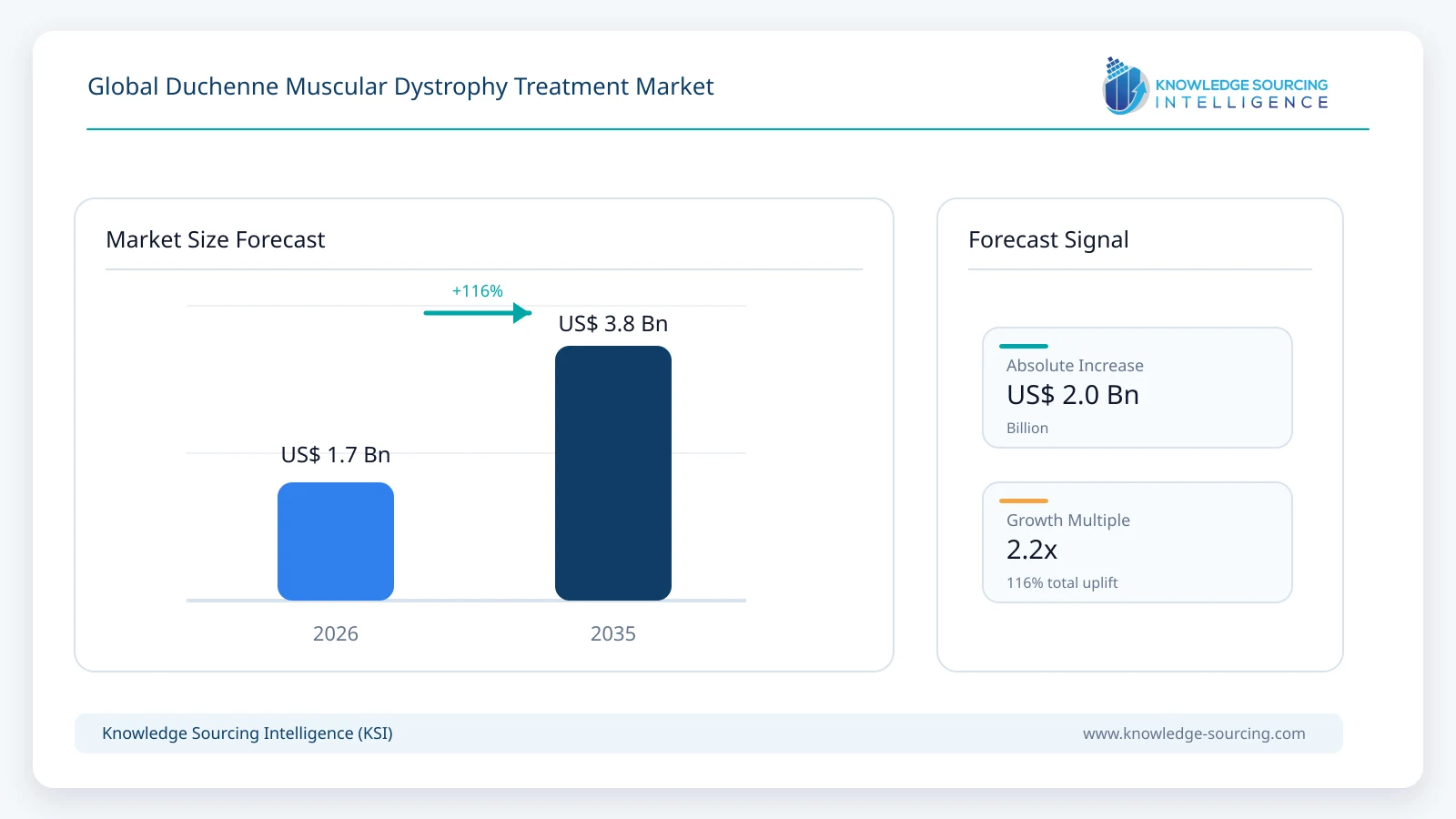
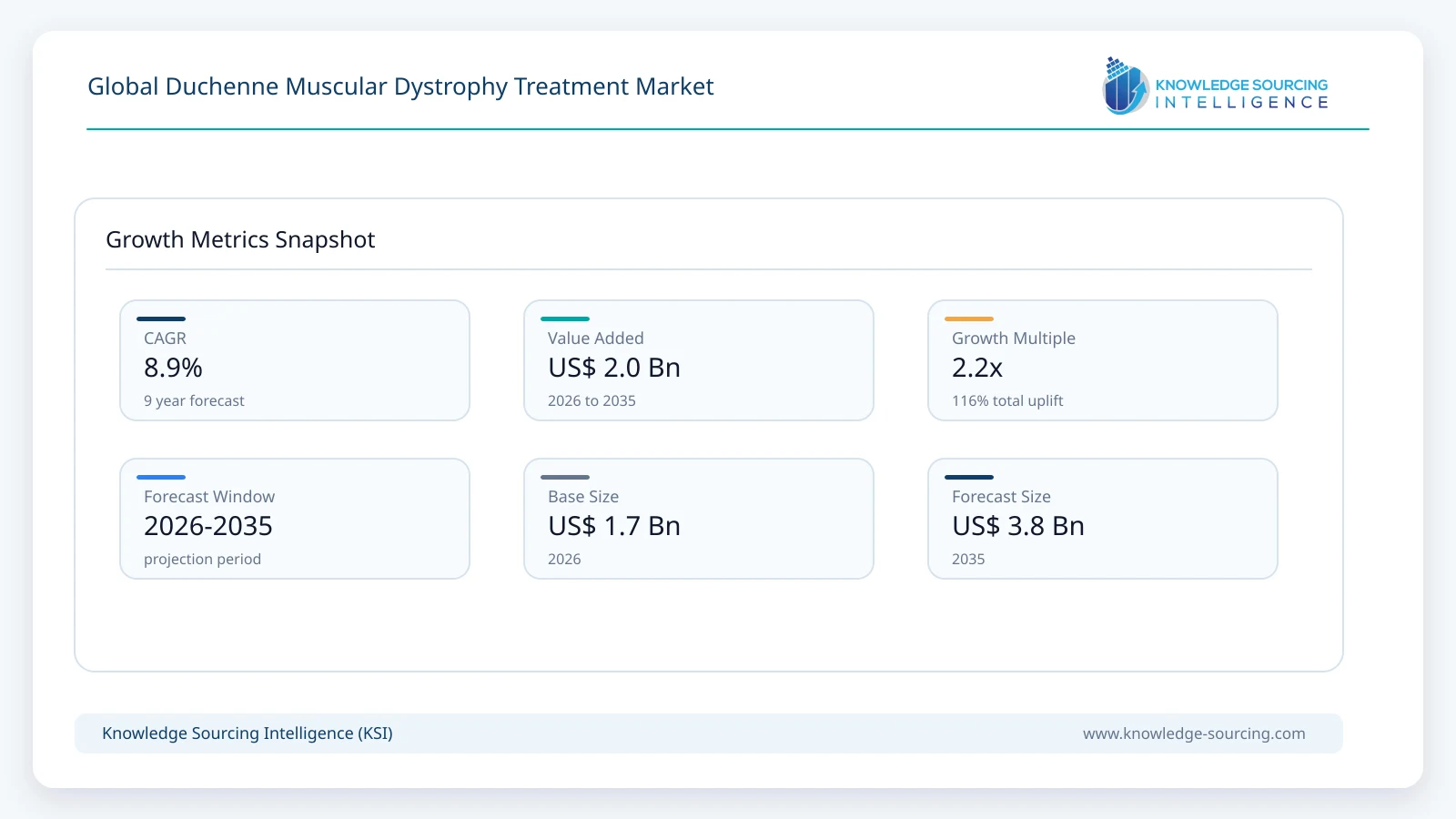
The Global Duchenne Muscular Dystrophy Treatment Market is expected to increase at a CAGR of 8.9% for the forecast period, growing from USD 1.74 billion in 2026 to USD 3.75 billion by 2035.
Highlights:
- 1Increasing genetic diagnosis rates are expanding the eligible patient population for targeted therapies.
- 2Expanded regulatory acceptance of surrogate endpoints is accelerating rare disease drug development.
- 3Growing adoption of gene therapy is shifting treatment demand from chronic administration toward one-time interventions.
- 4Clinical focus on preserving motor function is increasing investment in earlier-stage treatment initiation.
DMD treatment demand originates from the progressive loss of dystrophin, which causes irreversible skeletal, respiratory, and cardiac muscle damage. The disease affects approximately 1 in every 5,000 males aged 5–9 years according to CDC surveillance data.
Therapeutic dependency is increasing on precision medicine because genetic characterization determines eligibility for exon-skipping agents and gene therapies. This dependency is driving broader adoption of molecular diagnostics and newborn screening initiatives across several healthcare systems.
Regulatory influence remains substantial because approvals increasingly rely on surrogate biomarkers such as dystrophin expression alongside functional outcomes. FDA expansion of Elevidys eligibility in June 2024 illustrates how regulators are balancing unmet need against clinical uncertainty.
Strategic importance is increasing because DMD serves as one of the leading commercialization models for rare disease gene therapy, exon-skipping technology, and regenerative medicine development.
Market Dynamics
Market Drivers
Expansion of Gene Therapy Adoption: Gene therapy addresses the underlying genetic defect of DMD. Demand is increasing because clinicians seek durable functional benefits beyond symptomatic control. Manufacturing complexity remains a constraint because viral vector production requires specialized infrastructure. Sponsors are expanding production capabilities to support broader commercialization. The outcome is increasing acceptance of gene-replacement strategies across neuromuscular disorders. FDA expanded Elevidys approval to ambulatory and non-ambulatory patients aged four years and older in 2024.
Increasing Availability of Genetic Testing: Treatment selection depends on mutation identification. Diagnostic adoption is expanding because precision therapies require genetic confirmation. Delayed diagnosis remains a challenge because symptoms are often recognized after muscle damage has begun. Healthcare systems are implementing broader testing programs. The result is a larger pool of treatment-eligible patients.
Regulatory Support for Rare Diseases: Rare disease frameworks encourage innovation. Regulatory agencies are accelerating review pathways because the unmet clinical need remains substantial. Long-term efficacy evidence remains limited for many programs. Sponsors are conducting post-marketing studies to address evidence gaps. The outcome is a stronger development environment for advanced therapies.
Growing Focus on Early Intervention: Muscle preservation improves treatment potential. Demand is shifting toward earlier therapeutic intervention because disease progression reduces recoverable function. Treatment access barriers remain present in several healthcare systems. Stakeholders are expanding awareness and screening efforts. The result is increasing demand for disease-modifying therapies.
Market Restraints
High treatment costs limit accessibility and place pressure on reimbursement systems.
Long-term safety uncertainties surrounding gene therapies create regulatory and payer caution.
Mutation-specific therapies leave portions of the patient population without targeted treatment options.
Market Opportunities
Next-Generation Exon Skipping Platforms: Current exon-skipping therapies address only specific genetic mutations. Demand is increasing for broader mutation coverage because treatment eligibility remains fragmented. Limited applicability constrains market penetration. Developers are advancing improved oligonucleotide chemistries and delivery systems. The outcome is the potential expansion of addressable patient populations.
Regenerative Medicine Integration: Muscle degeneration continues despite existing interventions. Interest is increasing in regenerative therapies because functional restoration remains an unmet need. Clinical validation remains challenging due to long disease timelines. Sponsors are investing in cell-based and regenerative programs. The result is a potential new treatment paradigm.
Mutation-Independent Molecular Therapies: Many patients lack access to mutation-targeted drugs. Demand is shifting toward mutation-agnostic approaches because broader applicability supports commercial scalability. Biological complexity limits rapid development. Research programs are targeting inflammation, fibrosis, and muscle regeneration pathways. The outcome is a diversified treatment ecosystem.
Global Expansion of Rare Disease Infrastructure: Access to DMD therapies remains concentrated in developed markets. Demand is increasing across emerging healthcare systems because diagnostic capabilities are improving. Infrastructure limitations continue to restrict uptake. Governments and healthcare providers are expanding rare disease programs. The result is broader international commercialization potential.
Disease & Epidemiology Analysis
DMD represents the most common childhood muscular dystrophy and primarily affects males due to X-linked inheritance. The disease results from mutations in the dystrophin gene, leading to progressive muscle degeneration.
Disease burden remains substantial because loss of ambulation, respiratory decline, and cardiomyopathy progressively reduce patient survival. CDC surveillance indicates DMD prevalence of approximately 1 in 5,000 males aged 5–9 years. Median survival has improved due to advances in multidisciplinary care and corticosteroid use.
Treatment demand is increasing because earlier diagnosis enables intervention before severe muscle loss occurs. Diagnostic delays remain common, with CDC data indicating an average diagnosis age of approximately five years among affected males.
Treatment Guidelines Landscape
Treatment Category | Clinical Role | Typical Patient Population |
Corticosteroids | Standard disease management | Broad DMD population |
Exon Skipping Therapies | Mutation-specific dystrophin restoration | Eligible exon mutation groups |
Gene Therapies | Micro-dystrophin expression | Genetically confirmed DMD |
Emerging Molecular Therapies | Muscle preservation and disease modification | Broader DMD populations |
Market Segmentation
By Therapy Type
Corticosteroids remain foundational because they slow functional decline and extend ambulation. Demand is shifting toward exon-skipping and gene therapies because physicians increasingly seek disease-modifying outcomes. Access challenges continue due to cost and eligibility requirements. Developers are expanding next-generation molecular programs. The result is a progressively diversified treatment landscape.
By Drug Class
Antisense oligonucleotides maintain relevance because they provide targeted exon-skipping benefits for specific mutation groups. Demand is increasing for viral vector-based gene therapies because one-time treatment strategies offer long-term potential. Manufacturing constraints remain significant. Sponsors are investing heavily in scalable production platforms. The outcome is growing competition among advanced therapeutic modalities.
By Route of Administration
Intravenous administration dominates advanced therapies because gene therapies and several biologics require systemic delivery. Demand is increasing for oral formulations because long-term adherence remains important in pediatric populations. Administration burden constrains treatment convenience. Innovation is focusing on simplified delivery approaches. The result is increasing emphasis on patient-centered treatment design.
Regional Analysis
North America Market Analysis
North America represents the most advanced DMD treatment market because regulatory support, reimbursement infrastructure, and specialized neuromuscular centers support rapid therapy adoption. Demand is increasing as genetic testing becomes integrated into standard diagnostic pathways. Cost pressures remain significant because advanced therapies command premium pricing. Payers are expanding outcome-based evaluation frameworks to balance access and affordability. The outcome is continued leadership in commercial adoption and clinical development. FDA approvals of Elevidys, Duvyzat, and Agamree reinforce the region's strategic importance.
Europe Market Analysis
Europe maintains a strong rare disease infrastructure because coordinated regulatory systems support orphan drug development. Demand is increasing as patient advocacy organizations encourage earlier diagnosis. Pricing negotiations create access variability across countries. Manufacturers are pursuing country-specific reimbursement strategies. The result is uneven but expanding treatment penetration.
Asia Pacific Market Analysis
Asia Pacific presents substantial growth potential because diagnostic capacity continues to improve across major healthcare systems. Demand is increasing as awareness of rare genetic diseases expands. Limited specialist availability constrains treatment access in several markets. Governments are strengthening rare disease frameworks and reimbursement programs. The outcome is the gradual expansion of advanced therapy utilization.
Rest of the World
Emerging markets remain underpenetrated because genetic testing and specialty care infrastructure are still developing. Demand is increasing as healthcare modernization improves disease recognition. Affordability remains the primary constraint. Stakeholders are exploring access partnerships and patient support programs. The result is selective adoption concentrated in higher-income healthcare systems.
Regulatory Landscape
Regulatory agencies increasingly support accelerated development pathways because DMD remains a severe life-limiting disorder with limited treatment options. This support is encouraging sponsors to pursue biomarker-driven development strategies. Clinical uncertainty remains a challenge because long-term efficacy often requires extended observation periods. Agencies continue requiring confirmatory evidence following approval. The outcome is a balance between rapid access and ongoing evidence generation.
FDA actions continue shaping global regulatory expectations. Expansion of Elevidys approval and approval of Duvyzat demonstrate increasing willingness to consider broader evidence packages for rare diseases.
Pipeline Analysis
Pipeline activity is increasingly concentrating on gene therapy, exon skipping, regenerative medicine, and mutation-independent molecular approaches. Demand is shifting toward durable therapeutic benefit because progressive muscle loss limits the effectiveness of late intervention. Development complexity remains substantial due to heterogeneous disease progression. Sponsors are incorporating biomarker and functional endpoints simultaneously. The outcome is a more sophisticated clinical development framework.
Sarepta, Wave Life Sciences, REGENXBIO, Capricor Therapeutics, Roche, and Ultragenyx remain active participants in advanced neuromuscular development strategies. Clinical programs increasingly target earlier intervention because preserved muscle tissue improves treatment potential.
Reimbursement Landscape
Reimbursement decisions increasingly depend on long-term functional outcomes because advanced therapies carry substantial upfront costs. Demand is rising for value-based assessment frameworks that connect payment to clinical performance. Limited long-term evidence remains a challenge for payers. Manufacturers are expanding real-world evidence generation programs. The outcome is a growing emphasis on outcome-based reimbursement models.
Rare disease funding programs continue supporting patient access because DMD remains a high-priority unmet medical need in multiple healthcare systems.
Competitive Landscape
Sarepta Therapeutics
Sarepta remains strategically distinct because it possesses the broadest approved DMD portfolio, including Exondys 51, Vyondys 53, Amondys 45, and Elevidys. The company benefits from established physician relationships and extensive clinical development experience. Demand is increasing for Elevidys because gene therapy offers a disease-modifying approach. Manufacturing scale and safety monitoring remain critical priorities. The company continues expanding post-marketing evidence generation. The outcome is sustained leadership in the DMD therapeutic landscape.
NS Pharma
NS Pharma differentiates itself through Viltepso and its focused exon-skipping strategy. Demand is increasing because mutation-specific treatment remains clinically valuable for eligible patients. Limited mutation coverage constrains broader applicability. The company continues optimizing patient identification initiatives. The outcome is a targeted competitive position within precision neuromuscular medicine.
Santhera Pharmaceuticals
Santhera maintains strategic relevance through Agamree commercialization. Demand is increasing because clinicians seek alternatives that preserve corticosteroid efficacy while potentially reducing certain adverse effects. Competitive pressure from emerging therapies remains significant. Commercial expansion activities are increasing across key markets. The outcome is strengthening positioning within supportive disease management.
Pfizer Inc.
Pfizer maintains influence through its neuromuscular research capabilities and historical investment in DMD gene therapy programs. Demand is increasing for large-scale development expertise because advanced therapies require extensive clinical and manufacturing infrastructure. Competitive intensity remains high. Strategic portfolio optimization continues shaping future involvement. The outcome is selective participation in neuromuscular innovation.
Wave Life Sciences
Wave differentiates itself through stereopure oligonucleotide technology. Demand is increasing for next-generation exon-skipping approaches because improved tissue penetration may enhance efficacy. Development risks remain inherent to novel platforms. Clinical advancement efforts continue focusing on targeted genetic populations. The outcome is growing interest in differentiated RNA therapeutics.
Capricor Therapeutics
Capricor stands apart through regenerative medicine and cell-based therapeutic development. Demand is increasing because functional preservation remains a critical unmet need. Regulatory uncertainty continues affecting development timelines. Clinical evidence generation remains central to commercialization strategy. The outcome is a unique position within regenerative neuromuscular therapy development.
Key Developments
May 2026: NICE approved givinostat (Duvyzat) for DMD in England after negotiating a commercial deal with ITF Pharma, making it available immediately via the Innovative Medicines Fund for ~530 patients aged 6+ who can walk or stand, becoming the third DMD treatment recommended.
February 2026: Chugai Pharmaceutical launched Elevidys (delandistrogene moxeparvovec), Japan’s first regenerative medicine for DMD, at nearly 305 million yen—the highest price ever set under Japan’s drug reimbursement system—for patients 4 years and older.
April 2025: The EMA recommended conditional marketing authorization in the EU for Duvyzat (givinostat), an oral HDAC inhibitor for Duchenne muscular dystrophy in walking patients aged 6 and older, marking the first treatment covering all genetic variants of DMD.
Strategic Insights and Future Market Outlook
The DMD treatment landscape increasingly reflects a transition from symptom management toward genetic correction and muscle preservation. Demand is shifting because physicians now possess multiple disease-modifying options that directly target disease biology. Clinical development remains focused on improving durability, safety, and applicability across broader patient populations. The outcome is a progressively diversified therapeutic ecosystem.
Regulatory flexibility continues to support innovation because rare disease needs remain substantial. Evidence requirements are simultaneously becoming more rigorous as advanced therapies enter routine clinical practice. Sponsors are expanding long-term follow-up programs and real-world evidence initiatives. The result is a more mature commercial environment for precision neuromuscular medicine.
Future competition will increasingly depend on the durability of benefit, mutation coverage, safety profile, manufacturing scalability, and reimbursement acceptance. Companies capable of demonstrating meaningful preservation of motor, respiratory, and cardiac function are likely to secure the strongest market positions through 2031.
DMD treatment development is entering a phase where therapeutic differentiation depends less on obtaining approval and more on demonstrating sustained clinical value. As gene therapies, exon-skipping agents, regenerative medicines, and molecular therapies continue advancing, treatment selection is becoming increasingly personalized, creating a landscape defined by precision intervention, earlier diagnosis, and long-term functional preservation.
Market Segmentation
By Geography
Key Countries Analysis
Regulatory & Policy Landscape
Table of Contents
1. EXECUTIVE SUMMARY
1.1 Report Scope and Objectives
1.2 Key Findings and Strategic Insights
1.3 Duchenne Muscular Dystrophy (DMD) Market Snapshot
1.4 Key Commercialized Therapies Overview
1.5 Pipeline Development Highlights
1.6 Regulatory and Reimbursement Overview
1.7 Future Growth Opportunities
1.8 Analyst Recommendations
2. DISEASE & EPIDEMIOLOGY ANALYSIS
2.1 Introduction to Duchenne Muscular Dystrophy
2.1.1 Disease Definition and Clinical Characteristics
2.1.2 Genetic Basis and Dystrophin Deficiency
2.1.3 Disease Progression and Natural History
2.1.4 Disease Burden and Unmet Needs
2.2 Epidemiology Overview
2.2.1 Global Prevalence and Incidence
2.2.2 Diagnosed Patient Population
2.2.3 Age-Specific Distribution
2.2.4 Gender-Specific Distribution
2.2.5 Mortality and Survival Trends
2.3 DMD Subtype Analysis
2.3.1 Exon 51 Amenable Population
2.3.2 Exon 53 Amenable Population
2.3.3 Exon 45 Amenable Population
2.3.4 Non-Amenable Mutation Population
2.3.5 Ambulatory vs Non-Ambulatory Patients
2.4 Disease Burden Assessment
2.4.1 Clinical Burden
2.4.2 Economic Burden
2.4.3 Caregiver Burden
2.4.4 Quality of Life Impact
3. MARKET DYNAMICS
3.1 Market Overview
3.2 Market Drivers
3.2.1 Increasing Genetic Testing and Early Diagnosis
3.2.2 Advancements in Gene Therapy Development
3.2.3 Growing Rare Disease Funding and Support Programs
3.2.4 Expanding Regulatory Incentives for Orphan Drugs
3.3 Market Restraints
3.3.1 High Cost of Advanced Therapies
3.3.2 Limited Patient Eligibility for Mutation-Specific Therapies
3.3.3 Manufacturing and Supply Chain Challenges
3.3.4 Long-Term Safety and Durability Concerns
3.4 Market Opportunities
3.4.1 Next-Generation Gene Therapies
3.4.2 Combination Treatment Approaches
3.4.3 Expansion into Non-Ambulatory Patient Segments
3.4.4 Emerging Markets Penetration
3.5 Market Challenges
3.5.1 Reimbursement Constraints
3.5.2 Clinical Trial Recruitment Difficulties
3.5.3 Regulatory Complexity Across Regions
3.6 Porter’s Five Forces Analysis
3.7 PESTLE Analysis
3.8 Value Chain Analysis
3.9 Stakeholder Ecosystem Analysis
4. COMMERCIAL & MARKET ACCESS
4.1 Commercial Landscape Overview
4.2 Product Commercialization Strategies
4.3 Pricing Analysis of Approved DMD Therapies
4.4 Reimbursement Framework Assessment
4.4.1 Public Reimbursement Systems
4.4.2 Private Insurance Coverage
4.4.3 Managed Access Programs
4.5 Market Access Challenges
4.6 Orphan Drug Incentives and Impact
4.7 Patient Assistance Programs
4.8 Health Technology Assessment (HTA) Considerations
5. INNOVATION & PIPELINE LANDSCAPE
5.1 Pipeline Overview
5.2 Pipeline Distribution by Development Phase
5.2.1 Discovery and Preclinical Stage
5.2.2 Phase I
5.2.3 Phase II
5.2.4 Phase III
5.3 Pipeline Analysis by Modality
5.3.1 Gene Replacement Therapies
5.3.2 Exon Skipping Therapies
5.3.3 Gene Editing Approaches
5.3.4 Cell-Based Therapies
5.3.5 Small Molecule Therapies
5.3.6 RNA-Based Therapeutics
5.4 Pipeline Analysis by Mechanism of Action
5.4.1 Micro-Dystrophin Gene Transfer
5.4.2 Exon Skipping Mechanisms
5.4.3 Utrophin Modulation
5.4.4 Anti-Fibrotic Mechanisms
5.4.5 Muscle Regeneration Approaches
5.4.6 Anti-Inflammatory Approaches
5.5 Clinical Trial Landscape
5.5.1 Ongoing Clinical Studies
5.5.2 Recruitment Trends
5.5.3 Trial Endpoint Analysis
5.5.4 Key Development Milestones
5.6 Emerging Technologies and Innovation Trends
5.7 Academic and Industry Collaborations
5.8 Licensing, Partnerships, and M&A Activity
6. TREATMENT LANDSCAPE
6.1 Current Treatment Paradigm
6.2 Standard of Care Overview
6.2.1 Corticosteroid Therapy
6.2.2 Cardiac Management
6.2.3 Respiratory Management
6.2.4 Orthopedic Interventions
6.2.5 Rehabilitation and Physiotherapy
6.3 Approved Disease-Modifying Therapies
6.3.1 Exondys 51 (eteplirsen)
6.3.2 Vyondys 53 (golodirsen)
6.3.3 Viltepso (viltolarsen)
6.3.4 Amondys 45 (casimersen)
6.3.5 Elevidys (delandistrogene moxeparvovec-rokl)
6.3.6 Agamree (vamorolone)
6.4 Treatment Algorithm Analysis
6.5 Comparative Assessment of Available Therapies
6.6 Emerging Treatment Approaches
7. GLOBAL DUCHENNE MUSCULAR DYSTROPHY TREATMENT LANDSCAPE REPORT SIZE & FORECAST
7.1 Market Size Overview (Historical and Forecast)
7.2 Forecast Assumptions and Methodology
7.3 Market Revenue Forecast by Therapy Type
7.4 Market Revenue Forecast by Route of Administration
7.5 Market Revenue Forecast by Distribution Channel
7.6 Market Revenue Forecast by End User
7.7 Market Revenue Forecast by Region
7.8 Scenario Analysis
7.8.1 Base Case Scenario
7.8.2 Optimistic Scenario
7.8.3 Conservative Scenario
8. GLOBAL DUCHENNE MUSCULAR DYSTROPHY TREATMENT LANDSCAPE REPORT SEGMENTATION
8.1 By Therapy Type
8.1.1 Corticosteroids
8.1.2 Exon Skipping Therapies
8.1.3 Gene Therapies
8.1.4 Emerging Molecular Therapies
8.2 By Drug Class
8.2.1 Antisense Oligonucleotides
8.2.2 Viral Vector-Based Gene Therapies
8.2.3 Corticosteroid Derivatives
8.2.4 Small Molecule Therapeutics
8.3 By Route of Administration
8.3.1 Intravenous
8.3.2 Oral
8.3.3 Intramuscular
8.3.4 Other Routes
8.4 By End User
8.4.1 Hospitals
8.4.2 Specialty Neuromuscular Centers
8.4.3 Ambulatory Care Centers
8.4.4 Home Care Settings
8.5 By Distribution Channel
8.5.1 Hospital Pharmacies
8.5.2 Specialty & Retail Pharmacies
8.5.4 Online Pharmacies
9. GEOGRAPHICAL ANALYSIS (REGIONAL LEVEL)
9.1 North America
9.1.1 Market Size and Growth Trends
9.1.2 Demand Drivers
9.1.3 Regional Regulatory Overview
9.1.4 Competitive Intensity
9.2 Europe
9.2.1 Market Size and Growth Trends
9.2.2 Demand Drivers
9.2.3 Regional Regulatory Overview
9.2.4 Competitive Intensity
9.3 Asia-Pacific
9.3.1 Market Size and Growth Trends
9.3.2 Demand Drivers
9.3.3 Regional Regulatory Overview
9.3.4 Competitive Intensity
9.4 Latin America
9.4.1 Market Size and Growth Trends
9.4.2 Demand Drivers
9.4.3 Regional Regulatory Overview
9.4.4 Competitive Intensity
9.5 Middle East & Africa
9.5.1 Market Size and Growth Trends
9.5.2 Demand Drivers
9.5.3 Regional Regulatory Overview
9.5.4 Competitive Intensity
10. KEY COUNTRIES ANALYSIS
10.1 United States
10.1.1 Market Size
10.1.2 Epidemiology
10.1.3 Regulatory Framework
10.1.4 Reimbursement Landscape
10.1.5 Key Companies and Product Presence
10.2 Canada
10.3 Germany
10.4 United Kingdom
10.5 France
10.6 Italy
10.7 Spain
10.8 China
10.9 Japan
10.10 India
10.11 South Korea
10.12 Australia
10.13 Brazil
10.14 Mexico
10.15 Saudi Arabia
10.16 South Africa
11. REGULATORY & POLICY LANDSCAPE
11.1 Global Regulatory Overview
11.2 Orphan Drug Regulations
11.3 United States (FDA)
11.3.1 Approval Pathways
11.3.2 Accelerated Approval Programs
11.3.3 Rare Pediatric Disease Designation
11.4 Europe (EMA)
11.4.1 Orphan Medicinal Product Framework
11.4.2 Centralized Approval Procedures
11.5 Japan (PMDA)
11.5.1 Orphan Drug Approval Framework
11.5.2 Regenerative Medicine Regulations
11.6 India (CDSCO)
11.6.1 New Drug Approval Requirements
11.6.2 Rare Disease Policy Framework
11.7 China (NMPA)
11.7.1 Rare Disease Regulatory Pathways
11.7.2 Accelerated Review Programs
11.8 Regulatory Comparison Across Major Markets
11.9 Market Access and Pricing Policies
11.10 Future Regulatory Developments
12. COMPETITIVE LANDSCAPE
12.1 Market Structure Analysis
12.2 Market Share Assessment
12.3 Competitive Benchmarking
12.4 Product Portfolio Comparison
12.5 Pipeline Competitiveness Assessment
12.6 Strategic Initiatives Analysis
12.6.1 Collaborations and Partnerships
12.6.2 Licensing Agreements
12.6.3 Acquisitions and Investments
12.7 Clinical Development Competitiveness
12.8 SWOT Analysis of Leading Participants
12.9 Future Competitive Outlook
13. COMPANY PROFILES
13.1 Sarepta Therapeutics
13.1.1 Company Overview
13.1.2 Approved DMD Products (Exondys 51, Vyondys 53, Amondys 45, Elevidys)
13.1.3 Key Indications
13.1.4 Clinical Pipeline
13.1.5 Strategic Outlook
13.2 NS Pharma
13.2.1 Company Overview
13.2.2 Approved Product (Viltepso)
13.2.3 Key Indications
13.2.4 Clinical Pipeline
13.2.5 Strategic Outlook
13.3 Santhera Pharmaceuticals
13.3.1 Company Overview
13.3.2 Approved Product (Agamree)
13.3.3 Key Indications
13.3.4 Clinical Pipeline
13.3.5 Strategic Outlook
13.4 Pfizer Inc.
13.4.1 Company Overview
13.4.2 Neuromuscular Disease Portfolio
13.4.3 Key Indications
13.4.4 Verified Clinical Pipeline
13.4.5 Strategic Outlook
13.5 Wave Life Sciences
13.5.1 Company Overview
13.5.2 Neurodegenerative Disease Portfolio
13.5.3 Key Indications
13.5.4 Verified Clinical Pipeline
13.5.5 Strategic Outlook
13.6 Capricor Therapeutics
13.6.1 Company Overview
13.6.2 Neurological Disease Portfolio
13.6.3 Key Indications
13.6.4 Verified Clinical Pipeline
13.6.5 Strategic Outlook
13.7 Roche Holding AG
13.7.1 Company Overview
13.7.2 Rare and Neurological Disease Portfolio
13.7.3 Key Indications
13.7.4 Verified Clinical Pipeline
13.7.5 Strategic Outlook
13.8 Ultragenyx Pharmaceutical
13.8.1 Company Overview
13.8.2 Neurology Portfolio
13.8.3 Key Indications
13.8.4 Verified Clinical Pipeline
13.8.5 Strategic Outlook
13.9 Satellos Bioscience
13.9.1 Company Overview
13.9.2 Neurodegenerative Disease Portfolio
13.9.3 Key Indications
13.9.4 Verified Clinical Pipeline
13.9.5 Strategic Outlook
13.10 REGENXBIO
13.10.1 Company Overview
13.10.2 Neurological Disease Portfolio
13.10.3 Key Indications
13.10.4 Verified Clinical Pipeline
13.10.5 Strategic Outlook
14. FUTURE OUTLOOK
14.1 Future Market Projections
14.2 Emerging Therapeutic Trends
14.3 Next-Generation Gene Therapy Outlook
14.4 Precision Medicine Evolution in DMD
14.5 Commercial Opportunity Assessment
14.6 Investment and Funding Trends
14.7 Key Strategic Recommendations
14.8 Long-Term Market Outlook to Forecast Period
15. METHODOLOGY
15.1 Research Methodology Overview
15.2 Secondary Research Sources
15.3 Primary Research Approach
15.4 Epidemiology Modeling Framework
15.5 Market Forecasting Methodology
15.6 Pipeline Assessment Methodology
15.7 Competitive Intelligence Framework
15.8 Data Validation and Triangulation
15.9 Assumptions and Limitations
15.10 Abbreviations and Definitions
Navigate
Trusted by the world's leading organizations











