
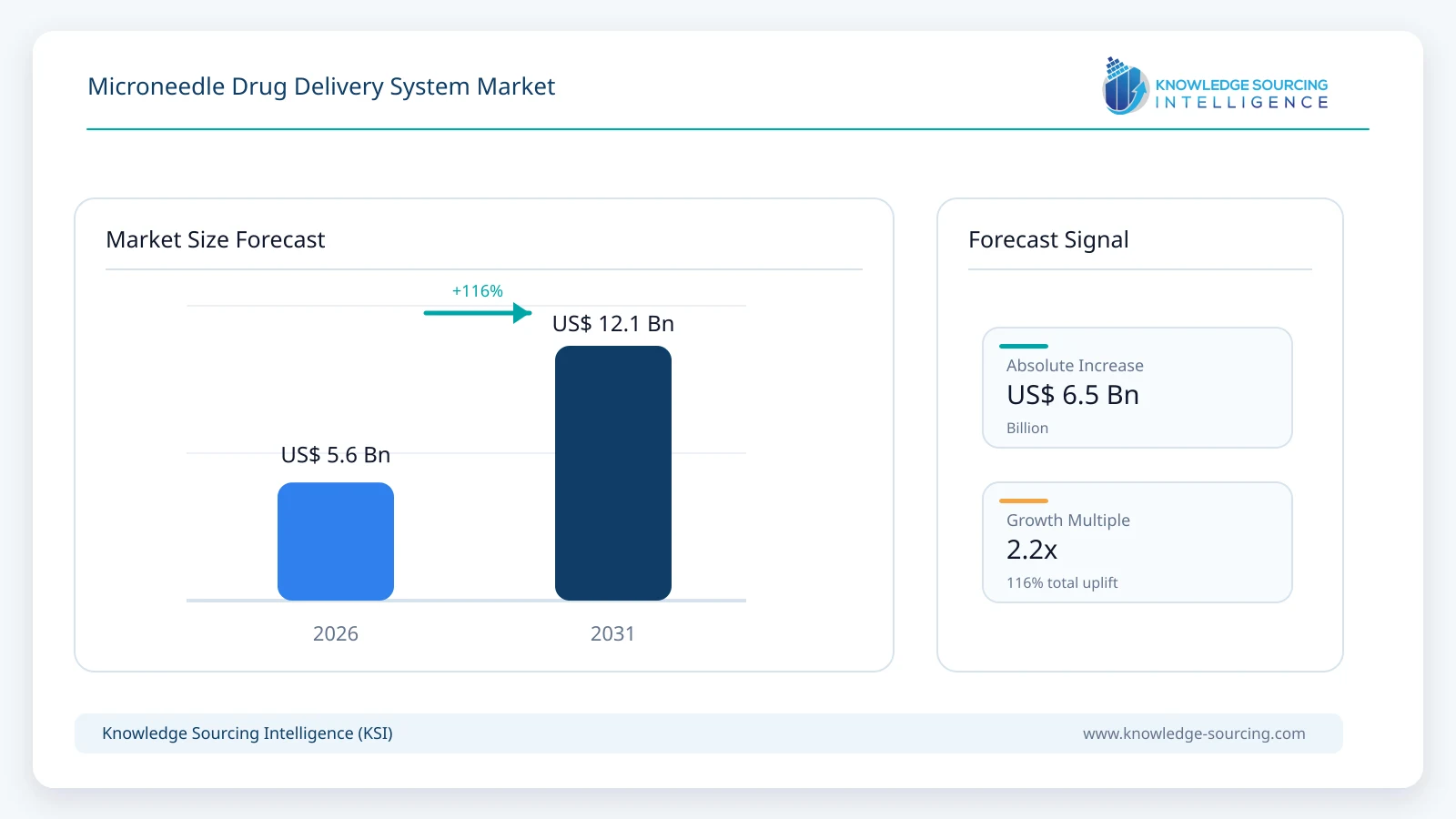
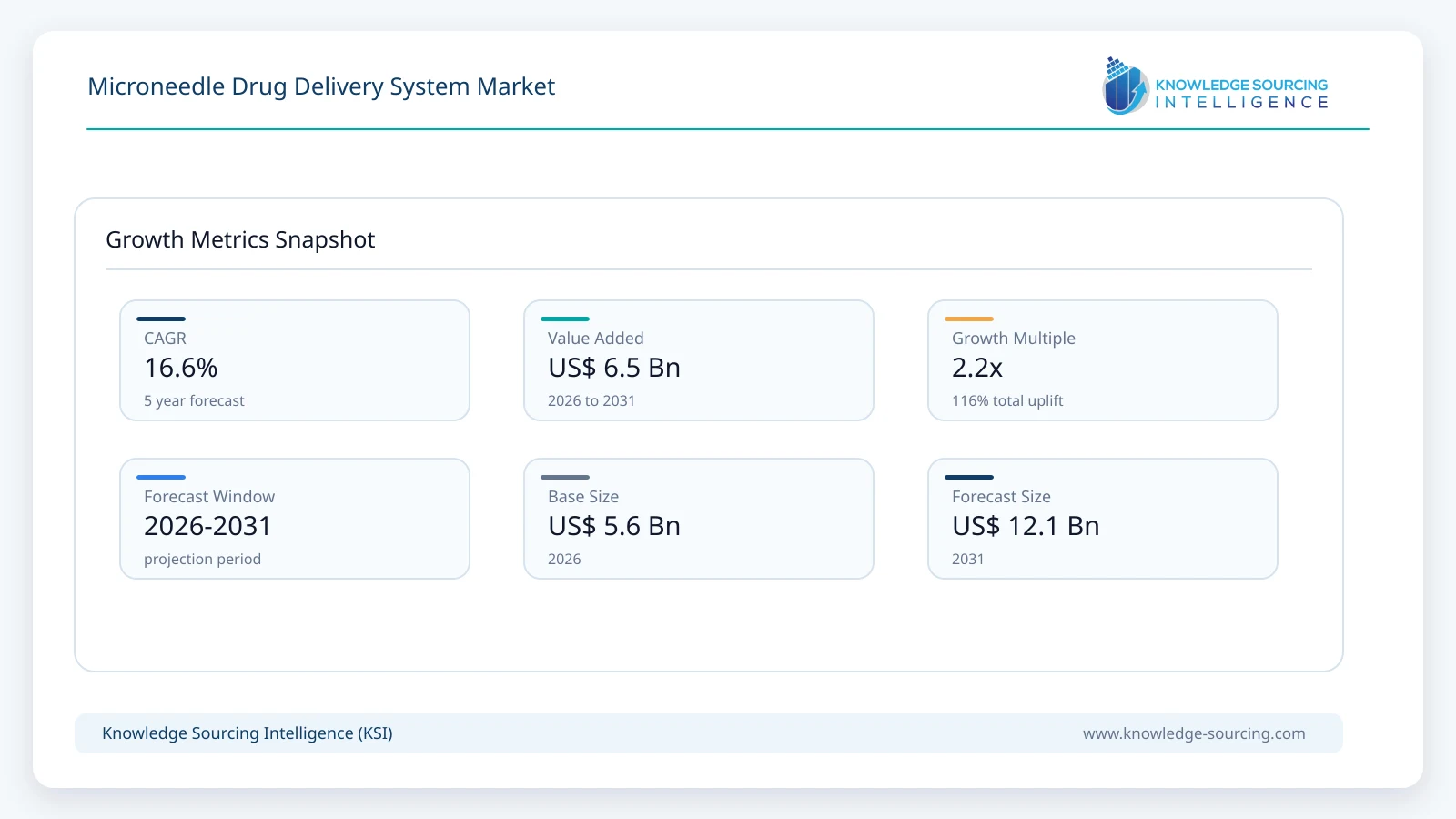
The Microneedle Drug Delivery System Market is forecast to grow at a CAGR of 16.6%, reaching USD 12.08 billion in 2031 from USD 5.60 billion in 2026.
Highlights:
- 1Self-administration requirements are supporting interest in drug delivery systems that can reduce dependence on conventional injections.
- 2Dissolving microneedles are attracting commercial attention because they can combine drug delivery with reduced sharps disposal requirements.
- 3North America remains an important center for clinical development, combination-product regulation, public-health funding, and platform investment.
- 4Manufacturing scalability is becoming a central technology differentiator as developers move from laboratory fabrication toward controlled commercial production.
- 5Regulatory evaluation is influenced by the integrated performance of the drug, device, manufacturing process, human factors, and product quality system.
- 6Competition is increasingly shaped by platform partnerships, formulation capabilities, intellectual property, and the ability to manufacture reproducible microneedle arrays at scale.
The microneedle drug delivery system market covers drug-device technologies designed to transport pharmaceutical or biologic agents across the skin barrier through arrays of microscale projections. These systems include hollow, solid, dissolving, coated, and hydrogel-forming microneedles. Depending on the design, the microneedle array may create temporary microchannels, dissolve after insertion, release a drug coating, swell to facilitate diffusion, or directly infuse a therapeutic formulation through hollow structures.
The commercial rationale for microneedle drug delivery is rooted in a persistent limitation of conventional administration routes. Oral delivery can be unsuitable for molecules that are poorly absorbed, degraded in the gastrointestinal tract, or subject to extensive first-pass metabolism. Conventional injections can provide reliable systemic delivery but require needles, sharps handling, trained administration in many settings, and patient acceptance of repeated injections. Standard transdermal patches, meanwhile, are limited by the skin's outer barrier and cannot efficiently deliver many large or poorly permeable molecules.
Microneedle systems seek to address part of this gap by combining skin-based administration with the ability to bypass the stratum corneum. Their commercial value therefore depends less on the novelty of the microneedle itself and more on whether the complete product can improve drug delivery, patient use, distribution, adherence, or healthcare resource utilization for a specific therapy.
The market is consequently characterized by application-specific development rather than a single procurement model. Pharmaceutical developers evaluate microneedle platforms according to formulation compatibility, dose capacity, pharmacokinetic performance, manufacturing reproducibility, sterility requirements, human factors, stability, and regulatory strategy. Public-health buyers may additionally prioritize ease of administration, cold-chain reduction, waste management, transport, and suitability for decentralized vaccination programs. Dermatology and localized treatment developers focus more heavily on skin penetration, delivery depth, residence time, dose uniformity, and tolerability.
The industry remains structurally different from mature transdermal patch markets. Many microneedle platforms are still moving through product development, clinical validation, manufacturing scale-up, or application expansion. As a result, technology providers compete not only for finished-product sales but also for development partnerships, contract manufacturing assignments, intellectual property access, and long-term platform relationships with pharmaceutical and biotechnology companies.
Demand is being supported by the growing commercial importance of self-administration and decentralized healthcare delivery. Health systems and pharmaceutical manufacturers have invested in administration formats that can move selected treatments away from hospitals and infusion centers where clinically appropriate. A microneedle product that can be safely applied by patients or minimally trained personnel may reduce dependence on conventional injection infrastructure. However, the value proposition must be demonstrated at the product level. Buyers will not replace established delivery formats solely because a microneedle is less invasive.
Procurement decisions are therefore increasingly influenced by total product economics. Drug manufacturers assess whether a microneedle platform introduces higher manufacturing costs that are justified by improved adherence, differentiated product positioning, lifecycle management opportunities, or reduced administration burdens. Public-health organizations consider whether patch-based or microarray-based administration can simplify distribution and expand access. Healthcare providers assess whether the delivery system can reduce procedure time without creating new risks associated with incorrect application.
The technology landscape also creates different commercial opportunities by microneedle architecture. Hollow microneedles are relevant where active infusion or controlled liquid delivery is required. Solid microneedles can be used to create pathways for subsequent drug application. Coated microneedles place the active formulation directly on the needle surface but may face payload limitations. Dissolving microneedles incorporate the active ingredient into a matrix that dissolves after skin insertion, eliminating the need to dispose of a conventional sharp needle. Hydrogel-forming systems provide another approach in which the array interacts with interstitial fluid and supports diffusion or drug transfer.
Among these approaches, dissolving microneedles are commercially important because they combine drug delivery with the potential elimination of sharps waste. They are also relevant to products where dry-state stability and simplified administration could provide logistical advantages. The U.S. Food and Drug Administration has explicitly identified microneedle patches as examples of drug-device and biologic-device combination products, illustrating the regulatory importance of evaluating both the therapeutic constituent and the delivery device as an integrated system.
The market's revenue model is likely to remain weighted toward specialized technology development, licensing, manufacturing, and product partnerships during much of the forecast period. Broader commercial expansion will depend on successful clinical translation, regulatory approvals, reliable high-volume production, and the ability to establish reimbursement or procurement economics that compare favorably with injections, oral formulations, and conventional patches.
Market Drivers
Growing demand for less invasive and more convenient drug administration
Repeated injectable therapy creates practical and behavioral challenges for patients, healthcare providers, and payers. Chronic treatment programs can involve regular clinic visits, administration training, needle anxiety, injection-site concerns, and adherence problems. These burdens create demand for alternative delivery formats, particularly where a therapeutic can be reformulated without compromising clinical performance.
Microneedle systems address this demand by creating a delivery interface that is fundamentally different from conventional hypodermic injection. The commercial objective is not simply to replace a needle with smaller needles. Suppliers must demonstrate that patients can correctly apply the system, receive a reproducible dose, and tolerate the product under real-world conditions.
This shifts buyer requirements toward human factors and usability. Pharmaceutical companies increasingly need evidence that a delivery system performs consistently across variations in application force, skin characteristics, handling, storage, and patient technique. A technically successful microneedle array that cannot deliver a consistent dose outside a controlled clinical setting will face limited adoption.
The commercial implication is that suppliers capable of integrating formulation development, applicator design, packaging, and usability testing may have an advantage over companies offering only microneedle fabrication. The purchasing decision increasingly concerns the complete delivery platform rather than the microstructure alone.
Expansion of vaccine and biologic delivery research
Vaccines and biologic products represent an important demand area because conventional delivery can require cold-chain infrastructure, trained administration, sharps management, and repeated contact with healthcare facilities. Microneedle systems may provide an alternative route for selected products, particularly where dry formulations or thermostable presentations can improve distribution economics.
Micron Biomedical's 2025 funding activity demonstrates the level of institutional interest in this application area. In January 2025, the company reported additional grant funding to support measles-rubella vaccine manufacturing scale-up and a Phase 2 infant trial. The company also received BARDA support connected with the development of microneedle-enabled mRNA influenza vaccine technology.
Demand from vaccine developers is influenced by more than patient preference. Large procurement programs assess manufacturing capacity, product stability, administration simplicity, wastage, and the feasibility of distribution in areas with constrained healthcare infrastructure. A successful microneedle vaccine platform could therefore compete partly on supply-chain economics.
This demand mechanism is particularly relevant to public-health programs. If a delivery system reduces dependence on conventional injection supplies or simplifies administration, the economic benefit may extend beyond the drug price. However, these advantages must be balanced against the cost of specialized microarray manufacturing and the regulatory evidence required for each vaccine formulation.
Need to overcome limitations of conventional transdermal delivery
The skin provides a useful administration route but its outer barrier restricts the delivery of many molecules. Conventional patches are therefore limited to drugs with suitable physicochemical properties and relatively low dose requirements.
Microneedles create a route through or beyond this barrier without using a conventional hypodermic needle. The resulting opportunity is relevant to small molecules, peptides, proteins, vaccines, nucleic acids, and other therapeutic categories, although commercial feasibility remains dependent on dose requirements and formulation stability.
FDA-supported research into dissolvable microneedles illustrates why formulation optimization is commercially important. The agency's research has examined how polymer-to-drug ratios influence mechanical strength and drug release, while emphasizing the need to establish appropriate critical quality attributes for product development.
This creates a direct commercial requirement for analytical and process-development capabilities. Buyers need evidence that the drug is distributed consistently across the array, that the microneedles insert without fracture, and that drug release remains within defined specifications. Suppliers that can provide validated analytical methods and reproducible manufacturing processes are likely to be more attractive partners.
Investment in decentralized and home-based healthcare delivery
Healthcare systems continue to seek delivery models that shift appropriate treatment from hospitals to outpatient and home settings. Pharmaceutical companies also view patient-friendly administration formats as an important component of product differentiation and lifecycle strategy.
Microneedle systems may support this transition where the therapy, dose, and patient population are compatible with skin-based delivery. The economic incentive is strongest when administration complexity is a meaningful contributor to total treatment costs.
Company investment is reflecting this direction. Micron Biomedical announced in January 2025 that an extension to its Series A financing brought total Series A funding above USD 33 million and would support expansion of commercial manufacturing capabilities for its dissolvable microarray technology.
The commercial implication is that investment is shifting beyond laboratory proof of concept toward manufacturing infrastructure. This transition will be necessary for the market to move from development programs toward sustained commercial supply.
Market Restraints and Challenges
Manufacturing scale-up and dose reproducibility remain difficult
Microneedle products require precise control over dimensions, mechanical properties, drug distribution, adhesion, packaging, and product stability. Scaling these requirements from laboratory batches to commercial production is a major industry challenge.
Small variations in needle geometry or material composition can affect insertion and release behavior. The manufacturing process must also maintain dose consistency across every array and throughout shelf life. This creates higher process-development requirements than those associated with conventional topical formulations.
The stakeholders most affected are technology developers, pharmaceutical partners, contract manufacturers, and regulators. Manufacturing uncertainty can increase development timelines, capital expenditure, validation costs, and product pricing.
Mitigation requires investment in automated production, in-process quality controls, analytical testing, controlled environmental conditions, and manufacturing systems capable of demonstrating batch-to-batch consistency. Companies that establish scalable processes early may reduce later technology-transfer risks.
Payload limitations constrain therapeutic selection
Microneedle systems are not suitable for every drug. Available surface area, needle volume, matrix composition, skin permeability, and delivery mechanism can limit the quantity of active ingredient that can be administered.
This affects pharmaceutical developers evaluating high-dose therapies or drugs requiring large administration volumes. A product may show promising laboratory performance but remain commercially impractical if the required therapeutic dose cannot be incorporated into a patient-acceptable patch size.
The impact extends to product economics. Increasing array size or adding multiple patches can raise material costs, packaging complexity, and patient burden. Suppliers therefore compete partly through formulation efficiency and delivery precision.
Potential mitigation includes increasing drug loading, optimizing microneedle geometry, improving formulation potency, and targeting therapeutic applications with lower required doses. The strongest opportunities are likely to remain application-specific rather than universal.
Regulatory classification and combination-product complexity
Microneedle drug delivery products can combine pharmaceutical and medical-device characteristics. Regulatory assessment may therefore require coordinated evidence relating to drug quality, device design, manufacturing, biocompatibility, usability, and clinical performance.
The FDA's combination-product framework specifically recognizes microneedle patches among examples of integrated drug or biologic delivery systems. This means that product developers must consider the interaction between the constituent parts rather than treating the device and drug as entirely separate commercial components.
Regulatory complexity can increase development expenditure and lengthen approval timelines. It also creates a barrier for smaller companies with limited regulatory infrastructure.
Companies can reduce this risk by defining regulatory strategies early, conducting structured risk assessments, maintaining clear design controls, and generating evidence on the relationship between product design and clinical performance. Strategic partnerships with pharmaceutical companies can also provide access to regulatory and quality-management resources.
Patient application variability
Self-administration is a major source of commercial opportunity but also introduces risk. Microneedles must penetrate the skin sufficiently to deliver the intended dose, yet patients differ in age, skin characteristics, dexterity, and application technique.
A system that performs well under controlled laboratory conditions may produce variable outcomes in broader populations. Pediatric, geriatric, and chronic-care populations may present distinct usability requirements.
This challenge affects product design and buyer confidence. Pharmaceutical companies need assurance that the administration system can support consistent use without excessive training. Healthcare providers may also require clear evidence that the technology does not create new medication errors.
Applicators, audible or tactile feedback mechanisms, improved adhesion, simplified instructions, and formal human-factors studies can mitigate this issue. Commercial adoption will favor systems that make correct application easier to verify.
Specialized supply chains and capital requirements
Commercial microneedle manufacturing may require specialized molds, precision equipment, polymers, packaging materials, analytical systems, and controlled production environments. These requirements can create supply-chain concentration and capital intensity.
Smaller developers may therefore depend on external manufacturing partners or strategic investors. This can affect negotiating power, production scheduling, and gross margins.
The challenge is particularly relevant as programs progress into late-stage development. Manufacturing capacity that is adequate for clinical trials may not support commercial demand.
Suppliers are responding through dedicated production facilities, manufacturing partnerships, and investment rounds tied directly to capacity expansion. Long-term success will depend partly on whether production yields improve enough to support economically viable pricing.
Major Segment Analysis:
Dissolving Microneedles
Dissolving microneedles represent one of the most commercially important segments of the microneedle drug delivery system market because the delivery mechanism combines administration with the disappearance of the microneedle structure after use. The array is generally formed from a dissolvable matrix containing the active ingredient or supporting its release after insertion into the skin.
This segment matters because it addresses a practical limitation of conventional injection systems: sharps disposal. Once a dissolving microneedle array has delivered its payload, the patch can potentially avoid leaving behind a conventional sharp needle. This characteristic is relevant to home administration, public-health programs, and decentralized healthcare settings.
Buyer requirements extend well beyond painless administration. Pharmaceutical companies evaluate drug loading, stability, mechanical strength, insertion reliability, dissolution behavior, release kinetics, packaging, and manufacturing scalability. Public-health buyers additionally consider storage conditions, ease of administration, waste management, and suitability for distribution across different healthcare environments.
The segment's competitive dynamics are increasingly linked to manufacturing competence. Micron Biomedical is developing dissolvable microarray technology for vaccines and therapeutics and has stated that its capabilities include formulation, process development, packaging, analytical methods, regulatory strategy, and cGMP manufacturing.
Nissha also maintains capabilities associated with dissolving microneedle patches and broader pharmaceutical manufacturing. Its portfolio demonstrates how companies with established manufacturing and materials expertise can enter microneedle-related applications from adjacent transdermal, pharmaceutical, and precision-processing capabilities.
RAPHAS provides another example of technology positioning around dissolving microneedle structures, including arrays based on dissolvable materials for transdermal applications.
Revenue potential in this segment is linked to the value of the complete product. Higher-value opportunities may arise when a dissolving microneedle system enables a pharmaceutical partner to create a differentiated administration format, extend a product lifecycle, simplify distribution, or enter settings where conventional injection infrastructure is costly.
The principal constraint remains the need to prove consistent performance at commercial scale. FDA research has demonstrated that formulation variables can affect mechanical strength and drug-release characteristics, reinforcing the importance of controlling material composition and critical quality attributes.
As more investment moves toward manufacturing capacity and clinical development, dissolving microneedles are likely to remain a central technology segment within the market. Their commercial success, however, will depend on product-specific approvals and economics rather than on the delivery format alone.
Regional Analysis

North America
North America is an important market for microneedle drug delivery development because it combines pharmaceutical innovation, biotechnology investment, advanced regulatory infrastructure, and substantial public funding for medical countermeasures and vaccine technologies.
The United States is particularly important for combination-product development. The FDA's regulatory framework requires developers to address the integrated performance of drug and device constituent parts, which creates a demanding but structured pathway for microneedle products.
Investment activity is also supporting the regional market. Micron Biomedical received funding from organizations including BARDA and CEPI-linked programs during 2025, while its financing activity was directed partly toward manufacturing expansion.
Buyer behavior is centered on clinical evidence, manufacturing readiness, regulatory credibility, and the ability to integrate the delivery platform with existing pharmaceutical programs. Growth constraints include high development costs and the difficulty of displacing established injection technologies.
Europe
Europe offers demand opportunities through its established pharmaceutical industry, biologics manufacturing base, and focus on patient-centered healthcare delivery. The region is also relevant for companies developing transdermal technologies, specialty pharmaceuticals, and advanced drug-device combinations.
European buyers are likely to place strong emphasis on product quality, clinical evidence, risk management, and manufacturing compliance. Market adoption will depend on demonstrating that a microneedle product offers measurable advantages over established administration formats.
The region's fragmented reimbursement systems can create both opportunity and complexity. A product may demonstrate clinical utility but still require country-specific evidence to support adoption and reimbursement.
European technology providers can benefit from established pharmaceutical partnerships and advanced manufacturing infrastructure. However, commercial expansion may be slower where healthcare systems require strong evidence of cost-effectiveness.
Asia Pacific
Asia Pacific combines manufacturing capability with a large potential patient base and strong activity in precision materials, pharmaceutical production, and skin-delivery technologies. Japan and South Korea are particularly relevant to the competitive environment represented by companies such as Nissha and RAPHAS.
The regional market includes opportunities across pharmaceuticals, vaccines, dermatology, and consumer-adjacent skin delivery technologies. However, pharmaceutical-grade applications require substantially different validation and regulatory evidence than cosmetic or consumer products.
Buyer decisions are influenced by manufacturing cost, product differentiation, local regulatory requirements, and the ability to partner with established pharmaceutical companies. The region also provides an important production base for high-volume microneedle components and patches.
A key growth constraint is the need to convert technical expertise into approved pharmaceutical products. Manufacturing capability alone does not ensure clinical or regulatory success.
Middle East and Africa
The Middle East and Africa represent a more selective opportunity, with demand concentrated around healthcare access, vaccination, specialty care, and decentralized delivery. Microneedle systems may offer strategic advantages where conventional administration requires infrastructure that is difficult to maintain across geographically dispersed populations.
Thermostable or simplified administration formats could be particularly relevant to public-health programs if product-specific evidence supports their use. However, procurement decisions are highly dependent on affordability, regulatory approval, supply reliability, and international funding structures.
Infrastructure differences between countries will create uneven adoption. Premium specialty therapies may find demand in advanced healthcare systems, while public-health applications may depend on government programs, donor organizations, and international procurement mechanisms.
South America
South America offers long-term demand potential through public vaccination programs, chronic disease management, and the need for accessible treatment formats. However, pricing sensitivity and procurement structures will influence adoption.
Government healthcare systems and centralized purchasing organizations may require clear economic evidence before replacing established administration technologies. Imported specialized devices may also face pricing pressure related to currency movements, tariffs, and local regulatory requirements.
The strongest initial opportunities are likely to emerge where microneedle systems provide a clear operational advantage, such as reduced administration burden or improved distribution characteristics. Broader adoption will depend on local manufacturing partnerships and sustainable pricing models.
Competitive Landscape
The Microneedle Drug Delivery System Market is characterized by a combination of specialized technology developers, precision manufacturing companies, established drug-delivery organizations, and companies pursuing pharmaceutical, dermatological, or microarray-based applications.
The competitive landscape represented by LTS Lohmann Therapie-Systeme AG, Nissha Co., Ltd., ASTI Corporation, AdminMed nanoBioSciences LLC, Micron Biomedical, Inc., RAPHAS Co., Ltd., Micropoint Technologies, 3M, MiNDERA Corporation, and MyLife Technologies is differentiated by technology architecture, manufacturing capabilities, application focus, and commercialization strategy.
Competition is not based solely on the number or shape of microneedles. Companies must establish defensible positions through materials science, formulation know-how, fabrication processes, intellectual property, analytical validation, and the ability to integrate the delivery system into a commercially viable pharmaceutical product.
Larger organizations and established drug-delivery manufacturers can compete through scale, quality systems, established customer relationships, and experience with regulated production. Specialized developers can compete through proprietary microarray designs, focused therapeutic programs, and platform partnerships.
Partnerships are likely to remain central to industry development. Pharmaceutical companies may prefer to work with technology specialists rather than build microneedle manufacturing capabilities internally. This creates opportunities for licensing, co-development, contract manufacturing, and joint clinical programs.
Technology positioning is also becoming more application-specific. One company may prioritize dissolving arrays for vaccines and biologics, while another may focus on dermatological delivery, localized treatment, coated systems, or materials-based platforms. This specialization can reduce direct competition in the short term but may increase competitive overlap as companies expand their addressable applications.
Manufacturing expansion is becoming a major competitive factor. The industry is moving beyond academic and pilot-scale fabrication toward controlled production systems capable of supporting clinical and commercial volumes. Companies that can demonstrate consistent quality, validated processes, and dependable supply will have stronger positions when pharmaceutical partners begin selecting long-term suppliers.
Geographic presence also affects competition. Companies with manufacturing facilities and regulatory experience in major pharmaceutical markets may have an advantage in partnership negotiations. At the same time, Asian manufacturers can benefit from expertise in precision processing and large-scale materials production.
Over the forecast period, the competitive environment is expected to become more dependent on clinical validation and commercial execution. Intellectual property will remain important, but a strong patent position will not substitute for manufacturing capability, regulatory expertise, or successful therapeutic applications.
Recent Developments
July 2026: Micron Biomedical secured a $4.5 million NIAID contract to develop a dissolvable microarray medical countermeasure for acute radiation syndrome, expanding therapeutic applications of needle-free delivery.
July 2026: Terrestrial Bio dosed the first patients in its Phase 1 trial of Tacterra™ VX-201, evaluating a needle-free microarray patch for semaglutide delivery in obesity treatment.
March 2026: PharmaTher introduced PatchPrint™, an automated tabletop 3D printer for microneedle patches, alongside a USPTO provisional patent covering integrated manufacturing, demolding and packaging processes.
Regulatory and Policy Environment
The regulatory environment for microneedle drug delivery systems is defined primarily by the intended therapeutic use and the relationship between the drug, biologic, and device components.
In the United States, a microneedle patch can fall within the FDA's combination-product framework when the delivery device and therapeutic constituent function together as a single product. FDA materials specifically identify microneedle patches among examples of integrated drug or biologic delivery systems.
This classification affects development requirements. Manufacturers may need to demonstrate product quality, mechanical performance, dose delivery, biocompatibility, stability, usability, and manufacturing controls. The regulatory assessment can also require evidence that changes to the delivery device do not alter safety, effectiveness, pharmacokinetics, or product quality in unexpected ways. FDA guidance on combination-product development emphasizes the importance of evaluating such differences through structured analyses.
Quality requirements are especially important for dissolving microneedles. The mechanical strength of the array, ability to insert into the skin, drug distribution, dissolution behavior, and release characteristics can all function as critical product attributes. FDA research examining dissolvable microneedles has shown that formulation composition can affect mechanical and release performance, reinforcing the importance of scientifically justified specifications.
Manufacturers must also consider conventional pharmaceutical quality expectations. Depending on the product, these can include identity, strength, purity, stability, packaging compatibility, process validation, analytical method validation, and current good manufacturing practice requirements.
Human factors and usability are also commercially relevant regulatory considerations. A microneedle product intended for home use must demonstrate that intended users can correctly handle and apply the product. Incorrect application could affect dose delivery even if the underlying formulation remains unchanged.
Government and public-health funding programs can influence market adoption by reducing early development risk. Support for vaccine platforms and medical countermeasures is particularly relevant because alternative delivery technologies may improve emergency preparedness and distribution options. The BARDA and CEPI-related funding activity involving Micron Biomedical illustrates how public and mission-oriented financing can support development before broad commercial demand is established.
Outlook and Strategic Implications
The outlook for the Microneedle Drug Delivery System Market between 2026 and 2031 will depend primarily on clinical translation and manufacturing execution. Scientific interest in microneedles is already broad, but commercial adoption will accelerate only where individual products demonstrate a clear advantage over injections, oral formulations, or conventional transdermal systems.
Investment priorities are likely to shift toward scalable production, automation, quality control, and formulation engineering. Early-stage research can establish whether a drug can be incorporated into a microneedle platform. Commercial development requires a more demanding demonstration that the product can be manufactured consistently at an acceptable cost.
Procurement behavior will increasingly favor suppliers capable of providing integrated development services. Pharmaceutical companies may seek partners that can support formulation, device design, analytical testing, packaging, regulatory documentation, and commercial manufacturing. This may create a competitive advantage for companies with broader drug-delivery infrastructure or strong development partnerships.
Technology direction will also become more selective. The market is unlikely to replace conventional injections across all therapeutic categories. Instead, microneedles are expected to gain adoption in applications where patient convenience, decentralized administration, reduced sharps handling, distribution efficiency, or skin-based delivery provide measurable value.
Dissolving microneedles are expected to remain strategically important because they address both delivery and disposal considerations. Their future commercial role will depend on improvements in payload capacity, stability, dose reproducibility, and manufacturing throughput.
The major risks include regulatory uncertainty for novel product configurations, manufacturing failures during scale-up, insufficient dose capacity, inconsistent patient application, and unfavorable product economics. Established delivery technologies benefit from mature supply chains, clinician familiarity, and existing reimbursement structures. Microneedle developers must therefore demonstrate enough incremental value to overcome switching costs.
Strategic opportunities will be strongest where the technology is integrated into drug-development planning from an early stage. Retrofitting a microneedle system to an established therapy may require extensive bridging work, formulation changes, and additional clinical evidence. Designing the therapeutic and delivery system together can improve the probability of achieving an optimized dose, release profile, and manufacturing process.
Vaccine delivery, selected biologics, dermatological therapies, and other applications requiring patient-friendly administration are expected to remain important development areas. Public-health programs may provide an additional route to commercialization where simplified administration and supply-chain efficiency have measurable operational value.
Competition will also evolve from platform demonstration toward proof of commercial reliability. Over the next five years, the strongest competitive positions are likely to belong to companies that can combine proprietary microneedle technology with clinical evidence, regulatory capability, dependable manufacturing, and pharmaceutical partnerships.
The central strategic question for suppliers is therefore not whether microneedles can penetrate the skin. That capability is already technically established. The more important question is whether a specific microneedle product can deliver a reproducible therapeutic outcome at a cost and scale that supports sustained commercial adoption.
For pharmaceutical manufacturers, the technology should be evaluated as a product strategy rather than simply a device selection. The most attractive programs will be those in which microneedle delivery improves adherence, differentiates the therapy, simplifies administration, reduces logistical burdens, or enables a product profile that competing delivery formats cannot easily replicate.
From 2026 through 2031, investment in manufacturing infrastructure, clinical validation, combination-product expertise, and application-specific partnerships will shape the market more strongly than the number of companies developing microneedle arrays. The industry is moving toward a period in which commercial execution, quality assurance, and therapeutic evidence will determine which platforms establish durable positions.
The Microneedle Drug Delivery System Market therefore presents a specialized but expanding opportunity within advanced drug delivery. Its long-term development will be driven by the ability of suppliers to connect microengineering with pharmaceutical performance, regulatory compliance, and practical healthcare economics.
Microneedle Drug Delivery System Market Scope
| Report Metric | Details |
|---|---|
| Total Market Size in 2026 | USD 5.60 billion |
| Total Market Size in 2031 | USD 12.08 billion |
| Forecast Unit | Billion |
| Growth Rate | 16.6% |
| Study Period | 2021 to 2031 |
| Historical Data | 2021 to 2024 |
| Base Year | 2025 |
| Forecast Period | 2026 – 2031 |
| Segmentation | Microneedle Type, Application, Geography |
| Companies |
|
Market Segmentation
By Microneedle Type
- Hollow Microneedles
- Solid Microneedles
- Dissolving Microneedles
- Coated Microneedles
- Hydrogel-Forming Microneedles
By Application
- Neurological Disorders
- Cardiovascular Diseases
- Dermatological Disorders
- Others
By Geography
- North America
- South America
- Europe
- Middle East and Africa
- Asia Pacific
Table of Contents
1. INTRODUCTION
1.1. Market Definition
1.2. Market Segmentation
2. RESEARCH METHODOLOGY
2.1. Research Data
2.2. Assumptions
3. EXECUTIVE SUMMARY
3.1. Research Highlights
4. MARKET DYNAMICS
4.1. Market Drivers
4.2. Market Restraints
4.3. Porter’s Five Forces Analysis
4.3.1. Bargaining Power of Suppliers
4.3.2. Bargaining Power of Buyers
4.3.3. Threat of New Entrants
4.3.4. Threat of Substitutes
4.3.5. Competitive Rivalry in the Industry
4.4. Industry Value Chain Analysis
5. GLOBAL MICRONEEDLE DRUG DELIVERY SYSTEMS MARKET ANALYSIS, BY MICRONEEDLE TYPE
5.1. Introduction
5.2. Hollow Microneedles
5.3. Solid Microneedles
5.4. Dissolving Microneedles
5.5. Coated Microneedles
5.6. Hydrogel-Forming Microneedles
6. GLOBAL MICRONEEDLE DRUG DELIVERY SYSTEMS MARKET ANALYSIS, BY APPLICATION
6.1. Introduction
6.2. Neurological Disorders
6.3. Cardiovascular Diseases
6.4. Dermatological Disorders
6.5. Others
7. GLOBAL MICRONEEDLE DRUG DELIVERY SYSTEMS MARKET ANALYSIS, BY GEOGRAPHY
7.1. Introduction
7.2. North America
7.3. South America
7.4. Europe
7.5. Middle East and Africa
7.6. Asia Pacific
8. COMPETITIVE ENVIRONMENT AND ANALYSIS
8.1. Major Players and Strategy Analysis
8.2. Emerging Players and Market Lucrativeness
8.3. Mergers, Acquisitions, Agreements, and Collaborations
8.4. Vendor Competitiveness Matrix
9. COMPANY PROFILES
9.1. LTS Lohmann Therapie-Systeme AG
9.2. Nissha Co., Ltd.
9.3. ASTI Corporation
9.4. AdminMed nanoBioSciences LLC
9.5. Micron Biomedical, Inc.
9.6. RAPHAS Co., Ltd.
9.7. Micropoint Technologies
9.8. 3M
9.9. MiNDERA Corporation
9.10. MyLife Technologies
Navigate
Trusted by the world's leading organizations











