
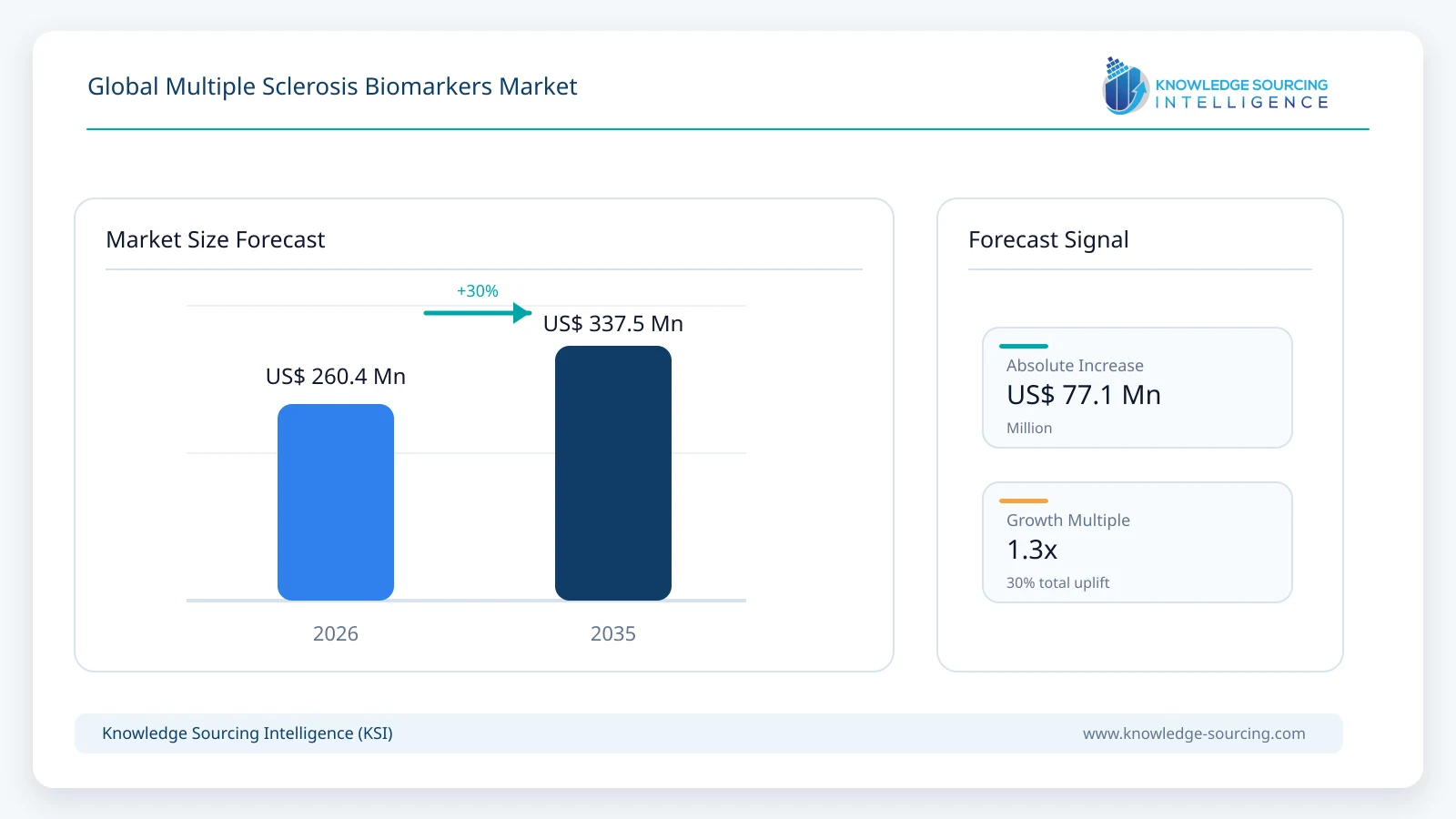
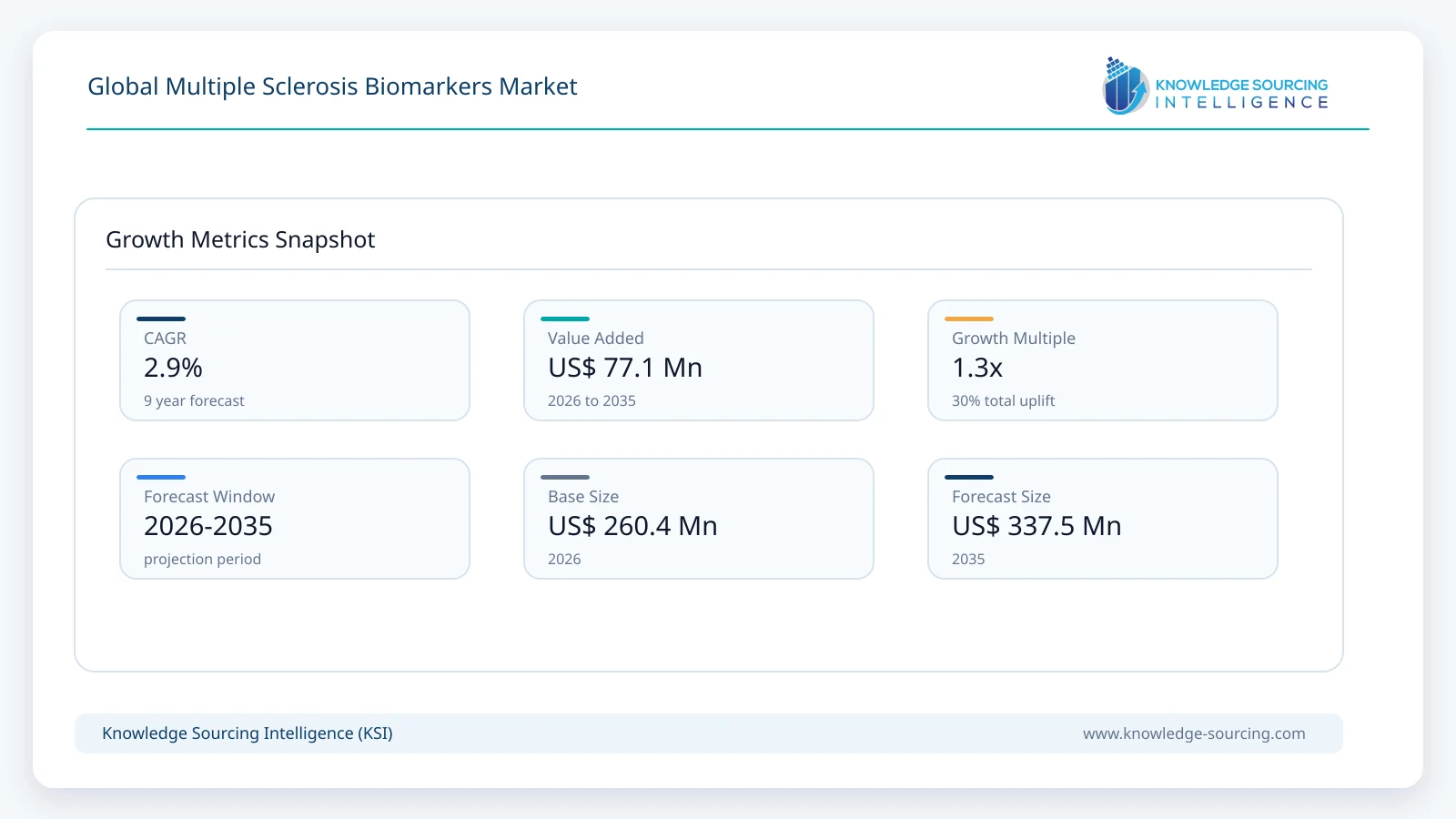
The Global Multiple Sclerosis Biomarkers Market is projected to grow at a CAGR of 2.9% during the forecast period, increasing from USD 260.4 million in 2026 to USD 337.51 million by 2035.
Highlights:
- 1Rising multiple sclerosis prevalence is increasing demand for biomarker-based monitoring because long-term disease management requires objective assessment tools.
- 2Expansion of precision medicine approaches is increasing demand for validated biomarkers because treatment response varies significantly across patient populations.
- 3Growing adoption of neurofilament light chain testing is strengthening biomarker utilization because clinicians increasingly seek indicators of neuroaxonal injury.
- 4Development of blood-based assays is improving accessibility because less invasive testing supports broader clinical implementation.
Multiple sclerosis remains a chronic immune-mediated neurological disorder that requires long-term disease monitoring and treatment optimization. Demand is increasing for objective disease assessment tools because conventional monitoring approaches often fail to detect early biological changes. Clinical decision-making remains constrained because disease activity may occur despite limited observable symptoms. Researchers are advancing biomarker validation programs because biological indicators may improve disease characterization. The outcome is growing adoption of biomarker-driven neurological care.
Neurofilament light chain, glial fibrillary acidic protein, kappa free light chains, and proteomic biomarkers are gaining clinical attention because they provide measurable insights into neurodegeneration, inflammation, and disease progression. Demand is increasing for blood-based assays because healthcare systems seek scalable monitoring approaches. Traditional cerebrospinal fluid testing remains valuable because neurological biomarkers often originate within the central nervous system. Diagnostic companies are developing increasingly sensitive detection platforms because broader clinical implementation depends on analytical reliability. The market therefore increasingly emphasizes assay standardization and validation.
Regulatory agencies continue strengthening oversight of biomarker qualification and diagnostic validation because clinical decision-making increasingly depends on biomarker-informed evidence. Healthcare providers require clinically validated biomarkers because treatment pathways continue becoming more personalized. Industry participants are expanding collaborative research initiatives because biomarker development requires extensive clinical validation. The market therefore increasingly aligns with precision medicine objectives.
Market Dynamics
Market Drivers
Increasing Demand for Early Disease Detection: Early diagnosis influences long-term neurological outcomes because timely intervention may reduce irreversible neurological damage. Demand is increasing for sensitive biomarkers because conventional diagnostic approaches often detect disease after biological progression has already occurred. Clinical uncertainty remains a challenge because disease presentation varies significantly across patients. Researchers are developing early detection biomarkers because objective biological indicators may improve diagnostic confidence. The market therefore increasingly supports biomarker-guided diagnosis.
Expansion of Precision Medicine in Multiple Sclerosis: Personalized treatment strategies require accurate biological characterization of disease activity. Demand is increasing for biomarker-guided therapeutic decision-making because treatment response remains heterogeneous across patient populations. Conventional treatment selection approaches create uncertainty because clinical parameters alone often provide incomplete information. Healthcare providers are integrating biomarker data into treatment assessment because biological monitoring may improve therapeutic outcomes. The market therefore increasingly aligns with precision medicine principles.
Advancements in Neurofilament Light Chain Testing: Neurofilament light chain has emerged as a promising marker of neuroaxonal injury because disease progression frequently involves ongoing neuronal damage. Demand is increasing for NfL testing because clinicians seek objective measures of disease activity. Conventional monitoring approaches remain limited because imaging findings may not fully reflect biological progression. Diagnostic companies are advancing ultra-sensitive assay technologies because broader clinical adoption requires reliable quantification. The market therefore increasingly supports NfL-based disease monitoring.
Growth of Biomarker Research Programs: Research institutions continue expanding biomarker development initiatives because unmet clinical needs remain substantial across multiple sclerosis management. Demand is increasing for validated biomarkers because healthcare systems increasingly prioritize outcome-based care. Existing monitoring tools create limitations because biological disease activity may not always correlate with clinical observations. Industry participants are strengthening collaborative validation programs because regulatory acceptance depends on robust evidence generation. The market therefore increasingly supports biomarker innovation.
Market Restraints
Limited assay standardization reduces consistency across clinical settings and delays widespread adoption.
Reimbursement uncertainty constrains implementation because healthcare providers require economic justification for routine testing.
Extensive clinical validation requirements increase development timelines and commercialization complexity.
Market Opportunities
Blood-Based Biomarker Development: Disease monitoring increasingly favors accessible testing approaches because routine patient assessment requires scalable solutions. Demand is increasing for blood-based biomarkers because lumbar puncture procedures remain less suitable for frequent monitoring. Traditional assessment pathways create logistical limitations because repeated cerebrospinal fluid collection may reduce patient acceptance. Diagnostic developers are expanding blood-based assay programs because simplified testing improves accessibility. The market therefore increasingly supports minimally invasive monitoring.
Companion Diagnostic Development: Targeted therapies increasingly require biological stratification because treatment response varies among patients. Demand is increasing for companion diagnostic solutions because precision medicine adoption continues expanding. Conventional treatment selection approaches create inefficiencies because biological heterogeneity influences outcomes. Companies are developing biomarker-guided diagnostic tools because treatment optimization depends on objective disease characterization. The market therefore increasingly supports personalized therapeutic strategies.
Multi-Omics Biomarker Integration: Disease complexity requires broader biological assessment because multiple molecular pathways contribute to progression. Demand is increasing for integrated biomarker platforms because single-marker approaches may provide limited insight. Conventional analyses constrain disease characterization because biological interactions remain multifactorial. Researchers are combining genomic, proteomic, and metabolomic technologies because comprehensive assessment improves understanding. The market therefore increasingly supports systems-based biomarker discovery.
Government Regulations
Region | Regulatory Authority | Regulatory Focus |
United States | FDA | Biomarker Qualification, IVD Regulation, LDT Oversight |
Europe | IVDR / EMA | Diagnostic Validation and Clinical Evidence |
Japan | PMDA | Diagnostic Approval and Clinical Validation |
India | CDSCO | Diagnostic Device Regulation |
China | NMPA | Diagnostic Registration and Performance Evaluation |
Market Segmentation
By Biomarker Type
Neurofilament light chain remains a leading segment because clinical evidence increasingly supports its role in monitoring neuroaxonal injury. Demand is increasing for GFAP biomarkers because disease progression assessment continues gaining importance. Kappa free light chains are attracting attention because inflammatory activity remains central to MS pathophysiology. Proteomic and genetic biomarkers continue expanding because comprehensive disease characterization increasingly influences treatment strategies. The segment therefore increasingly supports precision neurology applications.
By Clinical Application
Disease activity monitoring represents a major application because long-term management requires continuous assessment of disease progression. Demand is increasing for treatment response monitoring because therapeutic options continue expanding. Early diagnosis remains strategically important because earlier intervention improves disease management opportunities. Prognostic assessment is gaining importance because healthcare providers increasingly seek personalized treatment pathways. The segment therefore increasingly supports individualized clinical decision-making.
By End-User
Hospitals remain major adopters because neurological disease management frequently occurs within specialized healthcare settings. Demand is increasing among diagnostic laboratories because biomarker testing volumes continue expanding. Academic institutions remain important because biomarker validation depends on ongoing research activity. Pharmaceutical companies are increasing biomarker utilization because clinical development programs increasingly incorporate biological endpoints. The segment therefore supports broad adoption across clinical and research environments.
Regional Analysis
North America
North America leads multiple sclerosis biomarker adoption because the region combines advanced neurological care infrastructure, strong diagnostic laboratory networks, and extensive multiple sclerosis research activity. Demand is increasing as healthcare providers seek objective biomarkers that complement conventional imaging and clinical assessment approaches. Disease monitoring remains challenging because multiple sclerosis progression frequently occurs before significant clinical manifestations emerge. Diagnostic companies are expanding biomarker testing capabilities because neurologists increasingly require quantitative indicators of disease activity and treatment response. The outcome is strong regional demand supported by precision medicine adoption and extensive biomarker validation initiatives.
Europe
European healthcare systems emphasize early diagnosis and long-term disease management because multiple sclerosis continues creating significant clinical and economic burden. Demand is increasing for validated biomarker technologies because treatment optimization increasingly depends on objective biological evidence. Clinical decision-making remains constrained because conventional monitoring approaches may not fully capture subclinical disease progression. Research institutions and diagnostic developers are advancing biomarker validation programs because broader clinical adoption requires standardized evidence. The result is increasing integration of biomarker-guided monitoring across neurological care pathways.
Asia Pacific
Asia Pacific demonstrates significant growth potential because neurological disease awareness, diagnostic capabilities, and precision medicine initiatives continue expanding. Demand is increasing as healthcare providers seek more effective approaches for disease monitoring and treatment assessment. Diagnostic infrastructure remains uneven across several healthcare systems because access to advanced neurological testing continues varying by region. Governments, research organizations, and diagnostic companies are investing in biomarker research because personalized medicine increasingly influences healthcare priorities. The outcome is accelerating market development across the region.
Rest of the World
Latin America, the Middle East, and Africa continue strengthening neurological care capabilities because chronic neurological diseases increasingly affect healthcare systems. Demand is increasing for biomarker-based monitoring because healthcare providers seek objective tools that improve disease management. Access to advanced diagnostic technologies remains limited in several regions because specialized laboratory infrastructure continues developing gradually. Healthcare organizations are expanding partnerships and research collaborations because broader access to biomarker technologies supports improved patient outcomes. The result is growing interest in scalable and clinically validated multiple sclerosis biomarker solutions.
Regulatory Landscape
The multiple sclerosis biomarkers regulatory environment continues evolving because healthcare systems increasingly depend on objective biological indicators to support diagnosis, monitoring, and treatment decision-making. Regulatory agencies require extensive analytical and clinical validation because biomarker results directly influence therapeutic management and long-term patient outcomes. Diagnostic developers are increasing investment in assay standardization, clinical evidence generation, and regulatory compliance because broader market adoption depends on validated performance. The market therefore increasingly emphasizes clinically validated and regulatory-compliant biomarker solutions.
The FDA continues supporting biomarker qualification initiatives because precision medicine increasingly relies on objective disease measurement tools. The European In Vitro Diagnostic Regulation (IVDR) maintains rigorous oversight of diagnostic technologies because biomarker-guided decision-making requires strong clinical evidence. PMDA, NMPA, and CDSCO continue strengthening diagnostic regulatory frameworks because advanced biomarker technologies are becoming more important within neurological disease management. Regulatory oversight therefore increasingly balances innovation with analytical reliability and patient safety.
Biomarker commercialization remains closely linked to regulatory evolution because clinical adoption depends on demonstrated analytical validity, clinical validity, and clinical utility. Diagnostic developers are strengthening post-market evidence generation programs because long-term confidence increasingly influences physician utilization and reimbursement decisions. The regulatory landscape therefore continues supporting expansion of precision neurology diagnostics.
Pipeline Analysis
The multiple sclerosis biomarker pipeline increasingly focuses on blood-based biomarkers because healthcare providers seek less invasive and more scalable disease monitoring solutions. Demand is increasing for serum and plasma-based testing because routine disease assessment requires practical monitoring approaches. Conventional cerebrospinal fluid-based assessments remain clinically valuable because they provide direct neurological insights. Researchers are advancing blood-based biomarker validation programs because broader implementation may improve patient access and testing frequency. The pipeline therefore increasingly supports accessible disease monitoring strategies.
Neurofilament light chain, glial fibrillary acidic protein, and kappa free light chains are gaining importance because disease progression and neurodegeneration require objective biological assessment. Demand is increasing for biomarkers capable of predicting disease activity because treatment optimization increasingly depends on individualized monitoring. Conventional monitoring approaches create limitations because biological changes frequently occur before radiological or clinical progression becomes apparent. Researchers are expanding longitudinal validation studies because stronger evidence supports broader clinical adoption. The pipeline therefore increasingly aligns with precision medicine objectives.
Multi-omics and proteomic biomarker discovery continue attracting investment because multiple sclerosis involves complex immune and neurodegenerative pathways. Demand is increasing for integrated biomarker platforms because single-marker approaches may provide incomplete disease characterization. Clinical research programs are incorporating genomic, proteomic, and metabolomic technologies because disease heterogeneity influences treatment response. The biomarker pipeline therefore increasingly combines molecular biology, precision diagnostics, and personalized disease management strategies.
Competitive Landscape
Quanterix Corporation
Quanterix remains strategically differentiated because its ultra-sensitive Simoa technology enables detection of neurological biomarkers at extremely low concentrations. Demand is increasing for highly sensitive biomarker testing because clinicians increasingly require accurate assessment of neuroaxonal injury and disease activity. Conventional assay technologies may limit early detection because biomarker concentrations often remain very low in blood samples. Quanterix is expanding neurological biomarker applications because broader clinical utilization depends on reliable quantification. The company therefore benefits from strong positioning within ultra-sensitive biomarker detection technologies.
Roche Diagnostics
Roche Diagnostics maintains strong positioning because its extensive diagnostics portfolio supports integration of neurological biomarkers into established laboratory workflows. Demand is increasing for standardized biomarker testing because healthcare providers increasingly require reproducible and clinically validated diagnostic solutions. Clinical implementation remains challenging because assay harmonization continues evolving across healthcare systems. Roche is strengthening neurological diagnostics capabilities because precision medicine adoption continues expanding. The company therefore benefits from global diagnostics expertise and extensive laboratory market access.
Siemens Healthineers
Siemens Healthineers remains competitively relevant because advanced diagnostic technologies support large-scale biomarker testing and clinical implementation. Demand is increasing for integrated diagnostic platforms because healthcare providers seek efficient laboratory workflows. Diagnostic complexity continues increasing because neurological disease management requires increasingly sophisticated analytical tools. Siemens Healthineers is expanding precision diagnostics capabilities because healthcare systems increasingly prioritize personalized medicine. The company therefore benefits from broad diagnostic infrastructure expertise.
Abbott Laboratories
Abbott maintains strategic importance because diagnostic innovation increasingly influences chronic disease management. Demand is increasing for accessible and scalable biomarker testing because routine monitoring continues expanding across neurological disorders. Healthcare providers require reliable diagnostic solutions because treatment optimization increasingly depends on objective biological evidence. Abbott is strengthening diagnostic technology development because broader biomarker adoption supports long-term growth opportunities. The company therefore benefits from diversified diagnostics capabilities and strong global reach.
Bio-Techne Corporation
Bio-Techne remains differentiated because its life sciences technologies support biomarker discovery, validation, and translational research activities. Demand is increasing for research-grade biomarker solutions because clinical validation continues expanding across multiple sclerosis applications. Biomarker development remains complex because extensive analytical verification is required before commercialization. Bio-Techne is strengthening research and assay development capabilities because growing biomarker adoption depends on scientific evidence generation. The company therefore benefits from strong positioning within translational diagnostics research.
Olink Holding AB
Olink maintains competitive relevance because proteomics technologies support large-scale biomarker discovery and validation initiatives. Demand is increasing for proteomic analysis because disease heterogeneity requires broader biological characterization. Conventional approaches often limit discovery opportunities because single-marker analyses may not fully capture disease complexity. Olink is expanding proteomics applications because comprehensive biological profiling increasingly influences precision medicine strategies. The company therefore benefits from expertise in high-throughput protein analysis.
Myriad Genetics
Myriad Genetics remains strategically important because molecular diagnostics increasingly contribute to personalized healthcare approaches. Demand is increasing for genetic and molecular biomarker insights because disease variability influences treatment outcomes. Conventional disease monitoring approaches may not fully reflect underlying biological differences because patient populations remain heterogeneous. Myriad is strengthening precision diagnostics capabilities because personalized medicine continues expanding. The company therefore benefits from expertise in molecular diagnostics and genomic analysis.
Quest Diagnostics
Quest Diagnostics maintains strong positioning because large-scale laboratory infrastructure supports broad biomarker testing accessibility. Demand is increasing for clinically validated testing services because healthcare providers increasingly incorporate biomarkers into disease management pathways. Laboratory standardization remains important because widespread adoption depends on consistent test performance. Quest is expanding specialized neurological testing capabilities because precision diagnostics continue gaining importance. The company therefore benefits from extensive laboratory reach and diagnostic service expertise.
Key Developments
April 2026: Roche announced that its Elecsys® Neurofilament Light Chain (NfL) test has received CE mark approval for the detection of neuroinflammation in patients diagnosed with relapsing remitting multiple sclerosis (RRMS).
Strategic Insights and Future Market Outlook
The multiple sclerosis biomarkers market is transitioning toward precision disease monitoring because healthcare providers increasingly require objective measures of disease activity and treatment response. Demand is increasing for validated biomarker testing because conventional clinical and radiological assessments may not fully capture biological disease progression. Diagnostic developers are expanding assay capabilities because earlier intervention and personalized treatment strategies increasingly influence patient outcomes. The market therefore increasingly supports biomarker-guided neurological care.
Blood-based biomarkers are becoming strategically important because routine disease monitoring requires scalable and minimally invasive testing approaches. Healthcare providers are adopting biomarker-informed management strategies because objective biological evidence improves treatment assessment and disease monitoring. Researchers are integrating proteomic, genomic, and multi-omics technologies because disease heterogeneity requires more comprehensive biological characterization. The market therefore increasingly aligns with precision neurology principles.
Multiple sclerosis research and diagnostic innovation continue expanding because personalized medicine increasingly influences healthcare delivery. Companies capable of combining analytical sensitivity, clinical validation, regulatory compliance, and scalable diagnostic infrastructure are strengthening long-term competitive positioning because demand for biomarker-guided disease management continues growing globally.
The Global Multiple Sclerosis Biomarkers Market therefore continues evolving toward blood-based diagnostics, precision medicine frameworks, multi-omics biomarker discovery, and personalized disease monitoring as healthcare systems increasingly prioritize objective and data-driven neurological care.
Market Segmentation
By Geography
Key Countries Analysis
Regulatory & Policy Landscape
Table of Contents
1. EXECUTIVE SUMMARY
1.1 Market Overview
1.2 Key Findings
1.3 Market Snapshot
1.4 Executive Insights
1.5 Key Strategic Recommendations
1.6 Future Market Outlook
2. DISEASE & EPIDEMIOLOGY ANALYSIS
2.1 Overview of Multiple Sclerosis (MS)
2.1.1 Relapsing-Remitting Multiple Sclerosis (RRMS)
2.1.2 Secondary Progressive Multiple Sclerosis (SPMS)
2.1.3 Primary Progressive Multiple Sclerosis (PPMS)
2.1.4 Progressive-Relapsing Multiple Sclerosis (PRMS)
2.2 Global Burden of Multiple Sclerosis
2.3 Epidemiology by Disease Subtype
2.3.1 RRMS Patient Population
2.3.2 SPMS Patient Population
2.3.3 PPMS Patient Population
2.3.4 PRMS Patient Population
2.4 Disease Burden by Age Group
2.5 Disease Burden by Gender
2.6 Genetic and Environmental Risk Factors
2.7 Diagnostic Delay and Disease Monitoring Challenges
2.8 Biomarker Utility in Disease Management
2.9 Unmet Clinical Needs Driving Biomarker Adoption
3. MARKET DYNAMICS
3.1 Market Overview
3.2 Market Drivers
3.2.1 Rising Prevalence of Multiple Sclerosis
3.2.2 Growing Demand for Early Diagnosis and Disease Monitoring
3.2.3 Increasing Adoption of Precision Medicine Approaches
3.2.4 Advancements in Neurofilament Light Chain (NfL) Testing
3.2.5 Expansion of Biomarker-Based Clinical Research
3.3 Market Restraints
3.3.1 Limited Standardization of Biomarker Assays
3.3.2 High Validation and Development Costs
3.3.3 Reimbursement Challenges for Novel Biomarkers
3.3.4 Variability in Clinical Adoption Across Regions
3.4 Market Opportunities
3.4.1 Blood-Based Biomarker Development
3.4.2 Companion Diagnostic Opportunities
3.4.3 AI-Enabled Biomarker Discovery Platforms
3.4.4 Personalized Treatment Monitoring Solutions
3.5 Market Challenges
3.5.1 Clinical Validation Requirements
3.5.2 Regulatory Approval Complexity
3.5.3 Integration into Routine Clinical Practice
3.6 Porter's Five Forces Analysis
3.7 PESTLE Analysis
3.8 Value Chain Analysis
3.9 MS Biomarker Ecosystem Analysis
4. COMMERCIAL & MARKET ACCESS
4.1 Commercial Landscape Overview
4.2 Reimbursement Environment
4.2.1 Public Reimbursement Programs
4.2.2 Private Insurance Coverage
4.2.3 Value-Based Diagnostic Models
4.3 Biomarker Commercialization Models
4.3.1 Laboratory Developed Tests (LDTs)
4.3.2 Companion Diagnostics
4.3.3 Centralized Testing Services
4.4 Market Access Barriers
4.5 Stakeholder Analysis
4.5.1 Neurologists
4.5.2 Clinical Laboratories
4.5.3 Hospitals and Specialty Centers
4.5.4 Pharmaceutical Companies
4.5.5 Payers and Reimbursement Agencies
4.6 Procurement and Adoption Trends
5. INNOVATION & PIPELINE LANDSCAPE
5.1 Innovation Landscape Overview
5.2 Emerging Biomarker Technologies
5.2.1 Neurofilament Light Chain (NfL) Biomarkers
5.2.2 Glial Fibrillary Acidic Protein (GFAP) Biomarkers
5.2.3 Kappa Free Light Chain (KFLC) Biomarkers
5.2.4 Cytokine and Immune Biomarkers
5.2.5 Genetic and Genomic Biomarkers
5.2.6 Proteomic Biomarkers
5.2.7 Metabolomic Biomarkers
5.3 Biomarker Pipeline by Development Stage
5.3.1 Discovery Stage Biomarkers
5.3.2 Analytical Validation Programs
5.3.3 Clinical Validation Programs
5.3.4 Commercialization-Ready Biomarkers
5.4 Pipeline Analysis by Clinical Application
5.4.1 Early Diagnosis
5.4.2 Disease Activity Monitoring
5.4.3 Progression Monitoring
5.4.4 Treatment Response Assessment
5.4.5 Prognostic Evaluation
5.5 Pipeline Analysis by Modality
5.5.1 Blood-Based Biomarkers
5.5.2 Cerebrospinal Fluid (CSF)-Based Biomarkers
5.5.3 Imaging Biomarkers
5.5.4 Multi-Omics Biomarkers
5.5.5 Digital Biomarkers
5.6 Patent Landscape Analysis
5.7 Clinical Research Landscape
5.8 Strategic Collaborations and Partnerships
5.9 Funding and Investment Trends
6. TREATMENT LANDSCAPE
6.1 Current Multiple Sclerosis Treatment Paradigm
6.2 Approved Disease-Modifying Therapies (DMTs)
6.2.1 Interferon-Based Therapies
6.2.2 Anti-CD20 Therapies
6.2.3 S1P Receptor Modulators
6.2.4 Fumarate Therapies
6.2.5 Monoclonal Antibody Therapies
6.3 Role of Biomarkers in Treatment Selection
6.4 Biomarkers in Treatment Monitoring
6.5 Biomarkers and Personalized Medicine
6.6 Comparative Analysis of Conventional Monitoring and Biomarker-Based Monitoring
6.7 Future Treatment and Monitoring Models
7. MARKET SIZE & FORECAST
7.1 Global Market Overview
7.2 Historical Market Analysis (2021–2025)
7.3 Market Forecast (2026–2033)
7.4 Forecast by Biomarker Type
7.5 Forecast by Clinical Application
7.6 Forecast by End User
7.7 Forecast by Sample Type
7.8 Market Attractiveness Analysis
8. MARKET SEGMENTATION
8.1 By Biomarker Type
8.1.1 Neurofilament Light Chain (NfL)
8.1.2 Glial Fibrillary Acidic Protein (GFAP)
8.1.3 Kappa Free Light Chain (KFLC)
8.1.4 Cytokine Biomarkers
8.1.5 Genetic Biomarkers
8.1.6 Proteomic Biomarkers
8.1.7 Other Biomarkers
8.2 By Clinical Application
8.2.1 Early Diagnosis
8.2.2 Disease Activity Monitoring
8.2.3 Progression Assessment
8.2.4 Treatment Response Monitoring
8.2.5 Prognostic Assessment
8.3 By End User
8.3.1 Hospitals
8.3.2 Specialty Neurology Clinics
8.3.3 Diagnostic Laboratories
8.3.4 Academic and Research Institutes
8.3.5 Pharmaceutical and Biotechnology Companies
9. GEOGRAPHICAL ANALYSIS
9.1 North America
9.1.1 Market Size and Growth Analysis
9.1.2 Demand Drivers
9.1.3 Regional Regulatory Overview
9.1.4 Competitive Intensity Analysis
9.2 Europe
9.2.1 Market Size and Growth Analysis
9.2.2 Demand Drivers
9.2.3 Regional Regulatory Overview
9.2.4 Competitive Intensity Analysis
9.3 Asia-Pacific
9.3.1 Market Size and Growth Analysis
9.3.2 Demand Drivers
9.3.3 Regional Regulatory Overview
9.3.4 Competitive Intensity Analysis
9.4 Latin America
9.4.1 Market Size and Growth Analysis
9.4.2 Demand Drivers
9.4.3 Regional Regulatory Overview
9.4.4 Competitive Intensity Analysis
9.5 Middle East & Africa
9.5.1 Market Size and Growth Analysis
9.5.2 Demand Drivers
9.5.3 Regional Regulatory Overview
9.5.4 Competitive Intensity Analysis
10. KEY COUNTRIES ANALYSIS
10.1 United States
10.2 Canada
10.3 Germany
10.4 United Kingdom
10.5 France
10.6 Italy
10.7 Spain
10.8 China
10.9 Japan
10.10 India
10.11 South Korea
10.12 Australia
10.13 Brazil
10.14 Mexico
10.15 Saudi Arabia
10.16 South Africa
11. REGULATORY & POLICY LANDSCAPE
11.1 Global Regulatory Overview
11.2 United States Regulatory Framework (FDA)
11.2.1 In Vitro Diagnostic (IVD) Regulations
11.2.2 Biomarker Qualification Programs
11.2.3 Laboratory Developed Test (LDT) Framework
11.3 Europe Regulatory Framework (IVDR)
11.3.1 In Vitro Diagnostic Regulation Compliance
11.3.2 CE Marking Requirements
11.3.3 Clinical Evidence Requirements
11.4 Japan Regulatory Framework (PMDA)
11.4.1 Diagnostic Biomarker Approval Pathways
11.4.2 Clinical Validation Requirements
11.5 India Regulatory Framework (CDSCO)
11.5.1 Diagnostic Device Regulations
11.5.2 Clinical Performance Requirements
11.6 China Regulatory Framework (NMPA)
11.6.1 Diagnostic Registration Requirements
11.6.2 Biomarker Validation Standards
11.7 Companion Diagnostic Regulations
11.8 Reimbursement and Coverage Policies
11.9 Future Regulatory Trends
12. COMPETITIVE LANDSCAPE
12.1 Market Share Analysis
12.2 Competitive Benchmarking
12.3 Strategic Positioning Analysis
12.4 Mergers and Acquisitions
12.5 Strategic Partnerships and Collaborations
12.6 Product Launches and Commercial Expansions
12.7 Funding and Investment Analysis
12.8 Competitive Dashboard
13. COMPANY PROFILES
13.1 Quanterix Corporation
13.2 Roche Diagnostics
13.3 Siemens Healthineers
13.4 Abbott Laboratories
13.5 Bio-Techne Corporation
13.6 Olink Holding AB
13.7 Myriad Genetics
13.8 Quest Diagnostics
13.9 Laboratory Corporation of America Holdings (Labcorp)
13.10 PerkinElmer
14. FUTURE OUTLOOK
14.1 Future Evolution of MS Biomarkers
14.2 Expansion of Blood-Based Biomarkers
14.3 AI-Enabled Biomarker Discovery Trends
14.4 Multi-Omics Integration in MS Management
14.5 Precision Medicine and Personalized Monitoring
14.6 Companion Diagnostic Opportunities
14.7 Long-Term Growth Opportunities Through 2033
15. METHODOLOGY
15.1 Research Methodology Overview
15.2 Primary Research Framework
15.3 Secondary Research Framework
15.4 Epidemiology Data Collection Methodology
15.5 Biomarker Validation Methodology
15.6 Clinical Research Assessment Framework
15.7 Market Size Estimation Methodology
15.8 Forecasting Approach
15.9 Data Validation and Triangulation
15.10 Assumptions and Limitations
Navigate
Trusted by the world's leading organizations











