
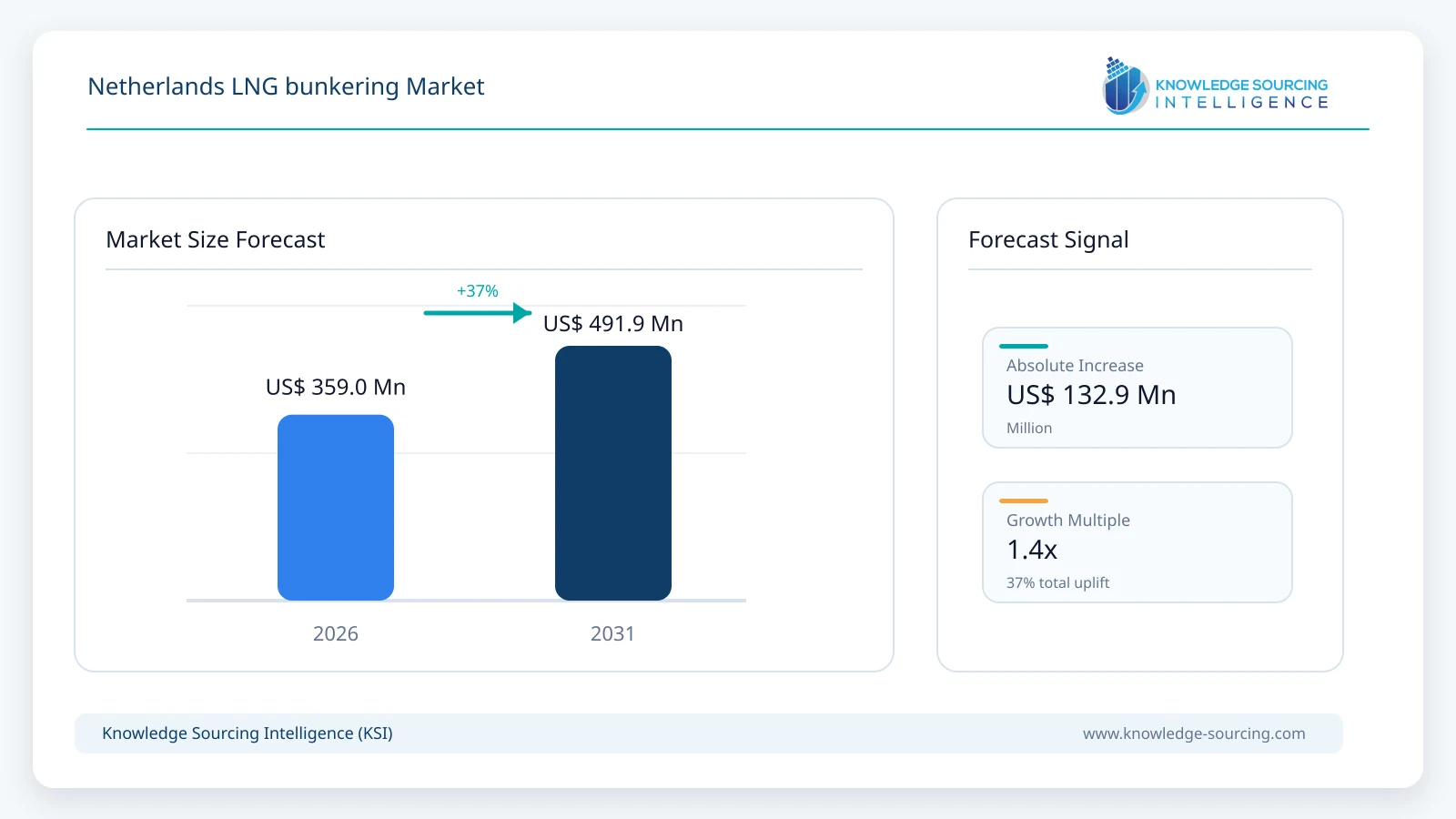
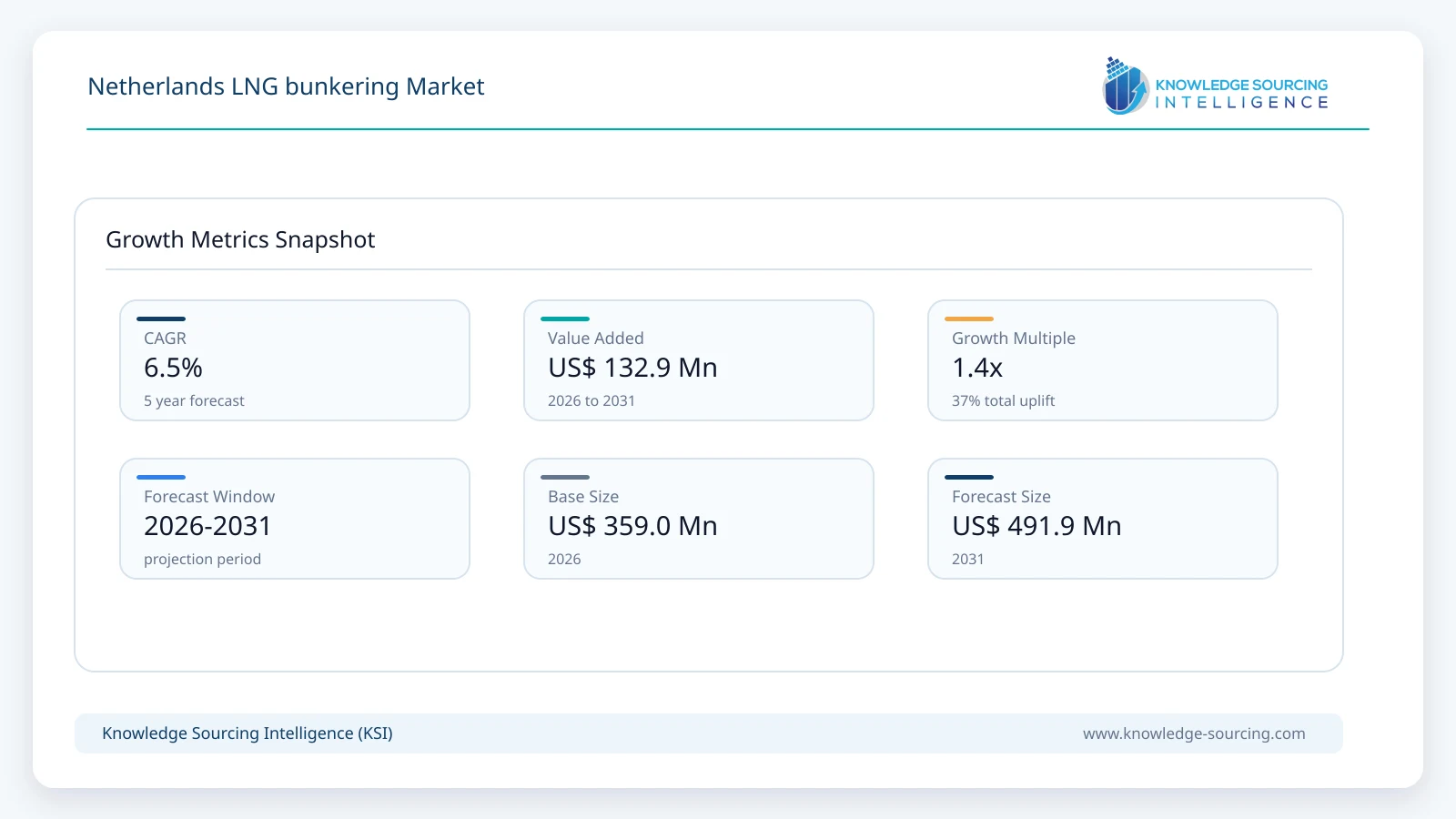
The Netherlands LNG Bunkering Market is expected to reach USD 491.9 million in 2031, growing at a CAGR of 6.5% between 2026 and 2031, from USD 359.0 million in 2026.
Highlights:
- 1Bio-LNG adoption is accelerating, with Rotterdam reporting stronger uptake as shipping operators increasingly integrate renewable LNG into marine-fuel strategies and decarbonisation pathways.
- 2Rotterdam is strengthening its LNG bunkering infrastructure, supported by terminal capabilities, bunker-vessel loading facilities, and continued development of maritime fuel logistics.
- 3Major industry partnerships are expanding supply capabilities, including the TotalEnergies–CMA CGM collaboration focused on LNG bunkering logistics across the ARA region.
- 4Alternative fuels are gaining momentum alongside LNG, with ports and suppliers increasingly developing multi-fuel bunkering ecosystems incorporating bio-LNG, biomethanol, ammonia, and other lower-carbon options.
Market Overview
The Netherlands LNG bunkering market is growing, especially in Rotterdam, which already has the country's LNG import infrastructure together with a marine-fuel distribution system and access to the wider Amsterdam–Rotterdam–Antwerp (ARA) bunkering corridor.
The overall demand for marine LNG grew with Rotterdam's sustainable volumes from 600000 m³ in 2021 to 1 million m³ by 2025, as per the Port of Rotterdam data.
The LNG-bunkering infrastructure established in Amsterdam was allowed a limit of up to 112,500 m³/year at the Passenger Terminal Amsterdam location, with a maximum pumping rate of 900 m³/hour.
The global LNG fuel fleet sector creates a sizeable obtainable customer base for Rotterdam in addition to alternative European bunkering ports. In 2026, IMO/Clarksons data showed 1,573 LNG-fuelled vessels in operation, with 702 on order and 871 operational LNG vessels.
The recent introduction of large-scale ships is illustrated by the CMA CGM Notre Dame, which made its first call at Rotterdam in July 2026 with a designed container capacity of 24,212 TEU and an 18,600 m³ LNG tank.
Rotterdam's Gate is significantly extending its storage Capex plans to the regional threshold of 20 bcm, and will add a further 160-metre berth as a specific location for bunker-vessel loading by the second half of 2028, catering to future LNG distribution capabilities.
The market is transitioning away from conventional LNG to bio-LNG and alternative low-carbon fuels as opposed to relying solely on fossil LNG. In 2025, Rotterdam reported 17,644 m³ of bio-LNG bunkers while also preparing land investments for ammonia bunkering.
In July 2026, the CMA CGM Notre Dame obtained bio-LNG produced in Europe in Rotterdam. The vessel is designed to use LNG, bio-LNG, and potentially synthetic e-methane, showing a new multi-fuel future.
Operators of vessels above 5,000 GT calling at EU ports will also be required to progressively reduce the GHG intensity of onboard energy under FuelEU Maritime, applicable from 1 January 2025, starting with a reduction of 2% in 2025 and ceasing by reducing it by 80% in 2050.
The war in Ukraine and Russia has had far-reaching structural consequences for the Netherlands' LNG ecosystem. Following the substantial reduction and eventual cessation of Russian pipeline gas, the Netherlands strengthened its gas security by expanding LNG import capacity and enabling LNG infrastructure, according to Gasunie.
The US–Iran/Middle East conflict in 2026 is relevant for the Netherlands LNG bunkering market because global LNG price and supply volatility will have more impact than any direct change in Dutch shipping policy.
Rotterdam’s bunker market is increasingly embracing a fuel-neutral approach, with LNG competing with methanol, biofuels, ammonia, hydrogen, and electrification and shore-power solutions.
Commercial Takeaways
Rotterdam is the reported location in the Netherlands for large-scale LNG bunkering, with highly developed import and storage infrastructure.
Amsterdam offers a key secondary port of LNG-bunkering authorizations with evidence of supporting infrastructure.
Rotterdam Gate's storage capacity is to be expanded and an extra bunker-vessel berth added up until 2028, which could reduce infrastructure-related constraints as additional capacity becomes available.
Bio-LNG is increasingly important from an economic perspective, thus allowing existing LNG bunkering infrastructure a route to lower-carbon marine fuels instead of being forced into the fossil LNG market.
Global LNG volatility is an important business risk, with the Russia-Ukraine war showing that Europe has significantly restructured its reliance on LNG and the 2026 Middle East conflict highlighting market vulnerabilities related to supply interruptions and shipping-route shortages.
Market Drivers
Growing Adoption of LNG-Fueled and Dual-Fuel Vessels
The rise in LNG-fuelled and LNG dual-fuel vessels is significantly expanding the range of end customers for the Netherlands' gas-to-liquid supply, especially at the Port of Rotterdam, as shipping operators seek fuels and propulsion systems that can meet ever-stricter maritime emission regulations.
In 2025, LNG bunkering volumes at Rotterdam hit an all-time high of over 1 million m³ against 0.94 million m³ in 2024, the first year this port passed this level and a sign of growing fuel demand from LNG-capable vessels.
The volume of LNG bunkered in Rotterdam rose 7% in Q1 2025 versus the same quarter a year earlier, indicating that underlying demand for LNG as marine fuel through Europe's largest bunkering hub remains strong.
SEA-LNG Ltd reported that there were 87 new LNG dual-fuel vessels ordered in China from January–June 2025, up from only 53 during the same period in 2024, taking the total global fleet of either operational or on order as dual-fuel vessels to a total of 1,369 vessels.
In July 2025, TotalEnergies and CMA CGM announced a 50:50 LNG-bunkering logistics joint venture for the Amsterdam-Rotterdam-Antwerp (ARA) region, comprising a planned 20,000 m³ LNG bunker vessel by 2028.
Under the deal, TotalEnergies will provide CMA CGM with up to 360,000 tonnes of LNG each year from 2028 to 2040, securing long-term fuelling for its new dual-fuel fleet, which supports the overall market expansion during the projected period.
Regulatory Compliance and Fuel Transparency Requirements: Regulatory enforcement defines operational standards in the Netherlands bunkering ecosystem. Demand is increasing as operators are aligning with emission and fuel traceability requirements enforced across EU waters. Conventional marine fuels create compliance risks due to stricter monitoring of emissions and fuel quality. Port authorities are enforcing licensing systems and measurement standards to improve transparency in fuel delivery. LNG adoption becomes aligned with both environmental compliance and operational accountability.
Expansion of LNG Terminal Infrastructure: Terminal capacity defines LNG availability within the Netherlands. Demand is increasing as LNG import and storage capacity is expanding through facilities such as the Gate terminal and planned new terminals. Limited domestic gas supply diversification created dependency on external sources. Authorities and operators are expanding LNG terminals and storage to strengthen supply resilience. Downstream bunkering capabilities are developing alongside terminal infrastructure.
Rotterdam as a Strategic LNG Bunkering Hub: Port concentration defines LNG bunkering demand in the Netherlands. Demand is increasing as Rotterdam functions as a central hub for European maritime logistics and fuel distribution. High vessel traffic creates consistent fuel demand across shipping segments. Operators are integrating LNG bunkering with port logistics systems to improve efficiency. LNG demand stabilizes around Rotterdam as a primary bunkering center within the ARA region.
Growth of Ship-to-Ship LNG Bunkering Operations: Operational flexibility defines bunkering method adoption across Dutch ports. Demand is increasing as ship-to-ship LNG transfer enables faster refueling in high-traffic environments. Fixed infrastructure limitations restrict reliance on shore-based systems. Operators are deploying bunker vessels to improve delivery efficiency and reduce turnaround time. LNG bunkering operations are expanding across ports such as Amsterdam through ship-to-ship transfers.
Market Restraints and Opportunities
Stringent Port-Level Regulatory Frameworks: Port authority regulations define operational constraints in LNG bunkering. Demand is increasing, but compliance requirements are becoming more stringent through licensing and monitoring systems. Mandatory bunker licenses and reporting obligations increase operational complexity. Operators are adapting to stricter compliance frameworks to maintain market access. Market growth remains dependent on regulatory alignment across ports.
High Capital Intensity of Infrastructure and Vessels: Investment requirements define scalability of LNG bunkering infrastructure. Demand is increasing in high-traffic ports, but capital-intensive systems limit expansion into smaller ports. LNG bunkering requires cryogenic storage, specialized vessels, and terminal integration. Companies are prioritizing investments in locations with assured utilization. Adoption remains concentrated in major logistics hubs.
Transition Toward Multi-Fuel Port Ecosystems: Energy transition strategies define long-term uncertainty in LNG demand. Demand is shifting as ports such as Rotterdam are preparing for alternative fuels including ammonia and hydrogen. LNG faces limitations due to its transitional emission profile. Operators are balancing LNG investments with future fuel readiness. LNG remains relevant as an interim fuel within multi-fuel port strategies.
Supply Chain Analysis
The supply chain integrates LNG imports, storage, reloading, and marine bunkering within port ecosystems. Demand is increasing for integrated logistics systems as LNG terminals act as distribution hubs for marine fuel supply. Cryogenic handling requirements and safety protocols restrict operational flexibility. Operators are connecting terminal infrastructure with bunker vessel fleets to improve last-mile delivery efficiency. The supply chain stabilizes around Rotterdam where import, storage, and bunkering functions converge.
Government Regulations
Dutch port authorities enforce bunkering regulations through licensing systems that govern operational compliance. Demand is increasing as LNG adoption expands, but operators must meet strict licensing and reporting requirements. Non-compliance risks operational restrictions and penalties within port jurisdictions. Companies are aligning operations with port authority standards to maintain access. Regulatory enforcement strengthens transparency and reliability in fuel delivery systems.
Regulatory frameworks are evolving to improve measurement accuracy and transparency in bunkering operations. Demand is increasing as ports are introducing systems such as mandatory mass flow meters for fuel measurement. Traditional measurement practices create disputes over delivered fuel quantities. Authorities are enforcing standardized measurement systems to ensure accountability. Operational transparency becomes a core requirement within the bunkering ecosystem.
Major Segment Analysis
By Fuel Type: Bio-LNG
By fuel type, the Netherlands LNG Bunkering Market is segmented into fossil LNG, bio-LNG, and synthetic LNG, where the bio-LNG segment is poised for positive growth, fueled by rising demand for low-carbon marine fuel.
Strong port concentration and expanding major ports’ operational flexibility for new fuel blends are driving the technological outlook in the Netherlands’ LNG bunkering. The bio-LNG segment is expected to grow at a considerable rate fueled by an expanding dual LNG fleet.
Continued efforts to reduce carbon emissions from marine vessels, followed by stringent EU climate rules to limit GHG intensity, have played a key role in expanding adoption of bio-LNG bunkering in major Netherlands ports.
Data from the Port of Rotterdam shows bio-blend LNG bunker sales within the first two quarters of 2026 reaching 22,766 cubic meters (Approx. 8,039 Tons), which experienced a significant growth of nearly 29% over the whole of 2025 sales.
Major shipping firms such as CMA CGM Group have launched bio-LNG-compatible vessels, namely “CMA CGM NOTREDAME”, which in July 2026 achieved its first bio-LNG bunkering in Rotterdam port. Likewise, Dutch maritime contractors such as Van Oord have also achieved this milestone, supporting market expansion.
Strategic collaborations between sustainable short sea Ro-Ro transportation solution providers such as United European Car Carriers (UECC) and clean fuel suppliers like Titan Clean Fuels (Titan) has supported eminent supply biomethane (Bio-LNG) in Netherlands.
The technical and economic advantages provided by the bio-LNG blend have accelerated LNG-bunkering infrastructure upgrades in major Dutch ports, establishing a framework for fleet operators to bolster their fleet modifications.
By Method: Truck-To-Ship
Truck-to-ship bunkering enables LNG delivery in ports without fixed infrastructure. Demand is increasing in smaller Dutch ports as operators avoid high capital investments. Multiple truck deliveries reduce operational efficiency for large vessels. Service providers are optimizing logistics to minimize delays. The segment supports early-stage LNG adoption in decentralized port environments.
By Vessel Type: Small Bunker Vessels
Small bunker vessels enable efficient LNG transfer in high-traffic ports. Demand is increasing as operators prioritize faster refueling in congested hubs such as Rotterdam. Limited fleet availability restricts expansion across multiple ports. Companies are investing in specialized bunker vessels to improve operational flexibility. The segment strengthens LNG distribution efficiency in core logistics hubs.
By Capacity: Below 4,000 cbm
Lower-capacity systems support inland and short-sea shipping segments. Demand is increasing as smaller vessels transition toward LNG fuel. Higher per-unit costs limit scalability compared to larger systems. Operators are deploying compact infrastructure to optimize cost-efficiency. The segment sustains LNG adoption across fragmented shipping routes.
Geographical Outlook
Rotterdam
By port, the Netherlands LNG Bunkering Market is segmented into Rotterdam, Amsterdam, and others, where Rotterdam is expected to constitute a significant share of the market due to its large LNG bunkering capacity.
Strategic maneuvers undertaken to expand LNG fuel transparency in the fleet, followed by investment in related infrastructure expansion, have shaped the market outlook. The Rotterdam LNG bunkering market is anticipated to grow consistently, fueled by the ongoing transition towards sustainable marine fuels.
As the second-largest LNG bunkering port globally, the Rotterdam port holds high market potential, and with stringent government policies such as the recent adoption of the “Mass Flow Meter (MFM) System” on board supporting transparency in bunkering, the market scope is expected to grow.
Report Metric Details Total Market Size in 2026 USD 359.0 million Total Market Size in 2031 USD 491.9 million Forecast Unit USD Million Growth Rate 6.5% Study Period 2021 to 2031 Historical Data 2021 to 2024 Base Year 2025 Forecast Period 2026 – 2031 Segmentation Method, Fuel Type, Capacity, Tank Type, Application, , Port Companies - Aalberts N.V.
- Amco Industrial Valves
- American Valve
- Emerson Electric Co.
- Flowserve Corporation
Progressive fleet strength, followed by improved container throughput, which reached 3.9 million TEUs in Q1 2026 and showed an 8.1% increase, is attributed to the demand for low-carbon transitional fuel by operators, thereby benefiting port LNG bunkering frequency.
The geopolitical tension raised by the US-Iran war, followed by the blockade of the Strait of Hormuz, limited bunkering volume in the EU, which negatively impacted the LNG bunkering frequency in Rotterdam. Hence, this port’s LNG bunker sales in Q1 2026 were 232.263 cubic meters (Approx. 82.022 Thousand Tons), representing nearly an 11% decline over Q1 2025 LNG bunker sales.
However, supply disruption had limited impact on LNG bunker sales in Rotterdam, and the continued demand for dual-fuel LNG vessels, followed by the development of alternatives aligning with the IGF Code, positively influenced LNG bunker sales, which reached 273,021 cubic meters (Approx. 96.416 Tons) in Q2 2026.
Strategic partnerships formed by global petrochemical players like TotalEnergies with shipping firms such as CGM Group support transparency in LNG bunker supply in Rotterdam. Likewise, the recent expansion of the Gate terminal through the addition of a fourth storage tank bolsters LNG infrastructure development at the port.
Company Profiles
Shell plc
Shell plc follows an integrated LNG strategy in the Netherlands by leveraging its global LNG supply, shipping, storage, and marine-fuel infrastructure to establish Rotterdam as a key LNG bunkering hub. Shell supplies LNG to large dual-fuel vessels through reliable ship-to-ship and other bunkering arrangements, while also expanding lower-carbon alternatives such as bio-LNG.
Rotterdam is part of Shell’s global LNG bunkering network, and Shell maintains dedicated marine-fuel sales operations in Rotterdam and Antwerp. The company also uses long-term customer agreements to secure demand from major shipping companies.
TotalEnergies SE
TotalEnergies is developing LNG bunkering logistics through partnerships in Rotterdam. Demand is increasing as shipping operators require integrated fuel supply solutions. Infrastructure dependency restricts rapid expansion. The company is investing in bunker vessels and terminal integration to enhance service capability. It strengthens its role in European LNG bunkering networks.
Vopak LNG
Vopak operates LNG storage and terminal infrastructure supporting bunkering operations. Demand is increasing as terminal capacity becomes critical for LNG distribution. Infrastructure expansion requires high capital investment and regulatory approvals. The company is expanding storage capacity to support growing LNG demand. It plays a key role in enabling LNG supply chains.
Key Developments
July 2026: The LNG-powered CMA CGM Notre Dame made its Rotterdam maiden call and received its first European-produced bio-LNG bunkering, demonstrating continued deployment of Rotterdam’s established LNG bunkering infrastructure.
June 2026: Global demand for liquefied natural gas (LNG) is expected to increase to nearly 700 million tonnes a year by 2050, an increase of around 65% from 2025 levels, according to Shell’s LNG Outlook 2026.
May 2026: Titan Clean Fuels chartered the 8,000-m³ United LNG I for Amsterdam-Rotterdam-Antwerp and Zeebrugge operations, expanding regional LNG and bio-LNG bunkering capacity for multiple vessel types.
February 2026: Vopak confirmed a final investment decision for an additional Gate terminal jetty in Rotterdam, designed to accommodate growing LNG infrastructure demand and strengthen LNG bunkering capabilities.
Analyst View
LNG bunkering in the Netherlands is being driven by port-centric infrastructure and regulatory enforcement, which concentrates demand in Rotterdam. Multi-fuel transition strategies are limiting long-term LNG dominance, while infrastructure integration is reinforcing its role as a near-term compliance fuel.
Netherlands LNG Bunkering Market Scope:
Market Segmentation
By Method
Truck-To-Ship
Shore-To-Ship
Ship-To-Ship
By Fuel Type
Fossil LNG
Bio-LNG
Synthetic LNG
By Capacity
Below 4,000 cbm
4,000 to 8,000 cbm
Above 8,000 cbm
By Tank Type
Independent Tanks
IMO-Type A
IMO-Type B
IMO-Type C
Membrane Tanks
By Application
Bulk & General Cargo Vessel
Tanker Vessel
Container Vessel
Ro-Ro & Passenger/Ferry Ships
Cruise Ships
Others
By Port
Rotterdam
Amsterdam
Other ports
Table of Contents
1. EXECUTIVE SUMMARY
2. MARKET SNAPSHOT
2.1. Market Overview
2.2. Market Definition
2.3. Scope of the Study
2.4. Market Segmentation
3. MARKET DYNAMICS
3.1. Market Drivers
3.2. Market Restraints
3.3. Market Opportunities
3.4. Porter’s Five Forces Analysis
3.5. Industry Value Chain Analysis
4. BUSINESS LANDSCAPE
4.1. Regulatory & Standards Landscape
4.2. LNG Terminal & Bunkering Infrastructure Ecosystem
4.3. LNG Supply, Bunker-Vessel & Distribution Ecosystem
4.4. Import/Export & LNG Procurement Analysis
4.5. Bunker Price Architecture Analysis
4.6. Bio-LNG, Alternative Marine Fuels & Lifecycle Emissions
4.7. Strategic Recommendation
5. TECHNOLOGICAL OUTLOOK
5.1. LNG Ship-to-Ship Bunkering & High-Capacity Transfer Technologies
5.2. Truck-to-Ship LNG Bunkering Technologies
5.3. Mass Flow Metering & Digital Bunker Measurement Technologies
5.4. LNG Bunkering Safety, Automation & Remote Monitoring Technologies
5.5. LNG Storage, Small-Scale Distribution & Break-Bulk Technologies
6. NETHERLANDS LNG BUNKERING MARKET BY METHOD (2021-2031)
6.1. Introduction
6.2. Truck-To-Ship
6.3. Shore-To-Ship
6.4. Ship-To-Ship
7. NETHERLANDS LNG BUNKERING MARKET BY FUEL TYPE (2021-2031)
7.1. Introduction
7.2. Fossil LNG
7.3. Bio-LNG
7.4. Synthetic LNG
8. NETHERLANDS LNG BUNKERING MARKET BY CAPACITY (2021-2031)
8.1. Introduction
8.2. Below 4,000 cbm
8.3. 4,000 to 8,000 cbm
8.4. Above 8,000 cbm
9. NETHERLANDS LNG BUNKERING MARKET BY TANK TYPE (2021-2031)
9.1. Introduction
9.2. Independent Tanks
9.2.1. IMO-Type A
9.2.2. IMO-Type B
9.2.3. IMO-Type C
9.3. Membrane Tanks
10. NETHERLANDS LNG BUNKERING MARKET BY APPLICATION (2021-2031)
10.1. Introduction
10.2. Bulk & General Cargo Vessel
10.3. Tanker Vessel
10.4. Container Vessel
10.5. Ro-Ro & Passenger/Ferry Ships
10.6. Cruise Ships
10.7. Others
11. NETHERLANDS LNG BUNKERING MARKET BY PORT (2021-2031)
11.1. Introduction
11.2. Rotterdam
11.3. Amsterdam
11.4. Other ports
12. COMPETITIVE ENVIRONMENT AND ANALYSIS
12.1. Major Players and Strategy Analysis
12.2. Market Share Analysis
12.3. Mergers, Acquisitions, Agreements, and Collaborations
12.4. Competitive Dashboard
13. COMPANY PROFILES
13.1. Shell plc
13.2. TotalEnergies SE
13.3. Titan Clean Fuels
13.4. Gasum Oyj
13.5. Royal Vopak N.V.
13.6. Anthony Veder
13.7. Elenger
13.8. Houpu Clean Energy Co., Ltd.
13.9. ENGIE SA
14. RESEARCH METHODOLOGY
15. LIST OF FIGURES
16. LIST OF TABLES
Navigate
Trusted by the world's leading organizations











