
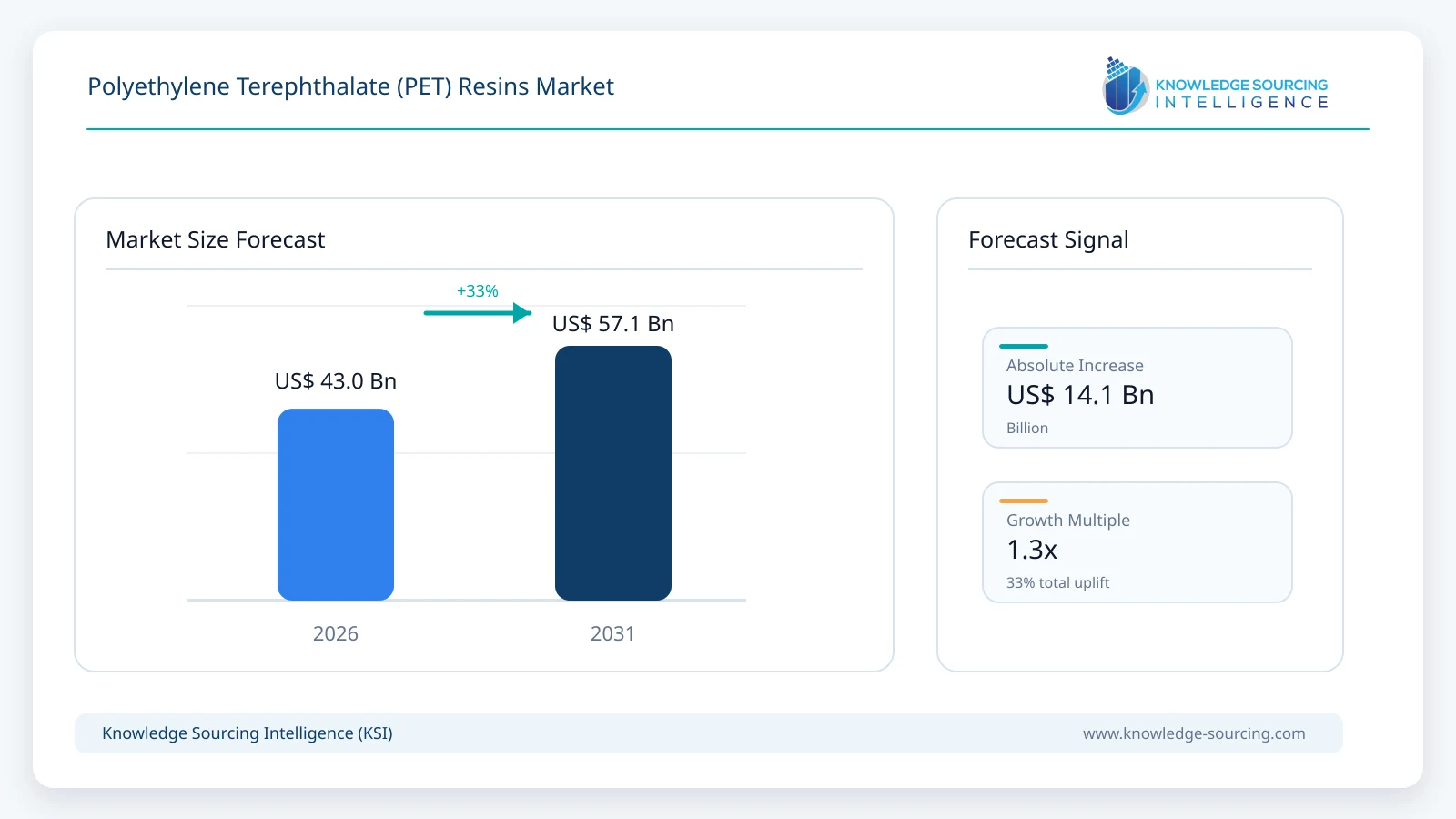
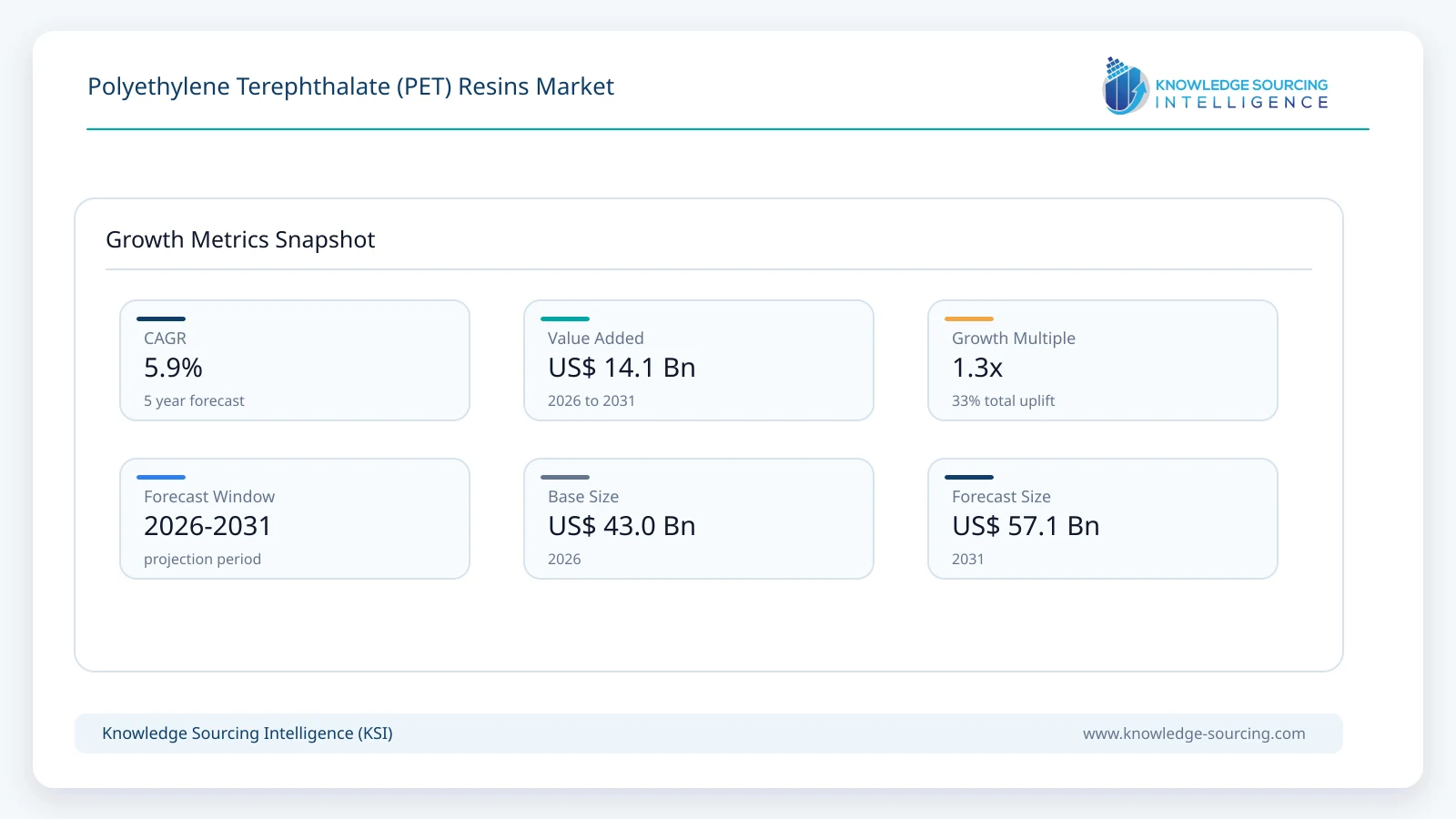
The polyethylene terephthalate resin market is forecast to grow at a CAGR of approximately 5.9%, reaching USD 57.1 billion in 2031 from USD 43.0 billion in 2026.
Highlights:
- 1Bottle-grade PET accounts for approximately 56% of global PET resin market value in 2026, supported by bottled water, carbonated soft drinks, edible oils, juices and other rigid packaging applications.
- 2Beverage bottles represent approximately 48% of global PET resin demand by value in 2026, reflecting PET’s combination of clarity, strength, low weight and suitability for high-volume blow-molding operations.
- 3Asia Pacific accounts for approximately 44% of global PET resin market value in 2026, supported by large production and conversion bases in China, India, Taiwan, Southeast Asia and other manufacturing centers.
- 4Food-grade recycled PET is becoming a higher-growth part of the resin market as bottle collection, decontamination.
- 5Global producers are rationalizing older virgin-PET assets while directing capital toward integrated production hubs, recycled PET, sheet and other higher-value polyester applications.
- 6European packaging regulation is strengthening demand for recycled PET by establishing progressively higher recycled-content and recyclability requirements for plastic packaging.
- 7Feedstock economics remain a major source of volatility because PET resin pricing is closely linked to purified terephthalic acid, monoethylene glycol, energy and regional freight conditions.
PET resin is used across beverage bottles, food packaging, films and sheets, fiber-related applications and specialty industrial products, while recycled PET is becoming an increasingly important component of the overall material supply.
Market Overview
Polyethylene terephthalate is a thermoplastic polyester produced primarily from purified terephthalic acid and monoethylene glycol. Resin is supplied in grades designed for bottle blowing, sheet extrusion, films, fiber conversion and specialty industrial uses. Bottle-grade formulations generally require higher intrinsic viscosity and tight control of acetaldehyde, color and crystallization behavior, while film, sheet and fiber grades are optimized for different extrusion, orientation and mechanical-performance requirements.
Packaging remains the central commercial use of PET resin. SABIC describes PET as a clear, lightweight and recyclable polymer suited to beverage bottles, food containers and liquid packaging, while Indorama Ventures currently markets bottle-grade and recycled-content PET formulations for carbonated soft drinks, hot-fill products, food applications and water bottles.
The competitive structure is unusually global. Large producers operate integrated PTA, PET and recycling assets across multiple continents, while China contains substantial export-oriented capacity. North American and European producers are simultaneously reducing exposure to older or higher-cost assets. Alpek reported 3.609 million tonnes of Polyester-segment volume in 2025 and expects global PET overcapacity pressure to persist through 2026, while focusing its commodity strategy on integrated and scalable hubs in the United States, Brazil and Mexico.
The industry is also moving from a virgin-resin model toward a blended virgin-and-recycled supply structure. Indorama Ventures reported 458,500 tonnes of post-consumer PET bales recycled in 2025 and had developed bale-processing capacity of 837,000 tonnes. Far Eastern New Century continues expanding food-grade rPET across Asia and describes itself as a leading global producer of food-grade recycled PET.
Market Trends
Food-Grade rPET Is Becoming a Structural Part of Resin Supply
Recycled PET is increasingly being specified as a direct feedstock for bottles and food packaging rather than being confined to fibers and lower-value applications. This shift requires more advanced sorting, washing, decontamination, solid-state polymerization and quality-control systems because food-contact resin must meet strict safety, intrinsic-viscosity and contamination requirements.
Far Eastern New Century is expanding this model across Taiwan, Japan, the United States, China, the Philippines, Vietnam and Malaysia. Its new Malaysian facility is designed for 50,000 tonnes per year of food-grade rPET and is intended to serve international beverage customers in ASEAN markets.
Indorama Ventures is taking a similar approach in Africa. In March 2026, the company, Nigerian Breweries and Genesis Energy announced a planned Lagos facility capable of producing up to 45,000 tonnes annually of food-grade rPET resin, with start-up targeted for the first half of 2027.
Producers Are Rationalizing Virgin PET Capacity
Global PET demand continues to grow, but capacity additions, particularly in Asia, are creating substantial pressure on utilization rates and reference margins. Alpek states that industry overcapacity is expected to remain an important factor through 2026 and has been concentrating production at larger integrated sites. Its Cedar Creek facility in North Carolina, with 170,000 tonnes of PET resin capacity, ceased operations in 2025 as production was reallocated to more competitive assets.
This trend changes the competitive basis of the industry. Scale, feedstock integration, freight positioning, energy cost and proximity to major bottle converters increasingly determine whether a plant remains competitive. Smaller or older standalone polymerization facilities face greater pressure when Asian export prices decline or shipping costs normalize.
PET Packaging Is Moving Toward Closed-Loop Designs
PET retains a structural advantage in packaging because an established bottle collection and recycling system already exists across many countries. The next stage is increasing the quantity of material retained in food-contact applications rather than downcycling bottles into textiles.
Indorama Ventures and AMB introduced an industrial-scale multilayer PET tray in February 2026 that places recycled PET flakes in the core while retaining food-grade virgin PET on external layers, allowing the structure to remain recyclable while increasing recycled content.
Suntory is taking a different approach in Thailand. In August 2026, it announced the introduction of flake-to-preform direct recycling technology through Indovida Thailand, with approximately 400 million recycled-PET preforms of annual capacity planned for supply to Suntory PepsiCo Beverage Thailand.
Chemical Recycling Is Moving Toward Commercial Demonstration
Mechanical recycling remains dominant for clean bottle streams, but chemical recycling is becoming more relevant for contaminated, colored, multilayer and textile PET streams that are harder to process mechanically.
In September 2026, Kirin and Japan Steel Works demonstrated an alkaline PET depolymerization process at production scale, achieving more than 95% depolymerization at throughput exceeding 250 kg per hour.
Loop Industries is also developing a 70,000-tonne-per-year PET resin and polyester facility in Gujarat through its Indian joint venture. Engineering work is progressing, with commercial operation targeted for 2028.
Market Drivers
Continued Expansion of Packaged Beverage Consumption
Bottled water, carbonated drinks, juices, edible oils and ready-to-drink products create large recurring resin demand because containers are high-volume disposable products. Population growth, urbanization, modern retail and expansion of beverage distribution continue to support bottle demand across emerging markets.
PET retains a strong position because its low package weight reduces transport cost compared with heavier materials and because modern preform and stretch-blow-molding systems can operate at very high throughput. Resin consumption is therefore closely linked to beverage filling capacity and preform production.
Mandatory Recycled Content Is Increasing rPET Demand
Regulation is changing recycled PET from an optional sustainability product into a mandatory packaging input. EU Regulation 2025/40 establishes a 30% minimum recycled-content requirement for contact-sensitive PET packaging by 2030, subject to the regulation’s implementation timetable, alongside recycled-content requirements for beverage bottles and other plastic packaging.
India is also increasing recycling obligations under its plastic packaging EPR framework. CPCB guidance sets progressively higher recycling requirements for rigid plastic packaging and establishes obligations for use of recycled plastic content. These rules support investment in bottle collection, washing, decontamination and food-grade resin production.
Growth of Thermoformed PET Packaging
PET sheet and thermoformed containers are gaining importance in food trays, produce packaging, bakery products, electronics and consumer-goods applications. PET provides clarity and stiffness while retaining compatibility with established recycling streams when structures are designed appropriately.
The shift toward mono-material packaging is strengthening this opportunity because converters are attempting to eliminate incompatible layers that reduce recyclability. Selenis, for example, offers modified PET copolyesters designed to create recyclable APET mono-material tray systems without conventional polyethylene sealing layers.
Expansion of Recycled PET Capacity
Major PET producers are adding recycling capacity in multiple regions. Far Eastern New Century’s Malaysian expansion, Indorama Ventures’ Nigeria project and planned Indian recycling facilities demonstrate that rPET investment is extending beyond mature European and North American markets.
Greater local supply reduces dependence on imported food-grade material and can improve collection economics by creating reliable downstream demand for post-consumer bottles.
PET’s Established Recycling Infrastructure Supports Material Retention
PET benefits from widely recognized resin identification, established bottle collection systems and mature mechanical-recycling processes. This provides an advantage as packaging policy increasingly prioritizes materials that can be collected and recycled at scale.
The market is moving from bottle-to-fiber toward bottle-to-bottle and tray-to-tray systems, allowing recycled polymer to remain in relatively high-value applications for multiple cycles.
Market Restraints
Global Overcapacity Pressures Virgin PET Margins
Capacity growth has outpaced demand in parts of the global PET industry. Alpek expects overcapacity pressure to persist through 2026 and continues optimizing its manufacturing footprint around integrated hubs.
Excess capacity can reduce operating rates, compress producer margins and increase export competition. This pressure is particularly important for older plants with weaker feedstock integration or higher energy costs.
PTA and MEG Price Volatility Affects Resin Economics
PET production depends primarily on purified terephthalic acid and monoethylene glycol. Changes in crude oil, paraxylene, ethylene, refinery economics and regional operating rates therefore pass through the PET value chain.
Converters can face rapid resin-price changes while finished packaging prices adjust more slowly, creating margin pressure throughout preform, bottle, sheet and film markets.
Food-Grade rPET Supply Remains Constrained by Collection Quality
Demand for recycled PET can expand faster than the availability of clean, food-grade bottle feedstock. Mixed materials, labels, colored bottles, contamination and inadequate sorting can reduce yields or prevent recycled resin from meeting food-contact requirements.
This creates competition for high-quality clear bottle bales and increases the importance of deposit-return systems, collection infrastructure and advanced decontamination.
Segment Analysis
By Grade: Bottle-Grade PET Resin
Bottle-grade PET remains the principal commercial grade because beverage and liquid-food packaging requires large, recurring quantities of resin with consistent intrinsic viscosity, low acetaldehyde and controlled crystallization properties. The segment covers cold-fill water bottles, carbonated soft-drink bottles, hot-fill packaging, edible oil, sauces, alcoholic beverages and larger containers.
Bottle-grade PET is projected to reach approximately USD 31.8 billion by 2031, supported by increasing bottled beverage consumption together with replacement of virgin polymer by higher-value food-grade rPET. Recycled-content formulations are increasingly being supplied alongside conventional virgin resin rather than operating as a separate downstream market. Nan Ya Plastics, for example, offers both standard bottle resin and PCR PET resin for beverage and food packaging.
The segment is facing pressure from lightweighting because bottle producers continue reducing resin usage per container. Growth in resin value therefore depends on rising packaged-beverage volumes, premium recycled-content grades and expansion into markets where PET bottles continue replacing heavier materials.
By Application: Beverage Bottles
Beverage bottles remain PET resin’s largest application due to extensive use in bottled water, carbonated soft drinks, juices, sports drinks and other liquid products. PET provides the required combination of clarity, mechanical strength, gas-barrier performance, blow-molding productivity and transport efficiency at a comparatively low package weight.
The beverage-bottle application is projected to reach approximately USD 27.0 billion by 2031. Growth is increasingly influenced by the composition of the resin rather than simply the number of bottles produced, as recycled-content mandates and brand-owner commitments increase the value contribution of certified food-grade rPET.
Europe provides a clear regulatory example. The EU Single-Use Plastics Directive requires PET beverage bottles to contain at least 25% recycled plastic from 2025, rising to 30% for all plastic beverage bottles from 2030.
Regional Outlook
Asia Pacific
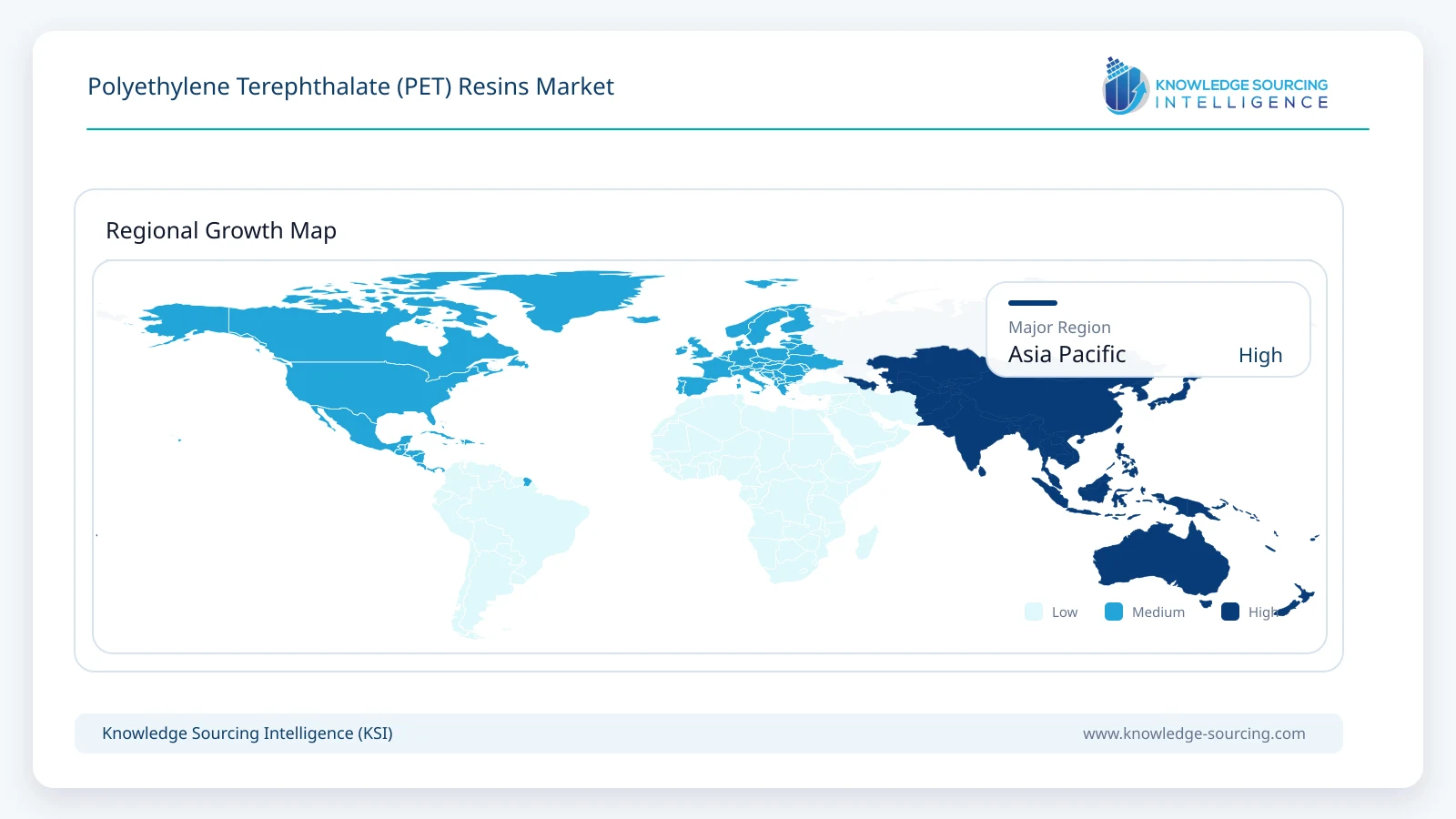
Asia Pacific is the largest PET resin market, supported by large bottle-conversion, polyester, film, sheet and packaging industries in China, India, Taiwan, Japan and Southeast Asia. China remains a major production and export center, while India continues adding domestic PET capacity and recycling infrastructure.
The regional market is projected to reach approximately USD 26.1 billion by 2031, supported by packaged beverage consumption, food packaging, industrial conversion and growing recycled-PET capacity. China continues to influence global PET economics through its large production base, while India’s market is becoming more strategically important as domestic producers expand and new recycling projects are developed.
India’s 2026 anti-dumping review noted substantial domestic PET resin investment and stated that national capacity was sufficient to meet domestic demand, with new production capacities having been established by several Indian companies.
Middle East and Africa
Middle East and Africa is expected to be the fastest-growing regional market, with a modeled CAGR of approximately 7.4% between 2026 and 2031. Growth is supported by packaged beverage consumption, new food-grade recycling infrastructure, regional packaging production and investments designed to reduce reliance on imported resin.
The market is projected to approach USD 3.7 billion by 2031. Nigeria is emerging as an important recycled-PET investment location through Indorama Ventures’ planned 45,000-tonne food-grade rPET facility, while established production in Oman and other Middle Eastern locations continues supplying domestic and export markets.
Competitive Landscape
The PET resin market combines a relatively concentrated group of large multinational and Asian producers with a broader base of regional suppliers. Scale matters because commodity bottle-grade PET is highly sensitive to feedstock integration, operating rates, energy costs and freight.
Indorama Ventures maintains one of the industry’s broadest global PET and recycling footprints and supplies virgin, blended and recycled-content bottle resins across multiple regions. Alpek, including DAK Americas and OCTAL operations, remains a major producer across the Americas and Middle East, although it is actively rationalizing older capacity and emphasizing integrated production hubs.
Far Eastern New Century has become particularly important in rPET, with production and recycling assets across Asia and North America and continuing investment in food-grade recycled resin.
Asian competition also includes large Chinese polyester groups, Reliance Industries and IVL Dhunseri in India, Nan Ya Plastics in Taiwan, LOTTE Chemical in South Korea and other integrated polyester producers. Competitive differentiation is moving beyond virgin resin cost toward recycled-content availability, food-contact approvals, carbon intensity, supply-chain traceability and the ability to offer specialized PET grades.
Recent Developments
September 2026: Kirin Holdings and Japan Steel Works demonstrated production-scale alkaline PET depolymerization with more than 95% depolymerization and throughput exceeding 250 kg per hour.
August 2026: Suntory announced plans to introduce flake-to-preform direct recycling in Thailand through Indovida Thailand, with annual capacity of approximately 400 million recycled-PET preforms.
July 2026: Indorama Ventures announced a zero-waste-to-landfill initiative at PETValue Philippines, where post-consumer bottles are converted into food-grade recycled PET.
March 2026: Indorama Ventures, Nigerian Breweries and Genesis Energy announced development of a Lagos food-grade rPET facility with capacity of up to 45,000 tonnes annually.
February 2026: Indorama Ventures and AMB introduced an industrial-scale recyclable multilayer PET tray incorporating recycled PET flakes within a food-grade PET structure.
Market Outlook
The polyethylene terephthalate resin market is forecast to expand on account of increasing resin demand combined with a structural change in the material mix.
Virgin bottle-grade PET remains the largest component of the industry, but recycled PET is expected to capture a growing share of incremental value as regulation and brand-owner procurement policies require higher recycled content. Food-grade recycling capacity is therefore becoming as strategically important as conventional polymerization capacity.
The market will remain exposed to periods of weak producer margins because global PET capacity continues to expand and Asian exports influence pricing across multiple regions. Producers are responding by closing less competitive plants, integrating PTA and PET operations and investing selectively in higher-value sheet, specialty and recycled-polymer applications.
Asia Pacific remains the principal production and consumption region through 2031, while Middle East and Africa provides a faster growth opportunity from a considerably smaller base. The strongest competitive positions are expected among companies able to combine low-cost virgin PET production with secure recycled feedstock, food-contact approvals and regional bottle-to-bottle recycling networks.
Polyethylene Terephthalate (PET) Resins Market Scope
| Report Metric | Details |
|---|---|
| Total Market Size in 2026 | USD 43.0 billion |
| Total Market Size in 2031 | USD 57.1 billion |
| Forecast Unit | Billion |
| Growth Rate | 5.9% |
| Study Period | 2021 to 2031 |
| Historical Data | 2021 to 2024 |
| Base Year | 2025 |
| Forecast Period | 2026 – 2031 |
| Segmentation | Grade, Application, Geography |
| Companies |
|
Market Segmentation
By Grade
Bottle-Grade PET Resin
Film and Sheet-Grade PET Resin
Fiber-Grade PET Resin
Engineering and Specialty PET Resin
By Application
Beverage Bottles
Food Packaging and Containers
Films and Sheets
Fibers and Industrial Polyester Applications
Pharmaceutical and Personal Care Packaging
Automotive and Industrial Applications
Others
By Geography
North America
United States
Canada
Mexico
South America
Brazil
Argentina
Others
Europe
Germany
France
United Kingdom
Italy
Spain
Poland
Others
Middle East and Africa
Saudi Arabia
UAE
Oman
Nigeria
South Africa
Others
Asia Pacific
China
India
Japan
South Korea
Taiwan
Indonesia
Thailand
Vietnam
Malaysia
Others
Table of Contents
1. INTRODUCTION
1.1. Market Overview
1.2. Market Definition
1.3. Revenue Inclusion and Exclusion Criteria
1.4. Scope of the Study
1.5. PET Resin Value Chain
1.6. Virgin PET versus Recycled PET
1.7. Market Segmentation
1.8. Currency
1.9. Assumptions
1.10. Base and Forecast Years
1.11. Key Benefits to Stakeholders
2. RESEARCH METHODOLOGY
2.1. Research Design
2.2. Secondary Research
2.3. Primary Research
2.4. Market Estimation
2.5. Resin Volume and Pricing Analysis
2.6. Segment Modelling
2.7. Data Triangulation and Validation
3. EXECUTIVE SUMMARY
3.1. Key Findings
3.2. PET Resin Market Size, 2026-2031
3.3. Resin Grade Outlook
3.4. Application Outlook
3.5. Regional Opportunity Summary
4. MARKET DYNAMICS
4.1. Market Drivers
4.1.1. Expansion of Packaged Beverage Consumption
4.1.2. Mandatory Recycled-Content Requirements
4.1.3. Growth of Thermoformed PET Packaging
4.1.4. Expansion of Food-Grade rPET Capacity
4.1.5. Established PET Collection and Recycling Infrastructure
4.2. Market Restraints
4.2.1. Global Virgin PET Overcapacity
4.2.2. PTA and MEG Price Volatility
4.2.3. Constraints on Food-Grade Recycled Feedstock
4.2.4. Lightweighting of PET Packaging
4.2.5. Competition from Alternative Packaging Materials
4.3. Market Opportunities
4.4. Porter’s Five Forces Analysis
4.5. Industry Value Chain Analysis
4.6. PTA and MEG Feedstock Outlook
4.7. Virgin versus Recycled PET Economics
4.8. PET Collection and Bottle-to-Bottle Recycling Infrastructure
4.9. Regulatory and Recycled-Content Environment
5. TECHNOLOGY AND MATERIAL OUTLOOK
5.1. Mechanical PET Recycling
5.2. Chemical PET Recycling
5.3. Bottle-to-Bottle Recycling
5.4. Flake-to-Preform Technology
5.5. Bio-Based PET
5.6. Lightweight and High-Performance PET Grades
6. PET RESIN MARKET BY GRADE
6.1. Introduction
6.2. Bottle-Grade PET Resin
6.3. Film and Sheet-Grade PET Resin
6.4. Fiber-Grade PET Resin
6.5. Engineering and Specialty PET Resin
7. PET RESIN MARKET BY APPLICATION
7.1. Introduction
7.2. Beverage Bottles
7.3. Food Packaging and Containers
7.4. Films and Sheets
7.5. Fibers and Industrial Polyester Applications
7.6. Pharmaceutical and Personal Care Packaging
7.7. Automotive and Industrial Applications
7.8. Others
8. PET RESIN MARKET BY GEOGRAPHY
8.1. North America
8.1.1. United States
8.1.2. Canada
8.1.3. Mexico
8.2. South America
8.2.1. Brazil
8.2.2. Argentina
8.2.3. Others
8.3. Europe
8.3.1. Germany
8.3.2. France
8.3.3. United Kingdom
8.3.4. Italy
8.3.5. Spain
8.3.6. Poland
8.3.7. Others
8.4. Middle East and Africa
8.4.1. Saudi Arabia
8.4.2. UAE
8.4.3. Oman
8.4.4. Nigeria
8.4.5. South Africa
8.4.6. Others
8.5. Asia Pacific
8.5.1. China
8.5.2. India
8.5.3. Japan
8.5.4. South Korea
8.5.5. Taiwan
8.5.6. Indonesia
8.5.7. Thailand
8.5.8. Vietnam
8.5.9. Malaysia
8.5.10. Others
9. COMPETITIVE ENVIRONMENT AND ANALYSIS
9.1. Major Players and Strategy Analysis
9.2. Competitive Dashboard
9.3. Market Share Analysis
10. COMPANY PROFILES
10.1. Indorama Ventures Public Company Limited
10.2. Alpek S.A.B. de C.V.
10.3. DAK Americas LLC
10.4. OCTAL
10.5. Far Eastern New Century Corporation
10.6. Reliance Industries Limited
10.7. IVL Dhunseri Petrochem Industries Private Limited
10.8. Nan Ya Plastics Corporation
10.9. LOTTE Chemical Corporation
10.10. SABIC
10.11. Sanfangxiang Group Co., Ltd.
10.12. Wankai New Materials Co., Ltd.
10.13. Sinopec Yizheng Chemical Fibre Company Limited
10.14. Selenis
10.15. Plastipak Holdings, Inc.
10.16. Toray Industries, Inc.
10.17. JBF Industries Limited
10.18. China Resources Chemical Innovative Materials Co., Ltd.
10.19. Hengli Petrochemical Co., Ltd.
10.20. Zhejiang Hengyi Petrochemical Co., Ltd.
Navigate
Trusted by the world's leading organizations











