
The Rail Mounted Gantry Crane Market is projected to register a strong CAGR during the forecast period (2026-2031).
Highlights:
- 1Largest End-UserContainer terminals at maritime ports represent the primary demand source, where the need for high-speed, 24/7 stacking operations necessitates the precision and reliability of rail-bound systems.
- 2Regulatory ImpactThe implementation of the International Maritime Organization (IMO) 2023 Greenhouse Gas Strategy is compelling port authorities to replace legacy diesel equipment with electric RMG cranes to meet carbon intensity reduction targets.
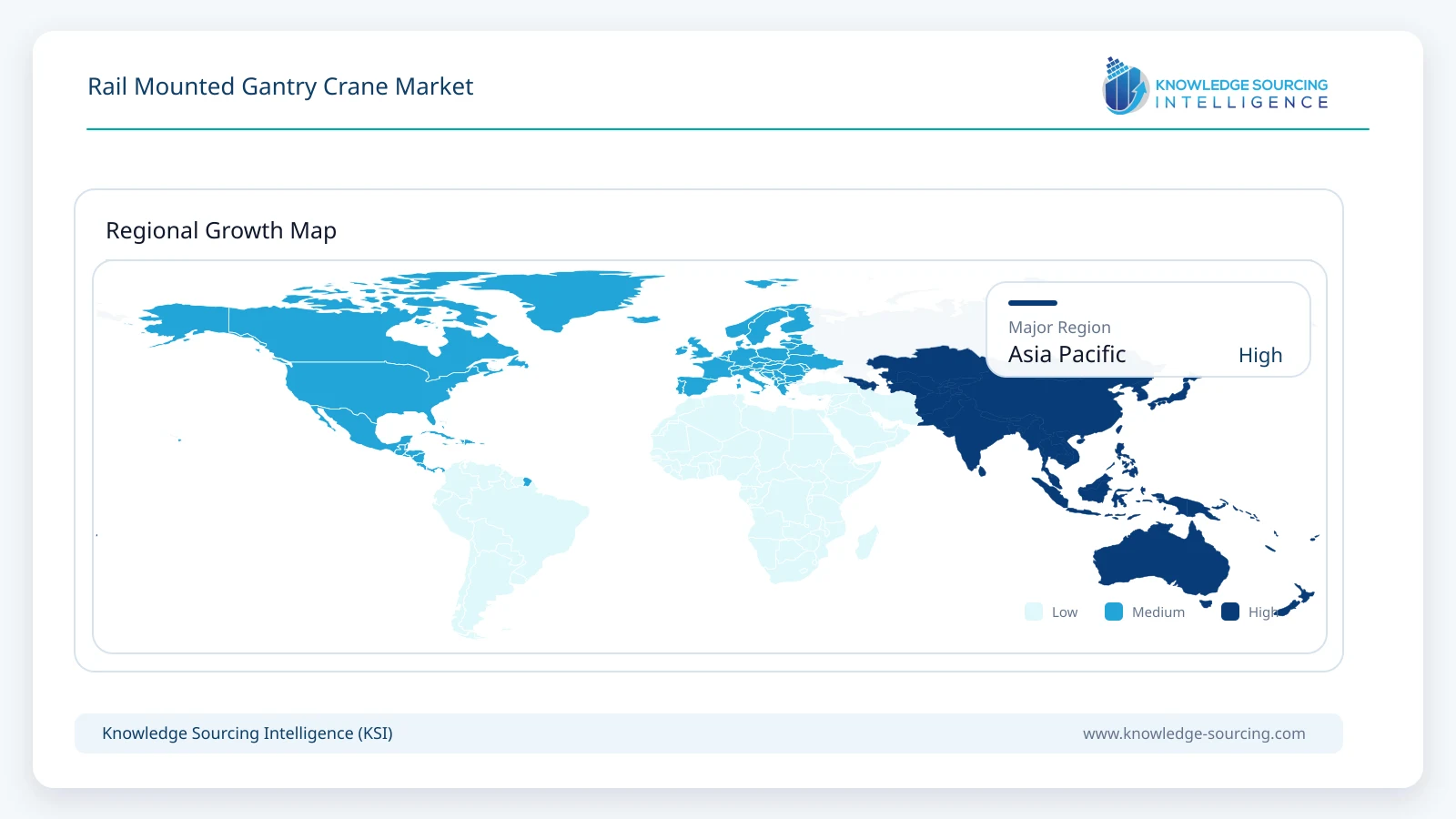
- 3Regional LeaderThe Asia-Pacific region maintains dominance due to massive infrastructure investments in China’s automated terminals and India’s Dedicated Freight Corridors (DFC), which rely on RMG systems for efficient intermodal transfers.
- 4Technology TransitionThere is a definitive shift from manual to autonomous technology, driven by the integration of LiDAR, AI-vision systems, and 5G connectivity that allow for supervised remote operations.
- 5Pricing SensitivityThe market’s demand is sensitive to the volatility of structural steel prices and the costs of high-performance electrical components, leading to a growing preference for modular crane designs to manage lifecycle expenditures.
The structural demand for Rail Mounted Gantry (RMG) cranes is fundamentally tied to the intensification of global containerization and the necessity for land-use efficiency. Unlike rubber-tired variants, RMG cranes provide a fixed-path operational model that allows for higher stacking density and more predictable automation cycles. This industry dependency is exacerbated by the trend toward mega-vessel deployment, which requires ports to achieve faster turnaround times per berth. As a result, terminal operators are increasingly viewing RMG infrastructure not merely as lifting hardware but as critical nodes within a digitized, automated logistics chain.
The technology evolution within this sector is focused on the move toward semi-automated and fully autonomous stacking. This transition is essential for mitigating labor-related operational variances and enhancing safety in high-density environments. Furthermore, the sustainability transition is a primary driver, as the electrification of gantry systems aligns with "green port" initiatives aimed at reducing Nitrogen Oxide (NOx) and Particulate Matter (PM) emissions. These factors combined underscore the strategic importance of RMG cranes as the preferred solution for modern, electrified, and high-capacity freight corridors.
Market Dynamics
Market Drivers
Expansion of Intermodal Rail Networks: The growth of inland dry ports and transhipment hubs requires RMG cranes to manage the rapid transfer of containers between rail and road, directly increasing demand for cranes with wide spans and high lifting speeds.
Port Automation Initiatives: The drive for operational cost reduction and increased throughput leads terminal operators to adopt autonomous RMG systems, as these minimize human error and allow for continuous operation during peak traffic.
Decarbonization Regulations: Strict environmental mandates, such as the EU’s FuelEU Maritime and "Fit for 55" package, incentivize the adoption of electric RMG cranes over diesel-powered alternatives to avoid carbon penalties and meet zero-emission quayside requirements.
Growth in Containerized Trade Volumes: The structural increase in the volume of goods shipped via standardized containers necessitates higher stacking heights (up to 1-over-8), which can only be safely and efficiently achieved using the stability of rail-mounted gantry structures.
Market Restraints and Opportunities
Substantial Upfront Capital Expenditure: The high initial investment required for RMG procurement and the associated rail infrastructure installation can limit adoption for smaller or emerging terminals with constrained financing.
Civil Engineering Constraints: RMG cranes require precise, high-load-bearing rail foundations, which pose a significant challenge for existing ports with limited space or poor soil conditions, creating a restraint on brownfield modernization.
Opportunity in Retrofitting and Modernization: A growing market exists for upgrading legacy manual RMG cranes with remote control and automation kits, allowing operators to enhance productivity without the cost of full equipment replacement.
Specialty Lifting for Renewable Energy: Emerging opportunities are surfacing in the offshore wind sector, where specialized RMG systems are required at assembly ports to handle massive nacelles and turbine components.
Raw Material and Pricing Analysis
The production of Rail Mounted Gantry cranes is highly sensitive to the pricing of high-grade structural steel, which constitutes a significant portion of the crane's mass and total material cost. Variations in the global steel market, often influenced by trade tariffs and energy costs in smelting, directly impact the final procurement price for terminal operators. Beyond the structural frame, the pricing dynamics are increasingly dictated by the supply chain of sophisticated electrical components, including variable frequency drives (VFDs), programmable logic controllers (PLCs), and high-tension copper cabling for electrification.
Energy sensitivity plays a dual role; while high energy costs increase manufacturing expenses, they also drive demand for RMG cranes equipped with regenerative braking systems that can feed power back into the port grid. Regional pricing variations are evident, with manufacturers in the Asia-Pacific region often benefiting from integrated steel supply chains and lower labor costs. In contrast, European and North American manufacturers emphasize total cost of ownership (TCO) by integrating advanced diagnostic software and higher-grade components that reduce long-term maintenance margins.
Supply Chain Analysis
The RMG crane supply chain is characterized by a high degree of production concentration, with a limited number of global players capable of delivering ultra-large, automated systems. This concentration creates a dependency on specialized shipping logistics, as fully or partially assembled cranes require heavy-lift vessels for intercontinental transport. Manufacturing is often strategically located near major maritime hubs to facilitate easier delivery and commissioning.
Recent shifts in the supply chain emphasize regional risk exposure, leading some manufacturers to establish local assembly plants in North America and Europe to bypass logistical bottlenecks and comply with "local content" requirements. The supply of critical automation software and sensors is an integrated part of the manufacturing strategy, with key players either developing in-house capabilities or forming long-term strategic partnerships with technology firms. This integration ensures that the hardware is seamlessly compatible with the increasingly complex terminal operating environments.
Government Regulations
Jurisdiction | Key Regulation / Agency | Market Impact Analysis |
Europe | EU Regulation 2023/1805 (FuelEU Maritime) | Mandates a reduction in GHG intensity; drives the replacement of diesel-powered yard equipment with electric RMG cranes to achieve zero-emissions at berth by 2030. |
United States | Clean Air Act / EPA Port Initiative | Provides funding and regulatory pressure for ports to adopt zero-emission technologies, increasing the demand for electrified rail-mounted solutions over traditional mobile cranes. |
Global | IMO 2023 GHG Strategy | Sets a target to reduce CO2 emissions per transport work by at least 40% by 2030; structurally favors RMG electrification as a primary decarbonization pathway for land-side operations. |
China | "Made in China 2025" / Green Port Policy | Incentivizes the development and deployment of domestic automated, energy-efficient port machinery, reinforcing China’s position as a lead market for autonomous RMG systems. |
Key Developments
September 2026: On 25 September, Baltic Hub confirmed delivery of two electric RMG cranes in Gda?sk, Poland, supporting increased intermodal capacity and raising annual rail-siding handling capacity to 1.2 million TEUs.
May 2026: On 20 May, PSA Halifax and the Port of Halifax received two electric, remotely operated RMG cranes, improving rail-container handling and targeting annual carbon emission reductions of at least 640 tonnes.
March 2026: On 25 March, RIKON completed delivery of the second and third automated RMG cranes to ADIF’s Madrid-Vicálvaro Intermodal Terminal, completing the delivery phase of its three-crane automated handling fleet.
January 2026: On 29 January, Konecranes announced an order for two RMG cranes at an unnamed greenfield container terminal in India, featuring twin-lift spreaders and rotating trolleys, with operations scheduled by Q2 2027.
January 2026: SANY Group – Launched a new regional supply center in Dubai to optimize logistics for the Middle East market. This expansion is strategically significant for reducing lead times in high-growth freight corridors.
November 2025: Konecranes – Upgraded profitability guidance citing strong execution in yard modernization projects. The company's focus on retrofitting 37 third-party RTGs with remote supervision technology signifies a shift toward hybrid-automation service models.
Market Segmentation
By Technology: Autonomous
The autonomous RMG segment is the primary engine of market transformation, driven by the requirement for consistent, high-speed container stacking that exceeds human capabilities. These cranes utilize a suite of sensors, including 3D LiDAR and high-definition vision systems, to perform container recognition and path optimization autonomously. The demand is particularly high in greenfield "smart port" projects where the entire yard layout is designed for driverless operations. Structurally, the adoption of autonomous technology reduces operational expenses (OPEX) by minimizing labor costs and energy waste through optimized movement algorithms.
By Lifting Capacity: 40 Tons and Above
The segment for cranes with a lifting capacity of 40 tons and above dominates the market, as it aligns with the standard weight of fully loaded 40-foot and 45-foot containers. This capacity is essential for high-throughput maritime terminals that must handle a wide variety of cargo weights without equipment switching. The demand for these heavy-lift RMG cranes is further bolstered by the growth of intermodal rail hubs that process heavy industrial goods and bulk-containerized commodities.
By Type: Cantilever
Cantilever RMG cranes provide a distinct operational advantage by extending the crane's reach beyond the rail tracks, allowing for the direct loading and unloading of trucks or trains adjacent to the stacking yard. This design maximizes the functional footprint of the terminal, making it a preferred choice for sites with constrained land area. The demand for cantilever types is driven by the need for seamless integration between different transport modes in congested port environments.
Regional Analysis
Asia Pacific
The Asia-Pacific region is the global leader in RMG demand, underpinned by the presence of the world’s busiest container ports in China, Singapore, and South Korea. Industrial growth and government-led infrastructure projects, such as the expansion of the Port of Shanghai and the development of new automated terminals in Southeast Asia, provide a stable foundation for market growth. The region’s focus on "smart port" technology and high-capacity freight corridors ensures continued investment in autonomous RMG systems.
North America
The North American market is characterized by a significant focus on port modernization and the reduction of reliance on foreign-manufactured equipment. Regulatory pressure for decarbonization in California’s ports and federal funding for infrastructure improvements are driving a transition toward electrified RMG cranes. The competitive landscape is shifting as manufacturers establish local presence to better serve the unique requirements of the U.S. and Canadian intermodal rail markets.
Europe
Europe’s market is heavily influenced by the most stringent environmental regulations globally. The requirement for zero-emission operations at major hubs like Rotterdam and Antwerp is forcing a complete phase-out of diesel-powered yard machinery. This regulatory environment creates a high-replacement demand for advanced, energy-efficient RMG cranes that can integrate with sophisticated European logistics networks.
List of Companies
Anupam Industries Limited
Konecranes
SANY GROUP
TNT Crane & Rigging
Liebherr
Shanghai Zhenhua Heavy Industries Co., Ltd. (ZPMC)
Doosan Heavy Industries Vietnam Co.
Konecranes
Konecranes holds a dominant market position as a provider of high-end, automated port solutions. The company’s strategy centers on "The Core of Lifting," which emphasizes the integration of hardware with advanced digital services and remote monitoring. Their competitive advantage lies in their ability to provide unified terminal setups where RMG cranes, RTGs, and horizontal transport systems operate under a single, supervised automation platform. Geographically, Konecranes maintains a strong presence in both European and North American markets, supported by an extensive global service network.
Shanghai Zhenhua Heavy Industries Co., Ltd. (ZPMC)
ZPMC is the world’s largest manufacturer of port machinery, benefiting from massive economies of scale and a fully integrated production model in China. Their strategy is based on rapid production and cost-effective delivery of ultra-large container handling systems. ZPMC’s technology differentiation is evident in their deployment of AI-assisted cranes at major automated terminals, such as Yangshan Port. Their geographic strength is unmatched, with equipment operating in over 100 countries and regions, capturing a significant share of the high-volume Asian market.
Liebherr
Liebherr is recognized for its high-performance engineering and the durability of its crane designs. The company’s RMG strategy focuses on modularity and flexibility, offering custom spans and stacking heights to meet specific terminal requirements. A key technological differentiator is their eight-rope reeving anti-sway system, which enhances productivity by allowing for faster and more precise load positioning. Liebherr’s geographic strength is particularly robust in Europe and the Middle East, where its reputation for premium quality and reliable after-sales service provides a significant competitive edge.
Analyst View
The RMG crane market is transitioning toward a digital-first infrastructure model. Growth is anchored by port automation and decarbonization mandates, forcing a shift to autonomous, electric systems. While high capital costs remain a challenge, the necessity for operational efficiency ensures a robust long-term outlook.
Rail Mounted Gantry Crane Market Scope:
| Report Metric | Details |
|---|---|
| Forecast Unit | Billion |
| Study Period | 2021 to 2031 |
| Historical Data | 2021 to 2024 |
| Base Year | 2025 |
| Forecast Period | 2026 – 2031 |
| Segmentation | Type, Technology, Lifting Capacity, Geography |
| Companies |
|
Market Segmentation
By Type
Cantilever
Non-Cantilever
By Technology
Manual
Autonomous
By Lifting Capacity
Less Than 40 Tons
40 Tons and Above
By Geography
North America
United States
Canada
Mexico
South America
Brazil
Argentina
Others
Europe
United Kingdom
Germany
France
Spain
Others
The Middle East and Africa
Saudi Arabia
UAE
Israel
Others
Asia Pacific
Japan
China
India
South Korea
Indonesia
Thailand
Others
Table of Contents
1. INTRODUCTION
1.1. Market Overview
1.2. Market Definition
1.3. Scope of the Study
1.4. Market Segmentation
1.5. Currency
1.6. Assumptions
1.7. Base and Forecast Years Timeline
2. RESEARCH METHODOLOGY
2.1. Research Data
2.2. Research Processes
3. EXECUTIVE SUMMARY
3.1. Research Highlights
4. MARKET DYNAMICS
4.1. Market Drivers
4.2. Market Restraints
4.3. Porter’s Five Force Analysis
4.3.1. Bargaining Power of Suppliers
4.3.2. Bargaining Power of Buyers
4.3.3. Threat of New Entrants
4.3.4. Threat of Substitutes
4.3.5. Competitive Rivalry in the Industry
4.4. Industry Value Chain Analysis
5. RAIL-MOUNTED GANTRY CRANE MARKET BY TYPE
5.1. Introduction
5.2. Cantilever
5.3. Non-Cantilever
6. RAIL-MOUNTED GANTRY CRANE MARKET BY TECHNOLOGY
6.1. Introduction
6.2. Manual
6.3. Autonomous
7. RAIL-MOUNTED GANTRY CRANE MARKET BY LIFTING CAPACITY
7.1. Introduction
7.2. Less Than 40 Tons
7.3. 40 Tons and Above
8. RAIL-MOUNTED GANTRY CRANE MARKET BY GEOGRAPHY
8.1. Introduction
8.2. North America
8.2.1. United States
8.2.2. Canada
8.2.3. Mexico
8.3. South America
8.3.1. Brazil
8.3.2. Argentina
8.3.3. Others
8.4. Europe
8.4.1. United Kingdom
8.4.2. Germany
8.4.3. France
8.4.4. Spain
8.4.5. Others
8.5. The Middle East and Africa
8.5.1. Saudi Arabia
8.5.2. UAE
8.5.3. Israel
8.5.4. Others
8.6. Asia Pacific
8.6.1. Japan
8.6.2. China
8.6.3. India
8.6.4. South Korea
8.6.5. Indonesia
8.6.6. Thailand
8.6.7. Others
9. COMPETITIVE ENVIRONMENT AND ANALYSIS
9.1. Major Players and Strategy Analysis
9.2. Market Share Analysis
9.3. Mergers, Acquisitions, Agreements, and Collaborations
10. COMPANY PROFILES
10.1. Anupam Industries Limited
10.2. Konecranes
10.3. SANY GROUP
10.4. TNT Crane & Rigging
10.5. Liebherr
10.6. Shanghai Zhenhua Heavy Industries Co., Ltd.
10.7. Doosan Heavy Industries Vietnam Co.
LIST OF FIGURES
LIST OF TABLES
Navigate
Trusted by the world's leading organizations











