
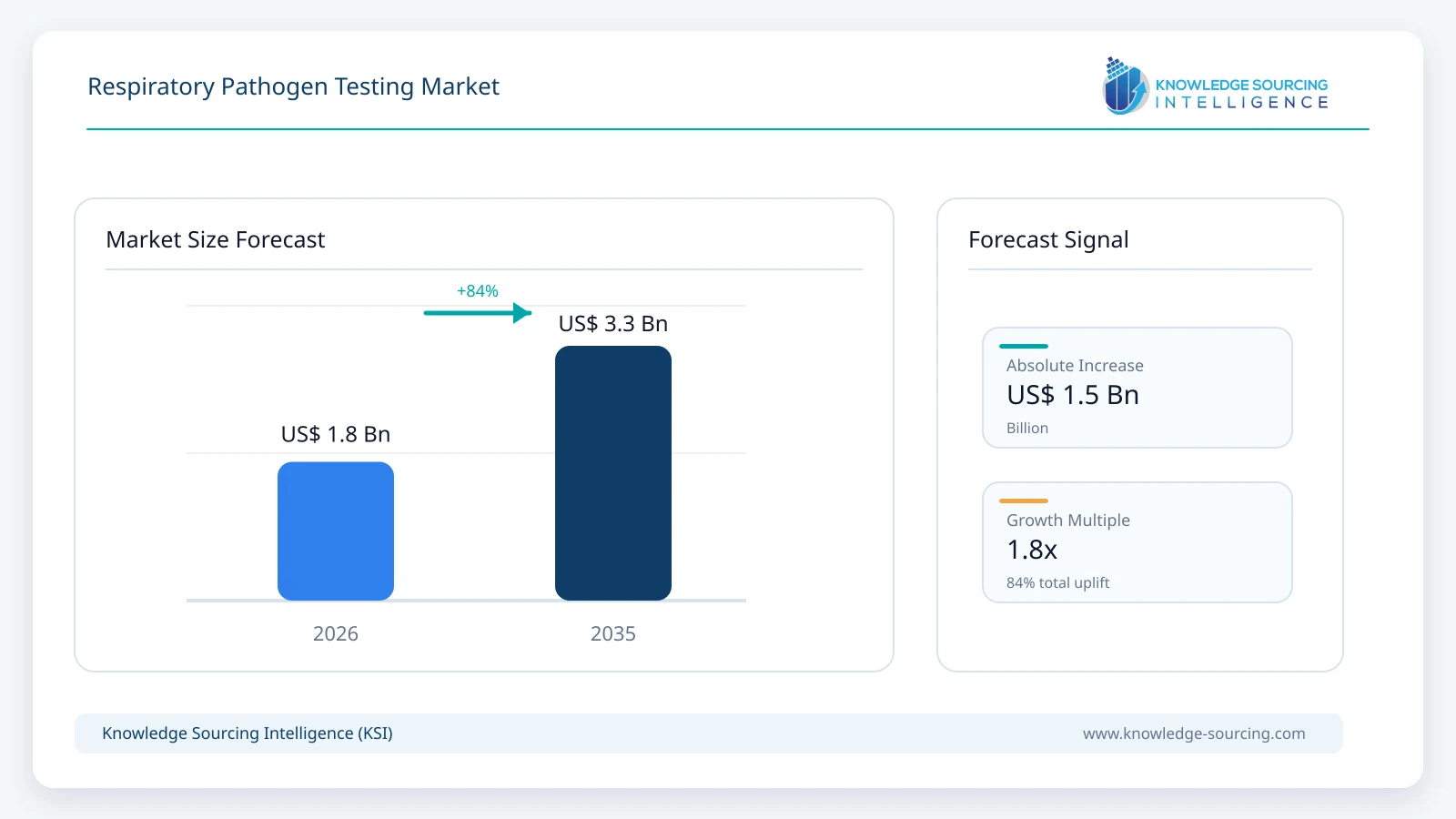
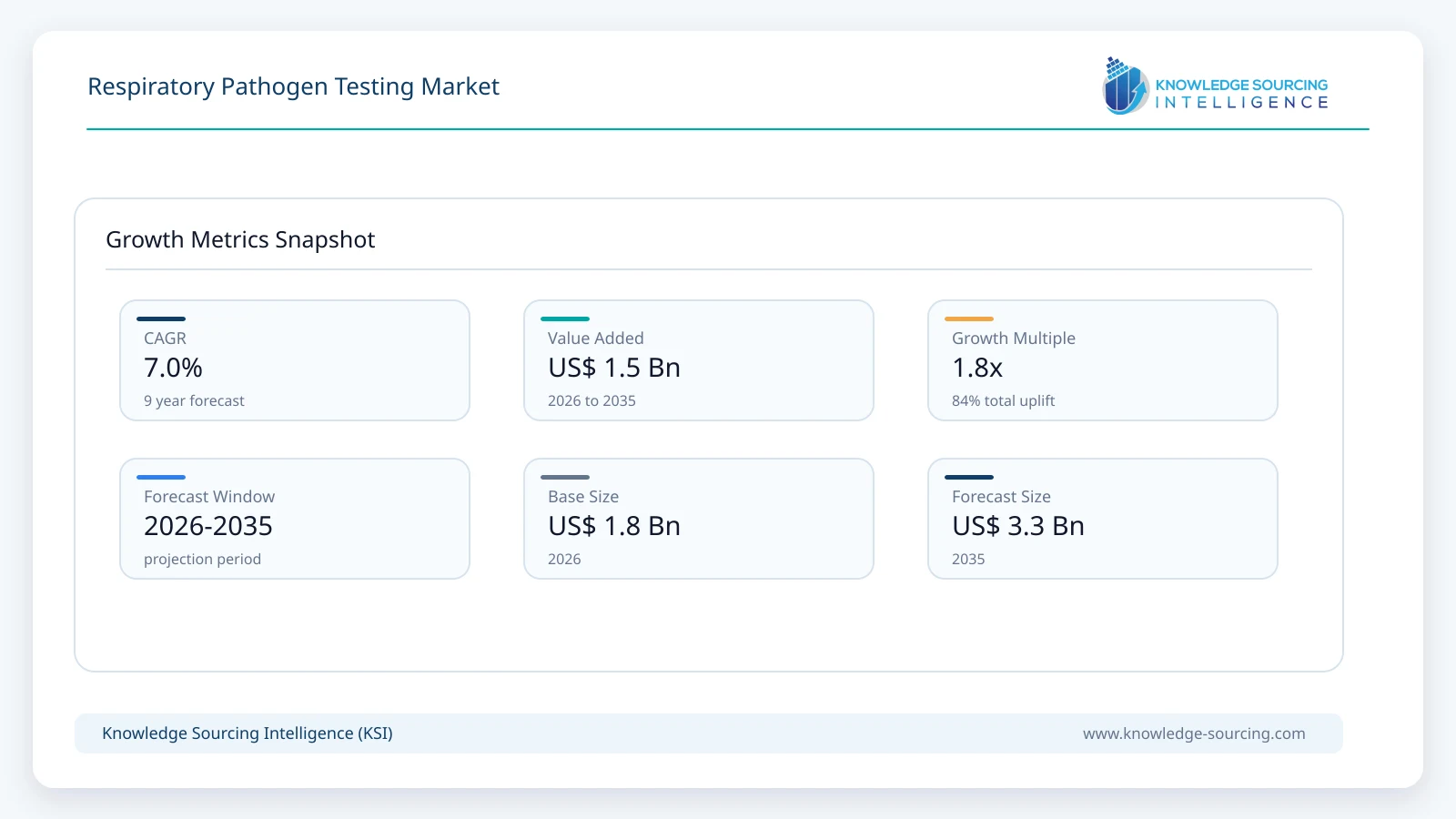
The Respiratory Pathogen Testing Market is expected to grow at a CAGR of 7.0% from a market value of USD 1.77 billion in 2026 to USD 3.25 billion in 2035.
Highlights:
- 1Rising circulation of multiple respiratory viruses is increasing demand for multiplex molecular testing because clinicians require simultaneous identification of several pathogens during a single patient encounter.
- 2Healthcare systems are expanding antimicrobial stewardship programs because accurate pathogen identification reduces unnecessary antibiotic prescribing and improves treatment precision.
- 3Regulatory agencies are strengthening performance standards because molecular diagnostics are becoming integral to national infectious disease surveillance strategies.
- 4Hospital laboratories are adopting automated high-throughput platforms because workforce shortages require higher operational efficiency without compromising diagnostic quality.
Respiratory pathogen testing identifies infectious microorganisms affecting the upper and lower respiratory tract through molecular, immunological, microbiological, and multiplex diagnostic technologies. The market enables accurate pathogen identification, antimicrobial stewardship, infection control, and surveillance across hospitals, diagnostic laboratories, and outpatient care settings.
Disease epidemiology is becoming increasingly dynamic because respiratory viruses, atypical bacteria, and opportunistic fungi are circulating simultaneously across multiple regions. Healthcare providers are therefore increasing reliance on comprehensive multiplex diagnostic assays instead of empirical treatment approaches. This shift reduces diagnostic uncertainty while improving targeted therapeutic decisions.
National surveillance programs are strengthening laboratory preparedness because governments are recognizing respiratory pathogens as continuing public health priorities after COVID-19. Investments in molecular laboratory infrastructure, genomic surveillance, and digital reporting systems are improving testing accessibility across both centralized and decentralized healthcare settings. These initiatives increase diagnostic capacity while supporting faster outbreak detection.
Regulatory oversight is evolving alongside diagnostic innovation because multiplex molecular assays, syndromic panels, and automated PCR systems require standardized analytical validation. Authorities, including the U.S. FDA, the European Commission under the In Vitro Diagnostic Regulation (IVDR), and regional health agencies, are encouraging higher clinical evidence requirements while facilitating review of clinically valuable respiratory diagnostics. The regulatory environment continues to support higher-quality diagnostic development without reducing innovation.
Market Dynamics
Market Drivers
Expanding Multiplex Molecular Diagnostics Is Improving Clinical Decision-Making: Respiratory infections frequently present with overlapping clinical symptoms, making laboratory confirmation essential for treatment selection. Healthcare providers are increasingly adopting multiplex PCR panels because they identify numerous respiratory pathogens from a single patient sample. Conventional single-pathogen testing limits diagnostic efficiency when multiple viruses circulate simultaneously. Diagnostic manufacturers are expanding syndromic respiratory panels that combine viral, bacterial, and atypical pathogen detection within automated workflows.
Respiratory Disease Surveillance Is Strengthening National Diagnostic Capacity: National surveillance programs depend on standardized laboratory testing to identify emerging respiratory outbreaks. Governments are increasing investments in molecular laboratory infrastructure because surveillance networks require higher diagnostic throughput and genomic monitoring capabilities. Seasonal influenza, respiratory syncytial virus (RSV), SARS-CoV-2, and novel respiratory pathogens continue generating sustained testing requirements beyond pandemic emergencies. Public health laboratories are integrating automated molecular platforms into surveillance networks, while hospitals are expanding routine respiratory testing.
Antimicrobial Stewardship Programs Are Increasing Diagnostic Utilization: Empirical antibiotic prescribing contributes to antimicrobial resistance because viral respiratory infections often resemble bacterial disease during early clinical evaluation. Hospitals increasingly require rapid pathogen confirmation before initiating targeted therapy. Diagnostic laboratories are expanding molecular respiratory testing because stewardship programs emphasize evidence-based antimicrobial selection. Healthcare providers reduce unnecessary antibiotic exposure when viral pathogens are rapidly identified.
Decentralized Molecular Testing Is Expanding Across Acute Care Settings: Emergency departments require rapid respiratory diagnosis because treatment delays increase hospitalization costs and infection transmission risks. Healthcare providers are adopting compact molecular platforms capable of delivering highly sensitive results within clinical workflows. Instrument manufacturers are introducing automated cartridge-based systems requiring minimal operator intervention. Outpatient clinics, urgent care centers, and community hospitals are increasingly implementing these technologies to reduce laboratory turnaround times.
Market Restraints
High acquisition and maintenance costs of automated molecular diagnostic platforms continue to limit adoption among smaller hospitals and resource-constrained healthcare systems.
Diverse regional reimbursement policies reduce testing accessibility because reimbursement levels frequently differ across molecular respiratory assays and multiplex diagnostic panels.
Frequent respiratory pathogen mutations require continuous assay validation, increasing research, regulatory, and manufacturing complexity for diagnostic developers.
Market Opportunities
Integration of Respiratory Diagnostics with Precision Infectious Disease Management: Precision infectious disease management relies on rapid identification of disease-causing microorganisms before targeted therapies begin. Pharmaceutical companies are expanding antiviral development while companion diagnostic requirements are becoming increasingly important. Diagnostic manufacturers are aligning multiplex respiratory platforms with precision treatment strategies to support personalized infectious disease management. These developments strengthen collaboration opportunities between diagnostic developers and pharmaceutical sponsors.
Artificial Intelligence Is Improving Laboratory Workflow Efficiency: Clinical laboratories process increasingly complex molecular datasets because multiplex respiratory panels generate larger diagnostic information volumes than traditional assays. Artificial intelligence applications are improving workflow prioritization, quality assurance, and automated interpretation. Laboratory software developers are integrating decision-support tools with molecular diagnostic platforms to reduce reporting delays.
Genomic Surveillance Programs Are Expanding Molecular Testing Infrastructure: Respiratory virus evolution requires continuous genomic monitoring because emerging variants influence diagnostic performance and public health responses. Governments are investing in sequencing infrastructure while reference laboratories are expanding genomic surveillance capabilities. Molecular diagnostic manufacturers are developing assays compatible with surveillance workflows to strengthen outbreak preparedness.
Respiratory Syndromic Testing Is Expanding Beyond Pandemic Applications: Routine respiratory care increasingly requires simultaneous identification of multiple pathogens because influenza, RSV, SARS-CoV-2, adenovirus, rhinovirus, and bacterial respiratory infections frequently coexist during seasonal outbreaks. Hospitals are incorporating syndromic testing into routine diagnostic algorithms rather than reserving multiplex assays for severe outbreaks. Diagnostic companies are broadening assay portfolios while healthcare systems are integrating respiratory panels into standard infectious disease protocols.
Disease & Epidemiology Analysis
Acute respiratory infections remain among the leading causes of global morbidity because viral and bacterial pathogens continue circulating across diverse demographic groups. Influenza viruses, respiratory syncytial virus (RSV), rhinoviruses, adenoviruses, human metapneumovirus, coronaviruses, Mycoplasma pneumoniae, Streptococcus pneumoniae, and opportunistic fungal organisms represent major diagnostic targets within respiratory testing. Their overlapping clinical presentation increases reliance on laboratory confirmation rather than symptom-based diagnosis alone.
Seasonal transmission patterns are becoming more complex because multiple respiratory viruses are co-circulating outside traditional influenza seasons. Healthcare providers are increasingly requesting multiplex molecular diagnostics to distinguish between pathogens that require antiviral therapy, antibiotic treatment, isolation precautions, or supportive care. This evolving epidemiology continues to increase diagnostic utilization across emergency departments, pediatric care, intensive care units, and outpatient settings.
Older adults, immunocompromised patients, individuals with chronic pulmonary disease, and pediatric populations remain the highest-risk groups for severe respiratory infections. Hospitals are strengthening early diagnostic protocols because delayed pathogen identification increases hospitalization duration, healthcare expenditures, and inappropriate antimicrobial use. Early laboratory confirmation remains central to effective respiratory disease management.
Treatment Guidelines Landscape
Organization | Guideline Focus | Impact on Respiratory Pathogen Testing |
World Health Organization (WHO) | Influenza surveillance and respiratory infection management | Recommends laboratory confirmation to support surveillance, outbreak detection, and public health response. |
U.S. Centers for Disease Control and Prevention (CDC) | Influenza and respiratory virus testing guidance | Supports molecular assays, particularly RT-PCR, for accurate diagnosis and infection control. |
Infectious Diseases Society of America (IDSA) | Influenza and community-acquired pneumonia guidelines | Encourages pathogen-directed diagnosis to improve antimicrobial stewardship and optimize treatment selection. |
European Centre for Disease Prevention and Control (ECDC) | Respiratory virus surveillance | Promotes standardized molecular surveillance across European laboratory networks. |
Market Segmentation
By Product Type
Assays and kits constitute the core revenue-generating segment because they determine the analytical performance, sensitivity, and specificity of respiratory pathogen testing workflows. Demand is shifting toward multiplex molecular assays as clinicians require simultaneous identification of viral, bacterial, and fungal pathogens from a single specimen. Conventional single-analyte testing increases laboratory workload and delays treatment decisions when several respiratory pathogens circulate concurrently. Diagnostic manufacturers are expanding respiratory syndromic panels with broader pathogen coverage, improved turnaround time, and compatibility with automated PCR platforms. This transition strengthens recurring reagent consumption while increasing long-term dependence on assay innovation rather than instrument replacement.
By Pathogen Type
Viral pathogens account for the largest share of testing demand because influenza viruses, respiratory syncytial virus (RSV), SARS-CoV-2, rhinoviruses, adenoviruses, human metapneumovirus, and seasonal coronaviruses remain the primary causes of acute respiratory infections. Disease surveillance programs are expanding viral monitoring as emerging variants continue influencing transmission dynamics and healthcare utilization. Clinical uncertainty increases during respiratory virus seasons because multiple viruses produce similar symptoms while requiring different treatment pathways and infection-control measures. Healthcare providers are therefore adopting multiplex molecular diagnostics capable of identifying several viral targets within a single test. This structural shift reinforces sustained investment in respiratory molecular diagnostics throughout both epidemic and routine healthcare settings.
By End User
Hospitals represent the leading end-user segment because critically ill patients require rapid laboratory confirmation to guide treatment, patient isolation, and antimicrobial stewardship decisions. Emergency departments and intensive care units are increasingly integrating molecular respiratory diagnostics into routine admission protocols as severe respiratory infections continue placing pressure on healthcare resources. Delayed diagnosis extends hospitalization, increases inappropriate antibiotic use, and elevates healthcare costs across inpatient settings. Hospital laboratories are expanding automated high-throughput molecular testing platforms alongside near-patient PCR systems to shorten diagnostic turnaround times. These investments position hospitals as the primary drivers of respiratory pathogen testing adoption.
Regional Analysis
North America Market Analysis
North America maintains the largest share of the respiratory pathogen testing market because the region combines advanced molecular diagnostic infrastructure with well-established infectious disease surveillance programs. Respiratory pathogen testing forms a routine component of clinical practice across hospitals, public health laboratories, and commercial diagnostic networks. Demand is increasing as multiplex molecular diagnostics replace sequential single-target testing for influenza, RSV, SARS-CoV-2, and atypical bacterial infections. This transition improves clinical efficiency while supporting antimicrobial stewardship initiatives throughout healthcare systems. The United States continues to strengthen respiratory surveillance because influenza, RSV, and emerging respiratory viruses remain significant public health concerns. Federal agencies are expanding genomic surveillance and laboratory reporting capabilities, while healthcare providers are integrating respiratory testing into standard clinical workflows.
Europe Market Analysis
Europe represents a mature respiratory diagnostics market because coordinated surveillance systems, harmonized regulatory oversight, and strong laboratory infrastructure support widespread molecular testing adoption. Seasonal influenza, RSV, and bacterial respiratory infections continue driving diagnostic utilization as aging populations increase vulnerability to severe respiratory disease. Healthcare providers are shifting toward comprehensive respiratory panels because syndromic testing improves diagnostic accuracy and reduces unnecessary antimicrobial prescribing. This transition supports increasing procurement of multiplex molecular platforms across both public and private healthcare systems. The implementation of the European Union's In Vitro Diagnostic Regulation (IVDR) is strengthening evidence requirements for diagnostic manufacturers while improving product quality and clinical validation.
Asia Pacific Market Analysis
Asia Pacific represents the fastest-evolving regional market because expanding healthcare infrastructure, growing infectious disease awareness, and increasing government investment are strengthening molecular diagnostic capacity. Population density and frequent respiratory disease outbreaks continue to increase demand for rapid laboratory diagnosis across both developed and emerging healthcare systems. Hospitals are expanding molecular testing capabilities because timely pathogen identification supports more effective infection control and clinical management. These developments create sustained demand for respiratory pathogen testing technologies. China continues to increase domestic molecular diagnostic production while expanding national infectious disease surveillance programs.
Rest of the World
The Rest of the World encompasses Latin America, the Middle East, and Africa, where respiratory pathogen testing demand varies according to healthcare infrastructure, laboratory capacity, and public health investment. Respiratory infections remain major contributors to morbidity because diagnostic access continues to differ across urban and rural healthcare settings. Governments are strengthening infectious disease preparedness while international health organizations are supporting laboratory modernization. These initiatives are gradually expanding access to molecular respiratory diagnostics. Latin American countries continue improving surveillance for influenza and other respiratory viruses because seasonal outbreaks frequently strain healthcare resources.
Regulatory Landscape
Respiratory pathogen testing operates within one of the most regulated areas of in vitro diagnostics because assay accuracy directly influences patient treatment, antimicrobial stewardship, and outbreak response. Regulatory agencies require manufacturers to demonstrate analytical sensitivity, specificity, reproducibility, and clinical performance before commercialization. Increasing adoption of multiplex molecular assays is raising regulatory expectations because simultaneous detection of multiple pathogens requires comprehensive validation across numerous clinical scenarios. These evolving standards strengthen product reliability while encouraging continuous technological improvement.
The United States Food and Drug Administration (FDA) continues regulating respiratory diagnostic assays through established in vitro diagnostic pathways while maintaining emergency authorization mechanisms when emerging respiratory threats require accelerated diagnostic availability. Regulatory review increasingly evaluates multiplex performance, analytical robustness, software integration, and post-market surveillance because diagnostic technologies are becoming more automated and clinically interconnected. These requirements encourage manufacturers to invest in extensive clinical evidence before product launch.
The European Union's In Vitro Diagnostic Regulation (IVDR) has fundamentally changed the regional regulatory environment by introducing more rigorous clinical evidence requirements, expanded oversight by notified bodies, and stronger post-market performance monitoring. Diagnostic developers are increasing investment in regulatory compliance because maintaining European market access depends upon successful IVDR certification. Similar modernization efforts are occurring across Asia-Pacific markets, where governments are strengthening diagnostic quality standards while encouraging local innovation and manufacturing capacity.
Pipeline Analysis
Respiratory pathogen diagnostic pipelines are increasingly focusing on multiplex molecular platforms capable of simultaneously detecting viral, bacterial, and fungal pathogens from a single specimen. Manufacturers are expanding respiratory panels beyond influenza, RSV, and SARS-CoV-2 because clinicians require comprehensive syndromic diagnosis during periods of co-circulating respiratory infections. Development programs increasingly combine PCR, isothermal amplification, and automated sample preparation technologies to reduce turnaround time while maintaining laboratory-grade analytical performance. These innovations are supporting both centralized laboratories and decentralized testing environments.
Several leading companies are advancing next-generation respiratory diagnostic platforms through continuous assay expansion rather than entirely new instrument development. Roche continues broadening the cobas molecular testing ecosystem with additional respiratory assays, while bioMérieux is expanding the BIOFIRE FilmArray respiratory panel portfolio to improve syndromic testing capabilities. QIAGEN continues developing the QIAstat-Dx respiratory platform through broader pathogen coverage and international commercialization activities. Thermo Fisher Scientific is strengthening multiplex PCR workflows supporting respiratory disease detection across clinical laboratories. Danaher subsidiaries, including Cepheid and Beckman Coulter Diagnostics, continue advancing rapid molecular respiratory diagnostics for hospital and near-patient settings.
Reimbursement Landscape
Reimbursement policies significantly influence the adoption of respiratory pathogen testing because advanced multiplex molecular diagnostics generally carry higher costs than conventional microbiological methods. Healthcare payers increasingly recognize the clinical value of rapid pathogen identification since early diagnosis reduces unnecessary antimicrobial prescribing, shortens hospitalization, and supports effective infection control. Coverage decisions, therefore, increasingly evaluate downstream healthcare savings alongside individual test costs. This approach strengthens reimbursement prospects for clinically validated multiplex molecular assays.
North America maintains the most established reimbursement environment through public and private healthcare payers supporting medically necessary respiratory molecular diagnostics. European reimbursement systems vary by country because national healthcare financing models determine diagnostic coverage according to clinical utility and cost-effectiveness assessments. Asia-Pacific reimbursement remains heterogeneous as developed healthcare systems expand molecular diagnostic coverage while several emerging markets continue relying on hospital-based procurement and government-supported public health programs. Continued demonstration of clinical and economic value is expected to strengthen reimbursement acceptance for advanced respiratory pathogen testing technologies.
Competitive Landscape
F. Hoffmann-La Roche Ltd.
Roche is a global leader in molecular diagnostics, offering the cobas® portfolio of PCR-based respiratory pathogen assays integrated with high-throughput laboratory automation. The company is strengthening its market position by expanding multiplex respiratory testing and digital laboratory connectivity to support large-scale infectious disease surveillance.
Abbott Laboratories
Abbott provides rapid molecular and immunoassay-based respiratory diagnostics through platforms including ID NOW™, Alinity, and m2000, addressing hospital and point-of-care testing needs. Its strategy emphasizes decentralized diagnostics and fast turnaround times to support timely clinical decision-making during seasonal and emerging respiratory outbreaks.
Thermo Fisher Scientific Inc.
Thermo Fisher Scientific develops RT-PCR reagents, instruments, and respiratory testing solutions that support clinical laboratories and public health surveillance worldwide. The company continues investing in laboratory automation, scalable molecular workflows, and assay innovation to improve diagnostic efficiency and testing capacity.
bioMérieux SA
bioMérieux specializes in syndromic infectious disease diagnostics through its BIOFIRE FilmArray Respiratory Panels, enabling rapid detection of multiple respiratory pathogens from a single sample. The company is expanding multiplex testing capabilities and integrating laboratory informatics to enhance antimicrobial stewardship and clinical workflow optimization.
QIAGEN N.V.
QIAGEN offers sample preparation technologies and the QIAstat-Dx Respiratory Panel, supporting comprehensive syndromic testing for viral and bacterial respiratory infections. Its strategic focus centers on expanding syndromic diagnostics, strengthening global commercialization, and integrating automated molecular workflows.
Danaher Corporation
Through subsidiaries including Cepheid and Beckman Coulter Diagnostics, Danaher provides rapid molecular respiratory testing and laboratory automation solutions. The company is advancing near-patient PCR diagnostics and connected laboratory systems to improve speed, accuracy, and accessibility of respiratory pathogen detection.
Key Developments
May 2026: Applied BioCode announced FDA clearance for KingFisher Nucleic Acid Extraction with BioCode Respiratory Pathogen Panel for IVD use, enhancing workflow flexibility by enabling seamless integration of the Thermo Fisher Scientific KingFisher Flex extraction platform with the BioCode MDx-3000 automated detection system for detecting 17 prevalent respiratory pathogens.
March 2026: BioMérieux received IVDR CE-marking for two BIOFIRE SPOTFIRE Respiratory/Sore Throat plus (R/STplus) Panels, including a Mini version, with Near-Patient Testing classification authorizing use at the patient's bedside (Point of Care), detecting up to 15 targets, including rhinovirus/enterovirus, Strep A, influenza, RSV, and SARS-CoV-2 in approximately 15 minutes during a typical visit.
March 2025: Roche launched the cobas eplex Respiratory Pathogen Panel 3, a fast and comprehensive test designed to help clinicians treat patients with respiratory infections in CE markets, providing rapid detection of multiple respiratory pathogens to support timely clinical decision-making and appropriate treatment.
Strategic Insights and Future Market Outlook
Respiratory pathogen testing is transitioning from outbreak-driven diagnostics to a routine component of infectious disease management because healthcare providers increasingly require rapid, multiplex identification of respiratory pathogens for appropriate treatment selection and antimicrobial stewardship. Diagnostic manufacturers are responding by expanding syndromic molecular panels, automating laboratory workflows, and integrating digital informatics, thereby strengthening recurring demand for assays and consumables.
Pipeline activity and regulatory evolution are supporting sustained market expansion as companies invest in broader pathogen coverage, decentralized molecular platforms, and AI-enabled diagnostic workflows. Future competition is expected to center on faster turnaround times, improved multiplex capabilities, interoperability with laboratory information systems, and compliance with evolving regulatory standards such as the EU IVDR and updated FDA diagnostic requirements.
Respiratory pathogen testing will remain strategically important as governments continue strengthening respiratory surveillance, healthcare systems prioritize pandemic preparedness, and precision infectious disease management becomes increasingly dependent on rapid molecular diagnosis. Companies capable of combining comprehensive respiratory panels with automated, scalable, and cost-effective diagnostic platforms are expected to maintain a competitive advantage throughout the forecast period.
Respiratory Pathogen Testing Market Scope:
| Report Metric | Details |
|---|---|
| Total Market Size in 2026 | USD 1.77 billion |
| Total Market Size in 2035 | USD 3.25 billion |
| Forecast Unit | USD Billion |
| Growth Rate | 7.0% |
| Study Period | 2021 to 2035 |
| Historical Data | 2021 to 2024 |
| Base Year | 2025 |
| Forecast Period | 2026 – 2035 |
| Segmentation | Product Type, Technology, End User, Geography |
| Companies |
|
Market Segmentation
Product Type
Technology
End User
Geography
- North America
- South America
- Europe
- Middle East and Africa
- Asia Pacific
Table of Contents
1. EXECUTIVE SUMMARY
1.1 Market Snapshot
1.2 Key Findings
1.3 Analyst Insights
1.4 Strategic Recommendations
2. RESEARCH METHODOLOGY
2.1 Research Design
2.2 Data Collection Methodology
2.3 Market Size Estimation
2.4 Forecasting Model
2.5 Assumptions & Limitations
3. RESPIRATORY PATHOGEN TESTING MARKET OVERVIEW, SIZE & FORECAST
3.1 Market Definition & Scope
3.2 Industry Overview
3.3 Industry Evolution
3.4 Key Market Trends
3.5 Historical Market Size Analysis (2021–2025)
3.6 Market Forecast (2026–2035)
3.7 Respiratory Disease Burden and Testing Demand Analysis
3.8 Testing Volume Analysis
3.9 Diagnostic Workflow and Patient Testing Pathway
3.10 Testing Guidelines and Clinical Practice Trends
4. MARKET DYNAMICS
4.1 Market Drivers
4.2 Market Restraints
4.3 Market Opportunities
4.4 Market Challenges
5. INDUSTRY LANDSCAPE
5.1 Industry Value Chain Analysis
5.2 Pricing Analysis
5.3 Reimbursement Landscape
6. INNOVATION LANDSCAPE
6.1 Emerging Diagnostic Technologies
6.2 Product Innovation Analysis
6.3 Clinical Trial Analysis
6.4 Pipeline Analysis
6.5 Multiplex Testing and Syndromic Panel Developments
6.6 Artificial Intelligence and Digital Diagnostics Integration
7. REGULATORY LANDSCAPE
7.1 Regulatory Framework
7.2 Approval Pathways
7.3 Compliance Requirements
8. RESPIRATORY PATHOGEN TESTING MARKET LANDSCAPE ANALYSIS
8.1 Analysis by Technology Platform
8.2 Analysis by Testing Methodology
8.3 Analysis by Sample Type
8.4 Analysis by Clinical Application
8.5 Analysis by Pathogen Type
8.6 Analysis by End-user Setting
9. RESPIRATORY PATHOGEN TESTING MARKET SEGMENT ANALYSIS (2021–2035)
9.1 By Product Type
9.1.1 Assays & Kits
9.1.2 Reagents & Consumables
9.1.3 Software & Informatics
9.2 By Technology
9.2.1 Polymerase Chain Reaction (PCR)
9.2.2 Isothermal Nucleic Acid Amplification
9.2.3 Next-Generation Sequencing (NGS)
9.2.4 Microarray-Based Testing
9.2.5 Immunoassays
9.2.6 Others
9.3 By Pathogen Type
9.3.1 Viral Pathogens
9.3.1.1 Influenza Viruses
9.3.1.2 SARS-CoV-2
9.3.1.3 Respiratory Syncytial Virus (RSV)
9.3.1.4 Human Rhinovirus/Enterovirus
9.3.1.5 Adenovirus
9.3.1.6 Human Metapneumovirus
9.3.1.7 Parainfluenza Viruses
9.3.1.8 Others
9.3.2 Bacterial Pathogens
9.3.2.1 Mycoplasma pneumoniae
9.3.2.2 Chlamydia pneumoniae
9.3.2.3 Bordetella pertussis
9.3.2.4 Legionella pneumophila
9.3.2.5 Others
9.3.3 Fungal Pathogens
9.4 By Sample Type
9.4.1 Nasopharyngeal Swab
9.4.2 Blood
9.4.4 Sputum
9.4.5 Bronchoalveolar Lavage (BAL)
9.4.6 Others
9.5 By End User
9.5.1 Hospitals
9.5.2 Diagnostic Laboratories
9.5.3 Outpaitents & Clinics
9.5.4 Others
10. RESPIRATORY PATHOGEN TESTING MARKET GEOGRAPHICAL ANALYSIS (2021–2035)
10.1 North America
10.2 Europe
10.3 Asia-Pacific
10.4 South America
10.5 Middle East & Africa
11. RESPIRATORY PATHOGEN TESTING MARKET COUNTRY ANALYSIS (2021–2035)
11.1 United States
11.2 Canada
11.3 Germany
11.4 United Kingdom
11.5 France
11.6 Italy
11.7 Spain
11.8 Netherlands
11.9 China
11.10 Japan
11.11 India
11.12 South Korea
11.13 Australia
11.14 Brazil
11.15 Mexico
11.16 Saudi Arabia
11.17 South Africa
12. COMPETITIVE LANDSCAPE
12.1 Market Share Analysis
12.2 Strategic Developments
12.3 Mergers & Acquisitions, Partnerships & Collaborations
12.4 Product Launches
13. COMPANY PROFILES
13.1 F. Hoffmann-La Roche Ltd.
13.1.1 Company Overview
13.1.2 Financials
13.1.3 Product Portfolio
13.1.4 Recent Developments
13.2 Abbott Laboratories
13.3 Thermo Fisher Scientific Inc.
13.4 bioMérieux SA
13.5 QIAGEN N.V.
13.6 Danaher Corporation
13.7 Becton, Dickinson and Company
13.8 QuidelOrtho Corporation
13.9 Hologic, Inc.
13.10 DiaSorin S.p.A.
14. RESPIRATORY PATHOGEN TESTING MARKET COMMERCIAL FORECAST ANALYSIS
14.1 Molecular Respiratory Diagnostic Tests
14.2 Multiplex Respiratory Pathogen Panels
14.3 Rapid Antigen Tests
14.4 Syndromic Testing Platforms
14.5 Point-of-Care Molecular Testing Systems
14.6 High-Throughput Laboratory Testing Platforms
15. INVESTMENT & FUNDING ANALYSIS
15.1 Venture Capital Trends
15.2 Government Funding
15.3 R&D Investments
16. FUTURE OUTLOOK
16.1 Key Growth Opportunities
16.2 Future Industry Trends
Navigate
Trusted by the world's leading organizations











