
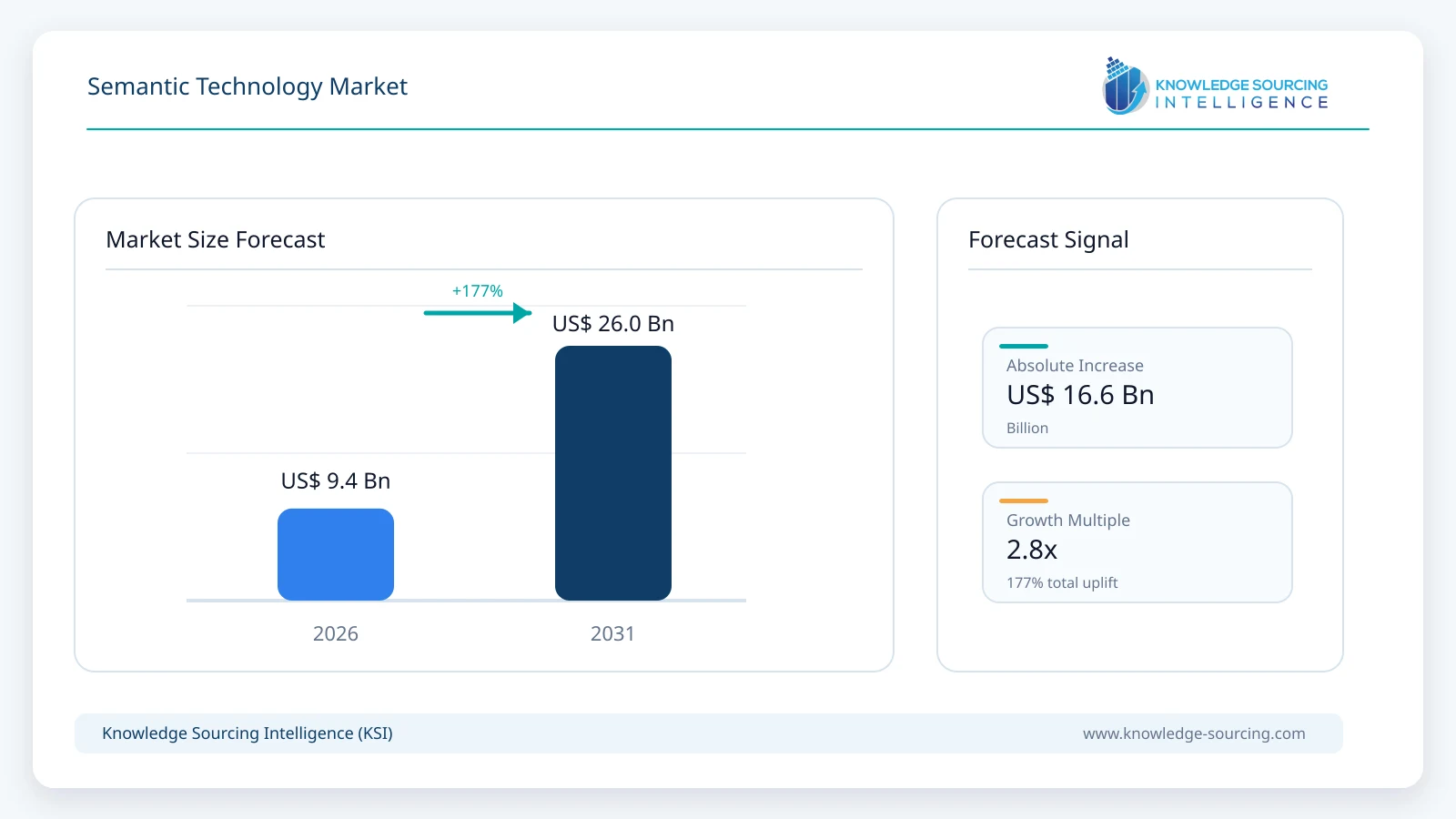
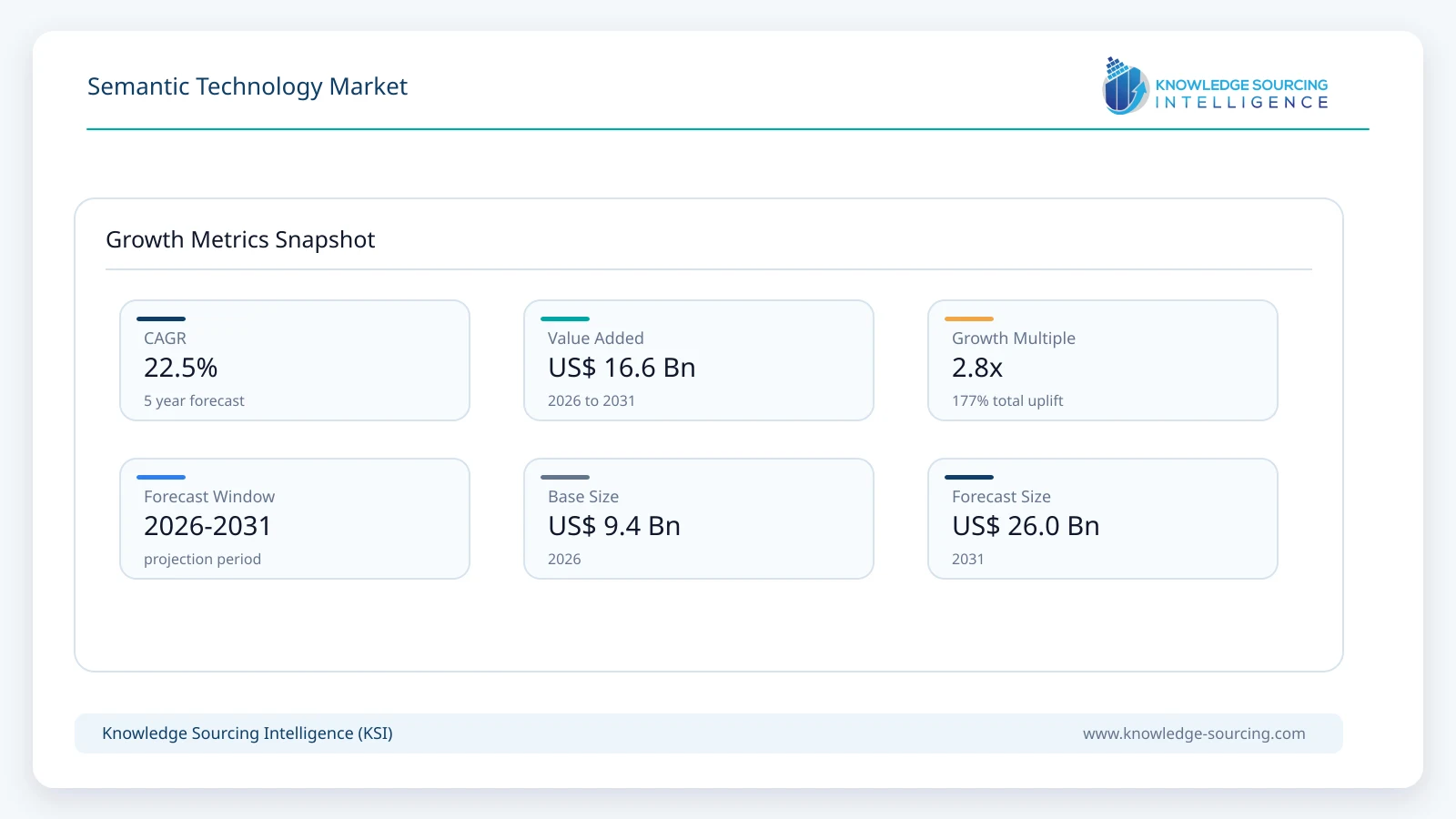
The Semantic Technology Market is forecast to grow at a CAGR of 22.5%, reaching USD 26.0 billion in 2031 from USD 9.4 billion in 2026.
Highlights:
- 1RDF is an underlying technology serving as a standardized graph-based data representation for connecting entities and relationships.
- 2AI and analytics are high-growth applications as semantic layers and knowledge graphs are being used to deliver trusted context to AI systems.
- 3Data integration and discovery is a use case where it will be applicable for an enterprise, particularly wherever an organization is looking at connecting siloed structured, semi-structured, or unstructured information.
- 4With grounded retrieval and reasoning needed for enterprise AI, knowledge graphs may be the crucial way to connect semantic technology with GenAI.
Semantic technology is a suite of technologies that allow machines and applications to read, write, relate, query, and reason on information as it relates to its meaning. The technology provides a semantic layer between raw data and applications, enabling organizations to define entities, for example, customers, products, assets, locations, transactions, documents, and processes, and then relate them. According to W3C, the Semantic Web is a common framework that provides a standard way for data to be shared and reused across application, enterprise, and community boundaries, in which RDF acts as one of its foundational layers.
The market includes software such as platforms, databases, semantic modeling tools, ontology management environments, query engines, and methods associated with inquiry request modeling by data structures such as semantic search platforms, KG technology knowledge graphs, and related professional services. RDF works by representing information as linked graph statements; OWL provides more expressive ontology-based representations and relationships; SPARQL is used to query RDF graphs.
Semantic technology is a part of enterprise data and AI architecture in today's scenario. Semantic layers are being created by organizations to map technical schemas to business concepts and connect the concepts to physical data. This will get rid of inconsistent definitions in departments and also provide structured criteria for AI systems based on context, relationships, provenance, and governance.
Additionally, it is also being used with knowledge graphs and generative AI. Graph-based semantic and knowledge models realize multiple database and document theories, enabling AI applications to access information via relations between data items as opposed to retrieving them through single disconnected documents. There are companies like Graphwise that integrate their GraphDB technology with a focus on RDF, SPARQL, semantic linking, data integration, and real-time AI insights.
Market Dynamics
Market Drivers
Rising need for AI-ready data in enterprises: Enterprises are beginning to realize that not only does AI need lots of data, but such data also must maintain consistent meaning and relationships with provenance and context. Semantic ontologies are defining business concepts and relationships in an explicit manner, and knowledge graphs are interspersing these definitions with operational data. TopQuadrant's 2026 work is about enabling the ability to set up a foundation for AI-ready data through semantic ontologies and knowledge graphs, where business concepts, relationships, metadata, and governance are clearly expressed.
Growing role of knowledge graphs and semantic layers: More organizations are engaging in the deployment of knowledge graphs to interlink data that is spread across disparate databases, data warehouses, documents, and applications. Rather than rebuilding business logic independently in each system, semantic layers are enabling businesses to use a common definition that can be reused across analytics, governance, applications, and AI.
Emergence of semantic search and contextual discovery: Conventional keyword search is falling flat when users seek concepts, relationships, intent, and context within vast repositories of information. Semantic search solves this with an interpretation of the meaning of queries and relationships between concepts. Semantic search shifts the focus from matching simply based on keyword combinations in literal or close variants of sentences, paragraphs, and documents to contextual meaning and search intent, according to Google.
Integration with requirements for data between heterogeneous systems: Enterprises are operating in highly fragmented data environments with relational databases, data lakes, cloud warehouses, documents, APIs, and external datasets. Semantic technology allows these sources to have homogeneous representation without ever consolidating every source. For instance, GraphDB supports semantic linking, MongoDB integration with SQL access using a JDBC driver, Kafka-based synchronization, and virtualization of SQL-accessible data as one of many supported graph query services.
Market Restraints & Opportunities
The creation of quality ontologies needs an organization to specify concepts, relationships, constraints, business rules, and the terminology consistently across departments. This usually consists of knowledge-engineering skills, along with governance, which demand more complexity and cost to implement.
There could be added complexity to the deployment since it likely involves mapping existing schemas into semantic models and then maintaining those mappings as source systems change.
This creates opportunity for semantic layers to provide AI systems with the governed business context, relationships, and machine-readable meaning. This is especially true now that enterprises are deploying AI agents needing guaranteed access to organizational knowledge rather than freestyling off unstructured retrieval.
It's creating a window for some semantic technology vendors to combine structured relationships with LLM-driven retrieval based on knowledge graphs. Common representations across complex datasets are now a requirement of organizations spanning healthcare, life sciences, financial services, manufacturing, energy, and government.
Key Developments
June 2026: W3C published as a draft standard, and work continued on protocol & update, federated query service description, and entailment regimes. This is building the foundations for standards-based querying and interoperability of semantic data.
June 2026: Event-Wingspan launched by Onix in Europe as an enterprise agentic-AI and semantic-intelligence platform built around Onix Semantic Twin. This Semantic Twin layer would constantly track and represent an organization's data landscape, system interrelations, and business context, continuously supporting governed and auditable AI execution.
Semantic Technology Market Segmentation
The market is segmented by component, type, application, end user, and geography.
By Component
Software
Software is predicted to dominate the largest share of the semantic technology market as Semantic databases, ontology platforms, RDF stores, SPARQL engines, semantic search platforms, knowledge-graph systems, and semantic modeling environments make up the technical foundation. For instance, GraphDB offers a graph-based enterprise RDF engine with full support for RDF and SPARQL, as well as intrinsic functionality to link data, integrate data, search semantically, and bolster AI applications.
The software layer is also evolving out of traditional semantic repositories towards enterprise semantic layers, GraphRAG, AI context platforms, and knowledge-graph-enabled agents. This progression can be seen in the Designer feature of Stardog, which allows users to build semantic models visually and connect to a wide variety of underlying data sources. Even if services are important, organizations need ontology development, semantic modeling, taxonomy engineering, integration, migration, implementation, customization, and governance.
By Type
Resource Description Framework (RDF)
RDF is predicted to continue to lead due mainly to the fact that RDF provides the foundational graph-based representation for semantic information described in terms of entities, properties, and relationships. RDF is one of the core standards identified by W3C as being a foundational technology for the Semantic Web, and the ongoing work within W3C is aimed at producing RDF specifications.
Additionally, RDF is so important to enterprise knowledge graphs, as they need the ability to link heterogeneous information while still maintaining machine-readable relations between that data. GraphDB is an enterprise RDF engine built directly around RDF+SPARQL to connect fragmented pieces of business data.
Additionally, OWL is more common in places where organizations need richer definitions of ontologies, along with defining logical relationships and reasoning, while regular SPARQL queries or updates are necessary for an RDF-based graph.
By Application
Data Integration & Data Discovery
Data Integration & Data Discovery is projected to be the largest application segment, as enterprises are now increasingly leveraging semantic models for connecting information distributed across databases, data lakes, documents, applications, and external datasets. Semantic technology gives users the ability to find data contextually rather than matching on fields or keywords.
For instance, GraphDB aims to connect disparate business data via semantic linking and allows integration for structured and semi-structured sources. The enterprise knowledge graph of Stardog takes a similar course with its focus on virtual and semantic data, inference, and improved analytics access.
Semantic Search is one more major application as organizations look for increasingly contextually relevant results. This is driven by the expectation of continued strong growth in AI and analytics, as semantic layers give more structure and context to generative AI, GraphRAG, and enterprise analytics.
Regional Analysis
North America Market Analysis
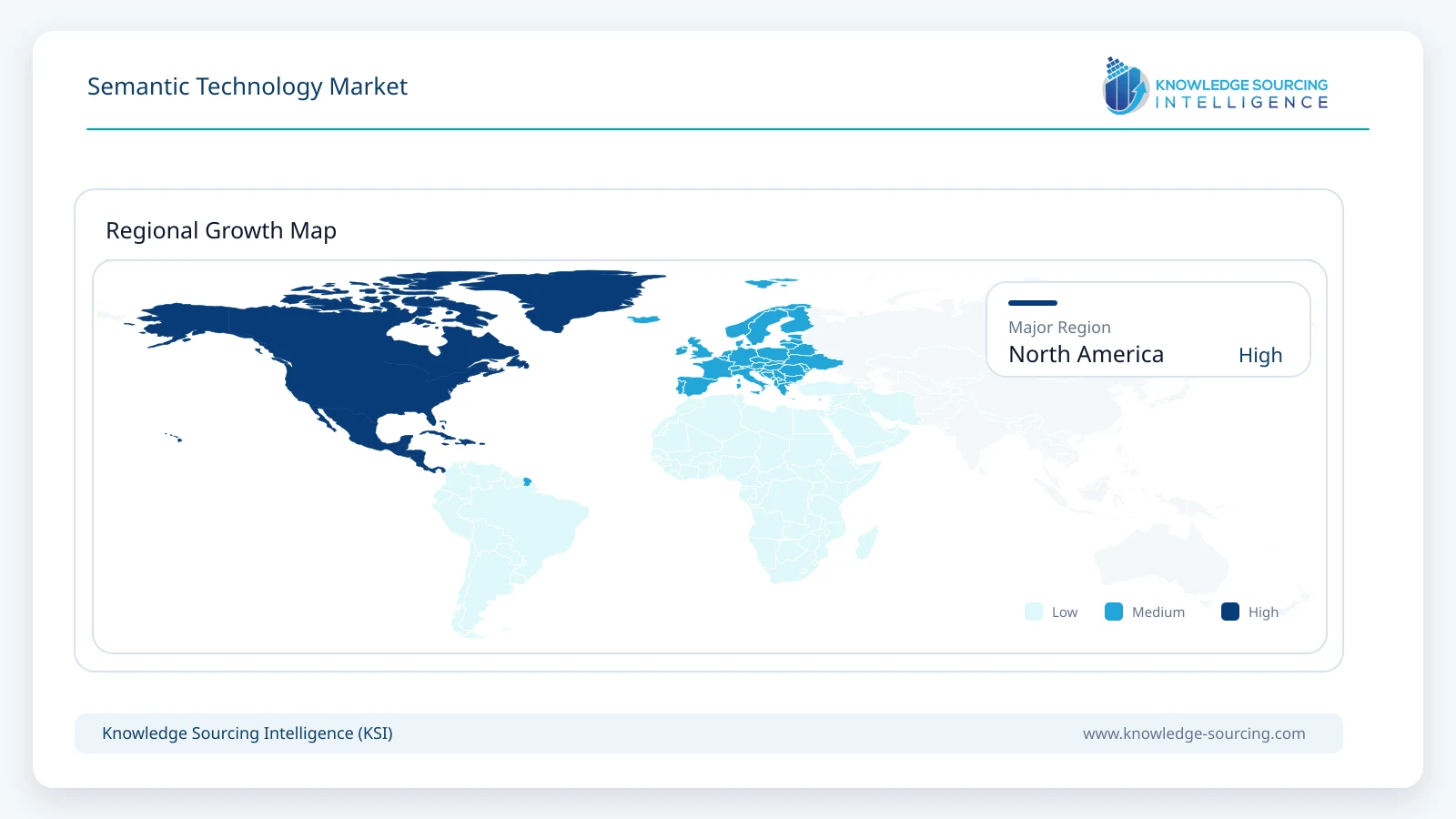
North America is estimated to hold the largest market share, as various enterprises across the United States and Canada are heavily investing in enterprise AI, knowledge graphs, data governance, semantic search, and advanced analytics. There are a large number of technology providers in the region building knowledge-graph databases, AI platforms, and semantic search systems for enterprise data infrastructure.
South America Market Analysis
Enterprise digital transformation, data integration and analytics, financial sector analytics, telecommunications analytics solutions, and public-sector modernisation are the primary areas where semantic technology is being embraced in South America. With organizations increasingly having to deal with heterogeneous datasets in fragmented information environments, there is a space for semantic models that fill these gaps by providing common definitions across systems.
Europe Market Analysis
Europe is a key semantic technology market due to its long-term investment in Semantic Web research, knowledge representation, linked data, and enterprise data governance. The region also has big semantic technology players like Graphwise and Semantic Web Company/ PoolParty.
Middle East and Africa Market Analysis
Middle East & Africa market is maturing across digital government, financial services, telecommunications, energy, and enterprise data modernization. Rising demand for a unified overview across diverse data sources opens up the potential for semantic-based data integration and related technologies.
Asia Pacific Market Analysis
Asia Pacific is likely to sustain strong growth with enterprises extending their digital transformation, AI, data integration, and knowledge-management initiatives. Japan, South Korea, China, India, Singapore, and Australia are building local data ecosystems across technology, manufacturing, health care, and finance as well as in the public sector, where semantic interoperability can serve to mitigate fragmentation.
List of Companies
Ontotext AD (Graphwise)
Stardog Union
InMoment
Linkurious SAS
Semantic Web Company
Semantic Web Tech Pvt Ltd
Expert.ai
Onix Networking Corp
TopQuadrant
Ontotext AD (Graphwise)
The company’s GraphDB platform is an enterprise RDF graph database supporting timed RDF, SPARQL, semantic linking, data integration, semantic search, and AI applications. The company is promoting its graph infrastructure as a base for enterprise AI and GraphRAG.
Stardog Union
Stardog offers an enterprise knowledge-graph platform for connecting, semantically augmenting, and performing graph-based discovery of distributed enterprise data. It provides no-code semantic modeling and integration with existing data lakes and warehouses through its Stardog Designer, and extends knowledge graphs into natural-language enterprise data access via its Voicebox technology.
InMoment
InMoment offers a semantic technology ecosystem, with a specialisation in customer-experience analytics, conversational intelligence, text analytics and sentiment understanding, and a core RDF/OWL infrastructure provider with major applications. The platform analyzes unstructured data for context around conversational and customer feedback data.
Analyst View
The semantic technology market is in a transition from conventional implementations of the Semantic Web to an enterprise semantic layer, knowledge graphs, aspects of semantic search and AI-ready data foundations. RDF, OWL, and SPARQL remain a crucial part of the technical foundation whilst generative AI and agentic applications are challenging existing conceptual divisions in demand for governed meaning, relations, and contextual data across enterprise environments.
Semantic Technology Market Scope:
| Report Metric | Details |
|---|---|
| Total Market Size in 2026 | USD 9.4 billion |
| Total Market Size in 2031 | USD 26.0 billion |
| Forecast Unit | USD Billion |
| Growth Rate | 22.5% |
| Study Period | 2021 to 2031 |
| Historical Data | 2021 to 2024 |
| Base Year | 2025 |
| Forecast Period | 2026 – 2031 |
| Segmentation | Component, Type, Application, End User, Geography |
| Companies |
|
Market Segmentation
By Component
Software
Services
By Type
Resource Description Framework (RDF)
Web Ontology Language (OWL)
SPARQL Protocol and RDF Query Language (SPARQL)
Others
By Application
Semantic Search
Data Integration and Data Discovery
E-Commerce and Search
AI and Analytics
Others
By End User
Media and Publishing
Healthcare and Life Sciences
Retail and E-Commerce
IT and Telecommunications
Others
By Geography
North America
United States
Canada
Mexico
South America
Brazil
Argentina
Others
Europe
United Kingdom
Germany
France
Others
Middle East and Africa
Saudi Arabia
UAE
Others
Asia Pacific
China
Japan
India
South Korea
Others
Table of Contents
1. EXECUTIVE SUMMARY
2. MARKET SNAPSHOT
2.1. Market Overview
2.2. Market Definition
2.3. Scope of the Study
2.4. Market Segmentation
3. MARKET DYNAMICS
3.1. Market Drivers
3.2. Market Restraints
3.3. Market Opportunities
3.4. Porter’s Five Forces Analysis
3.5. Industry Value Chain Analysis
4. BUSINESS LANDSCAPE
4.1. Semantic Technology Standards, Governance and Interoperability Landscape
4.2. Semantic Data Integration and Enterprise Information Architecture Analysis
4.3. Knowledge Graph, Ontology and Semantic-Layer Adoption Analysis
4.4. Strategic Recommendations
5. TECHNOLOGICAL OUTLOOK
5.1. Ontology, Taxonomy and Knowledge Representation Technologies
5.2. Knowledge Graph and Graph Database Technologies
5.3. Semantic Search, Retrieval and Query Technologies
5.4. AI, GraphRAG and Neural-Symbolic Technologies
6. SEMANTIC TECHNOLOGY MARKET BY COMPONENT
6.1. Introduction
6.2. Software
6.3. Services
7. SEMANTIC TECHNOLOGY MARKET BY TYPE
7.1. Introduction
7.2. Resource Description Framework (RDF)
7.3. Web Ontology Language (OWL)
7.4.SPARQL Protocol and RDF Query Language (SPARQL)
7.5. Others
8. SEMANTIC TECHNOLOGY MARKET BY APPLICATION
8.1. Introduction
8.2. Semantic Search
8.3. Data Integration & Data Discovery
8.4. E-Commerce and Search
8.5. AI and Analytics
8.6. Others
9. SEMANTIC TECHNOLOGY MARKET BY END USER
9.1. Introduction
8.2. Media and Publishing
8.3. Healthcare & Life Science
8.4. Retail & E-commerce
8.5. IT & Telecommunications
9.7. Others
10. SEMANTIC TECHNOLOGY MARKET BY GEOGRAPHY
10.1. Introduction
10.2. North America
10.2.1. USA
10.2.2. Canada
10.2.3. Mexico
10.3. South America
10.3.1. Brazil
10.3.2. Argentina
10.3.3. Others
10.4. Europe
10.4.1. United Kingdom
10.4.2. Germany
10.4.3. France
10.4.4. Others
10.5. Middle East and Africa
10.5.1. Saudi Arabia
10.5.2. UAE
10.5.3. Others
10.6. Asia Pacific
10.6.1. China
10.6.2. Japan
10.6.3. India
10.6.4. South Korea
10.6.5. Others
11. COMPETITIVE ENVIRONMENT AND ANALYSIS
11.1. Major Players and Strategy Analysis
11.2. Market Share Analysis
11.3. Mergers, Acquisitions, Agreements, and Collaborations
11.4. Competitive Dashboard
12. COMPANY PROFILES
12.1. Ontotext AD (Graphwise)
12.2. Stardog Union
12.3. InMoment
12.4. Linkurious SAS
12.5. Semantic Web Company
12.6. Semantic Web Tech Pvt Ltd
12.7. Expert.ai
12.8. Onix Networking Corp
12.9. TopQuadrant
13. APPENDIX
13.1. Currency
13.2. Assumptions
13.3. Base and Forecast Years Timeline
13.4. Key benefits for the stakeholders
13.5. Research Methodology
13.6. Abbreviations
Navigate
Trusted by the world's leading organizations











