
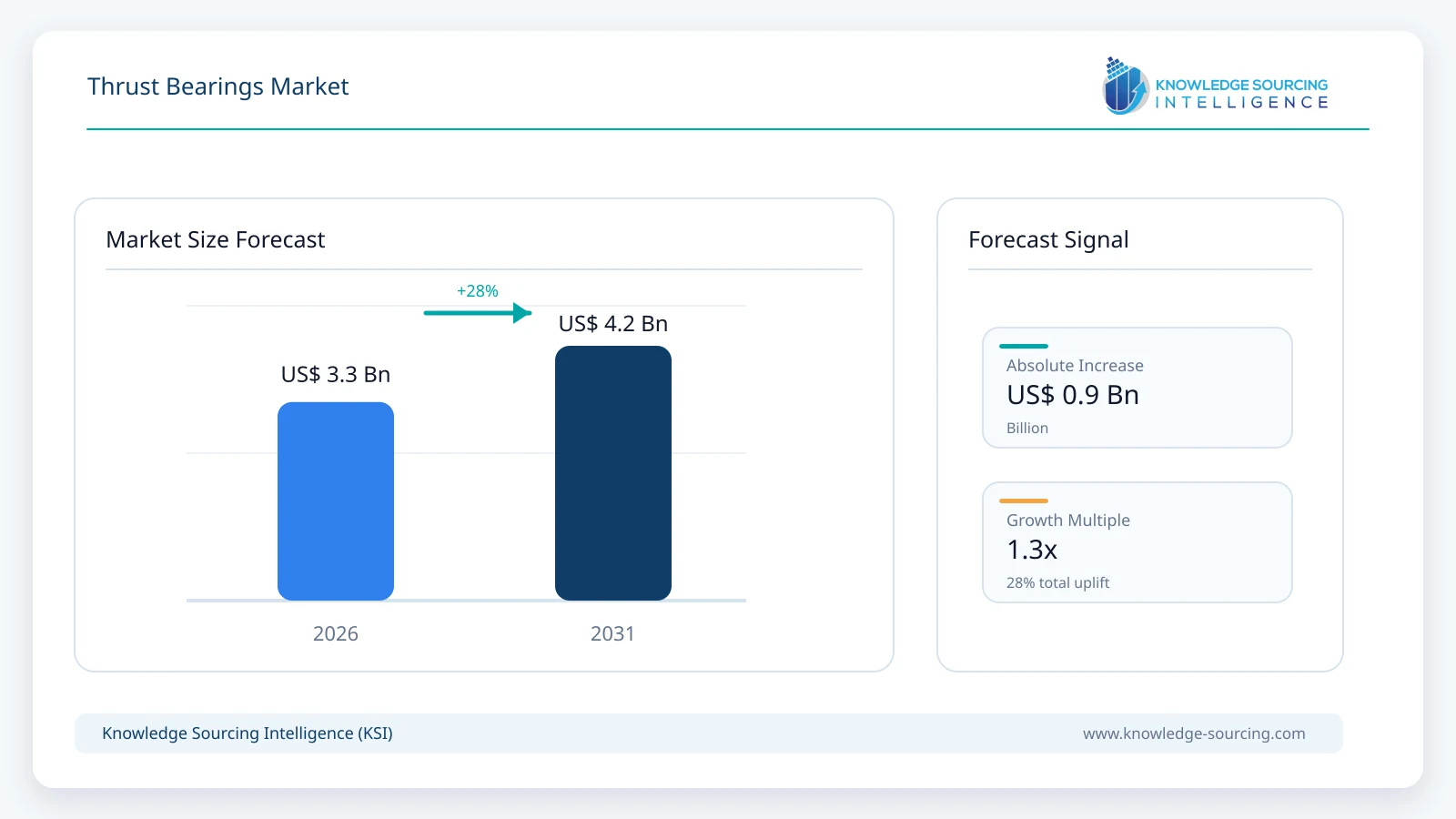
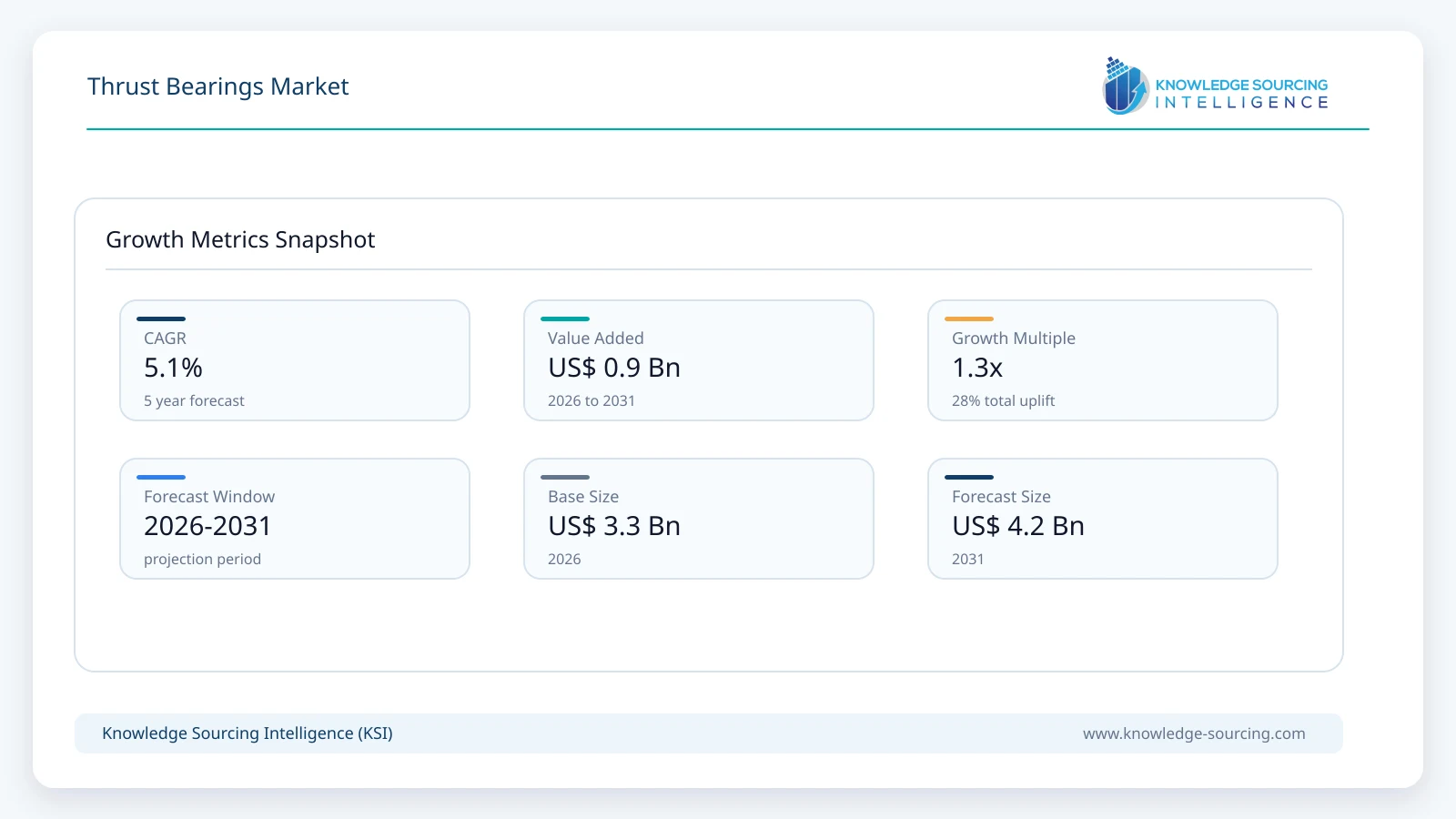
The Thrust Bearings Market is forecasted to rise at a 5.1% CAGR, reaching USD 4.17 billion in 2031 from USD 3.25 billion in 2026.
Highlights:
- 1Thrust Roller Bearings account for approximately 64% of market value in 2026, supported by heavy industrial, energy, construction and large-equipment applications.
- 2Thrust Ball Bearings remain important in higher-speed and moderate-load applications, including pumps, compressors, machine tools and precision positioning equipment.
- 3Bearing Steel remains the dominant material platform, while Ceramic/Hybrid Ceramic bearings are projected to grow at a double-digit rate from a smaller base.
- 4Industrial applications constitute the largest end-user segment, while Power and Energy records one of the strongest growth rates through 2031.
- 5Asia Pacific represents approximately 42% of global market value in 2026, supported by industrial machinery, automotive production, manufacturing investment and rapid wind-energy additions.
- 6Global wind installations reached a record 165 GW in 2025, materially expanding the installed base of turbine drivetrain and main-shaft systems requiring engineered bearing solutions.
Demand is supported by the increasing value and complexity of rotating equipment across industrial machinery, energy systems, automotive powertrains, aerospace, and precision manufacturing. Thrust bearings are specifically designed to manage axial loads acting parallel to a rotating shaft, making them essential where shaft position must be maintained under sustained or intermittent thrust.
Thrust Roller Bearings account for the largest share of market value in 2026 because roller designs provide high axial load capacity and rigidity across large industrial equipment, gearboxes, construction machinery, energy systems, and other severe-duty applications. Cylindrical, tapered and spherical thrust roller designs address different combinations of load, speed, alignment and equipment architecture, with spherical roller thrust bearings particularly valuable where shaft deflection or mounting misalignment must be accommodated. NSK identifies applications including crushers, vertical motors, gearboxes, mining and construction machinery, steelmaking equipment and oil and gas machinery, illustrating the breadth of high-value industrial demand.
The market is also shifting gradually toward higher-value materials and integrated reliability solutions. Conventional bearing steel remains the standard material for the majority of rings and rolling elements, but ceramic rolling elements are being adopted where lower mass, electrical insulation, reduced heat generation or high-speed performance justify the additional cost. SKF identifies carbon-chromium bearing steel as the standard material for bearing rings and washers, while NSK and JTEKT continue to expand silicon-nitride ceramic solutions for high-speed and electrically sensitive applications. This makes the transition better described as an increase in hybrid ceramic penetration rather than a wholesale replacement of steel bearings.
Power and Energy provide one of the strongest forecast-period growth opportunities. The global wind industry added a record 165 GW of new capacity in 2025, increasing installed wind capacity to approximately 1,299 GW. Larger turbines create demanding main-shaft and drivetrain loading conditions and increase the economic consequences of bearing failure, supporting demand for engineered bearing systems, improved lubrication and condition monitoring. The commercial opportunity extends beyond new turbine construction because the expanding installed base creates recurring maintenance, replacement and monitoring requirements.
Market Growth Drivers and Trends
Industrial Machinery and Automation Are Increasing Bearing Performance Requirements
Industrial machinery remains the largest structural source of thrust-bearing demand because axial loads occur across presses, gearboxes, pumps, compressors, injection-moulding machines, machine tools, extruders, cranes and material-processing equipment. These applications do not use a single bearing architecture. Thrust ball bearings are suitable for axial loads at relatively high speeds, while roller designs provide greater load capacity and rigidity where heavy machinery generates substantial shaft forces. NSK’s current product portfolio reflects this distinction, with thrust ball bearings used in equipment including vacuum pumps, compressors, press machines and positioning systems, while thrust roller bearings serve extruders, excavators, cranes and other heavy equipment.
Automation raises the commercial value of bearing reliability because a relatively small mechanical failure can stop an entire production cell or continuous process. Manufacturers are therefore paying greater attention to service life, lubrication, vibration, contamination control and predictive maintenance rather than selecting bearings solely on initial acquisition cost. This favours suppliers capable of combining application engineering with condition monitoring and lifecycle support. Industrial equipment consequently remains the largest end-user category throughout the forecast period, although its share changes only modestly as energy and aerospace applications grow faster.
Wind Power Expansion Is Increasing Demand for Heavy-Duty Bearing Systems
Wind power is creating a substantial installed base of rotating equipment operating under variable axial and radial loads. GWEC reports that 165 GW of wind capacity was connected globally in 2025, 40% above the previous record, while 28,395 turbines were mechanically installed during the year. China alone accounted for more than 120 GW of commissioned capacity, while India, the United States and several European markets also recorded significant additions.
Bearing requirements increase as turbine dimensions and rotor loads rise. Timken’s UltraWind systems use tapered roller bearings integrated with seals, lubrication and condition monitoring to manage main-shaft loads in geared and gearless turbine configurations. Waukesha Bearings’ 2026 NordAlign development takes another approach by using fluid-film technology that dynamically adjusts to radial and axial movement and is designed to reduce maintenance requirements in large turbines. These developments demonstrate that the commercial opportunity extends beyond conventional bearing replacement toward engineered bearing systems that reduce lifecycle cost.
Power & Energy is therefore projected to grow at approximately 8% annually through 2031, materially above the total market rate.
High-Speed Machinery Is Supporting Precision and Ceramic-Hybrid Products
Higher rotational speeds increase centrifugal force, heat generation and lubrication requirements, placing greater demands on bearing materials and internal geometry. Precision machine tools, electric motors, compressors and advanced production equipment increasingly require bearings that maintain shaft position under high-speed operation without generating excessive friction.
Ceramic rolling elements address several of these constraints because silicon nitride is lighter than steel, produces lower centrifugal force and does not conduct electricity. NSK notes that ceramic balls can deliver lower heat generation, high rigidity and improved performance at ultra-high speeds, while JTEKT’s June 2026 ceramic-ball bearing development for high-performance eAxles achieved operation at up to 30,000 r/min under grease lubrication.
The significance to the thrust-bearing market is not that every high-speed application converts to ceramic. Conventional bearing steel remains economically preferable across most standard machinery. However, applications in which electrical damage, high rotational speed or thermal control materially influence equipment performance can support considerably higher bearing value per unit, allowing Ceramic/Hybrid Ceramic products to grow faster than the market from a relatively small base.
Aerospace and Advanced Powertrains Are Raising Precision Requirements
Aerospace bearing applications operate under demanding combinations of thrust, temperature change, vibration and speed. Timken’s aerospace ball-bearing portfolio is engineered to withstand radial, thrust, moment and reversible-thrust loads while maintaining dimensional stability across extreme temperature variations. These performance requirements create a high-value bearing segment even though aerospace unit volumes remain substantially below those of general industrial machinery.
Vehicle electrification creates a related but distinct engineering challenge. Electric motors and eAxles can operate at high rotational speeds and may expose bearings to electrical currents capable of damaging raceway surfaces. JTEKT’s 2026 development combines high-carbon bearing-steel raceways with electrically insulating ceramic rolling elements to reduce electrical corrosion and heat generation.
Automotive remains one of the largest end-user markets by value, but the forecast opportunity comes more from higher specification and electrified powertrain requirements than from a simple increase in the number of thrust bearings installed per vehicle.
Condition Monitoring Is Expanding the Bearing Aftermarket
The cost of bearing failure is frequently determined by the equipment around the bearing rather than by the component itself. Unexpected failure in a wind turbine, steel mill, compressor or continuous-process plant can result in prolonged downtime and secondary equipment damage. This has encouraged both bearing manufacturers and industrial users to invest in technologies that detect changes in vibration, lubrication or other operating conditions before failure.
SKF signed an agreement in March 2026 to acquire G-Tech Instruments, strengthening its condition-monitoring portfolio across heavy industry, marine, rail, energy and food processing. The company positions condition monitoring as a way to detect developing issues earlier and enable proactive maintenance. NSK and Cosmo Eco Power similarly completed a 2026 field test of technology designed to monitor bearing lubrication conditions in operating wind turbines, with the objective of identifying deterioration earlier than conventional vibration-based approaches.
This trend increases aftermarket value because suppliers can participate in monitoring, lubrication and maintenance planning in addition to selling replacement bearings. The competitive advantage therefore shifts gradually toward manufacturers able to combine mechanical components with reliability services.
Market Restraints
Bearing Steel and Specialty Material Costs Can Pressure Manufacturing Economics
Rolling bearings require highly controlled materials because rings and rolling elements experience repeated contact stresses throughout their operating life. High-carbon chromium bearing steel remains the standard material, while high-temperature steels, stainless grades and ceramics are introduced where operating conditions require additional properties.
This dependence on high-purity and tightly specified materials exposes manufacturers to steel, alloy, ceramic-powder and energy costs. Commodity price movements can therefore affect margins even when unit demand remains stable, particularly in standardized products where manufacturers face greater resistance to price increases.
Long Component Life Limits Replacement Frequency
Bearing manufacturers continuously improve fatigue life, sealing, lubrication and materials. These improvements reduce equipment downtime and benefit end users but also extend replacement cycles when the bearing operates under appropriate load and lubrication conditions.
The aftermarket therefore depends heavily on the size of the installed machinery base and operating severity rather than on rapid replacement intervals. In mature industrial markets, value growth increasingly requires higher-specification products, monitoring services and application engineering instead of relying only on greater replacement volume.
Application Engineering Can Lengthen Qualification Cycles
Thrust bearings cannot be selected only by bore diameter or nominal load. Speed, shaft alignment, lubrication, contamination, axial rigidity, operating temperature and radial-load interaction all influence bearing suitability. Spherical roller thrust bearings, for example, are particularly useful where high axial load and misalignment occur, while conventional thrust ball bearings generally cannot carry radial loads.
Large industrial, energy and aerospace applications consequently require detailed engineering validation. This can slow adoption of new suppliers and technologies because operators generally prefer proven bearing designs in equipment where failure costs are high.
Lubrication and Contamination Can Reduce Service Life
Bearing performance depends on conditions outside the bearing itself. Insufficient lubrication, contamination, mounting errors and misalignment can damage rolling surfaces even when the bearing has been correctly designed for the nominal load.
The issue becomes particularly important in mining, construction, steelmaking and wind energy, where machinery operates in harsh environments or is difficult to access for maintenance. NSK’s 2026 wind-turbine field work focuses specifically on lubrication-condition monitoring because lubrication deterioration can occur before conventional vibration monitoring identifies a broader bearing problem.
Users therefore need to consider sealing, lubricant selection, inspection and maintenance as part of total bearing economics, adding complexity to installation and aftermarket support.
Capital-Equipment Cycles Affect OEM Demand
A significant share of thrust bearings is sold through original equipment manufacturers supplying industrial machinery, energy equipment, vehicles and aerospace systems. New-bearing demand consequently responds to changes in capital expenditure and production cycles.
Weak machinery investment or project delays can reduce OEM orders even when the installed equipment base remains large. Aftermarket demand provides some stability because existing machines continue to require maintenance, but it cannot fully eliminate exposure to cyclical industrial investment.
Segment Analysis:
By Type
Thrust Roller Bearings account for approximately 64% of market value in 2026, reflecting their higher unit value and extensive use in applications requiring high axial load capacity. Cylindrical designs provide strong axial rigidity for industrial equipment and gearboxes, tapered designs are used where demanding load management and rigidity are required, while spherical roller thrust bearings combine high axial capacity with the ability to accommodate some radial load and shaft misalignment. The roller category is projected to gain limited share through 2031 as wind power, heavy industrial machinery and large rotating equipment grow faster than several lighter-duty applications.
Thrust Ball Bearings remain a substantial market and are projected to grow at approximately 4% annually through 2031. They are particularly suitable where axial loads are moderate and higher rotational speed or compact design is important. NSK lists applications ranging from vacuum pumps and compressors to automatic guided vehicles and precision positioning equipment, indicating that the category continues to benefit from industrial automation even as heavy-duty roller bearings account for the larger value pool.
Within the roller category, Spherical Roller Thrust Bearings remain the largest high-value subsegment because their self-aligning capability makes them particularly suitable for gearboxes, crushers, vertical motors, mining equipment and other machinery where shaft deflection or mounting error is difficult to eliminate. Tapered and Cylindrical Thrust Roller Bearings remain important across gear drives, industrial machinery and engineered heavy-duty applications.
By Material
Bearing Steel represents an estimated market value of approximately USD 2.9 billion in 2026 and remains the dominant material platform. High-carbon chromium bearing steel is used widely because it provides the hardness, fatigue strength and dimensional stability required for rolling contact. Stainless and high-temperature steels remain important within this category for corrosion-resistant or severe-temperature applications, but they represent specialized grades rather than the baseline material for the entire market.
Ceramic/Hybrid Ceramic bearings are projected to record a double-digit CAGR through 2031 from a smaller base. Their lower rolling-element mass reduces centrifugal force at high speed, while electrical insulation helps prevent current-induced raceway damage. The strongest opportunities occur in high-speed motors, precision machinery and selected electrified powertrains rather than in conventional heavy-duty industrial equipment, where bearing steel retains a considerable cost advantage.
By End-User
Industrial applications account for approximately 36% of market value in 2026, making them the largest end-user group. The segment includes machine tools, pumps, compressors, gearboxes, mining and construction machinery, presses, metals processing and a wide range of other rotating industrial assets. Its breadth provides stability even when individual machinery categories experience different investment cycles.
Power & Energy is projected to grow at approximately 8.4% annually between 2026 and 2031, supported particularly by the expanding wind-turbine installed base. Wind-energy requirements extend beyond initial bearing supply into lubrication, condition monitoring and replacement, giving the segment an attractive lifecycle aftermarket.
Automotive represents a market of approximately USD 0.8 billion in 2026. Conventional drivetrains continue to provide meaningful demand, while electrified powertrains increase requirements for high-speed, low-friction and electrically resistant bearing solutions. The segment grows more moderately than Power & Energy because vehicle production is comparatively mature in several major markets.
Aerospace remains smaller in absolute size but records above-market value growth because of demanding performance requirements and high unit values. Bearings used in turbine engines, transmissions and other aerospace systems must manage thrust and combined loads across high speeds, extreme temperature variation and vibration. Other applications include agriculture, marine and specialized machinery.
Geographical Outlook
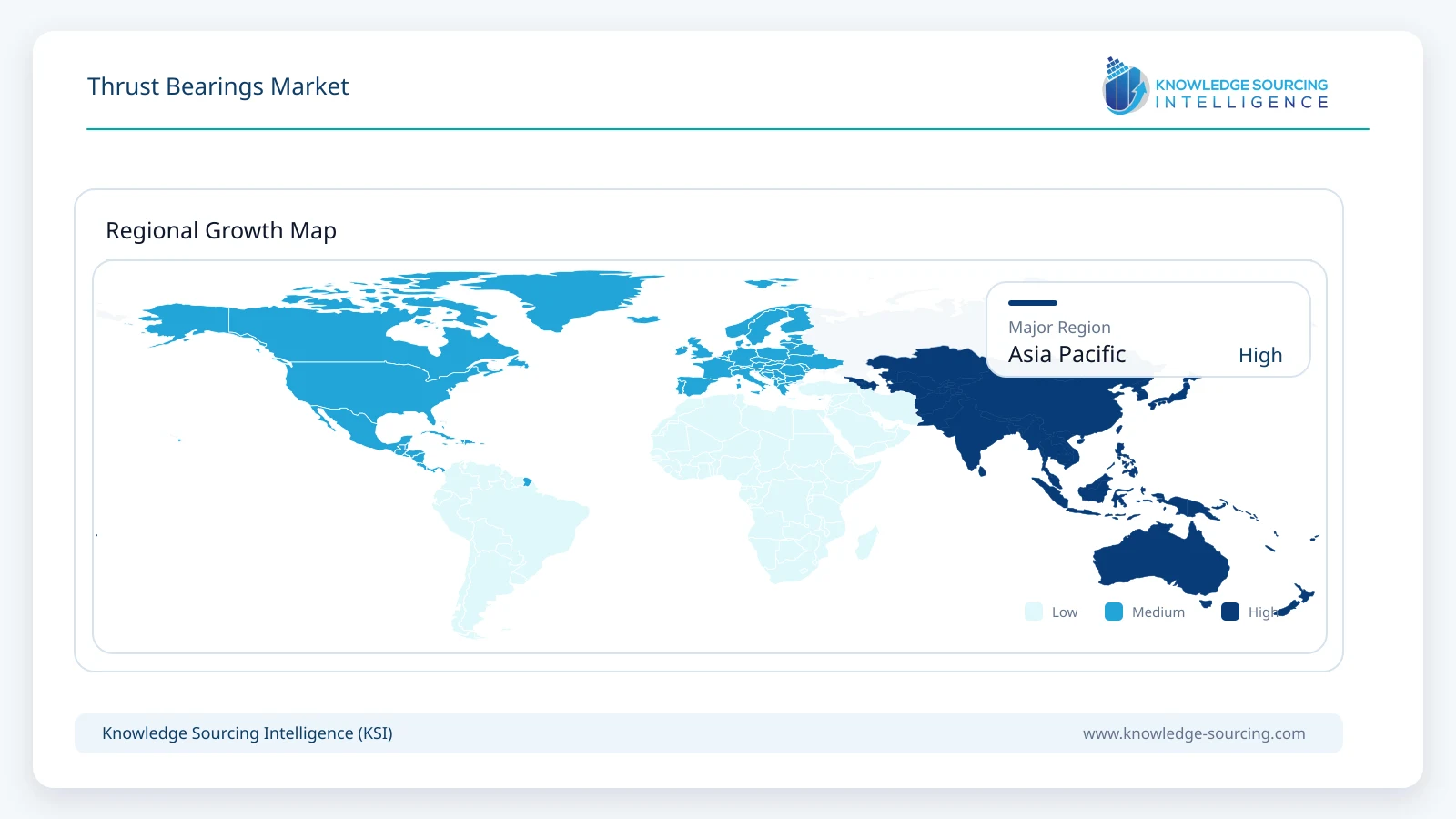
Asia Pacific accounts for approximately 42% of global market value in 2026 and remains the largest region through 2031. China provides substantial demand through machinery, automotive production, wind energy and industrial equipment, while Japan and South Korea contribute high-value precision and automotive applications. India adds incremental demand through manufacturing, infrastructure, wind power, metals and industrial machinery. GWEC reports that China commissioned more than 120 GW of wind capacity in 2025 and India added a record 6.3 GW, reinforcing the region’s importance to energy-related bearing demand.
North America represents an estimated USD 0.8 billion market in 2026. The United States supports demand from industrial machinery, aerospace, automotive, energy, mining and aftermarket services. The region also contains major bearing producers and specialized aerospace and engineered-bearing capabilities, supporting relatively high average product value.
Europe is projected to expand at a CAGR of approximately 4% through 2031. Germany remains central through automotive and industrial machinery, while the United Kingdom, France and Spain contribute wind-energy, aerospace and general industrial demand. Europe’s established machinery base also creates a substantial replacement and condition-monitoring market.
Middle East & Africa and South America remain smaller in value but generate specialized opportunities from mining, power generation, oil and gas, metals and industrial infrastructure. Brazil’s wind and industrial markets provide the largest South American demand base, while Saudi Arabia and the UAE support heavy industrial and energy-related applications in the Middle East.
Recent Developments
July 2026, NSK and Cosmo Eco Power reported successful field verification of bearing-lubrication condition-monitoring technology in operating wind turbines. The technology is intended to detect changes in bearing lubrication earlier and improve maintenance planning, uptime and lifecycle cost.
June 2026, JTEKT announced a new ceramic-ball bearing for high-performance electric-vehicle eAxles capable of operating at up to 30,000 r/min under grease lubrication. The product combines high-carbon bearing-steel raceways with lightweight, electrically insulating ceramic rolling elements.
April 2026, Waukesha Bearings launched the NordAlign main-shaft bearing for wind turbines. The design accommodates both radial and axial shaft movement and is intended to improve bearing life while allowing maintenance without the large cranes normally required for main-shaft bearing replacement
March 2026, SKF signed an agreement to acquire G-Tech Instruments, expanding its condition-monitoring and measuring-instrument capabilities across heavy industry, energy, marine and rail applications.
Competitive Environment
The thrust-bearing market is led by global bearing manufacturers with broad engineering capabilities rather than companies competing only on standardized component production. Timken has particular strength in tapered roller technology and engineered applications across wind energy, industrial machinery and aerospace. Its UltraWind main-shaft systems combine tapered roller bearings with sealing, lubrication and condition monitoring, illustrating the shift toward integrated solutions rather than isolated bearing supply.
SKF competes across industrial bearing products, lubrication and reliability services and continues to increase its condition-monitoring capabilities. NSK maintains a broad thrust-bearing portfolio covering ball, cylindrical, tapered and spherical roller designs and is investing in monitoring technologies and advanced materials. NTN and JTEKT remain significant global competitors with strong industrial and automotive positions, while Schaeffler participates across automotive and industrial bearing applications. RBC Bearings has a strong position in engineered and aerospace bearings, where qualification requirements and specialized performance support higher entry barriers.
Competition through 2031 is expected to depend increasingly on engineering support, operating life, condition monitoring, lubrication and application-specific design. Standard products remain price competitive, but customers operating high-value rotating equipment place greater weight on reliability and total cost of ownership. This creates an advantage for suppliers capable of supporting equipment from initial specification through monitoring, maintenance and replacement.
Analyst View
The Thrust Bearings Market growth is becoming increasingly uneven across product categories. Conventional bearing steel and established industrial machinery continue to provide most of the market’s value, while faster growth comes from energy equipment, precision applications, condition monitoring and ceramic-hybrid technologies.
Thrust Roller Bearings retain the largest market position because high axial-load applications tend to require higher-value engineered products. Ball bearings remain essential in moderate-load and higher-speed equipment, preventing the market from becoming dominated by a single architecture. Material evolution is similarly incremental: ceramic rolling elements improve performance in specific high-speed or electrically sensitive applications, but the economics of bearing steel keep it dominant across mainstream industrial machinery.
The largest commercial opportunity through 2031 therefore lies in increasing the value captured from each installed system rather than simply expanding bearing volumes. Wind turbines, aerospace systems, automated machinery and electrified drivetrains impose greater reliability requirements, while condition-monitoring technologies allow manufacturers to participate throughout the operating life of the equipment. Suppliers combining precision manufacturing, application engineering and lifecycle services are consequently better positioned than companies competing primarily on component price.
Thrust Bearings Market Scope:
| Report Metric | Details |
|---|---|
| Total Market Size in 2026 | USD 3.25 billion |
| Total Market Size in 2031 | USD 4.17 billion |
| Forecast Unit | Billion |
| Growth Rate | 5.1% |
| Study Period | 2021 to 2031 |
| Historical Data | 2021 to 2024 |
| Base Year | 2025 |
| Forecast Period | 2026 – 2031 |
| Segmentation | Type, Material, End-user, Geography |
| Companies |
|
Market Segmentation
By Type
Thrust Ball Bearing
Thrust Roller Bearing
Cylindrical Thrust Roller Bearing
Tapered Thrust Roller Bearing
Spherical Thrust Roller Bearing
By Material
Bearing Steel
Ceramic/Hybrid Ceramic
By End-User
Automotive
Power & Energy
Aerospace
Industrial
Others
By Geography
North America
USA
Canada
Mexico
South America
Brazil
Argentina
Others
Europe
Germany
France
United Kingdom
Spain
Others
Middle East and Africa
Saudi Arabia
UAE
Others
Asia Pacific
China
India
Japan
South Korea
Indonesia
Thailand
Others
Table of Contents
1. EXECUTIVE SUMMARY
2. MARKET SNAPSHOT
2.1. Market Overview
2.2. Market Definition
2.3. Scope of the Study
2.4. Market Segmentation
3. BUSINESS LANDSCAPE
3.1. Market Drivers
3.2. Market Restraints
3.3. Market Opportunities
3.4. Porter’s Five Forces Analysis
3.5. Industry Value Chain Analysis
3.6. Policies and Regulations
3.7. Strategic Recommendations
4. TECHNOLOGICAL OUTLOOK
5. THRUST BEARINGS MARKET BY TYPE
5.1. Introduction
5.2. Thrust Ball Bearing
5.3. Thrust Roller Bearing
5.3.1. Cylindrical Thrust Roller Bearing
5.3.2. Tapered Thrust Roller Bearing
5.3.3. Spherical Thrust Roller Bearing
6. THRUST BEARINGS MARKET BY MATERIAL
6.1. Introduction
6.2. Bearing Steel
6.3. Ceramic/Hybrid Ceramic
7. THRUST BEARINGS MARKET BY END-USER
7.1. Introduction
7.2. Automotive
7.3. Power & Energy
7.4. Aerospace
7.5. Industrial
7.6. Others
8. THRUST BEARINGS MARKET BY GEOGRAPHY
8.1. Introduction
8.2. North America
8.2.1. USA
8.2.2. Canada
8.2.3. Mexico
8.3. South America
8.3.1. Brazil
8.3.2. Argentina
8.3.3. Others
8.4. Europe
8.4.1. Germany
8.4.2. France
8.4.3. United Kingdom
8.4.4. Spain
8.4.5. Others
8.5. Middle East and Africa
8.5.1. Saudi Arabia
8.5.2. UAE
8.5.3. Others
8.6. Asia Pacific
8.6.1. China
8.6.2. India
8.6.3. Japan
8.6.4. South Korea
8.6.5. Indonesia
8.6.6. Thailand
8.6.7. Others
9. COMPETITIVE ENVIRONMENT AND ANALYSIS
9.1. Major Players and Strategy Analysis
9.2. Market Share Analysis
9.3. Mergers, Acquisitions, Agreements and Collaborations
9.4. Competitive Dashboard
10. COMPANY PROFILES
10.1. SKF
10.2. Schaeffler AG
10.3. The Timken Company
10.4. NSK Ltd.
10.5. NTN Corporation
10.6. JTEKT Corporation / Koyo
10.7. Nachi-Fujikoshi Corp.
10.8. RBC Bearings Incorporated
10.9. MinebeaMitsumi Inc.
10.10. Nippon Thompson Co., Ltd. (IKO)
10.11. C&U Group
10.12. Wafangdian Bearing Group Corporation (ZWZ)
10.13. Luoyang LYC Bearing Co., Ltd.
10.14. Harbin Bearing Manufacturing Co., Ltd. (HRB)
10.15. American Roller Bearing Company
10.16. Fersa Group
10.17. Zhejiang Tianma Bearing Group Co., Ltd. (TMB)
10.18. CW Bearing GmbH
11. APPENDIX
11.1. Currency
11.2. Assumptions
11.3. Base and Forecast Years Timeline
11.4. Key Benefits for Stakeholders
11.5. Research Methodology
11.6. Abbreviations
Navigate
Trusted by the world's leading organizations











