
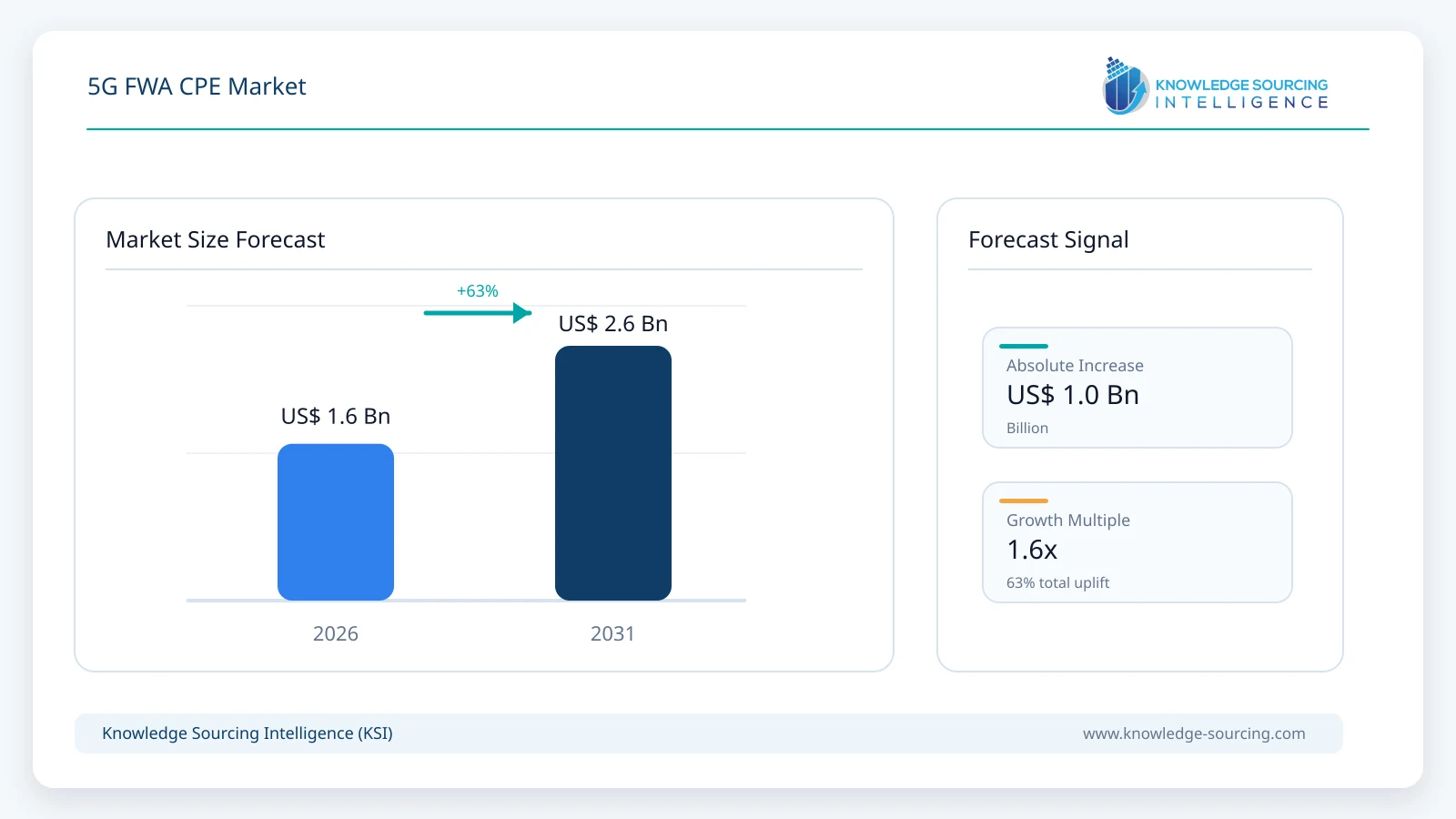
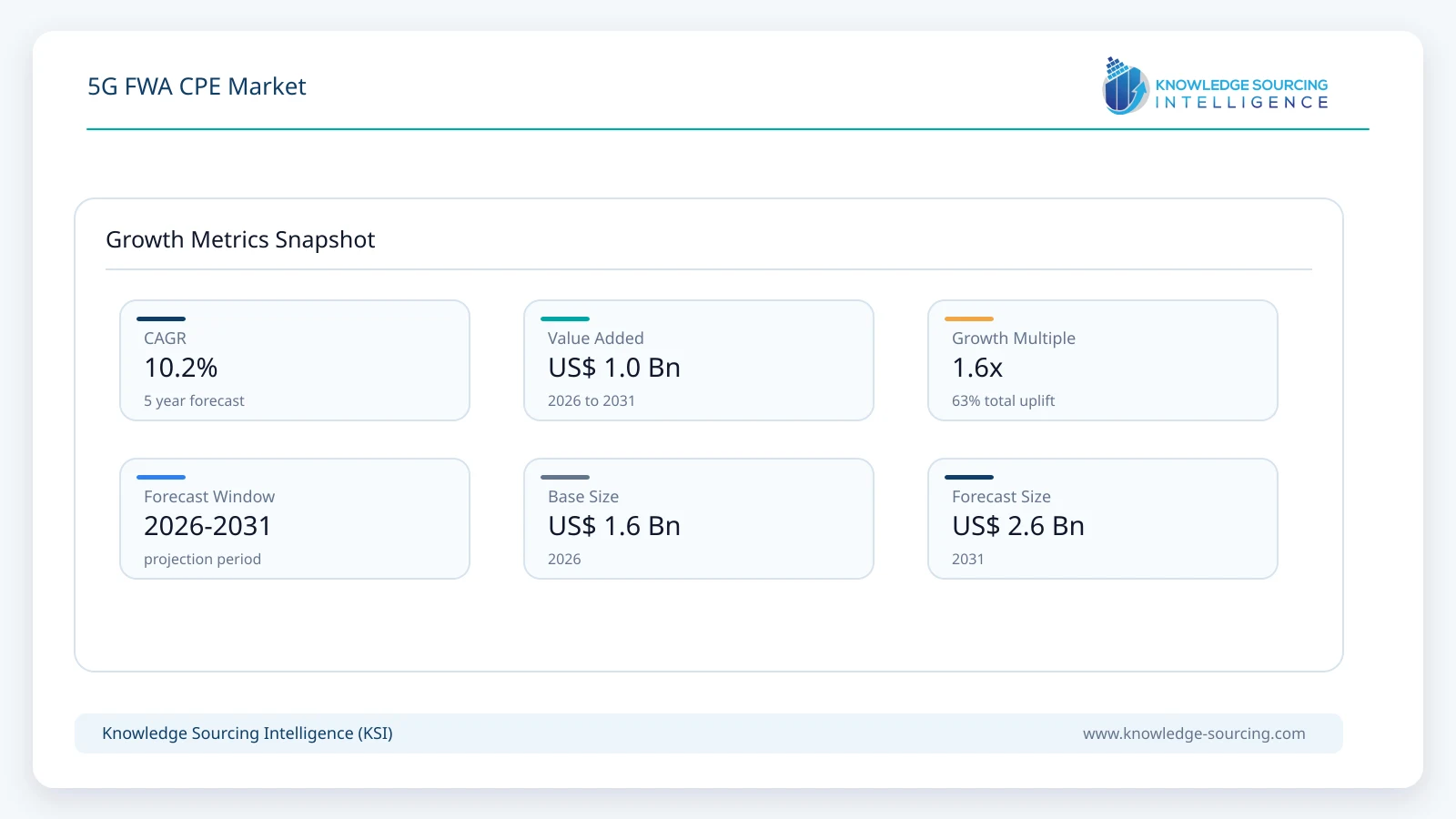
The global 5G FWA CPE market is forecast to grow at a CAGR of 10.2%, reaching USD 2.6 billion in 2031 from USD 1.6 billion in 2026.
Highlights:
- 1Indoor CPE accounts for an estimated 58.5% of 5G FWA CPE market revenue in 2026, reflecting the scale of self-installed residential gateways and integrated Wi-Fi devices.
- 2Sub-6 GHz devices account for an estimated 94.2% of market revenue in 2026, with mmWave remaining strategically important but much smaller in shipment volume.
- 3Urban and suburban settings represent an estimated 71.5% of 2026 market revenue, although rural deployments are expected to grow faster as operators expand broadband coverage beyond fixed-line economics.
- 4North America accounts for an estimated 33.2% of global revenue in 2026, supported by large installed FWA subscriber bases at T-Mobile and Verizon and comparatively high device specifications.
- 55G Standalone-capable FWA devices to account for almost the entire 5G shipment baseGSA expects , with 15.4 million SA-capable units projected in its 2026 vendor sample.
- 613 million subscribers by March 2026Jio AirFiber had approximately , demonstrating that large-scale 5G FWA is no longer predominantly a North American market.
- 75G-Advanced, Wi-Fi 7/8, AI-assisted traffic management, high-gain antennas and self-installation capabilitiesNew CPE platforms are increasingly integrating rather than competing primarily on modem speed.
The market covers customer premises equipment used to deliver fixed broadband over 5G networks, including integrated indoor gateways, outdoor receivers and routers that connect homes or businesses to a mobile network and distribute connectivity through Wi-Fi or Ethernet. The scope includes Sub-6 GHz and mmWave 5G CPE but excludes ordinary smartphones, conventional mobile hotspots where fixed broadband is not the principal application, radio-access-network equipment and the recurring broadband-service revenue earned by mobile operators.
GSA’s 2026 CPE survey provides an important volume reference. Participating vendors reported approximately 12 million 5G FWA CPE shipments in 2025 and expect around 16 million in 2026, with 5G increasing from 60% to 69% of the sample’s total FWA shipments. GSA also reports that approximately 97% of North American and 99% of Indian FWA CPE shipments are already 5G capable.
Market Overview
The 5G FWA CPE market is transitioning from an early deployment market into an increasingly established broadband-device category. Operators initially positioned 5G FWA primarily as a way to extend broadband into locations where fiber, cable or DSL were unavailable or uneconomic. That role remains important, but the addressable market has broadened. FWA is now being used to compete directly with fixed broadband in urban and suburban markets, replace ageing xDSL networks, connect small businesses and extend high-speed broadband into rural areas without constructing a dedicated access network to every premise.
Ericsson estimates that approximately 185 million FWA connections existed globally in 2025 and projects around 350 million by 2031. It identifies more than one billion premises as potentially unconnected or underserved, including more than 700 million unconnected households and around 200 million xDSL connections. This provides a considerably larger long-term addressable market than current CPE shipments alone indicate.
The relationship between connection growth and CPE revenue is not linear. Every new fixed-wireless subscriber generally requires a gateway or receiver, but device ASPs decline as 5G chipsets mature and production scales. Replacement cycles also become more important as the installed base expands. At the same time, higher-end outdoor CPE, mmWave support, Wi-Fi 7/8, 8Rx antenna configurations and 5G-Advanced functionality raise the value of selected devices. The resulting market therefore grows more slowly than 5G subscriber additions in some periods but receives additional revenue from technology upgrades.
The current KSI USD 1.6 billion 2026 estimate is consistent with this structure. GSA’s survey represents a cross-section rather than the complete global market and explicitly cautions against treating its sample shipments as total market volume. Nevertheless, approximately 16 million reported 5G devices in 2026, combined with additional vendors outside the survey and a mix of mainstream and premium device ASPs, supports a market in the low-single-digit billions rather than either a very small niche or an excessively large equipment category.
Market Drivers
5G FWA subscribers are expanding across several large markets simultaneously
FWA device demand is ultimately driven by broadband connections rather than mobile subscriber numbers. The current cycle is significant because deployment is no longer concentrated in one or two countries. T-Mobile ended 2025 with 8.5 million 5G broadband customers after adding approximately 1.9 million during the year. Verizon exceeded 5.7 million FWA subscribers at the end of 2025 and continued adding more than 200,000 during the first quarter of 2026 and 193,000 during the second quarter.
India has developed into another major volume market. Reliance Jio reported around 13 million AirFiber subscribers by March 2026, after adding approximately 10 million fixed-broadband subscribers during FY2026. Jio also introduced non-line-of-sight hardware intended to expand the addressable market and improve deployment efficiency. These additions create recurring demand not only for initial CPE but eventually for device upgrades as Wi-Fi standards and 5G capabilities evolve.
Operators can use existing 5G infrastructure instead of extending a fixed line to each customer
FWA economics differ materially from fiber-to-the-premises because operators can reuse spectrum, base stations, transport networks and core infrastructure originally deployed for mobile service. The incremental investment consists largely of available radio capacity, network optimization and customer equipment rather than trenching or aerial fiber to each location. This does not make FWA universally cheaper because heavily loaded cells may require additional capacity, but it allows operators to target specific neighborhoods or customer groups more quickly.
The CPE is central to those economics. Higher-gain antennas, 8Rx reception, intelligent placement tools and outdoor mounting can increase the number of premises that can be served from an existing base station. Nokia’s FastMile receivers, for example, use high-gain antennas and self-installation tools to improve cell-edge performance while reducing technician visits.
The device mix is moving from basic gateways toward 5G-Advanced broadband platforms
CPE specifications are increasing considerably. Qualcomm’s current FWA portfolio includes platforms supporting multi-gigabit 5G, Wi-Fi 7 and Wi-Fi 8, 5G-Advanced capabilities, AI processing and advanced antenna configurations. Its Dragonwing FWA Gen 5 Elite incorporates the X85 modem-RF platform, Wi-Fi 8 and native AI processing at the gateway.
ZTE introduced its G6 Ultra and G6 Max during MWC 2026. The G6 Ultra combines 5G-Advanced and Wi-Fi 8, while the G6 Max supports both Sub-6 GHz and mmWave and is designed for outdoor use. Such products demonstrate that the FWA gateway is evolving from a relatively simple cellular modem into the primary broadband and Wi-Fi platform for the premises.
Higher specifications create an important offset to falling semiconductor costs. Entry-level 5G CPE prices should continue declining, but premium devices increasingly incorporate more antenna elements, advanced Wi-Fi, additional Ethernet capability, edge processing and more sophisticated software.
5G Standalone adoption is creating a natural CPE replacement and upgrade cycle
The GSA 2026 survey indicates that 96% of reported 5G FWA shipments in 2025 supported 5G Standalone, with SA-capable shipments expected to increase 34% to 15.4 million during 2026. This means the device ecosystem is already preparing for networks that use standalone 5G cores rather than relying on LTE anchoring.
This matters because advanced FWA performance increasingly depends on features available through newer releases, including enhanced uplink, carrier aggregation, network slicing and improved quality-of-service management. Vantiva’s Hawk 5G gateway, launched in March 2026, was explicitly designed around increasing operator migration toward 5G SA and adds Wi-Fi 8 compatibility.
As operators progress to 5G-Advanced, early-generation CPE will not necessarily stop working, but the difference in attainable coverage, capacity and home-network performance provides a reason to upgrade selected customers.
Self-installation reduces customer-acquisition economics
A major cost advantage of FWA can disappear if every customer requires a professional installation. Device suppliers are therefore investing heavily in self-installation, high-gain antenna systems and apps that help consumers position gateways or receivers correctly.
Nokia’s FastMile outdoor receiver can be mounted on a window, wall, balcony or pole and uses an installation application to help identify suitable placement. Qualcomm’s platforms similarly incorporate technologies intended to extend coverage and simplify installation.
This is particularly important for suburban and rural deployment. A device that can establish a usable connection at a weak signal level without a technician increases the number of premises operators can economically serve and directly expands the addressable CPE market.
Market Restraints and Challenges
Radio capacity limits how many FWA customers can be added to a cell
FWA traffic behaves differently from smartphone traffic. A home broadband connection can consume hundreds of gigabytes each month and generate sustained evening traffic from streaming, gaming and connected devices. Operators cannot therefore sell an unlimited number of FWA subscriptions within every radio sector without degrading mobile and fixed service quality.
This places a practical ceiling on CPE deployment even where 5G coverage is widespread. Operators increasingly use address-level qualification to determine whether a specific location has sufficient radio capacity. FWA growth consequently depends on spectrum holdings, network densification and traffic-management capability rather than coverage alone.
Falling CPE prices limit revenue growth relative to unit growth
The device ecosystem is benefiting from scale, chipset integration and greater competition among Asian OEMs and ODMs. These developments reduce equipment cost and support broader adoption, but they also mean market revenue does not need to grow as quickly as unit shipments.
GSA reports that vendors continue to expect movement toward closer pricing between 4G and 5G devices. This creates a deliberate tension within the market: lower pricing expands the serviceable customer base but suppresses revenue per unit. The KSI forecast therefore does not extrapolate current shipment growth directly into an equivalent revenue CAGR.
Fiber remains superior for some high-capacity and guaranteed-service applications
FWA is increasingly competitive with cable and DSL, but it does not eliminate the advantages of dedicated fiber. Shared cellular capacity, variable radio conditions and spectrum limitations can make fiber preferable for enterprises requiring symmetrical multi-gigabit performance or households in areas where fiber is already economically available.
Operators therefore increasingly treat FWA and fiber as complementary technologies. Verizon, Jio and other providers use different access technologies according to neighborhood economics and network availability rather than assuming FWA should replace wired broadband everywhere.
mmWave remains technically attractive but commercially narrow
mmWave can provide very high capacity, but propagation losses and installation requirements constrain mass deployment. The latest GSA survey indicates that mmWave-capable 5G FWA devices represent only a small percentage of current 5G CPE shipments, with around 400,000 units expected within the survey sample during 2026.
Sub-6 GHz therefore remains the mainstream CPE architecture. mmWave has stronger potential in dense urban locations, multi-dwelling units and environments where operators have extensive high-frequency spectrum, but it should not be modeled as the principal global device category during the forecast period.
Operator procurement creates pricing concentration
A relatively small number of national telecom operators can account for very large CPE contracts. Vendors must pass technical certification, network integration, security and support requirements before reaching those customers. Once approved, volumes can be substantial, but dependence on a limited number of tenders creates revenue volatility.
The planned acquisition of Nokia’s FWA CPE business by Inseego illustrates the importance of scale. Inseego stated that the acquired business had an annualized revenue run rate of approximately USD 200 million and would significantly broaden its carrier footprint if the transaction closes as planned in Q4 2026.
Major Segment Analysis
By Deployment
Indoor CPE remains the largest deployment type because residential operators generally prefer plug-and-play devices that combine the 5G modem, routing and Wi-Fi system in one unit. GSA expects integrated indoor devices to represent 64% of its total FWA shipment sample in 2026, up from 57% in 2025.
The revenue mix is less concentrated because outdoor units typically command higher ASPs. Under the KSI model, indoor 5G FWA CPE reaches approximately USD 1.44 billion in 2031, while outdoor systems grow faster as FWA expands into weaker-signal suburban and rural locations. Outdoor receivers are particularly valuable where placing the antenna outside the building materially improves radio performance.
By Band
Sub-6 GHz remains the dominant architecture throughout the forecast period because operators can combine meaningful capacity with much broader propagation than mmWave. Mid-band spectrum around the 2.5 GHz, 3.5 GHz and C-band ranges is particularly important to the economics of mass-market FWA.
mmWave CPE is projected to grow faster from a small base, reaching an estimated USD 195 million by 2031 in the KSI model. The segment benefits from improved range and combined Sub-6/mmWave architectures, but current shipment evidence does not support treating mmWave as a mainstream global substitute for Sub-6 GHz.
By Setting
Urban and suburban applications retain the largest market position because operators can target premises where mobile networks already have substantial capacity and fixed broadband competition supports meaningful ARPU. U.S. deployments demonstrate that FWA does not need to be restricted to areas without wired infrastructure.
Rural deployment is projected to expand at approximately 13.5% annually through 2031, faster than the overall CPE market. High-gain outdoor devices, increased mid-band coverage and lower equipment costs make FWA increasingly relevant where constructing fiber to dispersed premises remains uneconomic.
By Geography
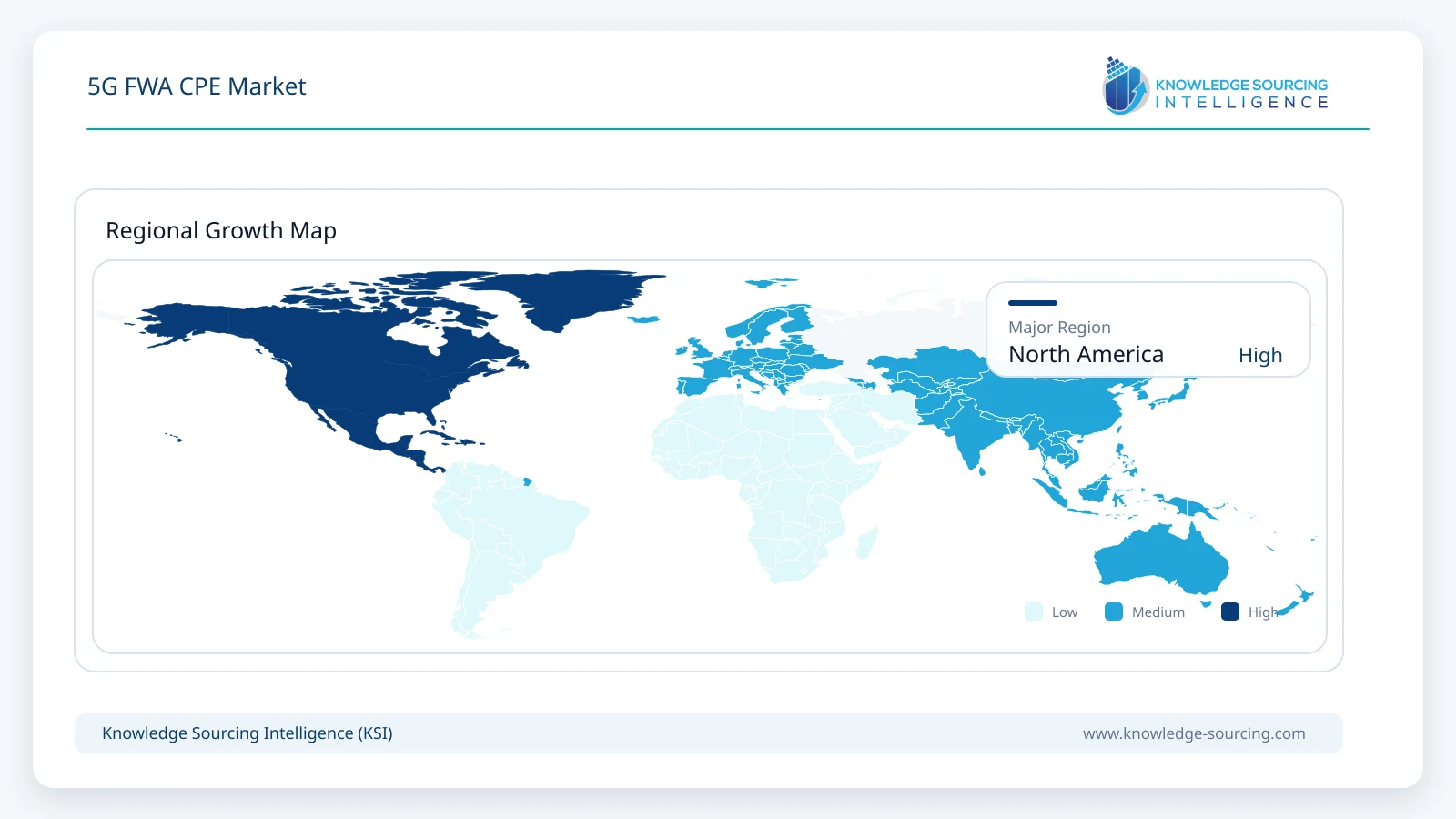
North America remains the largest revenue market in the early forecast period because operators already serve millions of FWA broadband customers and typically procure higher-specification gateways. T-Mobile finished 2025 with 8.5 million 5G broadband customers, while Verizon continues expanding toward its previously stated target of 8–9 million FWA subscribers by 2028.
Asia Pacific is projected to become increasingly important and is expected to reach approximately USD 860 million by 2031 in the KSI model. India is the major incremental driver, while China, Japan and other markets provide additional demand.
The Middle East and Africa offer significant longer-term potential because large numbers of homes remain underserved by fixed broadband. GSA’s latest survey found Africa already represented 21% of reported total FWA CPE shipments in 2025, although many devices remain 4G rather than 5G.
Technology Outlook
5G-Advanced and Higher-Power CPE
5G-Advanced CPE is increasing radio performance through improved carrier aggregation, higher-power transmission and more advanced antenna systems. Samsung and Qualcomm validated Power Class 1 FWA capability in May 2026 using Samsung vRAN and Qualcomm’s Dragonwing Gen 4 platform, targeting stronger uplink and longer effective reach.
Wi-Fi 7 and Wi-Fi 8 Integration
The cellular link is only useful if equivalent performance can be distributed through the premises. Wi-Fi 7 is already appearing across premium FWA gateways, while Vantiva, Qualcomm and ZTE introduced Wi-Fi 8-ready platforms during 2026. CPE differentiation is consequently shifting toward the combined quality of the 5G and in-home Wi-Fi experience.
AI-Assisted CPE Management
AI functionality is increasingly being incorporated into broadband gateways to optimize traffic, antenna behavior, Wi-Fi performance and device management. Qualcomm’s new FWA platforms include native edge-AI capability, while ZTE states that its G6 Ultra can identify application classes and dynamically manage bandwidth. These capabilities could improve customer experience while reducing operator support costs.
Recent Developments
September 2026: GSA’s latest FWA CPE survey reported expected 16% total shipment growth in 2026, with 5G devices increasing to approximately 69% of its sample and SA-capable 5G FWA equipment becoming effectively standard.
May 2026: Samsung and Qualcomm completed an industry-first validation of 5G Power Class 1 for FWA using Samsung’s virtualized RAN and the Qualcomm Dragonwing FWA Gen 4 platform.
April 2026: Inseego agreed to acquire Nokia’s global FWA CPE business. The transaction is expected to approximately double Inseego’s revenue and is currently expected to close in Q4 2026 subject to customary conditions.
March 2026: ZTE launched the G6 Ultra and G6 Max, combining 5G-Advanced with Wi-Fi 8, AI-enhanced networking and, in the G6 Max, combined Sub-6 GHz and mmWave support.
March 2026: Vantiva introduced Hawk 5G, an indoor FWA gateway designed for 5G Standalone networks and Wi-Fi 8 compatibility.
Competitive Landscape
The 5G FWA CPE market has a broad vendor ecosystem but only a smaller number of companies have the scale and operator relationships required for large Tier-1 carrier programs. ZTE has developed one of the largest global FWA portfolios and states that cumulative FWA and mobile broadband terminal shipments exceed 300 million units across more than 100 countries and regions. Huawei also maintains an extensive 5G CPE portfolio, particularly across Asia, the Middle East and emerging markets.
Nokia remains an important current supplier through the FastMile portfolio, although its CPE business is expected to transfer to Inseego if the announced transaction closes. Inseego would consequently become a substantially larger global FWA vendor with consumer, enterprise and carrier product lines. Vantiva is similarly increasing its position through Tier-1 operator gateways and its transition toward 5G SA and Wi-Fi 8 devices.
Sercomm, WNC, Askey, Arcadyan, Gemtek, GreenPacket, Tozed Kangwei, MeiG Smart Technology and other Asian ODM/OEM vendors provide significant manufacturing and design capacity. Some sell under their own brands while others supply operator-specific hardware. This makes the competitive market less visible than consumer electronics because a significant proportion of shipments occur under telecom-operator brands.
The chipset layer is also strategically important. Qualcomm and MediaTek provide integrated modem and processing platforms that determine many aspects of CPE performance, including supported radio releases, carrier aggregation, Wi-Fi integration, antenna capabilities and power consumption. Their roadmaps can therefore materially
5G FWA CPE Market Scope:
| Report Metric | Details |
|---|---|
| Total Market Size in 2026 | USD 1.6 billion |
| Total Market Size in 2031 | USD 2.6 billion |
| Forecast Unit | USD Billion |
| Growth Rate | 10.2% |
| Study Period | 2021 to 2031 |
| Historical Data | 2021 to 2024 |
| Base Year | 2025 |
| Forecast Period | 2026 – 2031 |
| Segmentation | Setting, Deployment, Band, Geography |
| Companies |
|
Market Segmentation
Market Segmentation
By Setting
· Urban & Suburban
· Rural
By Deployment
· Indoor CPE
· Outdoor CPE
By Band
· Sub-6 GHz
· mmWave
By Customer Type
· Residential
· Small & Medium Businesses
· Large Enterprises & Institutions
By Geography
North America
· United States
· Canada
· Mexico
South America
· Brazil
· Argentina
· Others
Europe
· United Kingdom
· Germany
· France
· Italy
· Spain
· Others
Middle East and Africa
· Saudi Arabia
· UAE
· South Africa
· Nigeria
· Others
Asia Pacific
· India
· China
· Japan
· South Korea
· Indonesia
· Others
Table of Contents
1. EXECUTIVE SUMMARY
2. MARKET SNAPSHOT
2.1. Market Overview
2.2. Market Definition and Scope
2.3. Scope Exclusions
2.4. Market Segmentation
2.5. Key Market Indicators
3. BUSINESS LANDSCAPE
3.1. Market Drivers
3.2. Market Restraints and Challenges
3.3. Market Opportunities
3.4. FWA Subscriber and Connection Outlook
3.5. CPE Shipment and Pricing Analysis
3.6. Operator FWA Economics
3.7. Porter’s Five Forces Analysis
3.8. Strategic Recommendations
4. TECHNOLOGY OUTLOOK
4.1. 5G-Advanced and Higher-Power CPE
4.2. Wi-Fi 7 and Wi-Fi 8 Integration
4.3. AI-Assisted CPE Management
5. 5G FWA CPE MARKET BY SETTING
5.1. Introduction
5.2. Urban & Suburban
5.3. Rural
6. 5G FWA CPE MARKET BY DEPLOYMENT
6.1. Introduction
6.2. Indoor CPE
6.3. Outdoor CPE
7. 5G FWA CPE MARKET BY BAND
7.1. Introduction
7.2. Sub-6 GHz
7.3. mmWave
8. 5G FWA CPE MARKET BY CUSTOMER TYPE
8.1. Introduction
8.2. Residential
8.3. Small & Medium Businesses
8.4. Large Enterprises & Institutions
9. 5G FWA CPE MARKET BY GEOGRAPHY
9.1. Introduction
9.2. North America
9.2.1. United States
9.2.2. Canada
9.2.3. Mexico
9.3. South America
9.3.1. Brazil
9.3.2. Argentina
9.3.3. Others
9.4. Europe
9.4.1. United Kingdom
9.4.2. Germany
9.4.3. France
9.4.4. Italy
9.4.5. Spain
9.4.6. Others
9.5. Middle East and Africa
9.5.1. Saudi Arabia
9.5.2. UAE
9.5.3. South Africa
9.5.4. Nigeria
9.5.5. Others
9.6. Asia Pacific
9.6.1. India
9.6.2. China
9.6.3. Japan
9.6.4. South Korea
9.6.5. Indonesia
9.6.6. Others
10. COMPETITIVE ENVIRONMENT AND ANALYSIS
10.1. Competitive Positioning
10.2. Indoor and Outdoor CPE Portfolio Analysis
10.3. 5G SA, 5G-Advanced and Wi-Fi Capability Benchmarking
10.4. Operator and OEM Relationships
10.5. Strategic Transactions and Product Developments
10.6. Competitive Dashboard
11. COMPANY PROFILES
11.1. ZTE Corporation
11.2. Huawei Technologies Co., Ltd.
11.3. Nokia Corporation
11.4. Inseego Corp.
11.5. Vantiva S.A.
11.6. Sercomm Corporation
11.7. Wistron NeWeb Corporation
11.8. Askey Computer Corporation
11.9. Arcadyan Technology Corporation
11.10. Sagemcom
11.11. Zyxel Group
11.12. Green Packet Berhad
11.13. Gemtek Technology Co., Ltd.
11.14. Tozed Kangwei Technology
11.15. MeiG Smart Technology Co., Ltd.
11.16. Hongdian Corporation
11.17. Jaton Technology Limited
11.18. Asiatelco Technologies Co., Ltd.
11.19. TCL Communication
11.20. D-Link Corporation
12. ANALYST VIEW
13. APPENDIX
13.1. Research Methodology
13.2. Market Estimation and Assumptions
13.3. Definitions and Abbreviations
Navigate
Trusted by the world's leading organizations











