
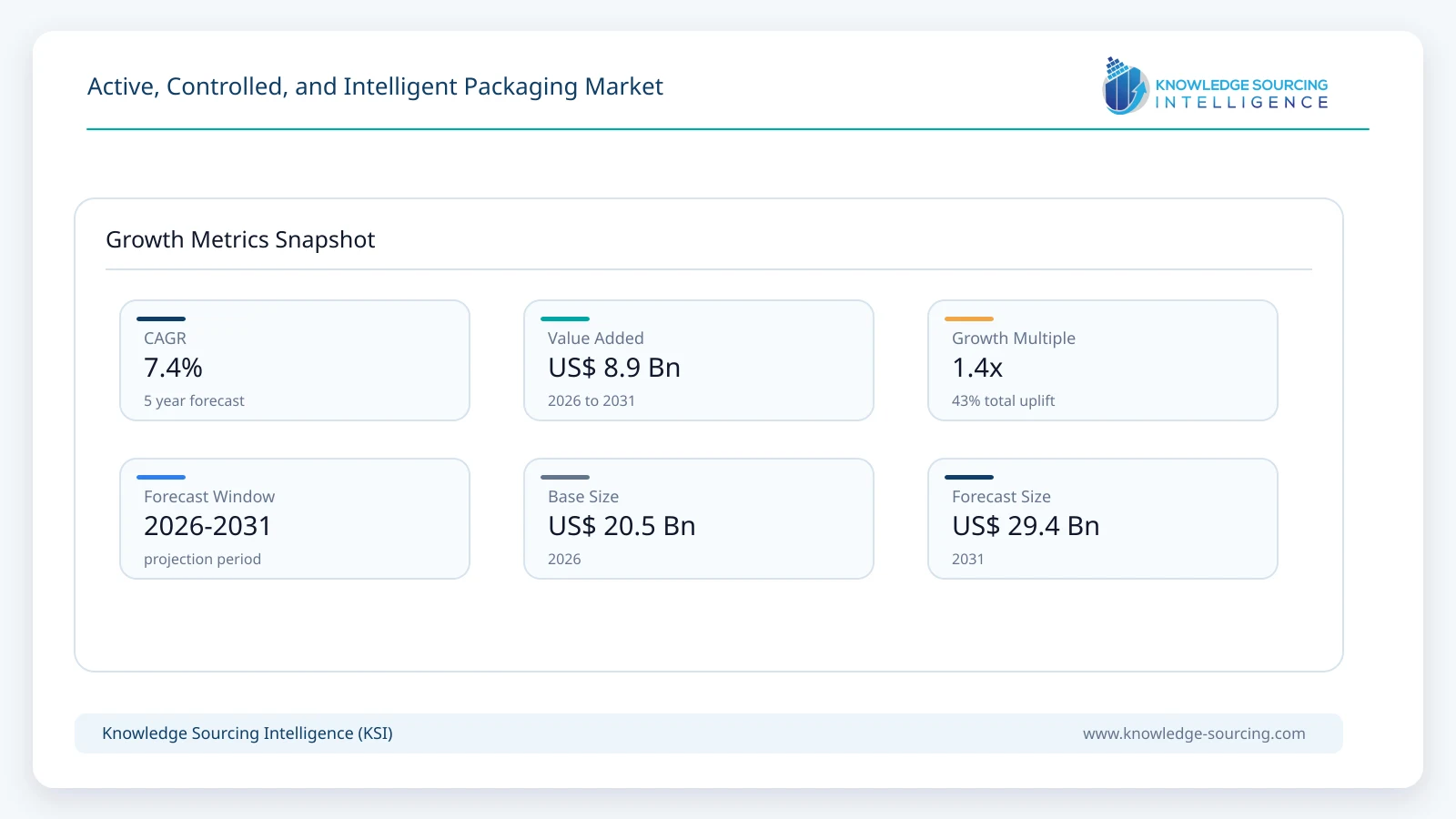
The Active, Controlled, and Intelligent Packaging Market is growing at a CAGR of 7.4%, from USD 20.5 billion in 2026 to USD 29.35 billion by 2031.
Highlights:
- 1Controlled packaging accounts for an estimated 43.8% of market revenue in 2026, supported by established aseptic, modified-atmosphere and retort packaging applications across food and beverage supply chains.
- 2Food and beverage represents approximately 49.0% of market demand in 2026, reflecting the measurable value of reducing spoilage, oxidation, moisture damage and inventory losses.
- 3Plastic accounts for an estimated 54.0% of packaging material demand in 2026, although paper and paperboard are increasing their participation as functional coatings and recyclable barrier technologies improve.
- 4North America represents approximately 33.5% of global market revenue in 2026, supported by mature food-processing, pharmaceutical, retail and logistics infrastructure.
- 5The U.S. Food Traceability Rule remains an important long-term catalyst for digital identification, although FDA enforcement will not begin before July 20, 2028, reducing the near-term regulatory acceleration previously assumed.
- 6The EU Packaging and Packaging Waste Regulation has applied since August 12, 2026, increasing pressure to combine product protection and intelligent functions with recyclability and material-reduction requirements.
- 7RFID is expanding beyond apparel and durable goods into fresh food categories where automated inventory visibility can directly reduce waste and improve stock rotation.
- 8GS1’s transition toward broader retail acceptance of 2D barcodes by the end of 2027 provides a lower-cost digital infrastructure layer for traceability, authentication and consumer information.
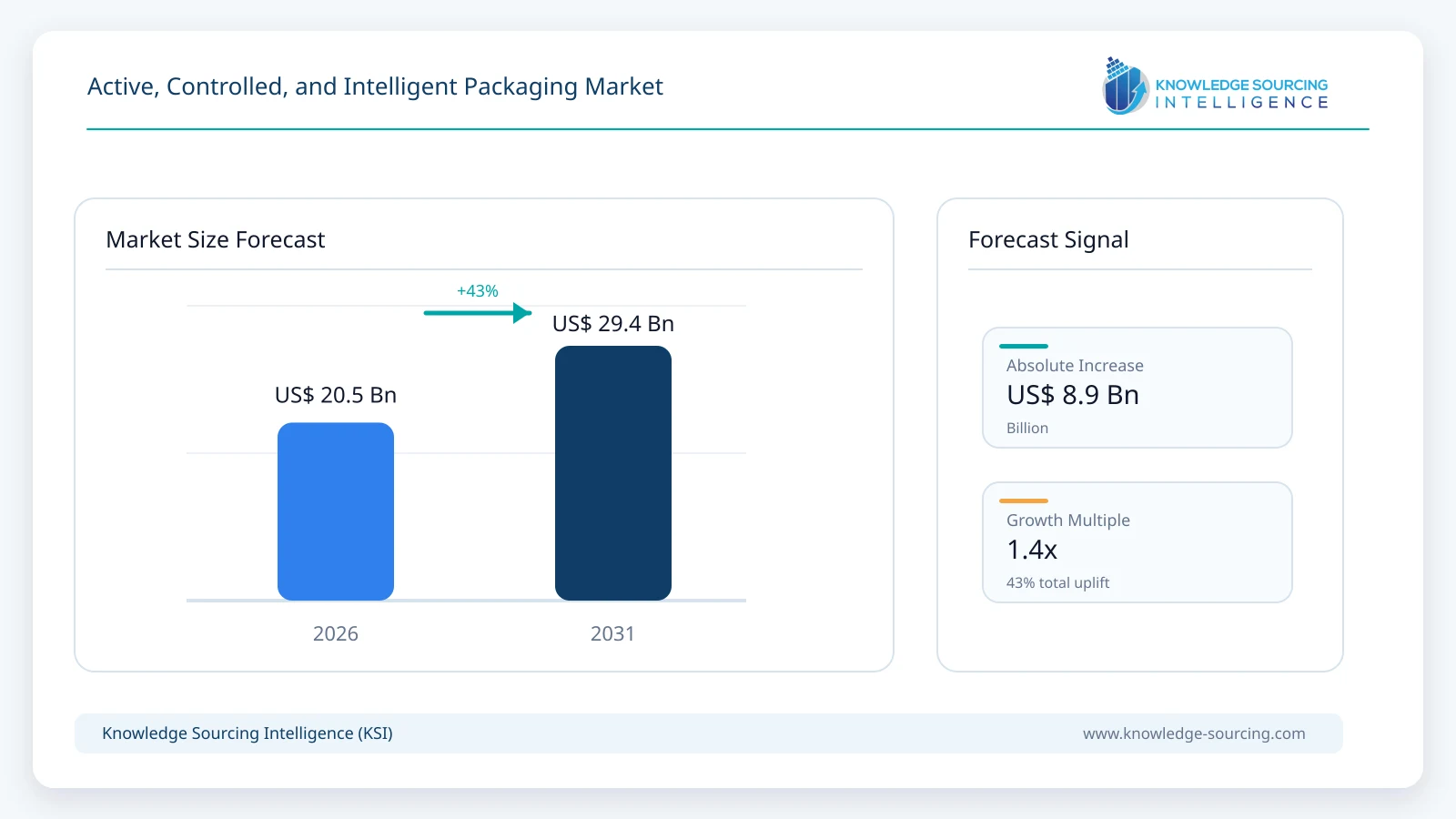
Growth is being supported by the increasing commercial value of shelf-life extension, supply-chain traceability, product-condition monitoring and digital product identification, alongside packaging-industry efforts to integrate these capabilities within structures that remain compatible with tightening recyclability requirements.
The market covers packaging systems that perform functions beyond conventional containment and physical protection. Active packaging interacts with the packaged product or its surrounding atmosphere through technologies such as oxygen scavengers, moisture controllers and antimicrobial components. Controlled packaging establishes defined product conditions through aseptic processing, modified-atmosphere packaging and retort technologies. Intelligent packaging identifies, monitors or communicates information about the product or its environment through RFID, NFC, time-temperature indicators, freshness indicators, sensors and digitally connected identifiers.
Active, controlled and intelligent packaging is evolving from a collection of specialist packaging technologies into a broader product-quality and information-management layer. Conventional packaging is designed primarily to contain, transport and protect the product. Advanced packaging extends these functions by controlling the internal environment, interacting with the product or recording and communicating information about product condition and identity. The technologies remain commercially distinct, but their use increasingly overlaps. A fresh-food package, for example, may combine modified atmosphere with moisture management and an RFID or QR-based digital identifier.
The market framework remains appropriate, particularly its emphasis on food preservation, pharmaceutical integrity, supply-chain visibility and packaging functionality. However, the growth profile for 2026–2031 is stronger than a simple continuation of the previous forecast because intelligent packaging is moving into a broader range of commercial applications. RFID systems are becoming suitable for lower-value fresh food, while 2D barcodes can provide digital product identities without the cost of an electronic tag. Battery-free sensing technologies are also receiving greater investment as suppliers attempt to capture condition information without relying on conventional powered data loggers.
At the same time, regulation creates both opportunity and constraint. Requirements for food traceability, pharmaceutical integrity and product information favor digital identification, but packaging regulation increasingly penalizes unnecessarily complex material structures. The EU PPWR illustrates this tension: packaging suppliers need to preserve shelf life and provide additional functions while making structures recyclable and limiting unnecessary material use. This is pushing development toward mono-material films, recyclable coatings, detachable labels and intelligent components that interfere less with end-of-life processing.
Market Drivers
Shelf-life extension is becoming more directly linked to product economics
Food manufacturers and retailers increasingly evaluate packaging according to total product loss rather than packaging cost alone. Oxygen scavengers can reduce oxidation, moisture-management systems can prevent condensation or texture deterioration, and modified-atmosphere packaging can slow spoilage in meat, bakery, dairy, fresh produce and prepared foods. The value of these technologies increases as supply chains lengthen and retailers attempt to reduce markdowns and discarded inventory. A more expensive package can therefore produce a positive economic return where it meaningfully extends saleable life or improves product consistency. This keeps preservation-oriented active and controlled packaging at the core of market demand even while digital technologies receive greater attention.
RFID is becoming commercially viable across additional food categories
Fresh-food RFID represents an important development because the business case differs from traditional apparel tagging. Avery Dennison introduced its AD IdentiFresh portfolio in February 2026 specifically for bakery, meat, deli and produce applications. Automatic item-level identification can support inventory visibility, stock rotation and freshness management without requiring individual line-of-sight barcode scans. The economics become attractive where improved inventory accuracy reduces spoilage and staff time rather than relying solely on consumer-facing functionality. Continued integration of RFID into conventional label-converting processes should gradually lower adoption barriers and expand intelligent packaging into higher-volume categories.
Digital traceability is strengthening the role of packaging as a data carrier
The FDA Food Traceability Rule requires covered entities to maintain defined information associated with critical tracking events for designated foods. Enforcement has been delayed until July 20, 2028, which reduces immediate compliance pressure but does not remove the need for improved product identification and data exchange. Packaging provides one of the most practical physical-to-digital connection points because barcodes, RFID and other identifiers travel with the product through the supply chain. The regulatory delay should therefore affect the timing rather than the underlying direction of investment, with implementation activity expected to strengthen as the revised deadline approaches.
2D barcode adoption lowers the cost threshold for intelligent packaging
Not every intelligent packaging application requires RFID, NFC or electronic sensing. GS1 is targeting the ability of retail point-of-sale systems to process defined 2D barcode formats by the end of 2027. These identifiers can hold more information than traditional linear barcodes and can connect physical products with traceability records, product instructions, authentication services and consumer information. This substantially widens the addressable intelligent-packaging market because digitally connected packaging can be implemented using conventional printing rather than an electronic component. RFID and sensors can then be concentrated in applications where automatic identification or condition monitoring generates additional economic value.
Pharmaceutical products increase demand for condition monitoring and authentication
Temperature-sensitive medicines, biologics and other specialty therapies create packaging applications where product condition can affect safety and usability. Time-temperature indicators and connected packaging can provide information about cumulative exposure, while digital identifiers can support authentication and supply-chain visibility. These technologies complement rather than replace validated cold-chain systems, but they allow monitoring to move closer to the individual product or package. Pharmaceutical manufacturers can also tolerate higher packaging costs than many mass-market consumer applications because the financial and clinical consequences of product loss or incorrect handling are considerably greater.
Market Restraints and Challenges
Advanced functionality remains difficult to justify for low-value products
The largest barrier to intelligent packaging remains unit economics. A conventional printed identifier costs very little, whereas RFID inlays, NFC components, sensors or time-temperature indicators add incremental material and conversion costs. The technology therefore needs to generate measurable value through lower waste, automated inventory management, authentication, regulatory compliance or reduced labor. This limits the speed at which advanced electronics can migrate into high-volume low-value consumer categories. The likely market structure is consequently a mix of inexpensive 2D identifiers across broad product categories and more sophisticated RFID or sensing systems where the economic benefit is clearly measurable.
Recyclability requirements constrain multi-component packaging design
Active packaging can require barrier layers, scavenging compounds and specialized coatings, while intelligent packaging may introduce antennas, chips, adhesives or sensors. These additions can complicate recycling when they are incorporated into already complex structures. The EU PPWR increases the importance of designing functionality around an acceptable end-of-life pathway. Suppliers increasingly need to develop active components that work in recyclable mono-material formats and digital labels that can be removed, separated or processed without contaminating the main packaging stream. Functionality that undermines recycling performance could face greater commercial resistance regardless of its preservation or traceability benefits.
Food-contact active systems require application-specific validation
Technologies that intentionally interact with the package atmosphere raise different regulatory considerations from external digital labels. Oxygen scavengers, antimicrobial systems and other active components need to operate without creating unacceptable migration into food, while permitted materials and testing requirements differ between jurisdictions. These requirements increase development time and complicate international standardization. Packaging producers cannot simply apply the same active formulation across all foods and markets without considering product chemistry, shelf life, storage environment and local food-contact requirements.
Intelligent packaging depends on backend systems as much as the package
An RFID tag or sensor creates little operational value if its information cannot be incorporated into inventory, traceability or quality-management software. Adoption therefore requires readers, data infrastructure, standards and integration with existing enterprise systems. This is particularly important in fragmented food supply chains involving producers, distributors, retailers and logistics providers using different technology platforms. The broader transition toward GS1 standards improves interoperability, but implementation costs outside the package itself remain a significant barrier for smaller participants.
Sensor information needs sufficient reliability for commercial decisions
Condition indicators need to produce information that can support actual product-release, inventory or safety decisions. False alerts can cause usable products to be discarded, while failure to identify a meaningful temperature or freshness excursion can create quality and liability risks. Sensors and indicators therefore need to be calibrated to the product and logistics environment rather than treated as universal devices. This increases validation requirements and explains why intelligent condition monitoring is likely to expand fastest in applications where the product value or risk justifies the additional technical work.
Major Segment Analysis
By Packaging Technology
Controlled packaging retains the largest commercial base because aseptic packaging, modified-atmosphere systems and retort formats are already used at scale across beverages, dairy, processed foods and other shelf-life-sensitive categories. It continues expanding through 2031, but its share gradually moderates as intelligent packaging grows faster.
Intelligent packaging is projected to record an estimated 12.4% CAGR between 2026 and 2031. RFID adoption in food retail, wider deployment of 2D digital identities, improved time-temperature indicators and investment in battery-free sensors support this acceleration. Active packaging records steadier growth because technologies such as oxygen scavenging and moisture control are comparatively mature, but continuing food-waste reduction and shelf-life requirements maintain a substantial underlying market.
By Material
Plastic remains the dominant substrate because flexible films, trays and other polymer structures provide strong barrier properties and can incorporate active additives, scavenging technologies and intelligent labels. Growth is increasingly concentrated in recyclable mono-material structures rather than conventional complex laminates as brands respond to regulatory and sustainability requirements.
Paper and paperboard are projected to grow at approximately 10.0% annually through 2031. Improvements in coatings, moisture resistance, oxygen barriers and fiber-based converting allow paper formats to serve applications that previously depended more heavily on plastic structures. Glass remains important in pharmaceutical, beverage and selected food applications but grows more slowly because of its weight and transportation economics.
By End User
Food and beverage remains the largest application throughout the forecast period and is projected to reach approximately USD 13.95 billion by 2031. Controlled-atmosphere systems, active preservation technologies and increasingly intelligent inventory solutions address a common commercial objective: keeping products saleable for longer while improving information about where they are and how they have been handled.
Pharmaceutical and healthcare applications grow faster than the market average as cold-chain complexity, specialty medicines, serialization and product authentication increase the value of advanced packaging. Electronics uses moisture and corrosion-control packaging for sensitive components, while cosmetics and personal care increasingly use digital packaging for product authentication and consumer interaction.
By Geography
North America remains the largest regional market through 2031, supported by its packaged-food, pharmaceutical, retail and logistics sectors. However, growth moderates relative to Asia Pacific as the latter expands from a smaller base.
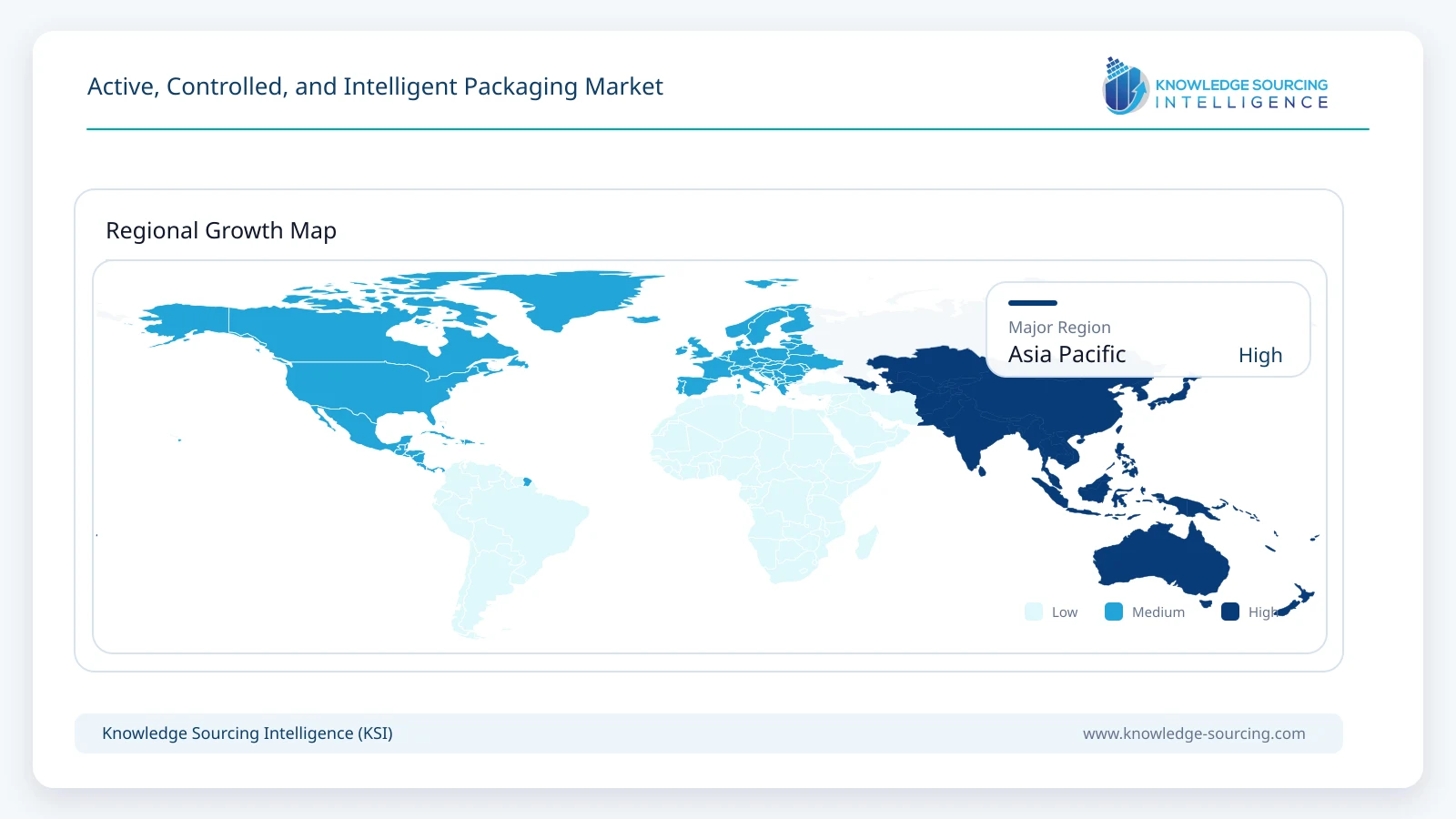
Asia Pacific is projected to reach approximately USD 8.95 billion by 2031. China provides substantial packaging production and digital-commerce scale, Japan and South Korea support advanced functional materials and sensor technologies, while India and Southeast Asia benefit from expanding packaged-food consumption, pharmaceutical manufacturing and modern retail infrastructure. Europe remains a major market where growth is increasingly shaped by the requirement to combine advanced functionality with recyclability under the PPWR.
Technology Outlook
Battery-Free and Low-Cost Intelligent Labels
Battery-free sensing is emerging between conventional RFID and powered data loggers. Avery Dennison’s USD 75 million investment in Wiliot during April 2026 illustrates supplier interest in passive Bluetooth-based devices capable of generating continuous information about location and condition. These technologies could expand sensor use where conventional powered devices are too costly or bulky, although widespread adoption will depend on infrastructure and unit economics.
Standards-Based Digital Product Identities
GS1-compatible 2D barcodes and digital identities are likely to have a wider near-term impact than electronic sensors because they can be incorporated into existing print workflows. A single product identifier can support retail scanning, traceability, authentication, instructions and consumer information. This provides manufacturers with a staged route into connected packaging before investing in RFID or condition-monitoring hardware.
Recyclable Functional Barrier Systems
Material innovation increasingly focuses on achieving oxygen, moisture and grease resistance without relying on difficult-to-recycle multilayer structures. The challenge is particularly important for active packaging because preservation performance cannot simply be sacrificed to simplify the material. Functional coatings, mono-material films and fiber-based barriers therefore become central to expanding advanced packaging under tighter circularity requirements.
Recent Developments
May 2026: Amcor launched its global Lift-Off Rigids challenge seeking commercially validated startup technologies including shelf-life indicators, smart packaging, recyclable barriers, retort systems and AI-enabled packaging applications.
May 2026: Smurfit Westrock introduced ActiBlu, a paper-packaging technology in which an adhesive applied during production is activated by a fine mist of water, reducing dependence on conventional hot-melt gluing and illustrating continuing functional innovation in fiber-based packaging.
April 2026: Avery Dennison announced a USD 75 million minority investment in Wiliot, expanding its exposure to battery-free Bluetooth sensing and item-level condition monitoring across food, retail and logistics applications.
February 2026: Avery Dennison launched AD IdentiFresh, an RFID inlay portfolio designed for bakery, meat, deli and produce applications to improve inventory visibility, freshness management and food-waste reduction.
Competitive Landscape
The market includes packaging converters, functional-material suppliers, digital-identification companies and specialist sensing technology providers. Amcor, Sonoco Products, Sealed Air, Tetra Pak, Smurfit Westrock, Mondi, Huhtamaki, ProAmpac and Constantia Flexibles compete primarily through packaging structures, barrier performance, preservation capability and relationships with major food, healthcare and consumer-goods customers.
Avery Dennison and CCL Industries occupy stronger positions in labeling and digital identification, while Impinj provides RFID semiconductor and platform technology. Wiliot is developing battery-free sensing, Timestrip specializes in condition-monitoring indicators, and Ynvisible focuses on printed and low-power visual display technologies. BASF and Clariant participate through functional materials and additives used within packaging systems.
Competitive advantage increasingly depends on combining capabilities rather than owning every technology internally. Packaging converters need access to identifiers, sensors and digital platforms, while technology companies need converters capable of embedding those components into economically viable packages at industrial scale. Partnerships between materials companies, label converters, sensor providers and software platforms should therefore become more important through 2031.
Analyst View
The market is likely to grow faster during 2026–2031 than suggested by the previous forecast, but the acceleration is not uniform. The postponement of FDA Food Traceability Rule enforcement to July 2028 reduces one of the immediate regulatory catalysts assumed in earlier projections. At the same time, commercial adoption of RFID in fresh foods, rapid development of standards-based 2D identities and investment in battery-free sensing create stronger growth opportunities later in the forecast period.
Controlled packaging remains the commercial foundation of the industry because aseptic, modified-atmosphere and retort systems are already deployed across very large food and beverage categories. Intelligent packaging does not overtake these technologies during the forecast period, but it becomes the most important source of incremental growth. Its strongest applications are those where digital information directly changes an operational outcome, such as reducing fresh-food waste, proving cold-chain integrity or automating inventory visibility.
Digital connectivity should also be viewed as a layered market rather than a single technology transition. 2D barcodes can address many traceability and information requirements at very low incremental cost. RFID becomes more attractive where automatic scanning and inventory accuracy produce measurable savings, while sensors remain concentrated in products where monitoring condition has sufficient economic or safety value. This prevents the forecast from assuming unrealistic universal adoption of expensive intelligent components.
The second structural issue is recyclability. Future growth depends on advanced functionality being integrated without making packaging materially harder to recover. The PPWR makes this particularly important in Europe, but the design implications extend globally as multinational brands standardize packaging platforms. Suppliers capable of combining shelf-life performance, digital identification and simpler recyclable structures should therefore gain a stronger competitive position.
Active, Controlled, and Intelligent Packaging Market Scope
| Report Metric | Details |
|---|---|
| Total Market Size in 2026 | USD 20.5 billion |
| Total Market Size in 2031 | USD 29.35 billion |
| Forecast Unit | Billion |
| Growth Rate | 7.4% |
| Study Period | 2021 to 2031 |
| Historical Data | 2021 to 2024 |
| Base Year | 2025 |
| Forecast Period | 2026 – 2031 |
| Segmentation | Packaging Technology, Material, End User, Geography |
| Companies |
|
Market Segmentation
By Packaging Technology
Active Packaging
Oxygen Scavengers
Moisture Controllers
Antimicrobial Agents
UV Blocking
Others
Controlled Packaging
Aseptic Packaging
Modified Atmosphere Packaging
Retort Packaging
Others
Intelligent Packaging
RFID Tags
NFC Packaging
Time-Temperature Indicators
Freshness Indicators
Sensor-Based Packaging
Others
By Material
Plastic
Paper & Paperboard
Glass
Others
By End User
Food & Beverage
Pharmaceuticals & Healthcare
Electronics
Cosmetics & Personal Care
Others
By Geography
North America
United States
Canada
Mexico
South America
Brazil
Argentina
Others
Europe
United Kingdom
Germany
France
Italy
Spain
Others
Middle East and Africa
Saudi Arabia
UAE
South Africa
Others
Asia Pacific
China
India
Japan
South Korea
Indonesia
Others
Table of Contents
1. EXECUTIVE SUMMARY
2. MARKET SNAPSHOT
2.1. Market Overview
2.2. Market Definition
2.3. Scope of the Study
2.4. Market Segmentation
2.5. Key Market Indicators
3. BUSINESS LANDSCAPE
3.1. Market Drivers
3.2. Market Restraints and Challenges
3.3. Market Opportunities
3.4. Raw Material and Pricing Analysis
3.5. Supply Chain Analysis
3.6. Regulatory Environment
3.7. Porter’s Five Forces Analysis
3.8. Strategic Recommendations
4. TECHNOLOGY OUTLOOK
4.1. Battery-Free and Low-Cost Intelligent Labels
4.2. Standards-Based Digital Product Identities
4.3. Recyclable Functional Barrier Systems
5. ACTIVE, CONTROLLED, AND INTELLIGENT PACKAGING MARKET BY PACKAGING TECHNOLOGY
5.1. Introduction
5.2. Active Packaging
5.2.1. Oxygen Scavengers
5.2.2. Moisture Controllers
5.2.3. Antimicrobial Agents
5.2.4. UV Blocking
5.2.5. Others
5.3. Controlled Packaging
5.3.1. Aseptic Packaging
5.3.2. Modified Atmosphere Packaging
5.3.3. Retort Packaging
5.3.4. Others
5.4. Intelligent Packaging
5.4.1. RFID Tags
5.4.2. NFC Packaging
5.4.3. Time-Temperature Indicators
5.4.4. Freshness Indicators
5.4.5. Sensor-Based Packaging
5.4.6. Others
6. ACTIVE, CONTROLLED, AND INTELLIGENT PACKAGING MARKET BY MATERIAL
6.1. Introduction
6.2. Plastic
6.3. Paper & Paperboard
6.4. Glass
6.5. Others
7. ACTIVE, CONTROLLED, AND INTELLIGENT PACKAGING MARKET BY END USER
7.1. Introduction
7.2. Food & Beverage
7.3. Pharmaceuticals & Healthcare
7.4. Electronics
7.5. Cosmetics & Personal Care
7.6. Others
8. ACTIVE, CONTROLLED, AND INTELLIGENT PACKAGING MARKET BY GEOGRAPHY
8.1. Introduction
8.2. North America
8.2.1. United States
8.2.2. Canada
8.2.3. Mexico
8.3. South America
8.3.1. Brazil
8.3.2. Argentina
8.3.3. Others
8.4. Europe
8.4.1. United Kingdom
8.4.2. Germany
8.4.3. France
8.4.4. Italy
8.4.5. Spain
8.4.6. Others
8.5. Middle East and Africa
8.5.1. Saudi Arabia
8.5.2. UAE
8.5.3. South Africa
8.5.4. Others
8.6. Asia Pacific
8.6.1. China
8.6.2. India
8.6.3. Japan
8.6.4. South Korea
8.6.5. Indonesia
8.6.6. Others
9. COMPETITIVE ENVIRONMENT AND ANALYSIS
9.1. Competitive Positioning
9.2. Active and Controlled Packaging Capability Analysis
9.3. Digital Identification and Sensor Technology Benchmarking
9.4. Market Share Analysis
9.5. Strategic Developments
9.6. Competitive Dashboard
10. COMPANY PROFILES
10.1. Amcor plc
10.2. Sonoco Products Company
10.3. Sealed Air Corporation
10.4. Tetra Pak International S.A.
10.5. Smurfit Westrock plc
10.6. Mondi plc
10.7. Huhtamäki Oyj
10.8. ProAmpac
10.9. Constantia Flexibles
10.10. Avery Dennison Corporation
10.11. CCL Industries Inc.
10.12. AptarGroup, Inc.
10.13. SÜDPACK Verpackungen SE & Co. KG
10.14. MULTIVAC Group
10.15. Coveris
10.16. Impinj, Inc.
10.17. Wiliot Ltd.
10.18. Timestrip UK Ltd.
10.19. BASF SE
10.20. Clariant AG
11. ANALYST VIEW
12. APPENDIX
12.1. Research Methodology
12.2. Market Estimation and Assumptions
12.3. Definitions and Abbreviations
Navigate
Trusted by the world's leading organizations











