
Global demand for AI engineering professionals is forecast to increase from 5.5 million in 2026 to 14.1 million by 2031, representing a CAGR of approximately 20.7% during the forecast period.
Highlights:
- 1Applied AI and machine learning engineering represents the largest specialization in 2026.
- 2Generative AI and LLM engineering records the fastest specialization growth through 2031.
- 3Mid-career professionals form the largest experience group within AI engineering demand.
- 4Senior, lead and principal AI engineers gain share as deployment complexity increases.
- 5Technology and cloud companies remain the largest employers of AI engineering talent.
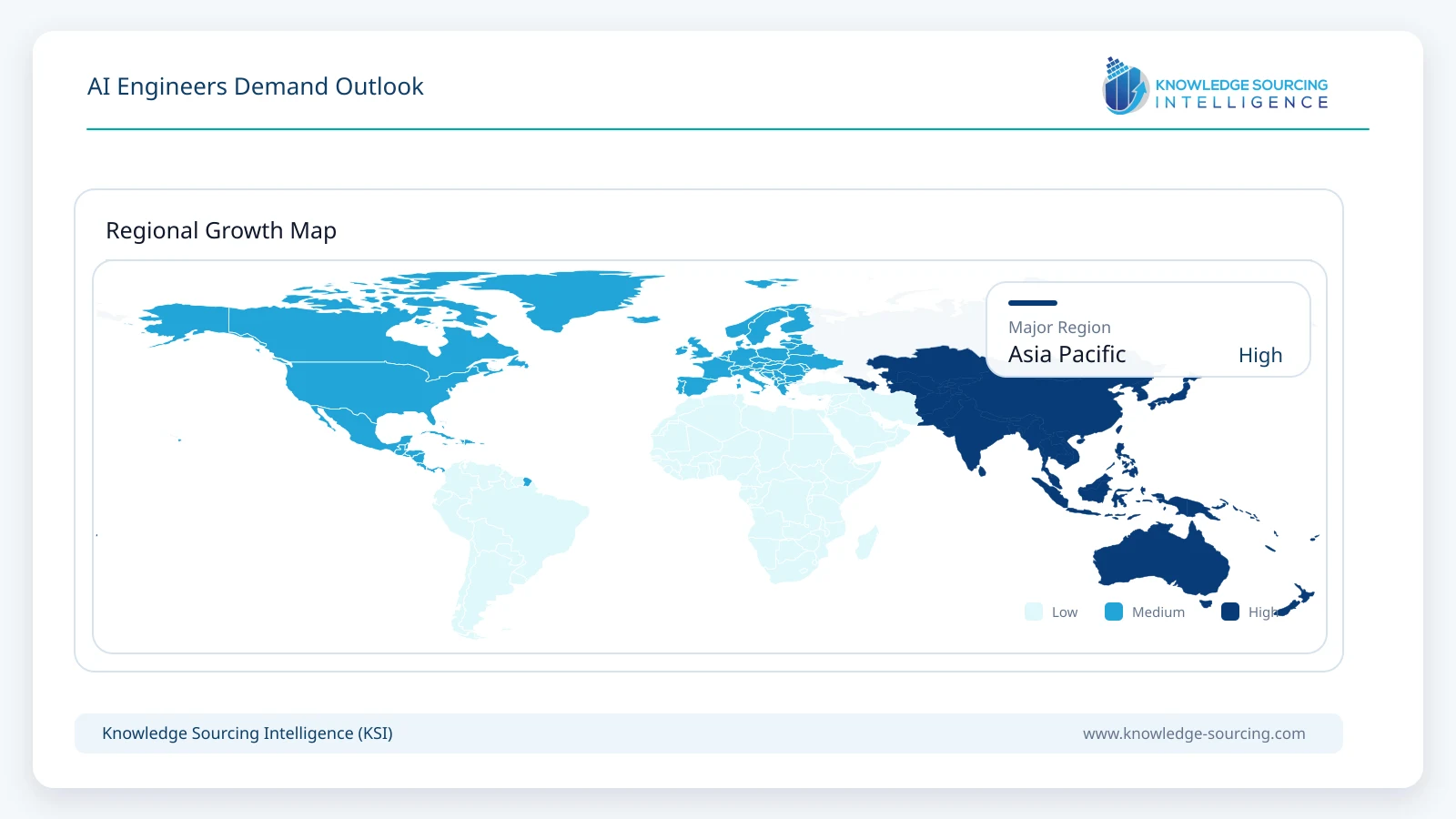
- 6Asia Pacific records the strongest regional expansion, led by India and other Asian technology hubs.
- 7Agentic AI and production-scale AI infrastructure are reshaping engineering skill requirements.
AI engineers design, build, deploy and maintain artificial intelligence systems that operate in production environments. The role increasingly spans model development, data pipelines, software engineering, evaluation, inference infrastructure, security, monitoring and integration with enterprise applications. Demand therefore extends beyond professionals working directly on foundation models and includes applied machine learning engineers, generative AI engineers, MLOps specialists, AI platform engineers, computer vision engineers, robotics engineers and research-oriented engineering roles.
Global AI engineering demand is expanding as enterprises move from experimentation toward deployment. LinkedIn’s workforce research shows that AI engineering talent represented approximately seven of every 1,000 members globally in 2024, more than double its level in 2016. More recent labor-market data indicate that AI Engineer has overtaken Machine Learning Engineer as the most common AI occupation on LinkedIn, while newer implementation-oriented roles such as Forward Deployed Engineer are becoming increasingly prominent.
The demand profile is changing alongside the technology. Earlier AI hiring was concentrated around machine learning model development, data science and research. Enterprises now require engineers who can connect models to data, applications and business processes; construct retrieval and agent architectures; establish evaluation frameworks; optimize inference costs; secure AI systems; and operate models reliably after deployment. The transition creates a broader employment opportunity but raises the technical threshold for experienced engineering roles.
The World Economic Forum identifies AI and Machine Learning Specialists among the fastest-growing occupations through 2030. Its employer survey also indicates that AI and information-processing technologies are expected to transform the operations of a large majority of participating organizations.
Major Market Drivers
Enterprise AI Is Moving From Experimentation Into Production Systems
The strongest driver of AI engineering demand is the transition from isolated AI pilots to production systems embedded within core business workflows. Generative AI initially increased experimentation through conversational interfaces, coding assistants and content applications. Enterprises are now building agent systems, search and retrieval platforms, workflow automation, model-routing systems and industry-specific AI applications that require considerably more engineering support than access to a standalone foundation model.
Production environments need engineers capable of managing model performance, latency, security, observability, data access, integrations and cost. This expands hiring beyond conventional machine learning specialists. Software engineers with AI expertise, MLOps professionals, AI infrastructure engineers, evaluation engineers and forward deployed engineers increasingly participate in AI delivery.
Stanford’s 2026 AI Index shows how employer requirements are changing. Demand is shifting toward capabilities required to operate AI systems at scale, while job postings referencing agentic AI, orchestration and deployment-related skills have expanded rapidly. This indicates that employers increasingly need professionals capable of turning models into reliable applications rather than simply training models.
The effect extends beyond technology companies. Financial institutions, healthcare providers, manufacturers, retailers, professional-services firms and public-sector organizations are building internal AI engineering capabilities as AI becomes more tightly integrated with operational systems.
AI Investment Is Expanding the Number and Diversity of Engineering Roles
Rapid investment in AI software, infrastructure and applications is supporting employment across the AI development stack. Stanford’s 2026 AI Index estimates that global corporate AI investment more than doubled during 2025, with generative AI accounting for a substantial portion of private investment. At the same time, organizational AI adoption continued to expand, creating demand for engineers capable of deploying and adapting AI within enterprise environments.
This investment is creating a wider range of engineering roles. Foundation-model companies require researchers and distributed-systems engineers. Cloud providers need AI infrastructure and platform engineers. Enterprises require applied AI engineers capable of integrating models into internal systems. Manufacturers need computer vision and industrial AI specialists, while automotive companies require engineers working across perception, robotics and autonomous systems.
Hiring is therefore becoming less concentrated around a single job title. AI Engineer, Machine Learning Engineer, Applied Scientist, MLOps Engineer, AI Platform Engineer, Research Engineer, Forward Deployed Engineer and AI Security Engineer increasingly represent different parts of the same technical workforce.
Major Market Restraints
Production-Ready AI Engineering Skills Remain Scarce
The principal labor constraint is not general familiarity with AI but the availability of professionals capable of deploying systems reliably at enterprise scale. Building a demonstration with a foundation-model API requires substantially fewer capabilities than creating a secure, observable and cost-efficient production system connected to proprietary data and enterprise applications.
Employers increasingly need combinations of software engineering, machine learning, distributed systems, cloud infrastructure, data engineering, evaluation and security expertise. Agentic systems add requirements around orchestration, tool use, permission management and failure handling.
The speed of technological change makes the shortage more difficult to resolve through conventional education alone. Google’s February 2026 workforce research found a large gap between managers who consider an AI-trained workforce important and workers who have actually received AI training from their employers. Google consequently expanded its AI Professional Certificate and related workforce programs during 2026.
Companies are responding through internal training, partnerships with universities, professional certifications and the conversion of experienced software and data engineers into AI roles. These measures expand supply but require time and practical production experience.
AI Is Also Changing Conventional Software-Engineering Hiring
Strong demand for specialized AI talent does not mean that all technical hiring expands at the same rate. AI-assisted development is improving engineering productivity and changing the composition of software teams, particularly at the entry level.
Research from the Stanford Digital Economy Lab using U.S. payroll data found a widening employment gap among workers aged 22 to 25 in highly AI-exposed occupations. The adjustment appears to be occurring primarily through reduced hiring of younger workers rather than widespread displacement of experienced employees.
This creates a more selective AI engineering labor market. Companies may require fewer junior developers for routine implementation while competing intensely for engineers capable of architecture, AI integration, model evaluation and production deployment. Demand consequently shifts toward professionals who combine strong software fundamentals with current AI capabilities.
AI Engineers Demand Outlook Trends
AI Engineer Is Replacing Narrower Machine Learning Titles
The definition of an AI engineer is broadening. Traditional machine learning engineering concentrated on training and deploying predictive models, while current AI engineering increasingly combines foundation models, software development, retrieval, agents, evaluation and infrastructure.
LinkedIn reported in August 2026 that AI Engineer had become the most common AI role on its platform, overtaking Machine Learning Engineer. Forward Deployed Engineer had also emerged as one of the most common AI occupations, reflecting growing demand for professionals who work directly with organizations to implement AI solutions.
The shift indicates that employers increasingly value end-to-end delivery capability rather than narrow model specialization. Engineers who can connect model behavior with enterprise software, data infrastructure and user workflows therefore gain importance.
Agent Engineering and LLM Operations Are Emerging as Core Skills
Enterprise adoption of generative AI is creating new specialization around agents, LLM operations, evaluation and inference infrastructure. Organizations need engineers who can manage prompts and context, but production systems increasingly require deeper capabilities such as retrieval architecture, tool integration, model routing, monitoring and automated evaluation.
LinkedIn identified AI Agents among the fastest-growing AI engineering skills during 2025 and also recorded rapid growth in LLM operations.
This alters hiring requirements. Prompt engineering as a standalone skill becomes less differentiated, while employers increasingly seek software engineers capable of embedding AI inside larger systems. Generative AI and LLM engineering consequently becomes the fastest-growing specialization through 2031.
AI Engineering Demand Is Expanding Beyond Large Technology Companies
Technology companies remain the largest employers of specialized AI engineering talent, but demand is spreading into finance, professional services, manufacturing, healthcare and other sectors.
Manufacturers increasingly use AI for inspection, predictive maintenance, industrial automation and engineering optimization. Financial institutions require engineers for fraud detection, risk analysis, customer-service automation and internal knowledge systems. Healthcare organizations are expanding AI applications in diagnostics, workflow automation and clinical data processing.
Smaller companies are also gaining access to AI infrastructure through cloud platforms and foundation-model APIs, reducing the requirement to build proprietary models from the ground up. Their engineering requirements therefore concentrate more heavily on integration, customization and application development.
Geography Is Becoming More Distributed
AI engineering talent remains concentrated in major technology hubs, but hiring growth is becoming geographically broader. India is particularly important because of its large software-engineering workforce, enterprise technology-services sector and growing domestic AI ecosystem.
LinkedIn’s 2026 labor-market research found rapid expansion in Indian AI engineering hiring, while demand was also increasing in the United Kingdom. The same research indicates that AI engineering skills remain internationally mobile, giving companies access to a more global talent pool than many traditional occupations.
Remote development, multinational engineering centers and global capability centers further allow companies to distribute AI teams across multiple countries.
AI Engineers Demand Outlook Segmentation
By Specialization
Applied AI and Machine Learning Engineering
Applied AI and machine learning engineering accounts for approximately 34% of global AI engineering demand in 2026, making it the largest specialization. The category covers engineers responsible for integrating machine learning and AI capabilities into commercial products, enterprise software and operational systems.
Demand remains broad because most organizations do not develop foundation models. Instead, they adapt existing models, connect them with proprietary data and incorporate AI functionality into applications. Applied engineers therefore need a combination of machine learning understanding and conventional software-engineering capability.
The segment continues to expand strongly through 2031, although its relative share moderates as generative AI, MLOps and specialist infrastructure roles grow faster.
Generative AI and LLM Engineering
Generative AI and LLM engineering represents the fastest-growing specialization through the forecast period. Demand encompasses agent architecture, retrieval-augmented generation, model adaptation, evaluation, inference optimization, multimodal applications and production integration.
Its growth reflects a transition from experimental chatbot development toward AI systems capable of interacting with software tools, company data and business processes.
The specialization is projected to increase from approximately 17% of demand in 2026 to 24% by 2031, making it one of the largest AI engineering talent pools by the end of the forecast period.
By Experience Level
Mid-Career Professionals
Mid-career engineers account for approximately 44% of global requirement in 2026, making them the largest experience group. These professionals generally combine several years of software, machine learning, cloud or data-engineering experience with enough technical depth to independently implement AI systems.
Employers value this group because production AI requires capabilities extending beyond model experimentation. Engineers need to understand existing software systems, deployment infrastructure, security constraints and business requirements.
Mid-career professionals remain the largest group through 2031 as enterprises expand AI teams beyond small groups of senior specialists.
Senior, Lead and Principal Engineers
Senior and lead roles record slightly faster growth than the total market as organizations move from isolated AI projects toward large-scale production architectures.
These engineers make decisions about model architecture, infrastructure, evaluation, security, data governance and system reliability. They also supervise increasingly mixed teams containing software engineers, ML engineers, data specialists and domain experts.
Senior and lead professionals consequently increase from approximately 32% of demand in 2026 to 35% by 2031.
By Industry
Technology, Cloud and AI Platforms
Technology, cloud and specialist AI companies represent approximately 31% of global demand in 2026, making them the largest employer category. This includes foundation-model developers, hyperscale cloud providers, software companies, semiconductor companies and AI-native startups.
These employers require some of the most specialized engineering talent, including model researchers, distributed-training engineers, AI infrastructure specialists and inference engineers.
Their share gradually declines as AI engineering spreads across other industries, but the technology sector remains the largest employer group throughout the forecast period.
Manufacturing and Industrial
Manufacturing and industrial companies record the fastest industry-level expansion through 2031. Demand is supported by computer vision, robotics, industrial automation, predictive maintenance, digital twins and AI-assisted engineering.
Unlike general office applications, industrial AI frequently requires engineers to integrate software with machines, sensors, production systems and physical processes. This creates demand for professionals combining machine learning with controls, robotics, industrial data and edge-computing knowledge.
The industry’s share of global AI engineering requirement increases materially through the forecast period.
AI Engineers Demand Outlook by Geography
North America
North America accounts for approximately 35% of global AI engineering demand in 2026, making it the largest regional market. The United States hosts many of the world’s largest foundation-model companies, cloud platforms, semiconductor businesses and software companies, creating particularly strong demand for high-end research and engineering skills.
The region remains the largest market through 2031, although its global share moderates as AI engineering expands faster across Asia.
Asia Pacific
Asia Pacific records the fastest regional growth and is projected to increase from approximately 34% of global demand in 2026 to 40% by 2031.
India provides one of the region’s largest engineering talent pools and is increasingly important for global capability centers, software development, AI services and domestic technology companies. China has a substantial AI research and engineering ecosystem, while Japan, South Korea, Singapore and Australia continue expanding AI investment across manufacturing, finance, robotics and digital services.
Google expanded its AI Research Foundations curriculum in India during July 2026 as part of broader efforts to strengthen advanced AI talent, illustrating the scale of industry investment in future engineering supply.
Employer and Talent Landscape
Competition for AI engineers increasingly involves both AI-native companies and established enterprises building internal AI capabilities.
Alphabet/Google, Microsoft and Amazon combine foundation models, cloud AI platforms and extensive enterprise ecosystems. Meta maintains substantial AI research and infrastructure operations, while NVIDIA requires engineering talent spanning AI software, accelerated computing, inference and developer platforms.
OpenAI and Anthropic compete for highly specialized research, infrastructure, safety and product-engineering talent. Databricks operates at the intersection of AI, data infrastructure and enterprise analytics, while Palantir has expanded demand for forward deployed engineering roles associated with enterprise AI implementation.
Traditional technology companies such as IBM and Salesforce are also expanding AI capabilities within enterprise platforms. Competition therefore extends beyond compensation. Employers increasingly differentiate through access to compute, proprietary models, technical autonomy, research opportunities and the ability to deploy AI at large scale.
The talent market does not operate like a conventional supplier market, so competitive positioning is better evaluated through hiring intensity, engineering specialization, geographic talent concentration and the ability to attract and retain scarce senior expertise rather than conventional revenue market share.
Recent Developments
August 2026: LinkedIn reported that U.S. AI job postings had approximately doubled since 2023 and identified AI Engineer as the most common AI occupation on its platform.
August 2026: LinkedIn’s latest AI Labor Market Update identified AI Engineer among the fastest-growing occupations across the major labor markets analyzed.
July 2026: Google announced expansion of its AI Research Foundations curriculum in India to support advanced AI talent development.
June 2026: Microsoft highlighted changing requirements for Indian engineers as AI agents and collaborative AI systems alter software-development work.
April 2026: LinkedIn reported accelerating AI engineering hiring across several major economies, with particularly strong expansion in India.
February 2026: Google introduced its AI Professional Certificate to expand practical AI skills aligned with employer requirements.
Market Outlook
AI engineering develops into a broader professional category through 2031 as artificial intelligence becomes embedded across software, products, industrial systems and business processes.
The strongest demand shifts away from isolated model development toward applied engineering, agent architecture, AI infrastructure, evaluation, security and production operations. Generative AI engineering grows particularly rapidly, while conventional applied machine learning continues to provide the largest underlying talent base.
The market also becomes more experienced-skewed. AI coding assistants improve productivity for routine implementation, while enterprises place greater value on engineers capable of making architectural decisions, integrating AI with complex existing systems and managing reliability.
Technology companies remain the largest employer group, but a growing proportion of demand comes from manufacturing, financial services, healthcare and other non-technology industries. Asia Pacific gains the most regional share as engineering capacity expands across India and other major Asian technology economies.
AI Engineers Demand Outlook Market Scope:
| Report Metric | Details |
|---|---|
| Total Market Size in 2026 | 5.5 million |
| Total Market Size in 2031 | 14.1 million |
| Forecast Unit | Million |
| Growth Rate | 20.7% |
| Study Period | 2021 to 2031 |
| Historical Data | 2021 to 2024 |
| Base Year | 2025 |
| Forecast Period | 2026 – 2031 |
| Segmentation | Specialization, Experience Level, Industry, Geography |
| Companies |
|
Market Segmentation
By Specialization
Applied AI and Machine Learning Engineering
Generative AI and LLM Engineering
MLOps and AI Platform Engineering
Computer Vision Engineering
Robotics and Autonomous Systems Engineering
AI Research, Safety and Security Engineering
Others
By Experience Level
Entry-Level / Early Career
Mid-Career
Senior / Lead / Principal
By Industry
Technology, Cloud and AI Platforms
Financial and Professional Services
Manufacturing and Industrial
Healthcare and Life Sciences
Retail, Media and Consumer
Automotive and Mobility
Government, Defense and Public Sector
Others
By Geography
North America
United States
Canada
Mexico
South America
Brazil
Argentina
Others
Europe
United Kingdom
Germany
France
Netherlands
Switzerland
Spain
Others
Middle East and Africa
UAE
Saudi Arabia
Israel
South Africa
Others
Asia Pacific
India
China
Japan
South Korea
Singapore
Australia
Taiwan
Others
Table of Contents
1. INTRODUCTION
1.1. Market Overview
1.2. Market Definition
1.3. Scope of the Study
1.4. Market Segmentation
1.5. Forecast Unit
1.6. Assumptions
1.7. Base and Forecast Years Timeline
1.8. Key Benefits for Stakeholders
2. RESEARCH METHODOLOGY
2.1. Research Design
2.2. Research Process
2.3. Primary Research Framework
2.4. Secondary Research Framework
2.5. Workforce Demand Estimation
2.6. Data Triangulation
2.7. Forecast Methodology
3. EXECUTIVE SUMMARY
3.1. Key Findings
3.2. Analyst View
4. MARKET DYNAMICS
4.1. Market Drivers
4.1.1. Enterprise AI Moving From Experimentation to Production
4.1.2. Expansion of AI Investment and Production Infrastructure
4.1.3. Increasing Deployment of Agentic AI Systems
4.1.4. AI Adoption Across Non-Technology Industries
4.2. Market Restraints
4.2.1. Shortage of Production-Ready AI Engineering Skills
4.2.2. Rapid Obsolescence of Technical Skill Sets
4.2.3. Pressure on Entry-Level Software-Engineering Pipelines
4.2.4. High Compensation and Retention Costs for Specialized Talent
4.3. Market Opportunities
4.4. AI Engineering Talent Supply-Demand Analysis
4.5. Workforce Value Chain
4.6. Education, Certification and Reskilling Landscape
4.7. Strategic Recommendations
5. AI ENGINEERING SKILLS AND TECHNOLOGY OUTLOOK
5.1. Foundation Models and LLMs
5.2. Agentic AI and Agent Orchestration
5.3. Retrieval-Augmented Generation
5.4. Model Evaluation and Observability
5.5. MLOps and LLMOps
5.6. AI Infrastructure and Inference Engineering
5.7. Multimodal AI
5.8. Computer Vision
5.9. Robotics and Autonomous Systems
5.10. AI Security and Safety Engineering
5.11. Distributed Systems and Cloud Infrastructure
6. AI ENGINEERS DEMAND OUTLOOK BY SPECIALIZATION
6.1. Introduction
6.2. Applied AI and Machine Learning Engineering
6.3. Generative AI and LLM Engineering
6.4. MLOps and AI Platform Engineering
6.5. Computer Vision Engineering
6.6. Robotics and Autonomous Systems Engineering
6.7. AI Research, Safety and Security Engineering
6.8. Others
7. AI ENGINEERS DEMAND OUTLOOK BY EXPERIENCE LEVEL
7.1. Introduction
7.2. Entry-Level / Early Career
7.3. Mid-Career
7.4. Senior / Lead / Principal
8. AI ENGINEERS DEMAND OUTLOOK BY INDUSTRY
8.1. Technology, Cloud and AI Platforms
8.2. Financial and Professional Services
8.3. Manufacturing and Industrial
8.4. Healthcare and Life Sciences
8.5. Retail, Media and Consumer
8.6. Automotive and Mobility
8.7. Government, Defense and Public Sector
8.8. Others
9. AI ENGINEERS DEMAND OUTLOOK BY GEOGRAPHY
9.1. North America
9.1.1. United States
9.1.2. Canada
9.1.3. Mexico
9.2. South America
9.2.1. Brazil
9.2.2. Argentina
9.2.3. Others
9.3. Europe
9.3.1. United Kingdom
9.3.2. Germany
9.3.3. France
9.3.4. Netherlands
9.3.5. Switzerland
9.3.6. Spain
9.3.7. Others
9.4. Middle East and Africa
9.4.1. UAE
9.4.2. Saudi Arabia
9.4.3. Israel
9.4.4. South Africa
9.4.5. Others
9.5. Asia Pacific
9.5.1. India
9.5.2. China
9.5.3. Japan
9.5.4. South Korea
9.5.5. Singapore
9.5.6. Australia
9.5.7. Taiwan
9.5.8. Others
10. EMPLOYER AND TALENT LANDSCAPE
10.1. Major Employers and Hiring Strategies
10.2. AI Engineering Talent Concentration
10.3. Talent Competition and Retention
10.4. Education and Workforce Partnerships
10.5. Employer Dashboard
11. LEADING AI ENGINEERING EMPLOYERS
11.1. Alphabet Inc.
11.2. Microsoft Corporation
11.3. Amazon.com, Inc.
11.4. Meta Platforms, Inc.
11.5. NVIDIA Corporation
11.6. OpenAI
11.7. Anthropic PBC
11.8. IBM Corporation
11.9. Salesforce, Inc.
11.10. Databricks, Inc.
11.11. Palantir Technologies Inc.
11.12. Tesla, Inc.
12. APPENDIX
Navigate
Trusted by the world's leading organizations











