
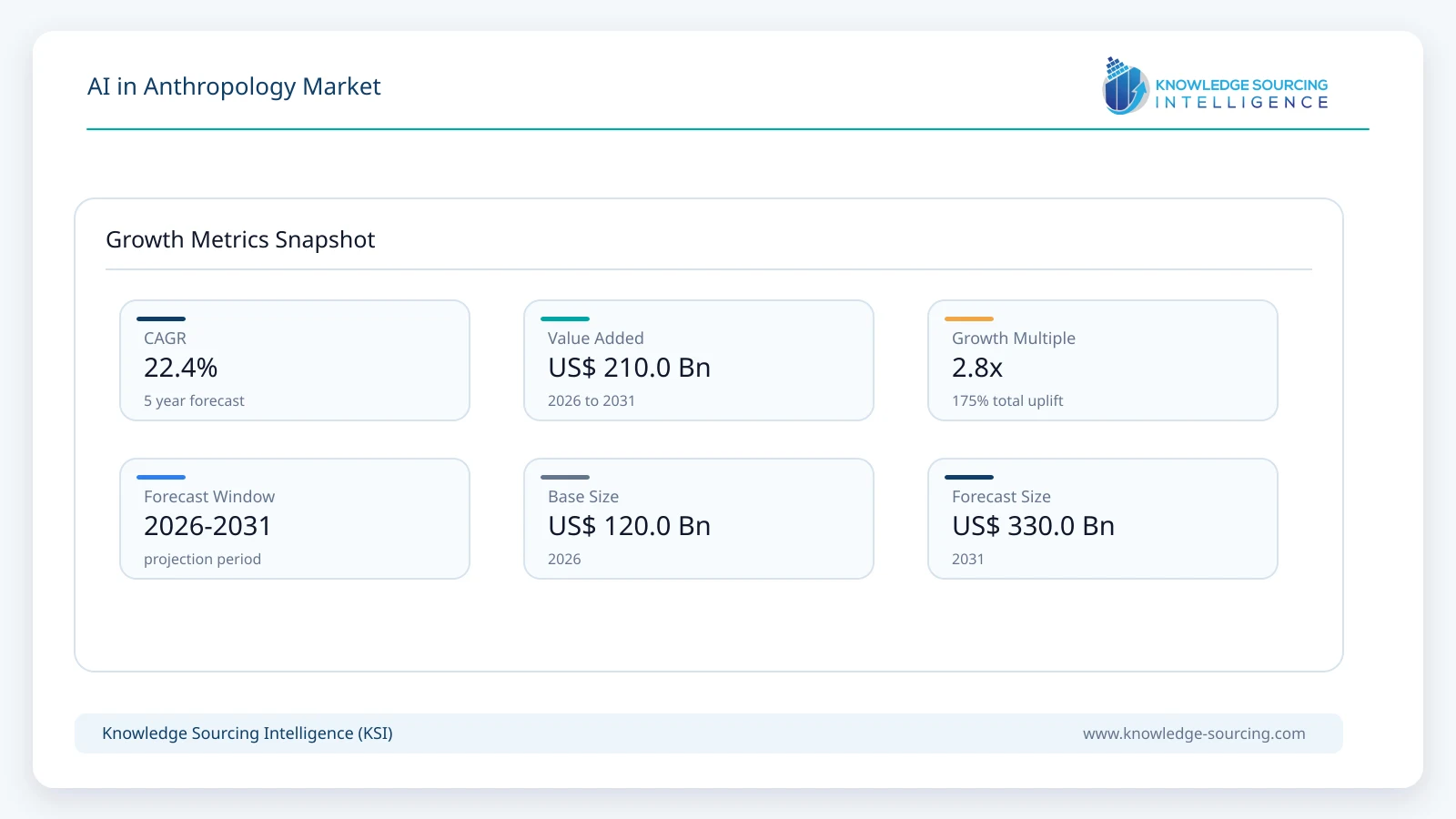
The AI in Anthropology Market is forecast to grow at a CAGR of 22.4%, reaching USD 330.0 million in 2031 from USD 120.0 million in 2026.
Highlights:
- 1AI-powered ethnographic tools are the most directly aligned commercial solution category, especially where human review and coding histories are built into the workflow.
- 2Academic and research institutions anchor specialist demand; corporations extend spending through consumer, product and workplace ethnography.
- 3New qualitative-analysis products emphasize source-linked findings, controlled coding and researcher sign-off rather than wholly automated interpretation.
- 4Language and heritage programmes widen the technical requirements beyond English-language interview analysis to manuscripts, speech and geospatial evidence.
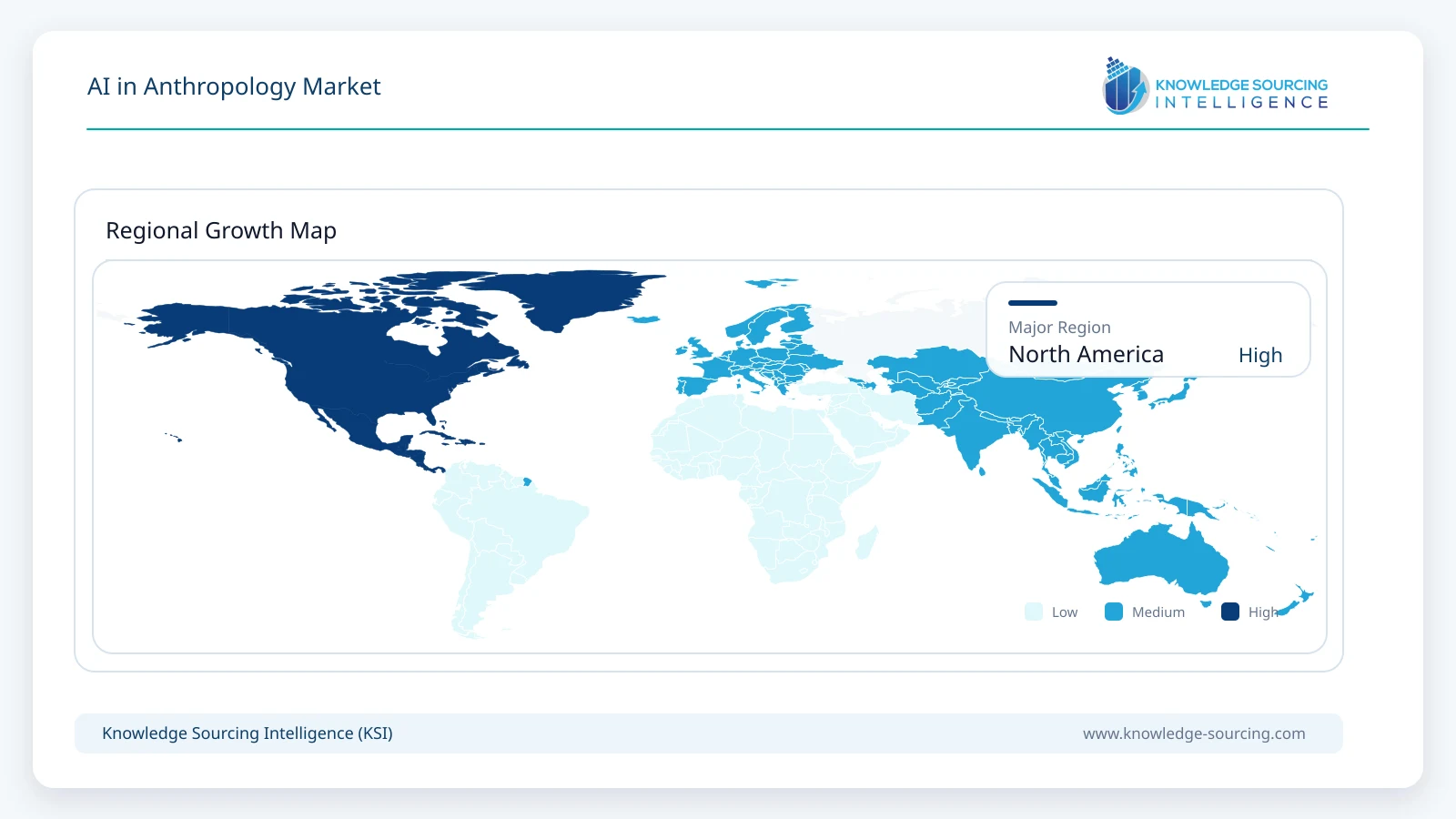
- 5North America has a concentrated supplier and research ecosystem; Asia Pacific offers substantial opportunity through linguistic diversity and public cultural initiatives.
- 6Academic and research institutions account for an estimated 48% of spending in 2026, with corporate research programmes broadening the buyer base.
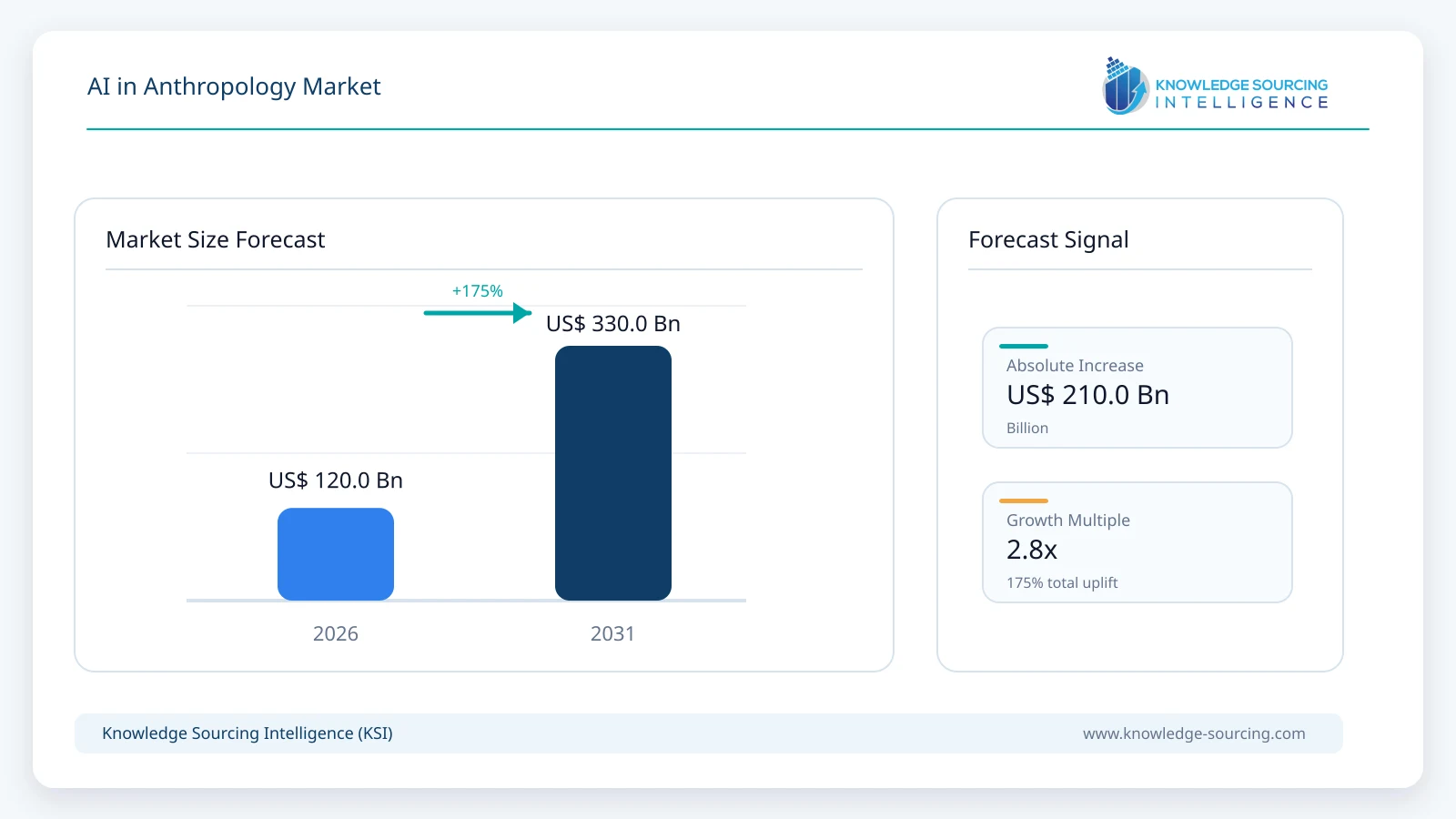
AI in anthropology encompasses software and specialist services used to interpret ethnographic interviews, fieldnotes, oral histories, archaeological records, language collections and digital behaviour. Relevant purchases include qualitative analysis subscriptions with AI coding or transcription, computational tools configured for cultural datasets, and research-platform integration commissioned for a specific anthropological purpose. AI supplied for unrelated enterprise workflows, ordinary cloud hosting, and the full budgets of museums or universities are not equivalent to this market.
The economic structure differs by setting. A university may buy MAXQDA AI Assist through its research software budget, build a curated manuscript corpus under a heritage grant and commission a separate data-integration project. Corporate teams more often subscribe to platforms such as Dovetail or Recollective for continuing interview and digital-diary programmes. Universities favour predictable institutional pricing and preservation compatibility; commercial buyers put greater weight on team throughput, cross-market coverage and the ability to revisit original evidence.
Procurement is shaped by the evidence chain. Participants must be able to withdraw or restrict recordings; field researchers need to trace machine-generated categories to original quotations; conservators may need to preserve the location, dating and uncertainty associated with archaeological evidence. Source-specific permissions are consequently more important than a model’s ability to produce fluent summaries. Dedicated methodological software has an advantage when a buyer must defend the interpretation months or years after the fieldwork.
Market Overview
NVivo AI Cloud, introduced by Lumivero in September 2026, links proposed themes and codes to original sources and places researcher approval before changes become part of the analytical record. ATLAS.ti provides a different route through its project-connected MCP Server, while MAXQDA 27.0 offers locally hosted AI Assist for projects where interview data must stay on institutional infrastructure. Buyers comparing these systems will judge the accuracy and traceability of analytical decisions, the depth of coding controls and the cost of adapting established research methods.
Outside qualitative analysis, the University of Chicago’s October 2026 AI & Human-Environment History initiative combines archaeology, philology, landscape evidence and environmental science. Oxford’s Bodleian LLM project, starting in September 2026, concentrates instead on training models with curated heritage collections. Neither initiative establishes a saleable mass-market anthropology product; both demonstrate why institutions are commissioning smaller systems around trusted source material instead of assuming broadly trained chatbots can resolve historical ambiguity.
The commercial audience divides accordingly. Universities and museums need long-lived, interoperable research assets. Applied research companies put more weight on recruitment, rapid synthesis and client reporting. Government bodies may pay for archival access and language preservation, with programme rules determining which data can leave a country or community. The result is multiple purchasing cycles and a limited basis for a single sector-wide adoption rate.
Market Trends
Auditability becomes a product requirement
A source quotation, coding decision and subsequent revision should remain connected even after several researchers have worked on an interview corpus. NVivo AI Cloud's approval controls address one part of that requirement; ATLAS.ti's MCP integration connects assistants to the existing project structure.
MAXQDA's October 2026 release goes further on deployment choice by supporting locally hosted models and AI-assisted code grouping. The result is a more substantive software comparison around audit records, institutional hosting rules, model choice and exportable work, rather than a contest over how many paragraphs can be summarised in one session.
Institutional models are moving closer to curated collections
Oxford’s BodleianLLM initiative is built around editorially reviewed library collections rather than indiscriminate web text. Curated corpora can preserve provenance and specialist terminology, although restricted access and small training samples create engineering costs.
In archaeology, linking records, maps and object metadata may prove more valuable than training a very large model. Specialist integrators can earn project revenue from digitisation, retrieval architecture and evaluation work; those receipts should not be confused with recurring platform subscriptions.
Geospatial and material evidence enlarge the analytical workload
The University of Chicago’s AI & Human-Environment History project connects spatial information with textual and environmental evidence. The shift changes vendor requirements: coordinate systems, image metadata, temporal uncertainty and classification thresholds matter alongside speech recognition.
Computer-vision tools can nominate patterns for examination, but excavation records and local expertise must establish their significance. Multimodal capability is useful when it reduces the movement of evidence between incompatible software, not simply because a product accepts more file formats.
Ethnography is expanding through continuous digital fieldwork
Recollective’s AI-moderated interviews and Dovetail’s evidence-exploration workflows show how applied researchers can revisit conversations across larger participant groups. Such platforms are commercially relevant to corporate anthropology and design research, where buyer budgets come from product development or customer insights.
The method is not interchangeable with participant observation: long-term relationships, informal context and unexpected field encounters can disappear when a study is mediated through scheduled digital activities. This limitation should shape both pricing and claims about research equivalence.
Community control is influencing product architecture
UNESCO's October 2026 discussion of community-centred AI for living heritage highlights the terms on which cultural knowledge may be digitised and reused. Speakers emphasised community participation, consent and benefit-sharing, and warned against reducing living traditions to data detached from practitioners.
Those principles affect software architecture: archive owners may require restricted collections, revocable access, local inference and prior approval of public outputs. Such safeguards are not ancillary features for fieldwork involving Indigenous or other community-held knowledge; they can determine whether a project is authorised at all.
Segment Analysis
AI-Powered Ethnographic Tools | Solution Type
AI-powered ethnographic tools have the clearest match with routine paid workflows. Anthropologists already work with interview transcripts, research diaries, coding frameworks and audiovisual records, so AI functions can be sold through familiar qualitative-data-analysis systems. Lumivero, ATLAS.ti and VERBI Software offer distinct approaches to summaries, code suggestions and interaction with project content. Buyers can evaluate time saved on initial classification while retaining a documented sequence of human decisions. This creates an identifiable product rather than an abstract claim that AI improves cultural understanding.
Automated Digital Ethnography, NLP Solutions, and AI Multimodal Analysis often function within the same research subscription, rather than being purchased as separate applications. The ethnographic-tools category is modeled at USD 43.2 million in 2026, growing to USD 102.3 million by 2031. Buyers pay a premium when suggested codes, participant attributes and the source passage remain linked throughout a project. Corporate digital-ethnography users place additional emphasis on multilingual participant recruitment and study administration; archaeology and museum researchers put more weight on long-lived records and exportable research files.
Academic and Research Institutions | End-User
Universities and research institutions form the established centre of specialist adoption because they hold interview collections, excavated material and linguistic resources and employ researchers trained to test machine output. Schmidt Sciences announced USD 11 million of support for up to 23 humanities-AI teams in December 2025. That award is a funding indicator for research activity, not revenue earned by software vendors. The University of Chicago and Oxford projects demonstrate a parallel pattern: computing units, libraries and subject scholars jointly define tools for specific bodies of evidence.
By 2031, the academic and research institution category is modeled at USD 135.3 million, with demand sustained by recurring software licences and selective commissioned model work. Its share becomes less concentrated as applied corporate ethnography expands. Departmental purchasing is often mediated by procurement offices, research-computing teams and ethics boards, so contracts depend on deployment rights, accessibility and long-term reproducibility as much as functionality. Projects that release reusable research datasets or open models still generate commercial demand for skilled implementation and support, but public funding itself is not a vendor sale.
Market Drivers
Digitised archives are becoming usable research collections
The growth in digitised manuscripts, sound recordings and ethnographic collections has exposed a difficult backlog of cataloguing, transcription and metadata work. Optical character recognition and language models can make previously inaccessible records searchable, while image tools help classify material with inconsistent labels.
Oxford’s BodleianLLM project illustrates a demand for systems trained on vetted collections. Investment is not proportional to the number of documents scanned: institutions first need copyright review, standards for description, preservation storage and staff capable of evaluating errors. The strongest commercial opportunity lies in making a collection useful for repeat research, not digitising it once.
Qualitative research software is adding identifiable paid AI capabilities
Qualitative-analysis vendors offer a practical purchasing route for university departments that already maintain codebooks and interview repositories. MAXQDA AI Assist combines paid feature tiers with an October 2026 option for institution-hosted models; ATLAS.ti's MCP Server can connect approved assistants directly to a project; and NVivo AI Cloud uses source-linked researcher sign-off.
Departments evaluating these products can test actual coding processes, permissible processing locations and the work needed to teach research teams their limitations. That is a more defensible basis for expenditure than a generic claim that automated coding is faster.
Linguistic preservation projects need adaptable models
Historical documents and indigenous oral traditions often use languages or spelling systems poorly represented in general-purpose models. India’s public cultural-technology initiatives include tools for tribal-language preservation, while UNESCO continues to document the limited inclusion of indigenous languages in national AI policies.
Research institutions may consequently commission bespoke transcription, translation and evaluation pipelines. A viable project needs speakers and language communities involved in defining accuracy; a technically fluent but culturally wrong output cannot be treated as a successful deployment. Such requirements support specialist services and locally governed datasets.
Interdisciplinary programmes are funding specialised infrastructure
Research linking archaeology with environmental history, remote sensing and anthropology needs more than a text summariser. The University of Chicago’s 2026 project explicitly brings these fields together; AI ArchaeoTopia is developing structured archaeological data and spatial extraction within a 2026–2028 programme.
Data engineers, collection managers and disciplinary experts have to agree on identifiers and uncertainty conventions before models can connect evidence. Procurement may therefore include geospatial software, semantic data integration and evaluation services. Only the attributable anthropological AI element should enter a narrow market estimate.
Applied ethnography is finding buyers outside universities
Product and customer-research teams use ethnographic interviews to understand why behaviour differs between user groups, not merely to count complaints. Dovetail’s research repository and Recollective’s moderated-interview tools serve these applied users through ongoing software relationships.
International businesses value multilingual analysis and the ability to revisit the original recording when a product decision is questioned. This customer base may sustain more flexible commercial pricing than academic institutions, although anthropology-related spending remains embedded within larger customer-insights budgets and cannot be isolated from published company revenue.
Market Restraints
Sensitive cultural records cannot be treated as unrestricted model inputs
Ethnographic interviews may document sacred practices, personal histories or community-owned knowledge. Permission to archive material does not automatically permit model training, commercial reuse or publication of generated text. Consent conditions can differ across speakers and projects and may be withdrawn.
Research teams therefore need granular access rights, deletion procedures and community review of output. Vendors that cannot document where prompts and source data are processed may be excluded from otherwise well-funded institutional work. In some cases the correct decision is not to use AI at all.
Training material is uneven and interpretation remains contested
Small, incomplete and selectively digitised archives can make statistical patterns appear more representative than they are. Colonial-era catalogues may contain outdated classifications; an automated translation can flatten distinctions central to the research question.
Tests of model accuracy must be designed by specialists familiar with the material and can require manual checking of original sources. These review costs reduce the apparent productivity benefit. They also prevent procurement teams from using benchmark scores on modern English documents as proof of performance on anthropological evidence.
Research budgets rarely identify an AI-in-anthropology line item
An archaeology grant might buy scanning equipment, data storage, student labour and a small inference service under a single award. University enterprise licences cover many departments, and public projects frequently release their code without charge.
Separating the anthropology-specific AI revenue from this mix requires customer-level billing, contract scope and usage data that vendors do not normally publish. The absence of clean demand accounting complicates market sizing and makes vendor-share claims unreliable. It also forces suppliers to justify a product against competing academic priorities rather than an established dedicated budget.
Integration and preservation obligations extend beyond deployment
Anthropological datasets often remain useful for decades, whereas AI products and model interfaces change rapidly. Institutions need durable formats, persistent identifiers, maintained security permissions and a way to reproduce analyses after software upgrades.
A platform that imports transcripts readily but cannot export codebooks and research memos may create unacceptable lock-in. Delivering these functions can slow product development and increase support costs. Universities may postpone deployment until their libraries or ethics boards have agreed on a sustainable infrastructure path.
Automated digital research creates new sampling and governance risks
Social-media conversations and AI-moderated interviews can capture broad volumes of text without representing communities evenly. Platform access rules, deleted posts, pseudonyms and translation errors can alter interpretation. Automated moderation may also discourage participation when respondents do not know how the conversation is stored or analysed. Commercial research clients sometimes prize speed over documentation, but unsupported cultural generalisations create reputational and operational risk. Responsible deployments require appropriate recruitment, transparent participant notices and human interpretation, raising the cost of producing defensible insights.
Regional Outlook
North America | Leading institutional and supplier ecosystem
North America represents an estimated USD 45.6 million of market spending in 2026, or 38% of the global modeled total. U.S. vendors Lumivero and Dscout have established channels into institutional and applied research, while Canadian supplier Recollective serves corporate qualitative programmes. Research-intensive universities commission tools for archival classification, interviews and cultural analysis; the University of Chicago’s October 2026 projects illustrate demand for joining texts, archaeology and environmental data. Specialist suppliers can benefit from joint development and recurring training without treating institutional research awards as direct software turnover.
The regional market is projected at USD 112.2 million by 2031, reflecting 19.7% annual growth. The major purchasing constraint is less the availability of language models than the work required to secure cultural consent and document methodological choices. Research organisations increasingly scrutinise where transcripts are processed and whether a participant’s restrictions remain enforceable when a model is retrained or an institution changes suppliers. Vendors with granular permissions, reliable audit records and local support should be better placed to retain multi-year university and government accounts.
Asia Pacific | Expanding linguistic and heritage use cases
Asia Pacific is projected to register the fastest growth among the regional markets, at an estimated 28.0% CAGR between 2026 and 2031, reaching USD 115.5 million by the end of the period. India’s language and digital-heritage initiatives and research activity across China, Japan and South Korea create demand for transcription, script recognition and culturally grounded retrieval. A university developing tools for local manuscripts will value adaptable language models and annotation workflows, whereas a consumer business conducting multi-country ethnography requires dependable translation and consistent participant management.
Regional growth is unlikely to be uniform. Oral-history collections, archaeological inventories and living-heritage projects are often held under public or community stewardship, limiting unrestricted model training and cross-border transfer. UNESCO’s October 2026 discussion of community-centred AI shows why data rights and benefit-sharing arrangements matter alongside technical performance. Specialist vendors will need local institutional partners, adaptable hosting choices and verifiable multilingual accuracy rather than treating Asia Pacific as a single undifferentiated software market.
Competitive Landscape
Qualitative analysis suppliers offer the most clearly identifiable commercial products. Lumivero’s NVivo AI Cloud, ATLAS.ti and VERBI Software’s MAXQDA address research coding, evidence provenance and researcher-controlled interpretation; their competitive position depends on methodological depth and research-data governance. Dovetail, Recollective and Dscout serve applied ethnographic and user-research programmes through interview collection, diaries, participant studies and AI-assisted synthesis. Their corporate customer base is broader than anthropology, but the products have directly relevant workflows.
General-purpose foundation-model providers remain important technology partners rather than direct substitutes for research platforms. Integrating such models safely requires granular access to transcripts, auditable coding histories and sustained support for institution-specific archives. Customers can compare model output across suppliers, but moving decades of annotated research records between systems is expensive. Specialist providers consequently compete on data portability, support and repeatable methodological performance; a company-wide cloud or model-revenue figure does not provide a meaningful anthropology-specific market share.
Recent Developments
19 October 2026: UNESCO published an account of community-centred AI initiatives for living heritage, emphasizing consent, cultural control and benefit-sharing. The guidance is relevant to vendors supplying tools for recording intangible cultural practices rather than a statement of commercial software uptake.
14 October 2026: The Institute for the Study of Ancient Cultures announced a USD 800,000 Schmidt Sciences grant for a three-year AI-assisted study of famine resilience. Its work links historical texts, archaeology and climate records; the funding supports research, not a reported vendor software contract.
5 October 2026: MAXQDA detailed version 27.0 with AI-assisted code grouping and a local-model option for AI Assist Premium. Institution-hosted processing is relevant where research ethics or restricted collections limit external data transfer.
29 September 2026: Lumivero announced NVivo AI Cloud, powered by AURA, introducing source-linked AI suggestions that require researcher sign-off before entering the analysis. Availability began for individual buyers on 6 October, with institutional access being phased in.
21 August 2026: ATLAS.ti published practical guidance on its MCP Server, showing how approved models can work with project documents, codes and memos. The development demonstrates how AI functions are being embedded in existing qualitative analysis rather than exported to untracked chat sessions.
27 March 2026: Dovetail introduced Explore for evidence-linked navigation of research interviews, highlights and documents. The release supports deeper analysis in applied ethnography and customer studies while retaining access to original participant material.
Market Outlook
By 2031, the most durable research-software revenues are likely to come from controlled workflows that preserve a chain from source material to annotated finding. Improvements in multilingual retrieval, media processing and local inference expand the amount of material a research team can examine, but their value is measured by evidence quality and methodological repeatability. Researchers in universities, museums and corporate teams will continue comparing specialist platforms with general-purpose models configured by their own technical staff.
Cultural and linguistic collections will increasingly need more than text-generation capability. Georeferenced evidence, uncertain historical classifications and restricted community-held knowledge place demands on architecture, staffing and governance. Providers that combine research-specific interfaces with strong permissions and portable records should retain a role even as foundation-model capabilities become cheaper. Commercial growth depends on converting pilots into maintained programmes that researchers can defend, re-evaluate and extend over multiple years.
AI in Synthetic Data Generation Market Scope:
| Report Metric | Details |
|---|---|
| Total Market Size in 2026 | USD 120.0 million |
| Total Market Size in 2031 | USD 330.0 million |
| Forecast Unit | Billion |
| Growth Rate | 22.4% |
| Study Period | 2021 to 2031 |
| Historical Data | 2021 to 2024 |
| Base Year | 2025 |
| Forecast Period | 2026 – 2031 |
| Segmentation | Solution Type, End-User, Geography |
| Companies |
|
Market Segmentation
By Solution Type
AI-Powered Ethnographic Tools
Natural Language Processing (NLP) Solutions
AI-Based Cultural Analysis Tools
Automated Digital Ethnography (ADE)
AI Multimodal Analysis
By End-user
Academic and Research Institutions
Corporations
Government and Policy Organizations
Others
By Geography
North America
USA
Canada
Mexico
South America
Brazil
Argentina
Others
Europe
United Kingdom
Germany
France
Italy
Spain
Others
Middle East & Africa
Saudi Arabia
UAE
Others
Asia Pacific
China
India
Japan
South Korea
Thailand
Others
Table of Contents
1. EXECUTIVE SUMMARY
2. MARKET SNAPSHOT
2.1. Market Overview
2.2. Market Definition
2.3. Scope of the Study
2.4. Market Segmentation
3. BUSINESS LANDSCAPE
3.1. Market Drivers
3.2. Market Restraints
3.3. Market Opportunities
3.4. Porter’s Five Forces Analysis
3.5. Industry Value Chain Analysis
3.6. Policies and Regulations
3.7. Strategic Recommendations
4. TECHNOLOGICAL OUTLOOK
5. AI IN ANTHROPOLOGY MARKET BY SOLUTION TYPE
5.1. Introduction
5.2. AI-Powered Ethnographic Tools
5.3. Natural Language Processing (NLP) Solutions
5.4. AI-Based Cultural Analysis Tools
5.5. Automated Digital Ethnography (ADE)
5.6. AI Multimodal Analysis
6. AI IN ANTHROPOLOGY MARKET BY END-USER
6.1. Introduction
6.2. Academic and Research Institutions
6.3. Corporations
6.4. Government and Policy Organizations
6.5. Others
7. AI IN ANTHROPOLOGY MARKET BY GEOGRAPHY
7.1. Introduction
7.2. North America
7.2.1. USA
7.2.2. Canada
7.2.3. Mexico
7.3. South America
7.3.1. Brazil
7.3.2. Argentina
7.3.3. Others
7.4. Europe
7.4.1. United Kingdom
7.4.2. Germany
7.4.3. France
7.4.4. Italy
7.4.5. Spain
7.4.6. Others
7.5. Middle East & Africa
7.5.1. Saudi Arabia
7.5.2. UAE
7.5.3. Others
7.6. Asia Pacific
7.6.1. China
7.6.2. India
7.6.3. Japan
7.6.4. South Korea
7.6.5. Thailand
7.6.6. Others
8. COMPETITIVE ENVIRONMENT AND ANALYSIS
8.1. Major Players and Strategy Analysis
8.2. Market Share Analysis
8.3. Mergers, Acquisitions, Agreements, and Collaborations
8.4. Competitive Dashboard
9. COMPANY PROFILES
9.1. Lumivero (NVivo)
9.2. ATLAS.ti Scientific Software Development GmbH
9.3. VERBI Software (MAXQDA)
9.4. Dovetail
9.5. Recollective
9.6. Dscout
10. APPENDIX
10.1. Currency
10.2. Assumptions
10.3. Base and Forecast Years Timeline
10.4. Key Benefits for Stakeholders
10.5. Research Methodology
10.6. Abbreviations
Navigate
Trusted by the world's leading organizations











