
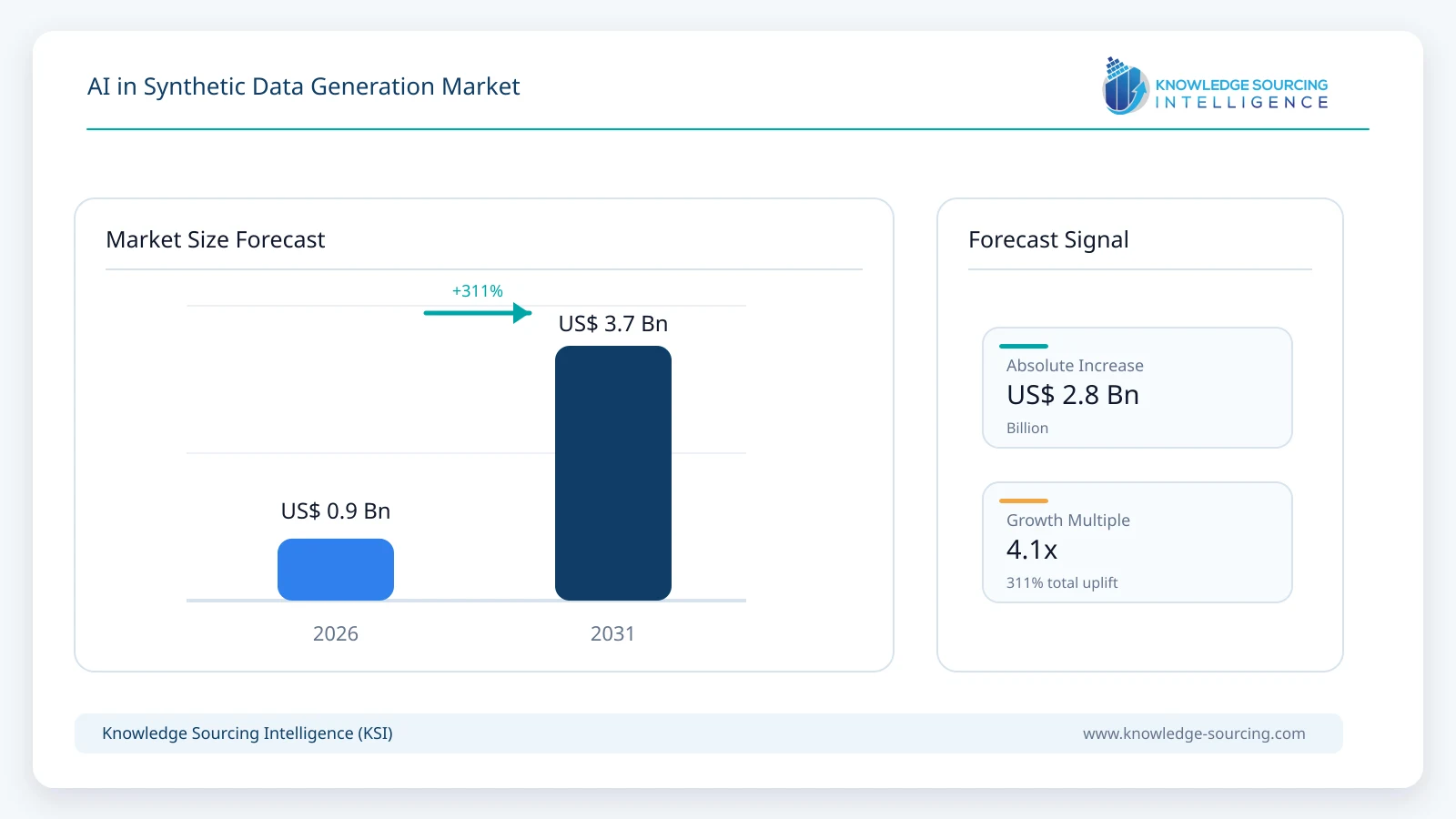
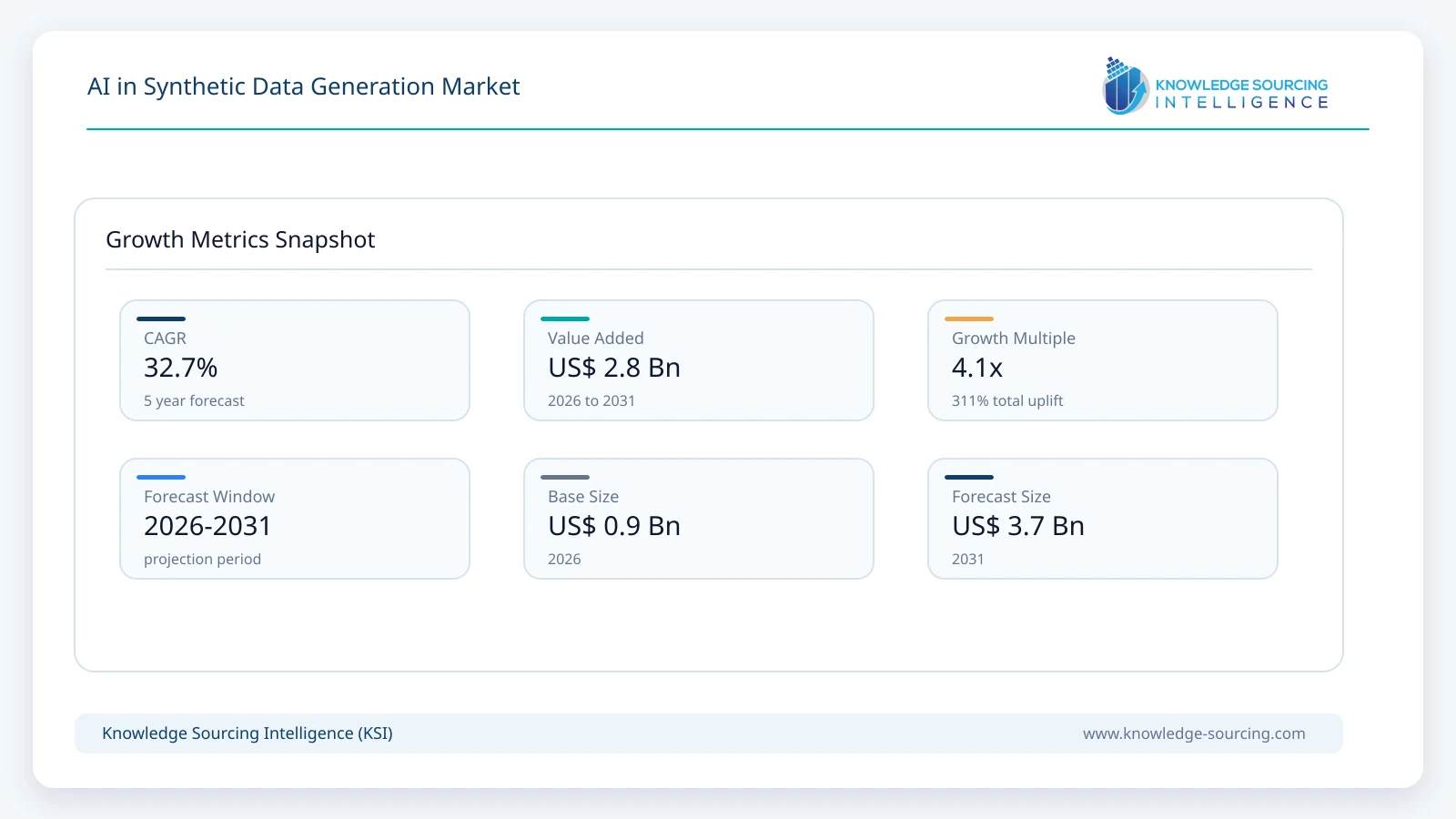
The AI in Synthetic Data Generation Market is forecast to grow at a CAGR of 32.7%, reaching USD 3.70 billion in 2031 from USD 0.90 billion in 2026.
Highlights:
- 1Privacy-aware generators for structured data retain substantial demand from financial institutions and healthcare organizations, where production records require controlled access and documented disclosure-risk assessment.
- 2Reusable solutions form the main commercial delivery channel, supplemented by specialist data engineering, validation and implementation services.
- 3Cloud deployment supports repeatable large-scale generation, while on-premises tools serve sensitive data environments where contractual or security restrictions limit source-data movement.
- 4Unstructured data is expanding into video, text, sensor and multimodal scenarios, particularly for robotics, software agents and physical-AI testing.
- 5North America has the largest modeled revenue base in 2026, while Asia Pacific has the fastest modeled growth to 2031, supported by industrial AI and enterprise software development.
- 6Corporate consolidation is changing vendor identitiesthe MOSTLY AI brand is now under Syntho, Gretel capabilities sit with NVIDIA and Hazy technology is embedded within SAS Data Maker.
Report Overview
A synthetic-data product creates new records, images, text, or sensor observations under specified statistical, logical, or physical constraints. In finance, the task may involve retaining correlations among accounts, transactions, and fraud labels without disclosing original customers. In engineering, a dataset must reproduce order dependencies, exception codes and failure states reliably enough to test software. A vehicle-perception model has a different requirement: generated scenes must remain physically plausible as lighting, traffic and weather change.
The revenue pool comprises identifiable software licences, subscription usage, generated-data services and implementation work specific to synthetic-data production and validation. It does not include the entire value of cloud compute, underlying foundation models, data-labelling operations or a customer’s downstream AI application. The distinction matters because large platforms commonly bundle synthesis into broader contracts, while specialist vendors price it as a discrete enterprise capability.
A useful commercial benchmark is no longer whether generated data resembles its source at first glance. Buyers assess statistical fidelity, membership-inference exposure, minority-case preservation, referential integrity, provenance and downstream task performance. AWS explicitly warns that synthetic generation can reproduce literal values from source data. For regulated customers, an auditor-friendly evaluation report is therefore as important as the model that performs the synthesis.
Market Overview
The market now serves two different kinds of scarcity. The first is restricted data: hospitals and financial institutions possess relevant information but cannot freely distribute it to software contractors or external researchers. The second is missing data: industrial systems and AI agents must handle rare events that have occurred too infrequently to form a representative training sample. A successful synthetic-data strategy handles these problems differently, using distribution-preserving models in the first case and designed scenario generation in the second.
SAS Data Maker, built with acquired Hazy technology, illustrates the regulated-data opportunity. Tonic Fabricate focuses on generating realistic relational records, documents, and simulated workflows even when production sources are absent. NVIDIA Cosmos operates at another level, creating controllable visual sequences from spatial inputs for robotics and physical AI. Their products should be evaluated against the jobs they perform rather than forced into a common feature ranking.
Purchase decisions increasingly sit with cross-functional teams. An analytics group may own the modelling budget, but security teams control source-data access, test engineers specify database dependencies, and legal advisers review output-sharing conditions. Pilot acceptance therefore requires more than attractive samples: the platform must pass reproducible measurements and operate within an approved data-handling environment.
Market Trends
Privacy evaluation is becoming part of normal data engineering
Synthetic datasets are being tested for membership inference, statistical similarity and the persistence of rare individual attributes. AWS Clean Rooms provides controls around output generation and describes clear limitations for source fields that could reveal an individual. Enterprise buyers are consequently asking vendors to make privacy tests repeatable alongside utility tests, rather than offer blanket claims that generated records are anonymous. This change favors documented methods, configurable thresholds and evidence that can accompany a dataset when it is shared with a partner or contractor.
Synthetic records are moving into development and testing pipelines
Software teams can create edge cases that are awkward or unsafe to reproduce in production: a disputed transaction, a partially completed order, a missing insurance field or an abnormal device event. GenRocket and K2view place emphasis on schema rules and relationships among business entities. Tonic Fabricate has extended the idea toward mock APIs and agent-driven generation. The commercial prize is recurring use throughout release cycles, not a single data export for a demonstration.
Generation and curation are being deployed together
A large output volume is of limited value when many examples are near-duplicates. NVIDIA reported in July 2026 that an initial financial-headline generation run lost 65% of its 50,000 records during semantic deduplication. Its iterative workflow subsequently produced more than 500,000 distinct headlines through repeated generation, filtering and rebalancing. That finding captures a wider change: dataset curation and coverage testing are increasingly part of the product, with generation treated as one stage of a controlled process.
Physical-AI demand is expanding unstructured synthesis
Robotics developers need credible responses to unusual road geometry, object placement and lighting conditions. NVIDIA Cosmos Transfer 2.5 takes structured inputs such as segmentation maps and depth maps to produce controlled visual variations; Cosmos Predict extends video-scenario generation. The ability to alter one factor while holding the physical context stable helps engineers probe perception and planning models. However, generated scenes still need independent checks against real sensor behavior, limiting how far simulation can replace field collection.
Specialist brands are being folded into larger portfolios
Syntho acquired the MOSTLY AI brand and related assets in June 2026; NVIDIA had already brought Gretel expertise into its data-design activities; and SAS integrated Hazy technology into Data Maker. The transactions bring synthetic generation deeper into existing AI, analytics and data-governance platforms. Buyers gain easier integration in some cases while facing more complicated decisions about vendor lock-in, support continuity and access to specialist methods.
Segment Analysis
Solutions | Component
Organizations buy synthesis software when generation becomes repeatable across development releases, AI training pipelines or governed analytical projects. Subscription and enterprise licensing suit this pattern because schemas, data-quality rules and evaluation thresholds must be revisited continuously. Indicative solutions revenue is estimated at about USD 675 million in 2026, equivalent to 75% of global spending, with revenue rising toward USD 2.74 billion by 2031. IBM, DataCebo, SAS and Tonic.ai approach the same category from different architectural starting points, making interoperability and measurable utility important purchasing criteria.
Services create value where customers must reconstruct relational structures, document privacy limits or validate whether synthetic examples preserve high-consequence edge cases. Their relative share can remain substantial even as licence spending expands: teams often need specialists to calibrate generators against changed production systems and independent holdout datasets. Contracting is strongest where delivery extends beyond one-off anonymization and into ongoing governance, reproducibility and model-quality assurance.
Structured Data | Data Type
Structured datasets underpin financial risk models, patient analytics, retail transaction testing and core enterprise applications. Their commercial difficulty is preserving cross-table relationships and rare outcomes while avoiding disclosure of individual records. The indicative 2026 structured-data value is USD 540 million, around 60% of this modeled market. DataCebo’s generative relational models and K2view’s business-entity approaches illustrate the requirement to create coherent databases rather than visually plausible but disconnected rows.
Unstructured synthesis is developing faster as language-model evaluation, robotics and video-based learning demand images, dialogue, audio and spatial sequences. Its validation burden differs from tabular synthesis: a photorealistic camera frame may still violate sensor physics, while a convincing generated conversation can omit a critical escalation condition. That divergence favors specialists able to demonstrate task-level performance, with unstructured generation gaining modeled share by 2031.
Cloud-Based | Deployment
Cloud-delivered generators fit AI engineering teams that need intermittent compute, shared workflows and integration with existing model services. The indicative cloud allocation of USD 675 million in 2026 rises to USD 2.92 billion by 2031, supported by increasing use of cloud data platforms and managed AI development. AWS Clean Rooms shows the appeal of generating model-training datasets inside governed collaborative environments, although its documentation is explicit about remaining risks from literal source values.
On-premises software and controlled private installations remain relevant for banks, healthcare organizations and infrastructure operators whose source data cannot leave approved environments. Procurement often requires local keys, audit logs, restricted model access and demonstrable controls over exports. These deployments carry a higher maintenance burden, but they can sustain demand among buyers unwilling to place sensitive source records in shared generation services.
BFSI | End-User
Banks and insurers need realistic transaction and customer data for fraud detection, credit modeling, claims systems and test environments, but unrestricted production extracts introduce avoidable privacy and security exposure. The BFSI segment contributes approximately USD 270 million of the independently modeled 2026 market and could reach USD 1.04 billion by 2031. Useful generators must preserve relationships between account history, merchant behavior, payment instructions and suspicious events; merely matching average amounts can make a fraud model less reliable.
Purchasing is therefore shaped by model-risk teams as well as software engineers. Evaluations test disclosure exposure, minority-class coverage, scenario controllability and downstream model performance before data is released. Retail and e-commerce have similar demands around sensitive customer journeys; automotive developers place more emphasis on physical coherence and sensor realism. These differing acceptance rules limit the usefulness of treating all end-users as one homogeneous customer group.
Market Drivers
Restricted production data is delaying AI and software programmes
Financial institutions and hospitals hold valuable datasets, yet copies cannot move freely into external development environments. Synthetic generation provides a way to create working substitutes under explicit rules, reducing requests for broad production access. K2view reported in March 2026 that 76% of respondents to its enterprise survey had experienced sensitive-data incidents outside production during the preceding three years; this is a vendor-sponsored survey rather than a census of all enterprises. The commercial implication is straightforward: development teams need usable records, while data owners need to limit exposure. Vendors that demonstrate both qualities can reach buyers beyond central data-science groups.
Institutional buyers increasingly ask vendors to demonstrate that a substituted dataset supports the actual task, such as detecting fraud patterns or reproducing an application fault, while reducing the number of staff who can access protected records. A measurable reduction in production-data copies can justify the security investment, but it does not remove the need for independent privacy testing.
Rare events are becoming a defined training requirement
Fraud patterns, equipment failures and dangerous traffic combinations are too infrequent to provide balanced training sets through passive collection. Artificial examples let engineers control severity, frequency and combinations of relevant factors. NVIDIA’s financial-headline work demonstrated the effort required to retain novel observations rather than generate superficial repetition. Physical-AI simulation addresses an analogous problem for sensor perception. Funding is most defensible when teams can compare model performance on held-out real observations before and after adding synthetic examples; artificially enlarged training volume alone is not evidence of improved reliability.
The advantage is greatest when generated exceptions are assessed against held-out real evidence. A model trained solely on plausible synthetic failures can learn the assumptions of the simulator rather than the behavior of equipment or customers. Providers that bundle scenario design with coverage analysis and performance evaluation will retain stronger value than simple generators.
Automated testing needs relational consistency
Large application estates connect customers, orders, devices, subscriptions and payment events across multiple databases. Engineering teams cannot fully test a workflow with independent randomly generated tables because keys, timestamps and process states must agree. GenRocket offers design-driven test data, and K2view organizes generation around business entities. The shift toward continuous integration makes this a recurring operating requirement rather than an occasional anonymisation exercise. Enterprise adoption can broaden from application testing to data migration rehearsal, API simulation and resilience testing where synthetic datasets have known expected outcomes.
Release engineering teams also need synthetic records that can be recreated exactly after a defect is found. Deterministic seeds, versioned generation plans and valid cross-application identifiers can shorten regression testing. This gives synthetic-data platforms a continuous software-quality role, separate from the privacy-driven use cases of data-science departments.
Cloud platforms are making synthesis easier to procure
AWS added synthetic dataset generation to Clean Rooms in November 2025, enabling collaborators to build training data without exposing the original records directly to model code. Microsoft and IBM likewise offer generation functions inside wider AI development environments. Existing security agreements, identity controls and billing arrangements can shorten the purchasing process for some clients. The advantage is not merely a reduced setup burden; it is the ability to manage generated assets alongside model evaluations and operational data. Specialists must respond through stronger controls, distinctive coverage or deployment flexibility.
Cloud integration can reduce procurement friction because the buyer already operates identity, governance and billing services in the same environment. The tradeoff is that a platform feature may satisfy uncomplicated generation tasks at little visible incremental cost. Independent suppliers must establish a clear improvement in fidelity, private deployment or specialized testing.
Synthetic data is being adopted as an evaluation asset
An AI assistant may encounter a harmful instruction, unfamiliar form or unusual customer request rarely present in real interaction logs. Synthetic scenarios offer repeatable stress tests across releases, with known expected behaviour and controlled variation. Tonic’s 2026 workflow releases include data generation from agent environments and simulated multi-document processes. Similar methods apply to insurance claims, communications systems and customer-service automation. This supports a commercial category in which datasets are refreshed as systems change, although gains still depend on independent evaluation of task difficulty and representativeness.
Adoption is moving from static datasets toward scenario suites that can be rerun and progressively extended. A test case involving a delayed delivery, failed payment and customer escalation is valuable when each component has known expected behavior. Continuous evaluation of such sequences can be a stronger basis for recurring contracts than periodic bulk data generation.
Market Restraints
Privacy protection is conditional, not automatic
Generative methods may reproduce rare values, memorable phrases or combinations capable of identifying people. AWS expressly cautions that its synthetic generation can retain literal source values in some circumstances. Regulators also distinguish statistical resemblance from demonstrable anonymisation. Buyers need membership-inference tests, disclosure-risk reviews and restrictions on outliers before releasing data outside a controlled environment. Stronger privacy settings can reduce analytical fidelity, so an acceptable configuration depends on the downstream task rather than a universal privacy score.
Privacy is a property to be tested against a specified threat model, not guaranteed by the label synthetic. The tolerance for reidentification differs between internal model development and publication to external researchers. Suppliers who present only a generic resemblance score may struggle to pass regulated procurement reviews.
Statistical fidelity can hide operational errors
A dataset can reproduce marginal distributions while losing clinically important correlations, transaction chronology or long-tail engineering faults. The error may not be obvious from generic similarity dashboards. Validation must include downstream tasks and domain-specific constraints, such as valid claim histories or physically consistent camera and LiDAR inputs. This increases the amount of specialist labour needed to implement products and may delay project sign-off. For healthcare and safety-related applications, model training on generated data should be checked against independent observed evidence.
The issue is particularly acute when developers ask for deliberately rare cases. Fabricating their frequency can improve a stress test while distorting a training distribution. Evaluation plans need to state whether a dataset is intended for model learning, functional testing or deliberate adversarial challenges, because success criteria cannot be identical.
Compute and curation costs complicate unit economics
Highly realistic video synthesis, repeated language-model generation and iterative deduplication can consume significant accelerator capacity. NVIDIA’s 2026 financial-data experiment required many generation and filtering rounds rather than one large batch. The resulting economic calculation must include curation, storage, privacy evaluation and labelling, not just the nominal cost of producing output tokens or frames. Customers may find simpler statistical or rule-based synthesis preferable when the target application does not need a large generative model.
For physical AI, a high-volume video generator also creates downstream costs for simulation execution, annotation, storage and validation. Budget owners increasingly compare the cost per useful failure uncovered or benchmark improvement, rather than cost per generated image. Lower-cost statistical methods remain relevant for simpler tabular assignments.
Historical bias can be reproduced at scale
A generative model trained on incomplete records can preserve inequitable treatment patterns or suppress under-represented cases. Increasing the number of synthetic observations does not correct the original sampling problem. In credit risk, clinical analysis or recruitment-related systems, careless rebalancing can also create unrealistic correlations. Organisations must distinguish between measured demographic coverage, fairness objectives and genuine underlying prevalence. These requirements raise validation costs and limit the acceptability of synthetic-only testing for consequential decisions.
Bias correction requires an explicit target definition and independent outcomes. Oversampling hypothetical events can create a dataset that appears balanced but no longer resembles the actual population. Financial and clinical users may therefore need separate datasets for robustness testing and real-world performance estimation.
Fragmented procurement obscures return on investment
Synthetic-data costs may be charged through software subscriptions, cloud consumption, consulting projects or wider analytics licences. Benefits are equally dispersed across security, application development and AI teams. This makes vendor comparisons and total spending difficult, particularly after several specialist products have been absorbed into larger portfolios. Buyers need task-specific baselines, such as reduced waiting time for test data, improved rare-case coverage or lower access risk, before committing to long-term contracts. Budget owners may otherwise regard synthesis as an auxiliary feature rather than a funded category.
Bundling obscures price transparency. Cloud consumption, enterprise AI credits and professional services can all pay for overlapping synthesis work, making supplier shares and return on investment difficult to observe. Teams can reduce this uncertainty by fixing acceptance tests and defining which cost line purchases generation versus validation.
Regional Outlook
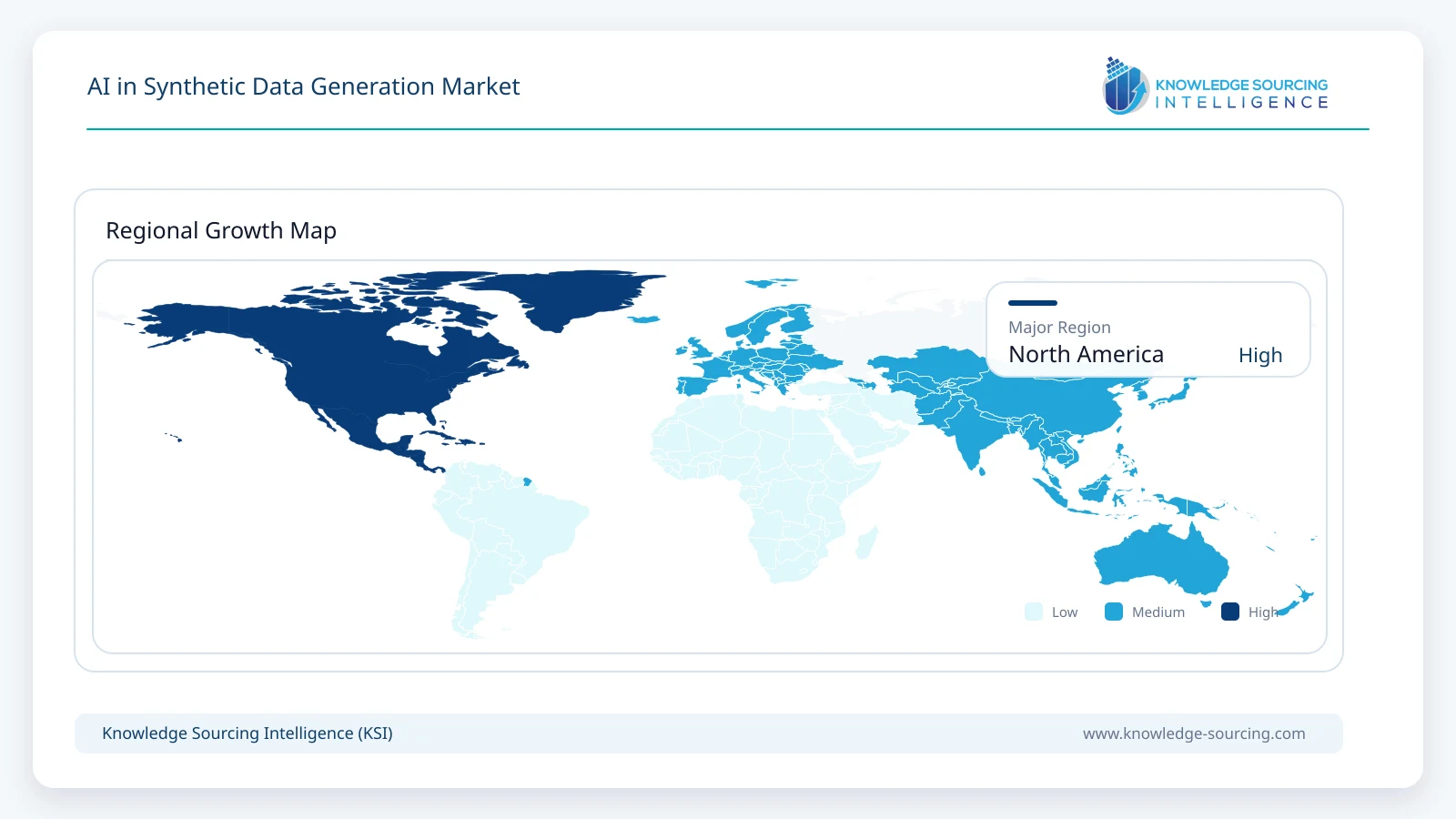
North America | Largest modeled revenue base
North America accounts for an indicative USD 360 million in synthetic-data generation revenue in 2026, representing 40% of estimated global spending, and could reach USD 1.37 billion in 2031 at a indicative CAGR of 30.6%. The United States concentrates numerous specialist firms, AI-platform providers and purchasers of high-value data engineering. Financial institutions and healthcare organizations need privacy-aware records, while autonomous-system developers require synthetic sensor and video data that supplement costly physical testing.
The region’s commercial strength rests on established enterprise software budgets and a broad supplier ecosystem, including NVIDIA, AWS, Microsoft, Tonic.ai, GenRocket, DataCebo and SAS. Yet cloud integration alone is not sufficient. Buyers increasingly require disclosure-risk evidence, reproducible test datasets and integration with identity and development infrastructure. Canada adds research-intensive and regulated customer demand, while Mexican automotive and digital-service operations create narrower but relevant applications.
Asia Pacific | Fastest modeled regional expansion
Asia Pacific is projected to grow from an indicative USD 225 million in 2026 to USD 1.11 billion in 2031, yielding the fastest indicative regional CAGR of 37.6%. China, Japan and South Korea combine advanced manufacturing and robotics with AI research that depends on rare-event simulation. India has a substantial software engineering and financial technology base, where synthetic test data can reduce the need to expose production customer records during distributed development and quality assurance.
Regional uptake will remain uneven. Public cloud availability, domestic hosting rules, language requirements and the maturity of operational data pipelines differ sharply between markets. Opportunities will favor vendors that localize deployment and validation without relying on headline AI investment as a substitute for paying users. Suppliers must show that generated examples improve a defined downstream task and do not create an unacceptable privacy or performance tradeoff.
Competitive Landscape
Specialist suppliers are competing on different performance measures. Syntho, through the MOSTLY AI brand, concentrates on privacy-aware enterprise datasets; Tonic.ai addresses programmable test data and broader agent simulations; K2view, GenRocket and DataCebo emphasise data relationships and operational test coverage. SAS Data Maker combines synthetic generation with established analytics and governance tools. These businesses do not compete head-to-head in every customer evaluation, and some implementations use more than one supplier.
Large technology vendors distribute synthesis within broader platforms. NVIDIA offers NeMo Data Designer and physical-world generation through Cosmos, while AWS and Microsoft connect synthesis to governed cloud workflows. IBM’s generator has evolved toward independent validation of unstructured text. YData technology and the MOSTLY AI brand have changed ownership, and Gretel capabilities have been absorbed by NVIDIA. As a result, a current supplier list should reflect parent companies and active products rather than count acquired brands as unrelated rivals.
Recent Developments
1 October 2026: Tonic Fabricate 4.32 introduced time-based simulations spanning documents, messages and connected workflow events. The feature was made available in enterprise private preview rather than general release, expanding the scope of synthetic testing beyond independent rows or files.
15 September 2026: DataCebo launched SDV 2.0 and introduced generative relational models intended to learn database relationships and business rules across tables. The commercial objective is to produce coherent synthetic databases for testing, evaluation and analysis.
9 July 2026: NVIDIA published a financial-data generation and curation workflow using NeMo Data Designer and Curator. It produced 502,536 unique headlines after iterative deduplication and rebalancing, illustrating the cost of producing diverse, task-useful examples.
16 June 2026: GenRocket introduced DataConnect, an enterprise synthetic Data-as-a-Service platform designed to provide deterministic test data through REST APIs and Model Context Protocol integration. The release targets repeatable agent-assisted software testing, not general-purpose conversational text generation.
9 June 2026: Syntho announced the acquisition of the MOSTLY AI trademark and related brand assets. The MOSTLY AI brand now continues as “MOSTLY AI, powered by Syntho”; the two names should not be counted as unrelated parent competitors.
16 March 2026: NVIDIA announced its Physical AI Data Factory Blueprint, bringing curation, synthetic augmentation and evaluation into a reference architecture for robotics, visual AI agents and autonomous vehicles. The announcement was for a blueprint expected on GitHub in April, not a separately priced standalone service.
Market Outlook
Synthetic-data spending should become more closely associated with repeatable operating workflows through 2031. Financial and healthcare buyers will favour products that document privacy risk and preserve useful relationships, while development teams will prioritise deterministic scenarios and tight integration with testing tools. For robotics and physical AI, the leading question will be how much generated experience can safely replace time-consuming collection or physical trials. These questions produce several distinct commercial models rather than one standard synthetic-data product.
The strongest suppliers will be those able to connect generation, validation and use within a single controlled process. A successful dataset must remain traceable to its configuration, suitable for its intended task and measurable against independent evidence. Platform consolidation may simplify purchasing, but it will also place pressure on vendors whose differentiation rests solely on creating plausible-looking data.
AI in Synthetic Data Generation Market Scope:
| Report Metric | Details |
|---|---|
| Total Market Size in 2026 | USD 0.90 billion |
| Total Market Size in 2031 | USD 3.70 billion |
| Forecast Unit | Billion |
| Growth Rate | 32.7% |
| Study Period | 2021 to 2031 |
| Historical Data | 2021 to 2024 |
| Base Year | 2025 |
| Forecast Period | 2026 – 2031 |
| Segmentation | Component, Data Type, Deployment, End-User |
| Companies |
|
Market Segmentation
By Component
Services
Solutions
By Data Type
Structured Data
Unstructured Data
By Deployment
On-Premise
Cloud-Based
By End-user
Banking, Financial Services, and Insurance (BFSI)
Retail and E-Commerce
Healthcare
IT & Telecommunication
Automotive
Others
By Geography
North America
USA
Canada
Mexico
South America
Brazil
Argentina
Others
Europe
United Kingdom
Germany
France
Italy
Spain
Others
Middle East & Africa
Saudi Arabia
UAE
Others
Asia Pacific
China
India
Japan
South Korea
Thailand
Others
Table of Contents
1. EXECUTIVE SUMMARY
2. MARKET SNAPSHOT
2.1. Market Overview
2.2. Market Definition
2.3. Scope of the Study
2.4. Market Segmentation
3. BUSINESS LANDSCAPE
3.1. Market Drivers
3.2. Market Restraints
3.3. Market Opportunities
3.4. Porter’s Five Forces Analysis
3.5. Industry Value Chain Analysis
3.6. Policies and Regulations
3.7. Strategic Recommendations
4. TECHNOLOGICAL OUTLOOK
5. AI IN SYNTHETIC DATA GENERATION MARKET BY COMPONENT
5.1. Introduction
5.2. Services
5.3. Solutions
6. AI IN SYNTHETIC DATA GENERATION MARKET BY DATA TYPE
6.1. Introduction
6.2. Structured Data
6.3. Unstructured Data
7. AI IN SYNTHETIC DATA GENERATION MARKET BY DEPLOYMENT
7.1. Introduction
7.2. On-Premise
7.3. Cloud-Based
8. AI IN SYNTHETIC DATA GENERATION MARKET BY END-USER
8.1. Introduction
8.2. Banking, Financial Services, and Insurance (BFSI)
8.3. Retail and E-Commerce
8.4. Healthcare
8.5. IT & Telecommunication
8.6. Automotive
8.7. Others
9. AI IN SYNTHETIC DATA GENERATION MARKET BY GEOGRAPHY
9.1. Introduction
9.2. North America
9.2.1. USA
9.2.2. Canada
9.2.3. Mexico
9.3. South America
9.3.1. Brazil
9.3.2. Argentina
9.3.3. Others
9.4. Europe
9.4.1. United Kingdom
9.4.2. Germany
9.4.3. France
9.4.4. Italy
9.4.5. Spain
9.4.6. Others
9.5. Middle East & Africa
9.5.1. Saudi Arabia
9.5.2. UAE
9.5.3. Others
9.6. Asia Pacific
9.6.1. China
9.6.2. India
9.6.3. Japan
9.6.4. South Korea
9.6.5. Thailand
9.6.6. Others
10. COMPETITIVE ENVIRONMENT AND ANALYSIS
10.1. Major Players and Strategy Analysis
10.2. Market Share Analysis
10.3. Mergers, Acquisitions, Agreements, and Collaborations
10.4. Competitive Dashboard
11. COMPANY PROFILES
11.1. NVIDIA Corporation (including Gretel technology)
11.2. Syntho B.V. (MOSTLY AI brand)
11.3. Tonic.ai
11.4. K2view
11.5. SAS Institute Inc. (including Hazy technology)
11.6. IBM Corporation
11.7. Amazon Web Services (Amazon.com, Inc.)
11.8. Microsoft Corporation
11.9. GenRocket, Inc.
11.10. Synthesis AI
11.11. KPMG LLP (YData technology assets)
11.12. DataCebo (SDV Enterprise)
12. APPENDIX
12.1. Currency
12.2. Assumptions
12.3. Base and Forecast Years Timeline
12.4. Key Benefits for Stakeholders
12.5. Research Methodology
12.6. Abbreviations
Navigate
Trusted by the world's leading organizations











