
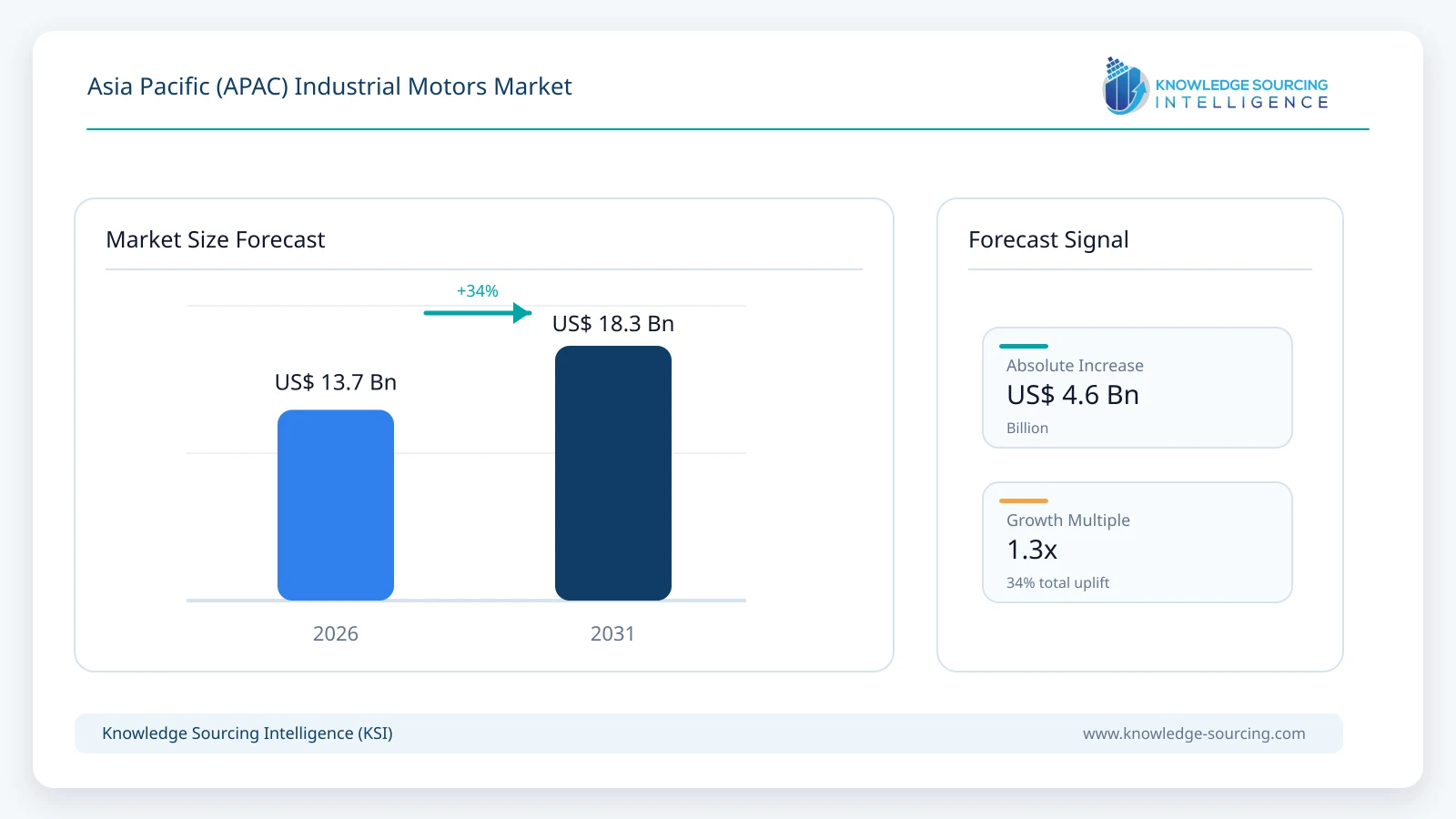
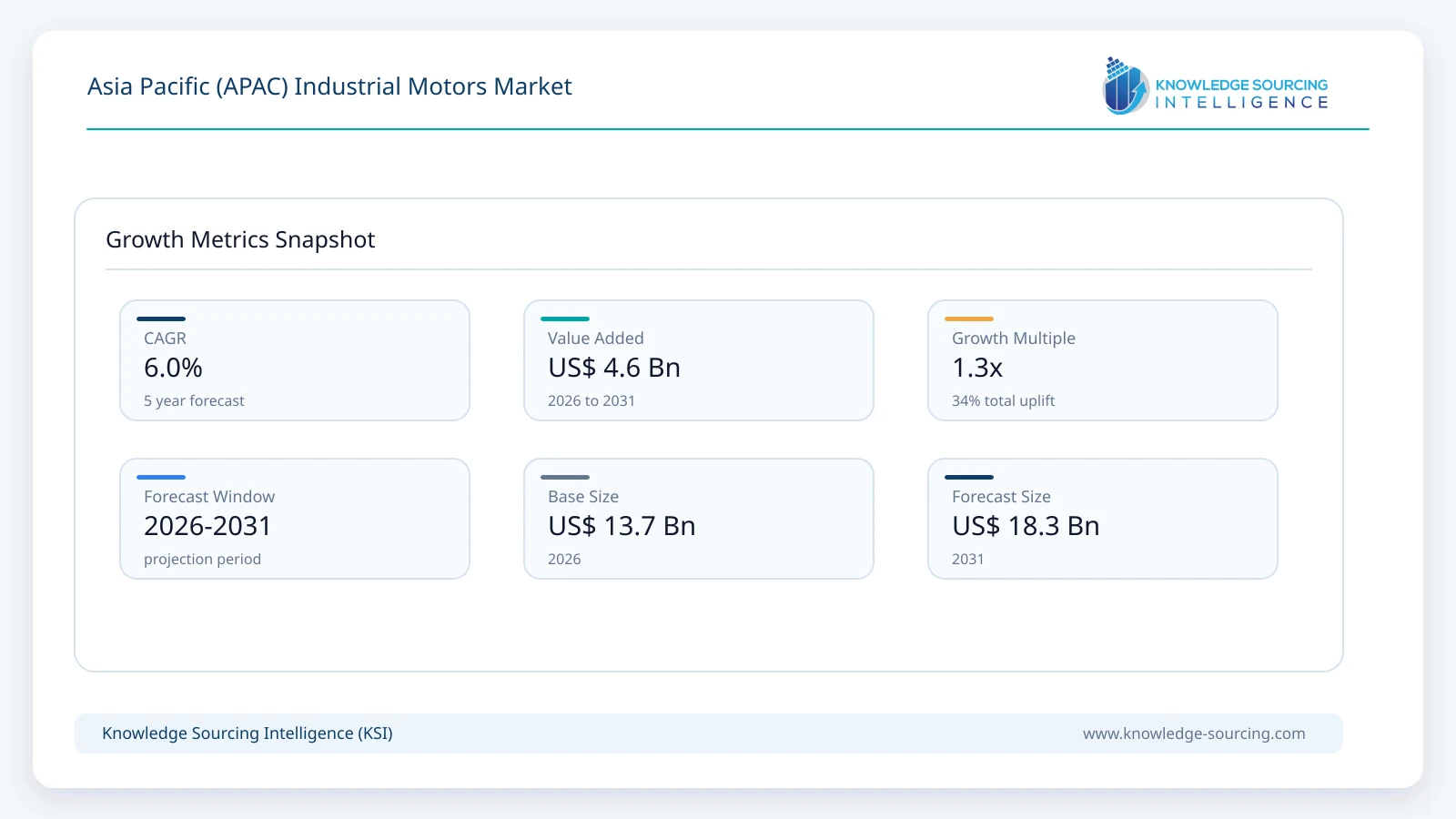
The Asia Pacific (APAC) Industrial Motors Market is forecast to expand at a CAGR of 5.96%, reaching USD 18.3 billion in 2031 from USD 13.7 billion in 2026.
Highlights:
- 1Alternating-current machines account for approximately 88.5% of 2026 regional motor sales value.
- 2Low-voltage motors contribute around 65.0% of 2026 market revenue across diverse industrial duties.
- 3Manufacturing represents approximately 37.2% of 2026 demand, spanning machinery and production lines.
- 4China accounts for about 48.2% of regional sales in the 2026 modeled distribution.
- 5India is projected to expand at approximately 10.2% annually as industrial investment and efficient-motor adoption increase.
- 6Higher efficiency classes support replacement demand, but application suitability and local servicing remain decisive.
Industrial motors convert electrical input into mechanical power for processing, production and infrastructure equipment. The market encompasses separately sold industrial AC and DC motors, including general-purpose induction motors, synchronous and specialty machines, across low-, medium- and high-voltage ratings. Demand arises from machinery manufacturers, plant contractors, industrial end users and replacement channels; full machine assemblies, standalone variable-frequency drives, automotive traction motors and separate generator sales are outside the product-market boundary.
Replacement purchases are particularly important where motors run for extended hours and electricity expenditure dominates ownership cost. ABB’s IE6 synchronous reluctance expansion and WEG’s W22 Prime introduction demonstrate the supplier shift toward higher efficiency without requiring every customer to adopt a completely new mechanical drive arrangement. In the larger process industries, motor specifications must also satisfy starting torque, vibration, enclosure and hazardous-area requirements, creating a separate engineering and service basis for competition.
Market Overview
Low-voltage induction motors remain widely used in Asia Pacific because pumps, conveyors, mixing systems and factory utility equipment can be standardized around established frame sizes and electrical interfaces. Industrial buyers increasingly evaluate the motor and its operating profile together: long daily running hours favor more efficient windings and magnetic designs, whereas intermittent applications may require a shorter payback threshold. According to the IEA’s 2025 energy-efficiency review, motor standards vary materially by country, so equivalent industrial machines can face different procurement requirements across the region.
ABB launched locally manufactured IE5 induction motors in India in September 2025 alongside an investment in low-voltage manufacturing capacity. Its subsequent IE6 synchronous reluctance offerings broaden the technical choice for larger and demanding installations. WEG introduced W22 Prime in March 2026 to bring IE4 and IE5 performance into an induction-motor platform designed for replacement work. These developments strengthen competition on electrical losses, installation compatibility and useful life rather than on rated power and initial purchase price alone.
Regional supply arrangements also influence purchasing. TECO discloses motor manufacturing locations across Taiwan, China, India and Southeast Asia; Toshiba Industrial Products Asia operates an industrial motor plant in Vietnam; and domestic producers in China and India serve large installed machinery populations. Local production, testing and service reduce lead times for standard motors, but high-voltage equipment and specialized designs still demand extensive engineering validation. Industrial users consequently balance efficiency upgrades against downtime, spares availability and the commercial risk of changing a critical motor specification.
Market Trends
Efficiency Upgrades Are Moving Beyond IE3
China, Japan and South Korea are among the economies applying relatively stringent motor-efficiency requirements, although coverage varies by power range and application. The IEA reports that national standards span several IE classes rather than converging on a uniform regional mandate. This matters for manufacturers designing product families that can be sold across multiple countries while meeting local test and certification rules.
ABB’s IE6 synchronous reluctance motors and WEG’s IE5 induction designs show two distinct routes to reducing electrical losses. Premium designs carry greater unit value, but plants generally require a credible lifetime energy-saving calculation before replacing motors that still operate reliably.
Integrated Motor and Drive Engineering Is Changing Procurement
Variable-flow pumping, ventilation and process-control applications benefit when motor selection is coordinated with speed-control equipment. A variable-frequency drive can improve system performance by avoiding unnecessary throttling or full-speed operation, but motor-only revenue must remain separate from the drive, software and complete process package.
Suppliers with both motor and drive engineering capabilities are better placed to address insulation stress, harmonics, bearing currents and low-speed cooling. The relevant competitive advantage is validated application compatibility, not merely selling a higher nominal efficiency class.
Local Manufacturing Is Supporting Faster Replacement Cycles
Industrial projects in India and Southeast Asia are encouraging manufacturers to expand locally available motors, testing and after-sales support. ABB’s Indian low-voltage investment and TECO’s network of Asian motor factories demonstrate why lead time and qualification can influence supplier choice as much as catalogue specifications.
Large factories normally need common spare-motor frame sizes and dependable repair services across multiple sites. Localized engineering and standardized product families make repeat procurement more economical, especially where a breakdown would stop a production line or essential water equipment.
Reliability Engineering Is Becoming a Premium Differentiator
Medium- and high-voltage motors operate in more demanding environments than many general-purpose low-voltage machines. Process plants and mines place high value on vibration management, bearing temperature, corrosion protection and the ability to withstand challenging duty cycles. Innomotics’ 2026 recognition for its vibration-control and oil-lubricated bearing technologies illustrates this engineering direction.
Maintenance intervals and predictable availability can justify higher unit prices when an interruption affects a refinery compressor, ore-processing train or municipal water station. Supplier margins therefore depend partly on installation engineering and long-term service capability rather than motor efficiency alone.
Water and Mining Applications Are Raising Specification Complexity
Water utilities, mine operators and processing sites are installing and renewing pumps, fans, crushers and conveyor systems against rising energy and reliability expectations. Motor operating profiles range from continuous high-load duties to highly variable flows, making one-size-fits-all upgrades inappropriate.
The most attractive investments tend to combine appropriate efficiency ratings with correct mechanical sizing and control strategy. Oversizing, unsuitable starting conditions and poorly matched duty cycles can erode expected savings, reinforcing demand for qualified supplier application teams.
Segment Analysis
By Motor Type: Alternating Current Motors
Alternating-current motors are expected to generate approximately USD 16.40 billion of regional sales by 2031. Induction machines account for much of their commercial importance because they can run fans, pumps, compressors and general-purpose factory machinery using familiar electrical and mechanical interfaces. Permanent-magnet and synchronous reluctance technologies expand the range of efficiency choices without displacing the broad installed base of conventional AC equipment.
The economic argument for these motors differs with the duty cycle. A continuously running pump can justify a premium specification on lifetime electricity cost, while a rarely used actuator may still favor a simpler product. ABB and WEG are competing on loss reduction and application compatibility, and TECO and Chinese manufacturers support high-volume demand with locally produced AC ranges. Growth in industrial automation is expected to reinforce AC motor demand, especially when new production lines are engineered around controlled-speed operation.
By Voltage: Low-Voltage Motors
Low-voltage motors supply a broad range of industrial loads below the medium-voltage boundary, from packaged pumps and compressors to material-handling equipment. Standardized ratings, relatively short replacement intervals and large distributor networks make this the market’s most diversified product group. Even where efficiency rules are not immediately upgraded, customers replacing older units can choose higher-rated machines within established dimensions.
Regional low-voltage motor revenue is forecast to reach approximately USD 11.78 billion in 2031. Its scale is supported by the range of users rather than a single large capital-spending sector. ABB’s Indian IE5 investment and WEG’s replacement-oriented W22 Prime range indicate how manufacturers are targeting incremental upgrades. Price competition remains considerable in standard ratings, so certified efficiency, prompt availability and field support matter for premium positioning.
By End-User: Manufacturing
Manufacturing absorbs motors through both original machinery purchases and maintenance of installed production equipment. Industrial machinery builders integrate motors into compressors, conveyors, mixers, packaging lines and factory utilities, while established plants purchase replacements for the same equipment over many operating cycles. Domestic manufacturing in China and rising industrial investment in India support this wide demand base.
The segment is projected to approach USD 6.75 billion by 2031. Buyers increasingly distinguish the cost of operating a motor continuously from its initial acquisition price, especially when energy management is linked to equipment uptime targets. Local production and familiar product families favor suppliers able to meet repeat specifications, while specialist engineering supports more valuable projects involving coordinated motors, controls and reliability requirements.
Market Drivers
Industrial Efficiency Policies and Energy Costs
Motor-efficiency standards encourage purchasers to retire lower-performance units as old equipment fails or facilities undergo upgrades. The IEA identifies industrial motor systems as an important source of available electricity savings and notes that country-level regulatory stringency remains uneven. Standards can therefore raise the achievable selling price for compliant motors while also expanding the range of products that manufacturers must qualify.
The largest commercial impact arises where motors run for long hours and electricity represents most of their lifetime cost. Plants still compare investment, expected operating hours and power tariffs before changing a functioning machine, so sales growth will occur gradually through new installations and replacement cycles.
Factory Automation and Production Capacity Investment
Machinery, packaging, textile, metals and electronics factories require motors at several points in their production processes, frequently using multiple ratings within one facility. New plant capacity therefore generates original-equipment demand while maintenance activity creates a recurring replacement market. China retains a large installed base, and India’s industrial manufacturing investment is widening the local customer and supplier network.
Local motor manufacturing supports quicker technical support, common replacement frames, and shorter delivery periods. TECO and ABB have documented regional manufacturing capabilities that help serve multinational industrial customers without relying entirely on imported units.
Water Infrastructure and Pumping Modernization
Municipal water networks, industrial wastewater facilities and pumping stations use motors that operate for extended periods and can incur substantial electricity costs. As utilities renew inefficient pumping equipment, selection increasingly depends on drive suitability, load patterns, environmental protection and service availability.
The replacement case is strongest where a more efficient motor can operate within an existing mechanical assembly without extensive piping or process changes. Variable-flow systems may also benefit from motor-drive optimization, although motor market value excludes the separate sale of drives and pumps.
Mining and Process-Industry Electrification
Mineral extraction, material handling, milling, ventilation and process pumping require industrial motors across diverse power ratings. Larger installations often specify medium- or high-voltage machines because of the electrical and mechanical requirements of heavy rotating equipment.
Projects in mining and energy-intensive production create demand for rugged enclosures, high starting torque, predictable bearings and specialist maintenance support. These characteristics give qualified suppliers an engineering advantage over vendors competing solely on standardized low-voltage catalogue prices.
Availability of Higher-Efficiency Motor Platforms
Premium efficiency is becoming commercially accessible through different motor designs rather than a single proprietary technology. ABB’s magnet-free synchronous reluctance systems and WEG’s higher-efficiency induction products illustrate how suppliers are expanding options for existing industrial applications.
Compatibility is a central purchasing consideration. Buyers favor motor upgrades that preserve required torque, mechanical footprint and maintenance practices, allowing gains in electrical performance without accepting excessive commissioning risk or operating disruption.
Market Restraints
Higher Purchase Cost and Uneven Payback
IE4, IE5 and emerging IE6 designs can cost more than basic industrial motors because of materials, engineering and manufacturing requirements. Whether that premium is justified depends on runtime, load factor, tariff and expected service life.
For intermittently operated equipment, calculated energy savings may not offset a higher upfront price quickly enough. Some industrial users therefore replace failed motors with familiar lower-cost models where regulations permit, especially when financing conditions are restrictive.
Differences in National Efficiency Requirements
Asia Pacific does not operate under one motor-efficiency regime. Requirements differ across countries, rated powers and use cases, complicating certification and catalogue rationalization for suppliers serving multiple markets.
The IEA has identified gaps in minimum performance standards across Southeast Asia. Manufacturers must maintain compliant product variants and documentation, while users procuring from several countries can face additional verification work.
Complex Motor-System Retrofitting
Replacing a motor can require changes to controls, protection devices, mounting, couplings, cooling and operating procedures. Premium motor efficiency alone does not guarantee improved plant efficiency if load conditions, speed control or sizing are unsuitable.
An incorrectly specified replacement may increase vibration or process downtime, offsetting expected energy benefits. Large industrial buyers commonly insist on engineering studies and staged commissioning before approving fleet-wide motor upgrades.
Raw-Material and Supply-Chain Exposure
Copper, electrical steel, insulation systems and specialist bearings affect motor manufacturing cost and lead times. More demanding efficiency ratings can require improved materials or tighter manufacturing tolerances, making the product mix sensitive to procurement conditions.
Regional production reduces some logistics risk but does not eliminate dependency on imported components or globally traded materials. In more price-sensitive segments, manufacturers have limited ability to pass every cost change directly to customers.
Long Replacement Cycles and Repair Economics
Many industrial motors remain in service for years after installation and may be repaired repeatedly before replacement. Plants may choose bearing or winding repairs for critical assets where immediate substitution would require unavailable spare units or lengthy commissioning.
The installed base therefore does not translate into an annual new-motor sale. Even when energy savings are measurable, a planned shutdown window, budget cycle and equipment reliability assessment often determine the actual purchasing date.
Geographical Outlook
China
China is the largest industrial motors market in Asia Pacific, supported by its extensive machinery-building capacity, industrial process equipment stock and domestic motor manufacturing ecosystem. The country represents approximately 48.2% of modeled regional sales value in 2026, a position strengthened by demand for induction motors in production machinery, pumping, materials processing and factory utilities. Producers including Wolong, ABB’s local operations and TECO participate across different industrial power ranges.
By 2031, China’s market is projected to reach USD 8.44 billion as higher-efficiency units gain share of replacement purchases and industrial automation creates new motor demand. Relative regional share moderates as India and selected Southeast Asian markets expand from smaller bases. Domestic price competition will continue in widely standardized low-voltage ratings, while engineering, certification and aftersales service remain important in premium and larger-power projects.
India
Indian industrial motor demand is being reshaped by additions to manufacturing capacity, energy-efficiency investment and the local availability of premium-rated machines. ABB’s September 2025 announcement of additional low-voltage capacity and locally manufactured IE5 induction motors illustrates how suppliers are positioning production and testing near industrial customers. Domestic manufacturers such as CG Power and Bharat Bijlee contribute further technical and distribution coverage.
The market is expected to reach approximately USD 3.25 billion by 2031, reflecting greater demand for industrial motors in general manufacturing, materials processing, water infrastructure and mining. The pace of adoption will differ among large process users and smaller workshops: many purchasers continue to prioritize cash cost and repairability, while continuous-duty facilities have stronger economic reasons to select efficient and robust replacement machines.
Competitive Landscape
Asia Pacific industrial motors combine large international engineering groups with domestic manufacturers serving substantial installed bases. ABB competes through IEC-rated low-voltage portfolios, advanced synchronous reluctance designs and localized production. WEG emphasizes standardized induction products and high-efficiency replacement options, while Nidec and Wolong address broad motor requirements through substantial manufacturing capabilities. TECO serves multiple industrial ratings with production bases spread across Taiwan, mainland China and several Southeast Asian countries.
Innomotics is a separate industrial-motor business with low- and high-voltage offerings; its ownership and product positioning should not be conflated with a generic Siemens catalogue. Toshiba Industrial Products and Systems operates industrial-motor manufacturing in Vietnam, while CG Power, Bharat Bijlee, Fuji Electric, Mitsubishi Electric and other producers compete through ratings, application specialization and service networks. Larger process customers place weight on reliability testing, torque characteristics, hazardous-area compliance and lifecycle support. At the standardized low-voltage end, availability and price remain particularly influential.
No single supplier position can be inferred reliably from industrial-group revenue alone, because reported Motion, electrification or automation sales frequently include drives, services, generators and other equipment. Competitive advantage is better assessed through directly marketed motor ranges, qualified manufacturing capacity, installed equipment relationships and documented engineering support.
Recent Developments
13 May 2026: Innomotics reported German Innovation Award recognition for its Active Vibration Control System and Oil Lubricated Rolling Bearing technologies, developed to improve vibration management and service life in high-voltage motor applications.
11 May 2026: ABB introduced an IE6 synchronous reluctance motor offering certified for hazardous areas under ATEX and IECEx requirements, expanding options for energy-intensive industrial processes where electrical safety and efficiency must be addressed together.
29 March 2026: WEG introduced its W22 Prime induction motor range at IE4 and IE5 performance levels, targeting industrial replacements that preserve the robustness and service approach of conventional induction equipment.
3 February 2026: ABB expanded its IE6 synchronous reluctance motor portfolio to larger frames and 110–450 kW ratings, providing additional high-efficiency choices for fans, pumps and compressors.
25 September 2025: ABB India announced an investment exceeding INR 140 crore in low-voltage motor manufacturing and launched a locally made IE5 induction-motor range for industrial customers.
Market Outlook
The largest part of future industrial motor sales will remain tied to conventional applications, pumping, ventilation, production machinery and materials handling, but product value will shift toward more efficient designs and better specified motor-system combinations. Low-voltage machines will retain the broadest user base, with premium AC products benefiting where electricity savings can be demonstrated over a long operating life. Medium- and high-voltage projects will continue to prioritize predictable performance, detailed engineering and maintenance accessibility.
China is expected to remain the regional demand and production center through 2031, while India gains share as factories, utilities and process industries procure more new and replacement machines. Competition will be shaped by local manufacturing, verified efficiency claims, delivery lead times and the ability to support motors after commissioning. Supplier positions should strengthen where higher performance can be delivered without requiring industrial users to accept unnecessary retrofit complexity.
Asia Pacific (APAC) Industrial Motors Market Scope:
| Report Metric | Details |
|---|---|
| Total Market Size in 2026 | USD 13.7 billion |
| Total Market Size in 2031 | USD 18.3 billion |
| Forecast Unit | Billion |
| Growth Rate | 5.96% |
| Study Period | 2021 to 2031 |
| Historical Data | 2021 to 2024 |
| Base Year | 2025 |
| Forecast Period | 2026 – 2031 |
| Segmentation | Motor Type, Voltage, End-user, Country |
| Companies |
|
| Customization Scope | 15% Free Customization included with purchase — Request Custom Breakdown → |
| Sample & Data Access | PDF Sample, Excel Databook & Analyst Briefing — Download Free Sample → |
Market Segmentation
By Motor Type
Direct Current
Alternating Current
Others
By Voltage
High
Medium
Low
By End-user
Oil and Gas
Mining
Food and Beverage
Construction
Manufacturing
Pulp and Paper
Water and Wastewater
Others
By Country
Japan
China
India
South Korea
Indonesia
Taiwan
Thailand
Others
Table of Contents
1. EXECUTIVE SUMMARY
2. MARKET SNAPSHOT
2.1. Market Overview
2.2. Market Definition
2.3. Scope of the Study
2.4. Market Segmentation
3. BUSINESS LANDSCAPE
3.1. Market Drivers
3.1.1. Industrial Efficiency Policies and Energy Costs
3.1.2. Factory Automation and Production Capacity Investment
3.1.3. Water Infrastructure and Pumping Modernization
3.1.4. Mining and Process-Industry Electrification
3.1.5. Availability of Higher-Efficiency Motor Platforms
3.2. Market Restraints
3.2.1. Higher Purchase Cost and Uneven Payback
3.2.2. Differences in National Efficiency Requirements
3.2.3. Complex Motor-System Retrofitting
3.2.4. Raw-Material and Supply-Chain Exposure
3.2.5. Long Replacement Cycles and Repair Economics
3.3. Market Opportunities
3.4. Porter’s Five Forces Analysis
3.5. Industry Value Chain Analysis
3.6. Policies and Regulations
3.7. Strategic Recommendations
4. TECHNOLOGICAL OUTLOOK
4.1. Motor Efficiency Classes and Applicable Standards
4.2. Induction and Synchronous Reluctance Technologies
4.3. Motor and Drive Integration
4.4. Condition Monitoring and Reliability Engineering
5. ASIA PACIFIC (APAC) INDUSTRIAL MOTORS MARKET BY MOTOR TYPE
5.1. Introduction
5.2. Direct Current
5.3. Alternating Current
5.4. Others
6. ASIA PACIFIC (APAC) INDUSTRIAL MOTORS MARKET BY VOLTAGE
6.1. Introduction
6.2. High
6.3. Medium
6.4. Low
7. ASIA PACIFIC (APAC) INDUSTRIAL MOTORS MARKET BY END-USER
7.1. Introduction
7.2. Oil and Gas
7.3. Mining
7.4. Food and Beverage
7.5. Construction
7.6. Manufacturing
7.7. Pulp and Paper
7.8. Water and Wastewater
7.9. Others
8. ASIA PACIFIC (APAC) INDUSTRIAL MOTORS MARKET BY COUNTRY
8.1. Introduction
8.2. Japan
8.3. China
8.4. India
8.5. South Korea
8.6. Indonesia
8.7. Taiwan
8.8. Thailand
8.9. Others
9. COMPETITIVE ENVIRONMENT AND ANALYSIS
9.1. Major Players and Strategy Analysis
9.2. Market Share Analysis
9.3. Mergers, Acquisitions, Agreements and Collaborations
9.4. Competitive Dashboard
10. COMPANY PROFILES
10.1. ABB Ltd.
10.2. WEG S.A.
10.3. Nidec Corporation
10.4. Wolong Electric Group Co., Ltd.
10.5. TECO Electric & Machinery Co., Ltd.
10.6. Innomotics GmbH
10.7. Toshiba Industrial Products and Systems Corporation
10.8. CG Power and Industrial Solutions Limited
10.9. Bharat Bijlee Limited
10.10. Fuji Electric Co., Ltd.
10.11. Mitsubishi Electric Corporation
10.12. Hyosung Heavy Industries Corporation
11. APPENDIX
11.1. Currency
11.2. Assumptions
11.3. Base and Forecast Years Timeline
11.4. Key Benefits to Stakeholders
11.5. Research Methodology
11.6. Abbreviations





Frequently asked questions
What is the forecast market size and growth rate for APAC industrial motors?
Market reaches USD 18.3 billion by 2031, growing at 5.96% CAGR.
Which type of industrial motor dominates the APAC market?
Alternating-current (AC) machines account for 88.5% of regional sales value.
What voltage segment holds the largest market share in APAC?
Low-voltage motors contribute approximately 65.0% of 2026 market revenue.
Which industry is the largest demand source for APAC industrial motors?
Manufacturing represents approximately 37.2% of 2026 demand.
Which country is the largest market for industrial motors in APAC?
China accounts for about 48.2% of regional sales in 2026.
Which APAC country shows the highest projected annual growth rate?
India is projected to expand at approximately 10.2% annually.
Cite this report
Knowledge Sourcing Intelligence. (Oct 2026). Asia Pacific (APAC) Industrial Motors Market - Strategic Insights and Forecasts (2026-2031). https://www.knowledge-sourcing.com/report/asia-pacific-apac-industrial-motors-market