
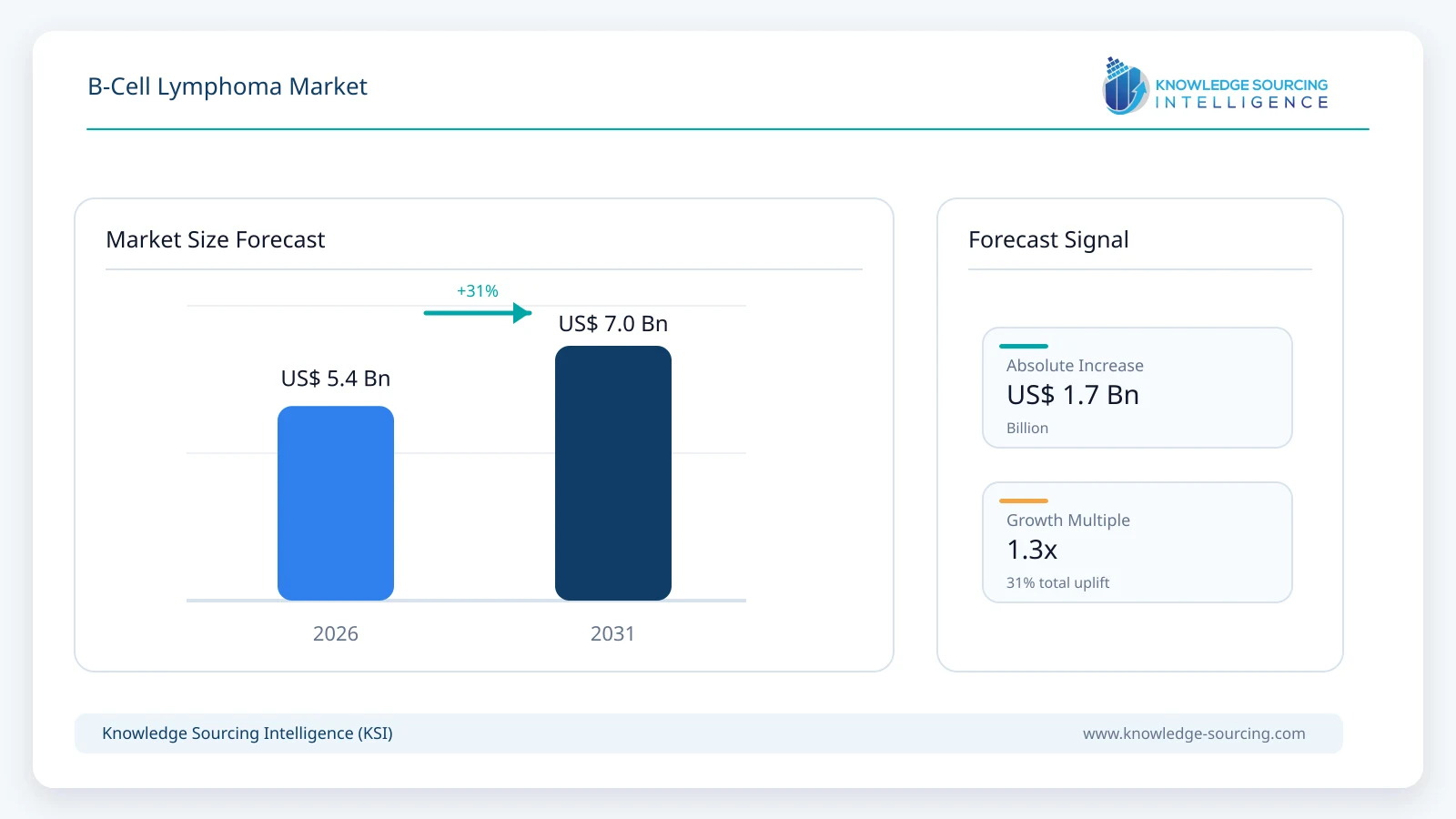
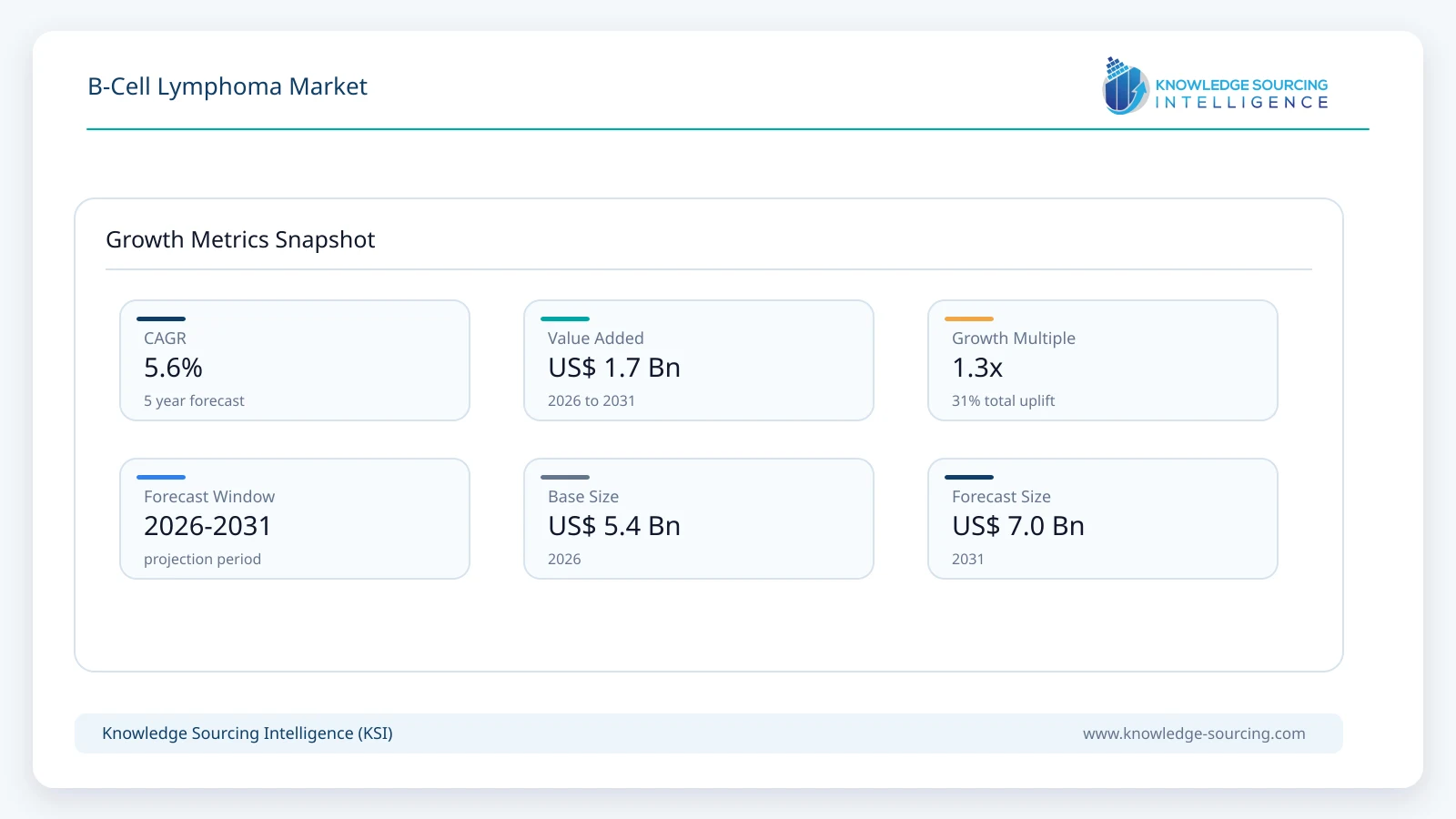
The B-Cell Lymphoma Market is forecast to grow at a CAGR of 5.6%, reaching USD 7.02 billion in 2031 from USD 5.36 billion in 2026.
Highlights:
- 1Rising relapse rates in aggressive lymphoma subtypes are increasing demand for CAR-T cell therapies because conventional salvage chemotherapy often produces limited long-term remission.
- 2Expanding biomarker-driven treatment selection is strengthening adoption of targeted therapies because clinicians are reducing exposure to generalized cytotoxic regimens.
- 3Hospital oncology networks are increasing investments in cellular therapy infrastructure because post-infusion monitoring requirements remain resource intensive.
- 4Oral BTK inhibitor utilization is expanding across chronic disease management settings because outpatient treatment continuity improves patient adherence
B-cell lymphoma represents a heterogeneous group of hematologic malignancies originating from abnormal B lymphocytes, with disease progression varying significantly across indolent and aggressive subtypes. Treatment demand increasingly depends on molecular profiling because physicians are stratifying patients according to relapse risk, CD20 expression, BTK pathway activation, and transplant eligibility. This shift is increasing the adoption of targeted therapeutics that reduce dependency on high-toxicity chemotherapy combinations.
Healthcare systems remain structurally dependent on monoclonal antibodies because anti-CD20 therapies continue forming the backbone of frontline regimens across diffuse large B-cell lymphoma and follicular lymphoma. Relapsed patient volumes are simultaneously increasing demand for advanced immunotherapies because survival expectations are improving across previously refractory populations. Academic cancer centers and commercial manufacturers are therefore expanding CAR-T treatment networks, while outpatient oncology providers are integrating oral targeted therapies into long-duration disease management strategies.
Regulatory authorities are strengthening accelerated approval pathways for hematologic malignancies because measurable residual disease reduction and durable response rates are increasingly accepted as surrogate efficacy markers. This environment is supporting faster commercialization timelines for next-generation lymphoma therapies. Strategic importance within the market increasingly centers on balancing clinical durability, manufacturing scalability, and reimbursement sustainability as therapy costs rise across advanced cellular platforms.
Market Dynamics
Market Drivers
Expansion of Cellular Immunotherapy Adoption: Cellular immunotherapy is redefining treatment expectations across relapsed and refractory B-cell lymphoma because durable remission rates are improving in heavily pretreated patients. Demand is shifting toward CAR-T platforms as oncologists prioritize long-term disease control over temporary response stabilization. Manufacturing complexity still limits treatment accessibility because autologous cell processing requires specialized logistics and certified treatment centers. Pharmaceutical companies are therefore expanding decentralized manufacturing partnerships and hospital collaborations to improve therapy availability. The market increasingly favors integrated oncology ecosystems capable of supporting both treatment delivery and post-treatment monitoring.
Increasing Dependence on Precision Oncology: Precision oncology increasingly shapes therapeutic decision-making because molecular heterogeneity influences treatment resistance and relapse probability. Diagnostic laboratories are expanding genomic profiling capabilities as physicians seek subtype-specific therapy selection strategies. Treatment costs remain under pressure because combination targeted regimens often require prolonged administration periods. Drug developers are therefore pursuing biomarker-enriched clinical trials that improve response predictability and payer acceptance. Clinical management increasingly centers on personalized sequencing strategies rather than uniform treatment algorithms.
Growth in BTK Inhibitor Utilization: BTK inhibitors remain central to chronic lymphoma management because oral administration supports long-term outpatient treatment continuity. Physicians are increasingly transitioning suitable patients toward targeted oral therapies as tolerability concerns limit chemotherapy duration in older populations. Resistance mutations continue constraining treatment durability because long-term pathway suppression can reduce therapeutic responsiveness. Manufacturers are responding through development of next-generation non-covalent inhibitors and combination regimens targeting parallel signaling pathways. Competitive positioning increasingly depends on balancing efficacy durability with cardiovascular and hematologic safety profiles.
Regulatory Support for Hematologic Oncology Innovation: Regulatory agencies continue prioritizing lymphoma therapies because refractory disease populations require faster therapeutic access. Accelerated approval mechanisms are supporting earlier commercialization timelines as surrogate endpoints gain regulatory acceptance. Post-marketing evidence requirements still create development pressure because long-term survival validation remains necessary for reimbursement stability. Companies are therefore increasing real-world evidence generation and multicenter outcome tracking initiatives. Regulatory flexibility is strengthening innovation intensity across the lymphoma therapeutic landscape.
Market Restraints
High treatment costs associated with CAR-T therapies continue limiting broad reimbursement adoption across middle-income healthcare systems.
Manufacturing delays and complex supply chain requirements reduce timely therapy availability for rapidly progressing lymphoma patients.
Long-term toxicity risks linked to immunotherapies and targeted therapies constrain physician willingness for aggressive combination utilization.
Market Opportunities
Expansion into Earlier Treatment Lines: Advanced immunotherapies are moving into second-line and frontline settings because clinical trials are demonstrating superior progression-free survival against traditional chemotherapy regimens. Treatment providers are reassessing transplantation strategies as cellular therapies show increasing efficacy in earlier disease stages. Cost pressures remain significant because earlier intervention expands eligible patient populations. Manufacturers are therefore pursuing value-based reimbursement negotiations and outpatient administration models. Earlier-line adoption is increasing the long-term commercial potential of next-generation lymphoma therapies.
Development of Bispecific Antibody Platforms: Bispecific antibodies are gaining strategic importance because they provide off-the-shelf immunotherapy alternatives without individualized manufacturing requirements. Oncology providers are increasing interest in outpatient-administered immunotherapies as healthcare systems attempt to reduce inpatient treatment burdens. Cytokine release syndrome management still requires specialized monitoring because immune activation remains clinically significant. Companies are responding by optimizing dosing schedules and subcutaneous delivery approaches. The market increasingly recognizes bispecific antibodies as scalable complements to CAR-T therapy.
Growth in Emerging Asia-Pacific Oncology Infrastructure: Cancer diagnosis capacity is improving across Asia-Pacific markets because governments are expanding hematology and oncology investment programs. Demand for targeted lymphoma therapies is rising as access to advanced diagnostics improves in urban healthcare networks. Reimbursement disparities continue limiting therapy penetration in lower-income regions because biologic treatment costs remain elevated. Pharmaceutical companies are increasing regional manufacturing and licensing partnerships to improve affordability and market access. Asia-Pacific is becoming strategically important for long-term patient volume expansion.
Integration of Combination Immunotherapy Regimens: Combination regimens are attracting clinical interest because single-agent resistance remains a persistent challenge in relapsed lymphoma populations. Clinical trial activity is increasing around BTK inhibitor and monoclonal antibody combinations as researchers attempt to improve remission durability. Toxicity management complexity still constrains broad multidrug adoption because overlapping immune-related adverse effects require intensive monitoring. Drug developers are refining patient selection criteria and dose optimization strategies to improve therapeutic balance.
Supply Chain Analysis
The B-cell lymphoma supply chain depends heavily on biologics manufacturing because monoclonal antibodies, CAR-T therapies, and antibody-drug conjugates require specialized production environments and validated cold-chain systems. Demand is increasing for temperature-controlled logistics as cellular therapies expand across international oncology networks. Manufacturing delays continue constraining treatment timelines because autologous CAR-T production involves individualized processing and strict chain-of-identity management. Pharmaceutical companies are expanding decentralized manufacturing partnerships and regional production hubs to reduce turnaround time. The market increasingly favors companies capable of integrating production, logistics, and treatment-center coordination.
Raw material sourcing remains strategically important because viral vectors, cell culture media, and biologic intermediates directly affect production scalability and quality consistency. Regulatory oversight is intensifying across biologics manufacturing as treatment complexity increases. Hospitals are simultaneously demanding predictable delivery schedules because aggressive lymphoma progression reduces tolerance for therapy delays. Manufacturers are therefore investing in digital supply tracking systems and predictive inventory management platforms. The supply chain structure increasingly reflects the transition toward precision biologics coordination rather than conventional pharmaceutical distribution.
Government Regulations
Region | Regulatory Authority | Key Regulatory Focus |
United States | U.S. Food and Drug Administration (FDA) | Accelerated approvals, CAR-T safety monitoring, and biologics licensing |
Europe | European Medicines Agency (EMA) | Orphan drug incentives, centralized biologics approvals |
China | National Medical Products Administration (NMPA) | Priority oncology review pathways, domestic biologics oversight |
Japan | Pharmaceuticals and Medical Devices Agency (PMDA) | Regenerative medicine regulation, expedited oncology approvals |
Market Segmentation
By Therapy Type
Immunotherapy and CAR-T therapies increasingly dominate treatment demand because clinicians are prioritizing durable remission over temporary disease stabilization. Chemotherapy remains relevant in frontline combinations, yet hospitals are gradually reducing dependence on high-toxicity salvage regimens as targeted alternatives demonstrate stronger long-term outcomes. Outpatient oncology centers are increasing utilization of oral targeted therapies because treatment continuity improves adherence and reduces inpatient dependency. Manufacturing complexity still constrains rapid CAR-T expansion because treatment delivery requires certified infrastructure and extended monitoring. The therapy landscape increasingly favors integrated immuno-oncology platforms.
By Drug Class
Anti-CD20 monoclonal antibodies continue to lead treatment utilization because rituximab-based regimens remain foundational across major lymphoma subtypes. BTK inhibitors are simultaneously expanding adoption as chronic lymphoma management shifts toward oral targeted therapy strategies. Resistance mutations continue to limit long-term effectiveness because prolonged pathway inhibition reduces treatment durability. Drug manufacturers are therefore increasing the development of next-generation inhibitors and combination regimens. Competition increasingly centers on efficacy, durability, tolerability, and outpatient feasibility.
By Indication
Diffuse large B-cell lymphoma represents the largest demand segment because aggressive progression requires immediate treatment intervention. Follicular lymphoma demand is increasing as long-term disease management extends therapy duration and relapse monitoring. Mantle cell lymphoma continues to attract targeted therapy development because conventional chemotherapy responses remain limited in relapsed populations. Oncology providers are increasing molecular diagnostic utilization to improve subtype-specific treatment alignment. Indication-level competition increasingly depends on progression-free survival improvement.
Regional Analysis
North America Market Analysis
North America leads advanced lymphoma therapy adoption because reimbursement systems and hematologic oncology infrastructure remain highly developed. CAR-T demand is increasing as academic cancer centers expand certified treatment programs. High therapy costs continue creating payer pressure because long-term reimbursement sustainability remains uncertain. Pharmaceutical companies are responding through value-based reimbursement models and expanded real-world evidence generation. The region maintains leadership through strong clinical trial ecosystems and advanced biologics manufacturing.
Europe Market Analysis
Europe sustains a strong biologic therapy demand because centralized healthcare systems prioritize evidence-based oncology treatment pathways. Adoption of BTK inhibitors and anti-CD20 antibodies remains extensive as reimbursement agencies continue supporting established standards of care. Budget constraints are increasing pressure on premium cellular therapies because public healthcare systems require cost-effectiveness validation. Companies are therefore pursuing outcomes-based reimbursement agreements. The market increasingly balances innovation adoption with long-term healthcare sustainability.
Asia Pacific Market Analysis
Asia Pacific is emerging as a major growth region because cancer diagnosis rates and oncology infrastructure investment continue increasing. Urban treatment centers are adopting targeted therapies more rapidly as diagnostic accessibility improves across China, Japan, South Korea, and India. Reimbursement limitations still constrain CAR-T penetration because treatment affordability remains uneven. Pharmaceutical companies are increasing regional manufacturing and licensing partnerships to improve accessibility. Demand growth increasingly reflects rising healthcare expenditure and expanding middle-class access.
Rest of the World
The Rest of the World market remains dependent on chemotherapy and monoclonal antibodies because advanced immunotherapy affordability continues to limit adoption. Gulf countries are increasing oncology infrastructure investment as healthcare diversification programs expand. Latin American healthcare systems continue facing reimbursement pressure because imported biologics remain expensive. Companies are pursuing regional partnerships and tiered pricing strategies to improve market penetration. Demand growth increasingly concentrates within tertiary oncology hospitals.
Regulatory Landscape
Regulatory agencies are accelerating lymphoma therapy approvals because unmet need remains high across relapsed and refractory patient populations. FDA and EMA pathways increasingly support biologics and cellular therapies through orphan designations and expedited reviews. Manufacturers are relying more heavily on surrogate endpoints such as complete response rates because long-term survival studies require extended timelines. This environment shortens commercialization pathways while increasing post-marketing evidence obligations.
Cellular therapies are increasing in regulatory complexity because manufacturing consistency and long-term safety monitoring remain central approval considerations. Authorities are strengthening pharmacovigilance requirements as immune-related adverse events require continuous assessment. Companies are therefore investing in patient registries and real-world evidence programs to maintain compliance. The regulatory structure increasingly rewards manufacturers capable of balancing innovation speed with manufacturing quality assurance.
Pipeline Analysis
The B-cell lymphoma pipeline increasingly concentrates on CAR-T therapies, bispecific antibodies, and next-generation BTK inhibitors because resistance management remains a major clinical challenge. Companies are expanding development into earlier treatment lines as durable remission expectations rise across aggressive lymphoma subtypes. Combination regimens involving monoclonal antibodies and targeted inhibitors are increasing because single-agent durability remains limited in relapsed disease.
Allogeneic and off-the-shelf cellular therapies are gaining development momentum because autologous manufacturing delays constrain rapid treatment access. Bispecific antibodies are also expanding because they provide scalable immunotherapy alternatives without individualized production requirements. Cytokine release syndrome management still limits broader deployment because intensive monitoring requirements increase healthcare resource utilization. Drug developers are refining dosing protocols and toxicity mitigation strategies to improve therapeutic balance.
Pipeline competition increasingly centers on durability, scalability, and outpatient feasibility. Roche, Bristol Myers Squibb, Gilead Sciences, Regeneron Pharmaceuticals, and BeiGene are expanding hematologic oncology development programs because relapsed lymphoma populations continue demonstrating high unmet clinical need. Regulatory agencies are supporting accelerated evaluation pathways as refractory disease burden remains clinically significant.
Competitive Landscape
Roche Holding
Roche maintains leadership in anti-CD20 therapy because Rituxan/MabThera remains foundational in lymphoma treatment protocols. The company is expanding Gazyva and Polivy combinations as frontline treatment competition intensifies. Roche sustains strategic strength through a broad oncology infrastructure and biologics expertise.
AbbVie
AbbVie remains strongly positioned through Imbruvica and Venclexta because targeted oral therapies continue supporting chronic lymphoma management. The company is increasing combination therapy development as resistance concerns rise across relapsed populations.
Johnson & Johnson
Johnson & Johnson combines hematology commercialization strength with expanding cellular therapy investment. Imbruvica continues supporting multiple lymphoma indications while CAR-T expansion strengthens long-term oncology positioning.
Bristol Myers Squibb
Bristol Myers Squibb is strengthening its lymphoma presence through Breyanzi and broader CAR-T expansion. The company is increasing treatment-center partnerships and manufacturing capabilities to improve therapy accessibility.
Gilead Sciences
Gilead Sciences and Kite Pharma remain major CAR-T leaders because Yescarta established strong positioning in relapsed lymphoma treatment. The company continues expanding early-line development and manufacturing optimization.
Novartis
Novartis sustains market relevance through Kymriah and broader cellular therapy expertise. The company is strengthening reimbursement positioning through expanded clinical evidence generation and treatment-network collaboration.
AstraZeneca
AstraZeneca is increasing lymphoma market penetration through Calquence and broader targeted oncology investment. Combination trial activity is expanding as the company pursues stronger differentiation within BTK inhibition.
BeiGene
BeiGene is rapidly expanding internationally through Brukinsa because demand for next-generation BTK inhibitors continues rising. The company is increasing manufacturing and regulatory investment to strengthen global competitiveness.
Eli Lilly and Company
Eli Lilly is strengthening hematologic oncology positioning through Jaypirca because non-covalent BTK inhibition is gaining relevance in resistant lymphoma populations. The company is expanding development activity across relapsed disease settings.
Regeneron Pharmaceuticals
Regeneron Pharmaceuticals is increasing its focus on bispecific antibody development because scalable immunotherapy platforms are becoming strategically important in relapsed lymphoma treatment. The company continues expanding hematologic oncology clinical programs.
Key Developments
May 2026: ImmunityBio launched a Phase 2 chemotherapy-free CAR-NK trial with ANKTIVA/RESQ215B in indolent lymphomas. The study is testing a cell-therapy approach that aims to avoid traditional chemotherapy while still driving anti-tumor activity.
May 2026: Lyell Immunopharma started patient dosing in its first clinical study of a new cell therapy approach. The program marks an early-step move in the company’s effort to advance next-generation immunotherapy.
December 2025: Bristol Myers Squibb’s Breyanzi was approved by the FDA as the first and only CAR-T therapy for adults with relapsed or refractory marginal zone lymphoma. The approval expands CAR-T access into another B-cell lymphoma subtype with few treatment options.
February 2025: Pfizer’s ADCETRIS combination regimen was approved by the FDA. The approval strengthens the drug’s role in a combination approach for lymphoma treatment.
June 2025: Johnson & Johnson reported encouraging first results for its dual-targeting CAR-T therapy in large B-cell lymphoma. The early data suggest the approach could improve precision by attacking tumors through two targets at once.
Strategic Insights and Future Market Outlook
The B-cell lymphoma market is moving toward integrated immunotherapy ecosystems because treatment success increasingly depends on sequencing targeted therapies, cellular therapies, and biologics across extended disease management timelines. Healthcare providers are reducing dependence on high-intensity chemotherapy as durable immunologic response strategies demonstrate stronger long-term outcomes. Manufacturing scalability remains a defining competitive constraint because cellular therapy expansion requires coordinated logistics, specialized treatment centers, and long-term pharmacovigilance capabilities.
Regulatory acceleration continues supporting rapid innovation because hematologic malignancies maintain a high unmet clinical need in relapsed patient populations. Payers are simultaneously increasing scrutiny around long-term value demonstration as premium-priced therapies expand into earlier treatment lines. This pressure is increasing demand for real-world evidence and outcome-linked reimbursement frameworks. The market increasingly rewards manufacturers capable of demonstrating durable remission alongside operational scalability and toxicity management.
Asia-Pacific expansion is expected to influence future competitive dynamics because regional oncology infrastructure investment continues to improve advanced treatment accessibility. Biosimilar competition is also reshaping pricing structures across mature monoclonal antibody segments as healthcare systems seek cost containment. Innovation leadership increasingly depends on balancing clinical differentiation with affordability and manufacturing efficiency.
B-Cell Lymphoma Market Scope:
| Report Metric | Details |
|---|---|
| Total Market Size in 2026 | USD 5.36 billion |
| Total Market Size in 2031 | USD 7.02 billion |
| Forecast Unit | USD Billion |
| Growth Rate | 5.6% |
| Study Period | 2021 to 2031 |
| Historical Data | 2021 to 2024 |
| Base Year | 2025 |
| Forecast Period | 2026 – 2031 |
| Segmentation | Therapy Type, Drug Class, Indication, Geography |
| Companies |
|
Market Segmentation
By Geography
Key Countries Analysis
Regulatory & Policy Landscape
Table of Contents
1. EXECUTIVE SUMMARY
1.1 Market Snapshot
1.2 Key Findings
1.2.1 Key Growth Drivers
1.2.2 Major Market Challenges
1.2.3 Emerging Therapeutic Trends
1.2.4 Competitive Landscape Highlights
1.3 Analyst Insights and Strategic Recommendations
1.4 Market Outlook and Opportunity Assessment
2. DISEASE & EPIDEMIOLOGY ANALYSIS
2.1 Overview of B-Cell Lymphoma
2.1.1 Definition and Classification
2.1.2 WHO Classification of B-Cell Lymphomas
2.1.3 Pathophysiology and Molecular Biology
2.1.4 Genetic and Biomarker Landscape
2.2 Disease Burden and Epidemiology
2.2.1 Global Incidence and Prevalence
2.2.2 Mortality Trends
2.2.3 Age-wise Distribution
2.2.4 Gender-wise Distribution
2.2.5 Relapsed/Refractory Patient Population
2.3 Epidemiology by B-Cell Lymphoma Subtype
2.3.1 Diffuse Large B-Cell Lymphoma (DLBCL)
2.3.2 Follicular Lymphoma (FL)
2.3.3 Mantle Cell Lymphoma (MCL)
2.3.4 Marginal Zone Lymphoma (MZL)
2.3.5 Burkitt Lymphoma
2.3.6 Chronic Lymphocytic Leukemia/Small Lymphocytic Lymphoma (CLL/SLL)
2.3.7 Primary Mediastinal B-Cell Lymphoma (PMBCL)
2.3.8 Waldenström Macroglobulinemia/Lymphoplasmacytic Lymphoma
2.4 Risk Factors and Disease Progression
2.4.1 Genetic Predisposition
2.4.2 Viral and Immunological Factors
2.4.3 Environmental and Lifestyle Factors
2.5 Diagnostic Landscape
2.5.1 Histopathology and Immunophenotyping
2.5.2 Flow Cytometry
2.5.3 Molecular Diagnostics and Genomic Testing
2.5.4 Imaging Modalities
2.5.5 Minimal Residual Disease (MRD) Assessment
3. MARKET DYNAMICS
3.1 Market Drivers
3.1.1 Rising Incidence of Hematologic Malignancies
3.1.2 Increasing Adoption of Targeted Therapies
3.1.3 Expansion of CAR-T Cell Therapies
3.1.4 Advancements in Precision Medicine and Biomarkers
3.1.5 Growing Clinical Trial Activity
3.2 Market Restraints
3.2.1 High Treatment Costs
3.2.2 Adverse Events and Safety Concerns
3.2.3 Limited Accessibility in Emerging Markets
3.2.4 Complex Manufacturing Requirements for Cell Therapies
3.3 Market Opportunities
3.3.1 Bispecific Antibody Expansion
3.3.2 Combination Therapy Development
3.3.3 Next-Generation CAR-T Technologies
3.3.4 Emerging Biomarker-Driven Therapies
3.4 Market Challenges
3.4.1 Resistance to Standard Therapies
3.4.2 Regulatory and Reimbursement Complexity
3.4.3 Supply Chain and Cold Chain Challenges
3.5 Porter’s Five Forces Analysis
3.6 PESTLE Analysis
3.7 Value Chain Analysis
3.8 Pricing Analysis
3.9 Unmet Needs Assessment
4. COMMERCIAL & MARKET ACCESS
4.1 Current Commercial Landscape
4.2 Marketed Drug Assessment
4.2.1 Anti-CD20 Monoclonal Antibodies
4.2.2 BTK Inhibitors
4.2.3 PI3K Inhibitors
4.2.4 EZH2 Inhibitors
4.2.5 CAR-T Cell Therapies
4.2.6 Bispecific Antibodies
4.2.7 Antibody-Drug Conjugates
4.3 Reimbursement Landscape
4.3.1 Public Payer Coverage
4.3.2 Private Insurance Coverage
4.3.3 Reimbursement Challenges for Cell Therapies
4.4 Market Access Strategies
4.4.1 Value-Based Pricing Models
4.4.2 Risk-Sharing Agreements
4.4.3 Patient Assistance Programs
4.5 Distribution and Supply Chain Assessment
5. INNOVATION & PIPELINE LANDSCAPE
5.1 Overview of Clinical Development Landscape
5.2 Pipeline Analysis by Phase
5.2.1 Phase I Pipeline Candidates
5.2.2 Phase II Pipeline Candidates
5.2.3 Phase III Pipeline Candidates
5.3 Pipeline Analysis by Mechanism of Action
5.3.1 CD19-Targeted Therapies
5.3.2 CD20-Targeted Therapies
5.3.3 CD3xCD20 Bispecific Antibodies
5.3.4 BTK Inhibitors
5.3.5 BCL-2 Inhibitors
5.3.6 PI3K Inhibitors
5.3.7 EZH2 Inhibitors
5.3.8 Antibody-Drug Conjugates
5.3.9 Immune Checkpoint Combinations
5.4 Pipeline Analysis by Modality
5.4.1 Monoclonal Antibodies
5.4.2 Bispecific Antibodies
5.4.3 CAR-T Cell Therapies
5.4.4 Small Molecules
5.4.5 Antibody-Drug Conjugates
5.5 Emerging Innovation Trends
5.5.1 Allogeneic CAR-T Therapies
5.5.2 Off-the-Shelf Cell Therapies
5.5.3 AI-Driven Drug Discovery
5.5.4 Novel Combination Regimens
5.6 Clinical Trial Benchmarking
5.6.1 Trial Volume Analysis
5.6.2 Sponsor Analysis
5.6.3 Endpoint Assessment
5.6.4 Trial Design Trends
6. TREATMENT LANDSCAPE
6.1 Current Standard of Care
6.2 Treatment Algorithms by Subtype
6.2.1 DLBCL Treatment Pathway
6.2.2 FL Treatment Pathway
6.2.3 MCL Treatment Pathway
6.2.4 MZL Treatment Pathway
6.2.5 CLL/SLL Treatment Pathway
6.3 Drug Class Analysis
6.3.1 Chemotherapy Regimens
6.3.2 Monoclonal Antibodies
6.3.3 Targeted Therapies
6.3.4 Cell Therapies
6.3.5 Immunotherapies
6.4 Treatment by Line of Therapy
6.4.1 First-Line Therapy
6.4.2 Second-Line Therapy
6.4.3 Third-Line and Relapsed/Refractory Therapy
6.5 Comparative Clinical Assessment
6.5.1 Efficacy Benchmarking
6.5.2 Safety and Tolerability
6.5.3 Progression-Free Survival Analysis
6.5.4 Overall Survival Analysis
6.6 Treatment Guidelines and Recommendations
6.6.1 NCCN Guidelines
6.6.2 ESMO Guidelines
6.6.3 ASCO Recommendations
7. B-CELL LYMPHOMA MARKET SIZE & FORECAST
7.1 Global B-Cell Lymphoma Market Overview
7.2 Historical Market Analysis
7.2.1 Revenue Analysis (2021–2024)
7.2.2 Volume Analysis
7.3 Market Forecast Analysis (2025–2035)
7.3.1 Revenue Forecast
7.3.2 Volume Forecast
7.3.3 CAGR Analysis
7.4 Market Forecast by Therapy Type
7.5 Market Forecast by Indication
7.6 Market Forecast by Route of Administration
7.7 Market Forecast by Distribution Channel
8. B-CELL LYMPHOMA MARKET SEGMENTATION
8.1 By Therapy Type
8.1.1 Chemotherapy
8.1.2 Immunotherapy
8.1.3 Targeted Therapies
8.1.4 CAR-T Cell Therapies
8.1.5 Others
8.2 By Drug Class
8.2.1 Anti-CD20 Monoclonal Antibodies
8.2.2 BTK Inhibitors
8.2.3 PI3K Inhibitors
8.2.4 Others
8.3 By Indication
8.3.1 Diffuse Large B-Cell Lymphoma (DLBCL)
8.3.2 Follicular Lymphoma (FL)
8.3.3 Mantle Cell Lymphoma (MCL)
8.3.4 Marginal Zone Lymphoma (MZL)
8.3.5 Other B-Cell Lymphomas
8.4 By Route of Administration
8.4.1 Intravenous
8.4.2 Oral
8.4.3 Subcutaneous
8.5 By End User
8.5.1 Hospitals
8.5.2 Specialty Cancer Centers
8.5.3 Others
8.6 By Distribution Channel
8.6.1 Hospital Pharmacies
8.6.2 Retail Pharmacies
8.6.3 Online Pharmacies
9. GEOGRAPHICAL ANALYSIS
9.1 North America
9.1.1 Market Size and Forecast
9.1.2 Epidemiology Overview
9.1.3 Regulatory Overview
9.1.4 Competitive Landscape
9.1.5 Reimbursement Trends
9.2 Europe
9.2.1 Market Size and Forecast
9.2.2 Epidemiology Overview
9.2.3 Regulatory Overview
9.2.4 Competitive Landscape
9.2.5 Reimbursement Trends
9.3 Asia-Pacific
9.3.1 Market Size and Forecast
9.3.2 Epidemiology Overview
9.3.3 Regulatory Overview
9.3.4 Competitive Landscape
9.3.5 Reimbursement Trends
9.4 Latin America
9.4.1 Market Size and Forecast
9.4.2 Epidemiology Overview
9.4.3 Regulatory Overview
9.4.4 Competitive Landscape
9.4.5 Reimbursement Trends
9.5 Middle East & Africa
9.5.1 Market Size and Forecast
9.5.2 Epidemiology Overview
9.5.3 Regulatory Overview
9.5.4 Competitive Landscape
9.5.5 Reimbursement Trends
10. KEY COUNTRIES ANALYSIS
10.1 United States
10.1.1 Market Size and Forecast
10.1.2 Epidemiology Analysis
10.1.3 FDA Regulatory Framework
10.1.4 Reimbursement Landscape
10.1.5 Key Companies and Product Presence
10.2 Canada
10.2.1 Market Size and Forecast
10.2.2 Epidemiology Analysis
10.2.3 Regulatory Framework
10.2.4 Reimbursement Landscape
10.2.5 Key Companies and Product Presence
10.3 Germany
10.3.1 Market Size and Forecast
10.3.2 Epidemiology Analysis
10.3.3 Regulatory Framework
10.3.4 Reimbursement Landscape
10.3.5 Key Companies and Product Presence
10.4 United Kingdom
10.4.1 Market Size and Forecast
10.4.2 Epidemiology Analysis
10.4.3 Regulatory Framework
10.4.4 Reimbursement Landscape
10.4.5 Key Companies and Product Presence
10.5 France
10.5.1 Market Size and Forecast
10.5.2 Epidemiology Analysis
10.5.3 Regulatory Framework
10.5.4 Reimbursement Landscape
10.5.5 Key Companies and Product Presence
10.6 Italy
10.6.1 Market Size and Forecast
10.6.2 Epidemiology Analysis
10.6.3 Regulatory Framework
10.6.4 Reimbursement Landscape
10.6.5 Key Companies and Product Presence
10.7 Spain
10.7.1 Market Size and Forecast
10.7.2 Epidemiology Analysis
10.7.3 Regulatory Framework
10.7.4 Reimbursement Landscape
10.7.5 Key Companies and Product Presence
10.8 China
10.8.1 Market Size and Forecast
10.8.2 Epidemiology Analysis
10.8.3 NMPA Regulatory Framework
10.8.4 Reimbursement Landscape
10.8.5 Key Companies and Product Presence
10.9 Japan
10.9.1 Market Size and Forecast
10.9.2 Epidemiology Analysis
10.9.3 PMDA Regulatory Framework
10.9.4 Reimbursement Landscape
10.9.5 Key Companies and Product Presence
10.10 India
10.10.1 Market Size and Forecast
10.10.2 Epidemiology Analysis
10.10.3 CDSCO Regulatory Framework
10.10.4 Reimbursement Landscape
10.10.5 Key Companies and Product Presence
10.11 South Korea
10.11.1 Market Size and Forecast
10.11.2 Epidemiology Analysis
10.11.3 Regulatory Framework
10.11.4 Reimbursement Landscape
10.11.5 Key Companies and Product Presence
10.12 Australia
10.12.1 Market Size and Forecast
10.12.2 Epidemiology Analysis
10.12.3 Regulatory Framework
10.12.4 Reimbursement Landscape
10.12.5 Key Companies and Product Presence
10.13 Brazil
10.13.1 Market Size and Forecast
10.13.2 Epidemiology Analysis
10.13.3 Regulatory Framework
10.13.4 Reimbursement Landscape
10.13.5 Key Companies and Product Presence
10.14 Mexico
10.14.1 Market Size and Forecast
10.14.2 Epidemiology Analysis
10.14.3 Regulatory Framework
10.14.4 Reimbursement Landscape
10.14.5 Key Companies and Product Presence
10.15 Saudi Arabia
10.15.1 Market Size and Forecast
10.15.2 Epidemiology Analysis
10.15.3 Regulatory Framework
10.15.4 Reimbursement Landscape
10.15.5 Key Companies and Product Presence
10.16 South Africa
10.16.1 Market Size and Forecast
10.16.2 Epidemiology Analysis
10.16.3 Regulatory Framework
10.16.4 Reimbursement Landscape
10.16.5 Key Companies and Product Presence
11. REGULATORY & POLICY LANDSCAPE
11.1 United States Regulatory Framework
11.1.1 FDA Oncology Drug Approval Pathways
11.1.2 Biologics and Cell Therapy Regulations
11.1.3 Orphan Drug Designation
11.2 Europe Regulatory Framework
11.2.1 EMA Approval Process
11.2.2 Advanced Therapy Medicinal Product (ATMP) Regulations
11.2.3 HTA and Reimbursement Environment
11.3 Japan Regulatory Framework
11.3.1 PMDA Approval Pathways
11.3.2 Regenerative Medicine Regulations
11.4 India Regulatory Framework
11.4.1 CDSCO Drug Approval Process
11.4.2 Biosimilar and Biologic Regulations
11.5 China Regulatory Framework
11.5.1 NMPA Oncology Drug Regulations
11.5.2 Accelerated Approval Programs
11.6 Pricing and Reimbursement Policies
11.7 Intellectual Property and Patent Analysis
12. COMPETITIVE LANDSCAPE
12.1 Market Share Analysis
12.2 Competitive Benchmarking
12.3 Strategic Developments
12.3.1 Mergers and Acquisitions
12.3.2 Licensing and Collaboration Agreements
12.3.3 Manufacturing Expansions
12.3.4 Regulatory Approvals
12.4 Pipeline Competitiveness Assessment
12.5 SWOT Analysis
13. COMPANY PROFILES
13.1 Roche Holding
13.1.1 Company Overview
13.1.2 Approved Products
13.1.2.1 Rituxan/MabThera (rituximab)
13.1.2.2 Gazyva/Gazyvaro (obinutuzumab)
13.1.2.3 Polivy (polatuzumab vedotin)
13.1.3 Key Indications
13.1.4 Pipeline Candidates
13.2 AbbVie
13.2.1 Company Overview
13.2.2 Approved Products
13.2.2.1 Imbruvica (ibrutinib) – partnered with Janssen
13.2.2.2 Venclexta/Venclyxto (venetoclax)
13.2.3 Key Indications
13.2.4 Pipeline Candidates
13.3 Johnson & Johnson
13.3.1 Company Overview
13.3.2 Approved Products
13.3.2.1 Imbruvica (ibrutinib)
13.3.2.2 Carvykti (ciltacabtagene autoleucel)
13.3.3 Key Indications
13.3.4 Pipeline Candidates
13.4 Bristol Myers Squibb
13.4.1 Company Overview
13.4.2 Approved Products
13.4.2.1 Breyanzi (lisocabtagene maraleucel)
13.4.2.2 Abecma (idecabtagene vicleucel)
13.4.3 Key Indications
13.4.4 Pipeline Candidates
13.5 Gilead Sciences
13.5.1 Company Overview
13.5.2 Approved Products
13.5.2.1 Yescarta (axicabtagene ciloleucel)
13.5.2.2 Tecartus (brexucabtagene autoleucel)
13.5.3 Key Indications
13.5.4 Pipeline Candidates
13.6 Novartis
13.6.1 Company Overview
13.6.2 Approved Products
13.6.2.1 Kymriah (tisagenlecleucel)
13.6.3 Key Indications
13.6.4 Pipeline Candidates
13.7 AstraZeneca
13.7.1 Company Overview
13.7.2 Approved Products
13.7.2.1 Calquence (acalabrutinib)
13.7.3 Key Indications
13.7.4 Pipeline Candidates
13.8 BeiGene
13.8.1 Company Overview
13.8.2 Approved Products
13.8.2.1 Brukinsa (zanubrutinib)
13.8.3 Key Indications
13.8.4 Pipeline Candidates
13.9 Eli Lilly and Company
13.9.1 Company Overview
13.9.2 Approved Products
13.9.2.1 Jaypirca (pirtobrutinib)
13.9.3 Key Indications
13.9.4 Pipeline Candidates
13.10 Regeneron Pharmaceuticals
13.10.1 Company Overview
13.10.2 Approved Products
13.10.2.1 Lunsumio (mosunetuzumab) – ex-US partnerships applicable
13.10.2.2 Ordspono (odronextamab) – approved in certain regions
13.10.3 Key Indications
13.10.4 Pipeline Candidates
14. FUTURE OUTLOOK
14.1 Future Market Trends
14.2 Next-Generation Therapeutic Outlook
14.3 Future of Personalized Medicine in B-Cell Lymphoma
14.4 Forecast for CAR-T and Bispecific Therapies
14.5 Strategic Recommendations for Stakeholders
15. METHODOLOGY
15.1 Research Methodology
15.2 Secondary Research Sources
15.3 Primary Research Methodology
15.4 Market Size Estimation Model
15.5 Forecasting Methodology
15.6 Data Triangulation
15.7 Assumptions and Limitations
Navigate
Trusted by the world's leading organizations











