
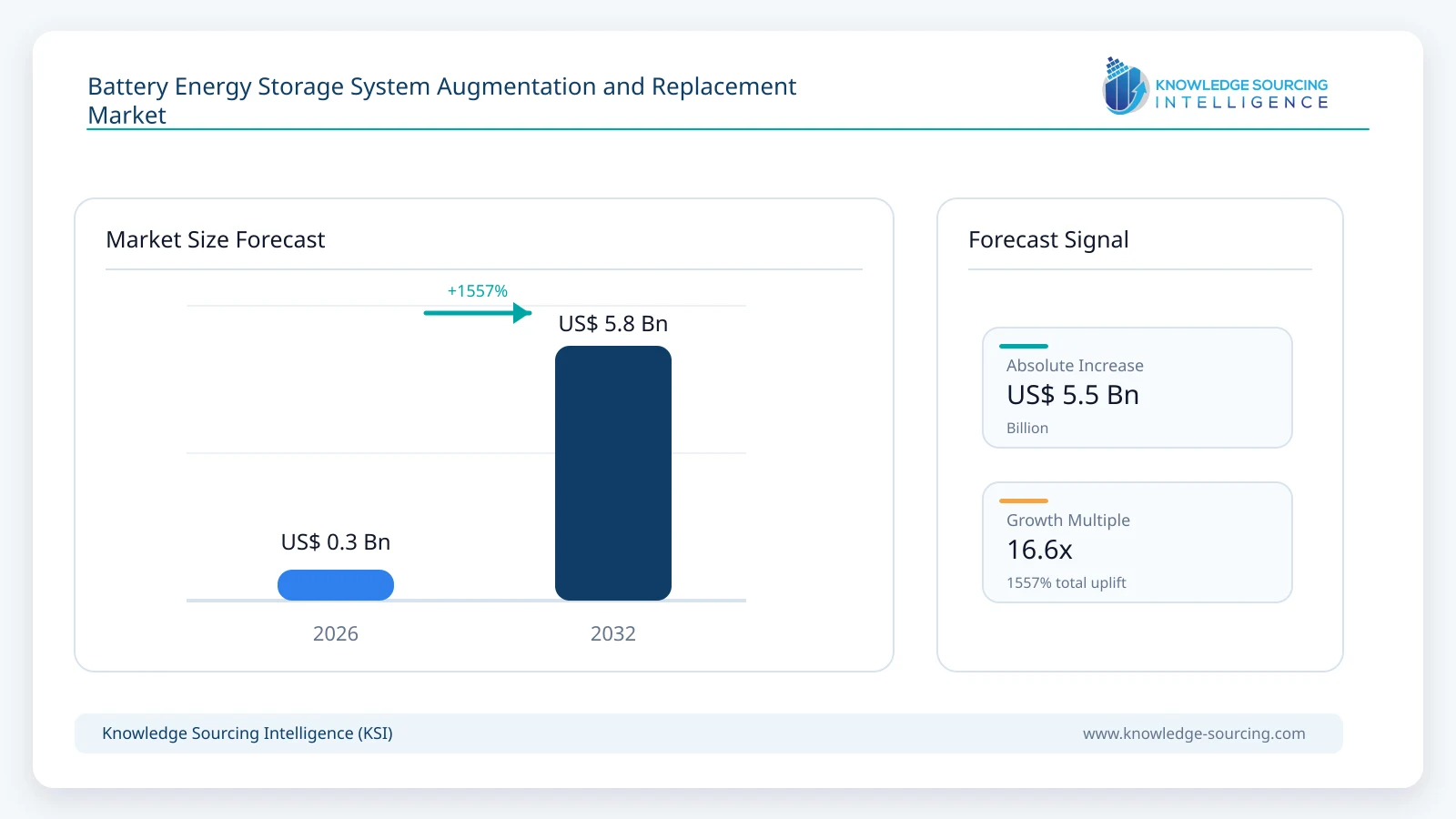
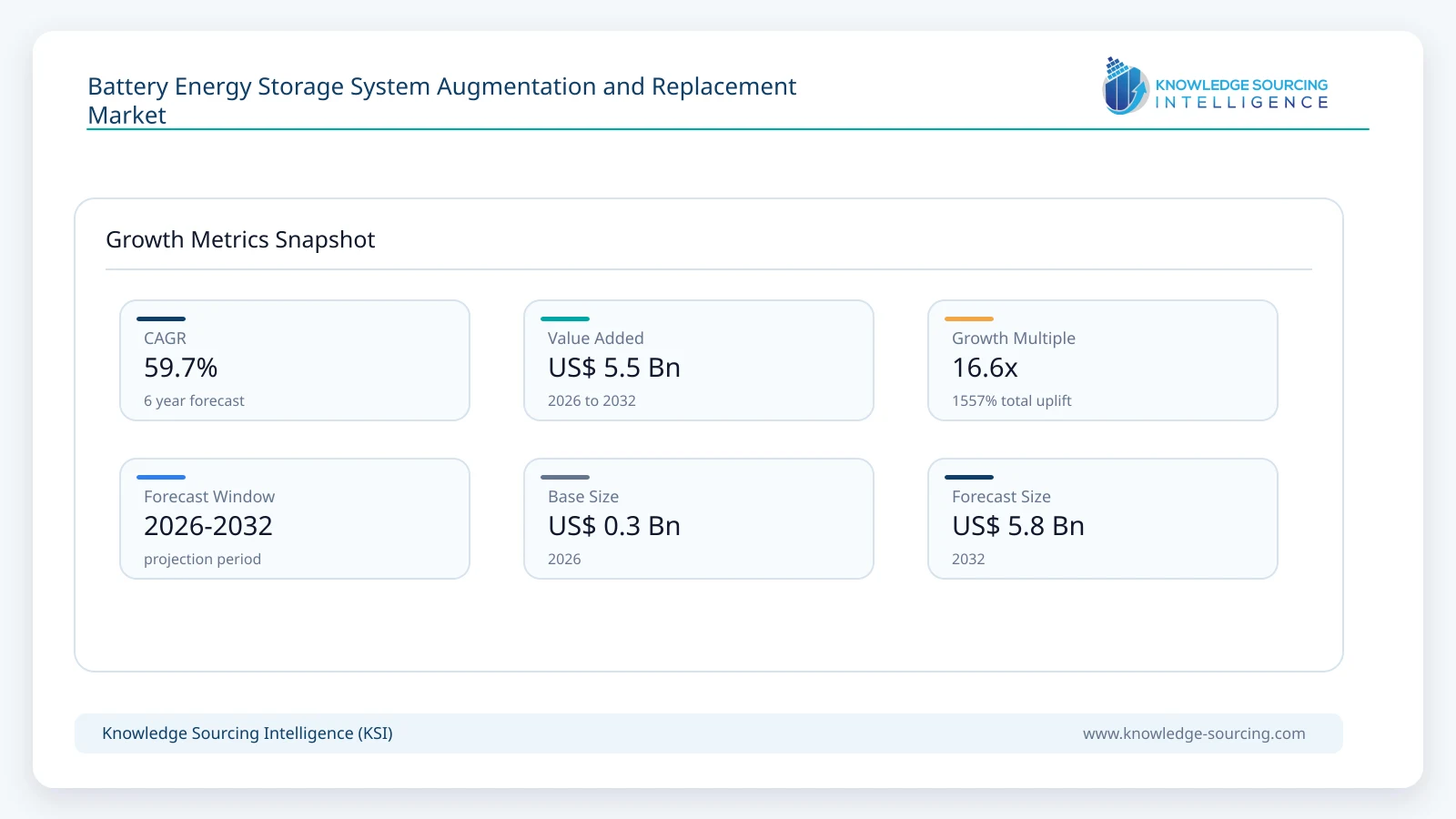
BESS augmentation and replacement interventions are forecast to grow at a CAGR of 59.7%, reaching approximately USD 5.8 billion by 2032 from USD 0.35 billion in 2026.
Key Highlights
· Battery owners increasingly treat augmentation as a contractual-delivery obligation because usable energy loss can reduce
· DC-side augmentation preserves existing inverter capacity when it remains available, whereas new AC blocks can simplify battery-vintage segregation but may trigger interconnection and protection review.
· New high-density battery containers can reduce replacement space requirements, but differences in DC voltage, battery management, fire protection and warranty terms prevent a simple one-for-one swap.
· Long-term service agreements increasingly specify augmentation rights, capacity thresholds, replacement responsibility and commissioning tests, shifting commercial competition beyond the initial battery system price.
Market Overview
Augmentation addresses a specific mismatch between electrochemical ageing and fixed commercial obligations. A project may retain its full inverter rating in megawatts even after cell degradation reduces usable megawatt-hours. In a four-hour contracted resource, that energy loss can compromise the duration requirement before the inverter reaches the end of its mechanical life. An owner can protect contract compliance by maintaining an initial battery overbuild, adding later battery modules, changing dispatch depth, or accepting partial replacement. The optimal option depends on the revenue at risk and the cost of restoring each deliverable megawatt-hour.
The commercial trigger is therefore not simply a battery reaching an arbitrary age. Owners must compare measured state of health with the minimum energy required at the point of interconnection, including temperature derating, round-trip efficiency, reserve margins and the relevant contract testing protocol. Where a project is paid for reliable four-hour availability, the loss of a relatively small energy margin may create a disproportionate economic penalty. This explains why the market for augmentation can emerge years before the original hardware reaches its nominal end of life.
Battery improvements complicate the intervention decision. Newer lithium iron phosphate equipment commonly offers higher energy per enclosure and more sophisticated thermal and fire-protection systems than earlier site generations. Substituting it into an existing DC architecture may require changes to voltage operating windows, fuse coordination, BMS hierarchies and communication interfaces. Separate DC blocks or dedicated AC conversion can reduce interaction between generations, but increase integration cost, equipment count and the scope of electrical studies. This makes engineering and software interoperability as commercially important as cell pricing.
Service arrangements are becoming a significant competitive differentiator. Integrators with original equipment records, historical operating data, compatible replacement inventories and manufacturer-authorized warranties have an advantage in planning capacity-restoration work without creating new asset-liability disputes. Fluence’s financial disclosures distinguish contracts with fixed numbers of augmentations from those guaranteeing capacity above a threshold; the two structures have different service obligations and revenue-recognition patterns. For owners, their economic effect is similarly different: one purchases specified work while the other transfers a portion of performance risk.
Market Drivers
Contractual Energy Requirements and Degradation
Calendar ageing and cycle-related degradation reduce available energy independently of inverter nameplate power. Frequent cycling, hot operating environments and deep discharge accelerate the margin erosion that matters to resource-adequacy, tolling and fixed-duration contracts. When a dispatch schedule is designed around a narrow energy buffer, augmentation becomes a way to protect contracted cash flow rather than a discretionary technology refresh. Utilities and lenders are consequently scrutinizing guarantees for delivered AC energy, not only factory-rated DC capacity.
Growth of Eligible Operating Cohorts
The scale of the opportunity follows commissioning vintages with a delay. Worldwide battery additions reached 108 GW in 2025, while the United States alone plans 24 GW of utility-scale additions during 2026 after adding 15 GW in 2025. The 2025 systems will not immediately create full augmentation demand, but they increase the future population of assets that will require testing, battery supplementation or replacement. Growth is not a fixed percentage of global storage deployment because sites use different oversizing strategies and cycling profiles.
Interconnection and Permitting Treatment
Regulatory friction can affect both intervention timing and asset revenue. NextEra Energy Resources asked CAISO in March 2026 to streamline augmentation reviews for operating systems that preserve existing injection limits. A routine installation can still require short-circuit calculations, updated models, control validation and local safety approvals. A twelve-month review delay may leave an owner unable to restore energy capability when a capacity contract is tested. This raises the value of pre-approved augmentation envelopes, documented design margins and repeatable engineering packages.
Changing Battery Prices and Duration Economics
Lower replacement equipment costs can pull interventions forward where a site has spare space or market access rewards longer duration. However, the relevant calculation is the fully integrated cost of additional usable AC megawatt-hours, not the ex-factory price of a new cell. A low-cost container may require control-system redesign, PCS equipment, civil works and warranty renegotiation. The economic advantage of expanding an existing asset is greatest when interconnection, transformers and existing foundations can be reused.
Market Restraints
Compatibility, Warranty and Fire-Safety Requalification
Mixing battery vintages introduces different impedance, voltage, degradation, thermal-management and warranty characteristics. Manufacturers may restrict paralleling across product generations, and fire-protection approvals can depend on the tested configuration. The need to preserve insurance, equipment certifications and contractual guarantees can make a seemingly inexpensive replacement project uneconomic when the original product has been discontinued.
Limited Ability to Reuse Upstream Electrical Infrastructure
Battery energy can be increased without raising maximum export power only where the existing plant has sufficient DC connection, protection and thermal margin. Duration extension may also require additional AC blocks, updated transformer studies or revised grid-code tests. Sites with constrained land, cable routes or switchgear can incur costs resembling a partial rebuild, reducing the relative appeal of augmentation.
Segmentation Analysis
By Intervention Type
Capacity-maintenance augmentation represents the main recurring commercial mechanism. Existing batteries continue operating while additional modules or DC blocks restore the usable-energy margin. The intervention is usually staged so it follows measured degradation and avoids purchasing every future replacement cell at initial commissioning. Project owners retain flexibility over timing, but are exposed to future cell compatibility and installation risk. Full container replacement and broad repowering become more attractive later in the asset life, particularly where repeated module failures or unavailable spare parts make incremental repair inefficient.
By Hardware and Service Scope
Battery containers, racks and modules capture the principal equipment expenditure because most interventions add or renew energy capacity. A site retaining its original PCS may require only battery blocks, DC wiring, protection changes and control integration, whereas an AC-block expansion adds inverters, transformers and potentially additional grid studies. Engineering and recommissioning typically represent smaller equipment-independent revenue pools, but they are decisive for warranty continuity, safety compliance and assured energy delivery.
By Project Age and Configuration
Early-life interventions are usually driven by component failure, unexpected degradation or a commercial decision to increase duration. Mid-life projects can support scheduled capacity supplementation while retaining usable transformers, switchgear and inverter systems. Late-life repowering is more extensive because battery replacement may coincide with cooling-system wear, communications obsolescence and evolving fire-safety standards. Standalone utility-scale plants present the clearest contractual trigger; solar-plus-storage and wind-plus-storage sites face the additional constraint of shared interconnection and generation-related operating restrictions.
North American Regional Analysis
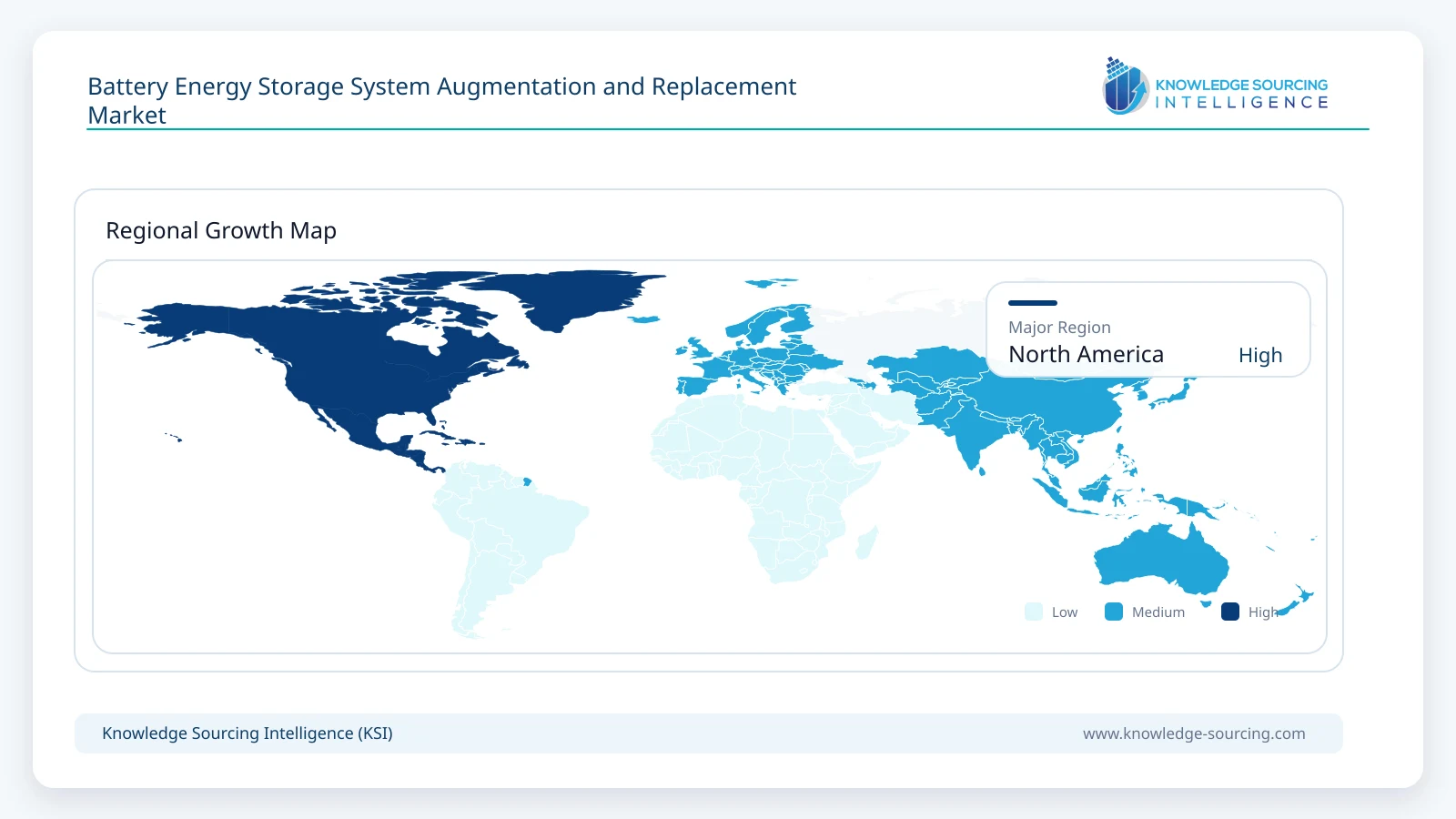
North America is a leading near-term commercialization region because operating utility-scale battery fleets already face capacity tests, merchant dispatch and performance guarantees. CAISO stakeholders reported almost 16 GW of installed battery capacity in its footprint as of March 2026. NextEra proposed separating routine augmentation from the full material-modification process where original injection capability is unchanged; Southern California Edison and other stakeholders supported considering the change. This demonstrates a regulatory bottleneck directly relevant to lifecycle revenue timing: a battery owner cannot treat adding cells as routine field work if interconnection approval delays the capacity-restoration schedule.
The Goleta Energy Storage project provides a tangible example. The 60 MW California site began operating in December 2023, and the developer subsequently sought approval to add up to 132 Powerpack augmentation units alongside existing Megapacks. City records describe installation in groups of up to 40 units, using existing pads and without additional grading. The project illustrates how reserving physical expansion space can lower civil-work requirements. It does not, however, show that all proposed units have been commissioned, and project-specific quantities cannot be extrapolated mechanically across the entire fleet.
Procurement arrangements further distinguish the region. Owners may have long-term commitments for capacity maintenance, separate preventive-maintenance packages, and equipment warranties that determine which party purchases replacement batteries. California’s relatively mature operating base supports earlier demand; Texas and Arizona will contribute more as newer high-volume installation cohorts age. The extent of annual aftermarket spending depends on how aggressively these assets are cycled, their initial energy overbuild, and whether existing controls and electrical plant support augmentation without major replacement.
Competitive Environment
The competitive landscape includes original BESS integrators, battery suppliers with authorized parts and service channels, and independent lifecycle software and field-service specialists. Tesla, Fluence, Sungrow, CATL, BYD, Trina Storage, Envision Energy and Canadian Solar’s e-STORAGE can combine equipment supply with varying degrees of lifecycle support. Nidec Conversion and Saft participate through integrated equipment, service capabilities or specialized battery systems. LG Energy Solution remains relevant as a battery supplier to installed system platforms, but should not be described as equivalent to a full lifecycle integrator.
Two corporate developments are particularly relevant to existing installed assets. FlexGen completed the acquisition of key Powin assets and intellectual property in August 2025 and reported an expanded service footprint exceeding 25 GWh across more than 200 sites. Separately, Wärtsilä and RCT Solutions closed their joint venture, Valo, on 1 October 2026, transferring the energy-storage business into a jointly owned entity. Both cases reinforce the importance of software continuity, contract assignment, warranty enforcement and replacement-part access after a change in supplier ownership.
Recent Developments
· October 2026: Wärtsilä and RCT Solutions completed the formation of Valo, a 50:50 joint venture containing Wärtsilä’s global Energy Storage business.
· August 2026: CATL broadened its NING Service aftermarket activities, including energy-storage operation and maintenance capabilities; its announced brand expansion also spans transport and other battery applications.
· May 2026: CAISO stakeholders, including Southern California Edison and REV Renewables, supported further consideration of streamlined review for operational BESS augmentation.
· March 2026: NextEra Energy Resources submitted a CAISO proposal addressing augmentations that maintain an asset’s original export limit, rather than increasing interconnection rights.
· 2025–2026: Goleta Energy Storage’s proposed 132-unit augmentation remained documented through local planning materials. The permitted or proposed intervention must not be described as completed solely from the application.
· August 2025: FlexGen closed the acquisition of key assets and intellectual property from Powin, expanding the fleet served by its software and lifecycle operations.
Battery Energy Storage System Augmentation and Replacement Market Scope:
| Report Metric | Details |
|---|---|
| Total Market Size in 2026 | USD 0.35 billion |
| Total Market Size in 2032 | USD 5.8 billion |
| Forecast Unit | USD Billion |
| Growth Rate | 59.7% |
| Study Period | 2021 to 2032 |
| Historical Data | 2021 to 2024 |
| Base Year | 2025 |
| Forecast Period | 2026 – 2032 |
| Segmentation | Intervention Type, Hardware and Service, Project Age, Project Configuration, Commercial Driver, Geography |
| Companies |
|
Market Segmentation
By Intervention Type
Contracted-Capacity Augmentation
Module and Rack Replacement
Container and DC-Block Replacement
New AC-Block Additions
Mid-Life Repowering
Duration Expansion of Operating Sites
By Hardware and Service
Battery Containers, Racks and Modules
Power Conversion and Transformers
BMS, EMS and Controller Upgrades
Electrical and Thermal Integration
Installation, Testing and Recommissioning
Specialized Lifecycle Engineering
By Project Age
Early-Life Interventions
Mid-Life Capacity Maintenance
Late-Life Replacement
By Project Configuration
Standalone Utility-Scale BESS
Solar-Plus-Storage Projects
Wind-Plus-Storage Projects
Commercial and Industrial BESS
By Commercial Driver
Contracted Capacity Maintenance
Resource Adequacy and Tolling Compliance
Duration and Revenue Optimization
Warranty and Component Failure
Asset-Life Extension
By Geography
North America
Europe
China
Asia Pacific Excluding China
Middle East and Rest of World
Table of Contents
1. EXECUTIVE SUMMARY
1.1. Market Opportunity
1.2. Market Drivers and Principal Constraints
1.3. Lifecycle Capacity Addition Outlook
1.4. Competitive Positioning
2. RESEARCH SCOPE AND METHODOLOGY
2.1. Market Definition and Revenue Recognition
2.2. Exclusions and Double-Counting Controls
2.3. Operating Fleet by Commissioning Vintage
2.4. State-of-Health and Intervention Probability Model
2.5. Battery and Balance-of-System Content
2.6. Price, Currency and Forecast Assumptions
3. BESS LIFECYCLE AND AUGMENTATION ARCHITECTURE
3.1. Calendar and Cycle Degradation
3.2. Contracted Energy and Power Capability
3.3. Initial Oversizing versus Planned Augmentation
3.4. DC-Side Capacity Additions
3.5. AC-Block Expansion
3.6. Mixed-Vintage BMS and EMS Integration
3.7. Electrical Protection and Safety Requalification
3.8. Repowering and Removal of Existing Equipment
4. GLOBAL MARKET SIZE AND FORECAST, 2026–2032
4.1. Global Lifecycle Intervention Revenue
4.2. Annual Battery Capacity Augmented or Replaced
4.3. Operational BESS Fleet Eligible for Intervention
4.4. Intervention Timing by Asset Vintage
4.5. Revenue per Added or Replaced MWh
4.6. Market Scenarios and Sensitivities
5. MARKET BY INTERVENTION TYPE
5.1. Contracted-Capacity Augmentation
5.2. Module and Rack Replacement
5.3. Container and DC-Block Replacement
5.4. New AC-Block Additions
5.5. Mid-Life Repowering
5.6. Duration Expansion of Operating Sites
6. MARKET BY HARDWARE AND SERVICE
6.1. Battery Containers, Racks and Modules
6.2. Power Conversion and Transformers
6.3. BMS, EMS and Controller Upgrades
6.4. Electrical and Thermal Integration
6.5. Installation, Testing and Recommissioning
6.6. Specialized Lifecycle Engineering
7. MARKET BY PROJECT AGE
7.1. Early-Life Interventions
7.2. Mid-Life Capacity Maintenance
7.3. Late-Life Replacement
7.4. Battery Vintage and Chemistry Compatibility
8. MARKET BY PROJECT CONFIGURATION
8.1. Standalone Utility-Scale BESS
8.2. Solar-Plus-Storage Projects
8.3. Wind-Plus-Storage Projects
8.4. Commercial and Industrial BESS
9. MARKET BY COMMERCIAL DRIVER
9.1. Contracted Capacity Maintenance
9.2. Resource Adequacy and Tolling Compliance
9.3. Duration and Revenue Optimization
9.4. Warranty and Component Failure
9.5. Asset-Life Extension
10. REGIONAL MARKET
10.1. North America
10.2. Europe
10.3. China
10.4. Asia Pacific Excluding China
10.5. Middle East and Rest of World
11. ECONOMICS, PROCUREMENT AND REGULATORY FRAMEWORK
11.1. Augmentation versus Initial Oversizing
11.2. Cost per Contracted Usable MWh
11.3. Interconnection and Material-Modification Review
11.4. Existing Asset and Foundation Reuse
11.5. Long-Term Service Agreement Obligations
11.6. Warranties, Guarantees and Financing
11.7. Asset Transfer and Supplier Insolvency Risk
12. COMPETITIVE LANDSCAPE
12.1. Integrated Lifecycle Equipment Suppliers
12.2. Battery Manufacturers and Authorized Parts
12.3. Software and Independent Service Providers
12.4. Supplier Ownership and Corporate Transactions
12.5. Technology, Service and Warranty Comparison
13. COMPANY PROFILES
13.1. Tesla, Inc.
13.2. Valo (Wärtsilä–RCT Solutions joint venture)
13.3. Fluence Energy, Inc.
13.4. Sungrow Power Supply Co., Ltd.
13.5. Contemporary Amperex Technology Co., Limited
13.6. BYD Company Limited
13.7. Trina Storage
13.8. Envision Energy
13.9. Canadian Solar / e-STORAGE
13.10. FlexGen Power Systems
13.11. Saft
13.12. Nidec Conversion
13.13. LG Energy Solution
14. APPENDIX
Navigate
Trusted by the world's leading organizations











