
The Second-Life Battery Energy Storage Systems Market is estimated at USD 0.11 billion in 2026 and is projected to reach USD 1.10 billion by 2032, representing a CAGR of 46.8% during the forecast period.
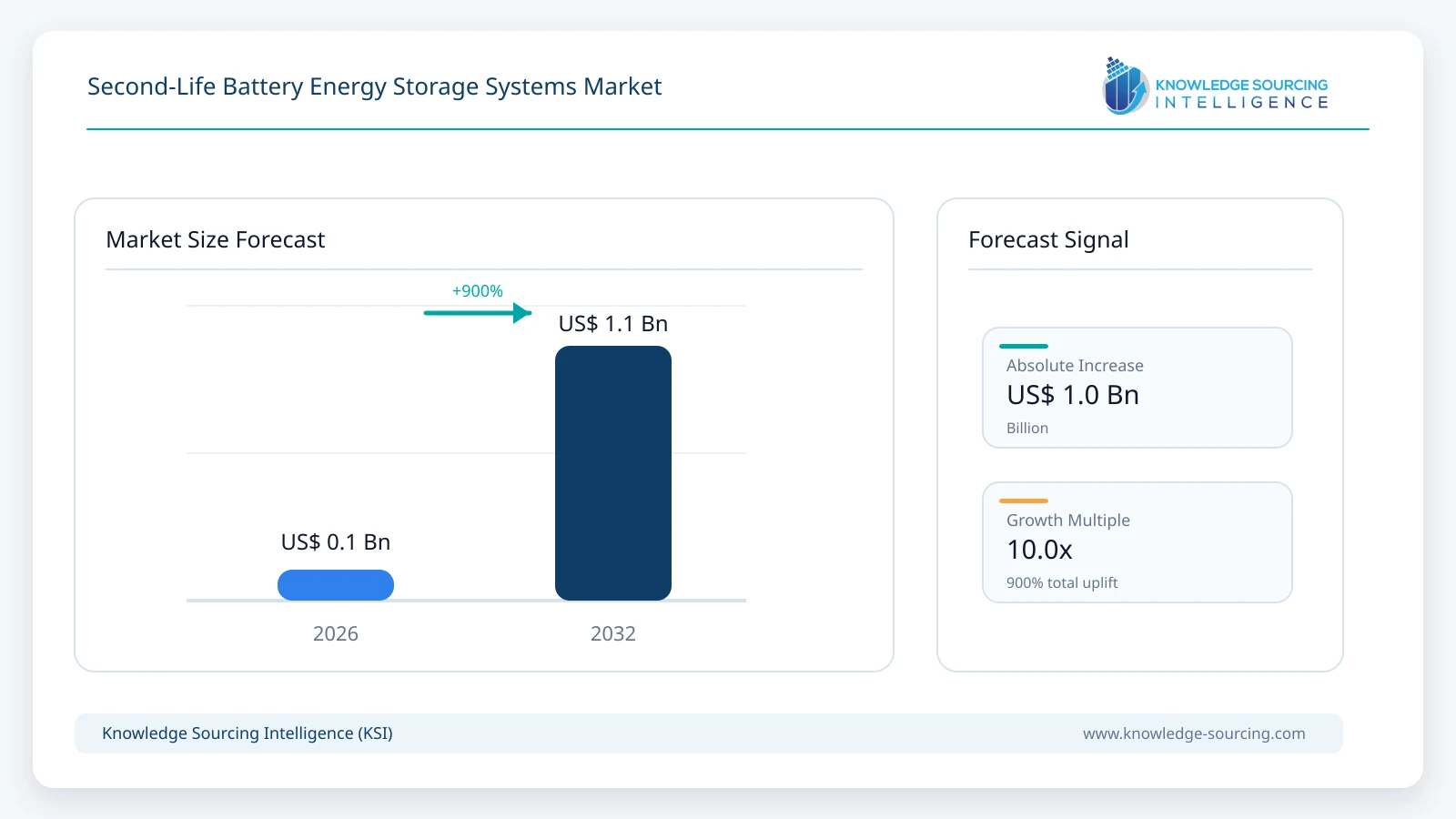
Key Highlights
• Second-life BESS is commercially proven at tens-of-megawatt-hour scale but remains small relative to new-battery storage.
• Pack-level reuse can avoid costly cell disassembly where battery health, safety and communications can be validated.
• State-of-health testing and battery-specific controls are becoming core enabling technologies rather than ancillary services.
• Grid-scale, commercial and data-center applications are expanding as retired EV battery supply becomes more predictable.
• North America leads current operating scale, while Europe has the strongest policy and project-development pipeline.
Market Overview
An EV battery can leave automotive service for several reasons: range degradation, vehicle retirement, warranty replacement, accident damage outside the battery, fleet replacement cycles or changing duty requirements. A pack that is no longer attractive for propulsion can still retain substantial usable capacity. Stationary storage places lower demands on gravimetric energy density and peak acceleration power, allowing qualified packs to continue operating for years if their internal condition, thermal history and remaining life are adequately understood.
Repurposing can occur at pack level or module level. Pack-level systems preserve much of the original enclosure, cooling hardware and internal battery management architecture, reducing labor and reassembly cost. B2U's EV Pack Storage approach is built around using intact EV packs inside purpose-built cabinets. Module-level systems disassemble packs and regroup qualified modules into stationary racks, providing more design flexibility but increasing testing, labor and traceability requirements. Both architectures require a supervisory battery-management layer that can operate heterogeneous batteries safely and account for differences in state of health.
The economics depend on more than the acquisition price of retired batteries. Operators must inspect, test, transport, store and qualify each pack, replace unsuitable components, adapt communications, provide fire and electrical protection, integrate power conversion and establish warranties acceptable to asset owners and financiers. Falling prices for new lithium iron phosphate storage create continuous competitive pressure, so second-life systems need to convert lower battery acquisition cost into lower installed or lifecycle cost without sacrificing safety, availability or bankability.
Market Drivers
The supply of retired EV batteries is becoming larger and more structured
As the first large cohorts of electric vehicles age, automakers and fleet operators are beginning to create predictable streams of batteries that are no longer required in vehicles. B2U's 2026 strategic supply agreement with Waymo is an example of a direct fleet-to-storage model in which batteries from retired autonomous vehicles can move into stationary systems. Similar arrangements with automotive manufacturers can reduce feedstock uncertainty and give repurposers access to battery history, diagnostics and engineering data that are difficult to obtain from fragmented aftermarket sources.
Grid and commercial storage demand creates applications tolerant of lower energy density
Stationary systems can use heavier and larger batteries because land and weight constraints are less severe than in vehicles. Second-life batteries are therefore suited to grid energy shifting, capacity services, renewable integration, commercial peak shaving, EV-charging support and resilience. B2U is operating grid-connected systems in California and Texas, while Moment Energy targets commercial, industrial, data-center and microgrid applications. The 53 MWh Element Energy project in Texas shows that second-life systems can operate at utility scale rather than only as demonstration assets.
Testing and certification are reducing a major bankability barrier
Heterogeneous battery condition has historically made warranties, permitting and insurance difficult. Repurposers are now investing heavily in qualification systems, state-of-health analytics and safety certification. In May 2026, Moment Energy announced third-party recognition of its battery-management hardware for repurposed batteries against UL 1973-related requirements. Connected Energy began development of a dedicated advanced EV battery testing facility in the United Kingdom, while Moment Energy and Pulsenics are developing faster industrial-scale battery qualification. Better testing reduces the risk of mixing weak or damaged batteries into commercial systems.
Circular-economy regulation is improving traceability
Europe's Batteries Regulation creates a more formal information framework for reuse and repurposing. From February 2027, covered EV and industrial batteries will require digital battery passports containing state-of-health, use-history and status information accessible to relevant operators. A repurposed battery receives a new passport linked to the original. This does not remove technical testing requirements, but it can improve provenance and lower information asymmetry for second-life operators, financiers and customers.
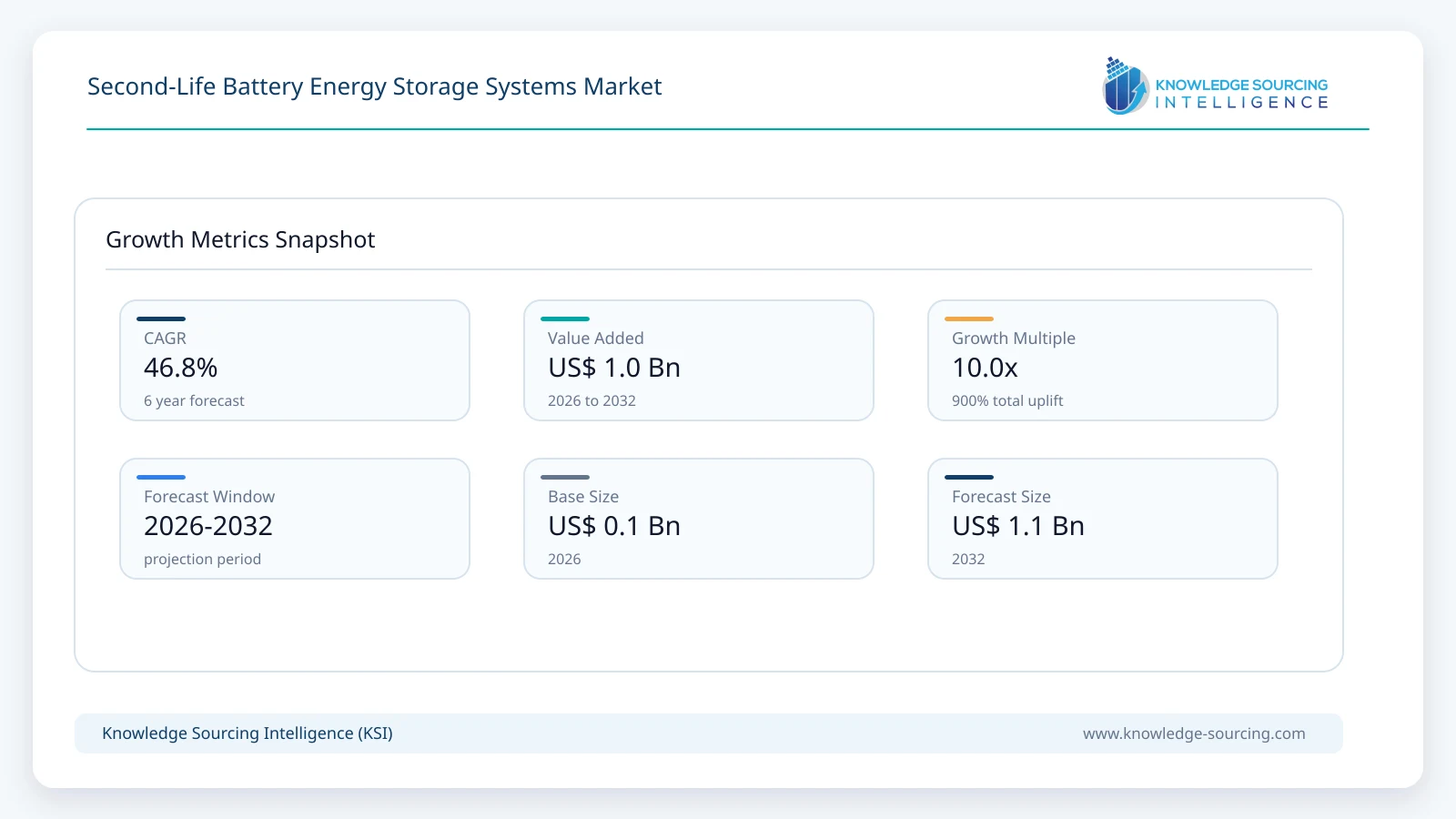
Restraints and Adoption Challenges
The largest constraint is variability. Retired packs differ by chemistry, cell supplier, vehicle platform, age, climate exposure, charging behavior, software version and failure history. State-of-health percentage alone does not capture internal resistance, cell imbalance, latent damage or future degradation. Logistics can also be expensive because used high-voltage batteries are heavy and regulated for transport. Repurposers must establish product liability, warranty and fire-safety frameworks for hardware originally designed for a different duty cycle. Falling new-BESS prices are another major pressure: if new lithium iron phosphate systems become inexpensive enough, the cost advantage of testing and integrating older batteries can narrow. Recycling can also compete for feedstock where material value is high.
Segment Analysis
By Repurposing Architecture
Pack-level repurposing is commercially attractive when batteries can remain mechanically intact and their original safety systems can be retained. It reduces dismantling labor and avoids rebuilding modules into new packs. B2U's operating portfolio demonstrates this architecture at grid scale. The trade-off is that the stationary system must accommodate different pack voltages, communications protocols and physical formats, requiring sophisticated cabinet controls and software.
Module-level repurposing offers greater flexibility. Developers can grade modules, remove weaker units and assemble standardized stationary racks from compatible components. This approach can achieve higher packing density or create products tailored to commercial and industrial applications, but it increases labor, testing and reassembly cost. The highest-growth enabling layer across both architectures is battery intelligence: diagnostics, state-of-health estimation, adaptive BMS and software that allows batteries of different histories to operate safely within one stationary system.
System Layer | Second-Life Function | Commercial Relevance | Direction |
Battery qualification | Measures state of health, resistance, imbalance and safety condition | Required before reuse | Moving toward faster automated diagnostics |
Pack-level repurposing | Reuses intact EV packs in stationary cabinets | Lowest-disassembly pathway | Strong in grid-scale projects |
Module-level repurposing | Rebuilds qualified modules into stationary racks | Greater design flexibility | Common in C&I and customized systems |
Adaptive BMS | Controls batteries with different aging histories | Critical safety and warranty layer | Fast-growing software and controls segment |
Container and PCS integration | Converts repurposed batteries into grid-ready BESS | Major project-value layer | Increasing standardization |
O&M and monitoring | Tracks degradation, availability and remaining life | Important for financing and guarantees | Growing with operational fleet size |
Commercial Deployment Indicators
Project / Indicator | Verified Evidence | Market Significance |
B2U operating portfolio | Approximately 100 MWh of storage deployed using repurposed EV batteries; more than 5,000 batteries under management. | Largest clearly disclosed operating portfolio among specialist second-life BESS developers. |
Bexar Martinez, Texas | 28 MWh entered commercial operation in September 2026; B2U expects another 50+ MWh in ERCOT over the following six months. | Shows repeat utility-scale deployment and an active near-term pipeline. |
Element Energy, Texas | 53 MWh second-life BESS commissioned using about 900 EV batteries. | Demonstrates utility-scale deployment with a major system-integration partner. |
Mercedes-Benz Energy | 31 MWh across Lünen and Elverlingsen continues to provide grid services after requalification. | Provides long-duration operating evidence for repurposed vehicle batteries. |
Renault Flins | More than 500 vehicle batteries provide 15 MWh of stationary storage at the Refactory. | Shows automotive OEM integration of repair, reuse and stationary storage. |
Connected Energy, France | Building permits secured in May 2026 for 12 MW and 9 MW second-life BESS projects; company also holds a 100 MWh grid connection in Centre-Val de Loire. | Represents one of Europe's clearest multi-MWh development pipelines. |
Regional Opportunity
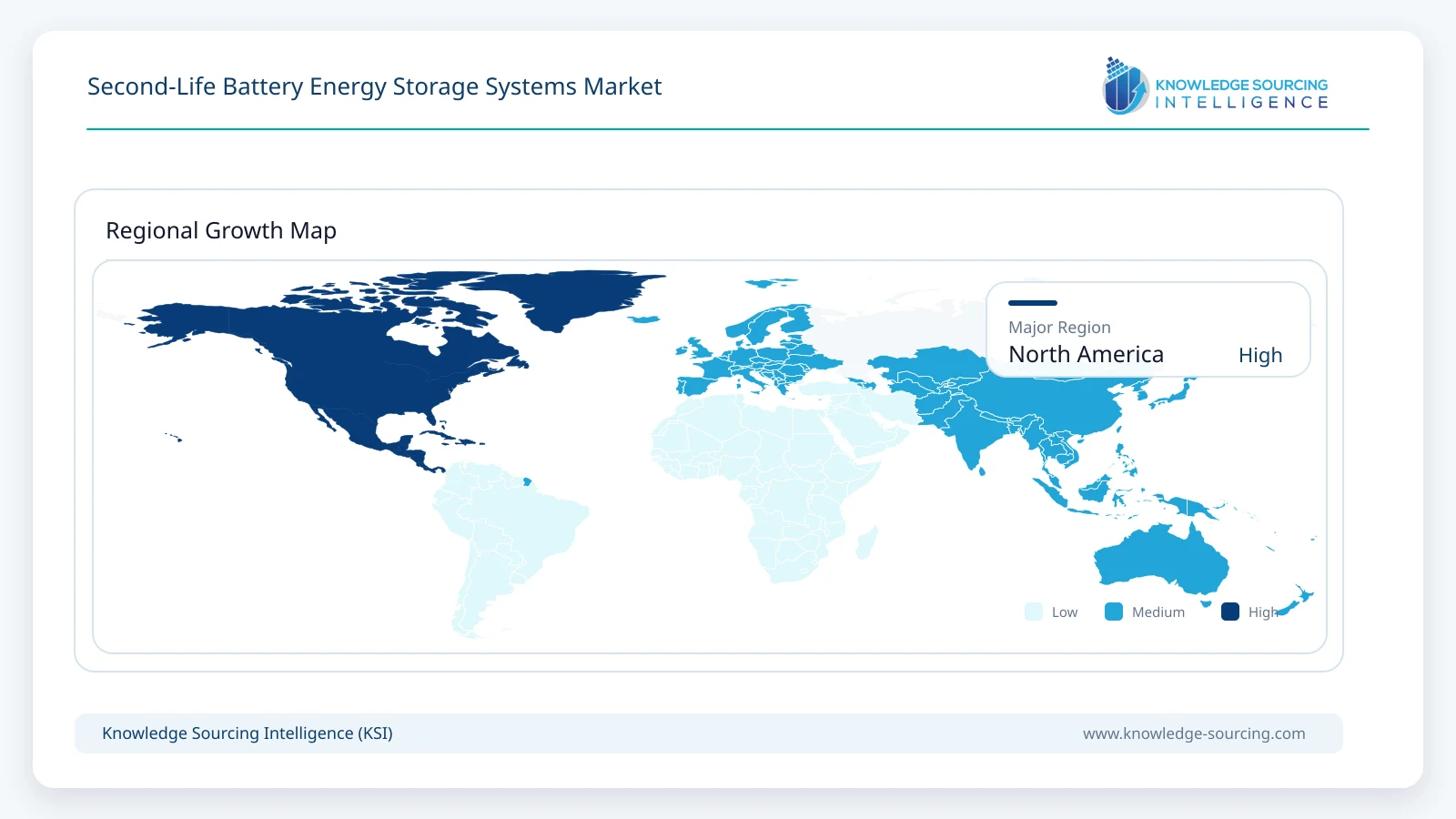
North America
North America is the leading current market for second-life BESS because it combines the largest clearly disclosed specialist operating portfolio, utility-scale project references, new repurposing capacity and access to a rapidly expanding electric-vehicle fleet. B2U Storage Solutions reported approximately 100 MWh of operational energy storage by September 2026 across California and Texas, with more than 5,000 repurposed EV batteries under management. Its systems have operated in wholesale power markets since 2020, providing an important bankability reference.
Texas is emerging as a central deployment market. B2U's Bexar Corrilla project entered operation in 2025 and Bexar Martinez followed in September 2026 at 28 MWh, taking the company's Texas portfolio above 50 MWh. B2U expects additional ERCOT capacity over the following six months. Element Energy also operates a 53 MWh second-life project in Texas, demonstrating that utility-scale deployment is no longer limited to one technology provider.
The supply and manufacturing side is also strengthening. Moment Energy raised USD 40 million in Series B financing in May 2026 and opened a new EV battery repurposing facility in Vancouver in June. Its 2026 battery-management certification work addresses one of the principal safety and permitting barriers for repurposed systems. B2U's supply partnership with Waymo illustrates how fleet operators can become direct feedstock partners, creating a more predictable route from first-life vehicle use to grid storage.
Europe remains strategically important because automakers and second-life developers have a longer history of pilot and commercial projects, while regulation is creating more structured battery traceability. Mercedes-Benz Energy, Renault Group, Connected Energy and Nissan-backed projects provide operating references. Connected Energy is developing a larger French pipeline, and the EU battery passport becomes mandatory for relevant battery categories from February 2027. Asia Pacific has a large future feedstock opportunity through Japan, China and South Korea but currently has fewer transparent grid-scale second-life BESS deployments than North America.
Competitive Landscape
B2U Storage Solutions is the strongest current utility-scale specialist by disclosed operating capacity. Its pack-level EV Pack Storage platform avoids cell-level remanufacturing and the company combines battery sourcing, repurposing, project development, financing and market operations. Element Energy differentiates through adaptive battery-management technology that can control heterogeneous battery modules, while LG Energy Solution Vertech provides turnkey integration for selected deployments.
Moment Energy focuses on commercial, industrial and infrastructure storage and is scaling battery qualification, repurposing and certification in North America. Connected Energy remains an active European second-life BESS specialist and is moving from distributed systems toward multi-MWh grid development. Mercedes-Benz Energy directly develops stationary storage solutions using repurposed vehicle batteries, while 4R Energy develops, manufactures and sells lithium-ion battery systems based on second-use automotive batteries. Automotive OEMs, battery suppliers and system integrators such as Renault/Mobilize, JLR, Volvo Energy, LG Energy Solution Vertech, Wykes Engineering, Allye Energy and Pramac are treated as project, feedstock or integration ecosystem participants unless they directly supply a dedicated second-life BESS product.
Key Market Participants: B2U Storage Solutions; Moment Energy; Element Energy; Connected Energy; Mercedes-Benz Energy; 4R Energy. These companies have current operating activity, dedicated second-life battery technology or products, and clear participation in stationary energy storage rather than only battery supply, investment or demonstration partnerships.
Recent Developments
• September 2026: B2U's 28 MWh Bexar Martinez project entered commercial operation in Texas, taking the company's operating second-life portfolio to about 100 MWh.
• September 2026: Moment Energy announced third-party verification of U.S. sourcing compliance for its BESS platform as domestic-content and foreign-entity rules tighten.
• June 2026: Moment Energy opened its new EV battery repurposing facility in Vancouver, expanding North American manufacturing capacity.
• Q2 2026: B2U announced a strategic battery-supply agreement with Waymo to repurpose batteries retired from its autonomous-vehicle fleet.
• May 2026: Connected Energy secured building permits for 12 MW and 9 MW second-life BESS projects in France.
• May 2026: Moment Energy announced recognized safety certification for battery-management hardware designed specifically for repurposed EV batteries.
• May 2026: Moment Energy closed a USD 40 million Series B financing round to scale second-life storage deployment.
• January 2026: Connected Energy began development of an advanced EV battery testing facility in Norfolk, which is also planned to host its first wholly owned and operated second-life BESS site.
Second-Life Battery Energy Storage Systems Market Scope:
| Report Metric | Details |
|---|---|
| Total Market Size in 2026 | USD 0.11 billion |
| Total Market Size in 2032 | USD 1.10 billion |
| Forecast Unit | USD Billion |
| Growth Rate | 46.8% |
| Study Period | 2021 to 2032 |
| Historical Data | 2021 to 2024 |
| Base Year | 2025 |
| Forecast Period | 2026 – 2032 |
| Segmentation | Repurposing Architecture, System Component, Application, System Scale, Battery Source, Geography |
| Companies |
|
Market Segmentation
By Repurposing Architecture
Intact EV Pack Reuse
Module-Level Repurposing
Cell-Level Reconfiguration
Mixed-Pack Adaptive Systems
By System Component
Retired EV Battery Packs and Modules
Battery Qualification and Diagnostics
Battery Management Systems
Racks, Cabinets and Containers
Power Conversion Systems
Energy Management Software
Thermal Management and Safety Systems
By Application
Grid Energy Shifting
Capacity and Ancillary Services
Commercial and Industrial Peak Shaving
Data Centers and Critical Infrastructure
EV Charging Support
Microgrids and Backup Power
Renewable Energy Integration
By System Scale
Below 500 kWh
500 kWh-5 MWh
5-50 MWh
Above 50 MWh
By Battery Source
Passenger EV Batteries
Electric Bus Batteries
Commercial Vehicle Batteries
Fleet and Autonomous Vehicle Batteries
Prototype and Engineering Batteries
By Geography
North America
United States
Canada
Europe
United Kingdom
France
Germany
Rest of Europe
Asia Pacific
Japan
China
South Korea
Rest of Asia Pacific
Rest of World
Table of Contents
1. EXECUTIVE SUMMARY
1.1. Market Opportunity and Key Findings
1.2. Second-Life Stationary Storage Outlook
1.3. EV Battery Feedstock and Commercial Scale-Up
2. MARKET OVERVIEW
2.1. Battery Retirement from Automotive Service
2.2. State-of-Health Assessment and Qualification
2.3. Pack-Level versus Module-Level Repurposing
2.4. Battery Management and Adaptive Controls
2.5. Stationary System Integration
2.6. End-of-Second-Life Recycling Pathway
3. MARKET SIZE AND FORECAST, 2026-2032
3.1. Global Market Revenue
3.2. Annual Growth Analysis
3.3. Repurposed Battery, Integration and Service Revenue
4. MARKET BY REPURPOSING ARCHITECTURE
4.1. Intact EV Pack Reuse
4.2. Module-Level Repurposing
4.3. Cell-Level Reconfiguration
4.4. Mixed-Pack Adaptive Systems
5. MARKET BY SYSTEM COMPONENT
5.1. Retired EV Battery Packs and Modules
5.2. Battery Qualification and Diagnostics
5.3. Battery Management Systems
5.4. Racks, Cabinets and Containers
5.5. Power Conversion Systems
5.6. Energy Management Software
5.7. Thermal Management and Safety Systems
6. MARKET BY APPLICATION
6.1. Grid Energy Shifting
6.2. Capacity and Ancillary Services
6.3. Commercial and Industrial Peak Shaving
6.4. Data Centers and Critical Infrastructure
6.5. EV Charging Support
6.6. Microgrids and Backup Power
6.7. Renewable Energy Integration
7. MARKET BY SYSTEM SCALE
7.1. Below 500 kWh
7.2. 500 kWh-5 MWh
7.3. 5-50 MWh
7.4. Above 50 MWh
8. MARKET BY BATTERY SOURCE
8.1. Passenger EV Batteries
8.2. Electric Bus Batteries
8.3. Commercial Vehicle Batteries
8.4. Fleet and Autonomous Vehicle Batteries
8.5. Prototype and Engineering Batteries
9. REGIONAL MARKET
9.1. North America
9.1.1. United States
9.1.2. Canada
9.2. Europe
9.2.1. United Kingdom
9.2.2. France
9.2.3. Germany
9.2.4. Rest of Europe
9.3. Asia Pacific
9.3.1. Japan
9.3.2. China
9.3.3. South Korea
9.3.4. Rest of Asia Pacific
9.4. Rest of World
10. MARKET DYNAMICS
10.1. Drivers
10.1.1. Growing Retired EV Battery Supply
10.1.2. Grid and Commercial Storage Demand
10.1.3. Automated Testing and Safety Certification
10.1.4. Circular-Economy Regulation and Battery Traceability
10.2. Restraints
10.2.1. Battery Heterogeneity and State-of-Health Uncertainty
10.2.2. Logistics, Handling and Product Liability
10.2.3. Falling New-BESS Prices
10.2.4. Competition with Direct Recycling
11. COMPETITIVE LANDSCAPE
11.1. Pack-Level Repurposing Specialists
11.2. Adaptive BMS and Module Repurposing Providers
11.3. Automotive OEM Second-Life Programs
11.4. System Integrators and Project Developers
11.5. Battery Diagnostics, Financing and O&M
12. COMPANY PROFILES
13. RECENT DEVELOPMENTS
14. APPENDIX
Navigate
Trusted by the world's leading organizations











