
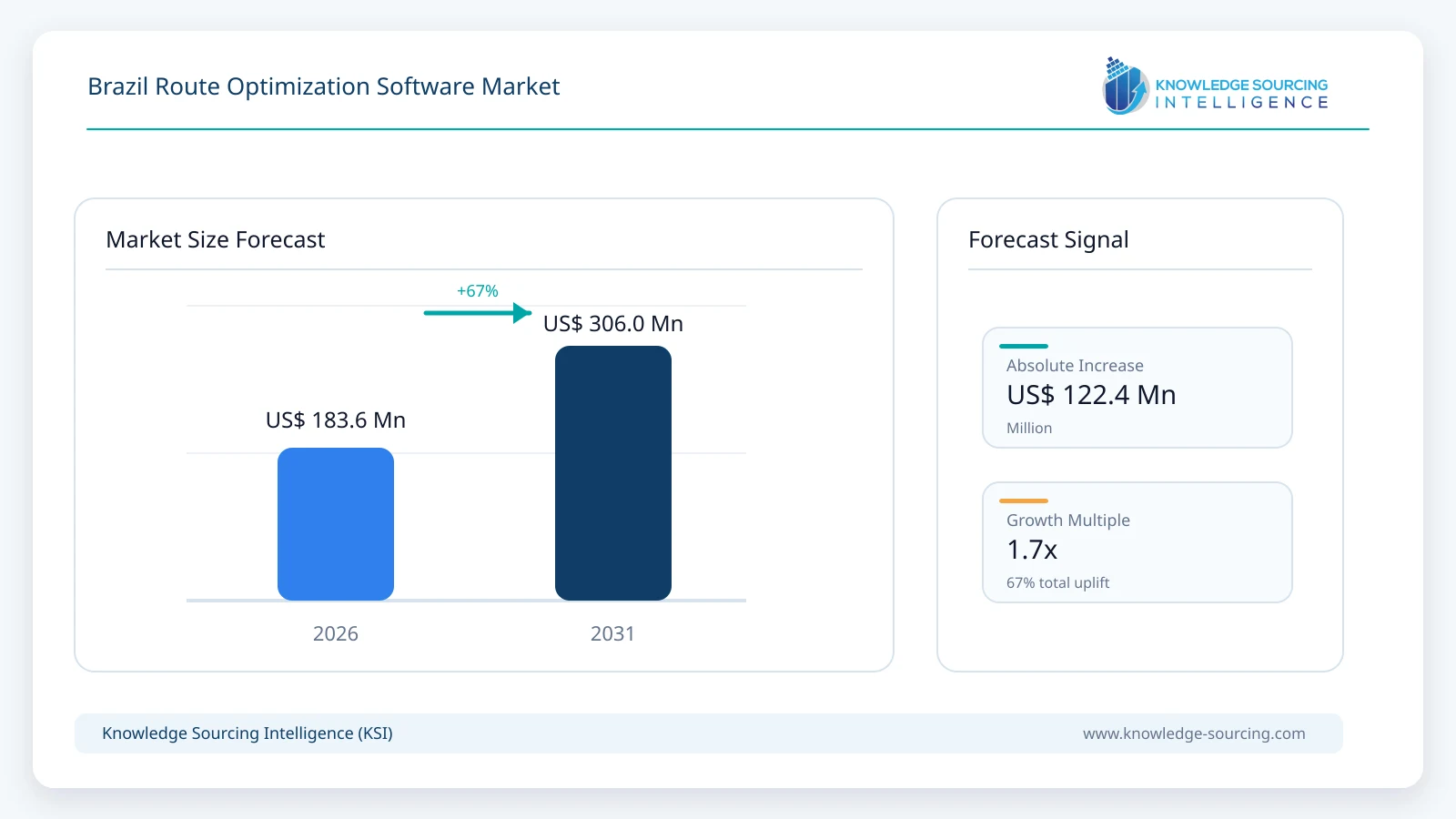
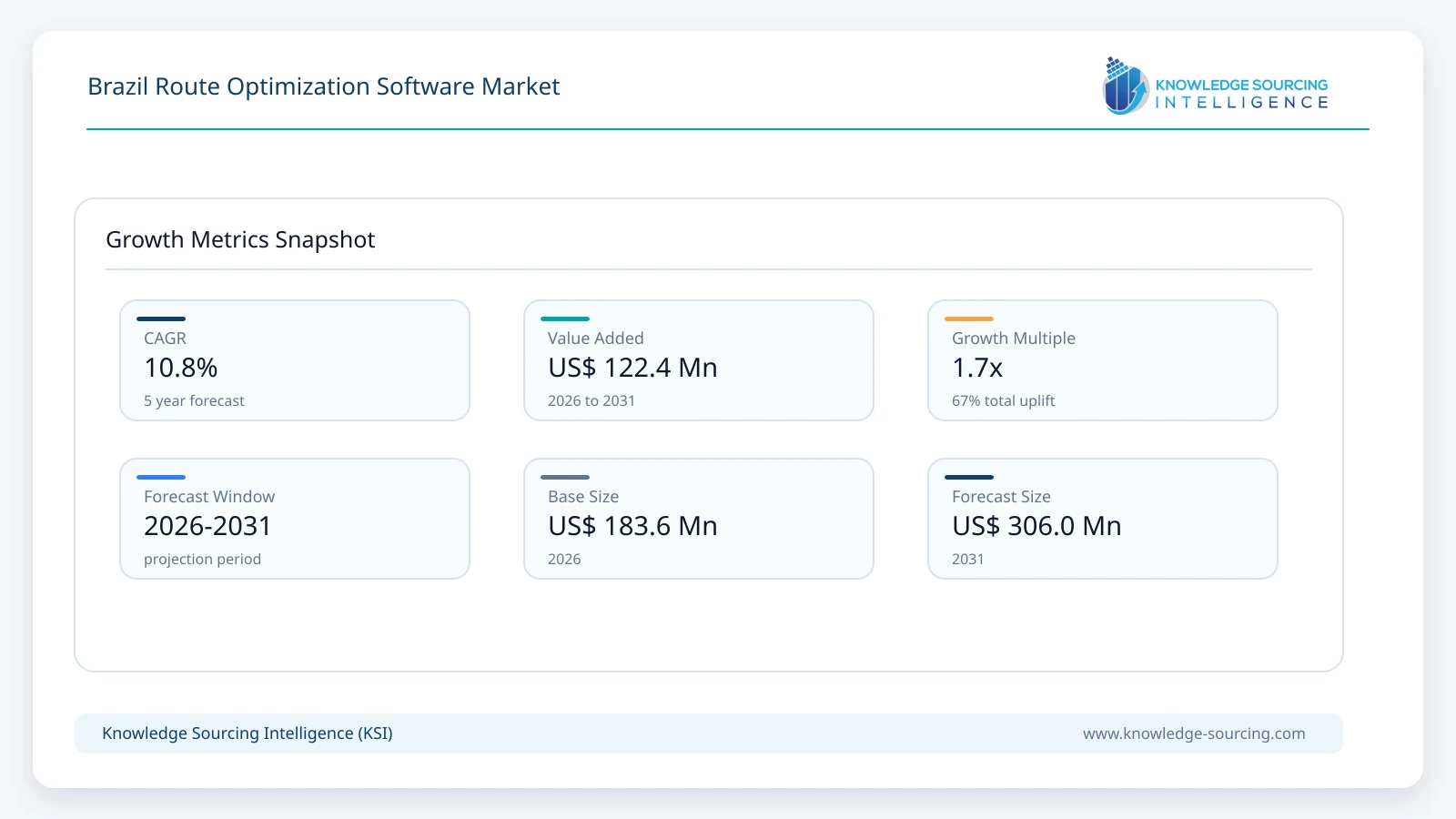
The Brazilian route optimization software market is forecast to grow at a CAGR of 10.8%, reaching USD 306.0 million in 2031 from USD 183.6 million in 2026.
Highlights:
- 1Food delivery and e-commerce logistics remain the primary demand generators for route optimization platforms.
- 2Real-time route planning is becoming a procurement requirement rather than a discretionary software feature.
- 3Urban congestion, delivery-density growth, and same-day fulfillment targets are increasing demand for optimization tools.
- 4Software subscriptions account for a larger share of market value than implementation services.
- 5AI-enabled transportation management systems are expanding route optimization from planning into automated decision support.
- 6Large logistics operators increasingly seek integrated routing, telematics, fleet management, and analytics capabilities.
Commercial adoption is being shaped by the economics of last-mile delivery. Brazil's large geographic footprint, dense metropolitan areas, traffic congestion, and rising consumer expectations for faster deliveries create conditions where route inefficiencies directly affect profitability. Logistics operators increasingly evaluate software investments based on reductions in fuel consumption, driver hours, vehicle utilization rates, failed deliveries, and dispatch complexity rather than on navigation functionality alone.
Competitive pressure within Brazil's e-commerce sector is intensifying logistics requirements. MercadoLibre expanded free-shipping eligibility across most products sold on its Brazilian marketplace during 2025 as competition from Amazon, Shopee, and other platforms increased. Lower shipping thresholds place additional pressure on delivery networks to improve route productivity and control transportation costs.
Delivery speed is becoming a more important purchasing criterion. Amazon launched its ultra-fast Amazon Now grocery service in Brazil in 2026 with delivery targets measured in minutes rather than hours. Such fulfillment models require continuous route recalculation, driver allocation optimization, and high levels of dispatch automation.
Value creation within the market is concentrated in software capabilities that improve operational outcomes. Buyers increasingly evaluate vendors on route accuracy, integration with transportation management systems, telematics compatibility, predictive analytics, real-time visibility, and scalability across large delivery fleets. As deployment maturity increases, software subscriptions, cloud-based delivery models, and recurring analytics services are capturing a larger portion of supplier revenue.
Key Market Indicators
Indicator | Latest Evidence | Commercial Meaning |
Latin American e-commerce sales | US$215.3 billion (2026) | Expanding parcel volumes increase routing and dispatch complexity. |
Share of regional sales from Brazil, Mexico, and Argentina | ~85% (2025) | Brazil remains one of the largest logistics software opportunities in the region. |
Mobile commerce share in Latin America | 84% of purchases (2025) | Higher order frequency increases last-mile delivery requirements. |
MercadoLibre's free-shipping threshold in Brazil | Reduced from R$79 to R$19 (2025) | Greater shipment volumes require improved route productivity. |
Amazon’s investment in Brazil | R$55 billion cumulative investment | Expanding logistics infrastructure increases demand for optimization tools. |
Key Indicator: Brazil remains one of the largest e-commerce logistics markets in Latin America.
Commercial Meaning: Route optimization software increasingly affects delivery economics, customer experience, and network scalability.
Market Drivers
Expansion of e-commerce fulfillment networks.
Brazilian e-commerce operators continue to expand distribution capacity, delivery coverage, and fulfillment speed. Delivery performance has become a competitive differentiator rather than a support function. As parcel volumes rise, route planning shifts from manual dispatch processes toward algorithm-driven optimization capable of managing thousands of daily deliveries. MercadoLibre's shipping initiatives and Amazon's accelerated logistics investments illustrate the growing operational importance of delivery efficiency.
Higher delivery-density requirements in food delivery operations.
Food delivery fleets operate under strict delivery-time constraints and narrow profitability margins. Route optimization platforms help operators improve driver productivity, reduce idle time, and increase delivery density within urban service areas. The economic impact is immediate because a small improvement in deliveries per driver can materially affect platform profitability. This dynamic is encouraging adoption among restaurant delivery aggregators, grocery delivery providers, and dark-store operators.
Growing use of AI within transportation management systems.
Software vendors are increasingly embedding artificial intelligence into transportation workflows. Trimble introduced AI-enabled transportation management capabilities that automate order intake, shipment planning, network balancing, and operational decision-making. These developments expand route optimization from static planning into predictive and adaptive logistics management.
Demand for real-time fleet visibility.
Large fleet operators increasingly require route planning systems that connect with telematics platforms, mobile workforce applications, GPS tracking systems, and enterprise resource planning software. Route optimization software is therefore becoming part of broader transportation management ecosystems. Buyers increasingly prefer vendors capable of providing integrated planning, execution, monitoring, and analytics capabilities rather than standalone routing tools.
Pressure to reduce transportation costs.
Fuel expenditures, labor costs, vehicle maintenance expenses, and fleet utilization rates remain critical operating metrics for logistics providers. Route optimization software enables measurable reductions in travel distance and empty mileage. Trimble's transportation initiatives continue to emphasize network balancing and operational efficiency improvements, reflecting customer demand for cost-control tools.
Market Restraints and Challenges
Complex urban traffic conditions reduce optimization accuracy.
Brazil's largest metropolitan areas present routing environments characterized by congestion variability, traffic incidents, road restrictions, and delivery-access limitations. Software-generated routes often require continuous adjustment during execution. Maintaining route accuracy under dynamic operating conditions increases software complexity and implementation requirements.
Integration with legacy logistics systems.
Many transportation operators continue to rely on fragmented dispatch platforms, spreadsheets, warehouse management systems, and proprietary fleet applications. Integrating route optimization software with existing technology environments frequently increases implementation timelines and project costs. Smaller fleet operators often lack internal technical resources needed for large-scale integration projects.
Limited digital maturity among small fleet operators.
Although large logistics providers increasingly deploy sophisticated transportation technology, adoption among small and medium-sized fleets remains uneven. Many operators continue to prioritize immediate operating costs over long-term efficiency gains. This slows market penetration outside enterprise customer segments.
Data quality and address standardization issues.
Route optimization performance depends on accurate location data, customer information, traffic inputs, and operational constraints. Inconsistent address formats and incomplete delivery information can reduce optimization effectiveness. Similar challenges have been identified across developing-market logistics environments where route-planning algorithms must operate with imperfect location datasets.
Price competition in software procurement.
As cloud deployment expands, buyers increasingly compare vendors based on subscription costs, implementation fees, and return-on-investment metrics. Suppliers face pressure to demonstrate measurable operational savings within relatively short implementation periods. This dynamic is particularly relevant in transportation sectors characterized by thin operating margins.
Major Segment Analysis
Food Delivery
Food delivery represents the most commercially important application segment within the Brazil route optimization software market. The segment combines high transaction frequency, narrow delivery windows, dense urban operating environments, and strong customer sensitivity to delivery delays. These characteristics create direct economic value from route optimization investments.
Procurement priorities differ from those observed in traditional logistics sectors. Food delivery operators prioritize dispatch speed, dynamic route recalculation, driver allocation efficiency, order batching, and delivery-time predictability. Software platforms must process large volumes of orders while continuously adapting to traffic conditions and changing delivery demand patterns.
Competition within this segment increasingly centers on execution quality rather than route calculation alone. Vendors capable of integrating real-time traffic intelligence, driver applications, customer tracking tools, and predictive dispatch capabilities are positioned more favorably than providers offering standalone optimization engines. Performance within food delivery frequently influences broader adoption across grocery delivery, quick-commerce, and urban logistics applications.
Competitive Landscape
The Brazil route optimization software market is moderately fragmented. Competition includes transportation software providers, fleet management vendors, optimization specialists, mapping and geospatial technology companies, and broader transportation management system providers.
Trimble Inc. competes through transportation management platforms, telematics integration, AI-enabled workflows, and connected transportation ecosystems. Recent product development emphasizes automation, predictive planning, and transportation visibility.
ORTEC focuses on advanced optimization algorithms, routing intelligence, and supply-chain planning capabilities. The company's integration of routing and loading functionality within SAP environments reflects growing demand for embedded logistics decision support.
Omnitracs competes through fleet visibility, telematics connectivity, compliance support, and transportation execution capabilities.
Microlise Telematics Pvt. Ltd. emphasizes telematics-driven route optimization, vehicle tracking, and operational analytics.
LLamasoft Inc. participates through network design and logistics optimization capabilities that support transportation planning decisions.
Esri benefits from mapping, spatial analytics, and location-intelligence capabilities that support routing applications.
Competitive differentiation increasingly depends on integration capability, analytics depth, AI functionality, cloud scalability, implementation speed, and the ability to connect routing decisions with broader transportation operations.
Recent Developments
May 2026: Comau signed a binding agreement to acquire Brazilian intralogistics specialist Invent Smart Intralogistics Solutions. The deal expands AI-driven warehouse automation, logistics orchestration, and route-optimization capabilities for high-throughput distribution networks.
March 2026: The Descartes Systems Group strengthened its South American presence by acquiring OrderMine, a provider of e-commerce forecasting and planning tools. This acquisition integrates OrderMine’s predictive analytics with Descartes’ Global Logistics Network, allowing Brazilian retailers to optimize inventory placement and route planning simultaneously to counter rising regional logistics costs.
February 2026: Aptean introduced Paragon Route 360, an AI-native routing and scheduling platform delivering real-time route optimization, predictive analytics, continuous planning, and automated decision-making for logistics and distribution operations.
November 2025: Trimble unveiled AI-powered transportation management innovations, including next-generation TMS capabilities and workflow automation tools. The initiative demonstrates accelerating AI integration across transportation software platforms.
October 2025: ORTEC launched an integrated routing and loading solution embedded within SAP ERP environments. The platform combines route planning and vehicle-loading optimization, addressing demand for unified logistics workflows.
Regulatory and Policy Environment
Brazil's route optimization software market operates within a regulatory framework that includes transportation regulations, labor requirements, data-protection obligations, and digital commerce rules. The country's General Data Protection Law (LGPD) affects the collection and processing of location data, driver information, and customer delivery information used by optimization platforms.
Transportation operators must also comply with fleet-management, driver-hours, and road-transport regulations that influence routing decisions. Software providers increasingly incorporate compliance functionality into route-planning platforms to help customers reduce operational risk.
Government efforts to improve logistics infrastructure, digital connectivity, and freight efficiency indirectly support adoption by increasing transportation volumes and expanding technology use across supply chains. Regulatory emphasis on data governance and operational transparency is expected to increase software requirements during the forecast period.
Outlook and Strategic Implications
Demand during 2026–2031 is expected to be shaped less by basic route planning requirements and more by broader transportation digitization initiatives. Buyers increasingly seek platforms capable of combining routing, dispatch management, telematics, analytics, artificial intelligence, and transportation visibility within a single operating environment.
Several strategic implications are emerging:
Logistics operators are expected to prioritize measurable cost savings and service-level improvements when selecting vendors.
AI-enabled optimization capabilities will become an increasingly important source of competitive differentiation.
Integration with transportation management systems, ERP platforms, and telematics ecosystems will remain a key procurement requirement.
Food delivery, quick commerce, and e-commerce fulfillment operations are likely to remain the most active investment areas.
Vendors capable of supporting both enterprise-scale deployments and mid-market fleet operators may capture broader adoption opportunities.
Market performance through 2031 will depend on delivery-volume growth, logistics digitization rates, transportation cost pressures, and the ability of software providers to convert optimization capabilities into measurable operational outcomes. Organizations that demonstrate quantifiable reductions in delivery costs, fuel consumption, and route inefficiencies are likely to secure stronger competitive positions as logistics networks become increasingly data-driven.
Brazil Route Optimization Software Market Scope:
| Report Metric | Details |
|---|---|
| Total Market Size in 2026 | USD 183.6 million |
| Total Market Size in 2031 | USD 306.0 million |
| Forecast Unit | Million |
| Growth Rate | 10.8% |
| Study Period | 2021 to 2031 |
| Historical Data | 2021 to 2024 |
| Base Year | 2025 |
| Forecast Period | 2026 – 2031 |
| Segmentation | Component, Application |
| Companies |
|
Market Segmentation
By Component
- Software
- Services
By Application
- Food Delivery
- Ride-Hailing Services
- E-Commerce
- Others
Table of Contents
1. INTRODUCTION
1.1. Market Definition
1.2. Market Segmentation
2. RESEARCH METHODOLOGY
2.1. Research Data
2.2. Assumptions
3. EXECUTIVE SUMMARY
3.1. Research Highlights
4. MARKET DYNAMICS
4.1. Market Drivers
4.2. Market Restraints
4.3. Porter’s Five Forces Analysis
4.3.1. Bargaining Power of Suppliers
4.3.2. Bargaining Power of Buyers
4.3.3. Threat of New Entrants
4.3.4. Threat of Substitutes
4.3.5. Competitive Rivalry in the Industry
4.4. Industry Value Chain Analysis
5. BRAZIL ROUTE OPTIMIZATION SOFTWARE MARKET BY COMPONENT
5.1. Introduction
5.2. Software
5.3. Services
6. BRAZIL ROUTE OPTIMIZATION SOFTWARE MARKET BY APPLICATION
6.1. Introduction
6.2. Food Delivery
6.3. Ride-Hailing Services
6.4. E-Commerce
6.5. Others
7. COMPETITIVE ENVIRONMENT AND ANALYSIS
7.1. Major Players and Strategy Analysis
7.2. Emerging Players and Market Lucrativeness
7.3. Mergers, Acquisitions, Agreements, and Collaborations
7.4. Vendor Competitiveness Matrix
8. COMPANY PROFILES
8.1. Trimble Inc.
8.2. ORTEC
8.3. Omnitracs
8.4. Microlise Telematics Pvt. Ltd.
8.5. LLamasoft Inc.
8.6. Esri
Navigate
Trusted by the world's leading organizations











