
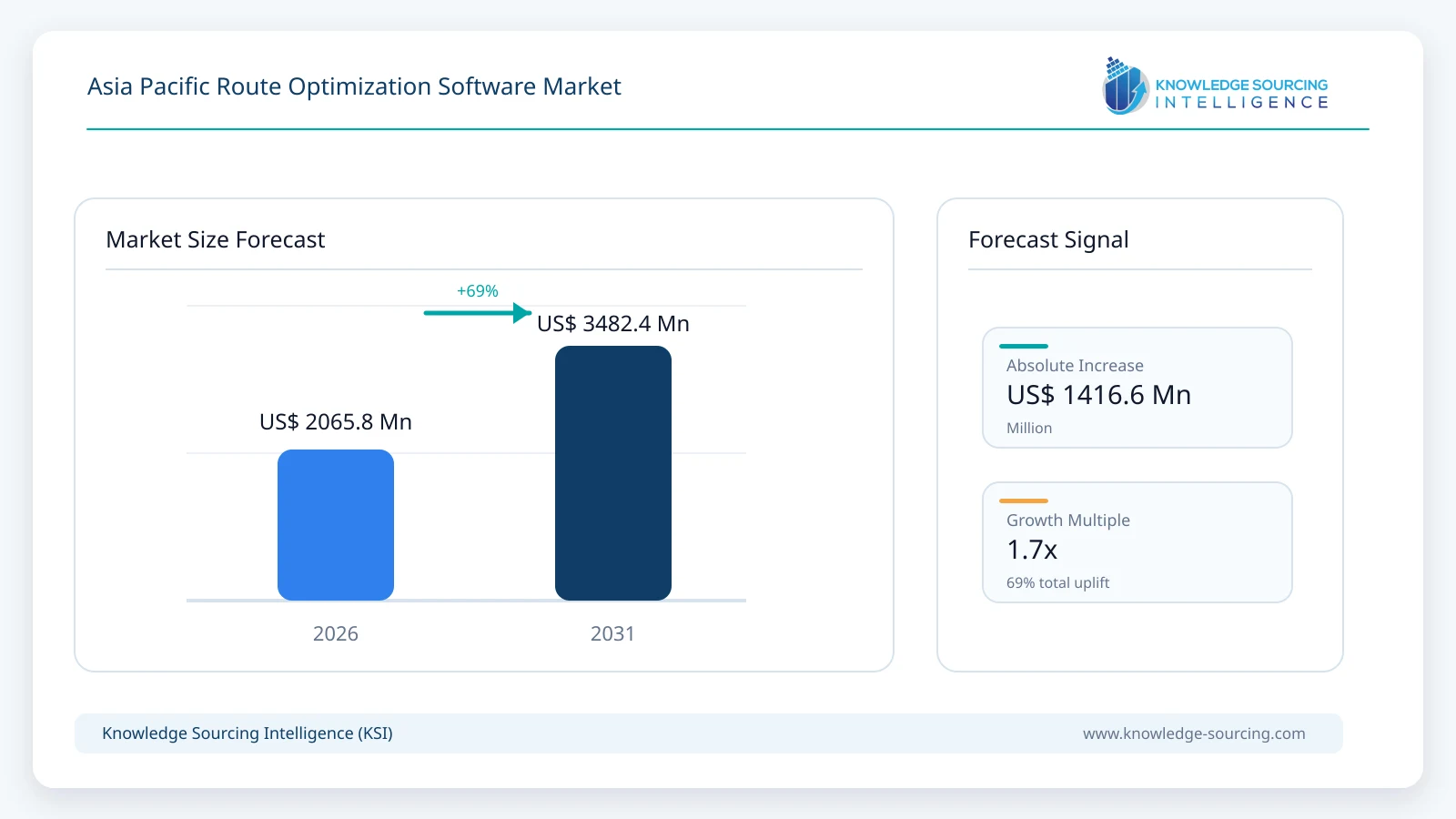
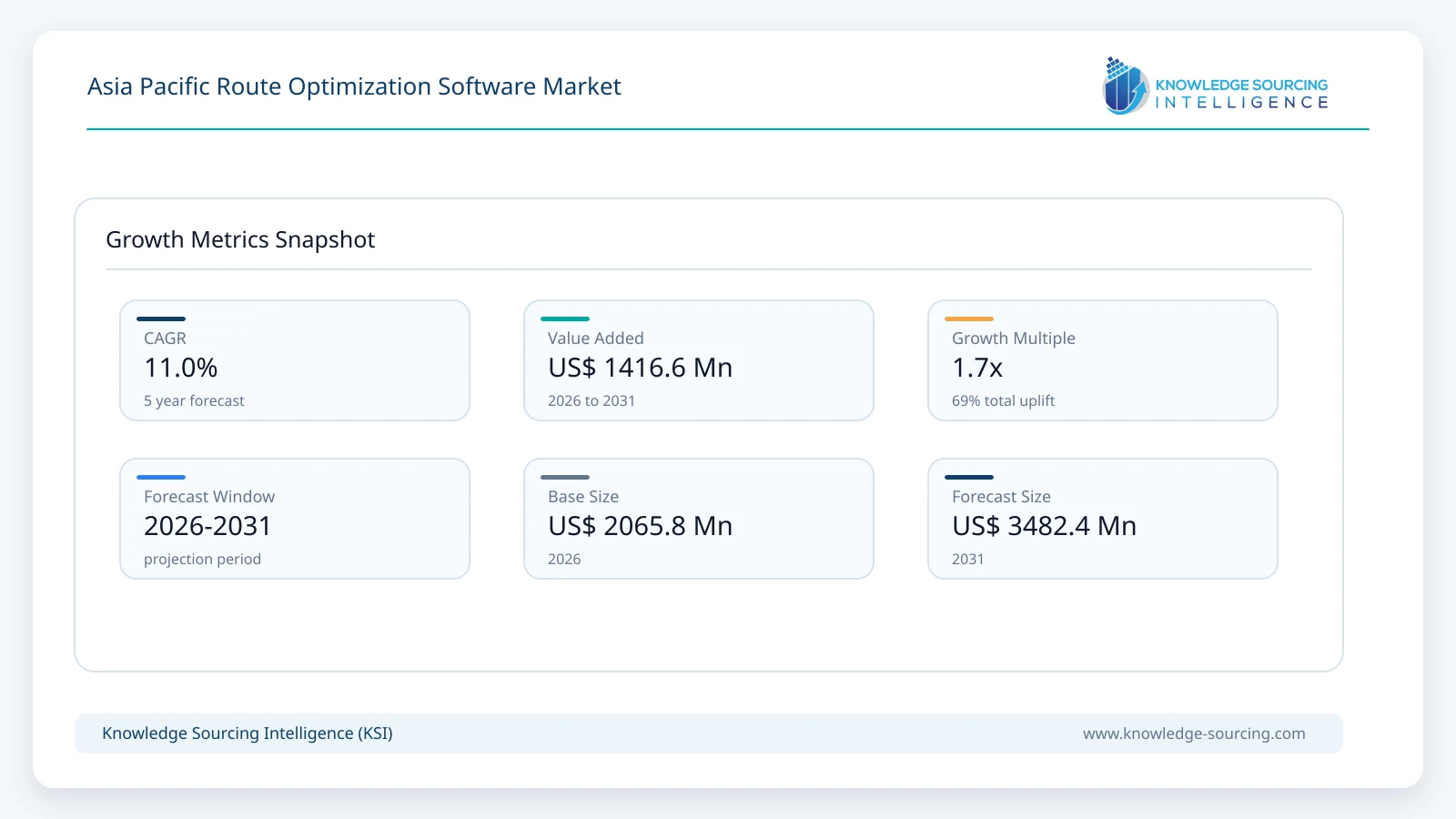
Asia Pacific’s route optimization software market is forecast to grow at a CAGR of 11.0%, reaching USD 3,482.4 million in 2031 from USD 2,065.8 million in 2026.
Highlights:
- 1Cloud-native route optimization platforms are replacing static planning across enterprise logistics networks.
- 2E-commerce fulfillment and last-mile delivery continue to reshape enterprise routing requirements.
- 3AI-enabled dynamic routing is expanding beyond logistics into field service, healthcare, and utilities.
- 4Integration with telematics, transport management systems, and GIS platforms has become a core purchasing criterion.
- 5Localization of mapping data, regulatory compliance, and scalable APIs increasingly influence vendor selection.
Demand increasingly originates from organizations managing complex distribution networks where delivery speed, vehicle utilization, fuel efficiency, and service reliability directly affect operating margins. Rather than purchasing standalone routing applications, buyers are seeking platforms that integrate with transport management systems (TMS), warehouse management systems (WMS), enterprise resource planning (ERP), GPS telematics, and customer communication platforms.
Rapid expansion of regional e-commerce, omnichannel retailing, pharmaceutical distribution, food delivery, and field service operations has increased the commercial value of real-time routing decisions. Static route planning is proving inadequate in urban markets where traffic congestion, delivery density, driver availability, and customer time-window commitments change throughout the day. Software capable of continuously recalculating routes using live traffic, vehicle capacity, weather conditions, and operational constraints has therefore become an important procurement requirement for large enterprises and third-party logistics providers. HERE Technologies' research among Asia Pacific logistics companies also shows that technology integration and software implementation remain among the largest barriers to achieving real-time supply chain visibility, illustrating that buyers increasingly evaluate implementation capability alongside optimization performance.
Competition extends beyond routing algorithms alone. Buyers increasingly compare vendors on mapping accuracy, API availability, geographic coverage, artificial intelligence capabilities, emissions reporting, proof-of-delivery functionality, predictive estimated arrival times, and integration with existing enterprise software. Software providers are responding by expanding cloud deployment, investing in AI-assisted planning, strengthening regional partner ecosystems, and developing industry-specific workflows for transportation, retail, healthcare, manufacturing, utilities, and mobility operators. As digital logistics investment continues across Asia Pacific economies, route optimization software is increasingly positioned as an operational efficiency platform rather than a standalone navigation application.
Key Market Indicators
Indicator | Latest Evidence | Commercial Meaning |
APAC logistics executives citing software integration challenges | 52% | Integration capability has become a critical software selection criterion. |
Companies using fully real-time logistics tracking | 51% | Real-time operational visibility increasingly supports dynamic routing adoption. |
Companies seeking higher customer satisfaction from tracking investments | 48% | Route optimization is increasingly linked with customer experience objectives. |
APAC firms aiming to increase logistics revenue through tracking solutions | 47% | Buyers increasingly justify software investments through commercial returns rather than cost reduction alone. |
APAC firms seeking competitive advantage through logistics visibility | 41% | Route optimization is evolving into a competitive differentiation tool. |
Key indicator: 52% of surveyed Asia Pacific logistics companies identified software integration as a major implementation challenge.
Commercial meaning: Vendors offering standardized APIs and enterprise integration services are likely to improve competitive positioning.
Market Drivers
Expansion of enterprise last-mile delivery operations. Retailers, third-party logistics providers, parcel operators, grocery chains, and healthcare distributors continue expanding same-day and scheduled delivery services throughout Asia Pacific. Larger delivery networks create greater routing complexity, making manual scheduling increasingly impractical. Enterprise buyers therefore seek software capable of balancing delivery windows, vehicle utilization, driver availability, and customer commitments simultaneously. Company deployments illustrate this transition. FarEye reports operational improvements across healthcare providers, retailers, logistics companies, and regional carriers through AI-supported route planning and delivery management solutions, while enterprise customers increasingly require dynamic routing rather than static route sequencing.
Growing reliance on AI-driven operational planning. Route optimization increasingly depends on artificial intelligence to process traffic conditions, historical delivery patterns, vehicle capacity, weather information, and customer preferences simultaneously. Instead of generating one optimal route before dispatch, modern platforms continuously adjust delivery plans throughout daily operations. Industry disclosures show software vendors expanding AI-assisted planning capabilities to improve ETA prediction, fleet utilization, and dispatch decisions. Trimble identifies transportation planning and optimization among the primary applications for AI across freight operations, while HERE Technologies continues expanding enterprise route planning capabilities through strategic partnerships that combine routing intelligence with operational analytics and execution platforms.
Cloud deployment supports enterprise scalability across multiple countries. Large logistics organizations increasingly manage cross-border transportation, multiple warehouses, outsourced fleets, and geographically dispersed operations. Cloud deployment enables centralized software management while supporting local operational customization across countries including China, India, Japan, Australia, Singapore, and Southeast Asian markets. Cloud architecture also shortens software updates, simplifies integration with enterprise applications, and improves access for mobile workforces. Trimble, HERE Technologies, FarEye, and other suppliers continue expanding cloud-based routing services with API connectivity, software subscriptions, and enterprise-scale deployment models that reduce infrastructure dependence compared with conventional on-premises installations.
Increasing emphasis on transport efficiency and sustainability targets. Fleet operators face rising pressure to reduce fuel consumption, improve asset utilization, lower emissions, and maintain delivery reliability despite increasing urban congestion. Route optimization software contributes by minimizing unnecessary mileage, improving vehicle loading efficiency, and supporting electric vehicle routing where charging constraints must be incorporated into delivery schedules. FarEye reports that its optimization platform supports reductions in vehicle miles travelled while enabling enterprise sustainability reporting, whereas commercial routing platforms increasingly include emissions monitoring alongside traditional operational metrics. These capabilities are becoming part of enterprise procurement criteria rather than optional analytical features.
Market Restraints and Challenges
Enterprise integration remains a complex implementation challenge. Large organizations rarely deploy route optimization software as an isolated application. Instead, it must exchange data with enterprise resource planning (ERP), transport management systems (TMS), warehouse management systems (WMS), telematics platforms, mapping services, and customer communication tools. This integration extends implementation timelines and raises project costs, particularly for enterprises operating across multiple countries with heterogeneous IT environments. According to HERE Technologies' Asia Pacific logistics survey, 52% of logistics organizations identified software integration as a major challenge, indicating that deployment capability has become almost as important as optimization performance during vendor evaluation. Vendors are therefore expanding API libraries, integration partnerships, and implementation consulting to reduce deployment complexity.
Dependence on accurate location and mapping data limits routing quality. Route optimization engines rely on high-quality digital maps, road restrictions, address databases, traffic information, and geospatial updates. Data quality varies considerably across Asia Pacific, particularly outside major metropolitan areas where address standardization and road-network updates remain inconsistent. Inaccurate mapping data reduces estimated arrival accuracy, increases rerouting frequency, and weakens customer confidence in automated planning systems. Companies including HERE Technologies and Esri continue investing in location intelligence, real-time map updates, and local geographic datasets to improve routing precision, yet maintaining comprehensive regional coverage remains resource intensive and creates an ongoing operating cost for software providers.
Regulatory and data-governance requirements increase implementation costs. Enterprise customers increasingly require routing platforms to comply with national cybersecurity rules, data localization requirements, and privacy regulations, particularly when cloud deployment spans multiple jurisdictions. Countries across Asia Pacific have introduced varying requirements covering personal data management, cross-border data transfers, and cybersecurity compliance. Software providers must therefore maintain regional cloud infrastructure, strengthen security controls, and adapt products to country-specific legal requirements. These obligations raise development and compliance costs, particularly for smaller vendors seeking regional expansion, while enterprise buyers often extend procurement cycles to evaluate security and regulatory readiness before software deployment.
Shortage of skilled implementation partners affects deployment speed. Successful route optimization projects depend not only on software functionality but also on process redesign, data preparation, system configuration, and user training. Many organizations continue facing shortages of professionals experienced in logistics analytics, enterprise integration, and optimization modelling. Software vendors increasingly address this constraint through certified implementation partners, managed services, and customer success teams. Nevertheless, organizations operating large multi-country distribution networks often require phased deployment programmes that extend implementation schedules before expected operational benefits can be fully realized.
Major Segment Analysis
Cloud-based Deployment
Cloud-based deployment represents the most commercially important deployment model within the Asia Pacific Route Optimization Software Market because enterprises increasingly require centralized fleet visibility, rapid software updates, and scalable computing resources across geographically dispersed operations. Organizations managing transportation, retail distribution, food delivery, healthcare logistics, and field service networks prefer subscription-based platforms that reduce infrastructure investment while supporting mobile access for dispatchers and field personnel. Vendors including FarEye, HERE Technologies, Trimble, and Descartes Systems Group continue strengthening cloud-native offerings with API connectivity, artificial intelligence, and real-time analytics to support increasingly complex routing requirements.
Buyer priorities extend beyond software accessibility. Enterprises evaluate cloud platforms according to cybersecurity capabilities, system availability, integration with ERP, TMS, telematics, and warehouse management systems, together with regional data-hosting options that satisfy local compliance requirements. Although on-premises deployment remains relevant for organizations operating under strict internal security policies or legacy infrastructure, cloud deployment increasingly aligns with enterprise demand for continuous feature updates, lower maintenance requirements, and scalable computing performance. As vendors expand software-as-a-service business models across Asia Pacific, cloud deployment continues influencing product design, implementation services, recurring revenue generation, and long-term customer retention.
Regional Analysis
Country | Primary Demand Signal | Principal Constraint |
Japan | Mature logistics sector, ageing workforce, automation investment | Legacy enterprise systems |
China | Large-scale e-commerce and digital logistics networks | Data governance and cybersecurity requirements |
India | Rapid expansion of organized logistics and e-commerce | Infrastructure variability across regions |
Australia | Long-distance freight operations and fleet efficiency priorities | High operating costs across dispersed routes |
Indonesia | Growth of urban delivery and island logistics | Geographic fragmentation |
Taiwan | Advanced manufacturing and export-oriented supply chains | Limited domestic market scale |
Thailand | Automotive manufacturing and regional distribution hubs | Cross-border logistics complexity |
South Korea | Smart logistics investment and digital supply chains | Highly competitive technology market |
Singapore | Regional logistics hub and advanced port connectivity | Limited domestic demand base |
Japan continues investing in logistics automation as transport operators respond to labour shortages, rising delivery expectations, and an ageing driver workforce. Route optimization platforms are increasingly deployed alongside warehouse automation, telematics, and transport management systems to improve fleet utilization while supporting stricter delivery schedules. Buyers typically prioritize reliability, enterprise integration, and operational continuity over rapid feature expansion.
China remains one of the region's most important markets because of its extensive e-commerce ecosystem, large delivery fleets, and continuous investment in digital logistics infrastructure. Demand increasingly focuses on AI-assisted route planning, real-time dispatch, and integrated fleet management. At the same time, cybersecurity legislation and data governance requirements influence deployment strategies, encouraging vendors to strengthen localized cloud infrastructure and compliance capabilities.
India is experiencing wider adoption across transportation and logistics, retail, food delivery, healthcare distribution, and field service management as enterprises digitize fleet operations. Expanding express delivery networks, increasing GPS-enabled fleet management, and government initiatives supporting logistics modernization encourage investment in routing software. Infrastructure quality and traffic variability across different states, however, require highly adaptive routing algorithms capable of responding to changing operating conditions.
Australia's commercial demand is shaped by long-distance freight transportation, mining support logistics, utilities, and national retail distribution. Fleet operators emphasize fuel efficiency, route planning accuracy, and vehicle utilization to control operating costs across large geographic areas. Indonesia and Thailand continue benefiting from expanding e-commerce fulfillment and manufacturing activity, although fragmented transport infrastructure and complex regional distribution networks increase planning complexity.
Taiwan supports demand through its advanced manufacturing sector and export-oriented supply chains, where efficient transportation planning contributes to production scheduling and inventory management. South Korea continues investing in digital logistics technologies that complement its advanced industrial base and urban delivery networks. Singapore, despite its relatively small domestic market, remains commercially important because multinational logistics providers, regional headquarters, and technology vendors frequently use the country as a base for Asia Pacific logistics operations and software deployment.
Competitive Landscape
Competition in the Asia Pacific route optimization software market is technology-led and service-intensive, with vendors competing through routing accuracy, AI capabilities, enterprise integration, mapping intelligence, and implementation expertise rather than price alone. Large enterprise customers generally prefer suppliers that can support complex multi-country deployments, integrate with existing ERP, TMS, WMS, and telematics platforms, and provide ongoing technical support throughout implementation and operation.
Trimble Inc., Descartes Systems Group, HERE Technologies, PTV Logistics (PTV Group), Esri, ORTEC, FarEye, Caliper Corporation, and Route4Me compete across different customer segments and deployment models. Established enterprise software providers continue expanding cloud-native platforms, AI-assisted route planning, predictive ETA capabilities, and API ecosystems. Several vendors are strengthening regional partner networks and managed implementation services to reduce deployment complexity, while investments in location intelligence, sustainability reporting, and real-time fleet visibility are becoming important competitive differentiators. The market also presents moderate barriers to entry because enterprise buyers place considerable emphasis on software reliability, implementation experience, mapping quality, cybersecurity compliance, and long-term vendor support, creating relatively high switching costs once routing platforms become integrated into daily operations.
Recent Developments
August 2026: Ryde partnered with HERE Technologies in Singapore, integrating AI-powered routing and real-time traffic intelligence to improve driver dispatch, routing accuracy, ETA predictions, and navigation efficiency.
May 2026: HERE Technologies launched HERE Last Meter Guidance in beta, extending route optimization with AI-powered guidance from optimal parking locations to final delivery handoffs for logistics operators.
April 2026: PTV Logistics announced a global partner program, enabling technology partners to integrate mapping, ETA prediction, and route-optimization APIs into transportation and logistics software platforms.
April 2026: FarEye launched PILOT, an autonomous AI dispatcher that streamlines route planning, driver assignment, delivery exception management, and invoice reconciliation, improving last-mile delivery productivity for enterprise fleets across Asia-Pacific markets.
May 2025: Log-hub and KNIME launched the Route Optimization Cockpit for automated route planning, interactive dashboards, and centralized operational KPIs across regional transportation networks.
Regulatory and Policy Environment
Government policy increasingly influences software procurement decisions across the Asia Pacific route optimization software market through cybersecurity legislation, digital infrastructure programmes, intelligent transport initiatives, and environmental regulations. Rather than regulating routing software directly, governments are establishing broader digital frameworks that shape how enterprise software is developed, deployed, and operated.
China's Cybersecurity Law, Data Security Law, and Personal Information Protection Law (PIPL) require organizations handling sensitive operational and personal data to comply with strict data governance and security obligations. These regulations have encouraged software providers serving Chinese customers to strengthen local hosting capabilities, cybersecurity controls, and regulatory compliance procedures.
India continues implementing digital logistics reforms through the National Logistics Policy, PM Gati Shakti National Master Plan, and logistics digitalization initiatives designed to improve multimodal connectivity and supply-chain efficiency. These programmes encourage wider adoption of digital fleet management, transport planning, and logistics optimization solutions across public and private sectors.
Japan promotes logistics digitalization through initiatives supporting supply-chain resilience, intelligent transport systems, and workforce productivity. The country's ageing driver population has also increased policy attention toward operational efficiency technologies that reduce manual planning and improve vehicle utilization.
Australia's Privacy Act, alongside evolving cybersecurity requirements, places increasing emphasis on enterprise data protection for cloud-based software providers. Singapore maintains one of the region's most mature digital governance environments through the Personal Data Protection Act (PDPA) and national Smart Nation initiatives, supporting enterprise adoption while maintaining clear compliance expectations. South Korea, Taiwan, Thailand, and Indonesia have also strengthened digital governance frameworks covering cybersecurity, personal information protection, and electronic transactions, requiring multinational software providers to adapt products to varying national compliance requirements.
Although regulatory requirements differ across jurisdictions, common procurement priorities are emerging throughout the region. Enterprise buyers increasingly evaluate software vendors according to cybersecurity certification, cloud security architecture, data residency options, audit capability, and regulatory compliance before approving large-scale deployments.
Outlook and Strategic Implications
Demand during the 2026–2031 forecast period is expected to shift from standalone route planning toward integrated operational decision platforms capable of supporting transportation management, field service operations, omnichannel fulfillment, healthcare distribution, and urban mobility. Artificial intelligence will increasingly optimize routing decisions using live traffic conditions, vehicle telemetry, customer delivery windows, historical operating patterns, and predictive demand information rather than relying on static route calculations.
Cloud deployment will remain the preferred implementation model for most new enterprise projects because it supports centralized management, continuous software updates, scalable computing capacity, and easier integration with broader digital supply-chain platforms. At the same time, vendors will need to invest further in cybersecurity, local data hosting, API standardization, and implementation services as enterprise customers place greater emphasis on regulatory compliance and deployment reliability.
Commercial competition is also expected to broaden beyond routing performance. Buyers increasingly evaluate total operational value, including integration effort, implementation speed, sustainability reporting, predictive analytics, and post-deployment support. Vendors capable of combining route optimization with transport management, geospatial intelligence, customer communication, and fleet analytics are likely to strengthen customer retention through deeper integration into enterprise operations.
Strategic priorities across the value chain are expected to include:
Software vendors: Expand AI-enabled optimization, strengthen regional cloud infrastructure, improve API interoperability, and invest in implementation services.
Enterprise customers: Prioritize platforms that integrate with existing logistics systems while supporting regulatory compliance and long-term scalability.
Logistics providers and distributors: Increase investment in dynamic routing to improve fleet utilization, delivery reliability, and operating cost control.
Technology partners and system integrators: Expand consulting, deployment, and managed services as implementation complexity grows across multi-country enterprise projects.
The Asia Pacific Route Optimization Software Market is therefore expected to remain driven by enterprise operational efficiency rather than navigation functionality alone. Organizations increasingly view route optimization as a strategic software capability that improves asset utilization, strengthens customer service, supports sustainability objectives, and enables more resilient logistics operations across increasingly complex regional supply chains.
Asia Pacific Route Optimization Software Market Scope:
| Report Metric | Details |
|---|---|
| Total Market Size in 2026 | USD 2,065.8 million |
| Total Market Size in 2031 | USD 3,482.4 million |
| Forecast Unit | Million |
| Growth Rate | 11.0% |
| Study Period | 2021 to 2031 |
| Historical Data | 2021 to 2024 |
| Base Year | 2025 |
| Forecast Period | 2026 – 2031 |
| Segmentation | Solution, Deployment Type, Industry Vertical, Country |
| Companies |
|
Market Segmentation
By Solution
Software
Services
By Deployment Type
Cloud-based
On-premises
By Industry Vertical
Transportation and Logistics
Retail and E-Commerce
Food and Beverage Delivery
Field Service Management
Manufacturing
Healthcare and Pharmaceuticals
Utilities
Ride-Hailing and Mobility Services
Others
By Country
Japan
China
India
Australia
Indonesia
Taiwan
Thailand
South Korea
Singapore
Others
Table of Contents
1. Introduction
1.1. Market Definition
1.2. Market Segmentation
2. Research Methodology
2.1. Research Data
2.2. Assumptions
3. Executive Summary
3.1. Research Highlights
4. Market Dynamics
4.1. Market Drivers
4.2. Market Restraints
4.3. Porter’s Five Forces Analysis
4.3.1. Bargaining Power of End-Users
4.3.2. Bargaining Power of Buyers
4.3.3. Threat of New Entrants
4.3.4. Threat of Substitutes
4.3.5. Competitive Rivalry in the Industry
4.4. Industry Value Chain Analysis
5. Asia Pacific Route Optimization Software Market Analysis, by Solution
5.1. Introduction
5.2. Software
5.3. Services
6. Asia Pacific Route Optimization Software Market Analysis, by Deployment Type
6.1. Introduction
6.2. Cloud-based
6.3. On-premises
7. Asia Pacific Route Optimization Software Market Analysis, by Industry Vertical
7.1. Introduction
7.2. Transportation and Logistics
7.3. Retail and E-Commerce
7.4. Food and Beverage Delivery
7.5. Field Service Management
7.6. Manufacturing
7.7. Healthcare and Pharmaceuticals
7.8. Utilities
7.9. Ride-Hailing and Mobility Services
7.10. Others
8. Asia Pacific Route Optimization Software Market Analysis, by Country
8.1. Introduction
8.2. Japan
8.3. China
8.4. India
8.5. Australia
8.6. Indonesia
8.7. Taiwan
8.8. Thailand
8.9. South Korea
8.10. Singapore
8.11. Others
9. Competitive Environment and Analysis
9.1. Major Players and Strategy Analysis
9.2. Emerging Players and Market Lucrativeness
9.3. Mergers, Acquisitions, Agreements, and Collaborations
9.4. Vendor Competitiveness Matrix
10. Company Profiles
10.1. Trimble Inc.
10.2. Caliper Corporation
10.3. Ortec
10.4. Descartes Systems Group
10.5. PTV Logistics (PTV Group)
10.6. FarEye
10.7. Esri
10.9. HERE TechnologiesList of FiguresList of Tables
Navigate
Trusted by the world's leading organizations











