
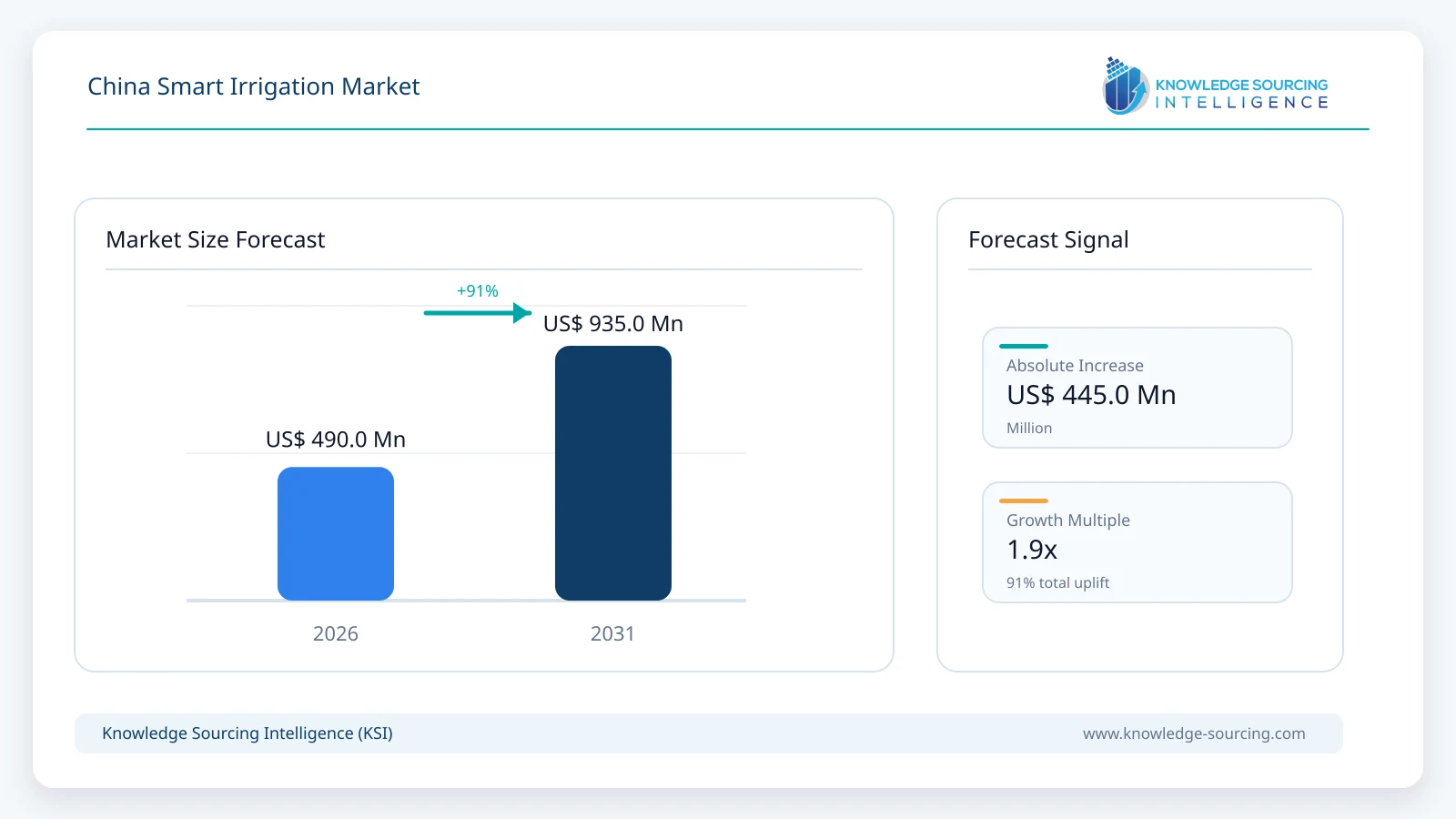
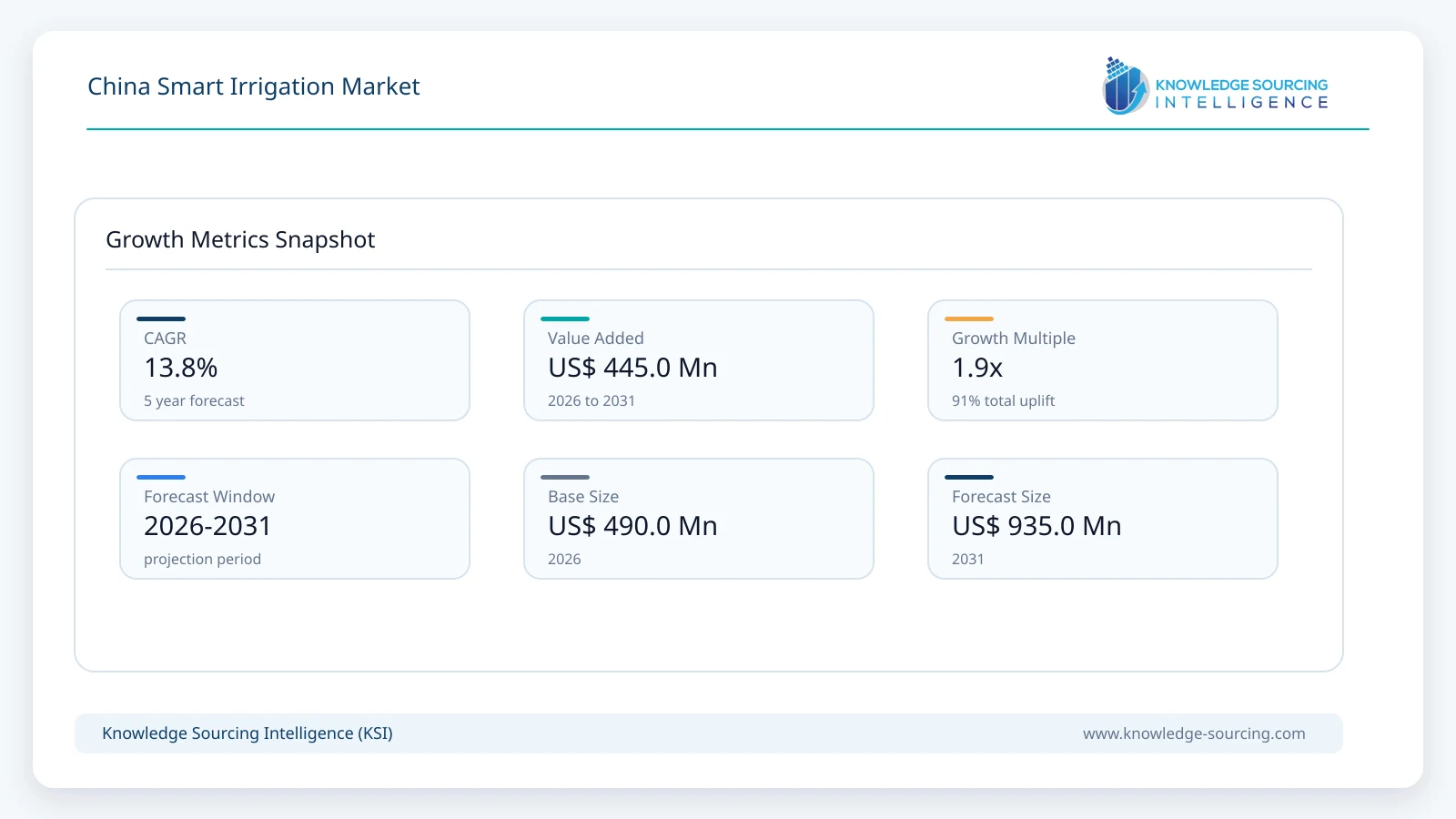
The China smart irrigation market is projected to expand at a CAGR of 13.8%, increasing from USD 490.0 million in 2026 to USD 935.0 million by 2031.
Highlights:
- 1Hardware accounts for about 67% of 2026 revenue, led by controllers and sensors.
- 2Software is projected to grow about 18.0% annually as cloud-based control expands.
- 3Open-field agriculture generates roughly USD 343.0 million of market value in 2026.
- 4Greenhouse and protected agriculture is projected to grow around 17.5% annually through 2031.
- 5Drip and micro-irrigation represent about 58% of smart-irrigation revenue in 2026.
- 6North and Northwest China account for approximately 44% of national market revenue in 2026.
Market Overview
China has one of the world's largest irrigation systems, but the smart-irrigation layer remains much smaller than the underlying physical infrastructure. The 2025 China Water Resources Bulletin reported agricultural water use of 368.38 billion cubic metres and a national farmland irrigation-water utilization coefficient of 0.583. More than 1 billion mu of high-standard farmland had been completed by 2025, while the 2030 policy target is 1.35 billion mu. The same plan calls for 80 million mu of additional high-efficiency water-saving irrigation by 2030. These programs create the physical base into which smart monitoring, automated control and fertigation technologies can be added.
The adoption path is increasingly policy-led. China's National Smart Agriculture Action Plan calls for smart water-fertilizer control facilities, soil-moisture monitoring, field meteorological networks and digital farm management. The September 2026 Digital Village High-Quality Development Action Plan extends that direction through 2030 and specifically promotes digital upgrading of irrigation infrastructure, agricultural sensors and smart-farm applications. A separate September 2026 digital-green development plan calls for IoT-based soil-moisture monitoring and intelligent water-saving irrigation.
Commercial demand is split between large-field agriculture and higher-value protected cultivation. Open-field systems typically use soil-moisture sensors, flow and pressure monitoring, automated valves, remote pump control, and connected fertigation at relatively low cost per mu. Greenhouses, orchards and specialty crops use denser sensing, nutrient dosing, climate integration and more sophisticated automation, producing materially higher equipment value per unit of cultivated area.
Public project data illustrate the range. A 2026 Hainan demonstration budgeted RMB 190,000 for smart fertigation equipment across 265 mu, partly reusing existing infrastructure. A Sichuan project budgeted RMB 3,334 per mu for full water-fertilizer integration, while Shanghai protected-vegetable projects allocated roughly RMB 0.6-1.0 million for irrigation and fertigation systems serving about 100-200 mu, with separate automation expenditure in several cases. These projects are not directly comparable, but they show why one national per-mu cost cannot be applied uniformly.
Market Trends
Smart Fertigation Is Moving From Horticulture Into Large-Field Grain Production
Water-fertilizer integration has become one of the main channels through which smart irrigation is expanding beyond greenhouses and orchards. The Ministry of Agriculture and Rural Affairs reported that the area of corn and wheat water-fertilizer integration increased by more than 20 million mu in 2025. By the end of 2025, water-fertilizer integration across grain and oil crops exceeded 88 million mu. In May 2026, the ministry set a target for state-farm systems to reach about 30 million mu of water-fertilizer integration by the end of 2027, with explicit emphasis on intelligent operation and precise water and nutrient control.
Sensor Networks Are Expanding Beyond Individual Farms
Soil-moisture monitoring is becoming a networked agricultural service rather than only a farm-level device purchase. The national agricultural extension system reported more than 3,500 automatic soil-moisture monitoring stations connected to a national platform by 2026, together with an AI model capable of producing soil-moisture forecasts up to 10 days ahead. Provincial procurement is also expanding. Shanxi's 2025 maintenance program covered hundreds of automatic monitoring devices, while Taiyuan procured multi-point soil-moisture monitoring stations in late 2025. This supports recurring demand for sensors, communications, calibration and data services.
Hybrid Control Is Replacing Timer-Only Irrigation
The fastest technology shift is toward systems that combine field sensors, weather data and crop-stage models. Sensor-only control remains the largest installed approach, but hybrid systems reduce false irrigation events caused by relying on one signal. Recent smart-farm projects in Xinjiang combine soil moisture, crop growth, weather, irrigation valves, fertigation equipment and decision models within a common visual platform. The commercial value is moving from individual devices toward integrated control logic and software.
Market Drivers
High-Standard Farmland Investment Creates a Large Upgrade Base
China completed construction or renovation of 75.68 million mu of high-standard farmland in 2025, taking the national total above 1 billion mu. The 2030 target of 1.35 billion mu, together with 80 million mu of additional high-efficiency water-saving irrigation, keeps irrigation modernization embedded in national farmland investment. Importantly, the implementation plan encourages farm operators to add water-fertilizer integration, intelligent irrigation, automatic soil-moisture and pest monitoring, and smart weather services where conditions permit. This creates a retrofit market on top of the underlying civil and hydraulic works.
Water Productivity Remains a Structural Agricultural Constraint
Agriculture represented 62% of China's water use in 2025. The national farmland irrigation-water utilization coefficient improved to 0.583, but efficiency remains materially below a theoretical closed-system benchmark because conveyance, evaporation, field application and timing losses persist. Smart irrigation does not replace physical water-saving infrastructure, but it improves the timing, measurement and control of water delivered through that infrastructure. The value proposition is strongest in water-stressed areas where groundwater quotas, water rights, crop economics and pumping costs create a direct incentive to reduce unnecessary irrigation.
Market Restraint
Low-Cost Conventional Irrigation and Fragmented Farm Economics Limit Penetration
The principal constraint is economic rather than technological. Basic drip tape, sprinklers, and manual fertigation can provide large water savings without the additional cost of sensors, telemetry, controllers, and software. For small or fragmented farms, the incremental benefit of automation may not justify the capital outlay unless equipment is shared through cooperatives, state farms or agricultural-service providers. Smart systems also introduce maintenance requirements for probes, communications, valves and software. Government-backed projects reduce the upfront barrier, but adoption remains concentrated in larger farms, high-value crops, protected agriculture and water-constrained regions.
Segment Analysis
By Component - Hardware and Software
Hardware remains the largest component category because every connected installation requires physical controllers, gateways, sensors, meters, valves, or actuator interfaces. The category is projected to approach USD 580 million by 2031 as deployment expands across farms and irrigation district interfaces. Software is growing faster because multi-farm monitoring, remote control, alert management, crop models, and irrigation scheduling are increasingly delivered through cloud platforms. Software also has a recurring revenue profile that is less dependent on replacement cycles for physical devices.
By Control Approach - Sensor-Based and Hybrid Systems
Sensor-based closed-loop irrigation remains the largest control approach because soil moisture, flow, pressure and climate data provide a direct basis for irrigation decisions. Hybrid systems that combine sensor readings with weather data, crop-stage models and AI-based recommendations are expanding faster. Their adoption is being supported by smart-farm demonstration projects in which irrigation, fertigation, field sensing and crop models are managed through one platform.
By Irrigation Method - Drip and Micro-Irrigation
Drip and micro-irrigation form the largest smart-enabled irrigation method because digital control can be added to pressure-regulated networks, filters, pumps, fertigation equipment and field valves with comparatively high precision. Connected sprinkler and pivot systems are expected to grow faster in percentage terms, particularly in large-scale grain and forage operations in northern and northeastern regions where automated field coverage and remote control reduce labour requirements.
By Application - Open-Field and Protected Agriculture
Open-field agriculture remains the largest application because the addressable irrigated area is substantially larger than the greenhouse base. Digital control is being adopted across maize, wheat, cotton, potatoes, orchards and other crops where water and fertilizer management affect yield. Greenhouse and protected agriculture is growing faster because higher crop value supports denser sensing, nutrient dosing, automated valves and integration with climate-control systems. The technology intensity per mu is therefore materially higher than in broad-acre agriculture.
By Region - North and Northwest China
North and Northwest China remain the principal demand center because water scarcity, irrigated acreage and large-scale water-saving projects are concentrated in Xinjiang, Inner Mongolia, Gansu, Ningxia, Shanxi and parts of Hebei. Northwest China also accounted for 16.6% of Top Cloud-agri's 2025 revenue, while Dayu Water-saving reported more than RMB 1.19 billion of revenue from Northwest China across its broader agricultural-water business. East China is a major secondary market because of protected agriculture, higher technology intensity and strong digital-agriculture procurement in provinces such as Zhejiang, Jiangsu and Shanghai.
Competitive Environment
The competitive landscape is fragmented across irrigation manufacturers, agricultural-IoT companies, water-engineering groups and specialist software providers. Dayu Water-saving Group is one of the largest domestic agricultural-water companies. Its 2025 revenue included RMB 636.8 million from agricultural-water technology sales and services and RMB 487.7 million from agricultural-water information and project-operation services, in addition to project construction and design. Only the smart-irrigation portion of those categories is included in this market estimate. Xinjiang Tianye Water Saving Irrigation System generated RMB 848.4 million of operating revenue in 2025, but much of that revenue came from conventional project construction, trading and pipe products and is therefore outside the smart-irrigation scope.
Zhejiang Top Cloud-agri generated RMB 510.6 million of 2025 revenue from the broader smart-agriculture industry, including RMB 352.1 million from smart-agriculture projects and RMB 150.5 million from intelligent hardware. Its product range spans sensing, monitoring and farm-control applications rather than irrigation alone. Jiangsu Huayuan Water Saving has scale in hose-reel, center-pivot and fertigation equipment, while smaller Chinese suppliers compete in controllers, valves, fertigation units and micro-irrigation hardware. International companies such as Netafim, Rivulis, Rain Bird, Hunter, Toro, Valmont and Lindsay compete mainly in higher-value system engineering, connected controls, specialty crops, landscape irrigation and large-field mechanized irrigation.
Competition is increasingly determined by integration rather than individual component price. A complete smart-irrigation project may require field sensing, communications, hydraulic design, pump and valve control, fertigation, cloud software and agronomic calibration. Companies with installation capability and recurring operation support are better positioned in large projects than suppliers selling stand-alone sensors or controllers.
Recent Developments
September 2026: China issued the Digital Village High-Quality Development Action Plan for 2026-2030, including digital upgrading of irrigation infrastructure and wider smart-agriculture deployment.
September 2026: A national digital-green transition plan called for IoT soil-moisture monitoring and intelligent water-saving irrigation in agricultural production.
July 2026: Xinjiang awarded AI-plus smart-farm projects that integrate irrigation valves, fertigation equipment, soil monitoring and decision models for maize and cotton production.
May 2026: The Ministry of Agriculture and Rural Affairs targeted about 30 million mu of water-fertilizer integration across state-farm systems by the end of 2027.
March 2026: Smart spring-farming demonstrations in Jiangsu showed AI-assisted irrigation and fertilization across more than 3,800 mu of digitally managed farmland.
China Smart Irrigation Market Scope:
| Report Metric | Details |
|---|---|
| Total Market Size in 2026 | USD 490.0 million |
| Total Market Size in 2031 | USD 935.0 million |
| Forecast Unit | Million |
| Growth Rate | 13.8% |
| Study Period | 2021 to 2031 |
| Historical Data | 2021 to 2024 |
| Base Year | 2025 |
| Forecast Period | 2026 – 2031 |
| Segmentation | Component, Control Approach, Irrigation Method, Application |
| Companies |
|
Market Segmentation
By Component
Hardware
Software
Services
By Control Approach
Sensor-Based Closed-Loop Systems
Weather-Based Systems
Hybrid Sensor, Weather and Model-Based Systems
By Irrigation Method
Drip and Micro-Irrigation
Sprinkler and Pivot Irrigation
Surface and Other Irrigation
By Application
Open-Field Agriculture
Greenhouse and Protected Agriculture
Landscape, Turf and Commercial Irrigation
Others
By Region
North and Northwest China
East China
Central and South China
Northeast China
Southwest China
Table of Contents
1. EXECUTIVE SUMMARY
2. MARKET SNAPSHOT
2.1. Market Overview
2.2. Market Definition
2.3. Market Segmentation
3. BUSINESS LANDSCAPE
3.1. Market Drivers
3.1.1. High-Standard Farmland Investment Creates a Large Upgrade Base
3.1.2. Water Productivity Remains a Structural Agricultural Constraint
3.2. Market Restraint
3.2.1. Low-Cost Conventional Irrigation and Fragmented Farm Economics Limit Penetration
3.3. Market Opportunities
3.4. Porter's Five Forces Analysis
3.5. Industry Value Chain Analysis
3.6. Policies and Regulations
3.7. Strategic Recommendations
4. TECHNOLOGICAL OUTLOOK
4.1. Soil-Moisture and Multi-Parameter Sensors
4.2. Smart Fertigation and Nutrient Dosing
4.3. Hybrid Weather and Sensor-Based Control
4.4. Cloud Platforms, AI and Remote Irrigation Management
5. CHINA SMART IRRIGATION MARKET BY COMPONENT
5.1. Introduction
5.2. Hardware
5.3. Software
5.4. Services
6. CHINA SMART IRRIGATION MARKET BY CONTROL APPROACH
6.1. Introduction
6.2. Sensor-Based Closed-Loop Systems
6.3. Weather-Based Systems
6.4. Hybrid Sensor, Weather and Model-Based Systems
7. CHINA SMART IRRIGATION MARKET BY IRRIGATION METHOD
7.1. Introduction
7.2. Drip and Micro-Irrigation
7.3. Sprinkler and Pivot Irrigation
7.4. Surface and Other Irrigation
8. CHINA SMART IRRIGATION MARKET BY APPLICATION
8.1. Introduction
8.2. Open-Field Agriculture
8.3. Greenhouse and Protected Agriculture
8.4. Landscape, Turf and Commercial Irrigation
8.5. Others
9. CHINA SMART IRRIGATION MARKET BY REGION
9.1. Introduction
9.2. North and Northwest China
9.3. East China
9.4. Central and South China
9.5. Northeast China
9.6. Southwest China
10. COMPETITIVE ENVIRONMENT AND ANALYSIS
10.1. Major Players and Strategy Analysis
10.2. Market Share Analysis
10.3. Mergers, Acquisitions, Agreements and Collaborations
10.4. Competitive Dashboard
11. COMPANY PROFILES
11.1. Dayu Water-saving Group Co., Ltd.
11.2. Xinjiang Tianye Water Saving Irrigation System Company Limited
11.3. Zhejiang Top Cloud-agri Technology Co., Ltd.
11.4. Jiangsu Huayuan Water Saving Co., Ltd.
11.5. Shandong Yibiyuan Water-Saving Irrigation Technology Co., Ltd.
11.6. Ningbo EZ Irrigation Technology Co., Ltd.
11.7. Xiamen Milesight IoT Co., Ltd.
11.8. Netafim Ltd.
11.9. Rivulis Irrigation Ltd.
11.10. Rain Bird Corporation
11.11. Hunter Industries, Inc.
11.12. The Toro Company
11.13. Valmont Industries, Inc.
11.14. Lindsay Corporation
11.15. Jain Irrigation Systems Ltd.
12. APPENDIX
12.1. Currency
12.2. Assumptions
12.3. Base and Forecast Years Timeline
12.4. Key Benefits for Stakeholders
12.5. Research Methodology
12.6. Abbreviations
Navigate
Trusted by the world's leading organizations











