
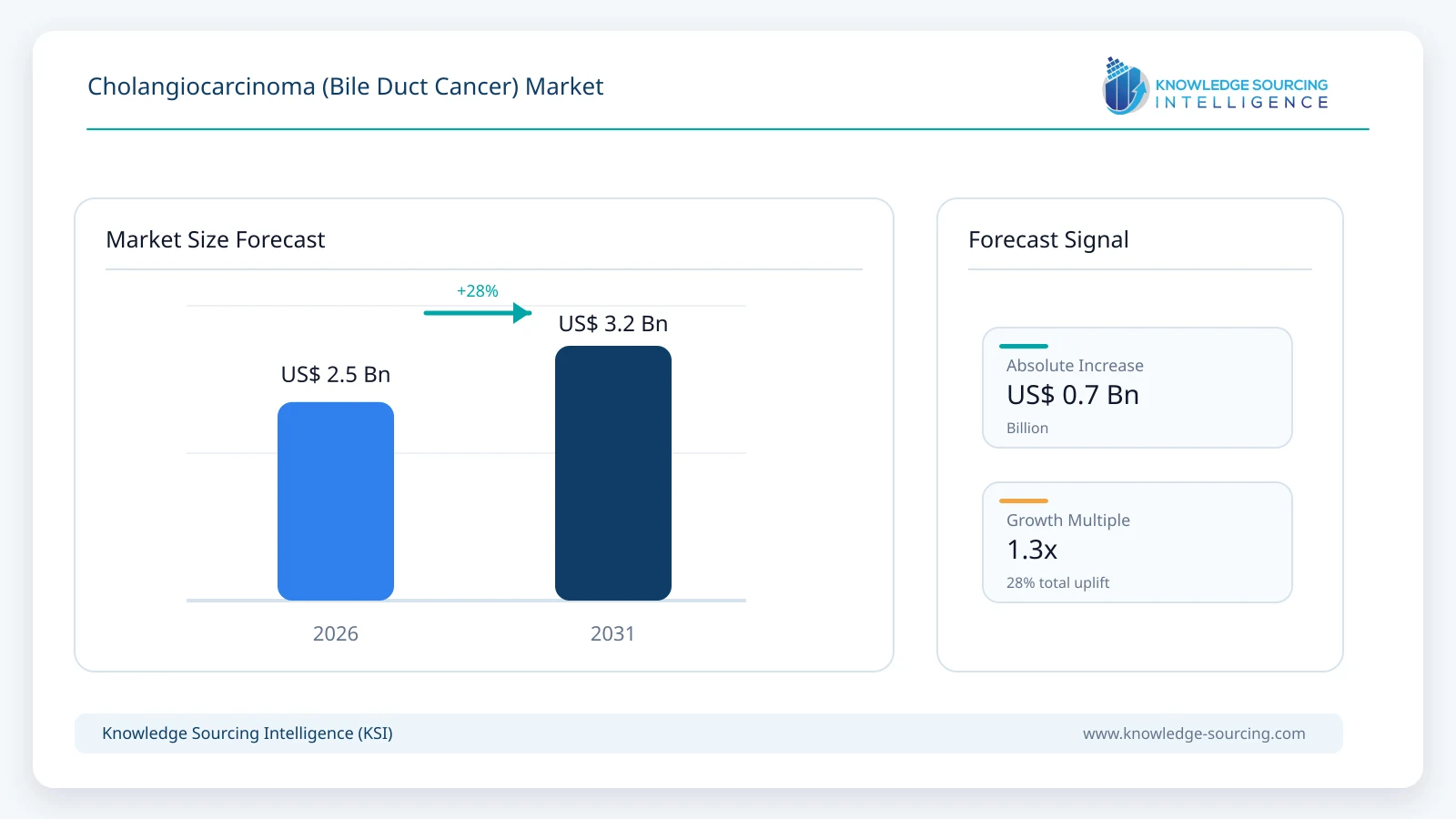
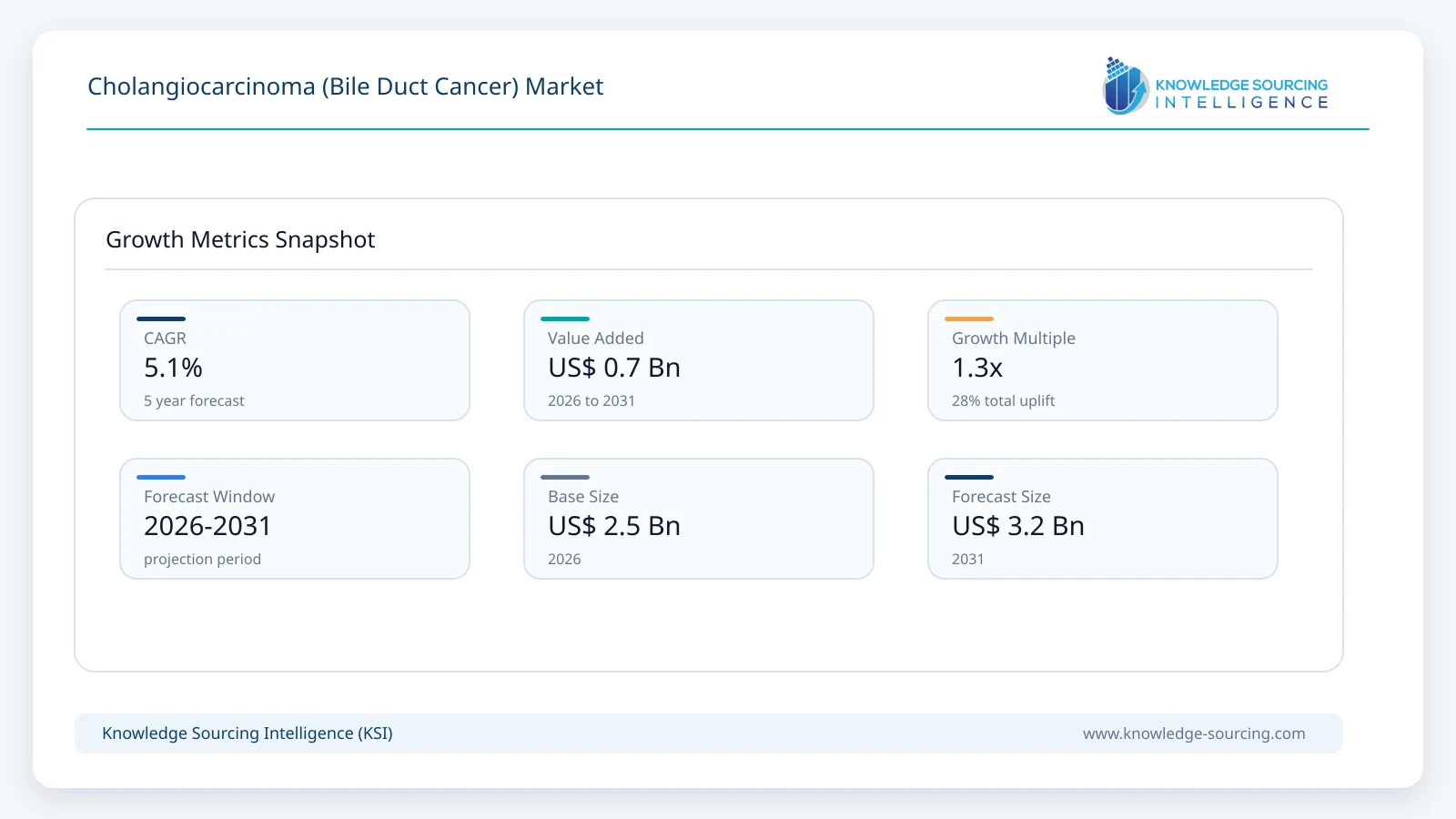
The Cholangiocarcinoma (Bile Duct Cancer) Market is set to reach USD 3.17 billion in 2031, growing at a CAGR 5.1 % from USD 2.47 billion in 2026.
Highlights:
- 1FGFR2 fusions are creating a major treatment segment because they occur predominantly in intrahepatic cholangiocarcinoma.
- 2IDH1 mutations are expanding targeted therapy adoption because they provide a validated molecular treatment pathway.
- 3Comprehensive genomic profiling is becoming routine because multiple low-frequency biomarkers influence treatment selection.
- 4Immunotherapy is gaining demand because checkpoint inhibitors benefit biomarker-selected patients and chemotherapy combinations.
- 5Surgery remains the only potentially curative intervention, but eligibility is limited by late diagnosis.
- 6Rare cancer incentives are accelerating development because orphan oncology programs receive regulatory support.
Cholangiocarcinoma arises from the epithelial lining of the bile ducts and includes intrahepatic, perihilar, and distal subtypes. Demand is increasing for biomarker-guided therapies because traditional chemotherapy provides a modest survival benefit in advanced disease. Molecular heterogeneity constrains standardized treatment because each subtype contains distinct genomic profiles and therapeutic opportunities. Developers are focusing on rare but highly actionable alterations that enable selective treatment approaches. This shift is redefining the market from a histology-based model to a mutation-directed oncology segment.
Market Dynamics
Market Drivers
Expansion of Precision Oncology
Precision medicine is driving market growth because actionable biomarkers are increasingly determining treatment decisions. Demand is increasing as physicians are sequencing tumors at diagnosis and progression. Small patient populations constrain commercial scale. Companies are focusing on high-value targeted therapies with strong clinical differentiation. This strategy is improving outcomes and increasing treatment intensity.
Rising Adoption of Comprehensive Genomic Profiling
Genomic testing is reshaping treatment pathways because multiple actionable mutations occur across cholangiocarcinoma subtypes. Demand is increasing as laboratories are expanding next-generation sequencing access. Testing cost and reimbursement constraints limit universal adoption. Oncology centers are integrating molecular tumor boards and companion diagnostics. This infrastructure is expanding eligible patient identification.
Regulatory Support for Rare Cancers
Rare cancer development benefits from orphan incentives because regulators prioritize high unmet need. Demand is increasing as companies pursue accelerated approval strategies. Confirmatory evidence requirements constrain long-term commercialization. Sponsors are conducting global studies with biomarker enrichment. This approach shortens development timelines.
Improved First-Line Combination Regimens
Systemic therapy demand is increasing because chemotherapy and immunotherapy combinations are extending survival. Toxicity and resistance constrain durability. Developers are layering targeted agents into earlier treatment settings. This progression is increasing total market value.
Market Restraints
Low disease incidence limits large-scale commercial opportunities.
Late-stage diagnosis reduces the proportion of patients eligible for curative surgery.
Biomarker testing access remains inconsistent across healthcare systems.
Market Opportunities
Earlier Biomarker Testing
Testing at diagnosis creates substantial opportunity because treatment selection increasingly depends on mutation status. Demand is increasing as guidelines emphasize upfront sequencing. Laboratory infrastructure constrains adoption. Diagnostic partnerships are expanding access. This trend increases targeted therapy utilization.
Expansion into Adjuvant Therapy
Post-surgical treatment represents an emerging opportunity because recurrence rates remain high. Demand is increasing as developers are evaluating targeted agents and immunotherapies in earlier disease stages. Long follow-up constrains development speed. Companies are launching global adjuvant studies. This expansion broadens addressable populations.
Emerging Biomarker Segments
HER2, KRAS G12C, and NTRK fusions create incremental opportunities because each defines a small but treatable subgroup. Demand is increasing as tumor-agnostic and mutation-specific drugs gain approvals. Low prevalence constrains standalone development. Companies are leveraging broader precision oncology portfolios. This model improves commercial efficiency.
Supply Chain Analysis
T The supply chain depends on coordinated genomic testing, specialty pharmaceuticals, and oncology distribution networks. Demand is increasing as targeted therapies require accurate and timely biomarker identification. Sample quality and testing turnaround constrain treatment initiation. Diagnostic laboratories are integrating sequencing platforms and standardized reporting. This diagnostic layer is becoming the essential entry point for treatment demand.
Manufacturing is concentrated in small-molecule and biologic oncology facilities because most approved therapies are oral targeted agents or monoclonal antibodies. Demand is increasing for companion diagnostic kits and centralized testing services. Global regulatory requirements constrain synchronized product launches. Companies are aligning manufacturing with specialty pharmacy and hospital oncology channels. This integrated supply chain supports rapid adoption in biomarker-positive patients.
Government Regulations
Region | Regulatory Authorities | Market Impact |
North America | U.S. Food and Drug Administration | Orphan drug and accelerated approval pathways are supporting targeted therapy launches. |
Europe | European Medicines Agency | Centralized approvals are expanding access across major markets. |
Japan | Pharmaceuticals and Medical Devices Agency | Strong oncology innovation policies are supporting rapid review. |
China | National Medical Products Administration | Regulatory reforms are accelerating precision oncology adoption. |
Market Segmentation
By Disease Type – Intrahepatic Cholangiocarcinoma
Intrahepatic disease represents the largest precision oncology segment because FGFR2 fusions and IDH1 mutations occur most frequently in this subtype. Demand is increasing as molecular testing identifies patients eligible for targeted therapy. Late diagnosis constrains surgical intervention. Pharmaceutical companies are prioritising this subtype in clinical development. This segment drives most biomarker-based revenue.
By Biomarker Type – FGFR2 Fusions/Rearrangements
FGFR2 fusions constitute a leading biomarker segment because they are linked to approved targeted therapies with defined companion diagnostics. Demand is increasing as sequencing becomes routine in advanced intrahepatic disease. Mutation rarity constrains total patient volume. Developers are expanding next-generation FGFR inhibitors. This biomarker remains central to market growth.
By Treatment Type – Targeted Therapy
Targeted therapy is becoming the fastest-growing segment because it delivers mutation-specific efficacy in selected patients. Demand is increasing as genomic testing expands. Resistance mechanisms constrain the duration of response. Companies are developing next-generation inhibitors and combination regimens. This category is reshaping treatment standards.
Regional Analysis
North America
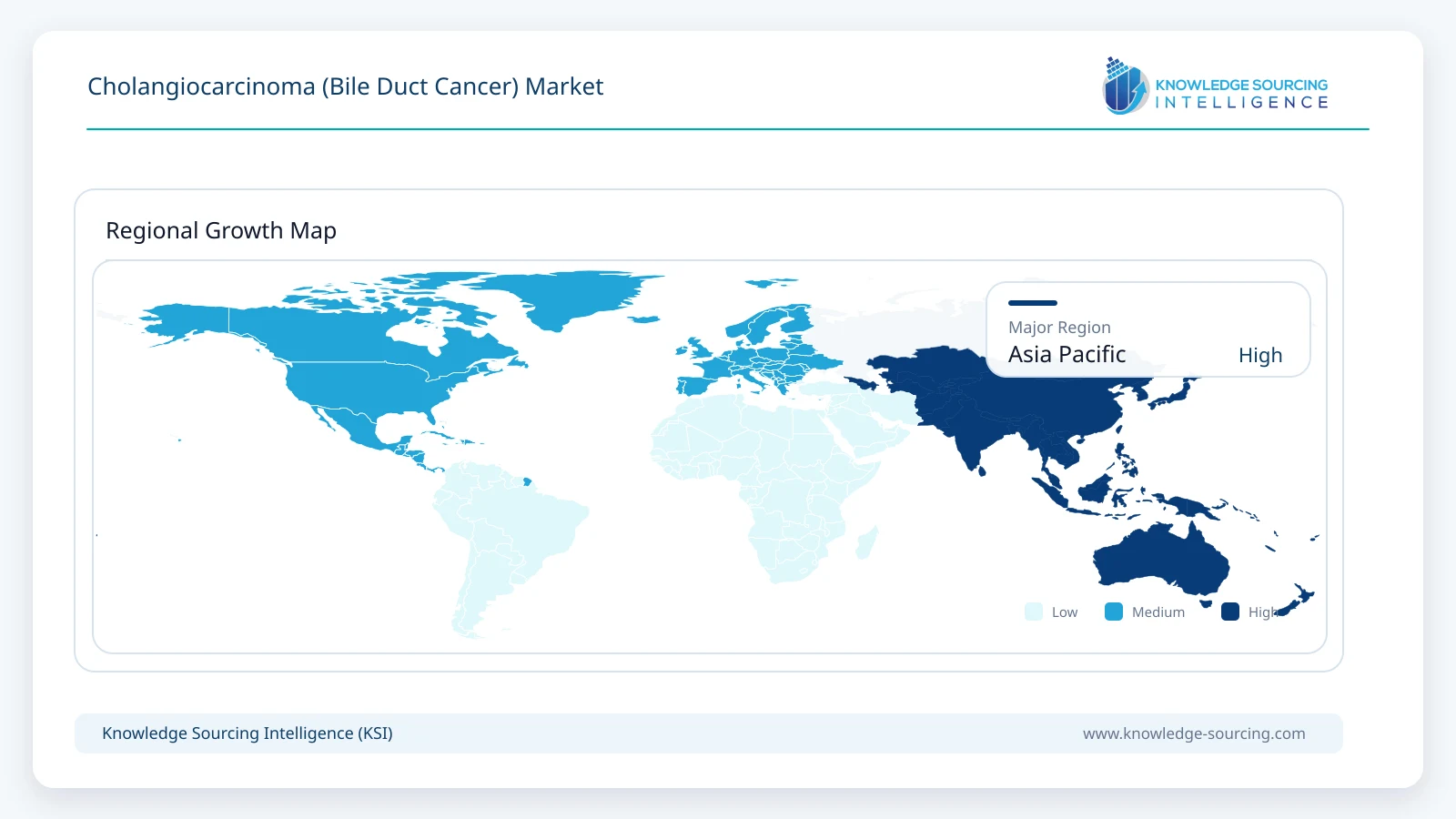
North America leads the market because academic centers, reimbursement systems, and genomic testing infrastructure support precision oncology adoption. Demand is increasing as molecular profiling becomes standard practice in advanced biliary tract cancers. High treatment costs constrain access in some settings. Companies are expanding clinical trials and specialty distribution. The region remains the principal commercial market for novel therapies.
Europe
Europe maintains strong market potential because centralized approvals and robust oncology networks support biomarker-guided treatment. Demand is increasing as major cancer centers integrate sequencing into hepatobiliary care. Country-level reimbursement reviews constrain uptake speed. Pharmaceutical companies are working with national health systems to demonstrate value. Europe remains a major market for targeted and rare cancer therapies.
Asia Pacific
Asia Pacific is strategically important because incidence is relatively high in countries such as Japan, China, Thailand, and South Korea. Demand is increasing as governments invest in oncology infrastructure and precision medicine. Testing variability and reimbursement constraints limit uniform adoption. Regional pharmaceutical partnerships are expanding access. This region offers the largest long-term patient opportunity.
Rest of the World
Latin America, the Middle East, and selected African markets are gradually adopting advanced cholangiocarcinoma therapies as oncology capacity improves. Demand is increasing in tertiary cancer centers. Limited sequencing infrastructure constrains targeted therapy use. Multinational companies are prioritizing specialist referral networks. These regions will contribute steadily to future growth.
Regulatory Landscape
Regulatory agencies are supporting cholangiocarcinoma innovation because the disease represents a rare cancer with significant unmet need. Demand is increasing as orphan designation and expedited review pathways reduce development timelines. Small trial sizes constrain statistical certainty. Regulators are accepting biomarker-enriched studies and surrogate endpoints. This flexibility is accelerating approvals.
Companion diagnostics are becoming integral because treatment eligibility depends on genomic alterations. Demand is increasing for standardized next-generation sequencing assays. Validation and reimbursement requirements constrain implementation. Diagnostic and pharmaceutical partnerships are expanding globally. This regulatory alignment is reinforcing precision oncology adoption.
Pipeline Analysis
The pipeline is highly biomarker-focused because multiple genomic subsets can be addressed with targeted therapies. Demand is increasing for next-generation FGFR inhibitors, IDH inhibitors, HER2-directed therapies, KRAS G12C inhibitors, and tumor-agnostic treatments. Acquired resistance constrains long-term benefit. Companies are testing combination approaches with immunotherapy and chemotherapy. This diversification is broadening the therapeutic landscape.Early-stage development is also exploring antibody-drug conjugates and novel immunotherapies. Demand is increasing as researchers seek options for biomarker-negative patients. Limited patient recruitment constrains rapid development. Global collaborative trials are improving enrollment efficiency. The pipeline remains one of the strongest among rare gastrointestinal cancers.
Strategic Competitive Landscape
Incyte Corporation
Incyte is the leading FGFR-focused competitor because Pemazyre established one of the first targeted treatments for FGFR2 fusion-positive cholangiocarcinoma. Its clinical pipeline emphasizes resistance management and broader precision oncology expansion.
Servier
Servier is strategically important because Tibsovo addresses IDH1-mutated cholangiocarcinoma. The company benefits from a highly differentiated biomarker-defined niche and growing molecular testing adoption.
Ipsen S.A.
Ipsen leverages its oncology and rare disease expertise to pursue targeted opportunities in hepatobiliary cancers. The company is expanding precision medicine collaborations and global commercialization capabilities.
Taiho Pharmaceutical Co., Ltd.
Taiho combines gastrointestinal oncology expertise with strong development capabilities in Asia and globally. Its research focus supports participation in biliary tract cancer treatment innovation.
Bayer AG
Bayer is extending its precision oncology portfolio into mutation-driven solid tumors. Broad experience in targeted therapies strengthens its strategic relevance in emerging biomarker segments.
BridgeBio Pharma, Inc.
BridgeBio focuses on genetically defined diseases and targeted therapeutics. Its platform-driven approach aligns well with rare oncology subsets and precision medicine development.
BeiGene, Ltd.
BeiGene is expanding globally through oncology innovation and regional clinical development. Its growing pipeline and Asia-Pacific presence strengthen long-term market potential.
AstraZeneca PLC
AstraZeneca leverages a leading precision oncology portfolio and strong immunotherapy capabilities. HER2-targeted and combination strategies enhance its relevance in cholangiocarcinoma.
Merck & Co., Inc.
Merck contributes immuno-oncology leadership through Keytruda and broad clinical partnerships. The company is evaluating checkpoint inhibitor combinations across biliary tract cancers.
Roche Holding AG
Roche combines targeted therapies, diagnostics, and genomic profiling. Its integrated precision oncology ecosystem positions it strongly for future biomarker-driven expansion.
Key Developments
September 2026: Elevar Therapeutics received U.S. FDA approval for Lyrfigtu (lirafugratinib), treating previously treated advanced cholangiocarcinoma with FGFR2 gene fusions or other rearrangements.
August 2026: OncoSil Medical received U.S. FDA Humanitarian Device Exemption approval for its OncoSil device, authorizing treatment of patients with distal cholangiocarcinoma.
August 2026: TransThera Sciences announced Chinese regulatory approval of Yochanra on August 6, introducing a treatment developed to address acquired resistance to FGFR inhibitors in cholangiocarcinoma.
May 2026: Partner Therapeutics announced U.S. FDA approval of Bizengri (zenocutuzumab-zbco) for advanced cholangiocarcinoma with NRG1 gene fusions following progression on or after systemic therapy.
Strategic Insights and Future Market Outlook
Cholangiocarcinoma is becoming a model for precision oncology because multiple low-frequency biomarkers now determine treatment selection and commercial opportunity. Demand is increasing as genomic testing moves earlier in the care pathway and targeted therapies enter standard practice. Small patient populations constrain scale, but high clinical value supports premium pricing and focused development. Pharmaceutical companies are aligning diagnostics, targeted therapies, and global trial networks. This structure is creating a durable rare cancer market with strong innovation intensity.
Future growth will depend on earlier diagnosis, broader reimbursement for genomic profiling, and expansion into adjuvant and first-line settings. Demand is increasing for therapies that overcome acquired resistance and address biomarker-negative disease. Combination regimens and next-generation inhibitors are advancing rapidly. Cholangiocarcinoma is positioned to remain one of the most scientifically active and commercially attractive rare gastrointestinal oncology markets through 2031.
The market’s long-term significance extends beyond one cancer type because it demonstrates how genomic stratification can transform treatment in rare tumors. Companies that combine biomarker leadership, regulatory agility, and global commercialization capabilities are likely to capture the greatest value in this evolving precision oncology segment.
Cholangiocarcinoma (Bile Duct Cancer) Market Scope:
| Report Metric | Details |
|---|---|
| Total Market Size in 2026 | USD 2.47 billion |
| Total Market Size in 2031 | USD 3.17 billion |
| Forecast Unit | USD Billion |
| Growth Rate | 5.1% |
| Study Period | 2021 to 2031 |
| Historical Data | 2021 to 2024 |
| Base Year | 2025 |
| Forecast Period | 2026 – 2031 |
| Segmentation | Disease Type, Biomarker Type, Treatment Type, Line of Therapy, End User, Geography |
| Companies |
|
Market Segmentation
By Disease Type
Intrahepatic Cholangiocarcinoma
Perihilar Cholangiocarcinoma
Distal Cholangiocarcinoma
By Biomarker Type
FGFR2 Fusions/Rearrangements
IDH1 Mutations
HER2 Amplification/Overexpression
BRAF V600E Mutations
KRAS G12C Mutations
NTRK Fusions
MSI-High/dMMR
By Treatment Type
Surgery
Chemotherapy
Targeted Therapy
Immunotherapy
Radiotherapy
By Line of Therapy
First-Line
Second-Line
Third-Line and Later
By End User
Hospitals
Specialty Cancer Centers
Academic Medical Centers
By Geography
North America
Europe
Asia-Pacific
Latin America
Middle East and Africa
Table of Contents
1. EXECUTIVE SUMMARY
1.1 Cholangiocarcinoma Market Definition and Scope
1.2 Key Market Insights and Therapeutic Trends
1.3 Clinical Development and Commercialization Snapshot
1.4 Probability-Adjusted Market Growth Outlook
1.5 Strategic Takeaways
2. CHOLANGIOCARCINOMA MARKET OVERVIEW
2.1 Market Definition and Structure
2.2 Cholangiocarcinoma Market Size Analysis 2018–2024
2.3 Cholangiocarcinoma Market Size Forecast 2025–2035
2.4 Market Drivers
2.4.1 Increasing Incidence of Intrahepatic and Extrahepatic Cholangiocarcinoma
2.4.2 Expansion of Precision Oncology and Biomarker Testing
2.4.3 Growing Adoption of Targeted Therapies and Immunotherapies
2.4.4 Improved Diagnostic and Molecular Profiling Capabilities
2.5 Market Restraints
2.5.1 Late Diagnosis and Limited Resectability
2.5.2 Small Patient Population and Clinical Trial Recruitment Challenges
2.5.3 High Treatment Costs and Reimbursement Constraints
2.6 Market Opportunities
2.6.1 Expansion of FGFR2 and IDH1 Targeted Therapies
2.6.2 Emerging KRAS, BRAF, HER2, and NTRK Targeted Treatments
2.6.3 Adjuvant and Earlier-Line Treatment Development
2.7 Cholangiocarcinoma Market Segmentation
2.7.1 By Disease Type
2.7.1.1 Intrahepatic Cholangiocarcinoma
2.7.1.2 Perihilar Cholangiocarcinoma
2.7.1.3 Distal Cholangiocarcinoma
2.7.2 By Biomarker Type
2.7.2.1 FGFR2 Fusions/Rearrangements
2.7.2.2 IDH1 Mutations
2.7.2.3 HER2 Amplification/Overexpression
2.7.2.4 BRAF V600E Mutations
2.7.2.5 KRAS G12C Mutations
2.7.2.6 NTRK Fusions
2.7.2.7 MSI-High/dMMR
2.7.3 By Treatment Type
2.7.3.1 Surgery
2.7.3.2 Chemotherapy
2.7.3.3 Targeted Therapy
2.7.3.4 Immunotherapy
2.7.3.5 Radiotherapy
2.7.4 By Line of Therapy
2.7.4.1 First-Line
2.7.4.2 Second-Line
2.7.4.3 Third-Line and Later
2.7.5 By End User
2.7.5.1 Hospitals
2.7.5.2 Specialty Cancer Centers
2.7.5.3 Academic Medical Centers
3. EPIDEMIOLOGY AND DISEASE BURDEN
3.1 Global Cholangiocarcinoma Incidence and Prevalence
3.2 Incidence by Anatomical Subtype
3.3 Biomarker-Specific Patient Populations
3.4 Regional Epidemiology Trends
3.5 Forecast of Treatable Patient Population
4. DISEASE AND UNMET NEED ANALYSIS
4.1 Diagnostic Challenges and Delayed Detection
4.2 Limited Curative Options in Advanced Disease
4.3 Molecular Testing Gaps
4.4 Resistance to Targeted Therapies
4.5 Need for Durable and Biomarker-Driven Treatments
5. TREATMENT LANDSCAPE
5.1 Current Standard of Care
5.2 Surgical and Locoregional Approaches
5.3 Targeted Therapy Landscape
5.4 Immunotherapy Landscape
5.5 Combination Therapy Strategies
5.6 Companion Diagnostics and Molecular Testing Ecosystem
6. CLINICAL DEVELOPMENT AND PIPELINE LANDSCAPE
6.1 Clinical Trial Activity
6.2 Pipeline Distribution by Development Phase
6.2.1 Preclinical
6.2.2 Phase I
6.2.3 Phase II
6.2.4 Phase III
6.2.5 Filed and Under Regulatory Review
6.3 Pipeline Distribution by Biomarker Target
6.4 Pipeline Distribution by Mechanism of Action
6.5 Clinical Trial Design Benchmarking
6.5.1 Sample Size Analysis
6.5.2 Endpoint Assessment
6.5.3 Recruitment Timelines
6.5.4 Duration Analysis
6.6 Success and Failure Rate Analysis
6.7 Attrition Trends
6.8 Regulatory Designations and Accelerated Pathways
7. PIPELINE ASSET BENCHMARKING
7.1 FGFR2 Inhibitor Assets
7.2 IDH1 Inhibitor Assets
7.3 HER2-Targeted Assets
7.4 KRAS and BRAF-Targeted Assets
7.5 Immunotherapy Assets
7.6 First-in-Class vs Best-in-Class Assessment
7.7 Novel Mechanism Analysis
8. PROBABILITY OF SUCCESS AND RISK ANALYSIS
8.1 Clinical Success Probability Modeling
8.2 Phase Transition Probability Analysis
8.3 Risk-Adjusted Pipeline Valuation
8.4 Attrition Rate Assessment
8.5 Key Risk Factors
8.5.1 Small Patient Population Constraints
8.5.2 Biomarker Testing Adoption Rates
8.5.3 Resistance Development
8.5.4 Reimbursement and Access Challenges
8.6 Sensitivity and Scenario Analysis
9. COMMERCIAL AND MARKET DYNAMICS
9.1 Commercialization Landscape
9.2 Launch Timeline Forecasting
9.3 Probability-Weighted Revenue Forecasts
9.4 Peak Sales Opportunity Analysis
9.5 Pricing and Reimbursement Trends
9.6 Companion Diagnostic Adoption
9.7 Competitive Positioning of Leading Therapies
Geographic Analysis
10.1 North America
10.2 Europe
10.3 Asia-Pacific
10.4 Latin America
10.5 Middle East and Africa
Company Profiles
11.1 Incyte Corporation
11.1.1 Overview
11.1.2 Financials
11.1.3 Cholangiocarcinoma Portfolio
11.1.4 Clinical Pipeline
11.1.5 Recent Developments
11.2 Servier
11.2.1 Overview
11.2.2 Financials
11.2.3 Cholangiocarcinoma Portfolio
11.2.4 Clinical Pipeline
11.2.5 Recent Developments
11.3 Ipsen S.A.
11.3.1 Overview
11.3.2 Financials
11.3.3 Cholangiocarcinoma Portfolio
11.3.4 Clinical Pipeline
11.3.5 Recent Developments
11.4 Taiho Pharmaceutical Co., Ltd.
11.4.1 Overview
11.4.2 Financials
11.4.3 Cholangiocarcinoma Portfolio
11.4.4 Clinical Pipeline
11.4.5 Recent Developments
11.5 Bayer AG
11.5.1 Overview
11.5.2 Financials
11.5.3 Precision Oncology Portfolio
11.5.4 Clinical Pipeline
11.5.5 Recent Developments
11.6 BridgeBio Pharma, Inc.
11.6.1 Overview
11.6.2 Financials
11.6.3 Targeted Therapy Portfolio
11.6.4 Clinical Pipeline
11.6.5 Recent Developments
11.7 BeiGene, Ltd.
11.7.1 Overview
11.7.2 Financials
11.7.3 Oncology Portfolio
11.7.4 Clinical Pipeline
11.7.5 Recent Developments
11.8 AstraZeneca PLC
11.8.1 Overview
11.8.2 Financials
11.8.3 Precision Oncology Portfolio
11.8.4 Clinical Pipeline
11.8.5 Recent Developments
11.9 Merck & Co., Inc.
11.9.1 Overview
11.9.2 Financials
11.9.3 Immuno-Oncology Portfolio
11.9.4 Clinical Pipeline
11.9.5 Recent Developments
11.10 Roche Holding AG
11.10.1 Overview
11.10.2 Financials
11.10.3 Oncology Portfolio
11.10.4 Clinical Pipeline
11.10.5 Recent Developments
Deals and Investment Landscape
12.1 Licensing Agreements
12.2 Co-Development Partnerships
12.3 Mergers and Acquisitions
12.4 Venture Capital and Strategic Investments
12.5 Companion Diagnostic Partnerships
12.6 Precision Oncology Collaborations
Future Outlook and Strategic Insights
13.1 Expansion of Biomarker-Driven Treatment Paradigms
13.2 Earlier-Line Targeted Therapy Adoption
13.3 Combination Immunotherapy Strategies
13.4 Global Expansion of Molecular Testing
13.5 Strategic Recommendations
Methodology and Data Framework
14.1 Data Sources
14.2 Epidemiology Modeling Framework
14.3 Pipeline Inclusion Criteria
14.4 Market Modeling and Forecasting Approach
14.5 Probability Adjustment Methodology
14.6 Limitations and Assumptions
Navigate
Trusted by the world's leading organizations











