
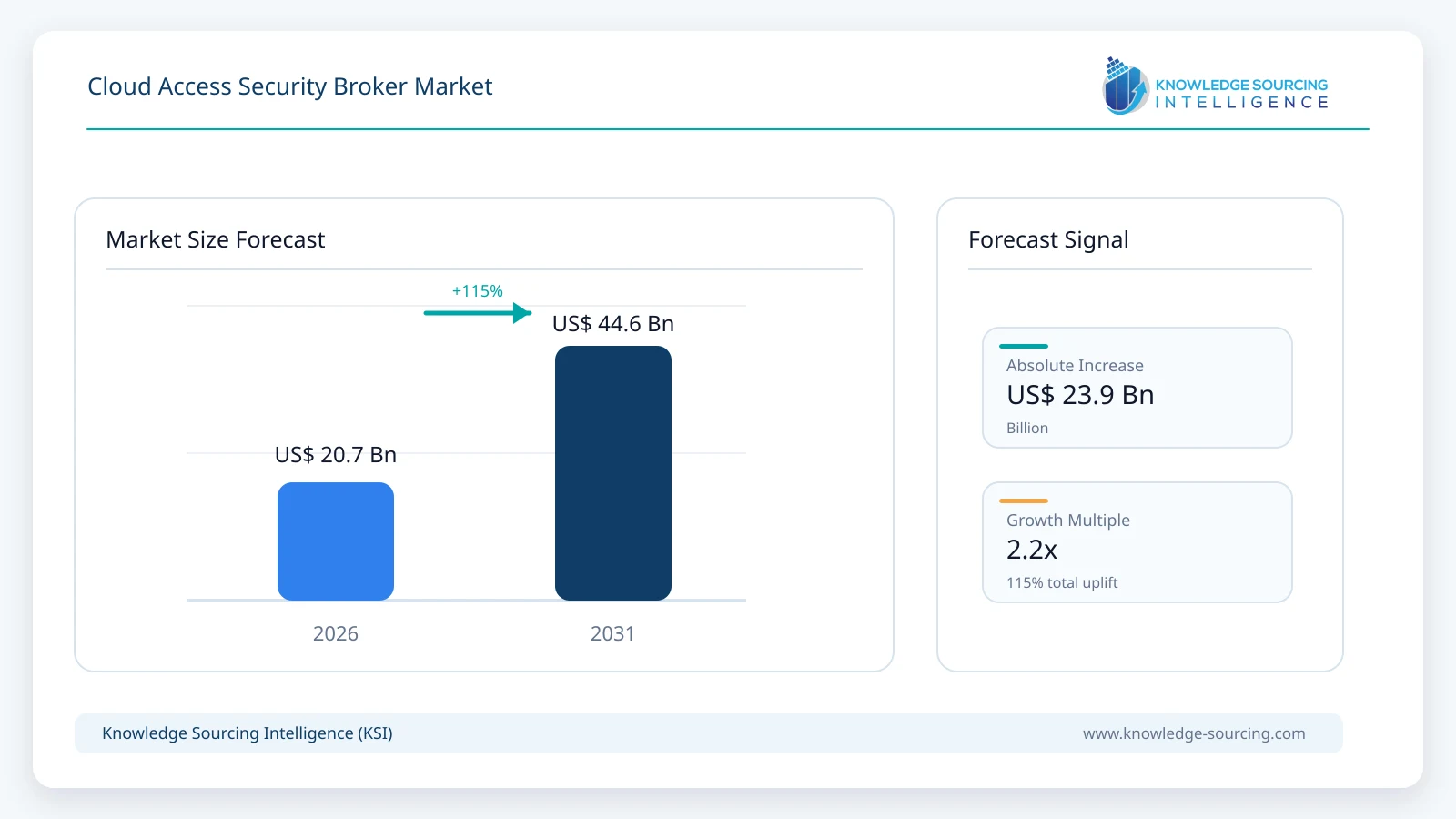
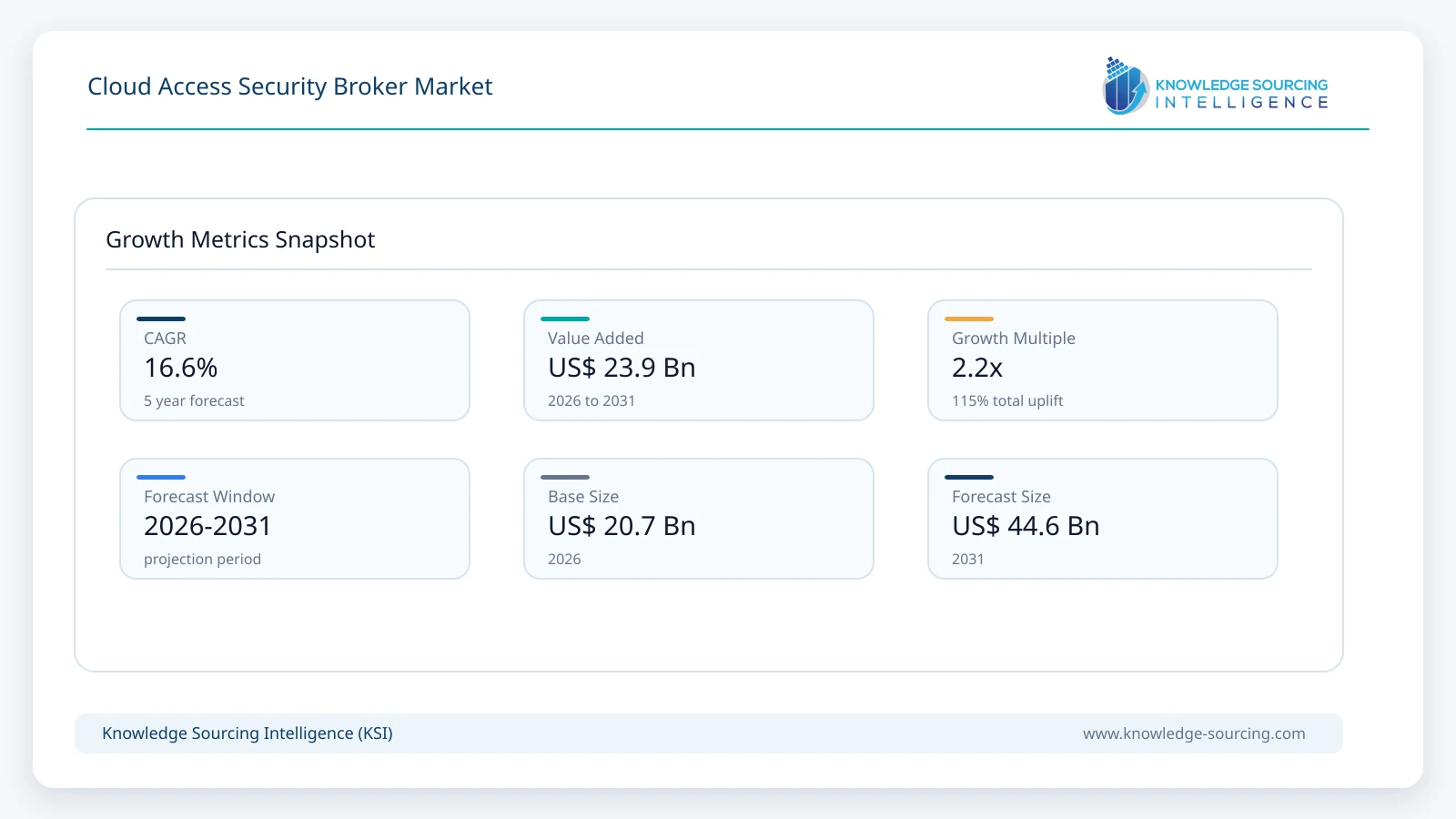
The Global Cloud Access Security Broker (CASB) market is forecast to grow at a CAGR of 16.6%, reaching USD 44.6 billion in 2031 from USD 20.7 billion in 2026.
Highlights:
- 1Cloud application controlEnterprises require continuous visibility and policy enforcement across sanctioned, unsanctioned, and AI-enabled cloud applications.
- 2Integrated security procurementCASB purchases increasingly connect with SSE, DLP, identity, endpoint, and SaaS security posture capabilities.
- 3Large-enterprise demandLarge enterprises remain commercially important because they manage complex cloud estates, sensitive data, and multiple regulatory obligations.
- 4AI application riskGenerative AI introduces new data-transfer and third-party application risks that expand the need for cloud activity monitoring.
- 5Regulatory influenceZero-trust guidance, cloud security requirements, privacy obligations, and sector-specific controls influence security architecture and procurement.
- 6Platform competitionVendors increasingly compete through integrated platforms rather than isolated CASB functionality.
The Cloud Access Security Broker (CASB) Market covers software and security services that sit between enterprise users, devices, and cloud applications to provide visibility, access control, data protection, threat detection, and compliance enforcement. CASB capabilities address cloud application usage across sanctioned and unsanctioned services, including software-as-a-service (SaaS), while increasingly connecting with identity, endpoint, data loss prevention (DLP), security service edge (SSE), and zero-trust architectures. Microsoft defines CASB as a security policy enforcement point between enterprise users and cloud service providers, with capabilities spanning authentication, encryption, malware detection, application visibility, DLP, and compliance.
The commercial importance of CASB is tied less to cloud migration alone and more to the difficulty of governing data and user activity once applications operate outside a traditional corporate network. Employees, contractors, customers, and third-party partners increasingly access SaaS applications from managed and unmanaged devices. Security teams therefore need controls that can identify cloud applications, evaluate their risk, restrict inappropriate activities, and protect sensitive information without disrupting legitimate workflows. This requirement creates demand for CASB capabilities across organizations with distributed workforces, multiple SaaS applications, regulated data, and complex identity environments.
Buyer priorities are shifting from basic application discovery toward integrated policy enforcement. Enterprises increasingly assess whether a CASB can connect with identity providers, endpoint security, DLP, security information and event management platforms, secure web gateways, and broader SSE architectures. This changes the procurement decision from a standalone cloud-security purchase to an architectural evaluation. Vendors that reduce duplicated policies and administrative consoles can therefore address an important operating-cost consideration for security teams.
The demand environment is also being shaped by the expansion of generative artificial intelligence applications. Employees can introduce sensitive business information into AI-enabled SaaS services without conventional application onboarding processes. Microsoft has expanded Defender for Cloud Apps beyond traditional CASB functionality to include SaaS security posture management, advanced threat protection, and app-to-app protection, illustrating how the category is extending toward broader SaaS risk management. Netskope similarly positions CASB within its broader SSE and AI-security architecture, with controls covering cloud applications, data movement, shadow IT, and generative AI applications.
Revenue opportunities therefore arise from several related requirements: cloud application discovery, data protection, threat prevention, compliance monitoring, real-time session controls, SaaS posture assessment, and integration with enterprise security infrastructure. Subscription-based cloud delivery is particularly relevant because it aligns security expenditure with distributed users and applications. However, enterprises with strict control, latency, sovereignty, or legacy-integration requirements can continue to consider on-premises or hybrid deployments.
The industry structure contains large cybersecurity and technology companies alongside specialists focused on cloud security and SSE. Competition increasingly occurs around the breadth of security controls, quality of application and data visibility, policy granularity, integration depth, threat intelligence, automation, and total administrative workload. The distinction between CASB, SSE, DLP, SSPM, zero-trust access, and broader cloud security is consequently becoming less rigid from a procurement perspective.
The market's forecast period from 2026 to 2031 is expected to be influenced by enterprise cloud application adoption, security spending priorities, regulatory obligations, AI application usage, identity-centric security architectures, and the replacement of fragmented security controls. No market size or CAGR has been supplied for this analysis; accordingly, no unsupported market-value estimate is presented.
Market Drivers
Expansion of SaaS Applications and Cloud-Based Workflows
Enterprise application estates have become more distributed, making application discovery and access governance an operational requirement. SaaS applications can contain customer records, intellectual property, financial information, employee data, and other sensitive material. The National Cyber Security Centre (NCSC) emphasizes that organizations remain responsible for configuring their SaaS environments securely even when infrastructure responsibilities are transferred to service providers. Its guidance also highlights authentication, authorization, logging, and secure configuration as important SaaS controls.
This creates a direct buyer requirement for tools that can identify applications and users, understand data movement, and apply policies without requiring security teams to inspect every cloud service individually. CASB suppliers respond by integrating application discovery, DLP, access controls, threat detection, and posture monitoring. Commercially, broader SaaS adoption expands the number of applications and data flows that require governance, increasing the addressable workload for cloud-access security platforms.
Shift Toward Identity-Centric and Zero-Trust Access Control
Traditional perimeter security becomes less effective when users and applications operate across corporate networks, public networks, and multiple clouds. NIST's Zero Trust Architecture guidance places users, assets, and resources at the center of security decisions rather than relying on network location as a primary basis for trust. NIST's cloud-native zero-trust guidance further describes application-level policies capable of operating across on-premises and multi-cloud environments.
CASB capabilities complement this approach by applying policies according to users, devices, applications, data, and contextual risk. Buyers therefore increasingly evaluate CASB alongside identity and access management, zero-trust network access, and secure web gateway technologies. Suppliers that provide integrated policy administration can reduce the operational burden of maintaining separate security rules across multiple products.
Rising Data Protection Requirements
Sensitive data increasingly resides within SaaS platforms and moves between cloud applications. This makes DLP and contextual data controls important components of CASB procurement. Microsoft identifies cloud data protection, DLP, threat prevention, application visibility, and compliance as core CASB use cases.
The commercial mechanism is straightforward: the financial and regulatory consequences of unauthorized data exposure can exceed the cost of preventive controls. Enterprises therefore increasingly assess whether cloud security platforms can identify sensitive information, determine where it is being transferred, and apply policy based on the sensitivity of the data and the circumstances surrounding access.
This demand is particularly relevant to BFSI, healthcare, government, telecommunications, and large enterprises holding valuable intellectual property. Vendors compete by improving classification accuracy, policy granularity, automated remediation, and integration with enterprise DLP and identity systems.
Growth of Generative AI Applications
Generative AI has introduced a new category of cloud applications into enterprise environments. Employees can use publicly available AI services, enterprise AI platforms, browser-based assistants, and AI-enabled productivity applications. These services can create new data-transfer paths that security teams may not have formally approved.
CASB vendors are responding by adding visibility and policy controls for AI applications. Microsoft, for example, describes Defender for Cloud Apps as providing visibility into more than 1,000 generative AI applications and controls intended to manage associated risks. Netskope positions its CASB offering as a component of its AI-security architecture and specifically addresses sensitive-data transfer involving generative AI applications.
For buyers, the commercial requirement is not simply blocking AI applications. Security teams need differentiated policies that permit approved use while restricting sensitive-data uploads, unauthorized applications, risky integrations, and anomalous behavior. This supports demand for context-aware cloud security rather than binary application blocking.
Government and Critical-Infrastructure Security Requirements
Government cybersecurity programs increasingly emphasize secure cloud adoption, identity controls, and zero-trust architectures. In the United States, CISA's implementation of federal cybersecurity policy includes secure cloud services and zero-trust architecture as major elements of federal security modernization.
Such policies influence government procurement and can also affect commercial suppliers serving regulated industries. Vendors must demonstrate security controls, logging, identity management, data protection, and compliance capabilities to qualify for sensitive deployments. Government requirements can therefore raise technical expectations across the broader market, particularly where enterprises use cloud services for regulated workloads.
Market Restraints and Challenges
Integration Complexity Across Existing Security Architectures
CASB rarely operates in isolation within a mature enterprise. Organizations may already have identity management, endpoint security, DLP, secure web gateways, SIEM, SOAR, firewalls, and cloud security platforms. Integrating another policy-enforcement layer can create duplicated controls, conflicting rules, and additional administrative requirements.
The challenge affects large enterprises most strongly because their technology estates typically contain products acquired at different times. Buyers therefore scrutinize APIs, identity integrations, policy synchronization, deployment models, and operational workflows. Vendors can mitigate this constraint through open integrations, centralized policy management, standardized connectors, and phased deployment models.
Data Privacy and Sovereignty Requirements
CASB platforms may process sensitive metadata, user activity information, application traffic, and potentially content associated with corporate data. Organizations operating across multiple jurisdictions must determine where information is processed, stored, and transferred.
This requirement can complicate procurement because a technically capable service may not satisfy local data-handling requirements. NCSC guidance emphasizes governance, data protection, service separation, identity, audit information, and secure administration when evaluating cloud services. Vendors consequently need regional hosting options, appropriate contractual controls, transparent data-processing practices, and compliance documentation.
Performance and User-Experience Trade-Offs
Real-time inspection can introduce performance concerns when security controls sit within application access paths. Users may attempt to bypass controls if legitimate workflows become slow or unreliable. CASB suppliers therefore face pressure to inspect sessions, apply policies, and protect data while maintaining acceptable application performance.
The issue is commercially relevant because security teams often share responsibility for user productivity. A solution that generates excessive latency can face resistance during renewal even when its security capabilities are strong. Vendors must therefore demonstrate efficient traffic handling, distributed infrastructure, selective inspection, and policy optimization.
Policy Complexity and Alert Volumes
Cloud environments can generate large volumes of application, identity, data, and behavioral signals. Poorly designed policies can create excessive alerts, false positives, or inconsistent enforcement. Security teams with limited personnel may struggle to investigate every event.
Automation can reduce this burden, but excessive automation creates its own risk when the system blocks legitimate activity or changes access without adequate context. Buyers therefore increasingly evaluate the quality of risk scoring, analytics, automated remediation, policy recommendations, and integration with security operations workflows.
Category Overlap and Procurement Uncertainty
CASB increasingly overlaps with SSE, SSPM, DLP, zero-trust access, cloud security, and identity security. This convergence can make product comparisons difficult. An enterprise may obtain certain CASB functions through an existing security platform rather than purchasing a separate product.
The challenge affects vendors because buyers increasingly assess incremental functionality rather than product labels. Suppliers must demonstrate measurable value through better visibility, stronger data controls, reduced operational workload, or broader coverage. This creates pricing pressure for standalone capabilities that can be replicated within consolidated security platforms.
Major Segment Analysis
Cloud-Based Deployment
Cloud-based deployment represents the most commercially important deployment direction because it aligns the security control layer with the distributed applications and users it protects. A cloud-delivered CASB can monitor cloud application usage without requiring organizations to maintain equivalent security infrastructure in every office or data center.
The buyer case is particularly strong for enterprises operating across multiple locations, remote users, branch offices, contractors, and unmanaged devices. Cloud delivery can simplify scaling because organizations can add users, applications, and policies without purchasing and installing equivalent appliances. Microsoft notes that most CASBs are deployed in the cloud while also recognizing on-premises options, illustrating the continuing shift toward cloud-delivered implementation.
Cloud deployment also supports integration with broader security platforms. CASB capabilities can connect with identity, endpoint, DLP, SSE, and security analytics services through common cloud-based control planes. This enables security teams to manage policies around users, devices, applications, and data from centralized interfaces.
However, procurement decisions remain influenced by data residency, latency, compliance, legacy infrastructure, and the customer's ability to integrate cloud security with existing systems. Highly regulated enterprises may require hybrid architectures when certain workloads or security controls must remain under tighter organizational control.
From a competitive perspective, cloud-based CASB suppliers compete on application coverage, real-time inspection, DLP accuracy, threat intelligence, AI application controls, policy automation, and integration depth. Vendors that combine CASB with SSE or broader security platforms can offer a larger security architecture, while specialist suppliers can compete through cloud visibility, data controls, and application-specific intelligence.
Regional Analysis
North America
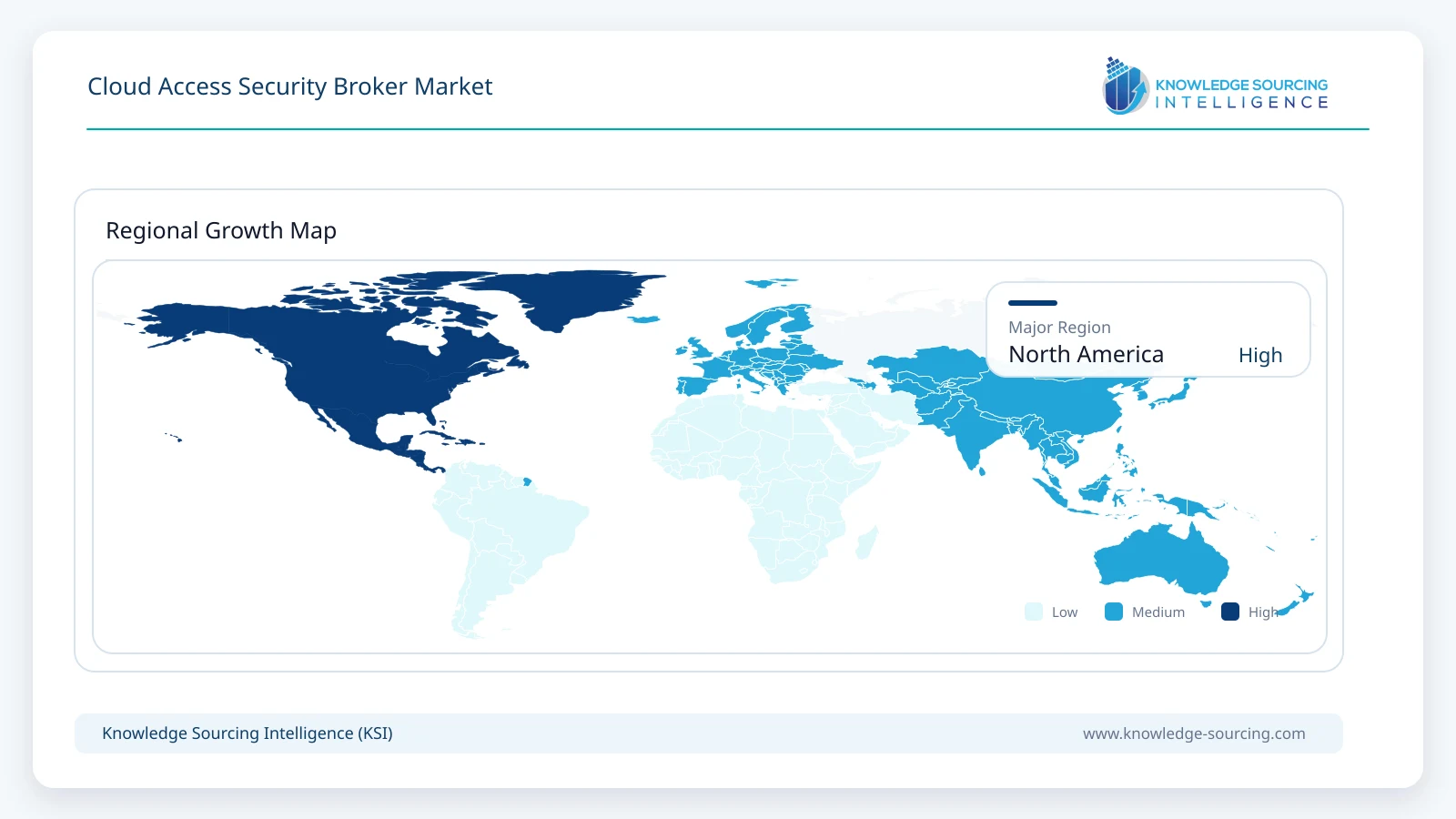
North America represents an important demand center because enterprises and government organizations operate extensive SaaS environments and face mature cybersecurity requirements. The United States has also established federal zero-trust and secure-cloud initiatives that influence security architecture decisions. CISA's cloud-security work explicitly connects secure cloud adoption with zero-trust architecture and stronger cybersecurity standards for federal agencies.
Buyer behavior in the region tends to emphasize integration, operational efficiency, regulatory compliance, and measurable security outcomes. Large enterprises commonly assess CASB alongside SSE, identity, endpoint, and DLP technologies rather than as a standalone control.
Canada presents demand associated with cloud adoption, privacy requirements, and enterprise security modernization, while Mexico offers opportunities as businesses expand cloud-based applications and strengthen security controls. The principal constraints include complex legacy environments, overlapping security products, and procurement scrutiny around platform consolidation.
Europe
European demand is strongly influenced by data protection, cybersecurity governance, and sector-specific compliance requirements. Organizations operating across multiple European jurisdictions must account for data handling, access controls, auditability, and third-party cloud risks.
The European Union Agency for Cybersecurity has specifically included CASB as a consideration in technical guidance for cybersecurity risk-management measures, recommending its use to improve visibility, control, and security of cloud-service usage.
European buyers therefore place substantial weight on data governance, identity controls, audit capabilities, cloud-provider security, and regulatory alignment. Germany, the United Kingdom, France, and Spain represent important enterprise markets, although procurement can vary according to sector regulation and national requirements. The main constraint is the complexity of meeting data-sovereignty, privacy, and security requirements across heterogeneous cloud estates.
Asia Pacific
Asia Pacific offers substantial long-term demand potential because enterprises across China, Japan, South Korea, India, Australia, and other markets are expanding cloud-based business applications while strengthening cybersecurity controls.
Japan and Australia have mature enterprise security procurement environments, while India represents an important market as organizations expand SaaS usage and modernize security architectures. China operates within a distinct regulatory and technology environment, making local compliance, data governance, and technology compatibility particularly important.
Regional buyers often balance security requirements against cost and implementation complexity. Large multinational organizations typically seek globally consistent policies, while domestic enterprises may prioritize deployment flexibility and integration with locally relevant infrastructure. Vendors with regional data centers, local partnerships, regulatory expertise, and strong implementation support can therefore improve their commercial positioning.
Middle East and Africa
Demand in the Middle East is supported by government-led cybersecurity programs, cloud adoption, smart infrastructure initiatives, financial services modernization, and increasing attention to national data protection. Saudi Arabia and the United Arab Emirates represent important procurement markets because government entities and large enterprises are investing in cloud infrastructure and cybersecurity capabilities.
South Africa remains a significant regional market because of its established financial, telecommunications, retail, and corporate sectors. Across the region, buyers increasingly require identity-based access controls, data protection, security monitoring, and compliance support.
Adoption can be constrained by skills shortages, procurement complexity, differing regulatory regimes, and uneven cybersecurity maturity. Vendors therefore compete partly through local implementation capabilities and partnerships with regional technology providers.
South America
South American demand is concentrated around Brazil, Argentina, and other economies where enterprises are expanding cloud applications and strengthening protection of customer and corporate data. Brazil represents the largest commercial opportunity within the supplied regional structure because of its sizeable enterprise base and data-protection requirements.
Financial services, telecommunications, retail, and large corporate organizations provide relevant demand sources. Buyers commonly evaluate data protection, application visibility, identity management, and regulatory compliance when selecting cloud security technologies.
Budget constraints and variations in cybersecurity maturity can delay deployment, particularly among smaller organizations. Cloud-based delivery can address some of these barriers by reducing infrastructure requirements, although organizations still require skilled personnel and integration capabilities.
Competitive Landscape
The competitive environment includes established cybersecurity platforms, cloud technology companies, and specialist cloud-security providers. The supplied competitive set comprises Forcepoint, Microsoft, Cisco, Netskope, Inc., Versa Networks, Inc., Oracle Corporation, Zscaler, Inc., Proofpoint, Inc., Skyhigh Security, and Palo Alto Networks.
Competition is increasingly based on platform breadth rather than CASB functionality alone. Microsoft integrates CASB with SaaS security posture management, threat protection, app governance, identity, and its wider security ecosystem. Netskope positions CASB as part of its SSE architecture and extends controls into SaaS, IaaS, shadow IT, and generative AI use cases.
The competitive model, therefore, rewards vendors that can consolidate multiple security requirements while maintaining specialized controls. Forcepoint's 2025 Data Security Cloud launch demonstrates another direction: combining SaaS security, DLP, data security posture management, data detection and response, web security, and email security within a cloud-delivered architecture.
Partnerships also influence competitive positioning because CASB products depend on integrations with cloud applications, identity systems, endpoint platforms, and cloud infrastructure. Proofpoint's expanded 2025 partnership with Microsoft, for example, placed Azure infrastructure at the foundation of future Proofpoint innovations and expanded collaboration around threat and data protection.
Vendors are also expanding into adjacent cloud-security categories. Palo Alto Networks introduced Cortex Cloud in February 2025 by bringing cloud detection and response together with cloud-native application protection capabilities. This indicates that suppliers increasingly compete across connected security domains rather than treating CASB as a standalone product category.
Geographic expansion depends on cloud infrastructure, data residency capabilities, channel partners, compliance certifications, and local implementation capacity. Product differentiation increasingly depends on policy automation, application discovery, data classification, AI-security controls, threat intelligence, and the ability to correlate identity, data, application, and device risk.
Recent Developments
June 2026: Zscaler announced new Zero Trust Exchange innovations for agentic AI, extending security controls to how autonomous agents access data, interact with systems, and operate enterprise-wide.
June 2026: Netskope introduced Netskope One AI Command Center, adding AI discovery, risk intelligence, and automated response capabilities to its unified platform supporting cloud and SaaS security.
December 2025: Palo Alto Networks released its 2025 State of Cloud Security Report, highlighting the expanding cloud attack surface associated with enterprise AI applications and workloads. The development reinforces the need for cloud-access controls capable of addressing AI-related application and data risks.
Regulatory and Policy Environment
Regulation is an important demand catalyst because CASB functionality can help organizations implement access controls, monitor cloud usage, protect sensitive information, and maintain audit records. However, regulatory requirements do not mandate a CASB in every jurisdiction. Instead, they create security and governance obligations for which CASB can form part of the technical control framework.
In the United States, federal cybersecurity policy has emphasized cloud security and zero-trust architecture. CISA's cloud-security technical reference architecture supports agencies transitioning workloads to cloud environments, while its zero-trust guidance promotes stronger identity, access, and policy controls.
NIST's Zero Trust Architecture framework provides an important technical reference for organizations developing identity-centric security models. Its approach assumes that trust should not be granted merely because a user or asset operates within a particular network location. This architecture supports CASB use cases involving cloud applications, user identity, device posture, and resource-level authorization.
European requirements place substantial emphasis on cloud governance, data protection, cybersecurity risk management, and third-party dependencies. ENISA's 2025 technical implementation guidance explicitly identifies CASB as a possible measure for improving cloud-service visibility, control, and security.
The United Kingdom's NCSC cloud-security principles provide another relevant procurement reference. They cover data-in-transit protection, asset resilience, customer separation, governance, operational security, secure development, supply-chain security, identity, authentication, audit information, and secure service administration. These requirements influence how enterprises assess cloud security providers and supporting security technologies.
Sector-specific requirements also influence demand. Financial institutions must protect customer and transaction information, healthcare organizations must control sensitive health data, government agencies must maintain strong access and audit controls, and educational institutions increasingly need to protect student and research information. Microsoft documentation for education, for example, identifies CASB capabilities as relevant to cloud application visibility, FERPA and COPPA considerations, risk assessment, and protection of institutional data.
Over the 2026–2031 period, regulatory influence is likely to operate primarily through higher expectations for identity security, cloud governance, data protection, third-party risk management, logging, auditability, and secure configuration. These requirements will favor vendors that can provide verifiable controls and integrate CASB functions with broader security operations.
Outlook and Strategic Implications
The Cloud Access Security Broker Market is entering the 2026–2031 period with procurement increasingly centered on security architecture rather than a single product category. Enterprises will continue to require visibility into cloud applications, but the commercial value of visibility alone will decline as buyers demand enforcement, data protection, posture assessment, threat detection, and automated remediation within the same operating model.
Investment priorities are likely to concentrate on cloud-delivered security infrastructure, application discovery, SaaS security posture management, DLP, identity-aware access, AI application governance, and security analytics. CASB suppliers that integrate these capabilities can address a broader portion of the enterprise security budget.
Procurement teams are also likely to favor products that reduce operational duplication. Security departments already manage numerous consoles and policy frameworks. A platform that allows one policy to govern web traffic, SaaS applications, data movement, identities, and endpoint activity can demonstrate a clearer economic case than a product requiring separate administration.
Generative AI will remain an important purchasing consideration. The issue is not simply the number of AI applications in use. Enterprises must determine which applications employees can access, what information can be submitted, which third-party integrations are authorized, and how activity should be monitored. CASB suppliers with granular AI application controls can therefore address an emerging governance requirement.
Cloud-based deployment should remain commercially important because it supports distributed users and applications while reducing the need for dedicated security infrastructure. Nevertheless, hybrid and on-premises deployment will retain relevance where organizations face sovereignty requirements, legacy-system dependencies, specialized network architectures, or strict control requirements.
Competitive differentiation will increasingly depend on integration quality. Vendors need to connect CASB with identity, endpoint, DLP, SSE, SIEM, SOAR, SaaS applications, and cloud infrastructure. The ability to correlate signals across these systems can improve policy decisions and reduce false positives.
Pricing and margins will also be influenced by platform consolidation. Large technology providers can bundle CASB functionality into broader security subscriptions, potentially putting pressure on standalone pricing. Specialist suppliers must therefore demonstrate differentiated visibility, better data controls, stronger analytics, superior application coverage, or more effective cross-cloud enforcement.
Regional strategy will remain important. North America will continue to benefit from mature cybersecurity procurement and federal cloud-security requirements. Europe will emphasize privacy, governance, and cloud risk management. Asia Pacific will offer opportunities tied to expanding cloud adoption and enterprise security modernization. Middle Eastern demand will be supported by government and enterprise cybersecurity programs, while South American adoption will remain closely connected to financial services, telecommunications, retail, and data-protection requirements.
The principal strategic risk is category commoditization if core CASB capabilities become standard features within broader SSE or security platforms. Suppliers can mitigate this risk by extending into SaaS posture management, AI application governance, data security, threat prevention, and automated remediation.
For enterprise buyers, the most important procurement question will shift from whether a CASB is required to how its functions should fit within the organization's wider security architecture. For vendors, the commercial opportunity will depend on proving that CASB capabilities reduce data exposure, improve cloud visibility, simplify policy administration, and support regulatory obligations without creating unacceptable user friction.
Over the forecast period, the strongest opportunities should therefore emerge where cloud application usage, sensitive data, regulatory exposure, and security complexity intersect. The market's trajectory will be determined not only by the number of cloud applications organizations adopt, but by how much control enterprises require over the data, identities, applications, and users operating across those environments.
Cloud Access Security Broker (CASB) Market Scope:
| Report Metric | Details |
|---|---|
| Total Market Size in 2026 | USD 20.7 billion |
| Total Market Size in 2031 | USD 44.6 billion |
| Forecast Unit | Billion |
| Growth Rate | 16.6% |
| Study Period | 2021 to 2031 |
| Historical Data | 2021 to 2024 |
| Base Year | 2025 |
| Forecast Period | 2026 – 2031 |
| Segmentation | Deployment Type, Enterprise Size, End-User, Geography |
| Companies |
|
Market Segmentation
By Deployment Type
- On-Premises
- Cloud-Based
- Hybrid
By Enterprise Size
- Small and Medium-Sized Enterprises
- Large Enterprises
By End-User
- BFSI
- IT & Telecommunications
- Government
- Healthcare
- Retail
- Manufacturing
- Education
- Others
By Geography
- North America
- United States
- Canada
- Mexico
- South America
- Brazil
- Argentina
- Others
- Europe
- Germany
- United Kingdom
- France
- Spain
- Others
- Middle East and Africa
- Saudi Arabia
- United Arab Emirates
- South Africa
- Others
- Asia Pacific
- China
- Japan
- South Korea
- India
- Australia
- Others
Table of Contents
1. INTRODUCTION
1.1. Market Overview
1.2. Market Definition
1.3. Scope of the Study
1.4. Market Segmentation
1.5. Currency
1.6. Assumptions
1.7. Base Year and Forecast Period
1.8. Key Benefits to Stakeholders
2. RESEARCH METHODOLOGY
2.1. Research Design
2.2. Research Process and Data Validation
3. EXECUTIVE SUMMARY
3.1. Key Findings
4. MARKET DYNAMICS
4.1. Market Drivers
4.2. Market Restraints
4.3. Porter’s Five Forces Analysis
4.3.1. Bargaining Power of Suppliers
4.3.2. Bargaining Power of Buyers
4.3.3. Threat of New Entrants
4.3.4. Threat of Substitutes
4.3.5. Competitive Rivalry
4.4. Industry Value Chain Analysis
4.5. Technology Trends
4.6. Analyst View
5. CLOUD ACCESS SECURITY BROKER MARKET BY DEPLOYMENT TYPE
5.1. Introduction
5.2. On-Premises
5.3. Cloud-Based
5.4. Hybrid
6. CLOUD ACCESS SECURITY BROKER MARKET BY ENTERPRISE SIZE
6.1. Introduction
6.2. Small and Medium-Sized Enterprises
6.3. Large Enterprises
7. CLOUD ACCESS SECURITY BROKER MARKET BY END-USER
7.1. Introduction
7.2. BFSI
7.3. IT & Telecommunications
7.4. Government
7.5. Healthcare
7.6. Retail
7.7. Manufacturing
7.8. Education
7.9. Others
8. CLOUD ACCESS SECURITY BROKER MARKET BY GEOGRAPHY
8.1. Introduction
8.2. North America
8.2.1. By Deployment Type
8.2.2. By Enterprise Size
8.2.3. By End-User
8.2.4. By Country
8.2.4.1. United States
8.2.4.2. Canada
8.2.4.3. Mexico
8.3. South America
8.3.1. By Deployment Type
8.3.2. By Enterprise Size
8.3.3. By End-User
8.3.4. By Country
8.3.4.1. Brazil
8.3.4.2. Argentina
8.3.4.3. Others
8.4. Europe
8.4.1. By Deployment Type
8.4.2. By Enterprise Size
8.4.3. By End-User
8.4.4. By Country
8.4.4.1. Germany
8.4.4.2. United Kingdom
8.4.4.3. France
8.4.4.4. Spain
8.4.4.5. Others
8.5. Middle East and Africa
8.5.1. By Deployment Type
8.5.2. By Enterprise Size
8.5.3. By End-User
8.5.4. By Country
8.5.4.1. Saudi Arabia
8.5.4.2. United Arab Emirates
8.5.4.3. South Africa
8.5.4.4. Others
8.6. Asia Pacific
8.6.1. By Deployment Type
8.6.2. By Enterprise Size
8.6.3. By End-User
8.6.4. By Country
8.6.4.1. China
8.6.4.2. Japan
8.6.4.3. South Korea
8.6.4.4. India
8.6.4.5. Australia
8.6.4.6. Others
9. COMPETITIVE ENVIRONMENT AND ANALYSIS
9.1. Major Players and Strategy Analysis
9.2. Market Share Analysis
9.3. Mergers, Acquisitions, Agreements, and Collaborations
9.4. Product and Technology Comparison
9.5. Competitive Dashboard
10. COMPANY PROFILES
10.1. Forcepoint
10.2. Microsoft
10.3. Cisco
10.4. Netskope, Inc.
10.5. Versa Networks, Inc.
10.6. Oracle Corporation
10.7. Zscaler, Inc.
10.8. Proofpoint, Inc.
10.9. Skyhigh Security
10.10. Palo Alto Networks
Navigate
Trusted by the world's leading organizations











