
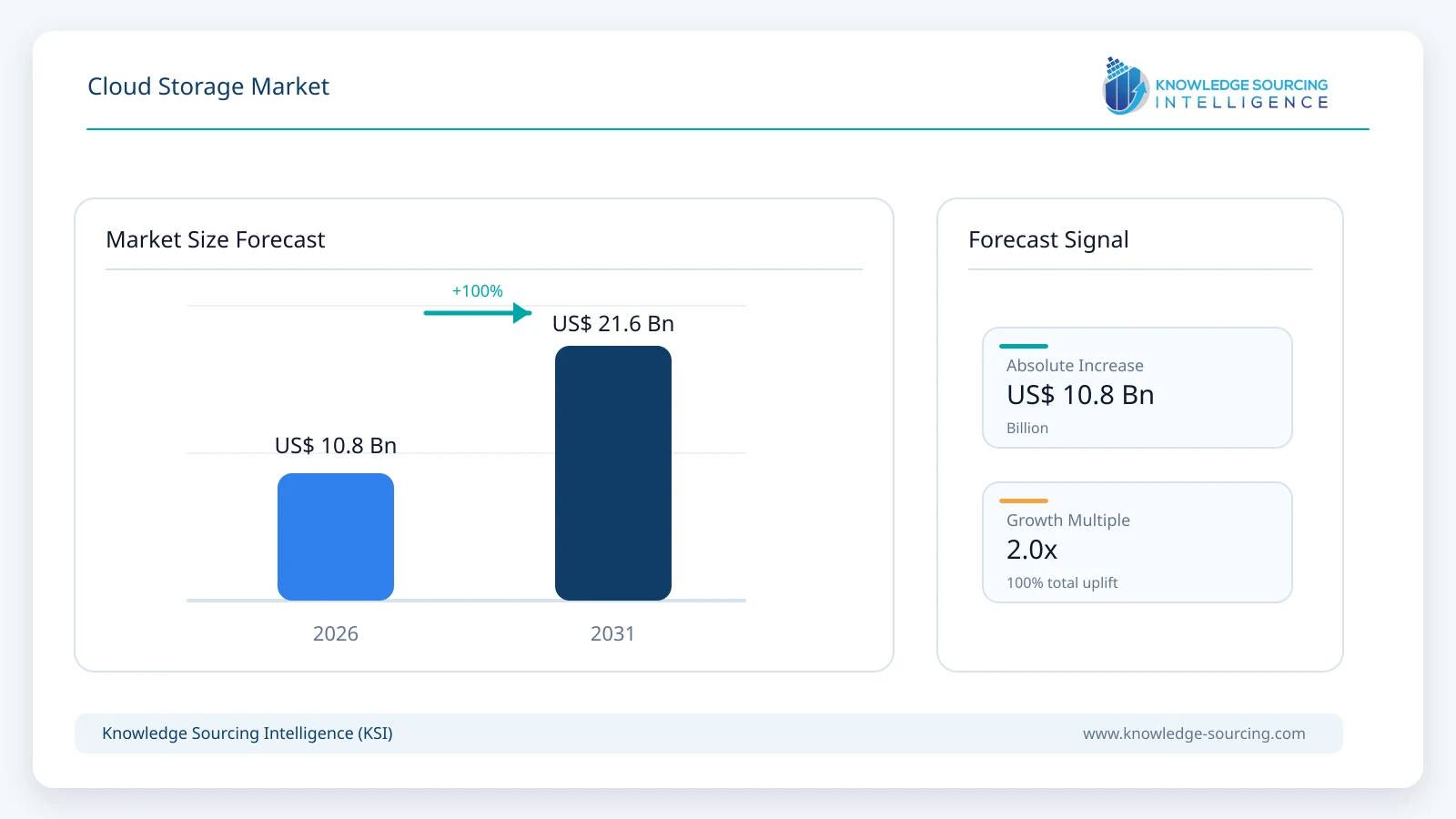
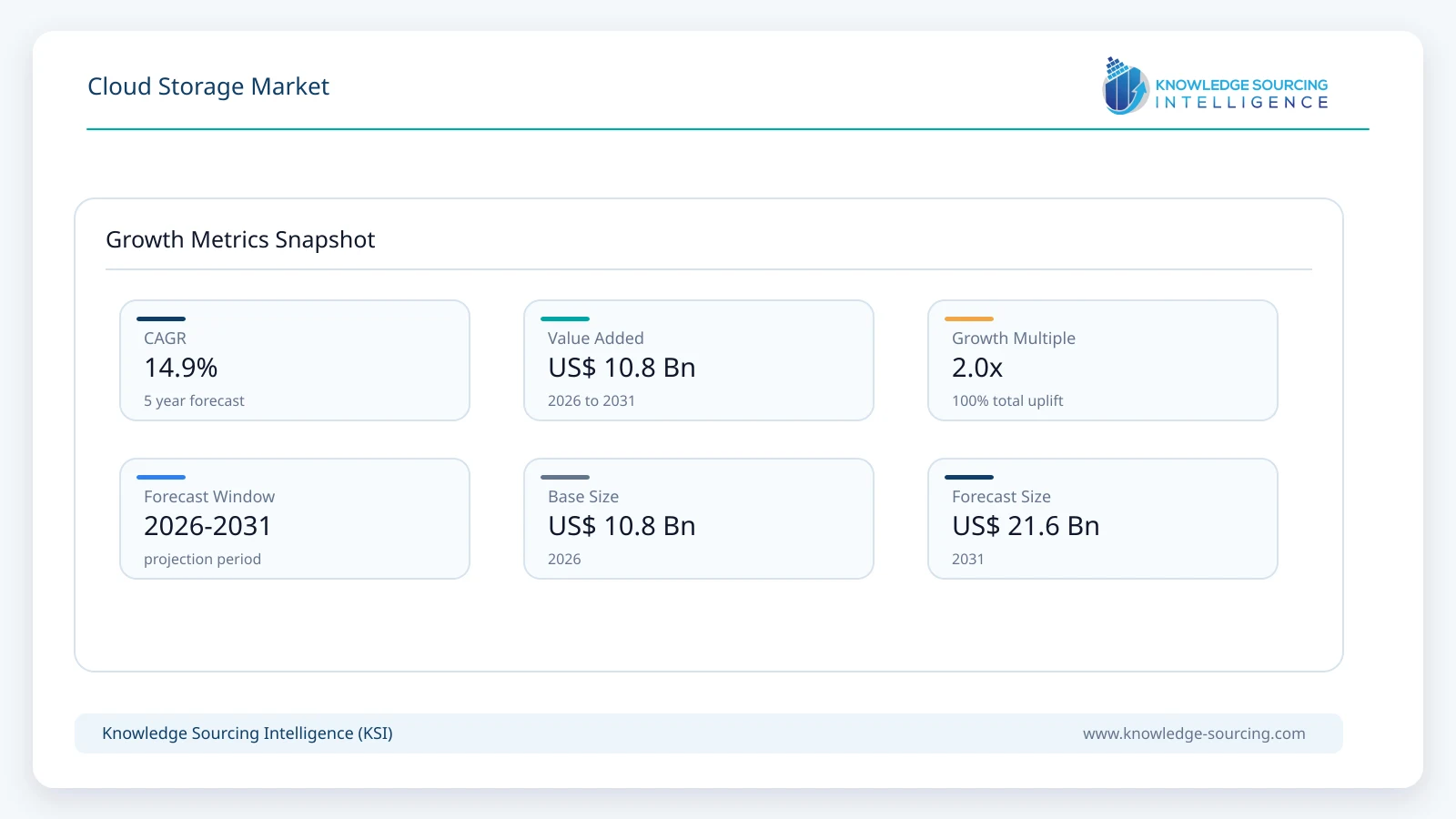
The Cloud Storage Market for Healthcare Industry is forecast to grow at a CAGR of 14.9%, reaching USD 21.6 billion in 2031 from USD 10.8 billion in 2026.
Highlights:
- 1Healthcare providers prioritize secure, compliant cloud storage to support expanding electronic health records and medical imaging.
- 2Hybrid cloud deployments remain commercially important where data sovereignty and workload flexibility influence purchasing decisions.
- 3Demand increasingly extends beyond storage capacity toward integrated backup, disaster recovery, governance, and cybersecurity capabilities.
- 4Compliance with healthcare privacy regulations has become a primary purchasing criterion alongside scalability and system interoperability.
- 5Cloud vendors are expanding healthcare-specific platforms, managed services, and AI-ready data infrastructure to address enterprise requirements.
Market Overview
Buyers increasingly seek secure data management, rapid recovery, lifecycle governance, interoperability, and regulatory compliance across distributed healthcare environments. U.S. Department of Health and Human Services (HHS) guidance also recognizes cloud services as an acceptable environment for electronic protected health information (ePHI), provided healthcare organizations implement appropriate safeguards and Business Associate Agreements (BAAs).
Commercial value is shifting toward platforms capable of supporting continuous clinical operations while reducing infrastructure management burdens. Large hospital networks typically evaluate cloud providers on security certifications, resilience, workload portability, geographic availability, integration with existing clinical systems, and long-term operating costs rather than storage pricing alone. Diagnostic imaging repositories, backup environments, disaster recovery, and AI-ready data lakes are becoming common entry points for cloud adoption because they offer measurable operational benefits without immediately replacing core clinical systems.
Competition increasingly extends beyond infrastructure capacity. Providers differentiate through healthcare-specific services, compliance capabilities, analytics integration, managed migration, and ecosystem partnerships with electronic health record vendors and system integrators. As healthcare datasets continue to expand in both volume and complexity, procurement decisions increasingly favor vendors capable of supporting secure multi-cloud environments, resilient disaster recovery, and long-term data governance across geographically distributed healthcare organizations.
Key Market Indicators
Indicator | Latest Evidence | Commercial Meaning |
HIPAA cloud storage requirement | Business Associate Agreement (BAA) required when cloud providers store or process ePHI | Compliance capabilities directly influence supplier selection. |
Deployment models | Public, private and hybrid cloud recognized under HHS/NIST guidance | Multiple deployment architectures support different healthcare workloads. |
Protected workload | Electronic Protected Health Information (ePHI) | Security, encryption and auditability remain core procurement priorities. |
Vendor qualification | HIPAA-assessed cloud services available from enterprise providers | Compliance-ready infrastructure reduces deployment complexity for healthcare organizations. |
Disaster recovery | Risk analysis and backup planning required under HIPAA security guidance | Storage procurement increasingly includes resilience and recovery capabilities. |
Market Drivers
Expansion of electronic health records, medical imaging, and clinical data repositories. Healthcare organizations continue to generate larger volumes of structured and unstructured clinical information through EHR systems, high-resolution medical imaging, pathology, laboratory platforms, wearable devices, and connected medical equipment. Storage infrastructure therefore requires elastic capacity, high availability, and rapid retrieval without interrupting clinical workflows. Large cloud providers have expanded healthcare-specific storage, analytics, and archival services to address these requirements, while hospitals increasingly evaluate suppliers on interoperability, lifecycle management, and operational resilience rather than storage hardware ownership alone.
Compliance requirements are reshaping procurement decisions. Regulatory obligations surrounding protected health information have elevated security, governance, encryption, identity management, audit logging, and disaster recovery from technical features to purchasing requirements. HHS guidance specifies that cloud service providers maintaining ePHI function as business associates and require compliant contractual arrangements, while healthcare organizations remain responsible for comprehensive risk assessments. Consequently, buyers increasingly select vendors with established compliance programs, healthcare certifications, documented security controls, and mature governance capabilities instead of evaluating infrastructure cost alone.
Artificial intelligence and advanced healthcare analytics require scalable cloud data infrastructure. Clinical decision support, population health analytics, medical imaging analysis, precision medicine, and generative AI applications depend on centralized, accessible, and well-governed healthcare datasets. These workloads frequently exceed the practical storage and computing limits of traditional on-premise environments. Cloud providers are therefore expanding integrated storage, AI, analytics, and data management services designed for healthcare organizations. This shift increases demand for cloud platforms capable of supporting secure large-scale data processing while maintaining regulatory compliance and operational continuity.
Market Restraints and Challenges
Regulatory compliance and data residency obligations increase implementation complexity. Healthcare organizations must satisfy stringent privacy, security, and record-retention rules before migrating clinical information to cloud platforms. Regulations such as HIPAA in the United States, the GDPR in Europe, and country-specific health data localization requirements often influence where data can be stored and processed. These obligations extend procurement timelines because buyers must complete security assessments, negotiate Business Associate Agreements where applicable, validate encryption controls, and verify audit capabilities. Large cloud providers continue expanding regional infrastructure and compliance certifications, but organizations operating across multiple jurisdictions still face higher governance costs and longer deployment cycles.
Migration from legacy healthcare systems remains technically demanding. Hospitals often operate a combination of electronic health record systems, picture archiving and communication systems (PACS), laboratory information systems, and departmental applications that were not originally designed for cloud-native environments. Migrating these platforms requires careful data validation, application testing, workflow redesign, and integration with clinical operations. Oracle Health, Microsoft, AWS, IBM, and other enterprise suppliers have expanded migration and professional services to reduce implementation risks, yet large healthcare organizations continue to report phased migration strategies because uninterrupted clinical operations remain a mandatory requirement throughout the transition.
Cybersecurity threats continue to increase operational and financial risk. Healthcare remains one of the most frequently targeted sectors for ransomware, credential theft, and data breaches because clinical information carries high operational and financial value. According to the U.S. Department of Health and Human Services' breach reporting database, large healthcare data breaches continue to affect millions of patient records annually, reinforcing demand for stronger identity management, immutable backups, and rapid recovery capabilities. Consequently, buyers increasingly evaluate storage providers based on security architecture, continuous monitoring, incident response support, and disaster recovery performance rather than storage capacity alone.
Major Segment Analysis
Hybrid Cloud Deployment Model
Hybrid cloud represents a commercially important deployment model because many healthcare providers must balance regulatory compliance, legacy application support, operational flexibility, and long-term infrastructure modernization. Clinical applications with strict latency, privacy, or operational requirements often remain within private infrastructure, while backup repositories, analytics platforms, disaster recovery environments, and collaboration workloads increasingly operate in public cloud environments. This combination allows organizations to modernize infrastructure without disrupting mission-critical clinical services.
Purchasing priorities within this segment extend beyond storage scalability. Healthcare organizations evaluate interoperability with existing electronic health record platforms, encryption, identity management, workload portability, vendor support, and disaster recovery performance before committing to large-scale deployments. Suppliers including Amazon Web Services, Microsoft, Google Cloud, Oracle, IBM, and Dell Technologies continue investing in hybrid cloud architectures, healthcare integrations, and management tools that simplify movement between on-premise and cloud environments. Although public cloud adoption continues to expand, hybrid deployment remains an important option for organizations managing sensitive clinical data, legacy applications, and country-specific regulatory obligations simultaneously.
Regional Analysis
Region | Main Demand Signal | Principal Constraint |
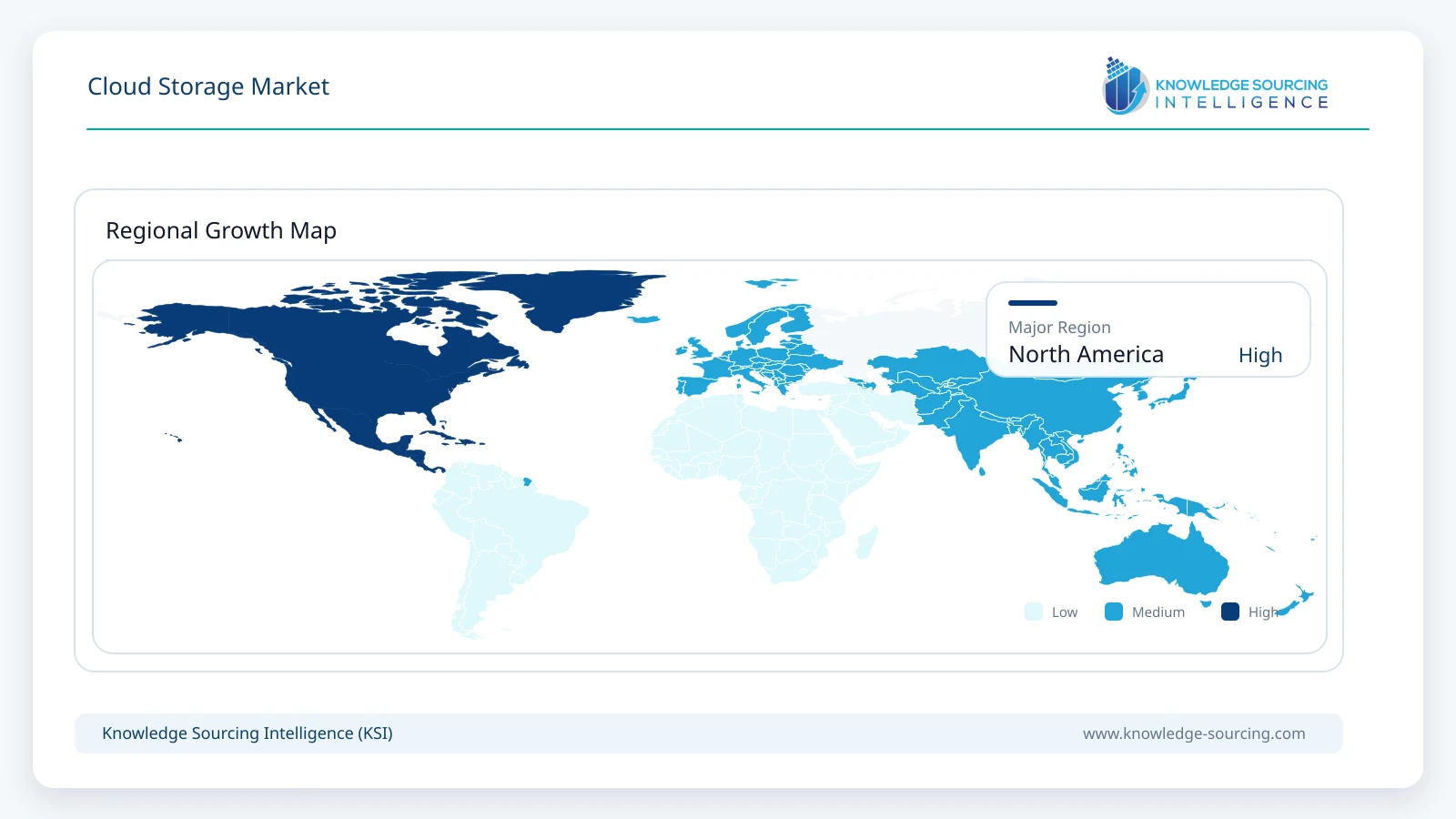
North America | Mature EHR adoption, healthcare cloud investment, AI integration | Strict privacy, cybersecurity, and compliance obligations |
Europe | GDPR compliance, digital health programmes, cross-border interoperability | Data sovereignty and fragmented national regulations |
Asia Pacific | Hospital digitalization, expanding healthcare infrastructure, government health IT initiatives | Uneven cloud maturity and regulatory diversity |
Middle East and Africa | National healthcare modernization and smart hospital investment | Infrastructure availability and skilled workforce limitations |
North America
North America represents one of the most commercially mature markets for healthcare cloud storage because electronic health record adoption, enterprise healthcare IT spending, and cloud-based clinical applications are well established. The United States accounts for the largest share of regional demand, supported by extensive use of electronic medical records, growing adoption of AI-enabled healthcare applications, and continued investment by major cloud providers in healthcare-specific services. Procurement decisions emphasize cybersecurity, disaster recovery, interoperability, and regulatory compliance under HIPAA, while healthcare organizations increasingly migrate secondary workloads before expanding cloud adoption across broader clinical environments.
Europe
European demand is shaped primarily by data protection requirements, digital health strategies, and increasing collaboration across healthcare systems. The General Data Protection Regulation (GDPR) has made governance, consent management, encryption, and data residency central procurement considerations. Countries including Germany, France, and the United Kingdom continue investing in healthcare digitization while encouraging secure exchange of clinical information across providers. Buyers often prefer suppliers with regional cloud infrastructure, established compliance frameworks, and transparent data management practices that reduce regulatory risk.
Asia Pacific
Asia Pacific continues to experience expanding demand as governments invest in digital healthcare infrastructure, electronic medical records, telehealth platforms, and national health information exchanges. China, Japan, India, and Australia represent important commercial markets because healthcare providers continue modernizing information systems while accommodating rising patient volumes. Cloud adoption also supports medical imaging, remote healthcare delivery, and AI-assisted diagnostics. However, procurement strategies differ considerably across countries due to varying privacy regulations, healthcare funding models, and cloud infrastructure maturity, encouraging vendors to localize services and establish regional partnerships.
Middle East and Africa
Healthcare modernization programmes across the Middle East are creating opportunities for cloud storage providers supporting digital hospitals, national electronic health record initiatives, and smart healthcare infrastructure. Countries including the United Arab Emirates, Saudi Arabia, and Israel continue investing in digital transformation programmes that require secure, scalable storage environments. Across many African markets, cloud adoption remains more gradual because infrastructure availability, connectivity, cybersecurity capability, and healthcare IT investment vary considerably between countries. Nevertheless, managed cloud services are becoming increasingly attractive where organizations seek to reduce capital investment while improving system resilience and disaster recovery capabilities.
Competitive Landscape
The cloud storage market for the healthcare industry is characterized by competition among hyperscale cloud providers, enterprise healthcare technology companies, and specialized content management vendors. Competitive differentiation depends less on storage capacity and more on security architecture, healthcare compliance, interoperability, migration expertise, geographic infrastructure, and integration with clinical applications. Amazon Web Services, Microsoft, Google Cloud, Oracle Corporation, IBM, and Dell Technologies continue expanding healthcare-focused cloud portfolios, while Box strengthens its position through secure content management and collaboration capabilities designed for regulated industries. Oracle Health complements Oracle's broader cloud strategy by integrating cloud infrastructure with electronic health record (EHR) platforms and healthcare information systems.
Healthcare customers typically award long-term contracts after detailed security assessments, compliance validation, and interoperability testing. These qualification processes create relatively high switching costs once large clinical datasets and operational workflows are migrated. Suppliers are responding by expanding managed migration services, AI-ready data platforms, disaster recovery offerings, regional cloud infrastructure, and healthcare partner ecosystems. Competition therefore increasingly centers on operational resilience, regulatory assurance, lifecycle data management, and support for hybrid cloud environments rather than pricing alone.
Recent Developments
May 2026 – Everpure (formerly Pure Storage) (Acquisition): Everpure announced the acquisition of 1Touch, adding data intelligence and orchestration to its Enterprise Data Cloud platform, helping healthcare organizations improve clinical data accessibility, governance, AI readiness, and hybrid cloud storage management.
March 2026 – GE HealthCare (Acquisition): GE HealthCare completed the acquisition of Intelerad for approximately $2.3 billion, expanding its cloud-enabled enterprise imaging portfolio with cloud PACS, vendor-neutral archives, image sharing, and AI-powered workflow solutions for healthcare providers.
September 2025 – GE HealthCare (Product Launch): GE HealthCare expanded availability of its Genesis cloud-enabled enterprise imaging portfolio through AWS Marketplace, simplifying healthcare providers' adoption of cloud storage, SaaS imaging, vendor-neutral archiving, and secure medical image management.
June 2025 – Pure Storage (Product Launch): Pure Storage introduced its Enterprise Data Cloud architecture with next-generation FlashArray and FlashBlade platforms, enabling healthcare organizations to unify cloud storage, strengthen cyber resilience, and manage growing clinical datasets across hybrid environments.
Regulatory and Policy Environment
Healthcare cloud storage operates within one of the most highly regulated information management environments. In the United States, the Health Insurance Portability and Accountability Act (HIPAA) establishes requirements for protecting electronic protected health information (ePHI), while the HITECH Act strengthens enforcement and breach notification obligations. Cloud providers supporting covered entities and business associates must implement administrative, technical, and physical safeguards consistent with these requirements.
Across Europe, the General Data Protection Regulation (GDPR) governs the processing and movement of personal health information, placing emphasis on lawful processing, accountability, data minimization, and cross-border data transfers. National healthcare regulations may introduce additional obligations relating to health records, patient consent, and data residency.
Many Asia Pacific and Middle Eastern countries are also strengthening digital health governance through cybersecurity laws, health information exchange frameworks, and national cloud strategies. These regulatory developments increasingly influence purchasing decisions because healthcare organizations evaluate providers on compliance certifications, audit capabilities, encryption standards, identity management, and regional data center availability before awarding enterprise contracts.
Outlook and Strategic Implications
Demand during the 2026–2031 forecast period is expected to remain closely linked to healthcare digitalization rather than storage expansion alone. Electronic health records, medical imaging, genomics, remote patient monitoring, and AI-assisted clinical applications will continue increasing storage requirements while also raising expectations for governance, interoperability, cybersecurity, and resilience. Suppliers capable of combining secure infrastructure with integrated data management, analytics, and managed services are likely to strengthen their competitive position.
Several strategic themes are expected to shape procurement priorities over the forecast period:
Healthcare providers: Preference for hybrid architectures that balance regulatory compliance, operational flexibility, and long-term infrastructure modernization.
Cloud platform providers: Continued investment in healthcare-specific services, regional infrastructure, AI-ready storage platforms, and compliance capabilities.
System integrators and managed service providers: Growing demand for migration, interoperability, cybersecurity, and lifecycle management services as organizations modernize legacy environments.
Regulators and policymakers: Greater emphasis on cybersecurity resilience, data governance, cross-border information management, and protection of sensitive health information.
Commercial success will increasingly depend on a supplier's ability to deliver secure, interoperable, and compliant cloud ecosystems rather than standalone storage infrastructure. As healthcare organizations place greater value on long-term data accessibility, business continuity, and AI-enabled clinical innovation, competition is expected to shift toward platform capability, service quality, ecosystem integration, and demonstrable regulatory assurance.
Market Scope:
| Report Metric | Details |
|---|---|
| Total Market Size in 2026 | USD 10.8 billion |
| Total Market Size in 2031 | USD 21.6 billion |
| Forecast Unit | USD Billion |
| Growth Rate | 14.9% |
| Study Period | 2021 to 2031 |
| Historical Data | 2021 to 2024 |
| Base Year | 2025 |
| Forecast Period | 2026 – 2031 |
| Segmentation | Solution, Deployment Model, Services, Enterprise Size, Geography |
| Companies |
|
Market Segmentation
By Solution
Primary Storage
Backup and Archive Storage
Disaster Recovery Storage
By Deployment Model
Public Cloud
Private Cloud
Hybrid Cloud
By Services
Consulting
Integration and Migration Services
Managed Services
Support and Maintenance
By Enterprise Size
Large
Small and Medium-sized Business (SMB)
By Geography
North America
United States
Canada
Mexico
Others
South America
Brazil
Argentina
Others
Europe
Germany
France
Italy
United Kingdom
Others
Middle East and Africa
Israel
Saudi Arabia
UAE
Others
Asia Pacific
Japan
China
India
Australia
Others
Table of Contents
1. INTRODUCTION
1.1. Market Overview
1.2. Market Definition
1.3. Scope of the Study
1.4. Currency
1.5. Assumptions
1.6. Base and Forecast Years Timeline
2. RESEARCH METHODOLOGY
2.1. Research Design
2.2. Secondary Sources
3. EXECUTIVE SUMMARY
4. MARKET DYNAMICS
4.1. Market Segmentation
4.2. Market Drivers
4.3. Market Restraints
4.4. Market Opportunities
4.5. Porter’s Five Force Analysis
4.5.1. Bargaining Power of Suppliers
4.5.2. Bargaining Power of Buyers
4.5.3. Threat of New Entrants
4.5.4. Threat of Substitutes
4.5.5. Competitive Rivalry in the Industry
4.6. Life Cycle Analysis - Regional Snapshot
4.7. Market Attractiveness
5. CLOUD STORAGE MARKET FOR HEALTHCARE INDUSTRY FORECAST BY SOLUTION
5.1. Primary Storage
5.2. Backup and Archive Storage
5.3. Disaster Recovery Storage
6. CLOUD STORAGE MARKET FOR HEALTHCARE INDUSTRY FORECAST BY DEPLOYMENT MODEL
6.1. Public Cloud
6.2. Private Cloud
6.3. Hybrid Cloud
7. CLOUD STORAGE MARKET FOR HEALTHCARE INDUSTRY FORECAST BY SERVICES
7.1. Consulting
7.2. Integration and Migration Services
7.3. Managed Services
7.4. Support and Maintenance
8. CLOUD STORAGE MARKET FOR HEALTHCARE INDUSTRY FORECAST BY ENTERPRISE SIZE
8.1. Large
8.2. SMB (Small and Medium-sized business)
9. CLOUD STORAGE MARKET FOR HEALTHCARE INDUSTRY FORECAST BY GEOGRAPHY
9.1. North America
9.1.1. United States
9.1.2. Canada
9.1.3. Mexico
9.1.4. Others
9.2. South America
9.2.1. Brazil
9.2.2. Argentina
9.2.3. Others
9.3. Europe
9.3.1. Germany
9.3.2. France
9.3.3. Italy
9.3.4. United Kingdom
9.3.5. Others
9.4. Middle East and Africa
9.4.1. Israel
9.4.2. Saudi Arabia
9.4.3. UAE
9.4.4. Others
9.5. Asia Pacific
9.5.1. Japan
9.5.2. China
9.5.3. India
9.5.4. Australia
9.5.5. Others
10. COMPETITIVE INTELLIGENCE
10.1. Recent Deals and Investment
10.2. Strategies of Key Players
10.3. Investment Analysis
11. COMPANY PROFILES
11.1. Amazon Web Services, Inc.
11.1.1. Company Overview
11.1.2. Financials
11.1.3. Products and Services
11.1.4. Recent Developments
11.2. Microsoft
11.2.1. Company Overview
11.2.2. Financials
11.2.3. Products and Services
11.2.4. Recent Developments
11.3. Google
11.3.1. Company Overview
11.3.2. Financials
11.3.3. Products and Services
11.3.4. Recent Developments
11.4. Oracle Corporation
11.4.1. Company Overview
11.4.2. Financials
11.4.3. Products and Services
11.4.4. Recent Developments
11.5. Box, Inc.
11.5.1. Company Overview
11.5.2. Financials
11.5.3. Products and Services
11.5.4. Recent Developments
11.6. Oracle Health (formerly Cerner)
11.6.1. Company Overview
11.6.2. Financials
11.6.3. Products and Services
11.6.4. Recent Developments
11.7. IBM
11.7.1. Company Overview
11.7.2. Financials
11.7.3. Products and Services
11.7.4. Recent Developments
11.8. Dell Technologies
11.8.1. Company Overview
11.8.2. Financials
11.8.3. Products and Services
11.8.4. Recent Developments
LIST OF FIGURES
LIST OF TABLES
DISCLAIMER
Navigate
Trusted by the world's leading organizations











