Cloud Governance Platform Market - Strategic Insights and Forecasts (2026-2031)
Cloud Governance Platform Market Share, Growth, Forecasts and Industry Trends By Deployment (Public Cloud, Private Cloud, Hybrid Cloud), Functionality (Security and Compliance, Identity and Access Governance, Policy and Configuration Management, Cost Management (FinOps), Automation and Orchestration, Others), End-user (Small and Medium Enterprises (SMEs), Large Enterprises), and Geography
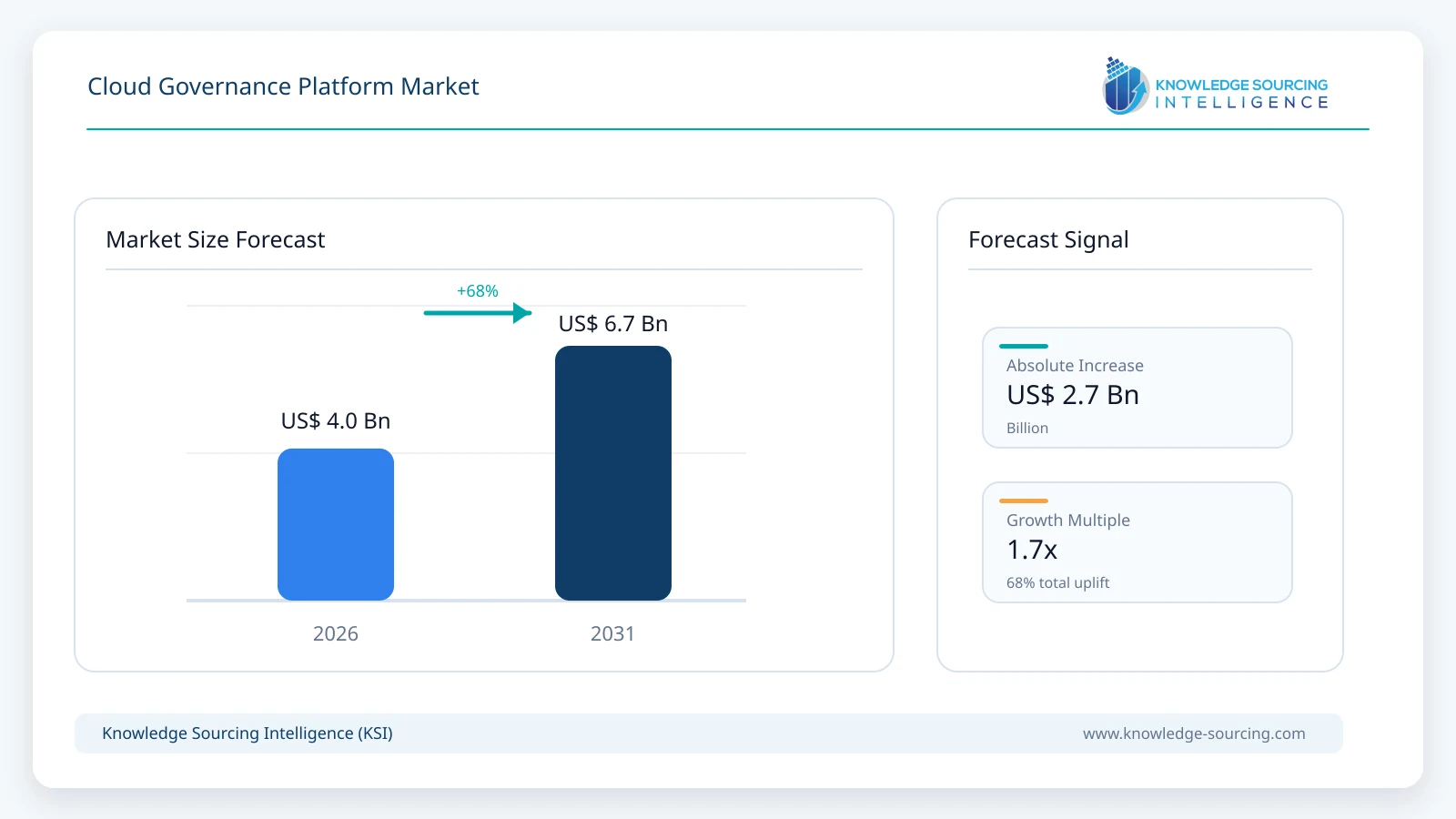
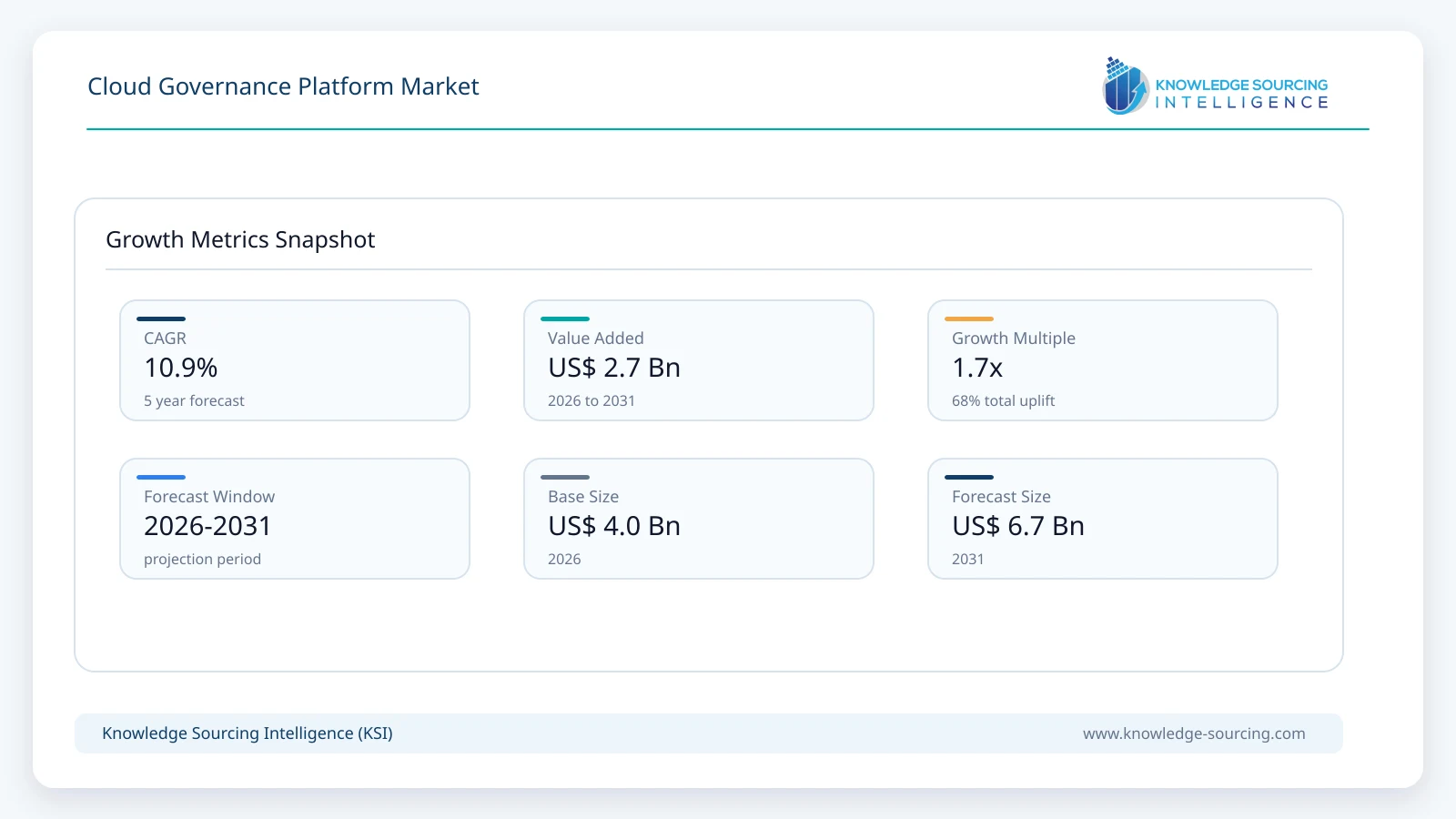
The cloud governance platform market is forecast to grow at a CAGR of 10.9%, reaching USD 6.7 billion in 2031 from USD 4.0 billion in 2026.
Highlights:
1
Growing multi-cloud and hybrid cloud deployments continue to strengthen demand for centralized governance, compliance, and operational control platforms.
2
Security and compliance functionality represents one of the most commercially important solution categories due to expanding regulatory obligations across industries.
3
North America remains a leading regional market supported by mature cloud adoption, enterprise IT spending, and stringent cybersecurity requirements.
4
Artificial intelligence and automation are increasingly incorporated into governance platforms to improve policy enforcement, anomaly detection, and operational efficiency.
5
Data privacy regulations, cybersecurity mandates, and industry-specific compliance frameworks continue to shape enterprise investment priorities.
6
Competition increasingly centers on integrated cloud governance capabilities that combine security, financial management, automation, and operational visibility within a unified platform.
The cloud governance platform market comprises software platforms and integrated management capabilities that help organizations establish, enforce, and monitor policies across public, private, and hybrid cloud environments. These platforms support centralized governance by addressing security controls, regulatory compliance, identity management, resource provisioning, financial accountability, configuration consistency, and operational automation. As enterprises expand their cloud footprints across multiple providers, governance has become a strategic requirement rather than an administrative function, enabling organizations to maintain operational control while supporting business agility.
Enterprise cloud adoption has shifted from isolated workload migration to organization-wide cloud operating models. This transition has increased the complexity of managing identities, application deployments, data residency requirements, and cloud spending across distributed environments. Buyers increasingly seek governance platforms capable of providing unified visibility into cloud assets while automating policy enforcement and reducing manual intervention. Procurement decisions now extend beyond traditional security considerations and include capabilities such as cloud cost optimization, infrastructure-as-code governance, workload monitoring, and continuous compliance reporting.
Demand originates from highly regulated industries including banking, healthcare, telecommunications, manufacturing, retail, government, and information technology services. Organizations operating across multiple jurisdictions require governance solutions that simplify adherence to evolving regulatory obligations while supporting cloud-native development practices. Large enterprises continue to account for a considerable share of platform investments because of their extensive cloud estates and diverse operational requirements. However, cloud-native software vendors and managed service providers are also creating opportunities among small and medium-sized enterprises that require enterprise-grade governance capabilities without extensive in-house administration.
Procurement priorities increasingly emphasize interoperability with existing cloud infrastructure, cybersecurity platforms, DevSecOps pipelines, and enterprise identity systems. Buyers evaluate governance platforms based on automation capabilities, policy customization, multi-cloud compatibility, scalability, reporting accuracy, and integration with cloud provider services. Vendors capable of delivering unified governance across heterogeneous cloud environments gain a competitive advantage as enterprises seek to reduce operational complexity and avoid fragmented management tools.
Cloud financial management has also become an important purchasing consideration. Rising cloud expenditures have prompted organizations to establish governance frameworks that improve resource allocation, eliminate underutilized infrastructure, and increase budget accountability across business units. Consequently, governance platforms increasingly combine operational oversight with FinOps capabilities, allowing organizations to balance innovation objectives with financial discipline.
The supplier ecosystem includes hyperscale cloud providers, enterprise software vendors, IT service management companies, and specialized governance software developers. Competition extends beyond feature breadth to encompass deployment flexibility, API ecosystems, automation maturity, and ecosystem partnerships. Continuous platform enhancement through artificial intelligence-assisted policy recommendations, automated remediation, and predictive compliance monitoring further influences purchasing decisions among enterprise customers.
Market Drivers
Expansion of Multi-Cloud and Hybrid Cloud Strategies
Organizations increasingly distribute workloads across multiple cloud providers while maintaining private cloud infrastructure for business-critical applications. This approach improves resilience, workload flexibility, and vendor diversification but introduces governance complexity that cannot be managed effectively through provider-specific tools alone.
Enterprise buyers therefore seek centralized governance platforms capable of enforcing standardized policies across heterogeneous cloud environments. Unified governance reduces administrative overhead, improves visibility into cloud resources, and minimizes configuration inconsistencies. Vendors respond by expanding integrations with leading cloud providers while supporting policy synchronization, automated compliance assessments, and centralized monitoring. These capabilities improve operational consistency and reduce enterprise risk associated with fragmented cloud management.
Rising Regulatory and Cybersecurity Compliance Requirements
Governments and industry regulators continue strengthening cybersecurity, data privacy, and operational resilience requirements across multiple sectors. Organizations handling financial information, healthcare records, government data, or critical infrastructure must demonstrate continuous compliance rather than periodic audits.
Cloud governance platforms address this requirement by automating policy enforcement, maintaining audit trails, monitoring security configurations, and identifying compliance deviations in real time. Buyers increasingly prioritize platforms capable of supporting multiple regulatory frameworks simultaneously. This trend encourages software vendors to expand compliance libraries, reporting capabilities, and automated remediation functions, creating additional commercial opportunities within regulated industries.
Increasing Enterprise Focus on Cloud Cost Governance
Cloud adoption has accelerated infrastructure scalability, but uncontrolled resource provisioning frequently results in budget overruns and inefficient utilization. Finance departments increasingly collaborate with IT and cloud operations teams to improve financial accountability for cloud spending.
Governance platforms have consequently evolved to incorporate FinOps capabilities including resource utilization monitoring, budget controls, spending forecasts, chargeback mechanisms, and policy-based resource optimization. Organizations view these capabilities as strategic tools for balancing operational flexibility with financial discipline. Vendors capable of combining governance and cloud financial management within a unified platform strengthen their competitive positioning among enterprise customers seeking operational efficiency.
Greater Adoption of Infrastructure Automation and DevSecOps
Modern software development increasingly depends on automated deployment pipelines and infrastructure-as-code practices. Manual governance processes are often incompatible with continuous software delivery because they delay deployments and introduce operational inconsistencies.
Organizations therefore invest in governance platforms that integrate directly with DevOps workflows, automatically validate infrastructure configurations, enforce security policies, and detect deployment risks before production implementation. These capabilities improve software delivery efficiency while maintaining governance standards. Suppliers increasingly differentiate their offerings through automation frameworks, API support, and integration with enterprise development environments.
Market Restraints and Challenges
Integration Complexity Across Diverse Cloud Environments
Many enterprises operate legacy applications alongside modern cloud-native workloads distributed across multiple providers. Integrating governance platforms with diverse infrastructure, identity systems, security applications, and operational workflows often requires substantial planning and customization.
Implementation complexity may lengthen deployment timelines, increase consulting costs, and delay realization of expected operational benefits. Organizations frequently mitigate these challenges through phased deployment strategies, standardized cloud architectures, and greater reliance on experienced implementation partners.
Shortage of Skilled Cloud Governance Professionals
Effective governance extends beyond software implementation and requires expertise in cloud architecture, cybersecurity, compliance management, financial operations, and automation technologies. Many organizations face difficulty recruiting professionals with interdisciplinary cloud governance experience.
Limited internal expertise may reduce platform utilization, delay policy development, and increase dependence on managed service providers. Software vendors increasingly address this constraint by improving platform usability, offering guided policy templates, expanding customer education programs, and incorporating intelligent automation to simplify governance administration.
Balancing Governance with Business Agility
Business units increasingly expect rapid cloud provisioning to accelerate product development and digital service delivery. Excessively restrictive governance frameworks can slow innovation, extend approval cycles, and reduce organizational responsiveness.
Decision-makers therefore seek governance platforms that combine automated policy enforcement with operational flexibility. Vendors continue developing adaptive governance capabilities that enable risk-based controls, automated approvals, and policy exceptions without compromising security or compliance objectives. Achieving this balance remains an important factor influencing customer satisfaction and long-term platform adoption.
Vendor Interoperability and Platform Standardization
Organizations often use products from multiple cloud providers and enterprise software vendors. Differences in APIs, configuration standards, security models, and management interfaces create interoperability challenges that complicate unified governance implementation.
Enterprises increasingly prioritize platforms supporting open architectures, standardized integrations, and extensive partner ecosystems. Suppliers capable of maintaining broad interoperability across cloud environments strengthen customer retention while reducing concerns related to vendor lock-in.
Major Segment Analysis
Security and Compliance Functionality
Security and compliance represent one of the most commercially significant functionality segments because governance initiatives are frequently initiated in response to regulatory obligations, cybersecurity risks, and enterprise risk management priorities. Organizations recognize that cloud adoption without centralized policy enforcement can expose critical workloads to configuration errors, unauthorized access, and compliance violations that carry financial and reputational consequences.
Enterprise buyers increasingly require governance platforms capable of continuously monitoring cloud environments, identifying policy deviations, automating remediation actions, and generating audit-ready compliance reports. Industries such as banking, healthcare, government, insurance, and telecommunications place particular emphasis on these capabilities due to stringent regulatory oversight and high-value data assets.
Competition within this segment increasingly depends on the breadth of supported regulatory frameworks, automation maturity, integration with security information and event management platforms, identity services, and cloud-native security tools. Vendors also differentiate through artificial intelligence-assisted threat detection, continuous compliance monitoring, and policy recommendation engines that reduce manual administration.
Commercially, security and compliance functionality generates recurring revenue opportunities through subscription licensing, managed governance services, compliance content updates, and premium analytics capabilities. As organizations continue expanding multi-cloud operations while facing stricter cybersecurity expectations, this functionality is expected to remain central to enterprise cloud governance investment strategies.
Regional Analysis
North America
North America represents the most mature regional market for cloud governance platforms due to widespread enterprise cloud adoption, advanced cybersecurity practices, and strong investment in hybrid and multi-cloud architectures. Financial services, healthcare, government agencies, technology companies, and telecommunications operators continue expanding cloud deployments while facing stringent governance and data protection obligations. Enterprise procurement increasingly favors platforms that integrate cloud security posture management, identity governance, FinOps, and policy automation within a unified operating model.
The United States remains the primary revenue contributor, supported by substantial cloud infrastructure investments and the presence of leading hyperscale cloud providers and enterprise software vendors. Buyers increasingly evaluate governance platforms based on automation capabilities, interoperability with existing security ecosystems, and support for AI-enabled operational controls. Canada continues strengthening cloud governance investments through public-sector modernization initiatives and regulated industry adoption, while Mexico presents opportunities as multinational organizations expand regional cloud infrastructure and digital operations.
Europe
European demand is primarily influenced by data privacy legislation, operational resilience requirements, and increasing emphasis on digital sovereignty. Organizations operating across multiple European jurisdictions require governance platforms capable of supporting data residency controls, audit reporting, and continuous compliance monitoring. Procurement decisions frequently prioritize platforms offering transparent policy management, identity governance, encryption management, and automated compliance documentation.
Manufacturing, banking, insurance, public administration, and pharmaceutical organizations remain among the largest enterprise buyers. Cloud governance investments increasingly accompany hybrid cloud adoption strategies that balance operational flexibility with regulatory compliance. However, differences in national regulatory interpretations and legacy IT environments may extend implementation timelines and increase integration complexity for multinational enterprises.
Asia Pacific
Asia Pacific is expected to register strong adoption as governments and enterprises continue investing in cloud infrastructure, digital public services, financial technology, e-commerce, and manufacturing modernization. Countries including China, Japan, India, Australia, and South Korea continue expanding enterprise cloud utilization while strengthening cybersecurity and data governance frameworks.
Large enterprises increasingly adopt governance platforms to standardize cloud operations across geographically distributed business units. Cloud-native startups and managed service providers also contribute to regional demand by seeking scalable governance solutions that simplify operational management without extensive internal resources. Cost sensitivity remains an important purchasing consideration, encouraging demand for subscription-based governance platforms with modular functionality.
Regional diversity presents implementation challenges because regulatory requirements, cloud adoption maturity, and digital infrastructure vary considerably across markets. Vendors with localized compliance capabilities, regional partnerships, and extensive cloud ecosystem integrations are better positioned to expand their customer base.
Middle East & Africa and South America
The Middle East continues increasing investments in cloud infrastructure as governments pursue national digital economy initiatives and encourage public-sector modernization. Financial institutions, energy companies, telecommunications providers, and government organizations increasingly require governance platforms capable of supporting cybersecurity compliance and sovereign cloud initiatives. Adoption remains influenced by regulatory developments, local cloud availability, and enterprise readiness.
South America presents steady opportunities, particularly in Brazil and Argentina, where financial institutions, retailers, and industrial enterprises continue migrating workloads to cloud environments. Budget constraints and limited cloud governance expertise may moderate adoption among smaller organizations, although managed cloud services and regional implementation partners help reduce deployment barriers.
Competitive Landscape
The cloud governance platform market demonstrates a moderately concentrated competitive structure characterized by established enterprise software providers, hyperscale cloud vendors, and specialized cloud management companies. Competition extends beyond governance functionality to encompass integration capabilities, operational automation, cloud financial management, artificial intelligence, and enterprise workflow orchestration.
Suppliers increasingly differentiate their offerings by providing unified platforms that consolidate security governance, compliance monitoring, policy management, identity administration, cost optimization, and automated remediation. Organizations prefer platforms capable of supporting public, private, and hybrid cloud environments without requiring multiple standalone management products.
Strategic partnerships remain an important competitive approach as vendors expand interoperability across cloud providers, cybersecurity platforms, DevOps toolchains, and enterprise IT service management environments. Open APIs, automation frameworks, and marketplace integrations improve platform extensibility while supporting customer-specific operational requirements.
Competition also reflects growing customer demand for AI-enabled governance capabilities. Vendors increasingly incorporate intelligent policy recommendations, automated compliance validation, anomaly detection, and predictive operational insights that reduce manual administration and improve governance efficiency.
Geographic expansion, cloud marketplace availability, subscription-based pricing models, and managed governance services further strengthen competitive positioning. As enterprise cloud environments become more distributed, suppliers capable of delivering consistent governance across multiple cloud providers while minimizing operational complexity are expected to strengthen long-term customer relationships.
Recent Developments
June 2026: Microsoft showcased expanded Azure governance and AI governance capabilities during Microsoft Build 2026, enabling partners to deliver cloud governance, migration, compliance, and cross-platform architecture services for enterprise customers.
June 2026: Everpure launched its Data Intelligence Platform, adding automated governance, enterprise-wide data discovery, compliance automation, and AI-ready data mapping to strengthen governance across hybrid cloud and enterprise data environments.
April 2026: Google Cloud highlighted major governance and security innovations at Google Cloud Next 2026, emphasizing AI-native cloud management, cross-cloud security, and integrated governance capabilities following its Wiz acquisition.
March 2026: OneTrust introduced its AI-Ready Governance brand positioning, expanding governance capabilities to help enterprises manage AI, data, privacy, security, and regulatory compliance through a unified trust intelligence platform.
March 2026: Flexera released its 2026 State of the Cloud Report, highlighting stronger FinOps maturity, wider Cloud Center of Excellence adoption, and increasing governance requirements driven by AI workloads and hybrid cloud complexity. The findings reinforce demand for centralized cloud governance platforms.
May 2026: ServiceNow and Amazon Web Services expanded their collaboration by introducing a unified AI governance architecture through ServiceNow AI Control Tower and Amazon Bedrock AgentCore, enabling enterprises to govern AI workloads within existing cloud operations.
Regulatory and Policy Environment
Cloud governance platforms are increasingly deployed to help organizations satisfy expanding cybersecurity, privacy, and operational resilience obligations. Regulations governing personal information, financial transactions, healthcare records, and critical infrastructure require organizations to demonstrate continuous monitoring, access control, auditability, and secure configuration management throughout cloud environments.
Data protection legislation across multiple jurisdictions continues influencing procurement priorities by requiring organizations to establish stronger identity governance, encryption management, data residency controls, and incident reporting processes. Enterprises operating internationally increasingly seek governance platforms capable of supporting multiple regulatory frameworks simultaneously through configurable policy libraries and automated compliance reporting.
Industry standards such as ISO/IEC 27001, ISO/IEC 27017, ISO/IEC 27018, SOC 2, and the NIST Cybersecurity Framework also influence purchasing decisions because organizations increasingly align internal governance practices with internationally recognized security frameworks. Continuous compliance monitoring has become more valuable than periodic assessments as regulators place greater emphasis on operational resilience.
Government cloud modernization initiatives further support adoption by encouraging standardized governance practices across public-sector agencies and regulated industries. Organizations increasingly evaluate governance platforms based on their ability to simplify audit preparation, reduce compliance costs, and automate policy enforcement without disrupting operational performance.
Outlook and Strategic Implications
The cloud governance platform market is expected to remain supported by enterprise investment in multi-cloud operations, hybrid infrastructure, artificial intelligence, and cloud-native application development. Governance is becoming an operational requirement that extends beyond security into financial management, infrastructure automation, software delivery, and enterprise risk management.
Procurement priorities are expected to favor platforms capable of integrating governance across cloud infrastructure, AI services, software supply chains, and enterprise workflows through centralized policy management. Buyers will increasingly assess solutions based on automation maturity, interoperability, implementation flexibility, and measurable operational outcomes rather than standalone governance functionality.
Artificial intelligence is expected to influence platform development through intelligent policy generation, automated remediation, predictive compliance analysis, and operational optimization. However, enterprises will continue requiring transparent governance controls, human oversight, and comprehensive audit capabilities before expanding autonomous cloud operations.
Competitive positioning will increasingly depend on ecosystem integration, cloud neutrality, and the ability to unify governance across diverse technology environments. Vendors capable of combining security, compliance, identity governance, FinOps, automation, and AI governance within scalable enterprise platforms are likely to strengthen long-term commercial opportunities.
At the same time, organizations must address implementation complexity, governance skill shortages, and evolving regulatory obligations. Enterprises that establish standardized governance frameworks early, supported by interoperable platforms and automated policy management, are expected to achieve greater operational efficiency, improved regulatory readiness, and stronger control over expanding cloud environments.
Cloud governance platform market scope
Report Metric
Details
Total Market Size in 2026
USD 4.0 billion
Total Market Size in 2031
USD 6.7 billion
Forecast Unit
Billion
Growth Rate
10.9%
Study Period
2021 to 2031
Historical Data
2021 to 2024
Base Year
2025
Forecast Period
2026 – 2031
Segmentation
Deployment, Functionality, End-User, Geography
Companies
Flexera Software LLC
Amazon Web Services Inc.
Microsoft Corporation
Google LLC
IBM Corporation
Oracle Corporation
Market Segmentation
By Deployment
Public Cloud
Private Cloud
Hybrid Cloud
By Functionality
Security and Compliance
Identity and Access Governance
Policy and Configuration Management
Cost Management (FinOps)
Automation and Orchestration
Others
By End-User
Small and Medium Enterprises (SMEs)
Large Enterprises
By Geography
North America
United States
Canada
Mexico
South America
Brazil
Argentina
Others
Europe
United Kingdom
Germany
France
Italy
Spain
Others
Middle East and Africa
Saudi Arabia
United Arab Emirates
South Africa
Others
Asia Pacific
China
Japan
India
South Korea
Australia
Indonesia
Thailand
Others
Table of Contents
1. INTRODUCTION
1.1. Market Overview
1.2. Market Definition
1.3. Scope of the Study
1.4. Market Segmentation
1.5. Currency
1.6. Assumptions
1.7. Base and Forecast Years Timeline
1.8. Key Benefits to the Stakeholder
2. RESEARCH METHODOLOGY
2.1. Research Design
2.2. Research Processes
3. EXECUTIVE SUMMARY
3.1. Key Findings
3.2. CXO Perspective
4. MARKET DYNAMICS
4.1. Market Drivers
4.2. Market Restraints
4.3. Market Opportunities
4.4. Porter’s Five Forces Analysis
4.4.1. Bargaining Power of Suppliers
4.4.2. Bargaining Power of Buyers
4.4.3. Threat of New Entrants
4.4.4. Threat of Substitutes
4.4.5. Competitive Rivalry in the Industry
4.5. Industry Value Chain Analysis
4.6. Analyst View
5. CLOUD GOVERNANCE PLATFORM MARKET BY DEPLOYMENT
5.1. Introduction
5.2. Public Cloud
5.3. Private Cloud
5.4. Hybrid Cloud
6. CLOUD GOVERNANCE PLATFORM MARKET BY FUNCTIONALITY
6.1. Introduction
6.2. Security and Compliance
6.3. Identity and Access Governance
6.4. Policy and Configuration Management
6.5. Cost Management (FinOps)
6.6. Automation and Orchestration
6.7. Others
7. CLOUD GOVERNANCE PLATFORM MARKET BY END-USER
7.1. Introduction
7.2. Small and Medium Enterprises (SMEs)
7.3. Large Enterprises
8. CLOUD GOVERNANCE PLATFORM MARKET BY GEOGRAPHY
8.1. Introduction
8.2. North America
8.2.1. By Deployment
8.2.2. By Functionality
8.2.3. By End-User
8.2.4. By Country
8.2.4.1. United States
8.2.4.2. Canada
8.2.4.3. Mexico
8.3. South America
8.3.1. By Deployment
8.3.2. By Functionality
8.3.3. By End-User
8.3.4. By Country
8.3.4.1. Brazil
8.3.4.2. Argentina
8.3.4.3. Others
8.4. Europe
8.4.1. By Deployment
8.4.2. By Functionality
8.4.3. By End-User
8.4.4. By Country
8.4.4.1. United Kingdom
8.4.4.2. Germany
8.4.4.3. France
8.4.4.4. Italy
8.4.4.5. Spain
8.4.4.6. Others
8.5. Middle East and Africa
8.5.1. By Deployment
8.5.2. By Functionality
8.5.3. By End-User
8.5.4. By Country
8.5.4.1. Saudi Arabia
8.5.4.2. United Arab Emirates
8.5.4.3. South Africa
8.5.4.4. Others
8.6. Asia Pacific
8.6.1. By Deployment
8.6.2. By Functionality
8.6.3. By End-User
8.6.4. By Country
8.6.4.1. China
8.6.4.2. Japan
8.6.4.3. India
8.6.4.4. South Korea
8.6.4.5. Australia
8.6.4.6. Indonesia
8.6.4.7. Thailand
8.6.4.8. Others
9. COMPETITIVE ENVIRONMENT AND ANALYSIS
9.1. Major Players and Strategy Analysis
9.2. Market Share Analysis
9.3. Mergers, Acquisitions, Agreements, and Collaborations
The Cloud Governance Platform Market is forecast to experience robust growth, with a projected Compound Annual Growth Rate (CAGR) of 10.9%. This growth is anticipated to increase the market size from USD 4.0 billion in 2026 to USD 6.7 billion by 2031, reflecting increasing adoption and strategic investment in managing cloud resources effectively.
Cloud governance platforms provide essential capabilities such as cost optimization and tracking, security monitoring, automating compliance checks, and implementing set policies. Key features include predominant policy administration, dashboarding, workflow automation, access monitoring, and control, all integrated to offer a single view of the entire cloud backbone.
The heightened demand for real-time visibility is a key driver, as organizations require precise perspectives of their cloud setup to track consumption, identify potential threats, and optimize work effectiveness. This seniority of vision ensures proactive management, helps in minimizing wastage and unnecessary costs, and is crucial for maintaining regulatory compliance, security, and governance.
The emergence of hybrid computing, which leverages both public/private clouds and on-premises facilities, and edge computing, which processes data closer to its source to reduce latency, has significantly altered IT infrastructure. These trends necessitate increased adaptable governance solutions to effectively manage distributed resources and ensure flexibility, driving market growth.
Cloud governance frameworks are particularly useful and seeing significant adoption in regulated sectors where compliance and data security are essential. This includes industries such as banking, healthcare, and e-commerce, where these platforms assist organizations in adhering to different regulations and safeguarding consumer data.
Organizations implementing cloud governance platforms gain strategic advantages including improved operational efficiency, reduced risk of possible data breaches or unauthorized access, and significant cost reductions. These platforms ensure optimum utilization of virtual resources, automate compliance, and provide centralized control, enhancing overall security posture and adherence to set guidelines.