
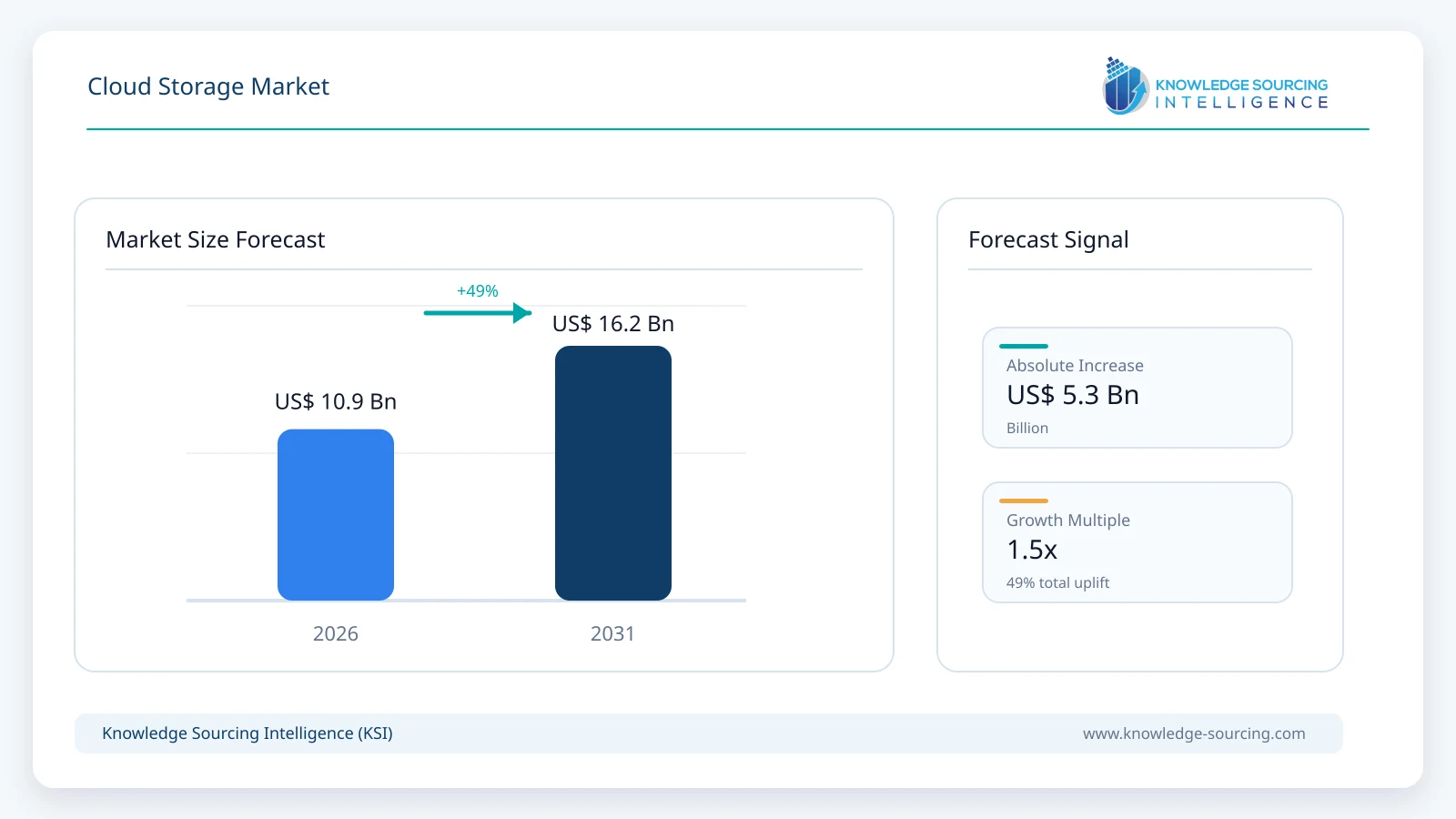
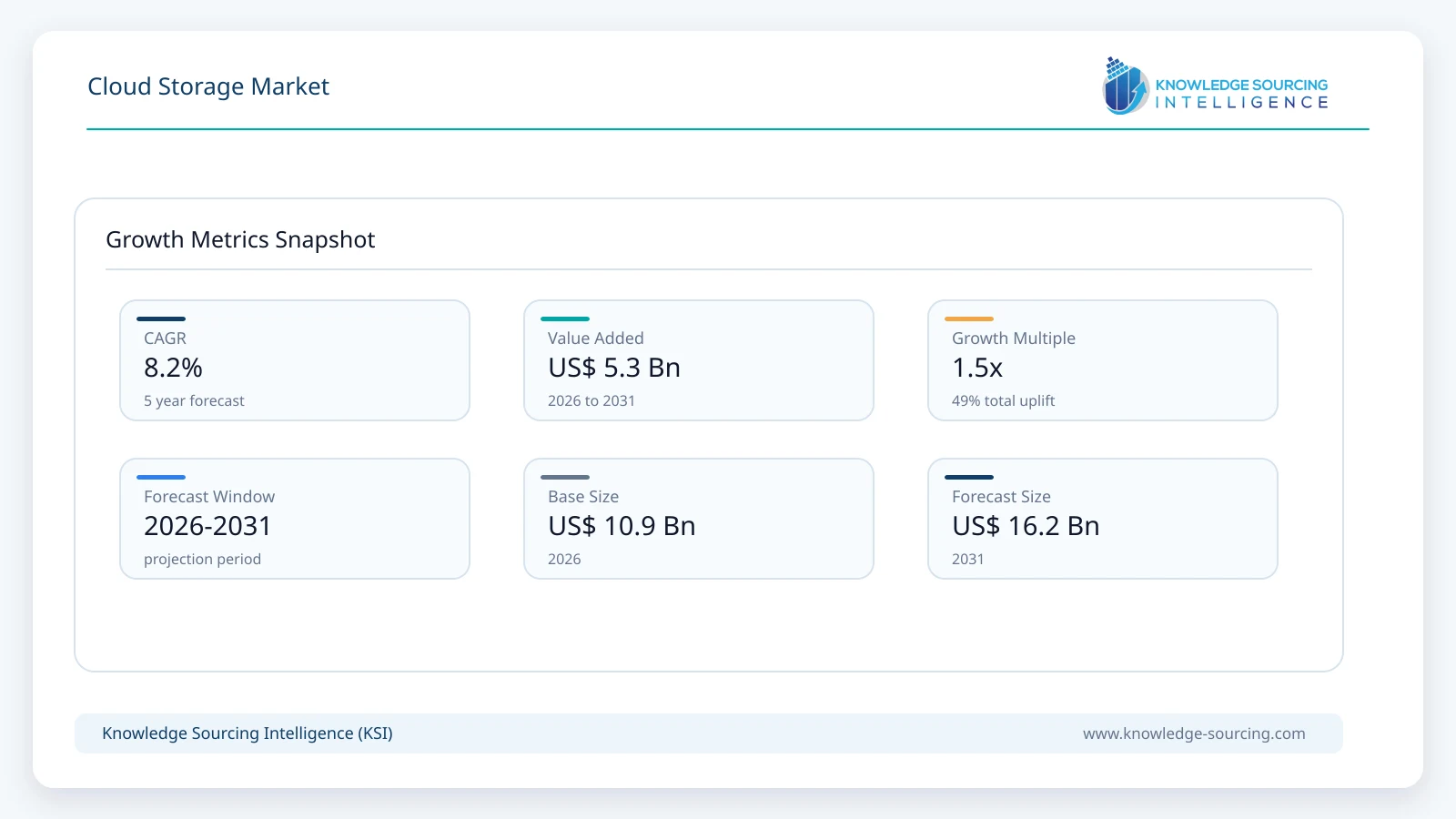
The Cloud Storage Market for Manufacturing Industry is forecast to grow at a CAGR of 8.2%, reaching USD 16.2 billion in 2031 from USD 10.9 billion in 2026.
Highlights:
- 1Manufacturing cloud storage demand is shifting from simple data archiving to integrated operational data management across production environments.
- 2Hybrid cloud deployments remain commercially important as manufacturers balance data sovereignty, latency, cybersecurity, and factory connectivity requirements.
- 3Industrial AI, digital twins, predictive maintenance, and IIoT deployments are increasing storage capacity and lifecycle data management needs.
- 4Cyber resilience, disaster recovery, and regulatory compliance have become central purchasing criteria alongside scalability and cost.
- 5Cloud providers are expanding manufacturing-focused platforms, edge capabilities, and industrial data services to strengthen enterprise adoption.
Market Overview
Manufacturers typically operate heterogeneous environments where enterprise resource planning (ERP), manufacturing execution systems (MES), supervisory control and data acquisition (SCADA), industrial Internet of Things (IIoT) platforms, and product lifecycle management (PLM) systems must exchange information securely. Cloud storage vendors are responding by integrating storage services with analytics, AI, edge computing, and industrial application ecosystems rather than competing on storage pricing alone. AWS notes that modernization of manufacturing execution systems depends on secure integration between shop-floor equipment and enterprise applications, while cloud-based historian modernization improves access to operational data trapped in legacy systems.
Manufacturing buyers increasingly evaluate suppliers according to resilience, ransomware recovery, regulatory compliance, geographic availability, industrial connectivity, and long-term operating costs. Hybrid architectures continue to receive considerable attention because many production workloads require low-latency processing while enterprise analytics and historical data management benefit from scalable cloud infrastructure. The commercial value of the market therefore extends well beyond storage infrastructure, supporting digital manufacturing initiatives, predictive maintenance, AI-driven production optimization, engineering collaboration, and secure multi-site operations.
Key Market Indicators
Indicator | Latest Evidence | Commercial Meaning |
Manufacturing data modernization | Legacy MES and historian modernization | Drives migration from isolated factory storage to cloud-integrated industrial platforms. |
Industrial AI adoption | Manufacturers increasingly building AI and agent-based solutions | Higher AI workloads require scalable, governed storage infrastructure. |
OT-IT convergence | Industrial data integration prioritized | Unified storage becomes essential for enterprise-wide manufacturing visibility. |
Disaster recovery priority | Cloud storage widely used for backup and recovery | Cyber resilience is becoming a purchasing requirement rather than an optional capability. |
Buyer selection criteria | Security, interoperability, scalability, and data governance | Competitive differentiation increasingly depends on platform capability instead of storage price alone. |
Market Drivers
Industrial AI and connected manufacturing require centralized operational data. Manufacturers are connecting production equipment, engineering systems, quality inspection platforms, and enterprise software to create continuous digital workflows. These initiatives depend on storage environments capable of handling structured and unstructured industrial data while supporting analytics and AI. Microsoft identifies secure digital threads, interoperable data platforms, and AI-ready manufacturing datasets as central priorities for industrial transformation. Cloud providers are expanding integrated storage and data services that allow manufacturers to combine operational technology with enterprise applications, increasing demand for scalable storage architectures rather than isolated on-premises repositories.
Manufacturing execution system and historian modernization are increasing migration projects. Many manufacturers continue operating legacy MES platforms and on-premises data historians that restrict enterprise-wide visibility and advanced analytics. Modernization projects increasingly replace isolated storage with cloud-connected repositories capable of supporting predictive maintenance, production optimization, and centralized monitoring across multiple facilities. AWS guidance highlights that historian modernization enables organizations to unlock production data from ageing equipment while improving operational decision-making through cloud analytics and machine learning capabilities. Integration and migration services therefore represent an important source of supplier revenue as enterprises modernize long-established factory infrastructure.
Cyber resilience and business continuity are changing storage procurement priorities. Manufacturing has become a frequent target of ransomware and operational disruption, making resilient backup architectures a strategic investment rather than an infrastructure upgrade. Enterprise buyers increasingly require immutable backups, rapid disaster recovery, geographically distributed replication, and continuous data protection for production systems. AWS identifies cloud storage as a durable platform for backup, disaster recovery, and business continuity while emphasizing that manufacturers must also address low-latency operational requirements for critical factory workloads. Vendors are therefore strengthening hybrid recovery capabilities alongside cloud-native storage offerings to satisfy manufacturing risk-management requirements.
Expansion of edge computing and distributed manufacturing environments is supporting hybrid cloud adoption. Modern production networks extend across multiple factories, suppliers, warehouses, and engineering centers that generate continuous operational data. Not all information can be processed in centralized cloud environments because production control often requires deterministic, low-latency performance. Manufacturers are consequently investing in hybrid architectures that retain selected workloads near production assets while synchronizing operational and historical data with cloud platforms. Microsoft's manufacturing strategy emphasizes adaptive cloud infrastructure, secure edge connectivity, and unified industrial data management, reflecting buyer demand for flexible storage environments rather than exclusive reliance on either public or private cloud deployments.
Market Restraints and Challenges
Operational technology integration remains technically demanding. Manufacturing environments often include decades-old programmable logic controllers (PLCs), supervisory control and data acquisition (SCADA) systems, manufacturing execution systems (MES), and proprietary industrial protocols that were not designed for cloud connectivity. Migrating these assets without interrupting production requires extensive validation, middleware, and phased implementation. IBM and Microsoft both emphasize that successful industrial cloud adoption depends on secure IT and OT integration rather than storage migration alone. For manufacturers operating continuous production facilities, even short periods of downtime can delay implementation schedules and increase project costs.
Cybersecurity obligations continue to expand across connected factories. Cloud adoption increases opportunities for centralized security management, but it also broadens the attack surface as production systems exchange data with enterprise applications, suppliers, and remote users. The U.S. National Institute of Standards and Technology (NIST) and the U.S. Cybersecurity and Infrastructure Security Agency (CISA) recommend segmented architectures, identity management, continuous monitoring, and secure backup strategies for industrial environments. Suppliers must therefore invest in encryption, access governance, ransomware recovery, and compliance capabilities, while manufacturers often extend procurement cycles to verify security controls before approving cloud deployments.
Data sovereignty and regulatory compliance complicate multinational deployments. Large manufacturers frequently operate production facilities across several jurisdictions, each with different requirements for personal data protection, industrial information handling, and cross-border data transfers. European operations must comply with the General Data Protection Regulation (GDPR), while other markets impose local cybersecurity or critical infrastructure rules. These obligations encourage regional storage architectures and increase demand for data residency options, adding operational complexity for providers that serve globally distributed manufacturing customers.
Migration costs and skills shortages can delay implementation. Moving engineering drawings, production records, machine histories, quality documentation, and application workloads from legacy environments requires specialized expertise in industrial systems, cybersecurity, and cloud architecture. Many manufacturers continue to report shortages of professionals with combined OT and cloud experience, increasing dependence on external integration partners. Service providers are expanding consulting, migration, and managed services to address this gap, but project costs remain a consideration for mid-sized manufacturers with limited digital transformation budgets.
Major Segment Analysis
Hybrid Cloud Deployment
Hybrid cloud represents the most commercially important deployment model because manufacturing operations rarely support a complete transition to either public or private cloud infrastructure. Production equipment, quality inspection systems, robotics, and process control applications often require local processing to maintain low latency and operational continuity, while enterprise analytics, engineering collaboration, disaster recovery, and historical data storage benefit from elastic cloud resources. This combination aligns with the operational priorities of manufacturers seeking greater scalability without compromising production reliability.
Purchasing decisions within the hybrid deployment segment extend beyond storage capacity. Manufacturers evaluate integration with existing MES, ERP, PLM, and industrial IoT platforms, together with cybersecurity, regulatory compliance, recovery time objectives, and multi-site synchronization. Vendors therefore compete through integrated storage services, edge computing capabilities, automated lifecycle management, and industrial application ecosystems rather than infrastructure pricing alone. Compared with fully public cloud deployments, hybrid environments generally involve higher implementation complexity but offer greater operational flexibility for organizations managing geographically distributed factories and mixed-generation production assets.
Regional Analysis
Region | Main Demand Signal | Principal Constraint |
North America | Industrial cloud investment, smart manufacturing programs, AI adoption | Cybersecurity compliance and legacy OT integration |
Europe | Industry 4.0 initiatives, manufacturing digitization, data governance | Data sovereignty and regulatory compliance |
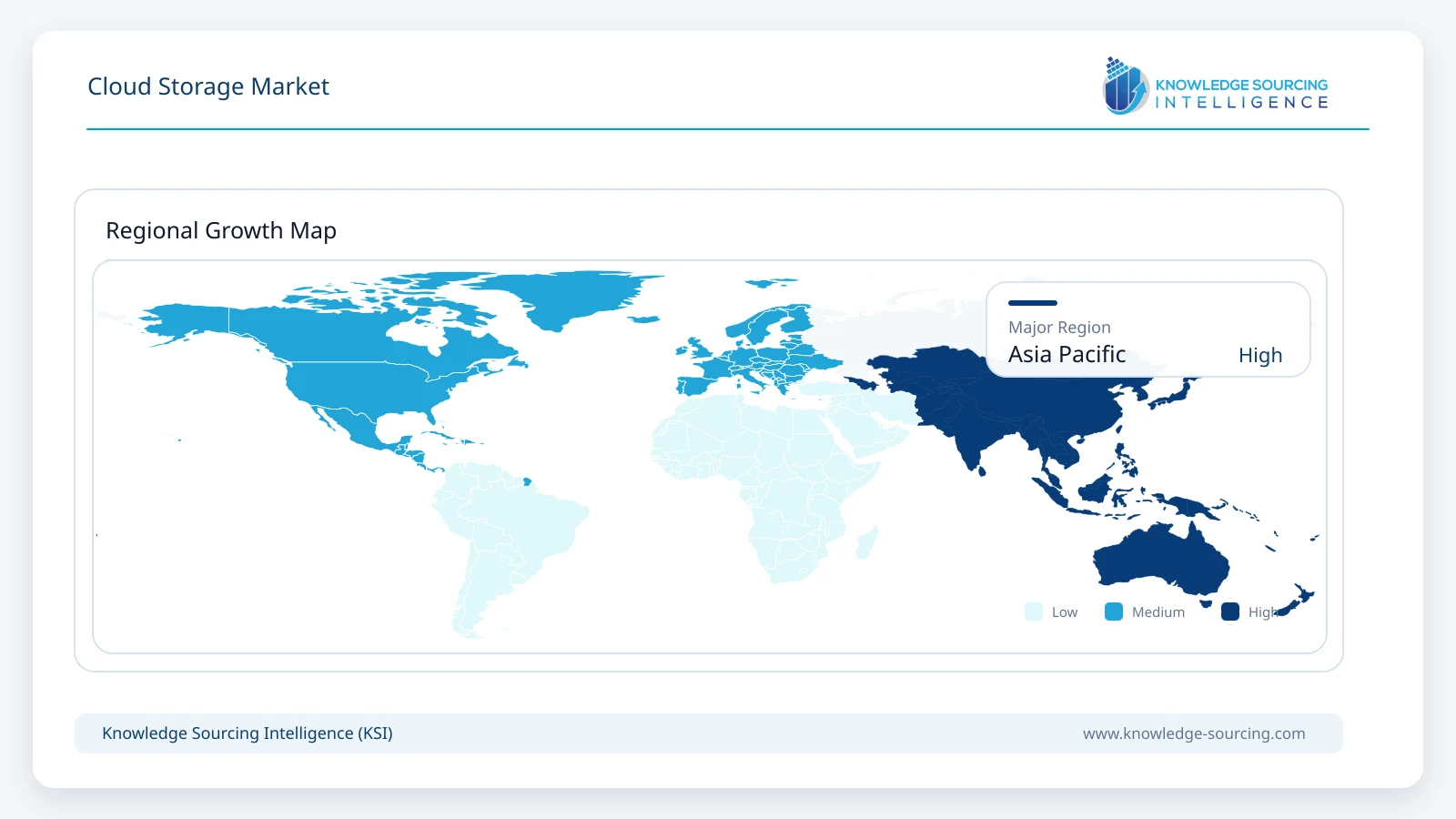
Asia Pacific | Expanding manufacturing capacity, factory automation, electronics production | Uneven cloud maturity across developing economies |
Middle East and Africa | Industrial diversification and smart manufacturing investment | Limited specialist workforce and digital infrastructure in some markets |
North American demand is supported by mature cloud infrastructure, widespread industrial automation, and continued investment in digital manufacturing. The United States remains the largest contributor within the region owing to its extensive manufacturing base across aerospace, automotive, electronics, food processing, and industrial equipment. Federal cybersecurity guidance from agencies such as NIST and CISA has encouraged manufacturers to strengthen resilience through secure cloud architectures, backup modernization, and identity management. Large enterprises are also expanding AI-enabled manufacturing programs, increasing requirements for centralized industrial data storage.
European manufacturers continue to invest in connected production environments supported by Industry 4.0 strategies, digital engineering, and sustainability reporting obligations. Germany maintains a particularly strong position because of its advanced automotive, machinery, and industrial equipment sectors. At the same time, GDPR and additional national cybersecurity requirements influence storage architecture decisions by encouraging regional data residency and stronger governance controls. Consequently, suppliers frequently expand European cloud regions and compliance capabilities to meet customer expectations.
Asia Pacific represents one of the most active investment environments for manufacturing cloud storage because the region combines extensive industrial production with accelerating factory automation. China, Japan, South Korea, and India continue investing in digital manufacturing, industrial robotics, semiconductor production, and electronics assembly, generating increasing volumes of operational data. Government-backed manufacturing initiatives and expanding domestic cloud infrastructure further support enterprise adoption. However, implementation speeds vary across countries because digital maturity, connectivity, and regulatory frameworks remain uneven.
The Middle East and Africa are gradually expanding cloud storage adoption within manufacturing as governments pursue industrial diversification and smart industry strategies. Countries including the United Arab Emirates and Saudi Arabia continue investing in digital infrastructure, advanced manufacturing, and industrial technology parks. Adoption nevertheless progresses at different rates across the region because workforce capabilities, connectivity, and local cloud infrastructure remain less developed in several markets. For providers, this creates opportunities for managed services, consulting, and regional partnerships rather than large-scale infrastructure deployment alone.
Competitive Landscape
Competition in the cloud storage market for the manufacturing industry is technology-led and service-intensive rather than price-driven alone. Large hyperscale cloud providers compete by offering integrated storage, analytics, AI, security, and edge computing capabilities that support digital manufacturing initiatives, while specialized providers differentiate through hybrid storage management, file services, migration expertise, and industry-focused support. Enterprise buyers increasingly assess suppliers according to cyber resilience, regulatory compliance, interoperability with existing manufacturing systems, global infrastructure availability, and service quality instead of storage capacity alone.
Amazon Web Services, Microsoft, Google Cloud, IBM, and Fujitsu continue expanding industrial cloud capabilities through manufacturing-specific platforms, AI services, edge integration, and industrial data management. Hewlett Packard Enterprise strengthens its position through hybrid cloud infrastructure and edge computing solutions for factory environments, while Nasuni focuses on global file storage and data management for distributed engineering operations. Rackspace complements hyperscale platforms through managed cloud services, migration support, and operational management. As manufacturing customers seek lower implementation risk, suppliers are increasing investment in professional services, ecosystem partnerships, automation, and security features that simplify multi-site deployment and long-term lifecycle management.
Recent Developments
May 2026 – Everpure (formerly Pure Storage) (Acquisition): Everpure acquired 1Touch, integrating data intelligence and orchestration into its Enterprise Data Cloud platform. Manufacturers gain unified cloud storage, improved factory data visibility, AI readiness, and streamlined hybrid data management.
September 2025 – Pure Storage (Product Launch): Pure Storage expanded its Enterprise Data Cloud platform, providing a unified control plane for cloud and on-premises storage. Manufacturers benefit from simplified data governance, cyber resilience, and scalable management across production environments.
June 2025 – Pure Storage (Product Launch): Pure Storage introduced next-generation FlashArray and FlashBlade systems alongside its Enterprise Data Cloud architecture, helping manufacturers accelerate AI-driven production analytics, operational resilience, and high-performance cloud storage modernization.
May 2025 – Pure Storage and Nutanix (Strategic Product Launch): Pure Storage and Nutanix launched an integrated cloud infrastructure solution combining enterprise storage with virtualization, enabling manufacturing companies to modernize mission-critical workloads, improve scalability, and simplify hybrid cloud operations.
Regulatory and Policy Environment
Government policy is increasingly influencing cloud storage adoption within manufacturing through cybersecurity requirements, data governance rules, industrial modernization programs, and digital infrastructure investment rather than direct regulation of storage services. Manufacturing enterprises operating critical infrastructure or handling sensitive industrial information must comply with evolving cybersecurity frameworks that affect storage architecture, disaster recovery planning, and identity management.
In the United States, the National Institute of Standards and Technology (NIST) Cybersecurity Framework and guidance issued by the Cybersecurity and Infrastructure Security Agency (CISA) continue shaping cybersecurity practices for industrial organizations. Within Europe, the General Data Protection Regulation (GDPR), the NIS2 Directive, and the Cyber Resilience Act are encouraging stronger governance of operational and business data while increasing compliance expectations for cloud service providers. These rules influence supplier selection because manufacturers increasingly prioritize platforms offering encryption, auditability, regional data residency, and lifecycle governance.
Across Asia Pacific, industrial digitalization strategies, domestic cloud investment, and manufacturing modernization programs continue supporting cloud adoption. Countries including Japan, China, South Korea, Singapore, and India are investing in smart manufacturing and industrial digital infrastructure, although regulatory approaches to cross-border data transfers and cybersecurity vary. Suppliers therefore continue expanding regional cloud infrastructure and localized compliance capabilities to support multinational manufacturing customers.
Outlook and Strategic Implications
Manufacturing cloud storage demand during the 2026–2031 forecast period is expected to be shaped by expanding industrial AI deployments, connected factory operations, engineering collaboration, and increasing use of digital twins rather than conventional enterprise data storage alone. As manufacturers integrate operational technology with enterprise platforms, storage solutions will increasingly function as part of broader industrial data ecosystems supporting analytics, automation, and predictive decision-making. This transition is expected to sustain demand for hybrid cloud architectures capable of balancing operational performance, scalability, and security.
Commercial competition is also likely to shift toward platform capability and service delivery. Suppliers offering integrated migration services, cybersecurity, compliance management, industrial edge connectivity, and AI-enabled data management are expected to strengthen their competitive position as manufacturing projects become more complex. Professional services will remain strategically important because many manufacturers continue to modernize legacy production environments while minimizing operational disruption.
Several strategic implications emerge for market participants:
Manufacturers: Purchasing decisions are expected to prioritize cyber resilience, interoperability with OT systems, regulatory compliance, and lifecycle data management over standalone storage capacity.
Cloud service providers: Continued investment in regional infrastructure, industrial AI platforms, hybrid cloud capabilities, and manufacturing-focused solution portfolios is likely to remain central to competitive differentiation.
System integrators and managed service providers: Migration, OT-IT integration, security implementation, and managed operations are expected to remain high-value service areas as manufacturers accelerate digital transformation initiatives.
Technology partners and software vendors: Opportunities are expected to expand for solutions integrating cloud storage with MES, ERP, PLM, digital twin, industrial IoT, and AI platforms, enabling manufacturers to derive greater operational value from production data.
The market is therefore expected to evolve from infrastructure-centric storage procurement toward integrated industrial data platforms that support secure manufacturing operations, distributed production networks, and enterprise-wide digital decision-making. Success will increasingly depend on providers' ability to combine scalable cloud infrastructure with industry-specific expertise, regulatory compliance, cybersecurity, and seamless integration across manufacturing environments.
Market Scope:
| Report Metric | Details |
|---|---|
| Total Market Size in 2026 | USD 10.9 billion |
| Total Market Size in 2031 | USD 16.2 billion |
| Forecast Unit | USD Billion |
| Growth Rate | 8.2% |
| Study Period | 2021 to 2031 |
| Historical Data | 2021 to 2024 |
| Base Year | 2025 |
| Forecast Period | 2026 – 2031 |
| Segmentation | Solution, Deployment Model, Services, Enterprise Size, Geography |
| Companies |
|
Market Segmentation
By Solution
Object Storage
File Storage
Block Storage
By Deployment Model
Public Cloud
Private Cloud
Hybrid Cloud
By Services
Integration and Migration
Consulting
Support and Maintenance
Managed Services
By Enterprise Size
Large
Small and Medium-sized Business (SMB)
By Geography
North America
United States
Canada
Mexico
Others
South America
Brazil
Argentina
Others
Europe
Germany
France
Italy
United Kingdom
Others
Middle East and Africa
Israel
Saudi Arabia
UAE
Others
Asia Pacific
Japan
China
India
Australia
Others
Table of Contents
1. INTRODUCTION
1.1. Market Overview
1.2. Market Definition
1.3. Scope of the Study
1.4. Currency
1.5. Assumptions
1.6. Base and Forecast Years Timeline
2. RESEARCH METHODOLOGY
2.1. Research Design
2.2. Secondary Sources
3. EXECUTIVE SUMMARY
4. MARKET DYNAMICS
4.1. Market Segmentation
4.2. Market Drivers
4.3. Market Restraints
4.4. Market Opportunities
4.5. Porter’s Five Force Analysis
4.5.1. Bargaining Power of Suppliers
4.5.2. Bargaining Power of Buyers
4.5.3. Threat of New Entrants
4.5.4. Threat of Substitutes
4.5.5. Competitive Rivalry in the Industry
4.6. Life Cycle Analysis - Regional Snapshot
4.7. Market Attractiveness
5. CLOUD STORAGE MARKET FOR MANUFACTURING INDUSTRY FORECAST BY SOLUTION
5.1. Object Storage
5.2. File Storage
5.3. Block Storage
6. CLOUD STORAGE MARKET FOR MANUFACTURING INDUSTRY FORECAST BY DEPLOYMENT MODEL
6.1. Public Cloud
6.2. Private Cloud
6.3. Hybrid Cloud
7. CLOUD STORAGE MARKET FOR MANUFACTURING INDUSTRY FORECAST BY SERVICES
7.1. Integration and Migration
7.2. Consulting
7.3. Support and Maintenance
7.4. Managed Services
8. CLOUD STORAGE MARKET FOR MANUFACTURING INDUSTRY FORECAST BY ENTERPRISE SIZE
8.1. Large
8.2. SMB (Small and Medium-sized business)
9. CLOUD STORAGE MARKET FOR MANUFACTURING INDUSTRY FORECAST BY GEOGRAPHY
9.1. North America
9.1.1. United States
9.1.2. Canada
9.1.3. Mexico
9.1.4. Others
9.2. South America
9.2.1. Brazil
9.2.2. Argentina
9.2.3. Others
9.3. Europe
9.3.1. Germany
9.3.2. France
9.3.3. Italy
9.3.4. United Kingdom
9.3.5. Others
9.4. Middle East and Africa
9.4.1. Israel
9.4.2. Saudi Arabia
9.4.3. UAE
9.4.4. Others
9.5. Asia Pacific
9.5.1. Japan
9.5.2. China
9.5.3. India
9.5.4. Australia
9.5.5. Others
10. COMPETITIVE INTELLIGENCE
10.1. Recent Deals and Investment
10.2. Strategies of Key Players
10.3. Investment Analysis
11. COMPANY PROFILES
11.1. Amazon Web Services, Inc.
11.1.1. Company Overview
11.1.2. Financials
11.1.3. Products and Services
11.1.4. Recent Developments
11.2. Microsoft
11.2.1. Company Overview
11.2.2. Financials
11.2.3. Products and Services
11.2.4. Recent Developments
11.3. Google
11.3.1. Company Overview
11.3.2. Financials
11.3.3. Products and Services
11.3.4. Recent Developments
11.4. FUJITSU
11.4.1. Company Overview
11.4.2. Financials
11.4.3. Products and Services
11.4.4. Recent Developments
11.5. RACKSPACE US, INC.
11.5.1. Company Overview
11.5.2. Financials
11.5.3. Products and Services
11.5.4. Recent Developments
11.6. Nasuni Corporation
11.6.1. Company Overview
11.6.2. Financials
11.6.3. Products and Services
11.6.4. Recent Developments
11.7. IBM
11.7.1. Company Overview
11.7.2. Financials
11.7.3. Products and Services
11.7.4. Recent Developments
11.8. Hewlett Packard Enterprise Development LP
11.8.1. Company Overview
11.8.2. Financials
11.8.3. Products and Services
11.8.4. Recent Developments
LIST OF FIGURES
LIST OF TABLES
DISCLAIMER
Navigate
Trusted by the world's leading organizations











