
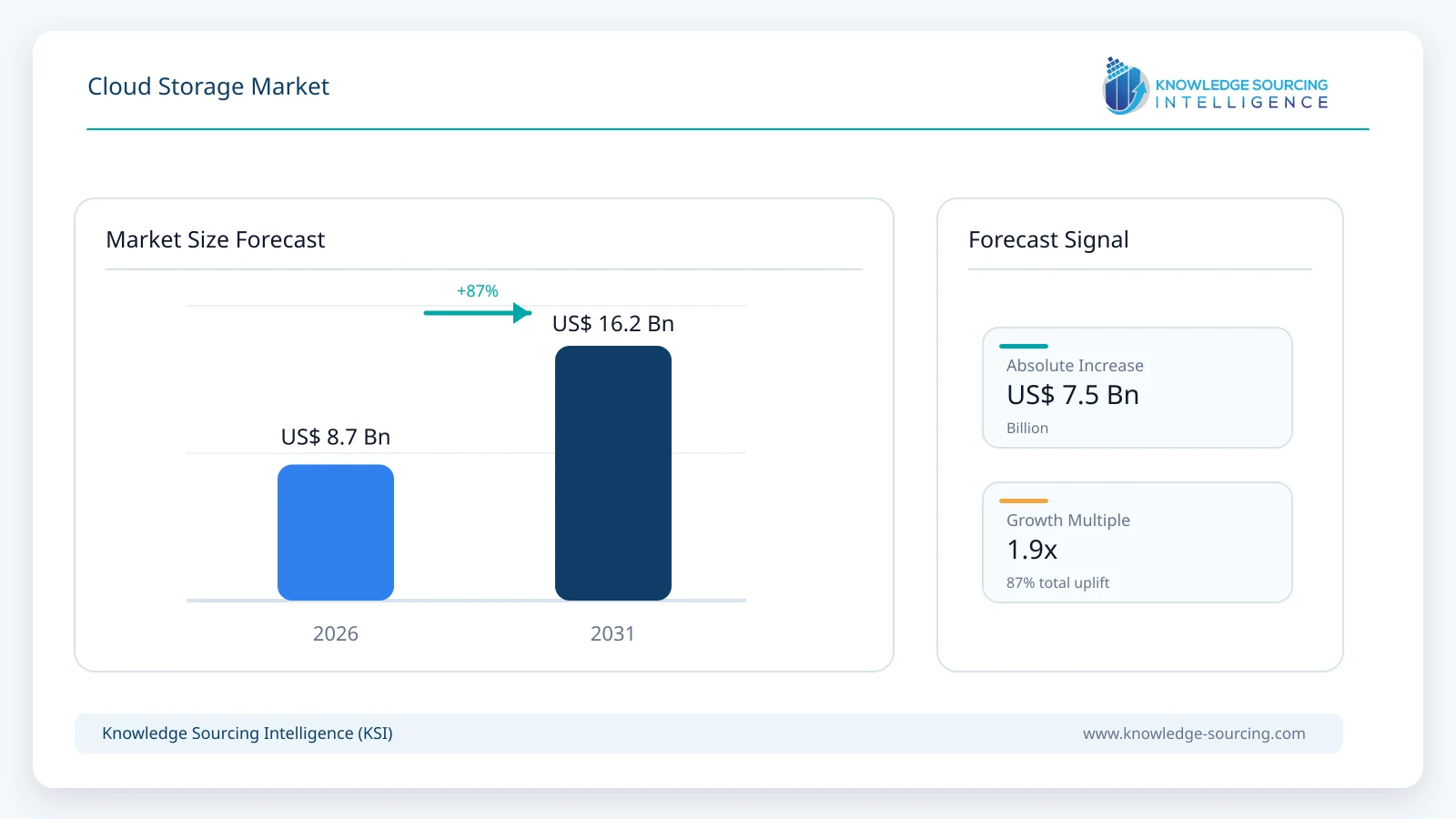
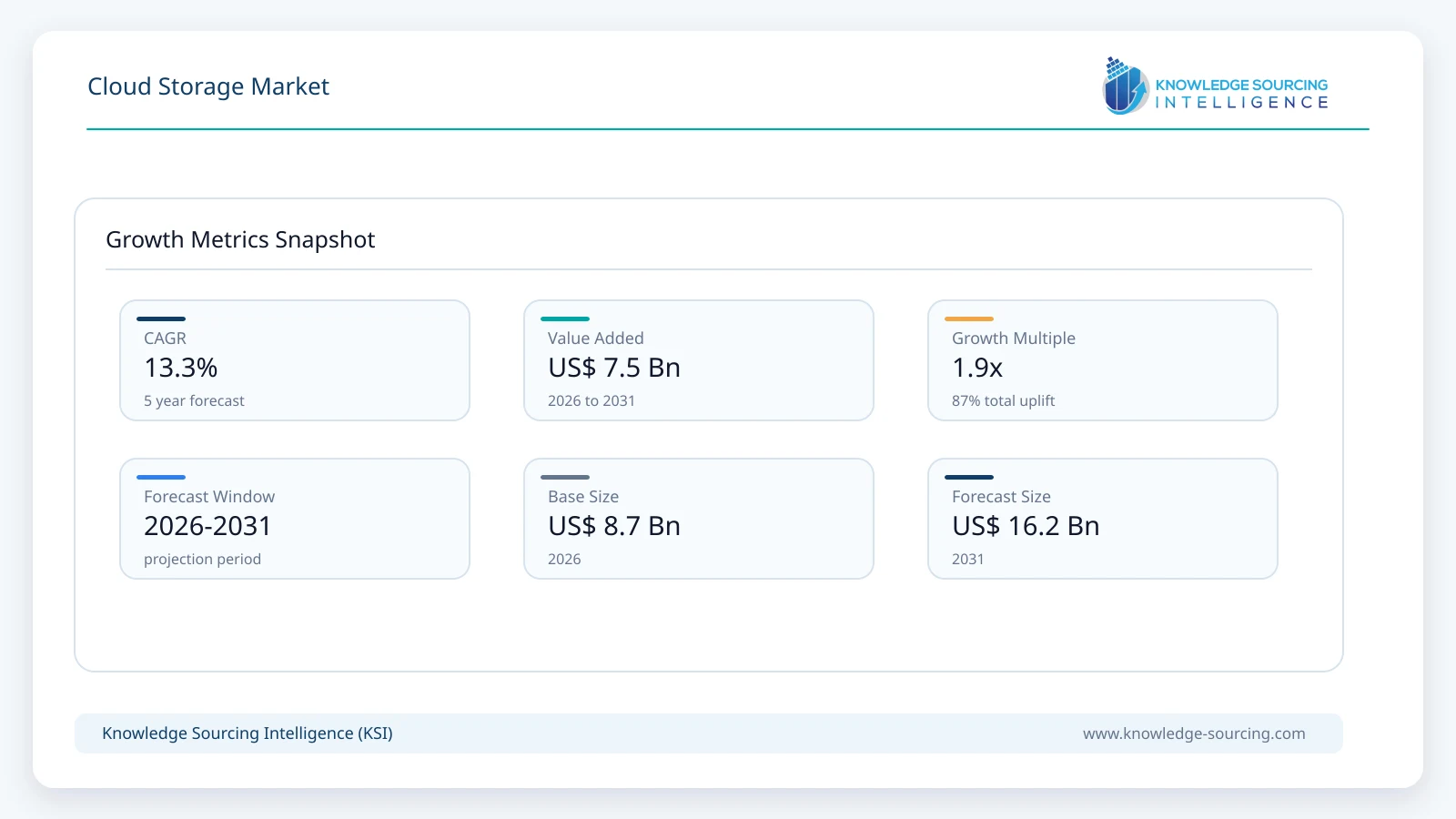
The Cloud Storage Market for Retail Industry is forecast to grow at a CAGR of 13.3%, reaching USD 16.2 billion in 2031 from USD 8.65 billion in 2026.
Highlights:
- 1Retail cloud storage demand is shifting toward unified platforms supporting omnichannel operations and AI-ready data environments.
- 2Hybrid deployment models remain commercially important for retailers balancing compliance, legacy systems, and cloud scalability.
- 3Object storage adoption is increasing as retailers manage growing volumes of images, video, IoT, and transactional data.
- 4Security, resilience, and regulatory compliance have become primary purchasing criteria alongside storage cost and scalability.
- 5Cloud providers are expanding AI, analytics, and managed data services to strengthen long-term retail customer retention.
Market Overview
The market extends beyond simple data storage and increasingly functions as the underlying platform for retail applications, including point-of-sale systems, merchandising platforms, customer loyalty programs, warehouse management, and digital marketing. Storage decisions are therefore influenced by workload performance, cybersecurity, regulatory compliance, integration capability, and long-term operating costs rather than capacity alone. Official cloud provider disclosures indicate that enterprise customers continue to consolidate multiple business workloads within integrated cloud environments to simplify operations and improve data accessibility.
Retail buyers increasingly evaluate storage platforms according to resilience, recovery capability, AI compatibility, and support for structured and unstructured data. High-resolution product images, surveillance video, customer interaction records, connected store devices, and machine-generated operational data have increased storage complexity across large retail enterprises. Public cloud deployments remain attractive for scalability, while private and hybrid environments continue to serve retailers with strict governance, latency, or regulatory requirements. Vendor selection increasingly depends on ecosystem compatibility, security certifications, application programming interfaces (APIs), migration support, and managed services instead of storage pricing alone.
Competition is concentrated among global hyperscale cloud providers alongside enterprise storage specialists that differentiate through hybrid architecture, workload optimization, governance capabilities, and enterprise support. At the same time, retailers are seeking suppliers capable of supporting AI workloads without requiring extensive redesign of existing storage environments. This has increased the commercial importance of object storage, automated lifecycle management, intelligent data classification, and disaster recovery capabilities across enterprise retail infrastructure.
Key Market Indicators
Indicator | Latest Evidence | Commercial Meaning |
Global retail e-commerce sales | Over US$6 trillion (2024) | Expanding digital commerce increases long-term storage demand for transactional and customer data. |
AWS annual capital investment | US$100+ billion planned during 2025 | Continued infrastructure expansion supports higher enterprise cloud storage capacity and AI workloads. |
Enterprise cloud security priority | Microsoft continues expanding multicloud security and governance capabilities | Security has become a primary buying criterion for retail storage platforms. |
Retail data sources | POS, e-commerce, IoT, video, customer engagement and supply-chain systems | Diverse data types increase demand for scalable object and archive storage solutions. |
Market Drivers
Expansion of omnichannel retail operations requiring centralized enterprise data storage. Retailers increasingly operate across physical stores, e-commerce platforms, mobile applications, social commerce, and third-party marketplaces, creating continuous data flows that require centralized storage and synchronized access. Inventory visibility, order management, and customer engagement depend on consistent access to shared datasets across business units. Large cloud providers continue investing in storage infrastructure and integrated retail solutions because enterprise customers increasingly expect unified environments rather than isolated storage repositories. This purchasing trend supports higher adoption of scalable cloud storage platforms capable of supporting multiple retail workloads simultaneously.
Growth of AI, analytics, and data-intensive retail applications. Retailers are generating larger volumes of structured and unstructured information from recommendation engines, demand forecasting, customer behavior analysis, computer vision, and digital merchandising systems. These workloads require storage architectures capable of handling high data throughput while supporting analytics and machine learning services. Cloud providers have expanded integrated AI capabilities alongside storage services, allowing retailers to retain operational data within the same cloud ecosystem. The result is higher demand for object storage, automated tiering, metadata management, and long-term archive capabilities supporting enterprise analytics strategies.
Business continuity and cyber resilience becoming mandatory procurement requirements. Retail operations depend on continuous availability of payment systems, inventory platforms, online storefronts, and logistics applications. Cybersecurity incidents, ransomware attacks, and operational disruptions have increased investment in backup storage, disaster recovery, immutable storage, and geographically distributed replication. Rather than treating backup as a separate technology purchase, retailers increasingly procure integrated resilience services from cloud providers. Enterprise vendors continue strengthening security posture management, automated recovery, encryption, identity controls, and workload protection because customers increasingly evaluate storage platforms according to operational resilience instead of storage capacity alone.
Migration from legacy on-premises infrastructure to hybrid cloud environments. Many retailers continue operating legacy enterprise resource planning systems, store servers, warehouse applications, and historical databases that cannot be migrated immediately to public cloud environments. Consequently, hybrid architectures have become commercially important because they allow phased migration while preserving operational continuity. Storage suppliers are responding through migration services, application compatibility tools, hybrid management software, and integrated governance capabilities. This approach reduces implementation risk while enabling retailers to modernize infrastructure without interrupting store operations or customer-facing services.
Market Restraints and Challenges
Data sovereignty, privacy rules, and compliance obligations increase deployment complexity. Retailers operating across multiple jurisdictions must comply with privacy, consumer protection, and data residency requirements that govern how customer and payment information is stored, processed, and transferred. Regulations such as the EU's General Data Protection Regulation (GDPR), the California Consumer Privacy Act (CCPA), and similar national frameworks require stricter governance over personal data. As a result, multinational retailers often adopt hybrid storage architectures and region-specific data management policies, increasing implementation effort and operating costs. Cloud providers have responded by expanding regional data center footprints, encryption capabilities, customer-managed encryption keys, and compliance certifications, yet regulatory variation continues to complicate cross-border data management.
Migration of legacy retail applications remains technically demanding. Many retailers continue to rely on long-established enterprise resource planning platforms, merchandising applications, warehouse management systems, and store-level software that were not originally designed for cloud-native environments. Migrating these workloads frequently requires application redesign, data validation, interface testing, and prolonged coexistence between on-premises and cloud systems. Official disclosures from enterprise technology suppliers consistently identify modernization of legacy environments as a multi-year process rather than a single infrastructure project. These longer implementation cycles increase consulting costs, delay return on investment, and extend procurement timelines, particularly for retailers with extensive store networks.
Cybersecurity threats continue to raise operational and compliance costs. Retail organizations remain frequent targets of ransomware, credential theft, supply chain attacks, and payment data breaches because they process large volumes of customer information and financial transactions. Although cloud platforms provide advanced security controls, retailers remain responsible for access governance, identity management, configuration, and compliance under shared responsibility models. This increases demand for continuous monitoring, security audits, immutable backup storage, and incident recovery planning. Smaller retailers with limited cybersecurity resources often face higher implementation costs when adopting enterprise-grade cloud storage solutions.
Escalating storage consumption creates ongoing cost management challenges. Retail businesses continuously generate product images, promotional videos, surveillance footage, customer engagement records, IoT sensor data, and transaction histories. While cloud storage reduces upfront infrastructure investment, long-term operational spending can increase through data growth, retrieval charges, network egress fees, and extended retention requirements. Consequently, retailers increasingly evaluate vendors according to lifecycle management, intelligent tiering, archive capabilities, and cost optimization tools rather than storage pricing alone. Suppliers are expanding automated storage optimization features, but cost predictability remains a key purchasing consideration for enterprise customers.
Major Segment Analysis
Hybrid Cloud Deployment
Hybrid cloud represents a commercially important deployment model because many retail organizations must balance operational flexibility with data governance, application compatibility, and business continuity requirements. Large retailers typically operate a combination of legacy enterprise systems, modern digital commerce platforms, and distributed store infrastructure, making complete migration to a single public cloud environment impractical. Hybrid storage enables organizations to retain sensitive payment, financial, or regulated data within controlled environments while moving analytics, collaboration, backup, and customer-facing workloads to scalable cloud infrastructure.
Buyer priorities within this segment extend beyond storage capacity. Retailers evaluate interoperability, workload portability, security controls, disaster recovery capability, latency, and integration with existing enterprise applications. System integrators and managed service providers therefore play an important role in deployment decisions because successful implementation depends on minimizing operational disruption during migration. Cloud vendors compete by providing unified management platforms, automated data movement, policy-based governance, and AI-enabled monitoring that simplify administration across multiple environments. Continued modernization of retail IT infrastructure is expected to sustain investment in hybrid storage throughout the forecast period, particularly among multinational retailers operating across diverse regulatory jurisdictions.
Regional Analysis
Region | Main Demand Signal | Principal Constraint |
North America | Mature cloud adoption, omnichannel retail, AI investment | Data privacy and cybersecurity compliance |
Europe | GDPR compliance, digital retail modernization | Cross-border data governance and regulatory complexity |
Asia Pacific | Rapid e-commerce expansion and digital retail infrastructure | Uneven cloud maturity across economies |
Middle East and Africa | Government digital transformation and organized retail growth | Limited cloud infrastructure in selected markets |
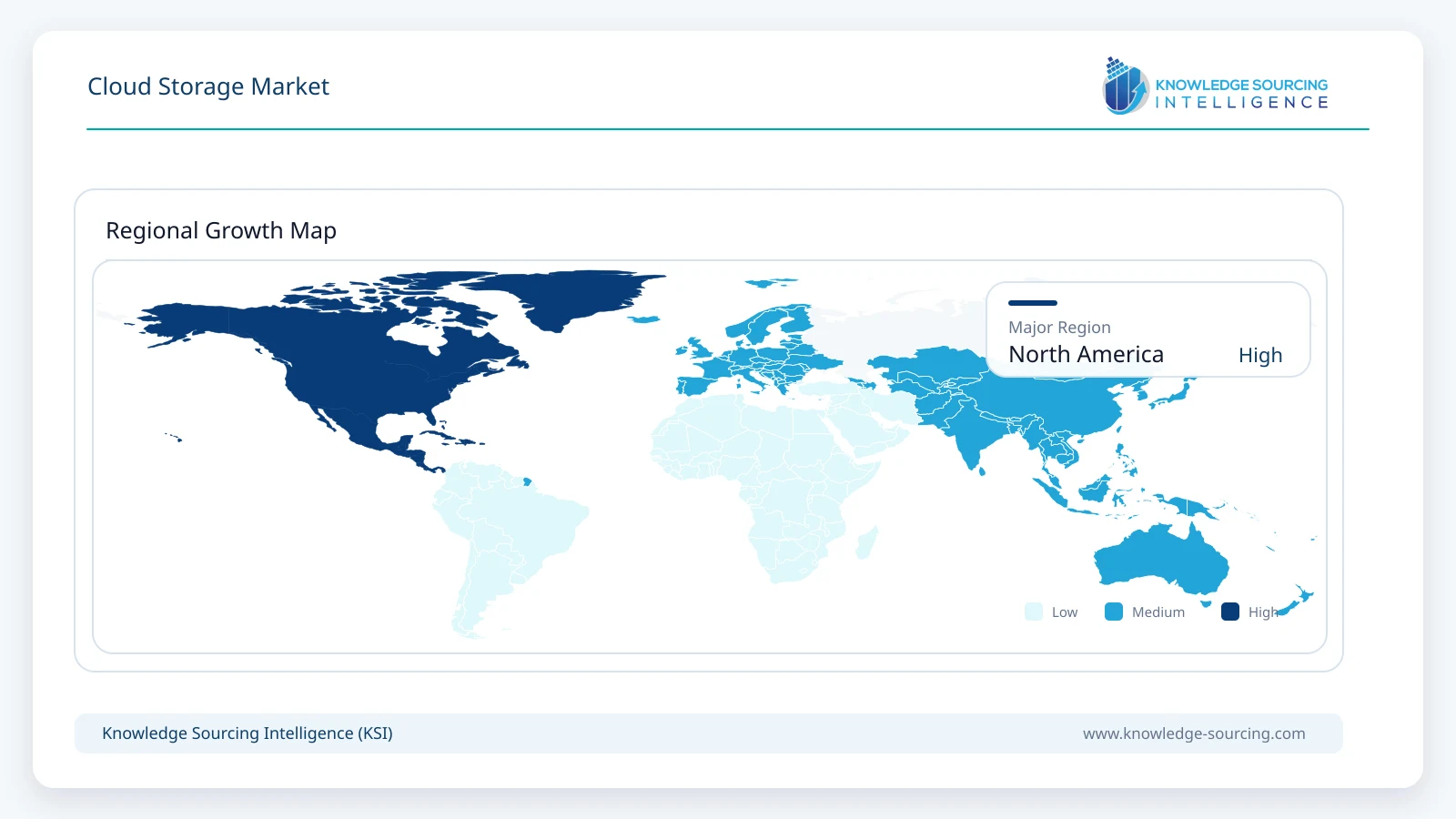
North America benefits from widespread enterprise cloud adoption, mature digital commerce ecosystems, and substantial investment in AI-enabled retail operations. The United States remains the largest contributor to regional demand owing to extensive adoption of cloud-native retail applications, advanced logistics platforms, and integrated customer engagement systems. Canada continues to expand enterprise cloud adoption across retail organizations, while Mexico is experiencing higher investment in digital commerce and omnichannel infrastructure. Major cloud providers continue to expand regional data center capacity and AI infrastructure to support enterprise storage requirements, reinforcing North America's position as an important market for advanced retail cloud storage services.
European demand is shaped by strict privacy legislation, digital retail modernization, and enterprise investment in secure cloud infrastructure. Compliance with GDPR has increased retailer emphasis on encryption, data residency, auditability, and governance. Germany, the United Kingdom, and France account for substantial enterprise cloud investment, while retailers increasingly prioritize hybrid deployment models to satisfy operational and regulatory requirements. Storage providers compete through regional infrastructure expansion, compliance certifications, and managed security capabilities that reduce implementation complexity.
Asia Pacific presents strong commercial opportunities as retailers continue expanding digital commerce, mobile payment ecosystems, and intelligent supply chain operations. China, Japan, India, and Australia represent the region's largest enterprise cloud markets, although purchasing priorities vary considerably. Large retailers increasingly adopt cloud storage to support AI-driven merchandising, warehouse automation, and customer analytics, while small and medium-sized businesses seek lower infrastructure costs and simplified IT management. Continued government investment in digital infrastructure and expanding cloud availability support broader enterprise adoption, although regulatory differences and varying levels of cloud maturity influence deployment strategies across countries.
The Middle East and Africa continues to attract investment through government-led digital transformation initiatives, expanding organized retail, and increasing enterprise cloud adoption. Countries including the United Arab Emirates, Saudi Arabia, and Israel are strengthening digital infrastructure and encouraging cloud investment through supportive technology policies and expanding data center capacity. However, cloud adoption remains uneven across several African economies because of infrastructure constraints, connectivity limitations, and lower enterprise technology spending. International cloud providers are addressing these challenges through regional partnerships and localized cloud services, improving long-term accessibility for retail customers.
Competitive Landscape
Competition in the cloud storage market for the retail industry is technology-led and increasingly influenced by AI integration, security capabilities, ecosystem compatibility, and global infrastructure scale. Amazon Web Services, Microsoft, and Google compete by combining scalable storage platforms with analytics, machine learning, security, and retail-specific cloud services, allowing retailers to consolidate multiple workloads within a single environment. Oracle and IBM strengthen their positions by supporting hybrid cloud deployments and enterprise application integration, particularly among retailers operating complex legacy systems. Box differentiates through enterprise content management and secure collaboration, while Dell Technologies and NetApp address customers requiring hybrid storage infrastructure and unified data management across on-premises and cloud environments.
Competition increasingly extends beyond storage capacity and pricing. Vendors are investing in AI-ready storage architectures, cyber resilience, automated lifecycle management, compliance capabilities, and migration services because enterprise retailers prioritize operational continuity and regulatory compliance. Long-term customer relationships are reinforced through managed services, ecosystem partnerships, and integrated security offerings that increase switching costs while supporting modernization of retail IT infrastructure.
Recent Developments
June 2026 – Snowflake Summit 2026 introduced advanced agentic AI capabilities and unified context tools designed to help retail and consumer goods firms manage complex cloud data workloads and streamline automated inventory analytics securely.
April 2026 – Google Cloud announced the major consolidation of Vertex AI into the Gemini Enterprise Agent Platform at Cloud Next '26, offering retail operators a unified infrastructure backbone for scaling intelligent data and storage workflows.
January 2026 – Google Cloud unveiled Gemini Enterprise for Customer Experience at NRF 2026. This agentic solution merges retail customer service and shopping data interfaces, helping major brands manage active problem-solving and unified product data.
September 2025 – Pure Storage (Product Launch): Pure Storage expanded its Enterprise Data Cloud platform into Microsoft Azure with Azure Native services, enabling retailers to unify cloud storage, strengthen cyber resilience, and simplify omnichannel application deployment.
Regulatory and Policy Environment
Retail cloud storage deployments operate within an increasingly stringent regulatory framework governing privacy, cybersecurity, digital resilience, and cross-border data transfers. The European Union's General Data Protection Regulation (GDPR) continues to influence storage architecture by requiring appropriate safeguards for personal data processing, retention, and international transfers. Similar privacy legislation, including the California Consumer Privacy Act (CCPA) and other national privacy frameworks, has expanded retailer investment in encryption, access controls, audit logging, and regional data residency.
Cybersecurity regulations have become equally influential. The European Union's NIS2 Directive and the Digital Operational Resilience Act (DORA) strengthen security expectations for organizations operating critical digital infrastructure and cloud services. Although DORA primarily targets the financial sector, its emphasis on operational resilience has accelerated broader enterprise adoption of structured disaster recovery, backup, and incident response practices that influence cloud procurement decisions.
Retailers processing payment information must also comply with the Payment Card Industry Data Security Standard (PCI DSS), which requires continuous protection of payment environments, encryption of sensitive information, and regular security assessment. Consequently, cloud providers continue expanding compliance certifications, identity management capabilities, customer-controlled encryption, and regional infrastructure to address evolving legal obligations across multiple jurisdictions.
Outlook and Strategic Implications
Demand during the 2026–2031 forecast period is expected to be shaped less by storage expansion alone and more by retailers' transition toward integrated digital operating environments. Storage platforms are increasingly functioning as enterprise data foundations supporting AI applications, predictive analytics, digital merchandising, inventory optimization, customer engagement, and automated supply chain management. Buyers are therefore expected to prioritize platforms capable of combining scalability, governance, security, and interoperability within a unified architecture.
Hybrid deployment models are likely to remain commercially important because many retailers will continue operating mixed IT environments for several years. Public cloud adoption will expand for analytics, customer-facing applications, and elastic workloads, while private infrastructure will continue supporting selected regulated or latency-sensitive systems. Object storage, disaster recovery, and intelligent data lifecycle management are also expected to receive sustained investment as retailers manage rapidly expanding volumes of structured and unstructured enterprise data.
Strategic priorities across the value chain are expected to include:
Cloud providers: Expand AI-enabled storage services, strengthen cyber resilience, and increase regional infrastructure to address compliance and data residency requirements.
Retail enterprises: Modernize legacy environments through phased migration strategies while improving governance, backup, and business continuity capabilities.
System integrators and managed service providers: Increase migration, integration, security, and lifecycle management services to support complex enterprise transformation projects.
Technology suppliers: Differentiate through interoperability, automated storage optimization, compliance support, and integration with enterprise retail applications.
Commercial success over the forecast period will depend on vendors' ability to reduce migration complexity, maintain regulatory compliance across multiple jurisdictions, support AI-ready data architectures, and provide predictable long-term operating costs. As retail organizations continue consolidating enterprise workloads onto cloud-based platforms, suppliers offering secure, scalable, and operationally resilient storage ecosystems will be better positioned to strengthen customer retention and expand recurring service revenue.
Market Scope:
| Report Metric | Details |
|---|---|
| Total Market Size in 2026 | USD 8.65 billion |
| Total Market Size in 2031 | USD 16.2 billion |
| Forecast Unit | USD Billion |
| Growth Rate | 13.3% |
| Study Period | 2021 to 2031 |
| Historical Data | 2021 to 2024 |
| Base Year | 2025 |
| Forecast Period | 2026 – 2031 |
| Segmentation | Solution, Deployment Model, Services, Enterprise Size, Geography |
| Companies |
|
Market Segmentation
By Solution
Primary Storage
Backup Storage
Archive Storage
Disaster Recovery Storage
Object Storage
By Deployment Model
Public Cloud
Private Cloud
Hybrid Cloud
By Services
Consulting
Integration and Migration
Managed Services
Support and Maintenance
By Enterprise Size
Large
Small and Medium-sized Business (SMB)
By Geography
North America
United States
Canada
Mexico
Others
South America
Brazil
Argentina
Others
Europe
Germany
France
Italy
United Kingdom
Others
Middle East and Africa
Israel
Saudi Arabia
UAE
Others
Asia Pacific
Japan
China
India
Australia
Others
Table of Contents
1. INTRODUCTION
1.1. Market Overview
1.2. Market Definition
1.3. Scope of the Study
1.4. Currency
1.5. Assumptions
1.6. Base and Forecast Years Timeline
2. RESEARCH METHODOLOGY
2.1. Research Design
2.2. Secondary Sources
3. EXECUTIVE SUMMARY
4. MARKET DYNAMICS
4.1. Market Segmentation
4.2. Market Drivers
4.3. Market Restraints
4.4. Market Opportunities
4.5. Porter’s Five Force Analysis
4.5.1. Bargaining Power of Suppliers
4.5.2. Bargaining Power of Buyers
4.5.3. Threat of New Entrants
4.5.4. Threat of Substitutes
4.5.5. Competitive Rivalry in the Industry
4.6. Life Cycle Analysis - Regional Snapshot
4.7. Market Attractiveness
5. CLOUD STORAGE MARKET FOR RETAILINDUSTRY FORECAST BY SOLUTION
5.1. Primary Storage
5.2. Backup Storage
5.3. Archive Storage
5.4. Disaster Recovery Storage
5.5. Object Storage
6. CLOUD STORAGE MARKET FOR RETAIL INDUSTRY FORECAST BY DEPLOYMENT MODEL
6.1. Public Cloud
6.2. Private Cloud
6.3. Hybrid Cloud
7. CLOUD STORAGE MARKET FOR RETAIL INDUSTRY FORECAST BY SERVICES
7.1. Consulting
7.2. Integration and Migration
7.3. Managed Services
7.4. Support and Maintenance
8. CLOUD STORAGE MARKET FOR RETAIL INDUSTRY FORECAST BY ENTERPRISE SIZE
8.1. Large
8.2. SMB (Small and Medium-sized business)
9. CLOUD STORAGE MARKET FOR RETAIL INDUSTRY FORECAST BY GEOGRAPHY
9.1. North America
9.1.1. United States
9.1.2. Canada
9.1.3. Mexico
9.1.4. Others
9.2. South America
9.2.1. Brazil
9.2.2. Argentina
9.2.3. Others
9.3. Europe
9.3.1. Germany
9.3.2. France
9.3.3. Italy
9.3.4. United Kingdom
9.3.5. Others
9.4. Middle East and Africa
9.4.1. Israel
9.4.2. Saudi Arabia
9.4.3. UAE
9.4.4. Others
9.5. Asia Pacific
9.5.1. Japan
9.5.2. China
9.5.3. India
9.5.4. Australia
9.5.5. Others
10. COMPETITIVE INTELLIGENCE
10.1. Recent Deals and Investment
10.2. Strategies of Key Players
10.3. Investment Analysis
11. COMPANY PROFILES
11.1. Amazon Web Services, Inc.
11.1.1. Company Overview
11.1.2. Financials
11.1.3. Products and Services
11.1.4. Recent Developments
11.2. Microsoft
11.2.1. Company Overview
11.2.2. Financials
11.2.3. Products and Services
11.2.4. Recent Developments
11.3. Google
11.3.1. Company Overview
11.3.2. Financials
11.3.3. Products and Services
11.3.4. Recent Developments
11.4. Oracle Corporation
11.4.1. Company Overview
11.4.2. Financials
11.4.3. Products and Services
11.4.4. Recent Developments
11.5. Box
11.5.1. Company Overview
11.5.2. Financials
11.5.3. Products and Services
11.5.4. Recent Developments
11.6. IBM
11.6.1. Company Overview
11.6.2. Financials
11.6.3. Products and Services
11.6.4. Recent Developments
11.7. Dell Technologies
11.7.1. Company Overview
11.7.2. Financials
11.7.3. Products and Services
11.7.4. Recent Developments
11.8. NetApp, Inc.
11.8.1. Company Overview
11.8.2. Financials
11.8.3. Products and Services
11.8.4. Recent Developments
LIST OF FIGURES
LIST OF TABLES
DISCLAIMER
Navigate
Trusted by the world's leading organizations











