
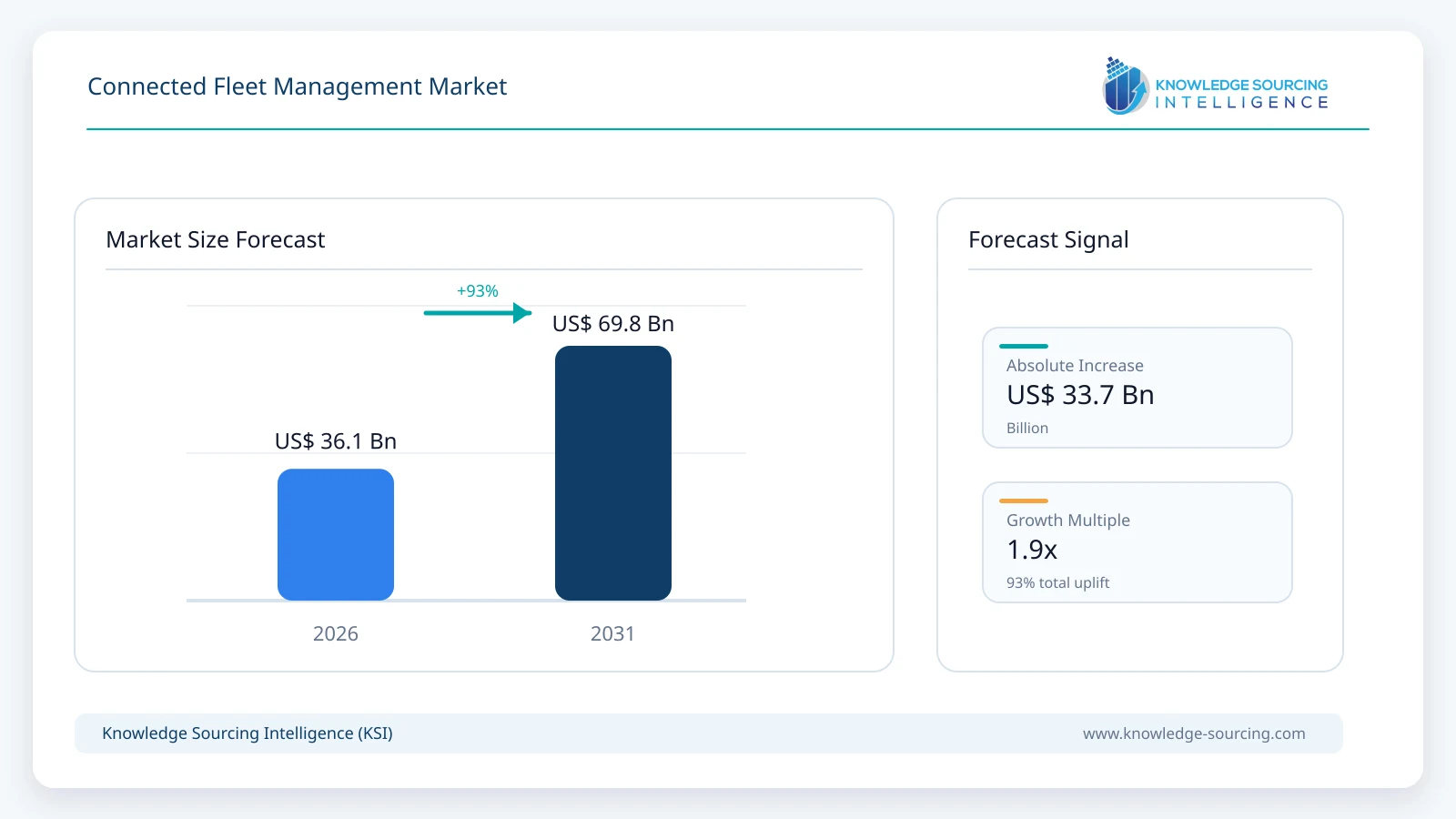
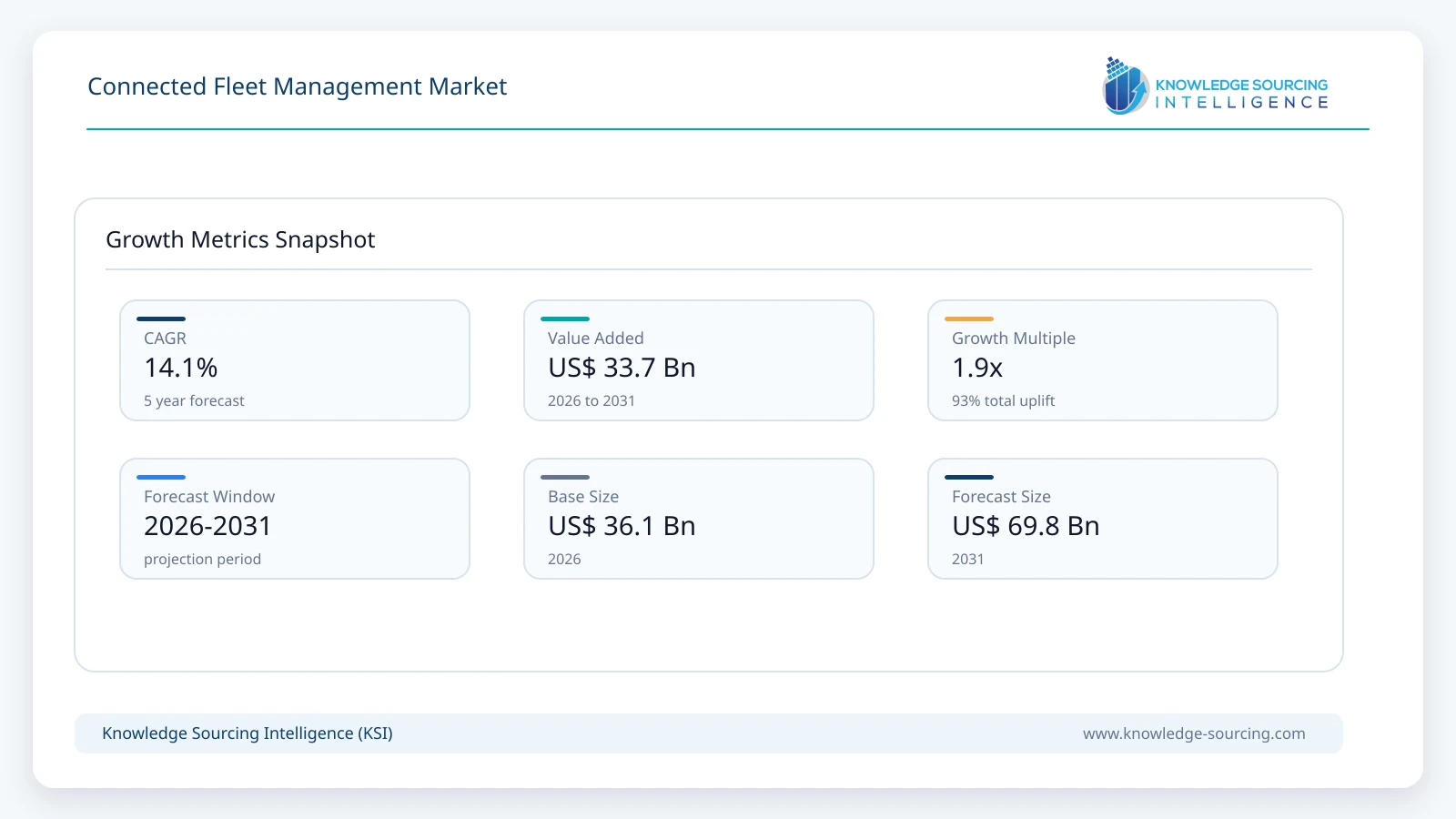
The Connected Fleet Management Market will expand from USD 36.1 billion in 2026 to USD 69.8 billion in 2031, at a 14.1% CAGR during the forecast period.
Highlights:
- 1Regulatory Compliance as a Demand AnchorStringent government mandates, particularly the U.S. Federal Motor Carrier Safety Administration (FMCSA) Electronic Logging Device (ELD) mandate and similar European road safety regulations, remain the primary catalysts for sustained demand in the hardware and software segments.
- 2AI-Driven Shift in Operational StrategyThe market is transitioning from simple GPS tracking to AI-powered predictive analytics, with industry leaders like Samsara and Geotab launching neural network-based safety and maintenance tools to reduce collision rates and optimize fuel consumption.
- 3Inorganic Growth and ConsolidationStrategic M&A activity reached a peak, highlighted by Powerfleet’s acquisition of MiX Telematics and Fleet Complete, creating a global entity with over 2.6 million subscribers to address "data indigestion" through unified IoT platforms.
- 4Supply Chain and Tariff HeadwindsNew 2025 trade policies, including tariffs on automotive components from Canada and Mexico, are projected to increase production costs for telematics hardware, forcing OEMs and fleet managers to re-evaluate regionalized sourcing and nearshoring strategies.
The Connected Fleet Management market has evolved into a mission-critical infrastructure for the global logistics and transportation sectors. This expansion is no longer driven solely by the need for location visibility but by the imperative to integrate disparate data streams ranging from engine diagnostics to driver fatigue monitoring into a single operational "pane of glass." As of 2025, the industry is characterized by a rapid move toward "Connected Operations," where real-time data from millions of IoT-enabled sensors is processed via Artificial Intelligence to mitigate rising insurance premiums, labor shortages, and energy costs.
This report provides an in-depth analysis of the current market landscape, examining how evolving regulations, technological breakthroughs in AI, and geopolitical shifts in the global supply chain are fundamentally reshaping the demand for connected fleet solutions. Through a rigorous examination of segment-specific drivers and regional dynamics, the analysis highlights the strategic shifts required by industry participants to navigate an increasingly complex and consolidated environment.
Connected Fleet Management Market Analysis
Growth Drivers
The global demand for connected fleet management solutions is primarily propelled by three interconnected catalysts: regulatory mandates, the escalation of operational insurance costs, and the rapid advancement of AI-integrated telematics. These factors do not merely influence market growth but create a non-discretionary requirement for fleet operators to adopt advanced digital tools.
Stringent Regulatory Mandates: The demand for connected hardware and software is intrinsically tied to government-enforced compliance frameworks. The FMCSA ELD mandate in the United States, which requires commercial motor vehicle operators to record Hours of Service (HOS) electronically, has moved from a new requirement to a replacement-cycle driver, demand is surging as fleets upgrade first-generation ELD hardware to more robust, integrated telematics units that can handle additional regulatory tasks, such as IFTA (International Fuel Tax Agreement) reporting and DVIR (Driver Vehicle Inspection Reports). This regulatory pressure ensures a high floor for market demand, as non-compliance results in severe financial penalties and operational shutdowns.
Rising Insurance Premiums and Risk Mitigation: Fleet operators face an unprecedented rise in insurance costs, often cited as one of the top three operational expenses behind labor and fuel. This has triggered a direct demand for Video-Based Safety (VBS) and driver behavior monitoring systems. By providing verifiable, real-time data on harsh braking, speeding, and cornering, connected fleet systems allow companies to exonerate drivers in "not-at-fault" accidents and negotiate lower premiums with underwriters. The integration of AI dashcams, which can detect driver distraction or drowsiness, has become an essential tool for reducing "nuclear verdicts" in litigation, thereby making investing in connected fleet technology a financial necessity rather than an optional upgrade.
Operational Efficiency and Sustainability Goals: Beyond compliance and safety, the demand is increasingly driven by the need for granular data to optimize fuel consumption and transition to Electric Vehicles (EVs). Major logistics firms have accelerated the use of route optimization software to counter fluctuating energy prices. Furthermore, as organizations commit to net-zero goals, there is a specific demand for "EV Suitability Assessments" provided by telematics firms. These tools use existing fleet data to determine which Internal Combustion Engine (ICE) vehicles can be replaced by EVs based on range requirements and charging infrastructure availability. This sustainability-linked demand is particularly strong in the European and North American markets, where corporate ESG (Environmental, Social, and Governance) reporting is becoming standardized.
Challenges and Opportunities
The market faces a significant challenge in the form of "data indigestion" the fragmentation of data across multiple, non-interoperable platforms. This complexity often deters smaller fleets (1–49 vehicles) from full-scale adoption due to high implementation costs and a perceived lack of clear ROI. However, this challenge presents a massive opportunity for "platform unifiers." Companies that can offer device-agnostic, unified SaaS ecosystems are seeing increased demand as they simplify the user experience. Additionally, the transition to 5G networks provides an opportunity to offer low-latency, high-bandwidth services like real-time remote vehicle diagnostics, which are currently restricted by 4G bandwidth limitations.
Raw Material and Pricing Analysis
The Connected Fleet Management hardware segment is highly dependent on the global semiconductor and rare-earth metal supply chains. Key components such as microcontrollers, GPS modules, and cellular modems rely on advanced silicon wafers, the pricing of which has remained volatile. Furthermore, the cost of lithium and cobalt for the internal batteries in asset trackers directly influences the MSRP of hardware units. In 2025, the industry has seen a shift toward using recycled content in hardware casings Samsara, for instance, reported using 50% recycled content in its Vehicle Gateways to mitigate raw material price fluctuations and meet sustainability standards. Despite these efforts, hardware pricing is under upward pressure due to the increasing complexity of AI-on-the-edge processors required for real-time video analytics.
Supply Chain Analysis
The global supply chain for fleet telematics is centered around production hubs in Southeast Asia and Mexico, with a heavy reliance on just-in-time logistics. These dependencies make the market vulnerable to regional geopolitical disruptions. Consequently, many manufacturers are shifting toward "nearshoring" strategies, expanding assembly lines in Mexico to serve the North American market more reliably. This regionalization helps reduce lead times but introduces complexities related to varying labor costs and local regulatory requirements for electronics manufacturing.
The reintroduction of 25% tariffs on automotive parts and finished goods from Canada and Mexico in early 2025 has created a significant headwind for the connected fleet hardware market. Because a large portion of telematics devices and vehicle components are assembled in the North American trade corridor, these tariffs have led to an immediate increase in the landed cost of hardware.
Furthermore, these tariffs have disrupted the regional supply chain efficiency, forcing telematics providers to absorb higher costs or pass them on to fleet operators through increased subscription fees or hardware surcharges. This inflationary environment has shifted demand toward software-only solutions and "bring-your-own-device" (BYOD) models, as fleet managers look to maximize the lifespan of existing hardware assets rather than purchasing new, tariff-inflated equipment.
Government Regulations
Jurisdiction | Key Regulation / Agency | Market Impact Analysis |
United States | FMCSA ELD Mandate | Mandates electronic HOS logging, driving 100% adoption in commercial heavy-duty trucks; currently driving replacement cycles for AI-integrated units. |
European Union | GSR (General Safety Regulation) | Requires advanced safety features like Intelligent Speed Assistance and Driver Drowsiness Monitoring, increasing demand for AI dashcams and ADAS sensors. |
Global | GSMA eSIM Standards | Standardizes embedded SIM technology, allowing Motive and other providers to offer seamless global connectivity for cross-border fleet operations. |
United States | GSA Multiple Award Schedule | Enables Verizon and others to sell directly to federal/state agencies, significantly boosting demand in the government and public sector segment. |
Connected Fleet Management Market Segment Analysis
By Application: Fleet Tracking & Geofencing
Fleet tracking and geofencing represent the foundational layer of the connected fleet market, yet the segment is undergoing a technological renaissance. Demand is shifting from reactive "where is my truck" queries to proactive, automated workflow triggers. In recent years, geofencing is used not just for theft prevention but as a critical tool for operational automation. For example, a vehicle entering a predefined geofence at a distribution center can automatically trigger a "digital handshake," notifying warehouse staff to prepare for loading, thereby reducing dwell time. This automation directly addresses the labor shortage challenge in logistics by optimizing the use of on-site personnel. Furthermore, advanced geofencing now incorporates "risk zones," where fleet managers are alerted if a vehicle enters a high-theft area or a region with height/weight restrictions. This intelligence drives demand by offering immediate reductions in operational risk and improving insurance profiles.
By End User: Transportation & Logistics
The Transportation and Logistics segment remains the largest consumer of connected fleet solutions, driven by the thin margins and high-volume nature of the industry. The demand in this segment has been hyper-focused on "Integrated Video" and "Route Optimization." Logistics firms are using these tools to combat the "last-mile" delivery challenge, where fuel costs and delivery windows are most volatile. The demand is also being shaped by the "Amazon effect," which has set a high standard for real-time customer visibility. Logistics providers must adopt connected fleet systems to provide end-customers with precise ETAs and proof-of-delivery data. Additionally, the integration of temperature sensors into the telematics platform is a growing requirement for "Cold Chain" logistics, ensuring that perishable goods or pharmaceuticals are transported within strict regulatory parameters. This makes the connected platform an essential component of the logistics service offering rather than a back-office utility.
Connected Fleet Management Market Geographical Analysis
US Market Analysis
The United States is the most mature market for connected fleet management, characterized by high adoption rates and a competitive landscape of "pure-play" telematics providers. Demand is currently driven by the transition to "AI-First" operations. Following the full implementation of the ELD mandate, US fleet managers are now seeking "Smart Compliance" tools that can automatically identify misattributed logs or predict HOS violations before they occur. The US market also leads in the adoption of AI-powered video safety, with carriers increasingly using dashcam footage to fight "crash-for-cash" scams. Government demand is also a significant factor, as evidenced by Verizon Connect Reveal’s availability on GSA contracts, which streamlines procurement for federal and state agencies.
Brazil Market Analysis
In South America, Brazil serves as the primary engine for connected fleet demand, largely driven by the high prevalence of cargo theft. This has created a unique demand for advanced security features, such as remote engine immobilization and "jamming detection" hardware. In late 2025, Motive expanded its presence in the region by bringing seamless eSIM activation to luxury European brands in Mexico and South America, facilitating better cross-border connectivity. The Brazilian market is also seeing increased demand from the agricultural and mining sectors, where monitoring "off-road" equipment in remote areas via satellite-integrated telematics is becoming an operational standard to ensure machine uptime.
United Kingdom Market Analysis
The UK market is at the forefront of the "Green Fleet" transition in Europe. Demand is heavily influenced by the expansion of Ultra Low Emission Zones (ULEZ) and the government’s commitment to phasing out ICE vehicles. Consequently, there is an intense demand for telematics software that can manage "mixed fleets" (EV and ICE) and optimize charging schedules. The UK also has a strong focus on "Duty of Care" regulations, which drive the adoption of driver behavior monitoring and "Lone Worker" safety tools.
Saudi Arabia Market Analysis
The Middle East market, led by Saudi Arabia, is experiencing a surge in demand for connected fleet solutions as part of the "Vision 2030" infrastructure projects. Large-scale construction and logistics developments like NEOM require massive fleets of heavy equipment and transport vehicles. This has created a specific demand for ruggedized hardware that can withstand extreme heat and provide high-precision tracking for multi-year project management. Government mandates for public safety and transportation efficiency are also increasing, with a focus on integrating telematics data into "Smart City" platforms to improve urban traffic flow and emergency response times.
China Market Analysis
China represents the world’s largest and most technologically distinct connected fleet market. Demand is driven by state-mandated safety standards and the world’s fastest adoption of Electric Heavy-Duty Trucks. Chinese fleet operators are major consumers of "V2X" (Vehicle-to-Everything) technology, as the government invests heavily in smart road infrastructure. The market is dominated by domestic tech giants and OEMs that offer factory-fitted connectivity. However, there is growing demand for sophisticated "Cold Chain" monitoring to support the country’s massive e-commerce and food delivery networks.
Connected Fleet Management Market Competitive Environment and Analysis
The competitive landscape is undergoing a period of intense consolidation and technological escalation. Large players are moving away from being "GPS providers" to becoming "Connected Operations Platforms." This involves high R&D investment in AI and the acquisition of smaller, specialized firms to broaden their service offerings.
Samsara Inc.
Samsara has positioned itself as the pioneer of the "Connected Operations Platform," focusing on a holistic view of physical operations. The company has focused heavily on AI-driven safety. Samsara’s strategic positioning involves a "one-pane-of-glass" approach, where safety, maintenance, and routing are all managed in a single interface.
Geotab Inc.
Geotab is a global leader known for its open-platform approach and deep data analytics capabilities. With over 4 million connected vehicles, Geotab emphasizes its "Marketplace" ecosystem, which allows third-party developers to integrate specialized apps. In January 2025, the company expanded its "Order Now" program to include software solutions, enabling customers to purchase and deploy third-party AI and analytics tools directly through the MyGeotab platform. Geotab’s strategic focus is on "Data Intelligence," providing fleets with the tools to benchmark their performance against industry averages and prepare for the 2026 "AI-driven boom" in operational efficiency.
Connected Fleet Management Market Key Development
October 2026: Geotab launched the Geotab Fleet Card with AtoB, integrating vehicle telematics, real-time fuel purchase authorization, fraud prevention, fuel discounts, and expense management for commercial fleets.
September 2026: Geotab announced enhanced fleet safety capabilities, including expanded video coaching, consolidated safety analytics, collision investigations, and red-light violation detection to improve driver coaching and risk management.
August 2026: Geotab introduced Geotab Investigations, a unified solution enabling fleet safety, compliance, and operations teams to organize incident evidence and accelerate collision-related investigations.
June 2026: Geotab launched its Model Context Protocol Connector, enabling secure access to live fleet data and AI-powered workflows through ChatGPT, Claude, Microsoft Copilot, and compatible platforms.
January 2026: Lytx launched LytxOne, an integrated fleet management platform combining video safety, telematics, and maintenance capabilities to help fleet operators improve safety, operational efficiency, and vehicle performance.
Connected Fleet Management Market Scope
| Report Metric | Details |
|---|---|
| Total Market Size in 2026 | USD 36.1 billion |
| Total Market Size in 2031 | USD 69.8 billion |
| Forecast Unit | Billion |
| Growth Rate | 14.1% |
| Study Period | 2021 to 2031 |
| Historical Data | 2021 to 2024 |
| Base Year | 2025 |
| Forecast Period | 2026 – 2031 |
| Segmentation | Component, Fleet Type, Application, End User, Geography |
| Companies |
|
Market Segmentation
By Component
Hardware
Software
Services
By Fleet Type
Commercial Fleets
Passenger Vehicles
Others
By Application
Fleet Tracking & Geofencing
Vehicle Maintenance & Diagnostics
Driver Behavior Monitoring & Management
Fuel Management
Route Optimization
Operations Management
Others
By End User
Transportation & Logistics
Construction & Mining
Government & Public Sector
Retail & E-Commerce
Manufacturing
Others
By Geography
North America
USA
Canada
Mexico
South America
Brazil
Argentina
Others
Europe
United Kingdom
Germany
France
Spain
Others
Middle East and Africa
Saudi Arabia
UAE
Others
Asia Pacific
China
India
Japan
South Korea
Australia
Others
Table of Contents
1. EXECUTIVE SUMMARY
2. MARKET SNAPSHOT
2.1. Market Overview
2.2. Market Definition
2.3. Scope of the Study
2.4. Market Segmentation
3. BUSINESS LANDSCAPE
3.1. Market Drivers
3.2. Market Restraints
3.3. Market Opportunities
3.4. Porter’s Five Forces Analysis
3.5. Industry Value Chain Analysis
3.6. Policies and Regulations
3.7. Strategic Recommendations
4. TECHNOLOGICAL OUTLOOK
5. CONNECTED FLEET MANAGEMENT MARKET BY COMPONENT
5.1. Introduction
5.2. Hardware
5.3. Software
5.4. Services
6. CONNECTED FLEET MANAGEMENT MARKET BY FLEET TYPE
6.1. Introduction
6.2. Commercial Fleets
6.3. Passenger Vehicles
6.4. Others
7. CONNECTED FLEET MANAGEMENT MARKET BY APPLICATION
7.1. Introduction
7.2. Fleet Tracking & Geofencing
7.3. Vehicle Maintenance & Diagnostics
7.4. Driver Behavior Monitoring & Management
7.5. Fuel Management
7.6. Route Optimization
7.7. Operations Management
7.8. Others
8. CONNECTED FLEET MANAGEMENT MARKET BY END USER
8.1. Introduction
8.2. Transportation & Logistics
8.3. Construction & Mining
8.4. Government & Public Sector
8.5. Retail & E-Commerce
8.6. Manufacturing
8.7. Others
9. CONNECTED FLEET MANAGEMENT MARKET BY GEOGRAPHY
9.1. Introduction
9.2. North America
9.2.1. USA
9.2.2. Canada
9.2.3. Mexico
9.3. South America
9.3.1. Brazil
9.3.2. Argentina
9.3.3. Others
9.4. Europe
9.4.1. United Kingdom
9.4.2. Germany
9.4.3. France
9.4.4. Spain
9.4.5. Others
9.5. Middle East and Africa
9.5.1. Saudi Arabia
9.5.2. UAE
9.5.3. Others
9.6. Asia Pacific
9.6.1. China
9.6.2. India
9.6.3. Japan
9.6.4. South Korea
9.6.5. Australia
9.6.6. Others
10. COMPETITIVE ENVIRONMENT AND ANALYSIS
10.1. Major Players and Strategy Analysis
10.2. Market Share Analysis
10.3. Mergers, Acquisitions, Agreements, and Collaborations
10.4. Competitive Dashboard
11. COMPANY PROFILES
11.1. Verizon
11.2. Samsara
11.3. Azuga
11.4. Teletrac Navman US Ltd
11.5. Motive Technologies, Inc.
11.6. Geotab Inc.
11.7. Rarestep, Inc.
11.8. Powerfleet
11.9. IntelliShift
11.10. GPS Insight
12. APPENDIX
12.1. Currency
12.2. Assumptions
12.3. Base and Forecast Years Timeline
12.4. Key benefits for the stakeholders
12.5. Research Methodology
12.6. Abbreviations
LIST OF FIGURES
LIST OF TABLES
Navigate
Trusted by the world's leading organizations











