
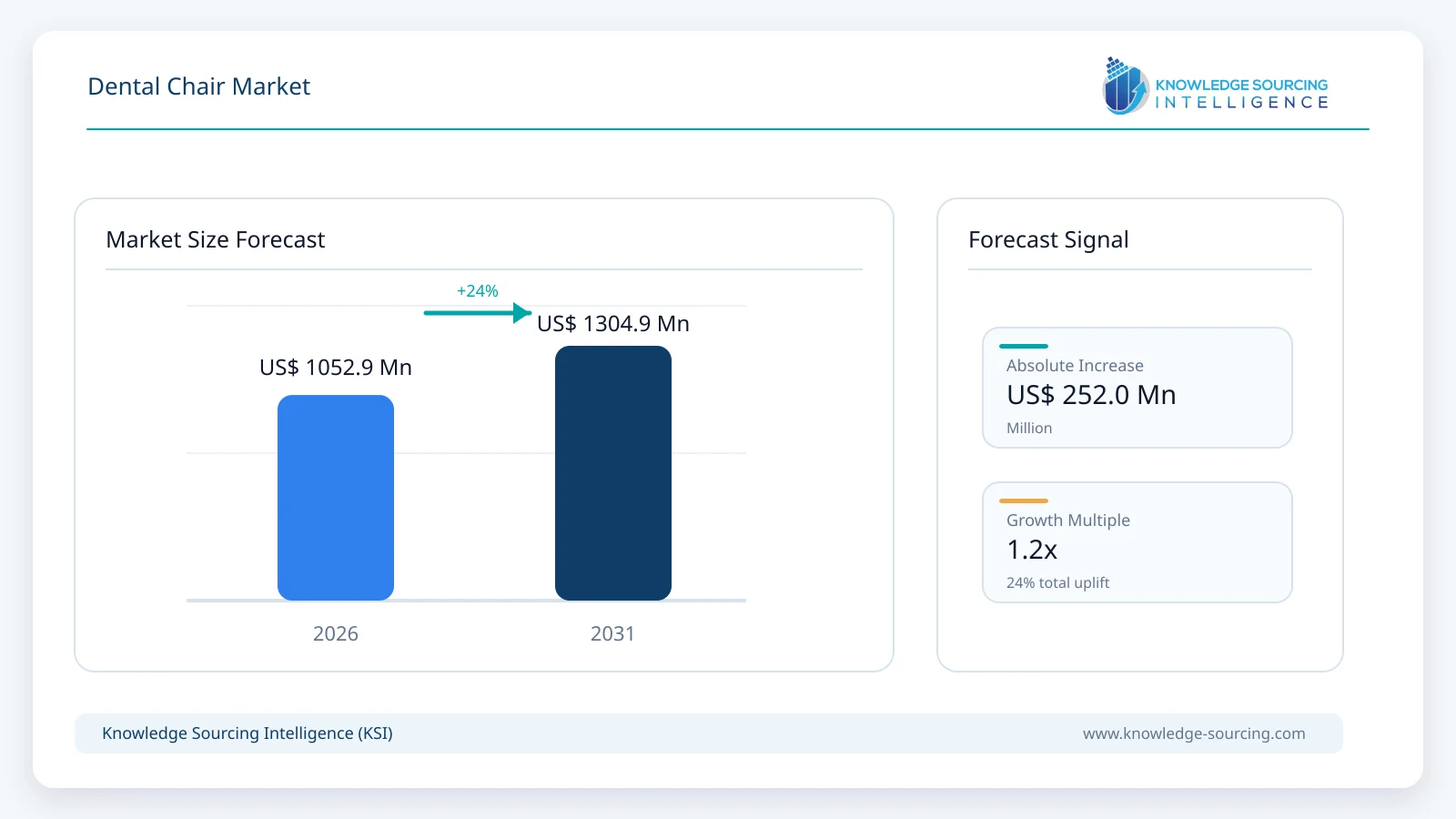
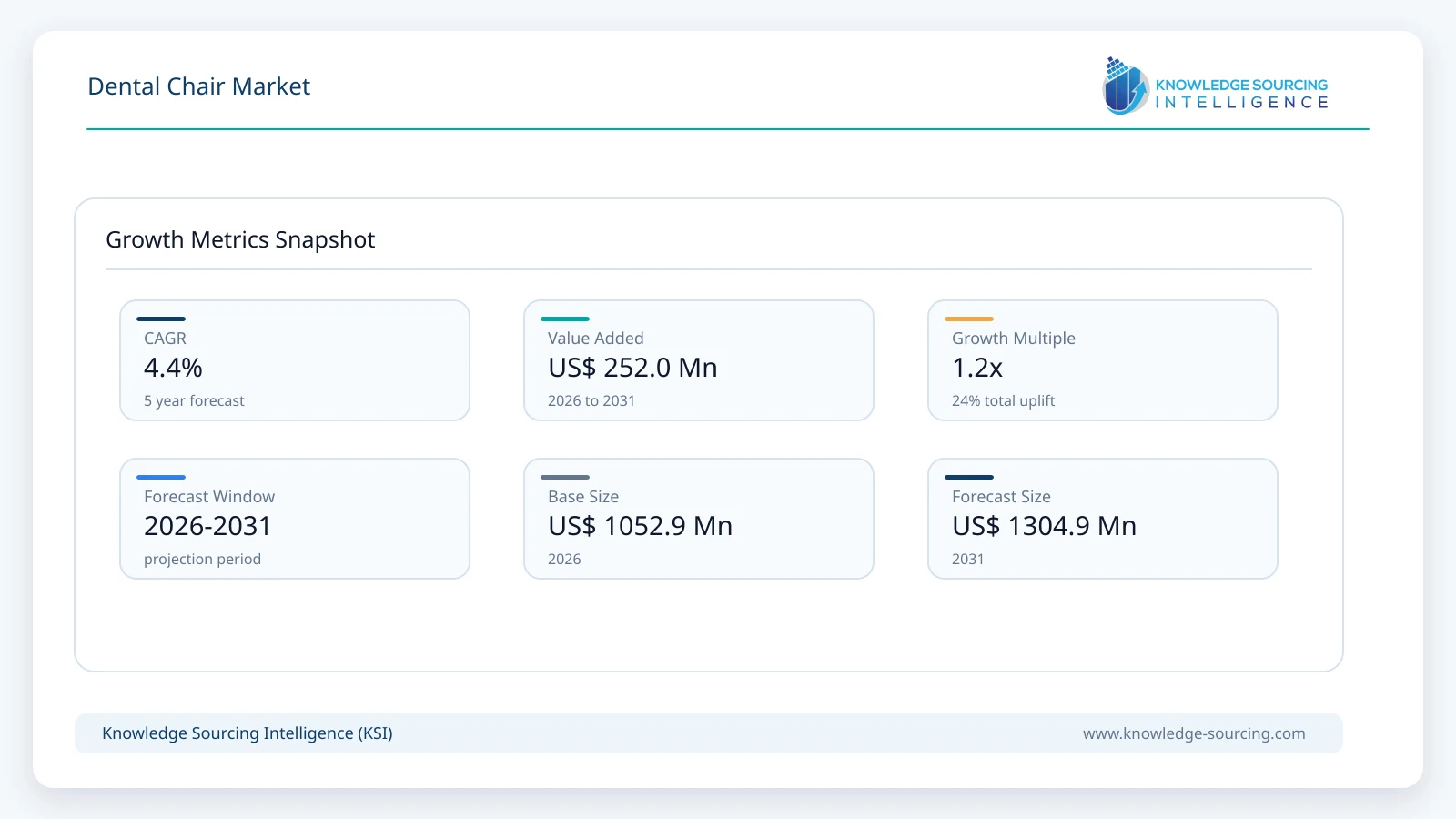
The dental chair market is forecasted to rise at a 4.4% CAGR, reaching USD 1304.86 million in 2031 from USD 1,052.90 million in 2026.
Highlights:
- 1The global dental chair market is expanding from USD 1,008.675 million in 2025 to USD 1,304.863 million by 2031.
- 2Clinical preferences are shifting rapidly toward digitally connected operatory ecosystems that streamline diagnostics and patient data management workflows.
- 3Strict regulatory transitions, particularly the European Medical Device Regulation updates, are escalating compliance costs for chair manufacturers globally.
- 4Advancements in electromechanical drive engineering are accelerating the adoption of powered chairs over entry-level non-powered alternatives.
- 5Multi-specialty corporate dental groups are driving high-volume procurement contracts for integrated, ergonomically optimized chair-mounted delivery systems.
- 6Asia Pacific is emerging as a high-growth region, supported by extensive public dental infrastructure programs across developing economies.
Market Overview
Dental chairs sit at the centre of the treatment room, but buyers rarely assess them as stand-alone clinical furniture. A typical purchase may include the patient chair, delivery unit, operating light, suction system, foot controls, imaging links, cabinetry, and technical support. Buyers therefore compare the cost and performance of the complete treatment room rather than the chair alone.
Demand comes from routine examinations, restorative care, orthodontics, surgery, endodontics, implant treatment, and dental education. The World Health Organization estimates that oral diseases affect nearly 3.7 billion people. This creates a lasting need for treatment capacity, although insurance, patient income, dentist supply, and public funding determine how much need becomes paid clinical activity.
Replacement demand is as important as new clinic formation. Mature markets generate sales when practices renovate rooms, change ownership, add specialist services, or set common equipment standards across several sites. Emerging markets also require new chairs for private clinics, hospitals, dental colleges, and public health facilities. The higher-value opportunity lies in systems that improve positioning, cleaning, workflow, and room uptime.
Key Market Indicators
Indicator | Latest Evidence | Commercial Meaning |
Global oral disease burden | Nearly 3.7 billion people, 2025 | Treatment need remains broad, but access and payment determine equipment use. |
Dental visits among older U.S. adults | 63.7% had a visit in 2022 | Older patients support recurring examination, restorative, and surgical workloads. |
Unmet dental care in the European Union | 6.3% of people needing care, 2024 | Cost, waiting time, and distance can restrict patient volumes and clinic investment. |
Practising dentists in Germany | 71,378 dentists, 2023 | A large professional base supports recurring replacement, service, and upgrade demand. |
Public dental units supported in India | 9,587 units since 2014–15 | Public programs create demand for chairs, sterilizers, supplies, training, and local service. |
Henry Schein dental equipment sales | 8.6% year-on-year increase, Q1 2026 | Distributor results point to firmer capital buying after mixed demand during 2025. |
Market Drivers
Treatment-room replacement is moving beyond chair age. Clinics can keep an older chair working through repairs, but ageing rooms may not support current delivery systems, digital devices, or cleaning routines. A-dec, Midmark, Planmeca, and XO CARE market the chair as part of a wider treatment-room system. Each project can therefore include controls, lighting, instruments, software, cabinetry, and service.
Complex procedures require controlled patient positioning. Implant treatment, endodontics, oral surgery, and long restorative sessions require stable patient support and clear access to the mouth. Powered movement lets clinicians adjust chair height, back angle, entry position, and stored settings without breaking the treatment sequence. Suppliers can charge more when better positioning also supports faster room turnover or a wider procedure mix.
Ergonomics is changing product specifications. A-dec uses thin backrests and headrests to improve clinician legroom and access. XO CARE places instruments above the patient to reduce reaching and twisting, while Midmark links chair adjustment with clinician access and patient support. These design choices matter because small movements are repeated throughout the working day, making posture part of the buyer’s operating case.
Public oral-health programs are adding capacity in underserved areas. India’s National Oral Health Programme supports dental staff, chairs, autoclaves, supplies, training, and mobile units across public facilities. This demand differs from premium private practice buying. Public buyers tend to favour durable equipment, simple upkeep, standard parts, and suppliers that can train staff and provide service outside large cities.
Cleaning and waterline control affect chair selection. U.S. Centers for Disease Control and Prevention guidance requires dental facilities to manage clinical surfaces and maintain acceptable dental-unit water quality. Planmeca has responded with smooth surfaces, low-seam upholstery, guided cleaning steps, and built-in infection-control functions. Similar design choices can reduce cleaning effort and lower the risk of treatment-room closures.
Market Restraints and Challenges
Long working lives restrict the natural replacement rate. A dental chair can remain in use for many years when its movement, upholstery, and core controls still work. Clinics often replace valves, tubing, lights, motors, or control parts instead of buying a complete system. Suppliers must prove that a new room will improve treatment range, uptime, staff posture, or patient output enough to justify early replacement.
Installed cost exceeds the chair price. Plumbing, suction, compressed air, electrical work, cabinetry, floor changes, software links, and staff training can add materially to the project. The clinic may also lose treatment income while the room is closed. Smaller practices are especially sensitive to these costs, which increases the value of financing, phased upgrades, and accurate site planning.
Service coverage can decide the purchase. A failed chair or delivery unit can stop work in an entire room, so buyers assess parts stock, engineer response, warranty terms, and dealer reach. Henry Schein is introducing a common field-service system across parts of Europe and North America to improve technician planning. Regional manufacturers can compete when they provide faster support than imported brands.
Tariff uncertainty can delay equipment orders. Henry Schein reported that U.S. dental equipment orders slowed during part of the second quarter of 2025 as customers reacted to tariff uncertainty. Activity returned to normal before the quarter ended, but the episode showed the discretionary nature of capital buying. Clinics may continue buying supplies while delaying a chair or complete room until costs become clearer.
Connected systems carry higher approval and support costs. A basic chair has a different risk profile from a treatment centre combining powered movement, software, waterlines, instruments, imaging links, and cloud services. Manufacturers must manage electrical safety, software updates, product records, cleaning instructions, and post-market duties. Smaller suppliers may compete on price but face a heavier burden when entering connected or export-focused categories.
Major Segment Analysis
Powered dental chairs are an important product segment because they shape room design, treatment workflow, and the value of attached equipment. Electric or electro-hydraulic movement supports height control, backrest adjustment, patient entry, rinse positions, and saved settings. These functions are useful in multi-user clinics and specialist rooms where positioning changes across patients and procedures.
Powered platforms also give suppliers more scope to sell a complete system. The chair can support delivery controls, lights, assistant instruments, monitors, imaging links, and software. Planmeca connects its dental units with clinic management software, while XO CARE offers a modular digital platform with stored workflows and device controls. The business value lies in the installed system, service relationship, and later upgrades, not only in chair movement.
Buying criteria still vary by customer. High-volume clinics and dental groups place more weight on repeatable settings, uptime, service contracts, and common room layouts. Small practices may choose simpler powered systems when premium functions do not offer a clear return. Non-powered chairs remain suitable for mobile care, teaching, basic treatment, and locations with weak power or limited technical support.
Regional Analysis
Region | Main Demand Signal | Principal Constraint |
North America | Mature replacement cycle, group-practice buying, and specialist care | Workforce shortages, financing cost, and delayed capital decisions |
Europe | Large dentist base, clinic upgrades, and strict quality rules | Uneven patient access and higher approval costs |
Asia Pacific | New clinics, public programs, dental education, and local manufacturing | Wide differences in price, rules, and service reach |
South America | Large urban dental markets and private clinic investment | Currency risk, import cost, and parts availability |
Middle East and Africa | Hospital projects, private clinics, and high unmet need | Limited workforce, public budgets, and service support in many countries |
North America
The United States combines a mature installed base with uneven access to care. Federal shortage-area data continues to identify communities that lack enough dental professionals. This can limit chair use even where treatment need is high. Older adults remain an active patient group, with CDC data showing that 63.7% of people aged 65 and above had visited a dentist during 2022.
Dental service organizations and multi-site groups can support larger orders because they seek common room layouts, equipment lists, training, and service terms. Independent clinics remain an important customer group, but they are more exposed to borrowing costs and room downtime. Canada follows a similar replacement pattern, while Mexico offers a wider mix of private clinics, public facilities, and price-sensitive buyers.
Europe
Eurostat reported 71,378 practising dentists in Germany during 2023, followed by 48,575 in Italy and 46,545 in France. This professional base supports demand for treatment rooms, repairs, and replacement equipment. Germany, France, the United Kingdom, and Spain are commercially important, although practice ownership and payment systems differ across the region.
European medical-device rules increase the value of product records, stable technical support, and trained dealers. Access remains uneven despite the mature clinical base. Eurostat found that 6.3% of people needing dental care in 2024 could not obtain it because of cost, waiting time, or distance. Weak patient conversion can restrict capital spending even in countries with a large dentist base.
Asia Pacific
Japan and South Korea support demand for compact room layouts, precise movement, and digital links within mature clinics. China combines domestic manufacturing, private dental groups, public services, and formal device controls. Suppliers must compete across several price tiers while adapting their products and service models to local buying conditions.
India combines private clinic expansion, dental education, local manufacturing, and public capacity building. The National Oral Health Programme reports that 9,587 dental care units have received partial or full support since 2014–15. The program covers equipment, staff, supplies, and training, which makes simple upkeep and local service important buying factors.
Indonesia and Thailand add demand through urban clinics, hospitals, dental colleges, and treatment travel. Buyers outside major cities often place more weight on price and repair access. Local suppliers can gain an advantage when imported systems carry high freight costs, long parts lead times, or weak engineer coverage.
South America
Brazil anchors regional demand through its mix of private practices, public services, dental schools, and specialist clinics. Argentina also supports an established professional market. Demand ranges from basic chairs to linked treatment centres, but imported equipment remains exposed to currency changes, taxes, and freight costs.
Local stock and dealer quality can be more important than small product differences. Clinics need assurance that motors, valves, upholstery, controls, and instruments can be repaired without long room closures. These conditions favour suppliers with local assembly or dealers that hold parts and train technicians.
Middle East and Africa
Saudi Arabia and the UAE support demand from hospital projects, private dental groups, specialist centres, and new healthcare facilities. Buyers may specify complete premium rooms, but suppliers need local approval, installation partners, and reliable service. Government and hospital contracts can also require staff training and long warranty periods.
The wider African market has a large treatment need but limited care capacity. WHO estimates that oral diseases affect about 44% of the regional population, while the dental workforce remains far below the global average. In many countries, basic chairs, mobile units, reliable utilities, and simple repair offer more value than highly connected systems.
Competitive Landscape
Competition differs by price tier and sales channel. A-dec, Midmark, Planmeca, Dentsply Sirona, and XO CARE compete for higher-value treatment rooms through chair design, delivery systems, controls, software links, hygiene functions, and service. Chesa Dental Care addresses a wider price range through Indian manufacturing and local distribution. No single competitive factor applies across every buyer group.
A-dec’s offer centres on clinician access, hydraulic movement, delivery systems, lighting, and flexible room design. Its thin backrests and low chair positions target clinician posture and access to the mouth. Midmark is expanding a connected treatment-room platform that covers both operatory and mechanical-room equipment, allowing it to sell room performance rather than one product.
Planmeca competes through dental units, imaging, software, and CAD/CAM links. Its Pro product family and Romexis software support a wider digital workflow and provide upgrade paths within the same system. XO CARE follows a more focused approach based on posture, instrument position, compact room design, and digital workflow control.
Dentsply Sirona combines equipment, consumables, imaging, and connected dental workflows, but its route to market depends heavily on third-party dealers. Its 2025 annual filing states that about two-thirds of its dental consumable, technology, and equipment products move through distributors. Agreements with Patterson Dental, Benco Dental, and Burkhart Dental Supply therefore carry direct business importance.
Henry Schein and Patterson Dental influence equipment choice through planning, finance, installation, software, supplies, and service. Their role reduces the number of vendors a clinic must manage during a room project. Henry Schein’s investment in field-service software also shows how distributors can defend customer relationships through technician capacity and response quality.
Switching costs rise after a clinic standardizes controls, instruments, service routines, and staff training around one platform. Price competition remains stronger in basic chairs and in markets where local firms can provide faster support. Manufacturers must balance product development with dealer training, parts supply, and the cost of supporting a large installed base.
Recent Developments
May 2026: Henry Schein reported that global dental equipment sales increased 8.6% during the first quarter, including 3.5% internal growth. The result points to improved capital buying after mixed demand during 2025.
February 2026: Dentsply Sirona and Burkhart Dental Supply expanded their U.S. agreement to include the company’s full dental technology portfolio from April 2026. The agreement widens access to connected equipment through an established sales and service channel.
February 2026: Midmark introduced its next generation of dental treatment-room and smart mechanical-room products. The launch links chair and delivery equipment with connectivity, reliability, and service visibility.
Regulatory and Policy Environment
The U.S. Food and Drug Administration classifies dental chairs with and without operative units as Class I devices under the dental chair and accessories category. Chairs without an operative unit are generally exempt from premarket notification, subject to the limits of that exemption. Suppliers must still assess the complete setup because attached equipment may carry different controls.
IEC 80601-2-60 covers the basic safety and essential performance of dental units, patient chairs, handpieces, and operating lights. The FDA recognizes this standard for dental equipment. It affects product testing, technical records, electrical design, and the changes manufacturers can make without creating new safety risks.
In Europe, Regulation (EU) 2017/745 sets the framework for medical devices. Manufacturers and importers must address product classification, technical files, risk control, conformity assessment, labelling, market monitoring, and incident reporting where applicable. These duties raise the fixed cost of entry and favour suppliers that can support products throughout their working life.
Infection-control rules also influence buying. CDC guidance covers the cleaning of clinical contact surfaces and regular treatment of dental-unit waterlines. Water used for routine treatment should meet accepted drinking-water quality limits. Chair and unit suppliers therefore compete on surface design, water treatment, guided cleaning, and access to parts that staff must maintain.
Outlook and Strategic Implications
During the next three to five years, market results will depend on replacement conversion rather than disease burden alone. Clinics will buy when suppliers can link a new treatment room to better access, more treatment options, lower downtime, easier cleaning, or improved staff posture. Features that do not change daily work will have less influence on capital approval.
Powered chairs should remain central to higher-value projects because they support repeatable positioning and a wider equipment package. Modular systems can lower the first purchase while preserving later sales of controls, instruments, software, and service. This approach may also reduce buyer resistance when a complete room replacement is not affordable.
Manufacturers: Link product design to room uptime, treatment access, cleaning effort, and service cost.
Buyers: Compare installed cost, parts, training, software fit, and room closure before comparing chair prices.
Distributors: Build value through planning, finance, installation, preventive service, and one accountable support channel.
Investors: Separate hardware-only sales from recurring income tied to service, upgrades, software, and the installed base.
Policymakers: Fund staff, utilities, sterilization, supplies, and maintenance alongside chairs in public facilities.
The market will continue to support both global platforms and regional manufacturers. Premium brands must defend their prices through reliability, ergonomics, linked workflows, and service reach. Local suppliers can gain share where they shorten lead times and keep repair costs predictable. Market performance will be decided by the useful output of each treatment room, not by chair shipments alone.
Dental Chair Market Scope:
| Report Metric | Details |
|---|---|
| Total Market Size in 2026 | USD 1,052.90 million |
| Total Market Size in 2031 | USD 1304.86 million |
| Forecast Unit | USD Million |
| Growth Rate | 4.4% |
| Study Period | 2021 to 2031 |
| Historical Data | 2021 to 2024 |
| Base Year | 2025 |
| Forecast Period | 2026 – 2031 |
| Segmentation | Type, Application, Product, Geography |
| Companies |
|
Market Segmentation
By Type
By Application
By Product
By Geography
Table of Contents
1. EXECUTIVE SUMMARY
2. MARKET SNAPSHOT
2.1. Market Overview
2.2. Market Definition
2.3. Scope of the Study
2.4. Market Segmentation
3. BUSINESS LANDSCAPE
3.1. Market Drivers
3.2. Market Restraints
3.3. Market Opportunities
3.4. Porter’s Five Forces Analysis
3.5. Industry Value Chain Analysis
3.6. Policies and Regulations
3.7. Strategic Recommendations
4. TECHNOLOGICAL OUTLOOK
5. DENTAL CHAIR MARKET BY TYPE
5.1. Introduction
5.2. Ceiling-mounted design
5.3. Mobile-independent design
5.4. Dental chair-mounted design
6. DENTAL CHAIR MARKET BY APPLICATION
6.1. Introduction
6.2. Examination
6.3. Surgery
6.4. Orthodontics
6.5. Others
7. DENTAL CHAIR MARKET BY PRODUCT
7.1. Introduction
7.2. Powered dental chairs
7.3. Non-powered dental chairs
8. DENTAL CHAIR MARKET BY GEOGRAPHY
8.1. Introduction
8.2. North America
8.2.1. USA
8.2.2. Canada
8.2.3. Mexico
8.3. South America
8.3.1. Brazil
8.3.2. Argentina
8.3.3. Others
8.4. Europe
8.4.1. Germany
8.4.2. France
8.4.3. United Kingdom
8.4.4. Spain
8.4.5. Others
8.5. Middle East and Africa
8.5.1. Saudi Arabia
8.5.2. UAE
8.5.3. Others
8.6. Asia Pacific
8.6.1. China
8.6.2. India
8.6.3. Japan
8.6.4. South Korea
8.6.5. Indonesia
8.6.6. Thailand
8.6.7. Others
9. COMPETITIVE ENVIRONMENT AND ANALYSIS
9.1. Major Players and Strategy Analysis
9.2. Market Share Analysis
9.3. Mergers, Acquisitions, Agreements, and Collaborations
9.4. Competitive Dashboard
10. COMPANY PROFILES
10.1. Austin Dental Equipment Company (A-Dec, inc.),
10.2. Midmark
10.3. XO CARE A/S
10.4. Sirona
10.5. Henry Schein, Inc.
10.6. PLANMECA OY
10.7. Patterson Dental Supply, Inc
10.8. Chesa Dental Care
11. APPENDIX
11.1. Currency
11.2. Assumptions
11.3. Base and Forecast Years Timeline
11.4. Key benefits for the stakeholders
11.5. Research Methodology
11.6. Abbreviations
Navigate
Trusted by the world's leading organizations











