
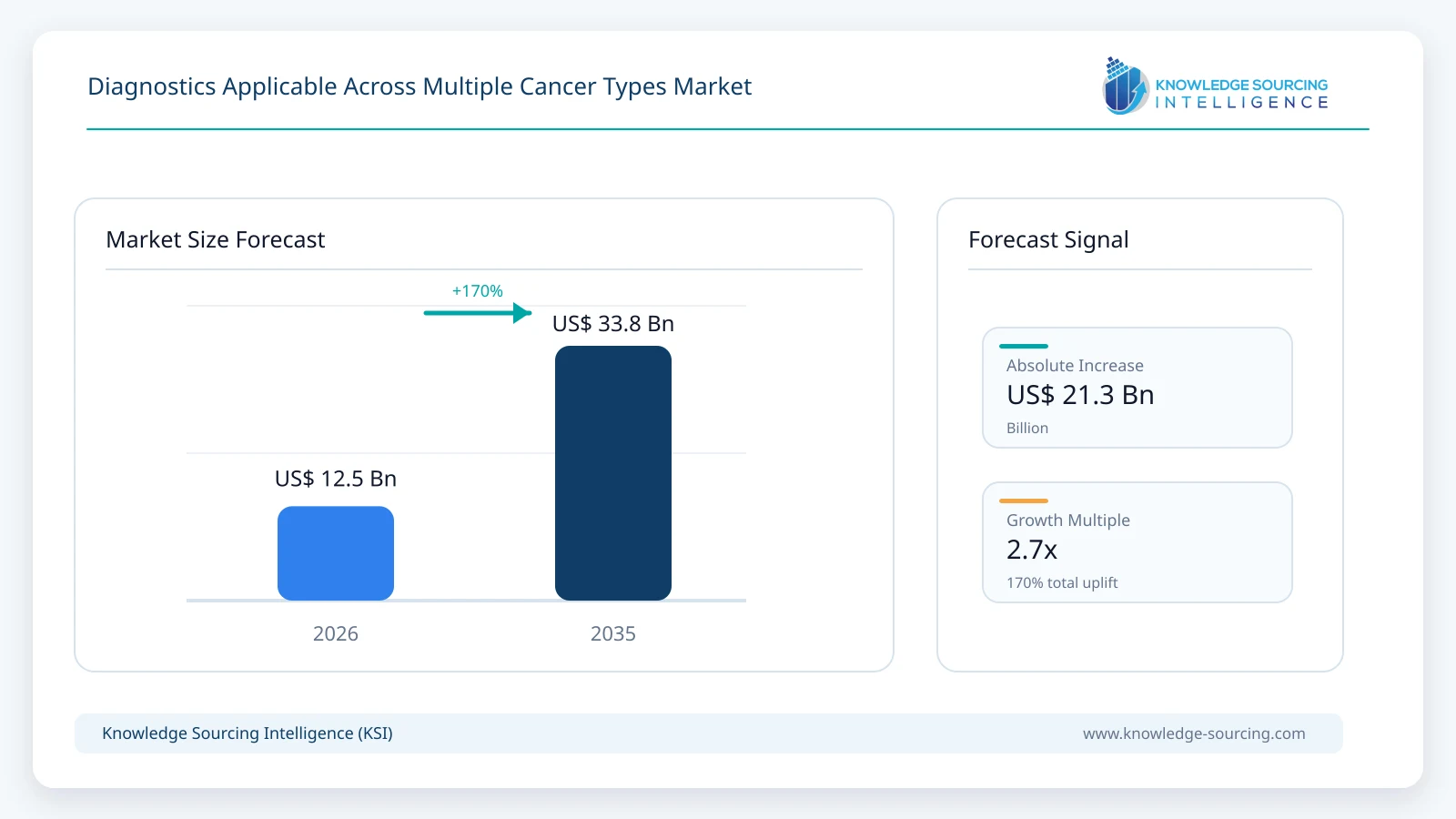
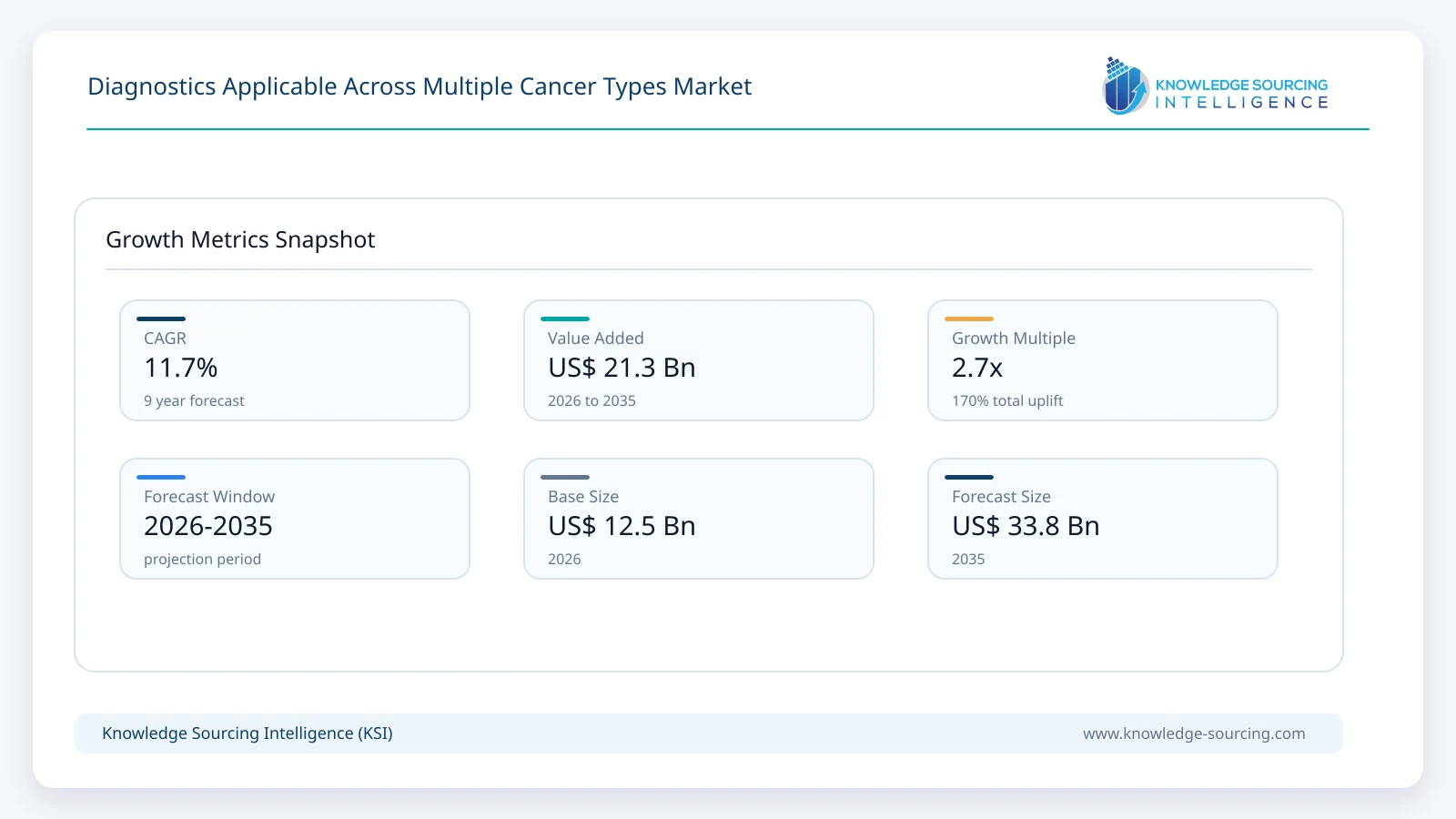
The Diagnostics Applicable Across Multiple Cancer Types Market is anticipated to grow at a CAGR of 11.7% from USD 12.50 billion in 2026 to USD 33.76 billion in 2035.
Highlights:
- 1Growing adoption of precision oncology is increasing demand for comprehensive genomic profiling because targeted therapies require biomarker-based patient selection.
- 2Expansion of liquid biopsy technologies is increasing testing utilization because clinicians seek minimally invasive monitoring approaches.
- 3Development of MCED platforms is increasing demand for population-level screening because healthcare systems aim to identify cancers at earlier stages.
- 4Growth in tumor-agnostic therapies is increasing biomarker testing demand because treatment eligibility increasingly depends on molecular characteristics rather than tumor location.
Cancer diagnostics increasingly depend on molecular characterization because tumor biology often determines therapeutic response. Demand is increasing for diagnostics applicable across multiple cancer types because clinicians require broader molecular visibility across heterogeneous patient populations. This requirement creates reliance on genomic profiling, biomarker discovery, and computational interpretation capabilities. Diagnostic developers are expanding pan-cancer testing portfolios to address these needs. The outcome is greater adoption of platform-based oncology diagnostics.
Precision oncology depends on identifying actionable biomarkers because targeted therapies require molecular validation before treatment initiation. Demand is shifting toward comprehensive diagnostic solutions because single-marker approaches frequently provide limited clinical insight. This limitation increases the value of multi-gene and multi-analyte testing strategies. Healthcare providers are incorporating broader testing frameworks into clinical workflows. The result is stronger integration of molecular diagnostics within oncology care pathways.
Regulatory agencies increasingly emphasize clinical validation because diagnostic outcomes directly influence treatment decisions. Demand is increasing for robust evidence generation because reimbursement and adoption depend on demonstrated clinical utility. Diagnostic companies are investing in prospective studies and real-world evidence programs to satisfy these requirements. This response strengthens confidence among providers and payers. The outcome is a more evidence-driven diagnostic marketplace.
Market Dynamics
Market Drivers
Precision Oncology Expansion: Targeted therapies require molecular confirmation because treatment effectiveness often depends on biomarker status. Demand is increasing for comprehensive cancer diagnostics because clinicians must evaluate multiple genomic alterations simultaneously. This requirement creates pressure on laboratories to expand testing capabilities. Diagnostic developers are introducing broader profiling solutions to support clinical decision-making. The outcome is sustained growth in multi-cancer diagnostic adoption.
Growth of Liquid Biopsy Testing: Cancer monitoring depends on repeated molecular assessment because tumor evolution can alter treatment response. Demand is increasing for blood-based testing because invasive tissue sampling creates clinical limitations. This constraint increases interest in liquid biopsy technologies. Diagnostic providers are expanding circulating tumor DNA testing services to address this need. The result is broader utilization across multiple cancer applications.
Emergence of Tumor-Agnostic Therapies: Tumor-agnostic treatments rely on molecular signatures because therapeutic eligibility transcends traditional cancer classifications. Demand is increasing for broad biomarker identification because clinicians must detect actionable alterations across diverse tumor types. This requirement elevates the value of pan-cancer testing approaches. Laboratories are expanding genomic profiling services to support therapy selection. The outcome is stronger demand for diagnostics applicable across multiple cancer types.
Increasing Early Detection Focus: Cancer outcomes improve when disease is identified earlier because intervention opportunities expand. Demand is increasing for MCED technologies because healthcare systems seek scalable screening approaches. This objective creates incentives for diagnostic innovation. Companies are advancing methylation-based and multi-analyte testing platforms to improve detection performance. The result is accelerating investment in early detection diagnostics.
Market Restraints
Clinical validation requirements increase development timelines because multi-cancer diagnostic claims require extensive evidence generation.
Reimbursement uncertainty limits adoption because payer coverage frequently depends on demonstrated clinical utility.
Bioinformatics complexity raises operational costs because large-scale molecular datasets require specialized interpretation infrastructure.
Market Opportunities
Multi-Cancer Early Detection Expansion: Population screening programs require scalable technologies because healthcare systems aim to reduce cancer mortality. Demand is increasing for MCED testing because traditional screening approaches cover only selected cancers. This gap creates opportunities for broader detection strategies. Diagnostic companies are expanding validation studies to support adoption. The outcome is growing commercial potential for MCED platforms.
Minimal Residual Disease Monitoring: Cancer recurrence management depends on early detection because treatment opportunities decline as disease progresses. Demand is increasing for MRD testing because clinicians seek earlier molecular signals of relapse. This requirement supports investment in highly sensitive assays. Diagnostic providers are refining detection capabilities to improve clinical utility. The result is expanding demand for recurrence monitoring solutions.
AI-Enabled Oncology Diagnostics: Diagnostic interpretation depends on increasingly complex molecular information because genomic datasets continue expanding. Demand is increasing for AI-supported analytics because manual interpretation creates scalability constraints. Diagnostic organizations are integrating computational tools into testing workflows. This response improves reporting efficiency and consistency. The outcome is stronger adoption of AI-enabled diagnostic platforms.
Companion Diagnostic Development: Biomarker-driven therapies require validated testing because treatment access depends on molecular confirmation. Demand is increasing for companion diagnostic programs because oncology drug pipelines remain highly targeted. Diagnostic companies are expanding pharmaceutical collaborations to support these developments. This activity strengthens commercialization opportunities. The result is continued growth in companion diagnostic demand.
Supply Chain Analysis
The supply chain begins with sequencing platform manufacturers, reagent suppliers, assay developers, software providers, and sample collection networks. Demand is increasing because multi-cancer diagnostics require highly standardized inputs and validated workflows. This dependence increases the importance of supplier quality and technology performance.
Clinical samples move through hospitals, oncology centers, physician practices, and laboratory logistics systems before testing occurs. Demand is shifting toward high-throughput processing because testing volumes continue expanding across oncology applications. This shift increases investment in automation and digital infrastructure. Laboratories are upgrading bioinformatics capabilities to accommodate larger datasets. The outcome is greater operational scalability.
Diagnostic results support treatment planning, recurrence monitoring, and pharmaceutical development activities. Demand is increasing because precision oncology programs depend on molecular evidence. This requirement reinforces long-term investment throughout the diagnostic value chain.
Government Regulations
Region | Regulatory Authority | Regulatory Focus |
United States | FDA, CMS, CLIA | Companion diagnostics, laboratory quality, molecular testing |
European Union | European Commission, National Competent Authorities | IVDR compliance and clinical evidence |
United Kingdom | MHRA | Oncology diagnostic oversight |
Japan | PMDA | Molecular diagnostic approvals |
Market Segmentation
By Diagnostic Type
Diagnostic type segmentation reflects changing oncology care requirements because different clinical decisions require distinct forms of molecular evidence. Demand is increasing for MCED tests because healthcare systems seek earlier identification of multiple cancers through a single screening approach. This shift increases interest in liquid biopsy and methylation-based technologies. Comprehensive genomic profiling remains essential because therapy selection frequently depends on broad molecular characterization. Recurrence monitoring and MRD testing are gaining adoption because oncologists require earlier visibility into disease progression. The result is increasing demand across multiple diagnostic categories.
By Technology
Technology adoption reflects the need for broader molecular insight because oncology care increasingly depends on comprehensive biomarker assessment. Demand is increasing for NGS because clinicians require simultaneous evaluation of numerous genomic alterations. This requirement reduces the practicality of sequential testing approaches. Digital PCR and methylation-based platforms are expanding because sensitivity requirements continue rising. Multi-omics technologies are emerging because single-data-type approaches often provide incomplete biological context. The outcome is stronger demand for advanced molecular technologies.
By Sample Type
Sample type selection reflects evolving clinical preferences because testing accessibility influences adoption. Demand is increasing for blood-based diagnostics because minimally invasive procedures improve patient acceptance and monitoring frequency. This preference creates pressure on developers to improve liquid biopsy performance. Tissue biopsy remains important because certain analyses still require direct tumor evaluation. Cytology and bone marrow samples continue supporting specialized applications where disease characteristics dictate sample requirements. The result is growing diversification of sample utilization across oncology diagnostics.
Regional Analysis
North America
North America leads adoption because precision oncology infrastructure remains highly developed. Demand is increasing for comprehensive genomic profiling because oncology providers increasingly rely on biomarker-driven treatment decisions. This reliance expands testing volumes across hospitals, cancer centers, and reference laboratories. Reimbursement challenges persist because evidence requirements remain substantial. Diagnostic developers are generating clinical utility data to strengthen payer acceptance. The outcome is continued regional leadership in multi-cancer diagnostics.
Europe
European demand reflects growing precision medicine integration because healthcare systems increasingly recognize the value of molecular diagnostics. Demand is increasing for pan-cancer testing because targeted therapies require validated biomarker identification. Regulatory requirements under IVDR create evidence expectations that influence commercialization strategies. Diagnostic companies are adapting validation programs to satisfy these standards. The result is steady adoption across major European oncology markets.
Asia Pacific
Asia Pacific demand is expanding because cancer incidence and genomic medicine investments continue rising. Demand is increasing for advanced molecular diagnostics because healthcare providers seek improved diagnostic accuracy and treatment personalization. Infrastructure disparities create adoption variability across countries. Diagnostic organizations are expanding laboratory capacity and partnerships to address these limitations. The outcome is rapid regional development in oncology diagnostics.
Rest of the World
Demand is increasing because healthcare systems are incorporating precision medicine principles into oncology programs. Resource constraints limit adoption because advanced testing requires specialized infrastructure. Diagnostic providers are expanding access through centralized laboratory models and international partnerships. This response improves availability of complex testing services. The result is gradual but sustained market expansion.
Regulatory Landscape
Regulatory oversight focuses on analytical validity because diagnostic accuracy directly influences clinical outcomes. Demand is increasing for validated oncology diagnostics because treatment pathways increasingly depend on molecular evidence. Regulatory agencies are strengthening evidence requirements to ensure reliability. The outcome is greater emphasis on clinical validation.
Companion diagnostics receive significant regulatory attention because targeted therapies often require linked testing strategies. Demand is increasing for coordinated approval processes because therapeutic and diagnostic development frequently occur simultaneously. Diagnostic developers are aligning evidence generation programs with pharmaceutical partners. The result is stronger integration between diagnostics and therapeutics.
Data governance requirements continue expanding because oncology diagnostics generate large volumes of genomic information. Demand is increasing for secure data management systems because providers and patients expect privacy protections. Diagnostic organizations are strengthening compliance capabilities to address these expectations. The outcome is increased investment in data security infrastructure.
Pipeline Analysis
The diagnostic pipeline focuses heavily on multi-cancer detection because healthcare systems seek earlier intervention opportunities. Demand is increasing for methylation-based assays because developers aim to identify multiple cancers from a single blood sample. This objective drives extensive clinical validation activity. Companies are refining analytical algorithms to improve sensitivity and specificity. The outcome is a growing MCED development landscape.
Tumor-agnostic diagnostics remain a major pipeline area because biomarker-directed therapies continue expanding. Demand is increasing for comprehensive profiling platforms because clinicians require broader molecular characterization. This need supports development of multi-gene and multi-omics approaches. Diagnostic developers are integrating increasingly complex datasets to improve clinical relevance. The result is continued innovation in pan-cancer testing.
MRD diagnostics represent another active pipeline segment because recurrence monitoring requires highly sensitive detection technologies. Demand is increasing for personalized assays because clinicians seek earlier identification of disease progression. Companies are advancing liquid biopsy platforms to address this requirement. The outcome is expanding investment in recurrence monitoring solutions.
Competitive Landscape
Illumina
Illumina remains strategically distinct because its sequencing platforms underpin a substantial portion of global oncology genomic testing infrastructure. Demand is increasing for broad genomic characterization because targeted therapies require comprehensive molecular assessment. This requirement strengthens utilization of Illumina-based sequencing ecosystems across research and clinical settings. The company continues supporting diagnostic developers through platform innovation and workflow improvements. The outcome is sustained influence across the multi-cancer diagnostics value chain.
GRAIL
GRAIL remains strategically distinct because it focuses specifically on multi-cancer early detection through blood-based screening technologies. Demand is increasing for population-scale cancer detection because healthcare systems seek earlier intervention opportunities. This objective supports continued interest in the Galleri platform. The company is expanding evidence generation activities to strengthen adoption. The outcome is growing visibility within the MCED segment.
Guardant Health
Guardant Health differentiates itself through liquid biopsy expertise and extensive oncology-focused assay development. Demand is increasing for minimally invasive testing because clinicians require more frequent molecular monitoring. This need strengthens adoption of circulating tumor DNA testing approaches. The company continues expanding clinical applications across screening, treatment selection, and monitoring. The result is strong positioning within liquid biopsy diagnostics.
Exact Sciences
Exact Sciences remains strategically distinct because it combines cancer screening capabilities with molecular diagnostic development. Demand is increasing for earlier detection because healthcare providers seek improved patient outcomes. This focus supports continued expansion of oncology testing programs. The company is strengthening molecular capabilities through investments and partnerships. The outcome is broader participation across the cancer diagnostics continuum.
Foundation Medicine
Foundation Medicine differentiates itself through comprehensive genomic profiling and strong pharmaceutical collaborations. Demand is increasing for actionable biomarker identification because targeted therapies require precise molecular evidence. This requirement reinforces adoption of broad profiling approaches. The company continues supporting therapy development and precision oncology programs. The result is a strong position within genomic diagnostics.
Natera
Natera remains strategically distinct because it emphasizes personalized molecular monitoring and recurrence detection. Demand is increasing for MRD testing because clinicians seek earlier evidence of disease progression. This requirement supports broader utilization of Signatera-based approaches. The company continues expanding clinical evidence and application areas. The outcome is increasing relevance within recurrence monitoring.
F. Hoffmann-La Roche
Roche differentiates itself through integrated diagnostics and pharmaceutical capabilities. Demand is increasing for companion diagnostics because targeted therapies depend on biomarker validation. This linkage strengthens Roche’s position across both diagnostic and therapeutic markets. The company continues advancing precision oncology initiatives. The result is strong competitive differentiation.
QIAGEN
QIAGEN remains strategically distinct because it combines molecular testing technologies with companion diagnostic expertise. Demand is increasing for standardized biomarker assessment because oncology treatment pathways require reliable testing solutions. This requirement supports continued adoption of QIAGEN technologies. The company is expanding collaborations with pharmaceutical developers. The outcome is sustained participation in precision oncology diagnostics.
Future Market Outlook
Demand for diagnostics applicable across multiple cancer types is increasing because oncology treatment strategies increasingly depend on molecular characterization rather than tissue origin alone. This shift raises the value of comprehensive testing platforms that generate actionable information across multiple clinical settings. Diagnostic developers are expanding technology portfolios to support these evolving requirements. The outcome is a more integrated precision oncology ecosystem.
Liquid biopsy, MCED technologies, and AI-enabled analytics are reshaping diagnostic workflows because healthcare providers require scalable and minimally invasive solutions. Demand is increasing for tests that support screening, therapy selection, and recurrence monitoring through a unified platform approach. This requirement encourages greater convergence between diagnostics, bioinformatics, and pharmaceutical development. The result is accelerated innovation across oncology diagnostics.
Regulatory scrutiny, reimbursement evidence, and clinical utility validation will continue determining competitive success. Organizations that combine strong molecular science, robust evidence generation, and scalable testing infrastructure are likely to maintain leadership positions. The market remains strategically important because molecular diagnostics increasingly determine how cancer is detected, classified, monitored, and treated.
The long-term trajectory of the market reflects a transition from single-cancer diagnostic strategies toward comprehensive pan-cancer testing ecosystems, creating sustained demand for technologies capable of supporting precision oncology across the entire continuum of cancer care.
Diagnostics Applicable Across Multiple Cancer Types Market Scope:
| Report Metric | Details |
|---|---|
| Total Market Size in 2026 | USD 12.50 billion |
| Total Market Size in 2035 | USD 33.76 billion |
| Forecast Unit | USD Billion |
| Growth Rate | 11.7% |
| Study Period | 2021 to 2035 |
| Historical Data | 2021 to 2024 |
| Base Year | 2025 |
| Forecast Period | 2026 – 2035 |
| Segmentation | Diagnostic Type, Technology, End User, Geography |
| Companies |
|
Market Segmentation
Diagnostic Type
Technology
End User
Geography
- North America
- South America
- Europe
- Middle East and Africa
- Asia Pacific
Table of Contents
1. EXECUTIVE SUMMARY
1.1 Market Snapshot
1.2 Key Findings
1.3 Analyst Insights
1.4 Strategic Recommendations
2. RESEARCH METHODOLOGY
2.1 Research Design
2.2 Data Collection Methodology
2.3 Market Size Estimation
2.4 Forecasting Model
2.5 Assumptions & Limitations
3. DIAGNOSTICS APPLICABLE ACROSS MULTIPLE CANCER TYPES MARKET OVERVIEW, SIZE & FORECAST
3.1 Market Definition & Scope
3.2 Oncology Diagnostics Industry Overview
3.3 Industry Evolution
3.4 Key Market Trends
3.5 Historical Market Size Analysis (2021–2025)
3.6 Market Forecast Analysis (2026–2035)
3.7 Global Cancer Burden Analysis
3.8 Diagnosed Cancer Patient Population Analysis
3.9 Multi-Cancer Testing Volume Analysis
3.10 Biomarker Adoption Trends in Oncology
3.11 Precision Oncology Diagnostic Landscape
3.12 Companion and Tumor-Agnostic Testing Trends
4. MARKET DYNAMICS
4.1 Market Drivers
4.2 Market Restraints
4.3 Market Opportunities
4.4 Market Challenges
5. INDUSTRY LANDSCAPE
5.1 Industry Value Chain Analysis
5.2 Pricing Analysis
5.3 Reimbursement Landscape
6. INNOVATION LANDSCAPE
6.1 Emerging Technologies in Multi-Cancer Diagnostics
6.2 Product Innovation and Assay Development
6.3 Clinical Trial Analysis
6.4 Pipeline Analysis
6.5 Technology Roadmap
6.6 AI Integration in Cancer Diagnostics
6.7 Digital Pathology and Data Integration
7. REGULATORY LANDSCAPE
7.1 Regulatory Framework
7.2 Approval Pathways
7.3 Compliance Requirements
8. DIAGNOSTICS APPLICABLE ACROSS MULTIPLE CANCER TYPES MARKET LANDSCAPE ANALYSIS
8.1 Analysis by Technology Platform
8.2 Analysis by Biomarker Type
8.3 Analysis by Sample Type
8.4 Analysis by Clinical Application
8.5 Analysis by Testing Methodology
9. DIAGNOSTICS APPLICABLE ACROSS MULTIPLE CANCER TYPES MARKET SEGMENT ANALYSIS (2021–2035)
9.1 By Diagnostic Type
9.1.1 Multi-Cancer Early Detection (MCED) Tests
9.1.2 Comprehensive Genomic Profiling Tests
9.1.3 Liquid Biopsy Tests
9.1.4 Companion Diagnostics
9.1.5 Tumor-Agnostic Biomarker Tests
9.1.6 Recurrence Monitoring and Minimal Residual Disease Tests
9.2 By Technology
9.2.1 Next-Generation Sequencing (NGS)
9.2.2 Polymerase Chain Reaction (PCR)
9.2.3 Digital PCR (dPCR)
9.2.4 Fluorescence In Situ Hybridization (FISH)
9.2.5 Immunohistochemistry (IHC)
9.2.6 Microarray Technologies
9.2.7 Methylation-Based Analysis
9.2.8 Multi-Omics Platforms
9.3 By Sample Type
9.3.1 Blood
9.3.2 Tissue Biopsy
9.3.3 Bone Marrow
9.3.4 Cytology Samples
9.3.5 Other Biological Samples
9.4 By Biomarker Type
9.4.1 Genomic Biomarkers
9.4.2 Transcriptomic Biomarkers
9.4.3 Proteomic Biomarkers
9.4.4 Epigenetic Biomarkers
9.4.5 Circulating Tumor Biomarkers
9.5 By End User
9.5.1 Hospitals
9.5.2 Cancer Centers
9.5.3 Independent Diagnostic Laboratories
9.5.4 Academic and Research Institutes
9.5.5 Pharmaceutical and Biotechnology Companies
10. DIAGNOSTICS APPLICABLE ACROSS MULTIPLE CANCER TYPES MARKET GEOGRAPHICAL ANALYSIS (2021–2035)
10.1 North America
10.2 Europe
10.3 Asia-Pacific
10.4 South America
10.5 Middle East & Africa
11. DIAGNOSTICS APPLICABLE ACROSS MULTIPLE CANCER TYPES MARKET COUNTRY ANALYSIS (2021–2035)
11.1 United States
11.2 Canada
11.3 Germany
11.4 United Kingdom
11.5 France
11.6 Italy
11.7 Spain
11.8 Netherlands
11.9 Japan
11.10 China
11.11 South Korea
11.12 Australia
11.13 India
11.14 Brazil
11.15 Saudi Arabia
12. COMPETITIVE LANDSCAPE
12.1 Market Share Analysis
12.2 Strategic Developments
12.3 Mergers & Acquisitions, Partnerships & Collaborations
12.4 Product Launches
13. COMPANY PROFILES
13.1 Illumina
13.2 GRAIL
13.3 Guardant Health
13.4 Exact Sciences
13.5 Foundation Medicine
13.6 Natera
13.7 F. Hoffmann-La Roche
13.8 QIAGEN
13.9 Thermo Fisher Scientific
13.10 NeoGenomics
13.11 Agilent Technologies
13.12 Myriad Genetics
13.13 Tempus AI
13.14 Caris Life Sciences
13.15 Genomic Health
14. DIAGNOSTICS APPLICABLE ACROSS MULTIPLE CANCER TYPES MARKET COMMERCIAL FORECAST ANALYSIS
14.1 Multi-Cancer Early Detection Tests Forecast
14.2 Comprehensive Genomic Profiling Tests Forecast
14.3 Liquid Biopsy Diagnostics Forecast
14.4 Companion Diagnostics Forecast
14.5 Tumor-Agnostic Biomarker Testing Forecast
14.6 Molecular Residual Disease Testing Forecast
14.7 Methylation-Based Cancer Detection Technologies Forecast
14.8 AI-Enabled Oncology Diagnostic Platforms Forecast
15. INVESTMENT & FUNDING ANALYSIS
15.1 Venture Capital Trends
15.2 Government Funding
15.3 R&D Investments
16. FUTURE OUTLOOK
16.1 Key Growth Opportunities
16.2 Future Industry Trends
Navigate
Trusted by the world's leading organizations











