
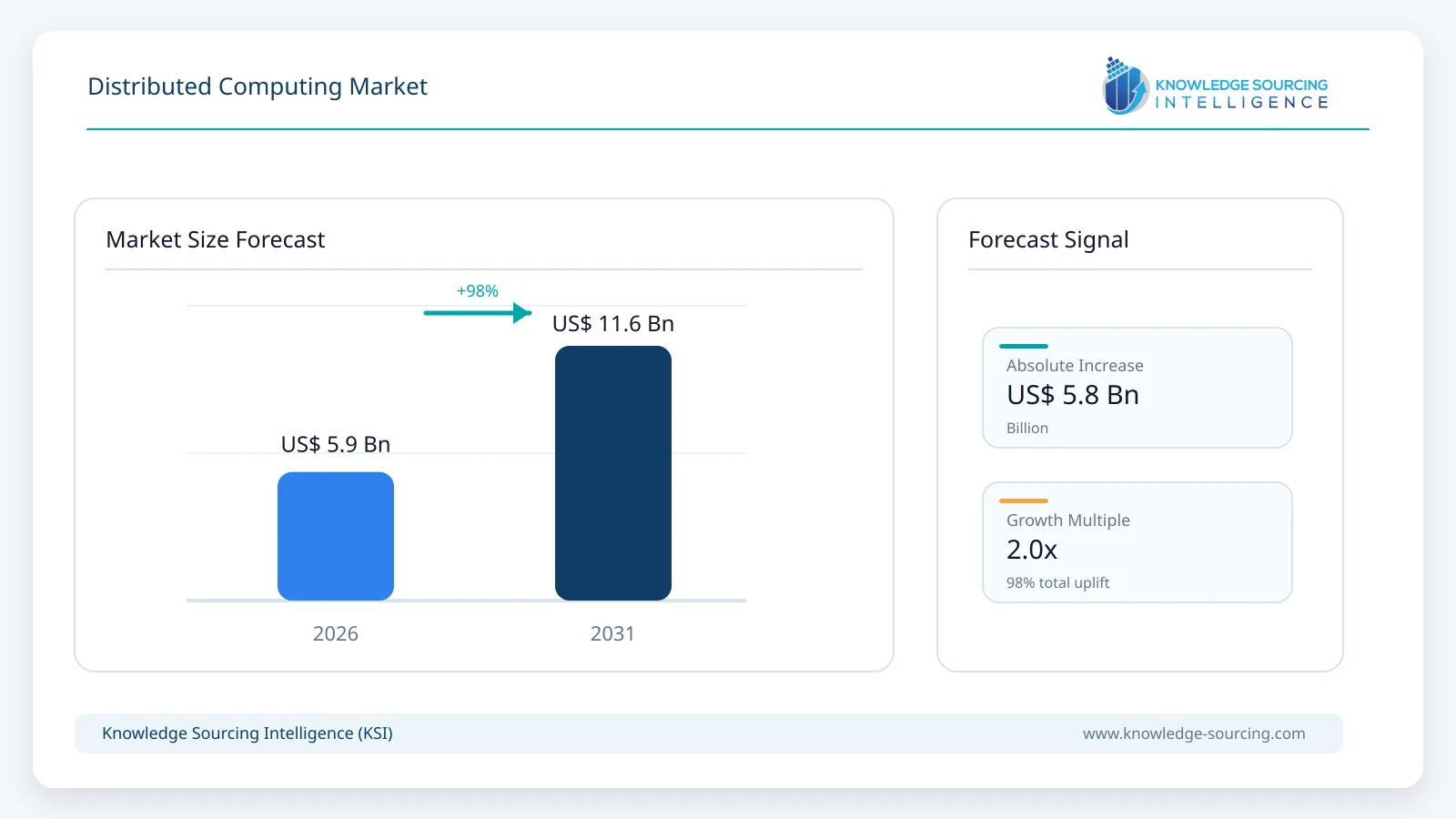
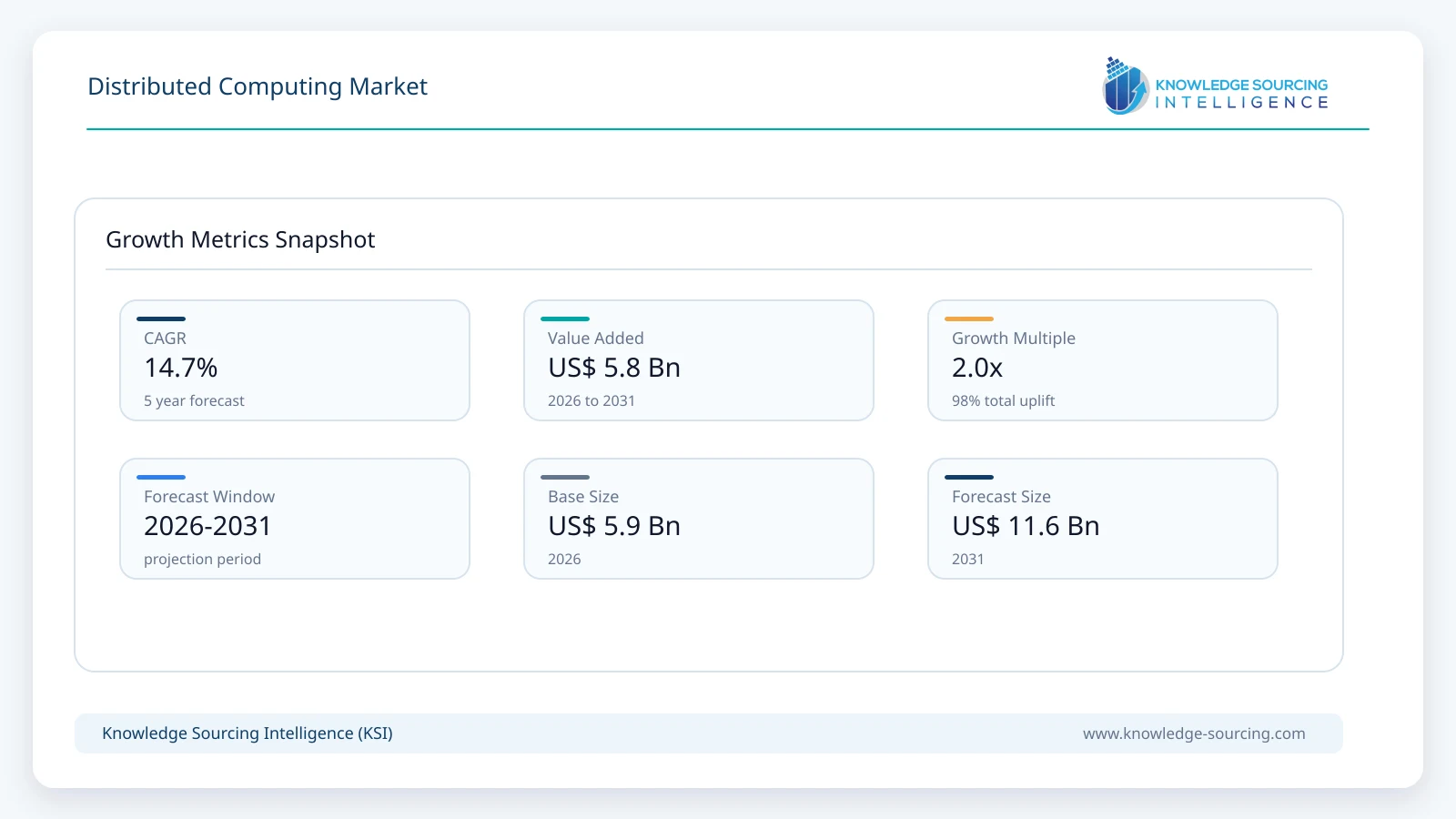
The Distributed Computing Market is projected to grow at a CAGR of 14.7%, increasing from USD 5.87 billion in 2026 to USD 11.63 billion in 2031 during the forecast period.
Highlights:
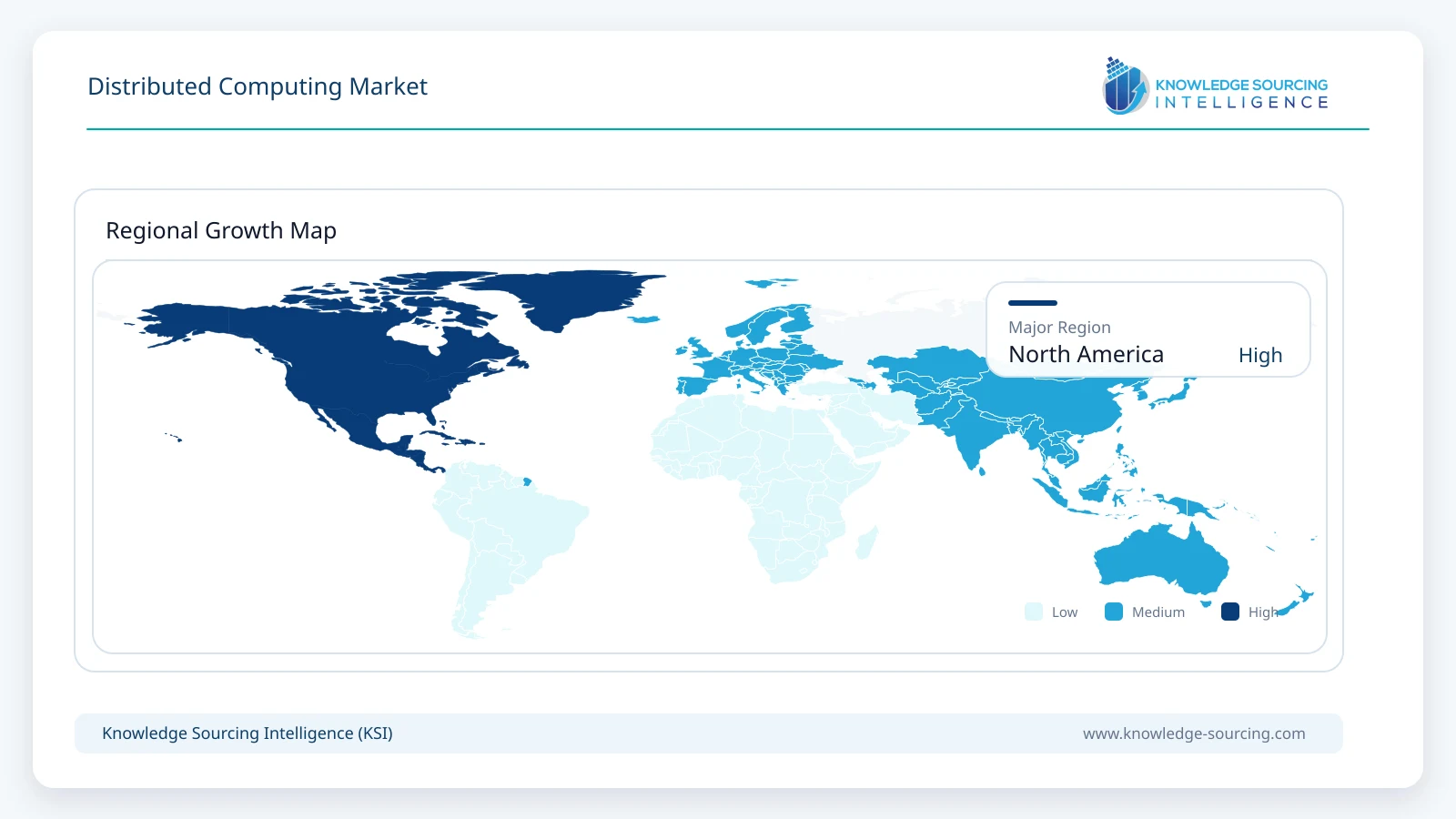
- 1Regional growth is expected to be the fastest in Asia-Pacific, driven by the presence of hyperscale cloud providers and early enterprise investments in the region, with North America being the clear leader.
- 2The majority of market revenue comes from large companies, but SMEs are an increasing portion of customers as providers bundle distributed services into managed products.
- 3The convergence of IT and OT security, increasing adoption of cloud-based security solutions, and growing deployment of AI-driven threat detection are creating new opportunities in the market, particularly as organizations seek to secure distributed devices across industrial, enterprise and critical infrastructure environments.
- 4Distributed AI computing is one of the key growth vectors as they parallelize model training and inference across clusters and edge locations to ensure cost, latency and sovereignty constraints are met.
Edge computing is the top use case as it represents maximum share of distributed cloud revenue in 2026, with organisations processing data near the source to satisfy latency, bandwidth and sovereignty needs. Content delivery and Internet of Things data processing and intelligent-transportation applications are also important, and embedding artificial intelligence into distributed infrastructure, where dynamic workload placement, automated failover, and distributed model training make a big difference, is one of the biggest catalysts for growth.
Data security, data storage and networking are the major service categories by service, and data security is often becoming an integral part of the distributed fabric as organizations look for a consistent policy to be enforced throughout heterogeneous locations. Large enterprises drive the bulk of spending, just as they have done in the past, with more than half of the market revenue attributable to them, due to their wider geographical reach and compliance requirements, but small and medium-sized enterprises are increasingly taking up managed distributed-cloud services as hyperscalers offer them in more manageable consumption models.
Each industry is a leading adopter, with specific motivating factors behind the use of verticals, regulatory data residency requirements in the BFSI segment, network-function distribution requirements in the IT and telecommunications segment, real-time clinical and imaging workloads in the healthcare segment and plant-floor analytics in the manufacturing segment. Geographically, North America accounts for the largest market share, with high concentration of hyperscalers and early adoption by enterprises and expected to experience the highest growth in the face of scaling of 5G and edge infrastructure.
Market Dynamics
Market Drivers
As edge computing and IoT deployments increase in number, data is being created at the edge of the network that simply can't be backed hauled to a centralized facility, prompting a need for distributed architectures that process data at the edge and keep it under a central management.
Orchestration, interconnect and fault-tolerant multi-node execution capabilities are being sustained as AI workloads are distributed, from model training to edge inference, across geographically dispersed infrastructure.
Regulated workloads are driving data-residency, sovereignty and compliance considerations that are causing organizations to move workloads to particular jurisdictions or to customer premises but maintain a single cloud operating model.
Cloud cost considerations and the necessity of being resilient are driving enterprises to distribute workloads across multiple locations and providers, thus minimizing the reliance on any single region or providers.
Market Restraints & Opportunities
Managing, securing and integrating infrastructure distributed across multiple locations, providers and hardware types is a major challenge, as is the lack of engineers who are proficient in distributed-systems design and operations.
Tariffs and pressure on supply chains have driven up the costs of edge hardware and networking gear and extended payback times for some deployments of servers.
However, the increasing adoption of AI and machine learning on orchestration platforms, rapid evolution of managed distributed-cloud services, and rising need for sovereign and low-latency AI inference are providing significant opportunity for vendors to make multi-site deployment easier and provide uniform security as well as policy enforcement.
Key Developments
September 2026: PANIM, a distributed AI computing company founded by Amit Shastri, has announced plans to take its distributed computing technology into field testing in India, targeting applications across agriculture and other data-intensive industries.
July 2026: Sunrun, America's largest provider of home battery storage, solar, and home-to-grid power plants, launched a distributed AI compute pilot program.
April 2026: SPAN announced the launch of XFRA, a distributed data center solution designed to deliver gigawatts of new compute capacity amidst growing power infrastructure constraints.
Distributed Computing Market Segmentation
The market is segmented by application, service, enterprise size, end-use industry, and geography.
By Application
Edge Computing
Edge computing is the largest application segment, driven by the need to process data close to its source to reduce latency, conserve bandwidth and satisfy data-sovereignty requirements across industrial, retail, telecommunications and transportation settings.
Amazon Web Services, Inc. extends its cloud services to customer premises and edge locations through offerings such as AWS Outposts and Local Zones.
Microsoft Corporation provides hybrid and edge management through Azure Arc and Azure Stack, enabling consistent operations across distributed environments.
By Service
Data Security, Storage & Networking
Data security, storage and networking are the core service categories, with security increasingly embedded into the distributed fabric so that policy, identity and encryption controls apply consistently across every site and provider.
Cisco Systems, Inc. supplies the networking and security infrastructure that interconnects distributed sites and edge locations.
Akamai Technologies, Inc. operates a large distributed edge platform supporting content delivery, security and edge compute services.
By Enterprise Size
Large Enterprises
Large enterprises account for the majority of market spending, reflecting their multi-region footprints and heavier regulatory obligations, while small and medium-sized enterprises are adopting managed distributed-cloud services that reduce operational complexity.
Google LLC (Alphabet Inc.) offers Google Distributed Cloud to run Google Cloud services in customer data centers and at the edge.
Regional Analysis
North America Market Analysis
North America holds the largest regional share, supported by the concentration of hyperscale cloud providers, early enterprise adoption of edge and hybrid architectures, and substantial investment in AI infrastructure across the United States and Canada.
Europe Market Analysis
Europe's market is shaped by data-sovereignty and digital-resilience regulation, which is encouraging sovereign-cloud and in-region distributed deployments across financial services, government and industrial sectors.
Asia-Pacific Market Analysis
Asia-Pacific is forecast to register the fastest regional growth, driven by large-scale 5G rollouts, expanding edge and IoT deployments, and rising investment in AI infrastructure across China, Japan, South Korea and India.
Middle East and Africa Market Analysis
The Middle East and Africa are seeing growing investment in distributed and sovereign cloud infrastructure tied to national digital-transformation programs, particularly across the Gulf states.
South America Market Analysis
South America represents a developing market, with telecommunications operators and financial institutions in Brazil expanding edge and distributed-cloud deployments to improve latency and meet local data-residency requirements.
List of Companies
Amazon Web Services, Inc.
Microsoft Corporation
Google LLC (Alphabet Inc.)
IBM Corporation
Oracle Corporation
Cisco Systems, Inc.
Akamai Technologies, Inc.
Cloudflare, Inc.
Hewlett Packard Enterprise Company
Nutanix, Inc.
Competitive Landscape
Amazon Web Services, Inc.
AWS extends its cloud services into customer data centers and edge locations through Outposts, Local Zones and Wavelength, positioning itself as the broadest provider of distributed infrastructure managed through a single cloud control plane.
Microsoft Corporation
Microsoft supports distributed operations through Azure Arc and Azure Stack, allowing customers to manage servers, Kubernetes clusters and data services across on-premises, multi-cloud and edge environments from one platform.
Akamai Technologies, Inc.
Akamai operates one of the world's largest distributed edge platforms and has expanded beyond content delivery into edge security and compute services, targeting latency-sensitive and AI inference workloads.
Analyst View
The Distributed Computing market is evolving from a niche architectural option to the standard operating model for latency sensitive, data-intensive and regulated workloads. While edge computing is the foundation use case, the distribution of AI training and inference is the most impactful growth driver, as organizations distribute model workloads across clusters, edge nodes and sovereign regions and exert control over cost and compliance requirements. The distributed cloud is defined differently by many people, and the distributed cloud core measured here has significant upside, due to decentralized compute networks and distributed-AI frameworks. The provider concentration and enterprise maturity are amongst the leading prospects in North America, while Asia-Pacific's 5G and edge build-out are expected to drive the highest growth.
Distributed Computing Market Scope:
| Report Metric | Details |
|---|---|
| Total Market Size in 2026 | USD 5.87 billion |
| Total Market Size in 2031 | USD 11.63 billion |
| Forecast Unit | USD Billion |
| Growth Rate | 14.7% |
| Study Period | 2021 to 2031 |
| Historical Data | 2021 to 2024 |
| Base Year | 2025 |
| Forecast Period | 2026 – 2031 |
| Segmentation | Application, Service, Enterprise Size, Geography |
| Companies |
|
Market Segmentation
By Application
Edge Computing
Content Delivery
Internet of Things
Intelligent Transportation
Others
By Service
Data Security
Data Storage
Networking
By Enterprise Size
Large Enterprises
Small & Medium Enterprises
By Geography
North America
USA
Canada
Mexico
South America
Brazil
Others
Europe
Germany
France
United Kingdom
Others
Middle East and Africa
UAE
Saudi Arabia
Others
Asia Pacific
China
India
Japan
Others
Table of Contents
1. EXECUTIVE SUMMARY
2. MARKET SNAPSHOT
2.1. Market Overview
2.2. Market Definition
2.3. Scope of the Study
2.4. Market Segmentation
3. BUSINESS LANDSCAPE
3.1. Market Drivers
3.2. Market Restraints
3.3. Market Opportunities
3.4. Porter's Five Forces Analysis
3.5. Industry Value Chain Analysis
3.6. Policies and Regulations (Data Sovereignty & Residency)
3.7. Strategic Recommendations
4. TECHNOLOGICAL OUTLOOK
4.1. Distributed Cloud & Edge Orchestration
4.2. Decentralized Compute Networks
4.3. Distributed AI Training & Inference
4.4. Fault-Tolerant Multi-Node Execution
5. DISTRIBUTED COMPUTING MARKET BY APPLICATION
5.1. Introduction
5.2. Edge Computing
5.3. Content Delivery
5.4. Internet of Things
5.5. Intelligent Transportation
5.6. Others
6. DISTRIBUTED COMPUTING MARKET BY SERVICE
6.1. Introduction
6.2. Data Security
6.3. Data Storage
6.4. Networking
7. DISTRIBUTED COMPUTING MARKET BY ENTERPRISE SIZE
7.1. Introduction
7.2. Large Enterprises
7.3. Small & Medium Enterprises
8. DISTRIBUTED COMPUTING MARKET BY GEOGRAPHY
8.1. Introduction
8.2. North America
8.2.1. USA
8.2.2. Canada
8.2.3. Mexico
8.3. South America
8.3.1. Brazil
8.3.2. Others
8.4. Europe
8.4.1. Germany
8.4.2. France
8.4.3. United Kingdom
8.4.4. Others
8.5. Middle East and Africa
8.5.1. UAE
8.5.2. Saudi Arabia
8.5.3. Others
8.6. Asia Pacific
8.6.1. China
8.6.2. India
8.6.3. Japan
8.6.4. Others
9. COMPETITIVE ENVIRONMENT AND ANALYSIS
9.1. Major Players and Strategy Analysis
9.2. Market Share Analysis
9.3. Mergers, Acquisitions, Agreements, and Collaborations
9.4. Competitive Dashboard
10. COMPANY PROFILES
10.1. Amazon Web Services, Inc.
10.2. Microsoft Corporation
10.3. Google LLC (Alphabet Inc.)
10.4. IBM Corporation
10.5. Oracle Corporation
10.6. Cisco Systems, Inc.
10.7. Akamai Technologies, Inc.
10.8. Cloudflare, Inc.
10.9. Hewlett Packard Enterprise Company
10.10. Nutanix, Inc.
11. APPENDIX
11.1. Currency
11.2. Assumptions
11.3. Base and Forecast Years Timeline
11.4. Key Benefits for the Stakeholders
11.5. Research Methodology
11.6. Abbreviations
Navigate
Trusted by the world's leading organizations











