
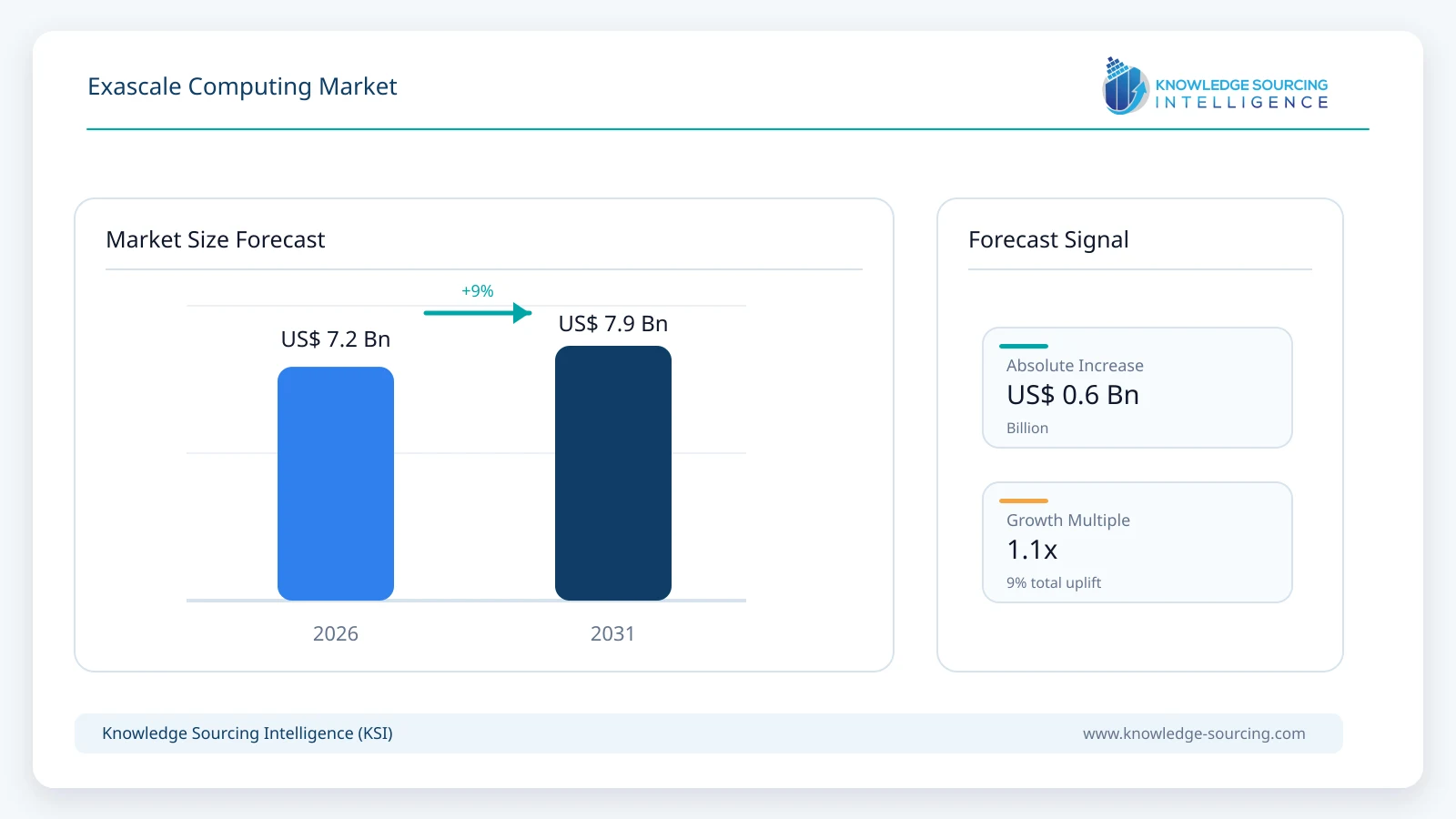
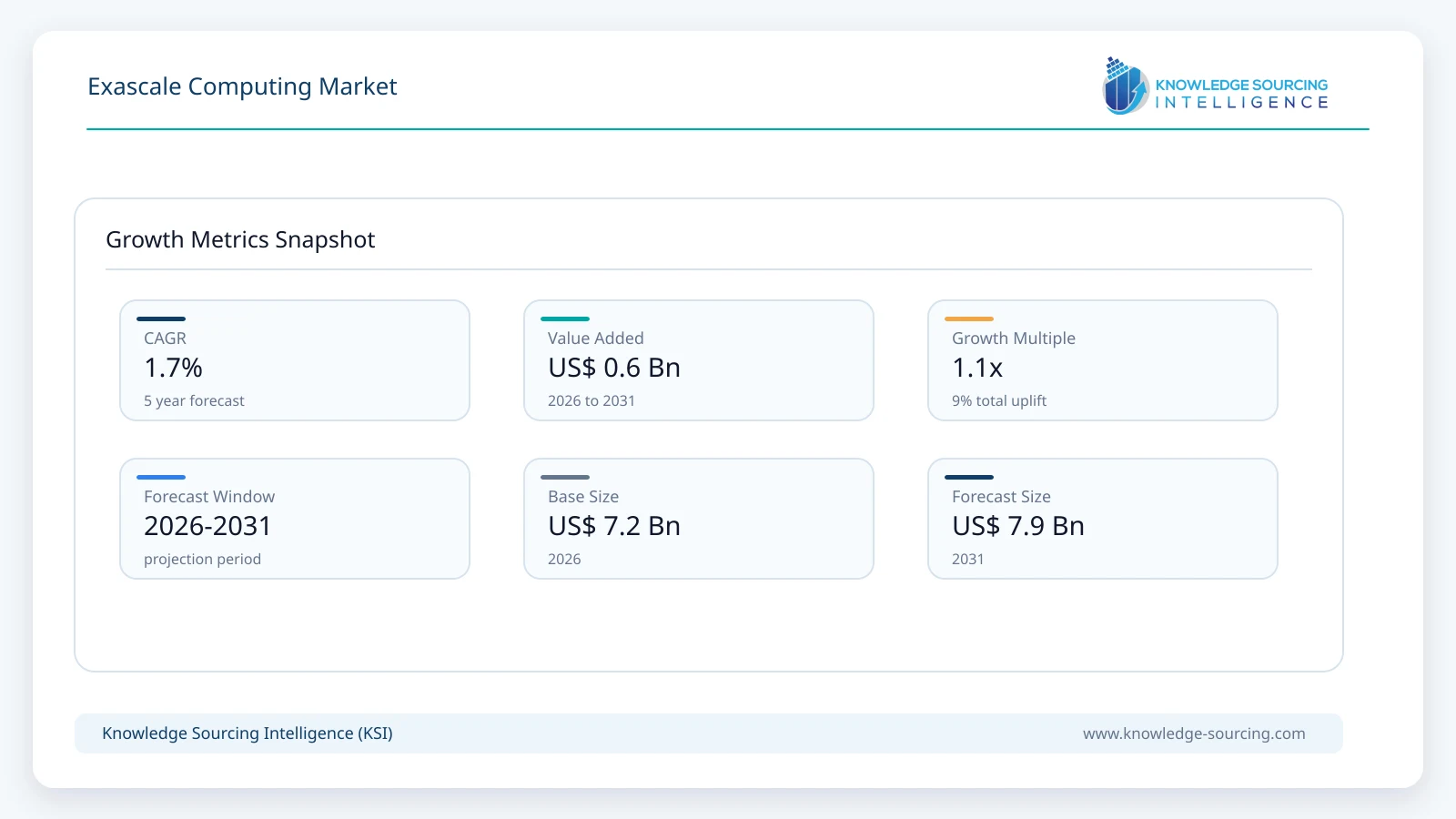
The Exascale Computing Market is projected to increase from USD 7.24 billion in 2026 to USD 7.89 billion in 2031, growing at a CAGR of approximately 1.7% over forecast period.
Highlights:
- 1Currently the on-premises deployment mode dominates market revenue but exascale-as-a-service is projected to be the fastest-growing deployment mode as cloud and specialized providers develop capacity-based access models.
- 2The end-use market that leads in revenue share is government and national labs, where exascale is used for intelligence analysis, cryptographic security, and large-scale defense simulation.
- 3Life sciences and pharmaceuticals will be the fastest-growing end-use category, thanks to exascale computing's simulation capacity that will grow increasingly critical to drug discovery and precision-medicine research.
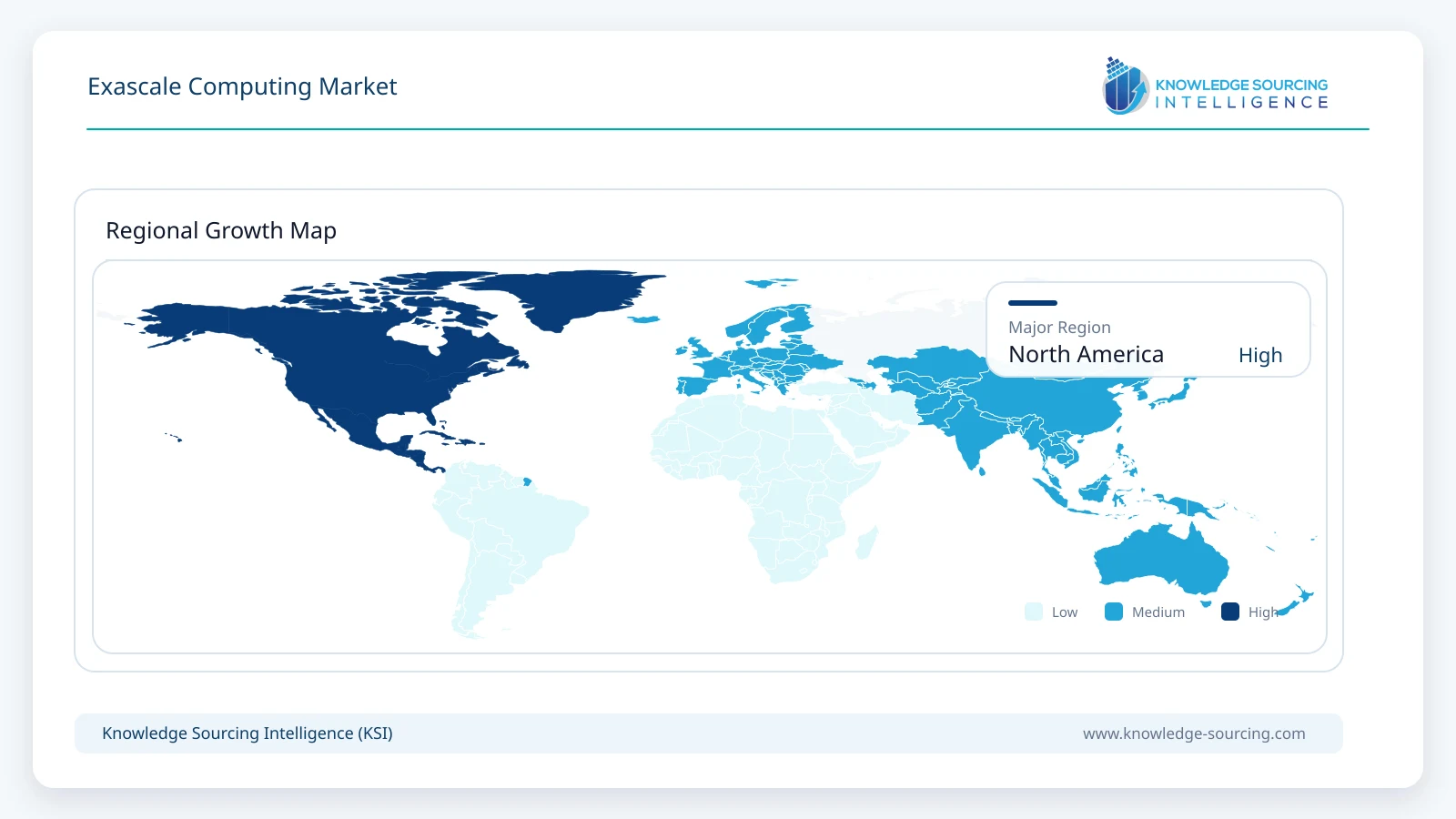
- 4The North America region is expected to generate the highest revenue share and the fastest growth in the region, whereas the Asia-Pacific region is projected to grow the most owing to the indigenous exascale initiatives and rising demand for research in the field of pharmaceutical outsourcing.
- 5The next big round of exascale procurements will be anticipated in the coming years in the U.S., the European Union and China from 2026 through 2028, with continued multi-year capital investment in the field.
By component, hardware is anticipated to command the largest share of market revenue, encompassing the massive processor arrays, high-bandwidth memory, and specialized interconnect and cooling infrastructure required to operate at exaflop scale, while the services segment is forecast to register the fastest growth as organizations increasingly require specialized expertise to design, deploy and optimize workloads for exascale-class architectures. By computing architecture, distributed computing approaches, which divide large computational tasks into smaller subtasks processed simultaneously across interconnected nodes, are forecast to see the fastest growth, reflecting the scalability and resource-utilization advantages this architecture offers for the largest, most data-intensive workloads.
By end-use industry, government and defense represents the largest end-user segment, accounting for a substantial share of total market revenue given the sector's reliance on advanced computing capabilities for real-time intelligence analysis, cryptographic security and large-scale defense simulations. Life sciences and pharmaceutical applications are forecast to register the fastest growth of any end-use segment, as exascale computing's simulation capacity increasingly supports precision-medicine research, protein-folding analysis and accelerated drug-discovery pipelines that would be computationally infeasible on smaller-scale systems.
Market Dynamics
Market Drivers
Prolonging a pipeline of next-generation exascale systems with strong public investment and growing geopolitical rivalry between the U.S., China and the European Union is creating a healthy multi-year procurement stream that is relatively protected from macroeconomic shocks.
The surge in investment in hardware designed for AI; and the increased computational requirements of training and running the largest frontier AI models is fueling demand for exascale-class infrastructure, systems that are able to support workloads at a scale smaller high-performance-computing systems can't practically accommodate.
Market Restraints & Opportunities
The demanding capital and operating costs, cooling systems and facilities are huge challenges for the exascale-class systems, which remain beyond reach for most organizations, and only a few well-funded Governments, national laboratories and technology giants can afford to own.
However, the increasing number of exascale-as-a-service services provided by the cloud and specialized high-performance-computing (HPC) service providers is significantly reducing the upfront capital investment required for owning an exascale class system, and presents real possibilities for a much wider spectrum of commercial and research organizations that would not otherwise be able to afford to own an exascale system.
Exascale Computing Market Segmentation
The market is segmented by component, deployment mode, computing architecture, end-use industry, and geography.
By Component
Hardware
Hardware commands the largest share of market revenue, encompassing the massive processor arrays, high-bandwidth memory, and specialized interconnect and liquid-cooling infrastructure required to operate computing systems at exaflop scale.
Hewlett Packard Enterprise Company supplies exascale-class supercomputing systems, including systems central to major U.S. Department of Energy exascale computing programs.
NVIDIA Corporation provides GPU accelerators and high-performance-computing infrastructure central to modern exascale system architectures, particularly for AI-integrated workloads.
By Deployment Mode
Exascale-as-a-Service
Exascale-as-a-service is forecast to register the fastest growth of any deployment mode, as cloud and specialized high-performance-computing providers expand capacity-based access models that let organizations access exascale-class computational capability without the capital investment required to own a dedicated system.
International Business Machines Corporation offers high-performance-computing and exascale-adjacent cloud infrastructure services supporting research and enterprise customers.
By End-Use Industry
Government & Defense
Government and defense represents the largest end-use segment by revenue share, reflecting the sector's growing reliance on advanced computing capabilities for real-time intelligence analysis, cryptographic security, and large-scale defense simulations.
Intel Corporation supplies processors and semiconductor technology used in government and national-laboratory exascale computing systems.
Regional Analysis
North America Market Analysis
North America holds the largest regional revenue share of the exascale computing market, supported by sustained U.S. Department of Energy investment in landmark systems including Frontier, Aurora and El Capitan, alongside a dense concentration of leading hardware and semiconductor vendors.
Europe Market Analysis
Europe's market is advancing through coordinated EuroHPC Joint Undertaking investment, with major exascale procurements scheduled between 2025 and 2028 across the region's leading supercomputing centers.
Asia-Pacific Market Analysis
Asia-Pacific is forecast to register the fastest regional growth, driven by indigenous exascale computing programs in China and Japan, alongside expanding pharmaceutical-outsourcing research demand that is broadening the region's commercial exascale computing customer base.
Middle East and Africa Market Analysis
The Middle East and Africa remain a nascent market for exascale computing, though sovereign wealth funds in the United Arab Emirates have shown early signs of pilot investment in high-performance-computing infrastructure.
South America Market Analysis
South America represents an early-stage market for exascale computing, with Brazil's agricultural research agencies among the first regional organizations to show interest in pilot high-performance-computing deployments.
List of Companies
Hewlett Packard Enterprise Company
International Business Machines Corporation
Intel Corporation
NVIDIA Corporation
Fujitsu Limited
Advanced Micro Devices, Inc.
Dell Technologies Inc.
Atos SE
Lenovo Group Limited
Cray Inc. (Hewlett Packard Enterprise)
Competitive Landscape
Hewlett Packard Enterprise Company
HPE supplies exascale-class supercomputing systems including infrastructure central to major U.S. Department of Energy programs, and continues to lead in exascale system integration following its acquisition of Cray's supercomputing business.
NVIDIA Corporation
NVIDIA provides GPU accelerators and high-performance-computing infrastructure central to modern exascale system architectures, benefiting from the growing convergence between exascale computing and large-scale AI model training and inference.
Intel Corporation
Intel supplies processors and semiconductor technology used across government and national-laboratory exascale computing systems, maintaining a long-standing position as a foundational hardware vendor to the exascale computing ecosystem.
Analyst View
The Exascale Computing market is moving from a capability demonstration phase, based on the next-generation flagship systems like Frontier, Aurora and El Capitan, to a mission critical operational phase of sustained deployment of Exascale systems across national security, scientific research and now, even commercial applications. The sector is enjoying a strong, multi-year demand pipeline, largely independent of the general macroeconomic environment, as sustained government funding has boosted spending in the United States, China, the European Union and Japan, and is set to keep rising in those countries. The sector is benefiting from a strong, multi-year demand pipeline that is relatively protected from the general macroeconomic environment, as sustained government funding has driven spending increases in the United States, China, the European Union and Japan, and is expected to continue to increase in those markets. The market is seeing the most significant new growth area where exascale computing meets the compute demand of frontier AI model training; the compute requirements for AI research is increasingly seen to be at the scale that only exascale can practically provide. The technology's relevance is growing beyond the government and national-laboratory customer base, as evidenced by its growth in the commercial end-use sector of life sciences and pharmaceutical applications. Currently, North America is anticipated to dominate in revenue share and system deployment, while the indigenous exascale efforts in Asia-Pacific coupled with the rising demand for pharmaceutical outsourcing is set to help the region grow fastest during the forecast period.
Exascale Computing Market Scope:
| Report Metric | Details |
|---|---|
| Total Market Size in 2026 | USD 7.24 billion |
| Total Market Size in 2031 | USD 7.89 billion |
| Forecast Unit | USD Billion |
| Growth Rate | 1.7% |
| Study Period | 2021 to 2031 |
| Historical Data | 2021 to 2024 |
| Base Year | 2025 |
| Forecast Period | 2026 – 2031 |
| Segmentation | Component, Deployment Mode, End-Use Industry, Geography |
| Companies |
|
Market Segmentation
By Component
Hardware
Software
Services
By Deployment Mode
On-Premises
Exascale-as-a-Service
By End-Use Industry
Government & Defense
Life Sciences & Pharmaceuticals
Energy & Climate Research
Academic & Research Institutions
Others
By Geography
North America
USA
Canada
Mexico
South America
Brazil
Others
Europe
Germany
France
United Kingdom
Others
Middle East and Africa
UAE
Saudi Arabia
Others
Asia Pacific
China
Japan
India
Others
Table of Contents
1. EXECUTIVE SUMMARY
2. MARKET SNAPSHOT
2.1. Market Overview
2.2. Market Definition
2.3. Scope of the Study
2.4. Market Segmentation
3. BUSINESS LANDSCAPE
3.1. Market Drivers
3.2. Market Restraints
3.3. Market Opportunities
3.4. Porter's Five Forces Analysis
3.5. Industry Value Chain Analysis
3.6. Policies and Regulations (National HPC Strategies, Export Controls)
3.7. Strategic Recommendations
4. TECHNOLOGICAL OUTLOOK
4.1. Exascale-as-a-Service
4.2. AI-Integrated Exascale Architectures
4.3. Distributed & Heterogeneous Computing
4.4. Liquid Cooling & Power Efficiency
5. EXASCALE COMPUTING MARKET BY COMPONENT
5.1. Introduction
5.2. Hardware
5.3. Software
5.4. Services
6. EXASCALE COMPUTING MARKET BY DEPLOYMENT MODE
6.1. Introduction
6.2. On-Premises
6.3. Exascale-as-a-Service
7. EXASCALE COMPUTING MARKET BY END-USE INDUSTRY
7.1. Introduction
7.2. Government & Defense
7.3. Life Sciences & Pharmaceuticals
7.4. Energy & Climate Research
7.5. Academic & Research Institutions
7.6. Others
8. EXASCALE COMPUTING MARKET BY GEOGRAPHY
8.1. Introduction
8.2. North America
8.2.1. USA
8.2.2. Canada
8.2.3. Mexico
8.3. South America
8.3.1. Brazil
8.3.2. Others
8.4. Europe
8.4.1. Germany
8.4.2. France
8.4.3. United Kingdom
8.4.4. Others
8.5. Middle East and Africa
8.5.1. UAE
8.5.2. Saudi Arabia
8.5.3. Others
8.6. Asia Pacific
8.6.1. China
8.6.2. Japan
8.6.3. India
8.6.4. Others
9. COMPETITIVE ENVIRONMENT AND ANALYSIS
9.1. Major Players and Strategy Analysis
9.2. Market Share Analysis
9.3. Mergers, Acquisitions, Agreements, and Collaborations
9.4. Competitive Dashboard
10. COMPANY PROFILES
10.1. Hewlett Packard Enterprise Company
10.2. International Business Machines Corporation
10.3. Intel Corporation
10.4. NVIDIA Corporation
10.5. Fujitsu Limited
10.6. Advanced Micro Devices, Inc.
10.7. Dell Technologies Inc.
10.8. Atos SE
10.9. Lenovo Group Limited
10.10. Cray Inc. (Hewlett Packard Enterprise)
11. APPENDIX
11.1. Currency
11.2. Assumptions
11.3. Base and Forecast Years Timeline
11.4. Key Benefits for the Stakeholders
11.5. Research Methodology
11.6. Abbreviations
Navigate
Trusted by the world's leading organizations











