
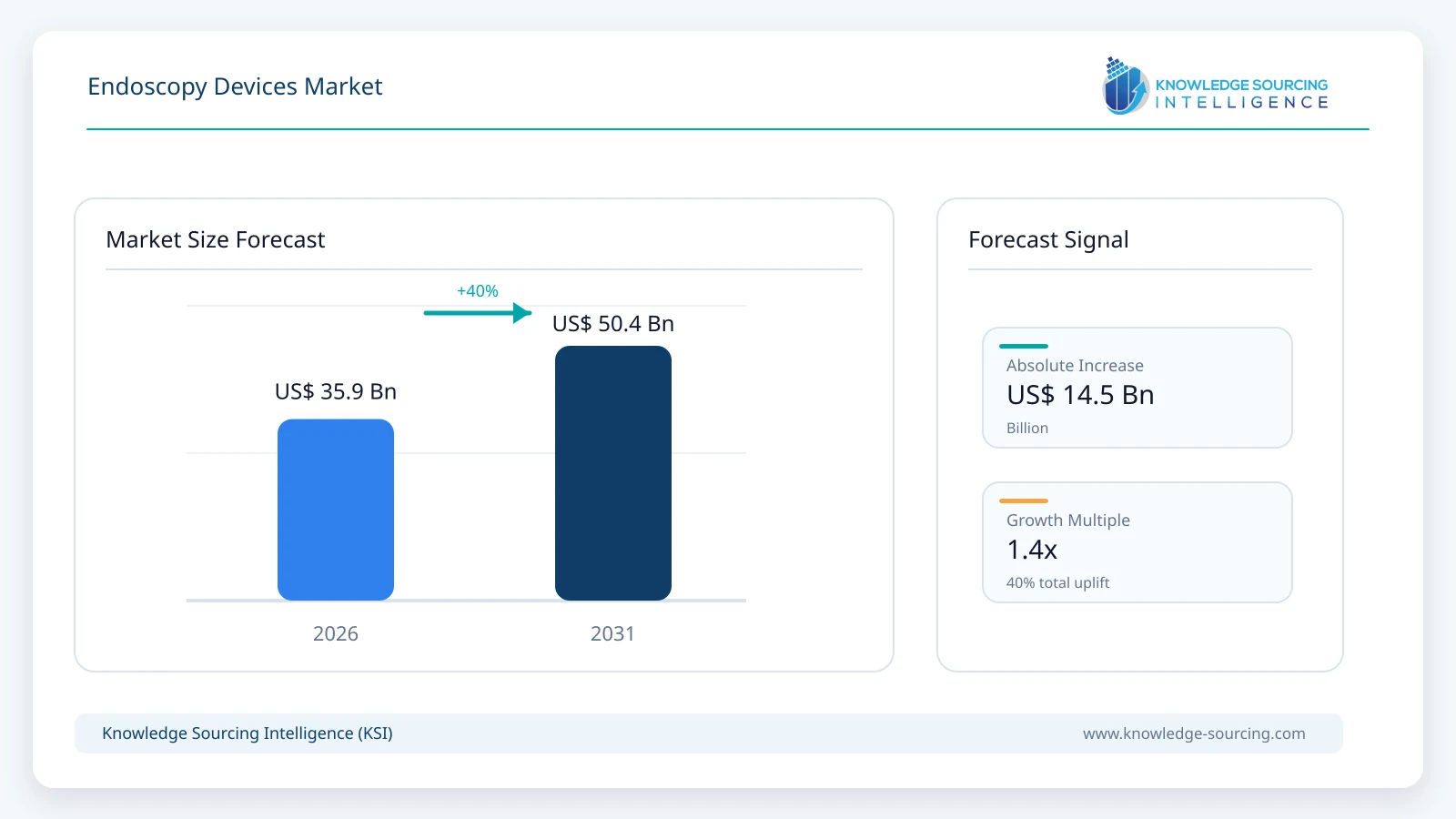
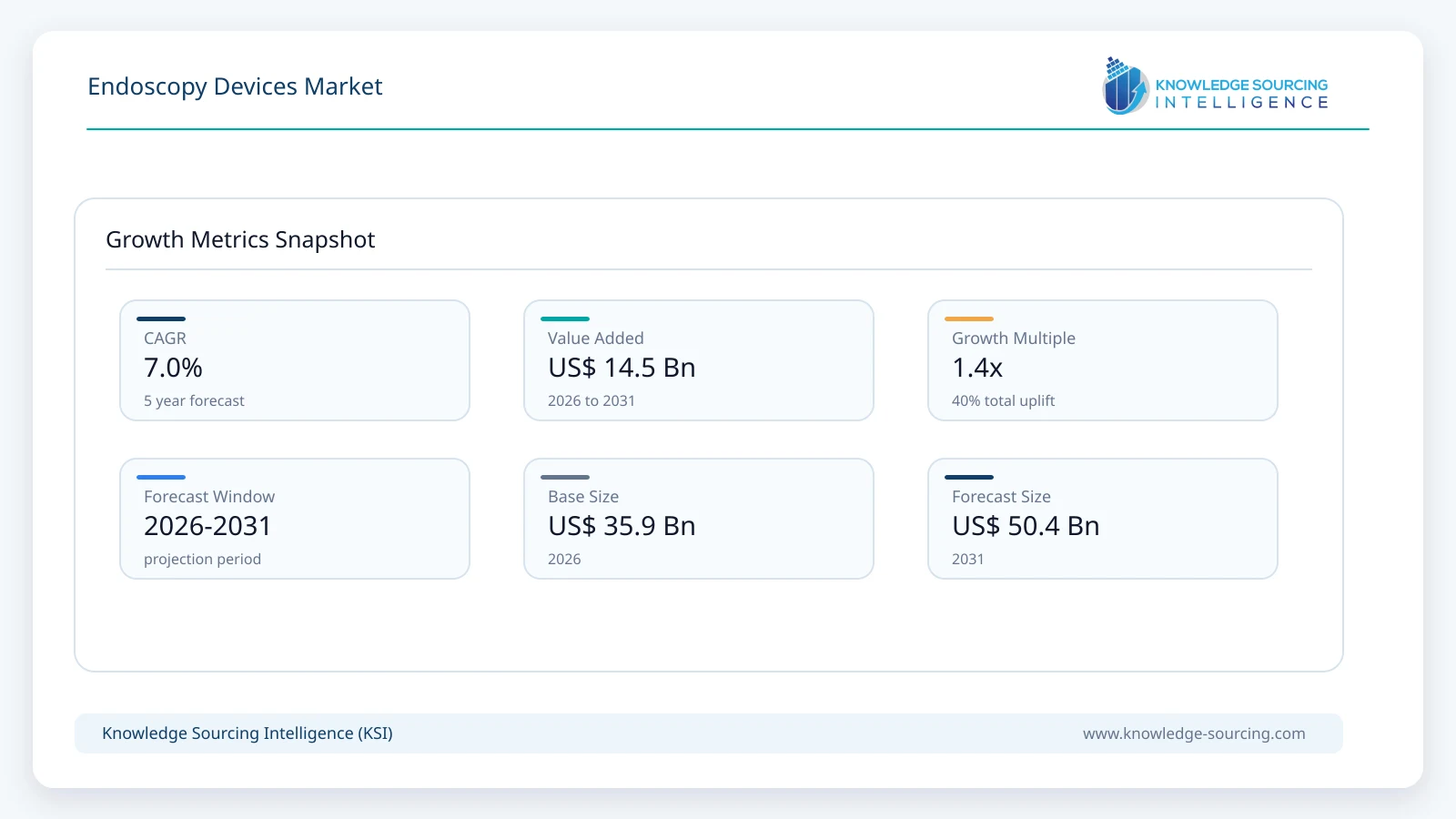
The endoscopy devices market is projected to increase from USD 35.9 billion in 2026 to USD 50.4 billion in 2031, representing a CAGR of 7.0% during the forecast period.
Highlights:
- 1Endoscopes account for approximately 35% of global 2026 market revenue.
- 2North America contributes about 37% of 2026 market value, led by the United States.
- 3Gastrointestinal procedures remain the largest procedure category across diagnostic and therapeutic endoscopy.
- 4Single-use endoscopes expand recurring revenue in bronchoscopy, urology and selected gastrointestinal applications.
- 5AI-assisted detection and characterization are moving from pilot deployments toward commercial clinical workflows.
- 64K, 3D and infrared imaging increase replacement demand for integrated surgical visualization platforms.
Market Overview
Endoscopy is moving from a largely visualization-led equipment category toward a connected procedural platform combining scopes, processors, displays, operative devices, imaging software and AI. Olympus is commercializing its OLYSENSE intelligent endoscopy ecosystem, including cloud-based computer-aided detection, while its 2026 product launches include a flexible-tip videoscope supporting 4K, 3D and infrared imaging. Fujifilm is extending the ELUXEO 8000 portfolio with next-generation therapeutic gastroscopes, colonoscopes and duodenoscopes, and is also localizing endoscopy-system manufacturing in India. These developments support both replacement demand in mature hospitals and broader adoption in fast-expanding healthcare systems.
Procedure mix is also changing. Diagnostic colonoscopy and upper gastrointestinal endoscopy remain high-volume anchors, but advanced therapeutic procedures are increasing equipment intensity through specialized channels, cutting and closure devices, endoscopic ultrasound, and robotic assistance. Single-use scopes address infection-control and workflow requirements where reprocessing is costly or difficult, particularly in bronchoscopy and urology. At the same time, outpatient migration supports compact systems and faster turnover, while high-acuity tertiary centres continue to invest in premium imaging and complex therapeutic platforms.
Selected Segment Estimates
Dimension | Selected Subsegment | 2026 Indicator | Forecast Interpretation |
Device Type | Endoscopes | ~35% share; ~USD 12.6 billion | Largest device category; single-use and therapeutic scopes add above-average growth. |
Device Type | Visualization systems | ~27% share; ~USD 9.7 billion | Replacement demand shifts toward 4K/3D, advanced processors and integrated operating-room platforms. |
Technology | Video endoscopy | Largest technology segment | Installed-base depth and broad procedural use support recurring upgrades. |
Technology | AI-integrated systems | Fastest-growing technology layer | Cloud and embedded software increasingly support lesion detection, characterization and workflow. |
Procedure | Colonoscopy | ~28% of 2026 revenue | Screening, surveillance and therapeutic interventions sustain high equipment and accessory demand. |
End User | Hospitals | ~58% of 2026 revenue | Complex GI, pulmonary, urology and surgical procedures remain concentrated in hospitals. |
Geography | North America | ~37% of 2026 revenue | High procedure volumes, premium technology adoption and outpatient infrastructure support leadership. |
Market Dynamics
Drivers
Rising endoscopic procedure intensity. Endoscopy increasingly combines diagnosis and treatment in the same care pathway. Colorectal cancer screening, gastrointestinal lesion surveillance, bronchoscopy, urological procedures and minimally invasive surgery create repeat demand for scopes, processors, accessories and operative devices. As health systems prioritize earlier diagnosis and less invasive treatment, procedure volumes and the value of equipment used per procedure both rise.
Technology-led replacement cycles. New systems are adding 4K and 3D imaging, infrared modes, advanced image enhancement, AI-enabled lesion detection, and cloud connectivity. These capabilities shorten the useful commercial life of older visualization platforms and encourage hospitals to standardize around integrated ecosystems. Software-based functionality also creates a recurring revenue layer beyond one-time capital purchases.
Growth of single-use and therapeutic endoscopy. Disposable bronchoscopes, ureteroscopes and selected gastrointestinal scopes reduce reprocessing requirements and contamination risk, while therapeutic endoscopy increases demand for high-value accessories and dedicated scopes. This expands market revenue even where installed reusable-scope penetration is already high.
Restraints
High capital expenditure and reprocessing costs remain important constraints, particularly for smaller hospitals in emerging markets. Complex reusable systems require cleaning infrastructure, maintenance, trained personnel, and downtime management. At the same time, single-use products can increase per-procedure cost and medical waste, limiting adoption where reusable fleets are economically efficient. Regulatory scrutiny, recalls, and cybersecurity requirements for connected systems can also slow product rollouts and replacement decisions.
Segment Analysis
By Device Type: Endoscopes
Endoscopes remain the largest device category, accounting for approximately 35% of 2026 market revenue. Flexible gastrointestinal scopes dominate the installed base, while rigid scopes remain central to laparoscopy and surgical specialties. The fastest value expansion is concentrated in high-function therapeutic scopes and single-use devices. Ambu continues to broaden its single-use endoscopy portfolio, while Fujifilm and Olympus are extending premium therapeutic and imaging capabilities. Robot-assisted and endoluminal technologies remain smaller in revenue terms but are important because they can expand the range of lesions treated endoscopically rather than surgically.
By Technology: AI-Integrated Endoscopy
AI-integrated endoscopy is emerging as the fastest-growing technology layer rather than a standalone replacement for conventional video endoscopy. Olympus has positioned OLYSENSE as a cloud-based ecosystem for computer-aided detection and related applications, while broader industry development is moving toward real-time lesion characterization, automated documentation, and procedure-quality analytics. Adoption is strongest in colonoscopy because clinical endpoints such as adenoma detection are measurable, but the same architecture can extend into upper gastrointestinal, pulmonary, and surgical workflows.
Technology and Demand Indicators
Indicator | Latest Development | Market Impact |
AI-assisted colonoscopy | Olympus reported 2026 EAGLE trial results for the CADDIE cloud-based CADe solution. | Supports software and subscription revenue within installed endoscopy ecosystems. |
Advanced surgical imaging | Olympus launched a 2026 flexible-tip videoscope supporting 4K, 3D and infrared imaging. | Accelerates premium visualization-system replacement and operating-room integration. |
Therapeutic GI scopes | Fujifilm expanded its ELUXEO 8000 therapeutic gastroscope portfolio in August 2026. | Raises equipment intensity for complex endoscopic treatment procedures. |
Single-use scopes | Multiple 2026 FDA clearances included disposable GI and specialty endoscopy systems. | Broadens recurring per-procedure revenue and infection-control options. |
Robot-assisted endotherapy | Olympus signed a 2026 global distribution agreement with EndoRobotics. | Expands addressable procedures for organ-sparing advanced endoscopic therapy. |
Localized manufacturing | Fujifilm inaugurated endoscopy-system manufacturing in India in February 2026. | Improves regional supply, service access and price competitiveness in a high-growth market. |
Geographical Outlook:
North America Analysis
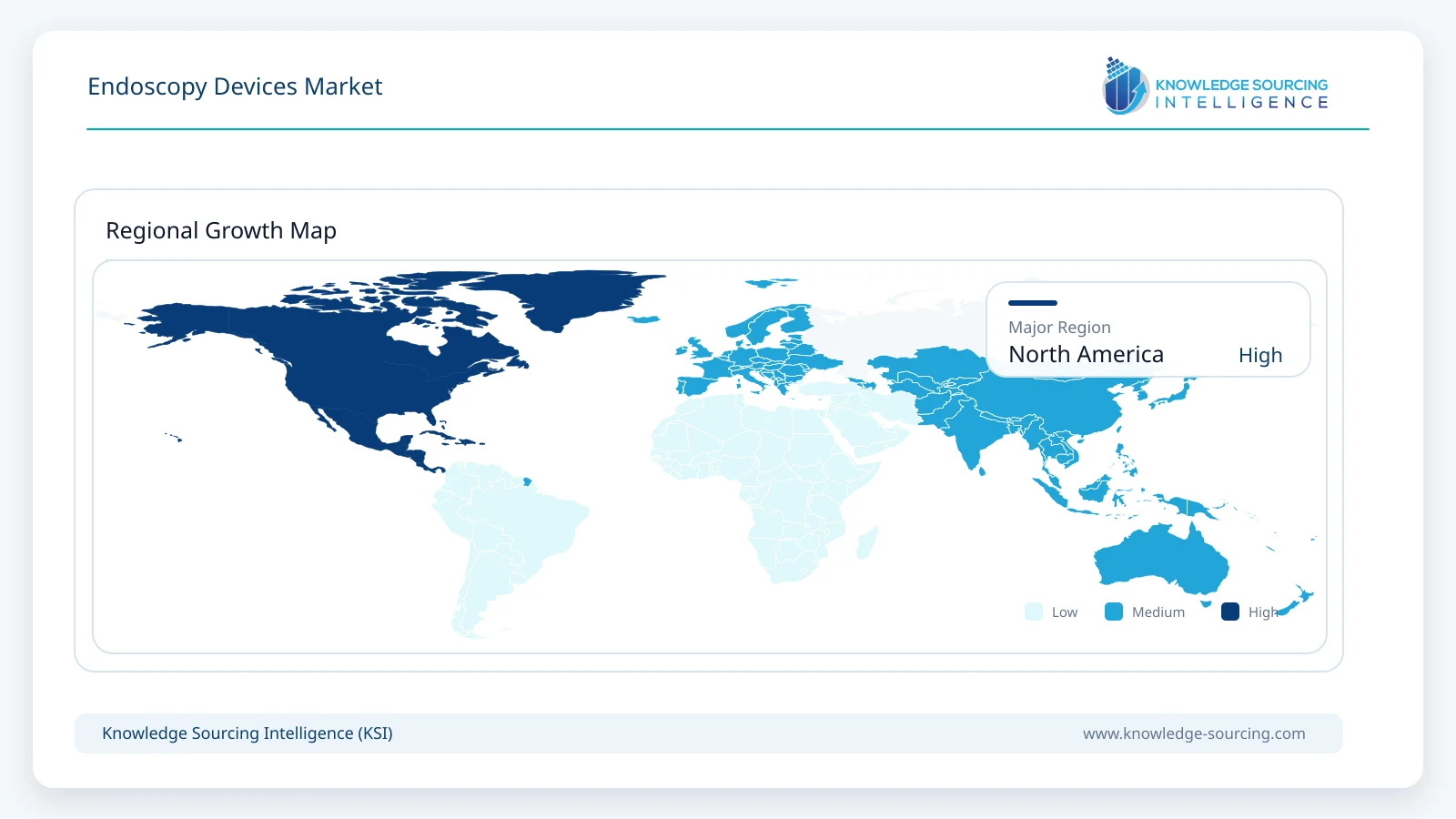
North America accounts for approximately 37% of global endoscopy-device revenue in 2026, with the United States providing the majority of regional demand. The region combines high screening and procedure volumes with rapid adoption of premium visualization, single-use scopes, and AI-enabled software. Ambulatory surgical centres are especially important because gastrointestinal and minimally invasive procedures continue to migrate toward outpatient settings, increasing demand for systems that support fast turnover and standardized workflows. The United States also remains a major launch market for new endoscopy technologies because FDA clearance can accelerate commercial adoption and support global reference-site development.
The regional growth mix is shifting from basic installed-base expansion toward technology replacement and recurring revenue. Recent 2026 clearances and launches span disposable gastroscopes, advanced GI videoscopes, AI applications and next-generation surgical imaging. This creates a layered revenue opportunity involving processors, scopes, displays, operative devices, software subscriptions, disposables and service contracts. Canada contributes a smaller but technologically advanced market, while Mexico adds procedure-volume growth and private-hospital investment, particularly in major urban centres.
Competitive Landscape
The competitive landscape combines broad endoscopy-platform companies with focused device specialists. Olympus maintains a particularly strong position across gastrointestinal endoscopy, surgical imaging and endotherapy, while Fujifilm competes through ELUXEO imaging, therapeutic scopes and expanding regional manufacturing and service capacity. Karl Storz and Stryker are important in surgical endoscopy and visualization, and PENTAX Medical remains established in gastrointestinal and pulmonary endoscopy. Boston Scientific and Medtronic participate heavily through therapeutic devices and procedure-enabling technologies, while Ambu is a major growth competitor in single-use endoscopy. Intuitive Surgical and specialized robotic developers are extending competition into endoluminal and robot-assisted procedures.
Recent Developments
August 2026: Olympus launched the ENDOEYE FLEX 3D flexible-tip videoscope supporting 4K, 3D and infrared imaging.
August 2026: Fujifilm India expanded the ELUXEO 8000 portfolio with next-generation therapeutic gastroscopes and related gastrointestinal scopes.
May 2026: Olympus signed an exclusive global distribution agreement with EndoRobotics for robot-assisted endotherapy technologies.
May 2026: Fujifilm launched the EB-710US next-generation balloon-less endobronchial ultrasound bronchoscope in the United States.
February 2026: Olympus reported results from the EAGLE trial evaluating the cloud-based CADDIE AI solution for colorectal-polyp detection.
February 2026: Fujifilm inaugurated localized endoscopy-system manufacturing in Jodhpur, India.
Endoscopy Devices Market Scope:
| Report Metric | Details |
|---|---|
| Total Market Size in 2026 | USD 35.9 billion |
| Total Market Size in 2031 | USD 50.4 billion |
| Forecast Unit | Billion |
| Growth Rate | 7.0% |
| Study Period | 2021 to 2031 |
| Historical Data | 2021 to 2024 |
| Base Year | 2025 |
| Forecast Period | 2026 – 2031 |
| Segmentation | Device Type, Technology, Procedure, Application |
| Companies |
|
Market Segmentation
By Device Type
Endoscopes
Rigid Endoscopes
Flexible Endoscopes
Capsule Endoscopes
Robot-Assisted Endoscopes
Visualization Systems
Ancillary Components and Accessories
By Technology
Fiber Optic Endoscopy
Video Endoscopy
Capsule Endoscopy
3D Endoscopy
Robot-Assisted Endoscopy
Artificial Intelligence Integrated Systems
By Procedure
Colonoscopy
Laparoscopy
Bronchoscopy
Cystoscopy
Other Procedures
By Application
Gastrointestinal Surgeries
Urology/Gynecology Surgeries
ENT Surgeries
Cardiovascular Surgeries
Neuro/Spinal Surgeries
Bariatric Surgeries
Other Applications
By End User
Hospitals
Ambulatory Surgical Centers
Specialty Clinics
Diagnostic Centers
Others
By Geography
North America
United States
Canada
Mexico
South America
Brazil
Argentina
Others
Europe
Germany
United Kingdom
France
Italy
Spain
Others
Middle East and Africa
Saudi Arabia
United Arab Emirates
South Africa
Others
Asia Pacific
China
Japan
India
South Korea
Australia
Others
Table of Contents
1. EXECUTIVE SUMMARY
2. MARKET SNAPSHOT
2.1 Market Overview
2.2 Market Segmentation
3. BUSINESS LANDSCAPE
3.1 Market Drivers
3.1.1 Rising Endoscopic Procedure Intensity
3.1.2 Technology-Led Replacement Cycles
3.1.3 Growth of Single-Use and Therapeutic Endoscopy
3.2 Market Restraints
3.2.1 High Capital, Reprocessing and Per-Procedure Costs
3.2.2 Regulatory, Recall and Cybersecurity Requirements
3.3 Market Opportunities
3.4 Porter’s Five Forces Analysis
3.5 Industry Value Chain Analysis
3.6 Regulatory and Standards Landscape
4. TECHNOLOGICAL OUTLOOK
5. ENDOSCOPY DEVICES MARKET BY DEVICE TYPE
5.1 Endoscopes
5.1.1 Rigid Endoscopes
5.1.2 Flexible Endoscopes
5.1.3 Capsule Endoscopes
5.1.4 Robot-Assisted Endoscopes
5.2 Visualization Systems
5.3 Ancillary Components and Accessories
6. ENDOSCOPY DEVICES MARKET BY TECHNOLOGY
6.1 Fiber Optic Endoscopy
6.2 Video Endoscopy
6.3 Capsule Endoscopy
6.4 3D Endoscopy
6.5 Robot-Assisted Endoscopy
6.6 Artificial Intelligence Integrated Systems
7. ENDOSCOPY DEVICES MARKET BY PROCEDURE
7.1 Colonoscopy
7.2 Laparoscopy
7.3 Bronchoscopy
7.4 Cystoscopy
7.5 Other Procedures
8. ENDOSCOPY DEVICES MARKET BY APPLICATION
8.1 Gastrointestinal Surgeries
8.2 Urology/Gynecology Surgeries
8.3 ENT Surgeries
8.4 Cardiovascular Surgeries
8.5 Neuro/Spinal Surgeries
8.6 Bariatric Surgeries
8.7 Other Applications
9. ENDOSCOPY DEVICES MARKET BY END USER
9.1 Hospitals
9.2 Ambulatory Surgical Centers
9.3 Specialty Clinics
9.4 Diagnostic Centers
9.5 Others
10. ENDOSCOPY DEVICES MARKET BY GEOGRAPHY
10.1 North America
10.1.1 United States
10.1.2 Canada
10.1.3 Mexico
10.2 South America
10.2.1 Brazil
10.2.2 Argentina
10.2.3 Others
10.3 Europe
10.3.1 Germany
10.3.2 United Kingdom
10.3.3 France
10.3.4 Italy
10.3.5 Spain
10.3.6 Others
10.4 Middle East and Africa
10.4.1 Saudi Arabia
10.4.2 United Arab Emirates
10.4.3 South Africa
10.4.4 Others
10.5 Asia Pacific
10.5.1 China
10.5.2 Japan
10.5.3 India
10.5.4 South Korea
10.5.5 Australia
10.5.6 Others
11. COMPETITIVE ENVIRONMENT AND ANALYSIS
12. COMPANY PROFILES
12.1. Olympus Corporation
12.2. Fujifilm Holdings Corporation
12.3. Karl Storz SE & Co. KG
12.4. HOYA Corporation (PENTAX Medical)
12.5. Stryker Corporation
12.6. Boston Scientific Corporation
12.7. Medtronic plc
12.8. Ambu A/S
12.9. STERIS plc
12.10. Richard Wolf GmbH
12.11. Smith+Nephew plc
12.12. CONMED Corporation
12.13. Cook Medical
12.14. SonoScape Medical Corp.
12.15. Mindray Medical International Limited
12.16. Intuitive Surgical, Inc.
12.17. EndoChoice
12.18. EvoEndo, Inc.
13. RECENT DEVELOPMENTS
14. APPENDIX
14.1 Currency
14.2 Assumptions
14.3 Base and Forecast Years Timeline
14.4 Research Methodology
14.5 Abbreviations
Navigate
Trusted by the world's leading organizations











