
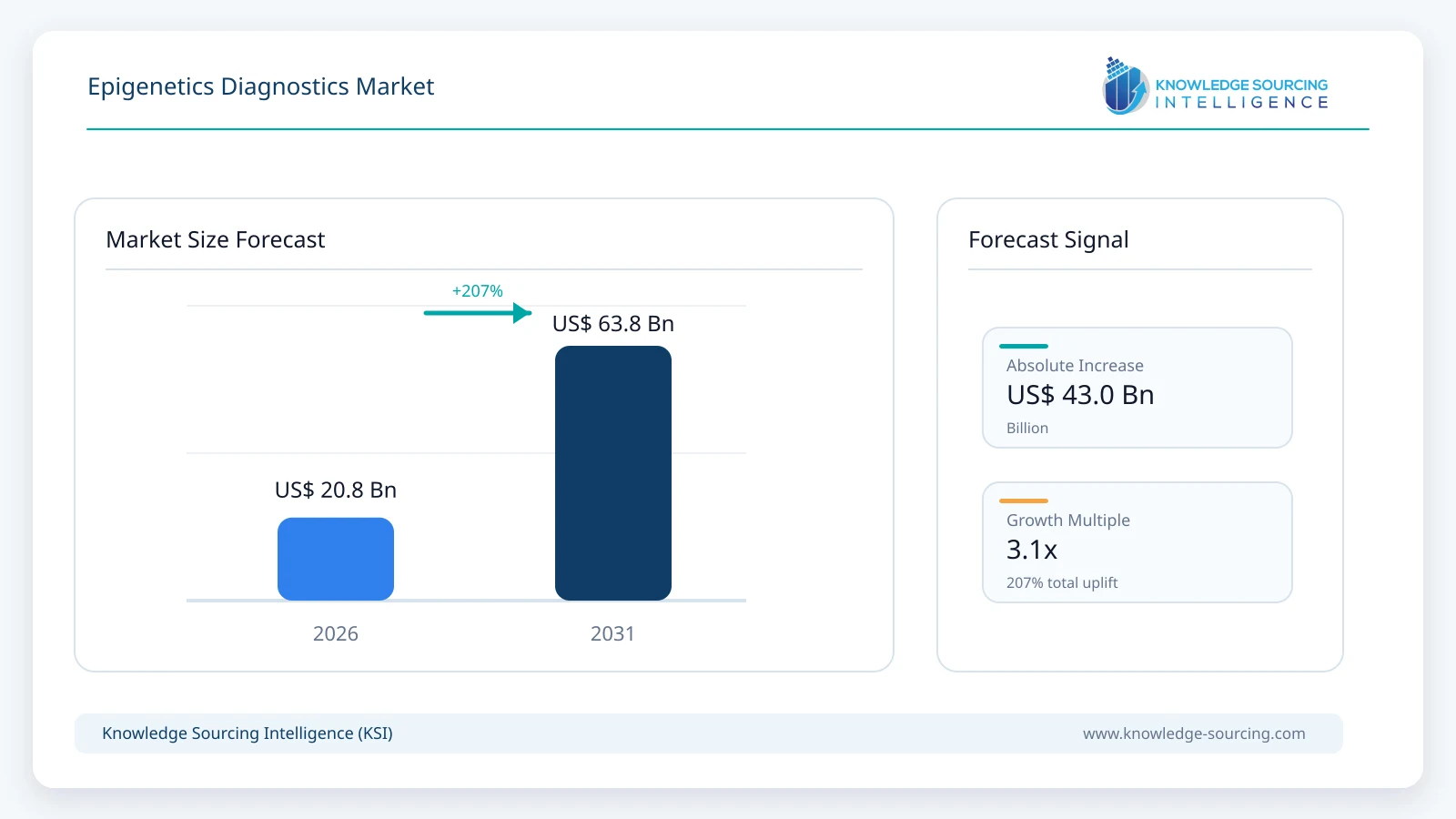
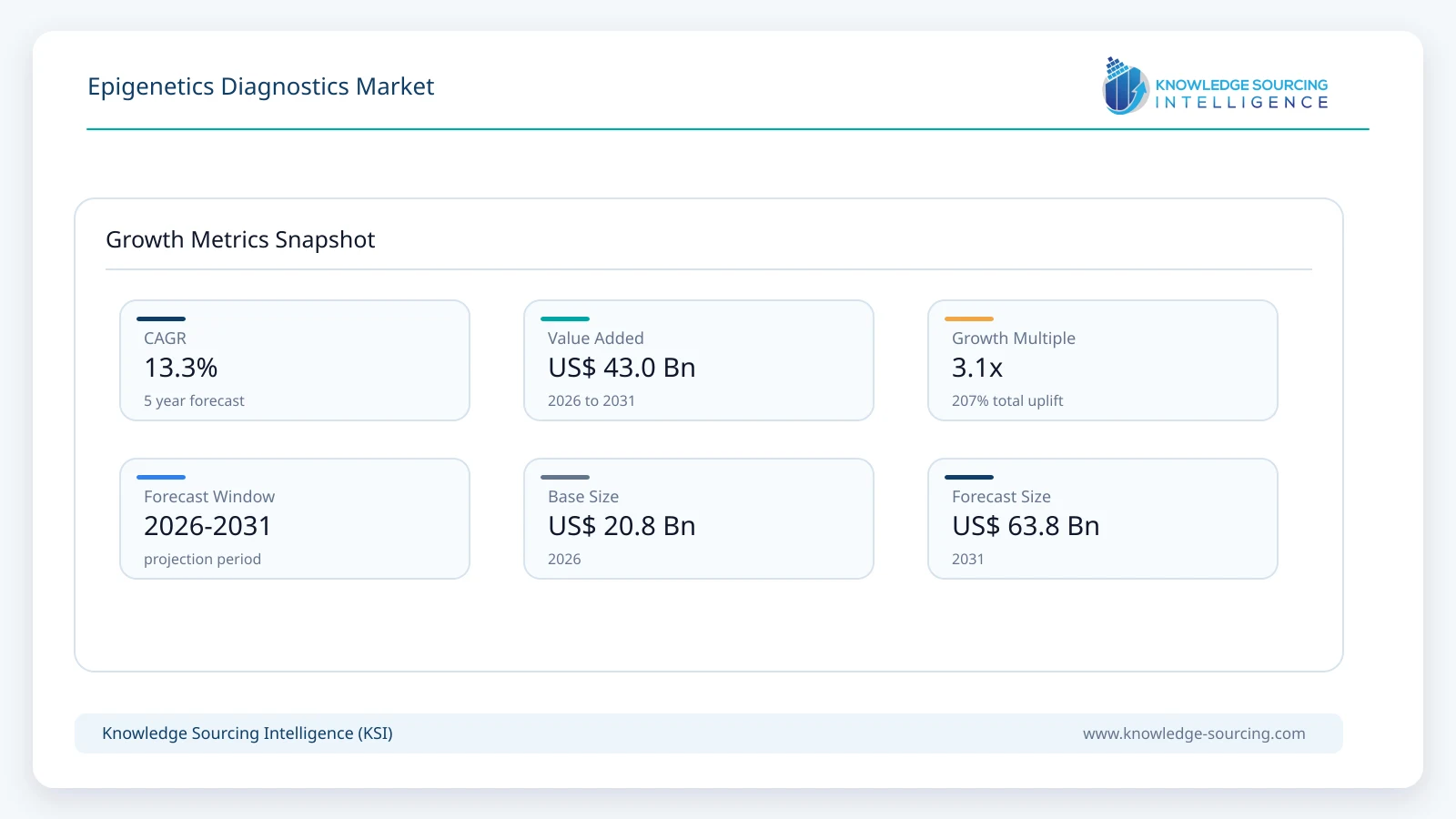
The Epigenetic Diagnostics Market is estimated to grow to USD 63.82 billion in 2035 at a CAGR of 13.3% from USD 20.8 billion in 2026.
Highlights:
- 1Increasing demand for early disease detection is expanding adoption because epigenetic alterations frequently precede clinical symptoms.
- 2Growth of precision oncology programs is strengthening utilization because cancer progression often involves epigenetic dysregulation.
- 3Expansion of liquid biopsy technologies is increasing demand because circulating epigenetic biomarkers support minimally invasive diagnostics.
- 4Pharmaceutical companies are increasing epigenetic biomarker analysis because therapeutic development increasingly depends on molecular stratification.
Epigenetic diagnostics enable detection of regulatory molecular changes because disease development often involves alterations in gene expression control mechanisms rather than permanent genetic mutations. This capability improves disease characterization and supports earlier clinical intervention. Healthcare providers are increasingly adopting epigenetic testing because molecular changes frequently occur before conventional diagnostic markers become detectable. The resulting demand supports continued expansion of advanced molecular diagnostic technologies.
Precision medicine depends on comprehensive biological understanding because treatment outcomes increasingly reflect molecular variability among patients. This dependency increases demand for diagnostic approaches capable of capturing dynamic biological regulation. Diagnostic laboratories are strengthening epigenetic testing capabilities because healthcare systems require more individualized disease management strategies. The resulting integration of epigenetic biomarkers into clinical workflows supports market development.
Regulatory interest continues increasing because molecular diagnostics play an expanding role in healthcare delivery. Healthcare organizations are investing in validated epigenetic testing platforms as evidence supporting clinical utility continues growing. This investment increases demand for quality-controlled workflows and analytical systems. The resulting ecosystem expansion supports broader adoption across healthcare environments.
Market Dynamics
Market Drivers
Expansion of Precision Oncology Programs: Cancer progression involves extensive epigenetic regulation because abnormal gene-expression control contributes to tumor initiation and development. Healthcare providers are increasing adoption of epigenetic diagnostics as precision oncology programs require more comprehensive molecular characterization. This requirement increases demand for technologies capable of identifying clinically actionable methylation and regulatory signatures. The resulting improvement in patient stratification supports market growth.
Increasing Demand for Early Disease Detection: Disease progression often begins with molecular changes that occur before structural pathology becomes evident because biological regulatory mechanisms respond early to disease stimuli. Healthcare systems are expanding biomarker research as preventive healthcare strategies gain importance. This expansion increases demand for epigenetic diagnostics capable of identifying early-stage disease signals. The resulting focus on proactive disease management supports adoption.
Growth of Liquid Biopsy Applications: Minimally invasive diagnostics improve patient monitoring because repeated tissue sampling creates practical and clinical limitations. Researchers are increasing development of circulating epigenetic biomarkers as liquid biopsy technologies continue advancing. This development increases demand for sensitive molecular detection platforms. The resulting integration strengthens market expansion.
Rising Focus on Neurological Disease Biomarkers: Neurological disorders require improved molecular characterization because disease mechanisms often remain difficult to detect using conventional diagnostic approaches. Research organizations are expanding epigenetic investigations as healthcare providers seek earlier diagnostic indicators. This expansion increases demand for advanced epigenetic analysis technologies. The resulting enhancement in disease understanding supports market growth.
Market Restraints
Epigenetic biomarker interpretation remains complex because molecular patterns vary across tissues, disease stages, and patient populations.
Clinical standardization challenges persist because testing methodologies continue evolving across laboratories.
Implementation costs remain significant because advanced molecular analysis requires specialized instrumentation and computational resources.
Market Opportunities
Expansion of Multi-Cancer Early Detection Testing: Cancer screening increasingly requires highly sensitive molecular biomarkers because early-stage disease detection improves clinical outcomes. Healthcare organizations are evaluating methylation-based diagnostics as screening initiatives expand. This evaluation increases demand for epigenetic testing platforms. The resulting opportunity supports market growth.
Growth of Companion Diagnostics: Targeted therapies require accurate molecular stratification because treatment response often depends on specific biological characteristics. Diagnostic developers are integrating epigenetic biomarkers into therapeutic development programs as precision medicine adoption expands. This integration increases demand for validated diagnostic assays. The resulting alignment between diagnostics and therapeutics creates commercial opportunities.
Advancement of Prenatal Epigenetic Testing: Prenatal diagnostics increasingly seeks non-invasive biomarker assessment because early molecular information supports healthcare decision-making. Researchers are expanding investigation of epigenetic markers associated with fetal development and pregnancy outcomes. This expansion increases demand for advanced analytical technologies. The resulting innovation supports future market development.
AI-Enabled Epigenetic Interpretation: Epigenetic datasets generate complex biological information because regulatory mechanisms involve multiple interacting molecular pathways. Organizations are implementing artificial intelligence tools as testing volumes continue increasing. This implementation improves interpretation efficiency and analytical consistency. The resulting enhancement supports broader clinical adoption.
Supply Chain Analysis
The epigenetics diagnostics supply chain begins with suppliers of reagents, enzymes, extraction kits, and sample preservation technologies because epigenetic analysis depends on maintaining molecular integrity throughout testing workflows. Demand is increasing for specialized consumables as epigenetic testing applications continue expanding. This requirement strengthens the importance of quality-focused supply networks. The resulting emphasis on molecular stability influences downstream performance.
Sample preparation providers occupy a critical position because epigenetic signatures require careful preservation during extraction and processing. Diagnostic laboratories are increasing investments in optimized workflows as testing complexity continues growing. This investment increases demand for automated preparation technologies. The resulting improvement in reproducibility supports broader implementation.
Sequencing and molecular analysis providers form the core technology layer because diagnostic accuracy depends on high-quality data generation. Healthcare organizations are expanding molecular testing capabilities as precision medicine initiatives accelerate. This expansion increases demand for advanced analytical platforms. The resulting technology development supports market growth.
Bioinformatics providers complete the value chain because epigenetic data requires sophisticated interpretation before clinical application. Laboratories are strengthening computational capabilities as molecular datasets become increasingly complex. This strengthening increases demand for analytical software and decision-support systems. The resulting integration of diagnostics and analytics improves scalability.
Government Regulations
Region | Regulation/Framework | Impact on Market |
United States | FDA oversight of molecular diagnostics | Supports analytical and clinical validation |
United States | CLIA laboratory standards | Governs laboratory quality and testing standards |
European Union | In Vitro Diagnostic Regulation (IVDR) | Strengthens diagnostic evidence requirements |
United Kingdom | NHS Genomic Medicine Service | Encourages advanced molecular diagnostics |
Market Segmentation
By Technology
DNA methylation analysis represents the largest segment because methylation changes provide highly informative biomarkers for disease detection and patient stratification. Healthcare organizations are increasing adoption as cancer diagnostics and early detection programs increasingly rely on methylation signatures. This expansion increases demand for technologies capable of accurately identifying regulatory alterations. The resulting clinical relevance supports continued segment growth.
By Application
Oncology remains the leading application because cancer development frequently involves extensive epigenetic dysregulation. Healthcare providers are expanding epigenetic testing as precision oncology programs increasingly depend on molecular characterization. This expansion increases demand for methylation and regulatory biomarker assays. The resulting integration into cancer care supports market growth.
Regional Analysis
North America
North America represents the largest demand center for epigenetics diagnostics because precision medicine programs increasingly require biomarkers that capture functional biological changes rather than static genetic information. Healthcare providers are expanding adoption of epigenetic testing as oncology treatment pathways become more dependent on molecular stratification and disease monitoring. This expansion increases demand for DNA methylation analysis and liquid biopsy-based diagnostic solutions. Diagnostic laboratories face growing pressure to improve early disease detection because conventional diagnostic methods often identify disease after significant biological progression has occurred. Organizations are investing in advanced molecular testing infrastructure to address these limitations. The resulting integration of epigenetic biomarkers into clinical workflows strengthens market adoption across oncology, neurological disorders, and reproductive health applications.
Pharmaceutical companies contribute significantly to market growth because biomarker-driven drug development increasingly relies on understanding gene regulation mechanisms. Research organizations are expanding epigenetic profiling activities as targeted therapeutic programs continue advancing. This expansion increases utilization of molecular diagnostic technologies capable of identifying clinically actionable epigenetic signatures. Academic medical centers continue strengthening translational medicine initiatives because disease heterogeneity remains a challenge for precision healthcare. The resulting convergence of diagnostics, therapeutics, and research supports sustained regional market expansion.
Government-supported genomics and precision medicine programs continue reinforcing adoption because healthcare innovation increasingly depends on advanced molecular characterization. Research institutions are generating larger epigenetic datasets as biomarker discovery programs expand. This increase strengthens demand for sequencing technologies and bioinformatics infrastructure. The resulting ecosystem supports continued regional leadership.
Europe
Europe maintains strong demand for epigenetics diagnostics because healthcare systems increasingly emphasize personalized treatment strategies supported by molecular evidence. Hospitals and diagnostic laboratories are expanding adoption as cancer management and disease monitoring become more dependent on biomarker-driven decision-making. This expansion increases demand for clinically validated epigenetic testing solutions. Healthcare organizations face increasing pressure to improve diagnostic precision because treatment effectiveness varies substantially across patient populations. Institutions are investing in advanced molecular diagnostics to address these challenges. The resulting improvement in disease stratification supports broader adoption throughout the region.
Translational medicine initiatives continue strengthening market development because healthcare innovation increasingly requires integration of research findings into clinical practice. Research institutions are increasing epigenetic analysis activities as precision medicine programs mature. This increase strengthens demand for methylation profiling technologies and associated analytical platforms. Pharmaceutical collaborations continue expanding because epigenetic biomarkers improve therapeutic development and patient selection processes. The resulting integration of diagnostics and research supports long-term market growth.
Population health initiatives contribute additional demand because molecular disease characterization improves healthcare planning and treatment optimization. Academic organizations are expanding biomarker discovery programs as biological databases continue developing. This expansion increases demand for advanced molecular testing capabilities. The resulting ecosystem development strengthens market adoption.
Asia Pacific
Asia Pacific represents one of the fastest-growing markets because governments increasingly prioritize biotechnology innovation and precision healthcare infrastructure. Healthcare organizations are expanding epigenetic testing capabilities as national healthcare strategies focus on improving molecular diagnostic capacity. This expansion increases demand for DNA methylation analysis, sequencing technologies, and biomarker interpretation platforms. Research institutions face growing expectations to generate region-specific molecular evidence because population diversity influences disease characteristics and therapeutic outcomes. Organizations are investing in advanced epigenetics research programs to address these requirements. The resulting growth in molecular diagnostics strengthens regional market development.
National genomics and biotechnology initiatives continue supporting adoption because healthcare modernization increasingly depends on advanced molecular characterization. Research centers are generating larger epigenetic datasets as government funding for life sciences innovation expands. This increase strengthens demand for molecular testing platforms and bioinformatics infrastructure. Biotechnology companies are increasing investment in biomarker research because precision medicine applications continue expanding. The resulting ecosystem growth supports sustained market expansion.
Healthcare accessibility remains uneven because advanced molecular diagnostics infrastructure is concentrated within major urban centers. Organizations are developing collaborative research and diagnostic networks as demand for precision healthcare increases. This development improves technology access and implementation. The resulting expansion supports long-term market opportunities.
Rest of the World
The Rest of the World market continues developing because healthcare systems increasingly recognize the value of molecular diagnostics in improving disease management and patient outcomes. Governments are evaluating epigenetics diagnostics as healthcare modernization efforts increasingly focus on precision medicine adoption. This evaluation increases demand for advanced biomarker testing solutions capable of supporting earlier disease detection and treatment optimization. Healthcare providers face infrastructure constraints because specialized molecular testing requires significant technical expertise and laboratory capabilities. Institutions are prioritizing high-impact applications to maximize clinical value. The resulting targeted implementation supports gradual market expansion.
Oncology and reproductive health applications continue generating substantial demand because healthcare providers increasingly require molecular evidence to improve clinical decision-making. Research organizations are expanding biomarker studies as international scientific collaboration strengthens. This expansion increases demand for epigenetic testing technologies and analytical software platforms. Global partnerships continue supporting adoption because expertise transfer remains essential for capability development. The resulting collaboration improves access to advanced molecular diagnostics.
Economic considerations continue influencing adoption because healthcare budgets remain constrained across many emerging markets. Organizations are seeking efficient testing solutions that balance diagnostic performance with operational affordability. This requirement increases focus on scalable molecular diagnostic workflows. The resulting emphasis on value-driven implementation supports sustainable market development.
Pipeline Analysis
Epigenetics diagnostics increasingly supports therapeutic development because gene regulation mechanisms influence disease progression and treatment response. Pharmaceutical companies are expanding epigenetic biomarker research as precision medicine strategies require more comprehensive molecular characterization. This expansion increases demand for technologies capable of identifying clinically relevant methylation patterns and regulatory signatures. Research organizations are generating larger epigenetic datasets because therapeutic innovation increasingly depends on understanding disease-associated biological pathways. The resulting integration of epigenetics into drug development strengthens long-term market demand.
Oncology pipelines remain a primary growth driver because tumor development frequently involves extensive epigenetic alterations that influence treatment outcomes. Researchers are increasing adoption of methylation-based diagnostics as cancer detection and monitoring programs require more sensitive biomarkers. This requirement increases demand for advanced molecular testing platforms capable of supporting precision oncology initiatives. Drug developers continue investing in epigenetic biomarker discovery because patient stratification increasingly influences clinical trial success. The resulting reliance on epigenetic information reinforces market growth.
Competitive Landscape
Illumina
Illumina remains strategically distinct because its sequencing platforms provide the foundation for large-scale epigenetic analysis across research and diagnostic environments. Epigenetics diagnostics increasingly depends on high-resolution molecular profiling because DNA methylation and regulatory signatures require accurate genomic interrogation. Healthcare organizations are expanding epigenetic testing as precision medicine initiatives increasingly rely on molecular stratification. This expansion increases demand for sequencing technologies capable of supporting clinically relevant biomarker discovery and validation. The resulting dependence on scalable sequencing infrastructure strengthens Illumina’s position within the market.
Demand is shifting toward comprehensive molecular characterization because healthcare providers increasingly require integrated biological insights rather than isolated genomic measurements. This shift increases the importance of sequencing ecosystems capable of supporting complex epigenetic workflows. Illumina continues strengthening sequencing and bioinformatics capabilities to address evolving diagnostic requirements. The resulting ecosystem approach supports sustained competitiveness.
Thermo Fisher Scientific
Thermo Fisher Scientific remains strategically distinct because it combines molecular analysis technologies, laboratory infrastructure, and diagnostic workflow solutions within a comprehensive life sciences portfolio. Epigenetics diagnostics increasingly requires coordination across sample preparation, molecular detection, and analytical interpretation because testing complexity continues increasing. This requirement increases demand for integrated workflow solutions capable of supporting laboratory efficiency. Diagnostic laboratories are expanding molecular testing capabilities as healthcare systems continue adopting precision medicine strategies. The resulting demand supports Thermo Fisher’s role within epigenetics diagnostics.
Demand is increasing for scalable laboratory operations because molecular testing volumes continue expanding across oncology and reproductive health applications. This increase strengthens the value of suppliers capable of supporting workflow standardization and operational consistency. Thermo Fisher continues enhancing molecular diagnostics capabilities to address these requirements. The resulting operational breadth improves competitive positioning.
QIAGEN
QIAGEN remains strategically distinct because it integrates molecular sample preparation expertise with advanced diagnostic informatics and analytical capabilities. Epigenetics diagnostics depends on molecular integrity because regulatory biomarkers require precise detection and interpretation. Laboratories are increasing focus on workflow reproducibility as clinical implementation continues expanding. This focus increases demand for technologies that improve analytical consistency and data quality. The resulting requirement strengthens QIAGEN’s position within epigenetic testing workflows.
Demand for advanced molecular interpretation continues increasing because epigenetic signatures involve highly complex biological relationships. This increase strengthens the importance of analytical platforms capable of converting molecular information into clinically actionable insights. QIAGEN continues expanding bioinformatics solutions to address these challenges. The resulting integration of laboratory and computational expertise supports long-term competitiveness.
F. Hoffmann-La Roche Ltd.
Roche remains strategically distinct because it combines diagnostics leadership with extensive pharmaceutical expertise. Epigenetics diagnostics increasingly supports personalized treatment strategies because disease progression often depends on molecular regulation mechanisms. Healthcare providers are expanding molecular testing as biomarker-driven therapies continue gaining clinical importance. This expansion increases demand for validated diagnostic solutions capable of supporting treatment selection and monitoring. The resulting connection between diagnostics and therapeutics supports Roche’s strategic advantage.
Demand is shifting toward integrated healthcare ecosystems because precision medicine increasingly requires alignment between molecular diagnostics and therapeutic interventions. This shift increases the value of organizations capable of supporting both areas simultaneously. Roche continues strengthening precision medicine initiatives built around advanced molecular diagnostics. The resulting ecosystem approach reinforces market relevance.
Agilent Technologies
Agilent Technologies remains strategically distinct because of its expertise in molecular analysis, genomic sample preparation, and laboratory workflow optimization. Epigenetics diagnostics increasingly relies on high-quality sample processing because biomarker accuracy depends on molecular preservation and analytical consistency. Diagnostic organizations are strengthening molecular testing capabilities as demand for precision diagnostics continues increasing. This strengthening increases demand for technologies supporting reproducible epigenetic workflows. The resulting emphasis on analytical quality supports Agilent’s position within the market.
Demand for efficient diagnostic operations continues increasing because healthcare systems seek scalable molecular testing solutions. This increase strengthens the importance of workflow optimization technologies capable of supporting high-throughput analysis. Agilent continues developing capabilities aligned with evolving diagnostic requirements. The resulting focus on operational performance supports long-term participation.
Exact Sciences Corporation
Exact Sciences remains strategically distinct because of its focus on molecular diagnostics and biomarker-driven disease detection. Epigenetics diagnostics increasingly supports cancer screening because methylation-based biomarkers can identify disease-associated molecular changes before conventional clinical indicators emerge. Healthcare providers are expanding interest in early detection technologies as preventive healthcare strategies become more important. This expansion increases demand for advanced epigenetic testing solutions. The resulting focus on early disease identification strengthens Exact Sciences’ position.
Demand is increasing for minimally invasive diagnostic approaches because patient monitoring and screening programs require practical testing solutions. This increase strengthens the value of molecular diagnostics capable of generating clinically meaningful information from non-invasive samples. Exact Sciences continues expanding biomarker development capabilities to address these requirements. The resulting innovation supports competitive differentiation.
Guardant Health
Guardant Health remains strategically distinct because of its expertise in liquid biopsy technologies and advanced molecular profiling. Epigenetics diagnostics increasingly integrates with liquid biopsy applications because circulating biomarkers enable repeated disease monitoring without invasive procedures. Healthcare providers are expanding adoption of molecular monitoring approaches as precision oncology programs continue growing. This expansion increases demand for technologies capable of detecting subtle molecular changes in circulating biological samples. The resulting capability strengthens Guardant Health’s market position.
Demand is shifting toward longitudinal disease assessment because treatment outcomes increasingly depend on continuous molecular monitoring. This shift increases the importance of technologies capable of generating timely and clinically relevant information. Guardant Health continues advancing liquid biopsy and biomarker analysis capabilities to address these requirements. The resulting focus on real-time disease monitoring supports long-term growth opportunities.
Natera Inc.
Natera remains strategically distinct because it specializes in molecular testing applications spanning oncology, reproductive health, and disease monitoring. Epigenetics diagnostics increasingly supports reproductive and prenatal healthcare because developmental processes depend heavily on gene regulation mechanisms. Healthcare providers are expanding molecular testing utilization as personalized reproductive healthcare continues advancing. This expansion increases demand for technologies capable of identifying clinically relevant biomarkers. The resulting alignment with precision healthcare strengthens Natera’s competitive position.
Demand for individualized healthcare solutions continues increasing because disease risk assessment and treatment planning increasingly rely on molecular evidence. This increase strengthens the value of advanced diagnostic technologies capable of supporting personalized care pathways. Natera continues strengthening molecular testing capabilities to address evolving healthcare needs. The resulting focus on patient-specific diagnostics supports sustained market participation.
Key Developments
In April 2026, Infinite EpigeneticsTM, a global leader in epigenetic science, biological age testing, and next-generation diagnostics, announced the acquisition of Tally Health, a biotechnology company pioneering consumer-focused longevity solutions.
Future Market Outlook
The future of the epigenetics diagnostics market depends on the increasing need to understand disease biology through functional molecular changes because many disease processes originate from regulatory alterations rather than permanent genetic mutations. Demand is shifting toward epigenetic biomarkers as healthcare providers seek earlier disease detection and more accurate patient stratification strategies. This shift increases reliance on technologies capable of identifying methylation patterns, regulatory RNA signatures, and chromatin-related biomarkers. Technology developers are improving analytical sensitivity and workflow standardization to address expanding clinical requirements. The resulting advancement supports broader implementation across healthcare systems.
Artificial intelligence is becoming increasingly important because epigenetic datasets contain highly complex regulatory information that challenges conventional analytical approaches. Diagnostic laboratories are integrating machine learning tools as testing volumes and biological complexity continue increasing. This integration improves interpretation efficiency and strengthens clinical usability. Healthcare providers are seeking advanced decision-support systems because molecular diagnostics increasingly influences treatment planning. The resulting convergence of epigenetics and computational analytics strengthens market development.
Liquid biopsy technologies continue influencing future growth because minimally invasive diagnostics increasingly align with preventive and personalized healthcare objectives. Organizations are expanding investments in circulating biomarker research as disease monitoring requirements continue evolving. This expansion increases demand for epigenetic testing solutions capable of supporting screening, prognosis, and treatment assessment. The resulting innovation expands the role of epigenetics diagnostics within routine healthcare environments.
Epigenetics diagnostics increasingly functions as a bridge between molecular research and clinical implementation because regulatory biomarkers provide insight into active disease processes and therapeutic response mechanisms. Healthcare providers continue expanding adoption because precision medicine strategies require more dynamic biological information. Diagnostic laboratories are strengthening epigenetic testing capabilities because biomarker-driven healthcare continues advancing. Technology developers continue improving accessibility and workflow efficiency because broader implementation requires greater scalability and standardization. These interconnected developments position epigenetics diagnostics as a foundational component of future molecular healthcare.
The market continues evolving around the need to transform complex regulatory molecular information into clinically actionable diagnostic insight. Demand is expanding because oncology, reproductive health, neurological disease management, biomarker discovery, and therapeutic development increasingly depend on understanding gene regulation mechanisms. This expansion creates opportunities for organizations capable of combining molecular innovation, analytical expertise, and clinical utility. Companies that successfully address these requirements are likely to strengthen their competitive positions as precision medicine and advanced molecular diagnostics continue expanding globally.
Epigenetics Diagnostics Market Scope:
| Report Metric | Details |
|---|---|
| Total Market Size in 2026 | USD 20.8 billion |
| Total Market Size in 2031 | USD 63.82 billion |
| Forecast Unit | USD Billion |
| Growth Rate | 13.3% |
| Study Period | 2021 to 2031 |
| Historical Data | 2021 to 2024 |
| Base Year | 2025 |
| Forecast Period | 2026 – 2031 |
| Segmentation | Product & Service, Technology, Application, Geography |
| Companies |
|
Market Segmentation
Product Type
Technology
Application
Geography
- North America
- South America
- Europe
- Middle East and Africa
- Asia Pacific
Table of Contents
1. EXECUTIVE SUMMARY
1.1 Market Snapshot
1.2 Key Findings
1.3 Analyst Insights
1.4 Strategic Recommendations
2. RESEARCH METHODOLOGY
2.1 Research Design
2.2 Data Collection Methodology
2.3 Market Size Estimation
2.4 Forecasting Model
2.5 Assumptions & Limitations
3. EPIGENETICS DIAGNOSTICS MARKET OVERVIEW, SIZE & FORECAST
3.1 Market Definition & Scope
3.2 Industry Overview
3.3 Industry Evolution
3.4 Key Market Trends
3.5 Historical Market Size Analysis (2021–2025)
3.6 Market Forecast Analysis (2026–2035)
3.7 Epigenetic Biomarker Landscape
3.8 Molecular Diagnostics Workflow Overview
3.9 Testing Volume Analysis
3.10 User Adoption Analysis
3.11 Clinical Utility of Epigenetic Diagnostics
3.12 Precision Medicine and Companion Diagnostics Landscape
4. MARKET DYNAMICS
4.1 Market Drivers
4.2 Market Restraints
4.3 Market Opportunities
4.4 Market Challenges
5. INDUSTRY LANDSCAPE
5.1 Industry Value Chain Analysis
5.2 Pricing Analysis
5.3 Reimbursement Landscape
6. INNOVATION LANDSCAPE
6.1 Emerging Technologies in Epigenetics Diagnostics
6.2 Product Innovation Analysis
6.3 DNA Methylation Analysis Advancements
6.4 Histone Modification Detection Technologies
6.5 Chromatin Accessibility Profiling Innovations
6.6 Clinical Trial Analysis
6.7 Pipeline Analysis
6.8 AI Integration in Epigenomic Data Interpretation
6.9 Digital Health and Bioinformatics Integration
6.10 Technology Roadmap
7. REGULATORY LANDSCAPE
7.1 Regulatory Framework
7.2 Approval Pathways
7.3 Compliance Requirements
8. EPIGENETICS DIAGNOSTICS MARKET LANDSCAPE ANALYSIS
8.1 Analysis by Technology Platform
8.2 Analysis by Epigenetic Biomarker Type
8.3 Analysis by Diagnostic Technology
8.4 Analysis by Sample Type
8.5 Analysis by Clinical Application
8.6 Analysis by Testing Setting
8.7 Analysis by End User
9. EPIGENETICS DIAGNOSTICS MARKET SEGMENT ANALYSIS (2021–2035)
9.1 By Product & Service
9.1.1 Instruments
9.1.2 Reagents & Consumables
9.1.3 Software & Bioinformatics Solutions
9.1.4 Diagnostic Testing Services
9.2 By Technology
9.2.1 DNA Methylation Analysis
9.2.2 Histone Modification Analysis
9.2.3 Chromatin Immunoprecipitation (ChIP)-Based Assays
9.2.4 Bisulfite Sequencing
9.2.5 ATAC-Seq and Chromatin Accessibility Assays
9.3 By Sample Type
9.3.1 Blood
9.3.2 Tissue
9.3.3 Other Biological Samples
9.4 By Application
9.4.1 Oncology
9.4.2 Neurological Disorders
9.4.3 Cardiovascular Diseases
9.4.4 Autoimmune Diseases
9.4.5 Metabolic Disorders
9.4.6 Prenatal & Reproductive Health
9.4.7 Other Applications
9.5 By End User
9.5.1 Hospitals & Clinical Laboratories
9.5.2 Reference Laboratories
9.5.3 Academic & Research Institutes
9.5.4 Pharmaceutical & Biotechnology Companies
9.5.5 Other End Users
10. EPIGENETICS DIAGNOSTICS MARKET GEOGRAPHICAL ANALYSIS (2021–2035)
10.1 North America
10.2 Europe
10.3 Asia-Pacific
10.4 South America
10.5 Middle East & Africa
11. EPIGENETICS DIAGNOSTICS MARKET COUNTRY ANALYSIS (2021–2035)
11.1 United States
11.2 Canada
11.3 Germany
11.4 United Kingdom
11.5 France
11.6 Italy
11.7 China
11.8 Japan
11.9 South Korea
11.10 India
11.11 Australia
11.12 Brazil
11.13 Saudi Arabia
12. COMPETITIVE LANDSCAPE
12.1 Market Share Analysis
12.2 Strategic Developments
12.3 Mergers & Acquisitions, Partnerships & Collaborations
12.4 Product Launches
13. COMPANY PROFILES
13.1 F. Hoffmann-La Roche Ltd
13.1.1 Company Overview
13.1.2 Financials
13.1.3 Product Portfolio
13.1.4 Recent Developments
13.2 Illumina, Inc.
13.3 Thermo Fisher Scientific Inc.
13.4 QIAGEN N.V.
13.5 Agilent Technologies, Inc.
13.6 Bio-Rad Laboratories, Inc.
13.7 Merck KGaA
13.8 Pacific Biosciences of California, Inc.
13.9 Oxford Nanopore Technologies plc
13.10 Revvity, Inc.
13.11 Zymo Research Corporation
13.12 Active Motif, Inc.
13.13 Hologic, Inc.
13.14 Diagenode SA
13.15 New England Biolabs, Inc.
14. EPIGENETICS DIAGNOSTICS MARKET COMMERCIAL FORECAST ANALYSIS
14.1 Forecast by Instruments
14.2 Forecast by Reagents & Consumables
14.3 Forecast by Software & Bioinformatics Solutions
14.4 Forecast by Diagnostic Testing Services
14.5 Forecast by DNA Methylation Diagnostics
14.6 Forecast by Histone Modification Diagnostics
14.7 Forecast by Oncology Diagnostics
14.8 Forecast by Neurological Disorder Diagnostics
15. INVESTMENT & FUNDING ANALYSIS
15.1 Venture Capital Trends
15.2 Government Funding
15.3 R&D Investments
16. FUTURE OUTLOOK
16.1 Key Growth Opportunities
16.2 Future Industry Trends
Navigate
Trusted by the world's leading organizations











