
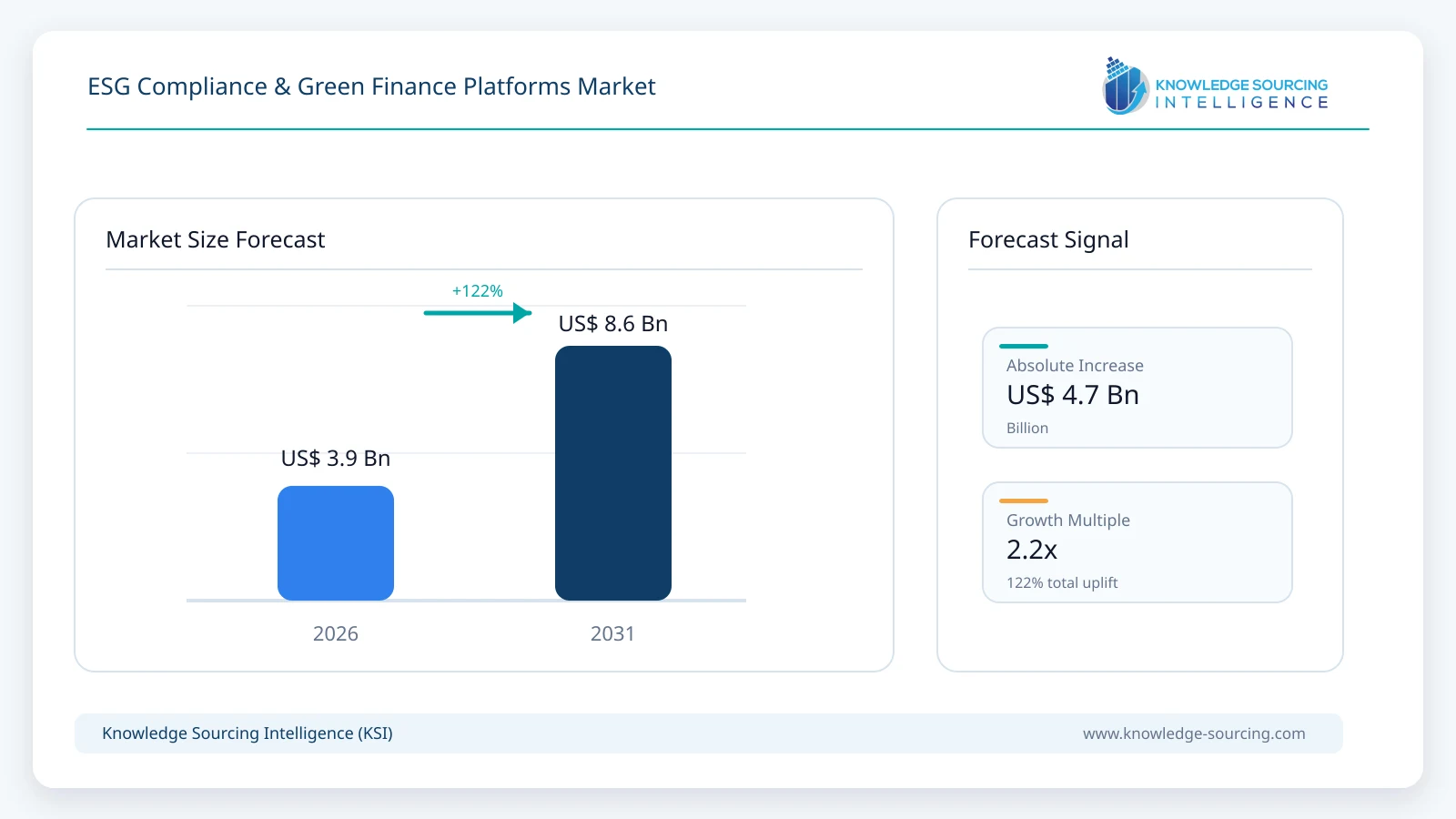
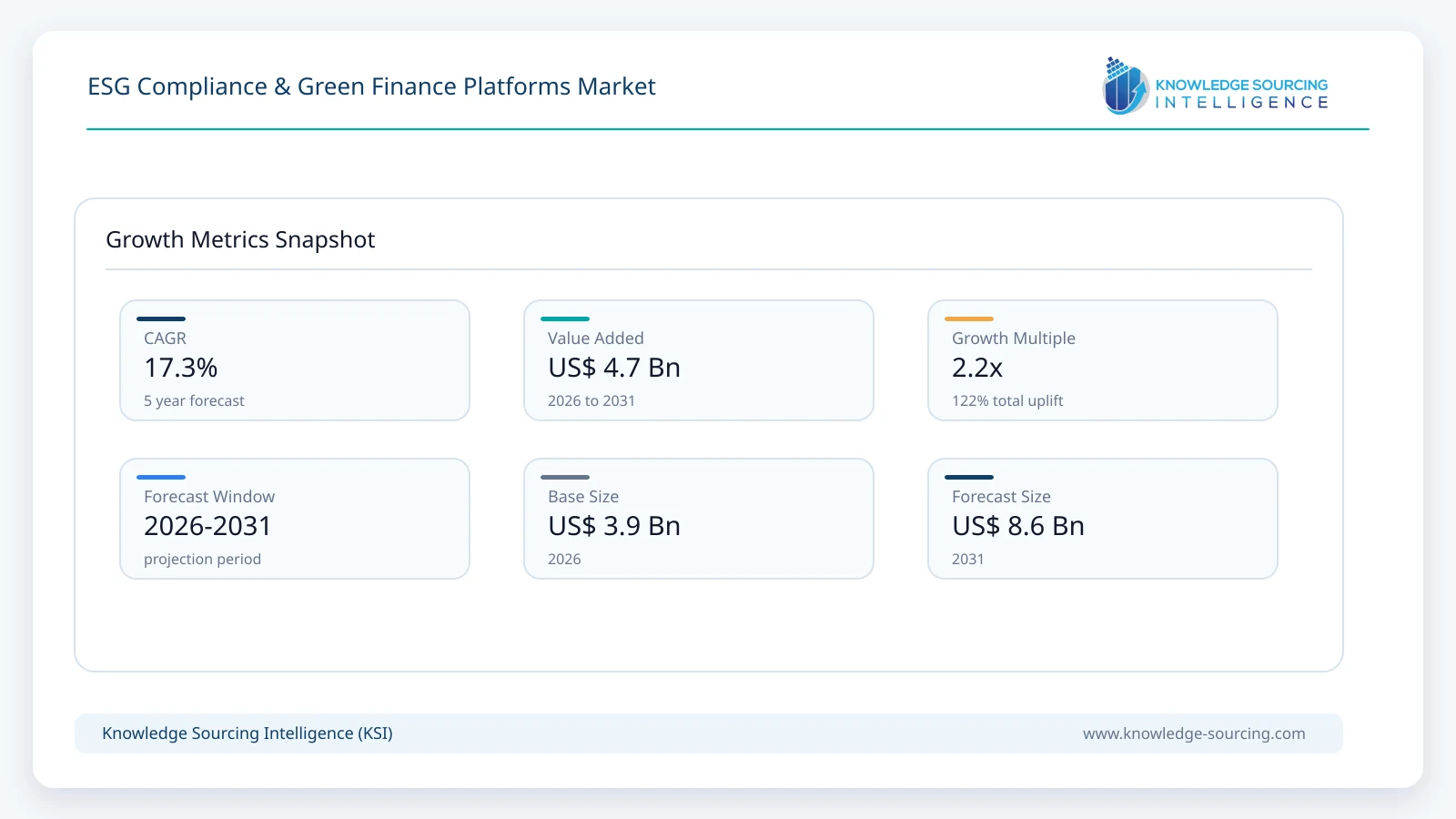
The global ESG compliance & green finance platforms market is forecast to grow from USD 3.85 billion in 2026 to USD 8.55 billion in 2031, representing a CAGR of 17.3% during the forecast period.
Highlights:
- 1Solutions are estimated to account for approximately 79.0% of global market revenue in 2026 as organizations prioritize software for sustainability data, compliance workflows, carbon accounting and sustainable-finance analytics.
- 2Cloud-based platforms are estimated to represent approximately 82.0% of 2026 revenue, reflecting the need to collect ESG data across distributed business units, suppliers, assets and investment portfolios.
- 3ESG compliance management is estimated to account for approximately 38.0% of global market revenue in 2026 as disclosure, auditability and regulatory-change management remain the largest immediate software use cases.
- 4Financial institutions are estimated to generate approximately 31.0% of global market spending in 2026, supported by sustainable-investment analytics, financed-emissions data, green-bond workflows and portfolio reporting.
- 5North America is estimated to account for approximately 37.0% of global revenue in 2026, while Europe remains the most regulation-intensive market and Asia Pacific continues to expand through BRSR, exchange-led disclosure and sustainable-finance initiatives.
- 6The regulatory environment is becoming more differentiatedthe European Union revised ESRS in July 2026, while the U.S. SEC proposed rescinding its federal climate-disclosure rule in May 2026, increasing the importance of multi-framework platforms rather than single-rule compliance tools.
Market Overview
The ESG compliance & green finance platforms market covers software and directly associated services used to collect, govern, calculate, analyze and disclose environmental, social and governance information and to support sustainable-finance workflows. The market includes ESG reporting and data-management platforms, carbon accounting, regulatory compliance management, supply-chain ESG monitoring, sustainable investment analytics, green-bond and taxonomy workflows, financed-emissions tools, risk analytics, implementation and platform support.
The scope excludes general enterprise resource planning, broad financial-planning software, standalone consulting projects without a platform component, ESG ratings sold only as data feeds, and investment-management systems without a material ESG or sustainable-finance workflow. This boundary avoids double counting the wider financial-software market while retaining the software layers that organizations use specifically for sustainability governance and capital-allocation decisions.
Demand is being shaped by a mix of regulation, investor expectations, customer procurement requirements and internal decarbonization programs. The European Union adopted revised European Sustainability Reporting Standards in July 2026 as part of the Omnibus simplification program, reducing reporting burden while preserving structured disclosure requirements. India is extending BRSR Core toward the top 1,000 listed entities by FY 2026-27. In contrast, the U.S. SEC proposed rescinding its 2024 climate-disclosure rule in May 2026, which reduces one federal compliance driver but does not remove state-level, investor, customer or multinational reporting requirements.
Commercial platform scale confirms that ESG workflows have moved beyond niche sustainability teams. Workiva reported USD 885 million of total 2025 revenue across its connected reporting, finance, risk and sustainability platform and serves more than 6,500 organizations. IBM Envizi continues to expand managed reporting frameworks and emissions functionality, while Diligent, Sphera, SAP, Wolters Kluwer, Persefoni, Watershed, Cority, EcoVadis and other vendors support combinations of carbon accounting, ESG reporting, supplier data and governance.
Green-finance functionality is also becoming more integrated with corporate ESG data. Financial institutions increasingly require financed-emissions calculations, taxonomy alignment, sustainable-investment screening, green-bond reporting and portfolio-level sustainability analytics. Platforms that can connect corporate disclosure data with investment or lending workflows are therefore expanding beyond traditional sustainability reporting.
Market Trends
Regulatory Simplification Increases the Value of Multi-Framework Platforms
ESG regulation is not moving in one direction. The European Union is simplifying the scope and content of sustainability reporting while retaining structured ESRS requirements, whereas the U.S. SEC has moved toward rescinding its federal climate-disclosure rule. Companies operating across jurisdictions therefore need platforms that can map the same underlying data to different regulatory and voluntary frameworks rather than building separate systems for each rule.
This favors configurable data models, managed framework libraries, audit trails and disclosure workflow. IBM Envizi added simplified and granular ESRS frameworks during 2026, illustrating how vendors are turning regulatory change itself into an ongoing software requirement.
AI Moves from Narrative Drafting into Data and Control Workflows
AI is increasingly being used to classify evidence, identify disclosure gaps, map data to frameworks, detect anomalies and draft supporting narrative. The higher-value use cases are tied to traceable source data and review workflows rather than generic text generation.
Platforms are also applying AI to supplier data, spend-based emissions estimation and materiality assessment. This can reduce manual workload, but buyers increasingly require transparent calculations, human approval and documented evidence because sustainability disclosures may be assured or incorporated into regulated reporting.
Carbon Accounting and Supply-Chain Data Converge with ESG Reporting
Organizations are combining emissions calculation, supplier surveys, energy data and disclosure management within one platform. Scope 3 remains particularly important because value-chain emissions require data collection from procurement systems and suppliers rather than only corporate facilities.
The convergence favors platforms with factor libraries, supplier portals, API integrations and finance-grade controls. It also broadens the buyer base from sustainability teams to finance, procurement, risk, internal audit and operations.
Sustainable Finance Requires Portfolio-Level Data and Taxonomy Mapping
Banks, asset managers and issuers increasingly need to connect asset-level or company-level sustainability data with portfolio reporting, green-bond frameworks and transition-finance decisions. The European Green Bond Standard and ongoing EU taxonomy work reinforce demand for structured, reviewable datasets.
This creates a distinct green-finance layer within the broader ESG software market. Clarity AI and other sustainable-finance specialists compete alongside corporate reporting platforms by providing investment analytics, taxonomy alignment and portfolio-level sustainability intelligence.
Segment Analysis
By Component - Solutions
Solutions are estimated at approximately USD 3.04 billion in 2026. This value includes ESG reporting and data-management software, carbon accounting, compliance-management platforms, sustainable finance analytics and other recurring software products used to manage ESG information and workflows.
Software remains the principal value pool because sustainability requirements are continuous rather than project-based. Organizations need recurring data ingestion, calculations, framework updates, user permissions, evidence management and audit trails, which supports subscription revenue and long-term platform relationships.
By Deployment Mode - Cloud-Based
Cloud-based platforms are estimated at approximately USD 3.16 billion in 2026. Cloud deployment is the default architecture for most new ESG implementations because sustainability information must be collected from multiple legal entities, sites, suppliers, business systems and external data providers.
Cloud platforms also allow vendors to update emissions factors, disclosure frameworks and regulatory mappings without requiring customer-managed software releases. On-premise and hybrid deployments remain relevant for highly regulated organizations, but they represent a smaller share of new adoption.
By Application - ESG Compliance Management
ESG compliance management is estimated at approximately USD 1.46 billion in 2026. The segment includes disclosure workflow, evidence management, framework mapping, materiality, controls, audit trails and related regulatory-change functions.
The segment is supported by the need to prepare comparable information for regulators, investors, customers and assurance providers. Even where specific rules are simplified, multinational companies still face overlapping requirements across jurisdictions, making centralized compliance orchestration a durable use case.
By End User - Financial Institutions
Financial institutions are estimated at approximately USD 1.19 billion in 2026. Banks, insurers, asset managers, pension funds and other institutions use ESG platforms for financed emissions, portfolio analysis, sustainable-product classification, green-bond processes, stewardship information and regulatory reporting.
Financial institutions have unusually complex data requirements because they must evaluate both their own operational footprint and the sustainability characteristics of financed companies and assets. This supports higher spending on external datasets, analytics, taxonomy mapping and portfolio workflows.
By Geography - North America
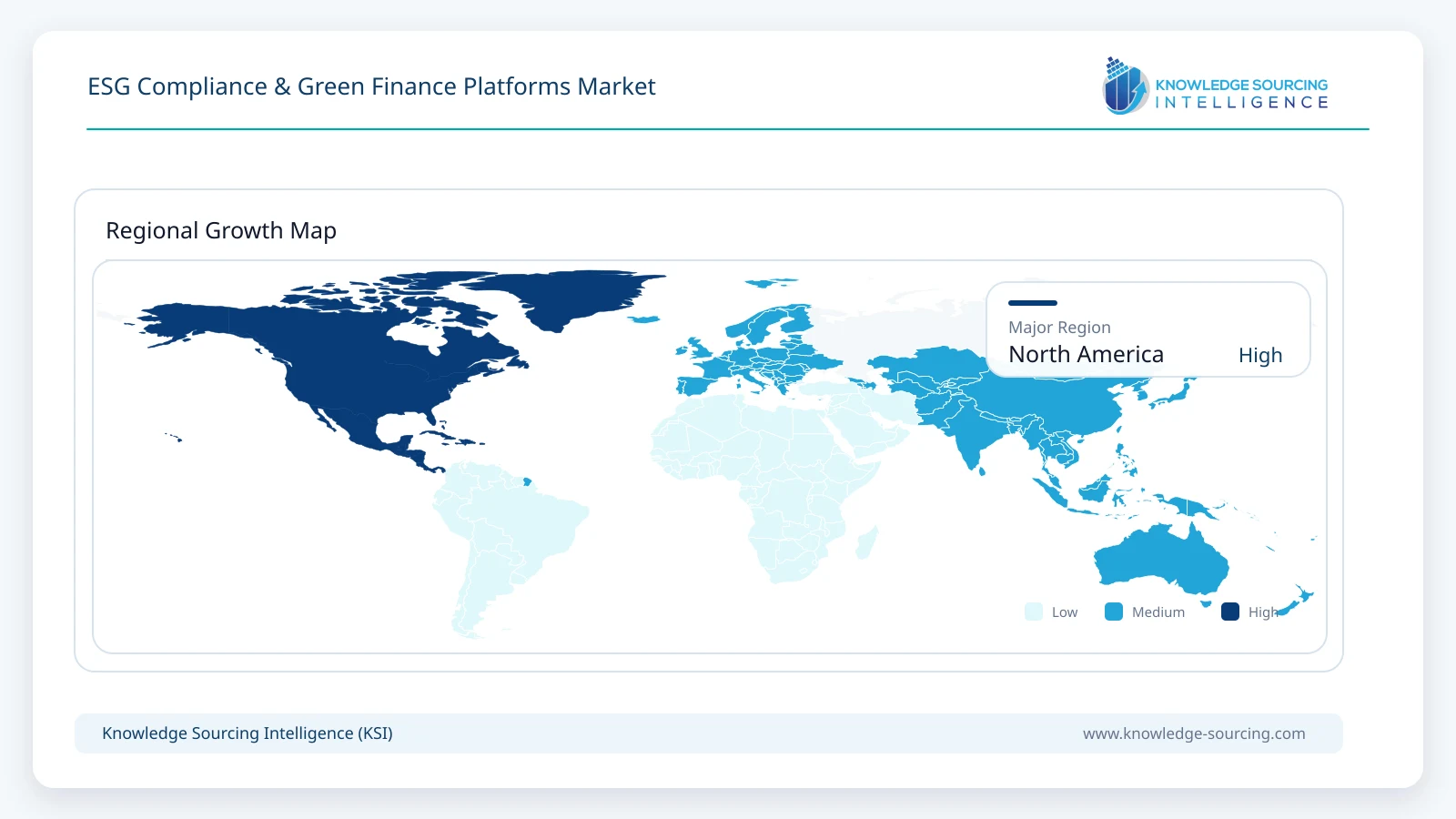
North America is estimated at approximately USD 1.42 billion in 2026. Demand is supported by high enterprise-software adoption, investor reporting, customer and supplier requirements, state-level climate disclosure, corporate decarbonization programs and the concentration of leading ESG software vendors.
The market is less dependent on one federal disclosure mandate than earlier forecasts implied. The SEC proposed rescinding its 2024 climate-disclosure rule in May 2026, so platform demand increasingly reflects multinational compliance, voluntary reporting, California and other subnational requirements, lender expectations and internal sustainability management.
Market Drivers
Mandatory and Quasi-Mandatory Sustainability Disclosure
Corporate sustainability reporting remains a major software driver despite regulatory simplification. The EU continues to maintain structured ESRS reporting, India is expanding BRSR Core, and multiple exchanges and jurisdictions require or encourage climate and sustainability disclosure.
Organizations prefer software that can reuse governed data across several reporting regimes, reducing the cost of duplicate data collection and strengthening consistency between sustainability, finance and risk disclosures.
Finance-Grade ESG Data and Assurance Requirements
Sustainability information is moving closer to financial reporting processes. Audit trails, controls, ownership, evidence retention and calculation transparency are becoming more important as companies prepare for limited or reasonable assurance and respond to investor scrutiny.
This shift benefits vendors that can connect sustainability data with financial systems, internal controls and collaborative reporting workflows.
Carbon Management and Scope 3 Data Collection
Carbon accounting remains one of the most persistent operational requirements because emissions data is spread across utility bills, travel, procurement, logistics and supplier systems. Scope 3 data can involve thousands of suppliers and large factor libraries.
Platforms that automate data ingestion, emissions calculations and supplier engagement reduce manual spreadsheet work and create a reusable foundation for disclosure and decarbonization planning.
Sustainable Finance and Transition-Capital Allocation
Green bonds, sustainability-linked finance, transition finance and sustainable investment products require structured data on assets, issuers and projects. Taxonomy mapping and financed-emissions calculations are increasingly embedded in investment and lending processes.
This expands the market beyond corporate reporting departments into banks, asset managers, insurers, investment research and treasury functions.
Market Restraints
Regulatory Volatility and Scope Changes
Frequent changes to sustainability rules can delay purchasing decisions and force vendors to maintain multiple framework versions. The 2026 EU ESRS revision and the U.S. SEC rescission proposal illustrate how compliance assumptions can shift materially within a short period.
Flexible data models reduce this risk, but organizations may defer large implementations when regulatory scope remains uncertain.
Data Quality and Organizational Fragmentation
ESG data often sits across finance, procurement, facilities, HR, logistics and supplier systems. Inconsistent units, missing supplier information and weak ownership can limit the value of even sophisticated software.
Implementation therefore requires governance and process change in addition to technology, increasing deployment complexity for large multinational organizations.
Overlap Between ESG, EPM, Risk and Data Platforms
Large software vendors increasingly embed sustainability features inside enterprise performance management, ERP, governance-risk-compliance and data platforms. This can reduce willingness to purchase a standalone ESG application for basic functionality.
Specialist vendors must therefore differentiate through deeper carbon calculation, regulatory content, supplier workflows or sustainable-finance analytics.
Political and Terminology Risk
ESG terminology has become politically contested in some markets, particularly the United States. Some organizations are shifting language toward sustainability, climate risk, responsible investment or regulatory reporting while retaining similar data-management needs.
This can affect marketing and procurement cycles even where the underlying operational requirement for emissions, risk and disclosure data remains intact.
Regional Outlook
North America
North America has a large enterprise-software base and strong demand from financial institutions, technology companies, industrial groups and multinational issuers. Workiva, Persefoni, Watershed, Diligent and several other major vendors are headquartered or have substantial operations in the region.
U.S. federal climate-disclosure policy is less supportive than expected in 2024, but California requirements, investor information needs, multinational obligations and corporate decarbonization programs continue to sustain platform adoption.
Europe
Europe remains the most regulation-intensive market. Revised ESRS, the EU Taxonomy, SFDR-related investment workflows and the European Green Bond Standard create demand across both corporate reporting and sustainable finance.
The 2026 simplification program reduces the number of entities directly in scope but also increases the importance of platforms that can adapt quickly to revised standards and voluntary reporting for smaller companies.
Asia Pacific
Asia Pacific is expanding through a combination of exchange-led sustainability reporting, national disclosure frameworks and growing sustainable-finance markets. India is extending BRSR Core, while Japan, Singapore, Australia and other markets continue to strengthen climate and sustainability reporting expectations.
Large regional supply chains also create demand for supplier ESG data because multinational customers increasingly request emissions and sustainability information from Asian manufacturers.
South America
South American adoption is concentrated in large listed companies, financial institutions, exporters and energy or mining groups with international financing and customer requirements. Brazil represents the largest regional software opportunity.
Growth is supported by sustainable-finance activity and the need to respond to global customer and investor frameworks even where local mandatory disclosure is less extensive than in Europe.
Middle East and Africa
Gulf markets are developing sustainability disclosure, green-finance and transition-investment frameworks alongside large energy-transition projects. Banks, sovereign-related companies and listed issuers are the principal buyers.
African adoption is more selective and concentrated in multinational subsidiaries, financial institutions, mining groups and companies accessing international capital markets.
Competitive Environment
The market combines broad enterprise-software vendors, specialist carbon-accounting companies, governance and compliance platforms, sustainable-finance analytics providers and ESG data networks. Workiva competes through connected reporting and audit-ready collaboration; IBM Envizi, SAP and Wolters Kluwer integrate sustainability into broader enterprise software; Diligent and Sphera combine ESG with governance, risk or operational sustainability; Persefoni, Watershed and Sweep focus strongly on carbon and climate workflows.
Financial-market specialization creates a second competitive axis. Clarity AI supports sustainable-investment analysis, while EcoVadis is differentiated by supplier sustainability ratings and network data. Datamaran emphasizes regulatory and materiality intelligence, and OneStream integrates ESG reporting and planning with corporate performance management.
Competitive advantage increasingly depends on data connectivity, calculation transparency, framework maintenance, workflow controls, supplier engagement and the ability to support assurance. Vendors that can link sustainability data directly with finance and investment decisions are positioned to capture a larger share of enterprise spending.
Recent Developments
• September 2026: Workiva continued expanding AI capabilities for regulatory work and connected reporting while reporting more than 6,500 organizations on its platform.
• July 2026: The European Commission adopted revised European Sustainability Reporting Standards designed to reduce administrative burden while maintaining structured sustainability disclosures.
• May 2026: The U.S. Securities and Exchange Commission proposed rescinding the 2024 federal climate-related disclosure rules in their entirety, materially changing the U.S. regulatory backdrop for ESG reporting.
• 2026: IBM Envizi expanded managed reporting frameworks, including simplified and granular ESRS structures, and added updated climate and supply-chain emissions functionality.
• 2025–2026: Diligent, OneStream, Datamaran, Watershed, Persefoni and other vendors continued expanding carbon accounting, regulatory workflow and sustainability-reporting capabilities.
Market Outlook
The ESG compliance & green finance platforms market is expected to remain a high-growth enterprise-software category through 2031, but growth will become more selective as regulatory simplification reduces some compliance burden and customers consolidate point solutions. Demand is expected to concentrate around auditable data foundations, carbon accounting, supply-chain data, multi-framework disclosure, sustainable-finance analytics and integrated planning.
Platforms that treat regulatory change as a configurable content layer rather than a fixed workflow are likely to be more resilient. The market is also expected to converge gradually with finance, risk, procurement and investment systems, making integration depth and data governance increasingly important competitive differentiators.
ESG Compliance & Green Finance Platforms Market Scope:
| Report Metric | Details |
|---|---|
| Total Market Size in 2026 | USD 3.85 billion |
| Total Market Size in 2031 | USD 8.55 billion |
| Forecast Unit | USD Billion |
| Growth Rate | 17.3% |
| Study Period | 2021 to 2031 |
| Historical Data | 2021 to 2024 |
| Base Year | 2025 |
| Forecast Period | 2026 – 2031 |
| Segmentation | Component, Deployment Mode, Application, End User, Geography |
| Companies |
|
| Customization Scope | 15% Free Customization included with purchase — Request Custom Breakdown → |
| Sample & Data Access | PDF Sample, Excel Databook & Analyst Briefing — Download Free Sample → |
Market Segmentation
By Component
Solutions
ESG Reporting and Data Management
Carbon Accounting and Management
Risk and Compliance Software
Sustainable Finance Analytics
Services
Consulting
Implementation and Integration
Support and Managed Services
By Deployment Mode
Cloud-Based
On-Premise
Hybrid
By Application
ESG Compliance Management
Sustainable Investment Management
Carbon Footprint Tracking
Supply Chain ESG Monitoring
Green Bond and Taxonomy Management
Risk and Performance Analytics
By End User
Financial Institutions
Industrial and Energy
Technology and Services
Consumer-Facing Industries
Public and Regulatory Bodies
By Geography
North America
United States
Canada
Mexico
South America
Brazil
Others
Europe
United Kingdom
Germany
France
Italy
Others
Middle East and Africa
Saudi Arabia
UAE
Others
Asia Pacific
China
India
Japan
South Korea
Australia
Others
Table of Contents
1. INTRODUCTION
1.1. Market Overview
1.2. Market Definition
1.3. Scope of the Study
1.4. Market Segmentation
1.5. Currency and Study Period
2. RESEARCH METHODOLOGY
2.1. Research Design
2.2. Secondary Research
2.3. Primary Validation
2.4. Market Estimation and Forecasting
2.5. Data Triangulation and Quality Control
3. EXECUTIVE SUMMARY
3.1. Key Findings
3.2. Global Market Size, 2026-2031
3.3. Regulatory and Technology Outlook
3.4. Regional Opportunity Summary
4. MARKET DYNAMICS
4.1. Market Drivers
4.1.1. Mandatory and Quasi-Mandatory Sustainability Disclosure
4.1.2. Finance-Grade ESG Data and Assurance Requirements
4.1.3. Carbon Management and Scope 3 Data Collection
4.1.4. Sustainable Finance and Transition-Capital Allocation
4.2. Market Restraints
4.2.1. Regulatory Volatility and Scope Changes
4.2.2. Data Quality and Organizational Fragmentation
4.2.3. Overlap Between ESG, EPM, Risk and Data Platforms
4.2.4. Political and Terminology Risk
4.3. Porter’s Five Forces Analysis
4.4. Industry Value Chain Analysis
5. ESG COMPLIANCE & GREEN FINANCE PLATFORMS MARKET BY COMPONENT
5.1. Introduction
5.2. Solutions
5.2.1. ESG Reporting and Data Management
5.2.2. Carbon Accounting and Management
5.2.3. Risk and Compliance Software
5.2.4. Sustainable Finance Analytics
5.3. Services
5.3.1. Consulting
5.3.2. Implementation and Integration
5.3.3. Support and Managed Services
6. MARKET BY DEPLOYMENT MODE
6.1. Introduction
6.2. Cloud-Based
6.3. On-Premise
6.4. Hybrid
7. MARKET BY APPLICATION
7.1. Introduction
7.2. ESG Compliance Management
7.3. Sustainable Investment Management
7.4. Carbon Footprint Tracking
7.5. Supply Chain ESG Monitoring
7.6. Green Bond and Taxonomy Management
7.7. Risk and Performance Analytics
8. MARKET BY END USER
8.1. Introduction
8.2. Financial Institutions
8.3. Industrial and Energy
8.4. Technology and Services
8.5. Consumer-Facing Industries
8.6. Public and Regulatory Bodies
9. MARKET BY GEOGRAPHY
9.1. Introduction
9.2. North America
9.2.1. United States
9.2.2. Canada
9.2.3. Mexico
9.3. South America
9.3.1. Brazil
9.3.2. Others
9.4. Europe
9.4.1. United Kingdom
9.4.2. Germany
9.4.3. France
9.4.4. Italy
9.4.5. Others
9.5. Middle East and Africa
9.5.1. Saudi Arabia
9.5.2. UAE
9.5.3. Others
9.6. Asia Pacific
9.6.1. China
9.6.2. India
9.6.3. Japan
9.6.4. South Korea
9.6.5. Australia
9.6.6. Others
10. COMPETITIVE ENVIRONMENT AND ANALYSIS
10.1. Major Players and Strategy Analysis
10.2. Corporate Reporting Platform Positioning
10.3. Carbon and Supply-Chain Platform Positioning
10.4. Sustainable-Finance Analytics Positioning
10.5. Mergers, Acquisitions and Partnerships
10.6. Competitive Dashboard
11. COMPANY PROFILES
11.1. Workiva Inc.
11.2. IBM Corporation (Envizi)
11.3. Diligent Corporation
11.4. Sphera Solutions, Inc.
11.5. SAP SE
11.6. Wolters Kluwer N.V.
11.7. Clarity AI, Inc.
11.8. Persefoni AI, Inc.
11.9. Watershed Technology, Inc.
11.10. Cority Software Inc.
11.11. EcoVadis SAS
11.12. Sweep
11.13. Datamaran Ltd.
11.14. OneStream, Inc.
11.15. Nasdaq, Inc.
12. APPENDIX





Frequently asked questions
What is the forecasted growth of the ESG compliance & green finance platforms market?
Market forecast to reach $8.55B by 2031 with 17.3% CAGR from $3.85B in 2026.
Which deployment model dominates the ESG compliance platform market?
Cloud-based platforms represent approximately 82% of 2026 revenue.
What is the largest immediate use case for ESG software?
ESG compliance management accounts for 38% of global market revenue in 2026.
Which industry segment leads spending on ESG platforms?
Financial institutions generate approximately 31% of global market spending in 2026.
Which region accounts for the largest market revenue in 2026?
North America is estimated to account for approximately 37% of global revenue.
What primary factors drive demand for these platforms?
Regulation, investor expectations, procurement requirements, and decarbonization programs drive demand.
Cite this report
Knowledge Sourcing Intelligence. (Oct 2026). ESG Compliance & Green Finance Platforms Market - Strategic Insights and Forecasts (2026-2031). https://www.knowledge-sourcing.com/report/esg-compliance-and-green-finance-platforms-market