
The sustainable finance investment analytics market is expected to grow at a high CAGR over the forecast period.
Highlights:
- 1Regulatory reporting and greenwashing controls are strengthening demand for auditable ESG datasets, screening engines, portfolio analytics, and evidence-based sustainability classifications.
- 2Climate and transition analytics represent an important commercial application, as investors increasingly need to assess emissions exposure, transition readiness, physical hazards, and portfolio sensitivity to future scenarios.
- 3North America and Europe remain major demand centers, supported by deep institutional investment markets, sophisticated data procurement practices, and extensive sustainability reporting requirements.
- 4Asia-Pacific is expanding its addressable opportunity as asset owners, banks, exchanges, and regulators develop local sustainability-disclosure and transition-finance frameworks.
- 5Analytics platforms are becoming more integrated with conventional investment systems, combining sustainability information with prices, fundamentals, holdings, benchmarks, risk factors, and portfolio construction workflows.
- 6Competition is shifting toward data quality, methodological transparency, interoperability, and workflow integration, rather than relying solely on the breadth of ESG scores.
The Sustainable Finance Investment Analytics Market comprises data, analytical models, software, ratings, scoring systems, screening tools, portfolio applications, climate-risk models, scenario analysis, and impact-measurement capabilities used by financial institutions to incorporate sustainability-related information into investment and risk decisions. The market sits at the intersection of financial market data, investment research, risk management, regulatory reporting, portfolio construction, and sustainability intelligence.
Demand is being shaped less by a single sustainability objective and more by the practical requirement to translate environmental, social, governance, climate, and transition information into investment variables. Asset managers need to determine whether securities satisfy defined mandates, banks need to evaluate financed emissions and climate exposures, institutional investors need to test portfolios against future scenarios, and wealth managers need evidence to support sustainability-related product positioning. Pension funds, sovereign investors, insurers, private-equity firms, family offices, development-finance institutions, and corporate treasury teams represent additional buyers.
The commercial value of investment analytics arises from reducing the cost and uncertainty associated with collecting, normalizing, interpreting, and applying sustainability data. A large institution may receive information from company filings, sustainability reports, regulatory databases, emissions datasets, market feeds, alternative data providers, and specialist research sources. Without an analytical layer, these inputs remain difficult to compare across issuers, asset classes, geographies, and reporting periods. Vendors therefore compete not simply on the quantity of data supplied, but on data lineage, historical depth, methodology transparency, update frequency, coverage, interoperability, and the ability to integrate outputs into existing investment workflows.
The market is also moving toward greater integration between sustainability analytics and conventional financial analysis. Investment committees generally do not assess sustainability information in isolation. They examine how environmental exposure may affect operating costs, how governance weaknesses may affect capital allocation, how climate transition policies may influence asset values, and how physical climate hazards may affect cash flows or collateral. Consequently, analytics products that connect ESG variables with financial and market data have a stronger commercial use case than tools that provide sustainability scores without investment context.
Buyer priorities differ according to institutional function. Portfolio managers typically prioritize security-level comparability, screening, factor analysis, portfolio attribution, and benchmark comparison. Risk teams require scenario testing, exposure measurement, forward-looking climate indicators, and stress analysis. Compliance teams emphasize data traceability, regulatory mapping, evidence retention, and reproducibility. Sustainability teams focus on impact indicators, emissions, taxonomy alignment, transition plans, and stewardship information. Procurement departments increasingly evaluate whether providers can supply the same datasets through APIs, cloud platforms, enterprise feeds, and existing market-data terminals.
Regulation is reinforcing the need for structured analytics. In Europe, sustainability disclosure obligations and fund-name requirements have created demand for systems that can map investment holdings to defined sustainability criteria. ESMA’s fund-name guidelines established an 80% investment threshold for funds using ESG or sustainability-related terms, together with exclusions linked to Paris-aligned and Climate Transition Benchmark methodologies. The guidelines became applicable to new funds in November 2024, with the transition period for existing funds ending in May 2025.
The regulatory environment is not uniform across regions. The European Union continues to develop and revise its sustainable-finance architecture, while the United States has taken a more materiality-focused direction. In May 2026, the U.S. Securities and Exchange Commission proposed rescinding its 2024 climate-related disclosure rules, illustrating how regulatory changes can alter the data requirements facing investors and companies.
For analytics suppliers, this divergence creates both opportunity and complexity. Global financial institutions require systems capable of supporting multiple regulatory regimes without rebuilding their data architecture for every jurisdiction. The resulting procurement preference is moving toward modular platforms that allow clients to select specific data fields, methodologies, regulatory mappings, and analytical functions.
Market Drivers
Expansion of Sustainability-Related Investment Mandates
Institutional investors are creating mandates that require sustainability characteristics to be considered alongside conventional financial metrics. This creates recurring demand for screening, scoring, benchmarking, and portfolio analytics because investment teams need repeatable methods rather than manual research.
Asset managers must demonstrate that portfolios follow defined investment rules. Pension funds may apply exclusion lists, climate targets, or stewardship requirements, while insurers and banks may incorporate sustainability-related risk into investment and financing decisions. These requirements generate demand for security-level data that can be refreshed as holdings and issuer disclosures change.
The commercial implication is a shift from one-time ESG research toward subscription-based analytical infrastructure. Buyers increasingly value continuous data feeds, historical datasets, APIs, portfolio connectors, and automated calculations because these features reduce the operational burden associated with monitoring large portfolios.
Increasing Need to Quantify Climate and Transition Risk
Climate analytics is becoming more closely linked to financial risk management. Investors need to understand how carbon-intensive assets may respond to carbon pricing, regulation, technology substitution, energy-market changes, and changing consumer demand. At the same time, physical risks such as heat, flooding, water stress, and extreme weather can affect operating locations and supply chains.
This creates demand for forward-looking models rather than static emissions scores. Portfolio managers require transition indicators, implied temperature measures, emissions trajectories, target assessments, and scenario analysis. Risk teams require stress-testing capabilities that connect climate assumptions to financial outcomes.
Providers therefore compete on the quality of underlying emissions information, scenario methodologies, geographic granularity, asset-level exposure mapping, and integration with portfolio-risk systems.
Growth in Sustainability Disclosure and Data Requirements
The increasing volume of corporate sustainability information is generating a secondary demand for data normalization and analytics. The IFRS Foundation reported continued jurisdictional work on the adoption or use of ISSB Sustainability Disclosure Standards, with jurisdictional profiles being developed as regulatory approaches are finalized.
For investors, broader disclosure does not automatically create usable information. Data must be classified, mapped, checked, time-stamped, and connected to issuers and financial instruments. Differences in reporting boundaries, calculation methodologies, fiscal years, definitions, and estimation practices can create inconsistencies.
Analytics suppliers can capture value by providing structured datasets and analytical layers that convert disclosure information into investment-ready metrics. This favors vendors with established financial-data infrastructures because sustainability information can be connected directly with issuer identifiers, securities, financial statements, prices, and portfolio holdings.
Increasing Institutional Scrutiny of Greenwashing and Sustainability Claims
Investors, regulators, and distributors are demanding stronger evidence behind sustainability claims. ESMA's review published in December 2025 found that 64% of funds identified in shareholder notifications changed their names following the fund-name guidelines, while 56% updated their investment policies to strengthen their sustainability focus.
The commercial effect extends beyond fund naming. Investment firms need systems that can verify whether portfolio exposures are consistent with stated objectives. Screening engines, exclusion checks, taxonomy analysis, principal adverse impact calculations, and portfolio-level sustainability assessments therefore become operational controls rather than optional research features.
This increases demand for transparent methodologies. Buyers need to understand where an input originated, when it was updated, which assumptions were applied, and how the resulting score or classification was generated.
Integration of Alternative and Non-Traditional Data
Traditional corporate disclosures remain central to sustainable-finance analysis, but investors increasingly require information that captures operational conditions not fully represented in annual reports. Alternative datasets may include geospatial information, supply-chain indicators, controversy monitoring, satellite observations, physical asset information, news-derived signals, and other externally generated variables.
Alternative data can improve timeliness and granularity, particularly for climate and physical-risk analysis. However, buyers require evidence of data quality, legal usability, methodology stability, and statistical relevance. Consequently, providers with established data-governance processes and strong financial-market distribution channels have an advantage when incorporating alternative datasets into institutional workflows.
Market Restraints and Challenges
Inconsistent Definitions and Methodologies
ESG ratings and sustainability indicators can differ materially because providers use different definitions, weighting structures, materiality assessments, estimation methods, and data sources. Two providers may therefore assign different assessments to the same issuer without either dataset being technically defective.
This creates difficulties for institutional investors seeking consistency across mandates. Procurement teams must evaluate methodology rather than simply compare headline coverage. Providers need to publish methodology documentation, data lineage, historical revisions, and limitations.
The commercial consequence is higher due-diligence costs and longer sales cycles, particularly among large asset owners and regulated financial institutions.
Data Gaps and Estimation Dependence
Many companies do not disclose all sustainability indicators at the same level of granularity. Scope 3 emissions, supply-chain exposure, biodiversity impacts, workforce information, and forward-looking transition indicators can be difficult to obtain consistently.
Analytics suppliers therefore use estimation models where reported information is unavailable. Estimation expands coverage but introduces model risk. Buyers need to distinguish reported figures from modeled values and understand how estimates affect portfolio conclusions.
Mitigation requires clear data provenance, confidence indicators, version control, and the ability to filter or override estimated observations where clients have superior proprietary information.
Regulatory Fragmentation
Sustainable-finance regulation differs by jurisdiction, product type, investor category, and reporting obligation. Rules can also change after firms have implemented data pipelines and reporting processes.
The European Commission has been reviewing SFDR with the stated objective of improving usability, legal certainty, and the framework's ability to address greenwashing. In November 2025, the Commission proposed amendments intended to simplify and improve the regulation.
For analytics vendors, regulatory fragmentation increases product-development and maintenance costs. Systems must support jurisdiction-specific calculations while preserving a common underlying data model.
Cost and Integration Complexity
Enterprise sustainability analytics can require substantial investment in data licenses, implementation, integration, model validation, cloud infrastructure, and internal governance. Smaller asset managers may not have the resources to build complex sustainability-data architectures.
Integration is also a technical challenge. Buyers want analytics inside portfolio-management systems, research terminals, risk engines, data warehouses, and reporting platforms. Vendors that require separate interfaces can face lower adoption even when their underlying data is strong.
Methodology and Model Risk
Climate scenarios and sustainability scores contain assumptions that may influence investment conclusions. Scenario models depend on assumptions regarding policy, technology, economic activity, energy prices, emissions, and physical climate conditions.
Financial institutions therefore require model governance and validation procedures. Providers need to support auditability and explainability, particularly where analytics influence regulated risk decisions. The requirement increases development costs but also raises barriers to entry for less established vendors.
Major Segment Analysis
Climate Risk Analytics
Climate Risk Analytics represents a commercially important segment because it connects sustainability information directly with financial risk management. Unlike a simple ESG score, climate-risk analytics can be used to evaluate how physical hazards and transition factors may affect securities, portfolios, borrowers, assets, and investment strategies.
The demand base includes asset managers, banks, insurers, pension funds, sovereign investors, private-market investors, and corporate finance teams. Their requirements differ, but most need to translate climate variables into financial exposures. A portfolio manager may examine emissions intensity and transition readiness, while a bank may assess the climate sensitivity of borrowers and collateral. An insurer may focus on physical hazards affecting insured assets.
Buyer requirements are shifting toward forward-looking analytics. Historical emissions remain important, but investment decisions increasingly require information about targets, transition plans, capital expenditure, technology exposure, policy sensitivity, and future scenarios. Physical-risk analytics similarly requires location-specific information rather than country-level averages.
The competitive model favors providers that combine high-quality underlying financial data with sustainability datasets and established analytical workflows. Bloomberg, LSEG, MSCI, S&P Global, Morningstar Sustainalytics, and other listed suppliers can differentiate through issuer coverage, historical data, proprietary methodologies, scenario libraries, portfolio integration, and distribution through existing financial-data platforms.
Revenue opportunities extend beyond standalone analytics subscriptions. Climate-risk tools can be bundled with market data, enterprise data licenses, portfolio platforms, regulatory solutions, and risk-management applications. This creates a recurring revenue model based on data access, analytical functionality, portfolio scale, and user count.
Climate Risk Analytics is also important because climate analysis increasingly intersects with transition finance. Investors are not only excluding carbon-intensive assets; they may assess whether companies have credible pathways to reduce emissions while maintaining financial viability. This broadens the analytical requirement from negative screening toward transition assessment, scenario analysis, and capital-allocation decisions.
Regional Analysis
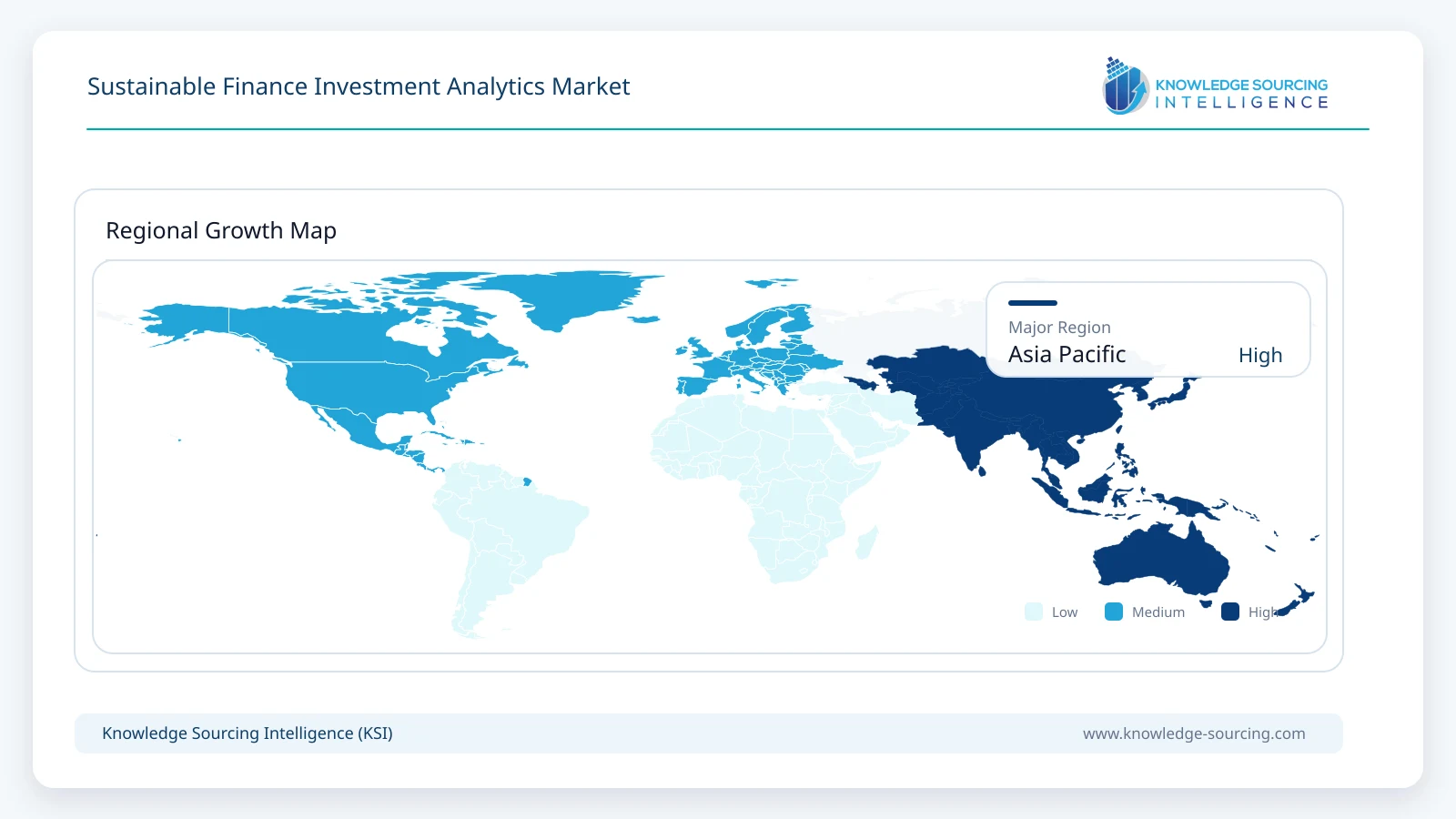
North America
North America represents a major market for sustainable-finance investment analytics because of its large asset-management industry, developed capital markets, sophisticated institutional investors, and extensive financial-data infrastructure.
The United States presents a particularly complex demand environment. Investors continue to use ESG and climate analytics, but regulatory expectations can differ from those in Europe. The SEC's May 2026 proposal to rescind its climate-related disclosure rules highlights the importance of monitoring regulatory direction when building sustainability-data products.
Buyers in the United States are likely to emphasize financially material sustainability information, risk analytics, portfolio performance, climate exposure, and customizable investment screens. Canada maintains a strong institutional-investment base and sustainability-reporting agenda, while Mexico offers opportunities associated with sustainable infrastructure, energy transition, and financial-sector modernization.
Competitive conditions favor providers with strong integration into existing investment platforms. Data suppliers that can combine financial, ESG, climate, and market information within established workflows can reduce switching costs for institutional customers.
Europe
Europe is a core demand center because sustainable-finance regulation has created extensive requirements for data, disclosure, classification, and portfolio analysis. SFDR, EU Taxonomy requirements, benchmark rules, and fund-name guidelines create multiple use cases for investment analytics.
The European Commission's continuing work on SFDR and taxonomy rules means that providers must maintain regulatory mappings and update analytical frameworks as requirements change.
The United Kingdom has developed its own sustainability-disclosure and investment framework, while Germany, France, Italy, Spain, the Netherlands, Switzerland, and Luxembourg contribute substantial institutional-investment and asset-management demand. Luxembourg is particularly relevant as a major European fund domicile.
European buyers place considerable emphasis on auditability, regulatory alignment, taxonomy analysis, sustainability classifications, exclusion screening, and portfolio-level reporting. The region also creates a strong market for climate scenario analysis and transition-risk tools.
Asia-Pacific
Asia-Pacific offers a diverse demand environment ranging from mature financial centers to rapidly developing sustainable-finance markets. Japan, Australia, Singapore, South Korea, China, and India are important demand centers, while Thailand and other Southeast Asian economies provide additional opportunities.
Singapore's role as a financial center supports demand for institutional ESG data and sustainable-finance analytics across Southeast Asia. Japan and Australia have sophisticated institutional-investment sectors with growing requirements for climate and sustainability analysis. India is developing sustainable-finance capabilities alongside infrastructure investment, energy transition, and corporate disclosure requirements.
China represents a large potential market because of its financial-system scale and transition-finance requirements, although local regulatory frameworks, data accessibility, language requirements, and domestic-provider competition influence procurement.
The regional opportunity favors vendors that can provide localized data and regulatory mappings rather than simply repackaging Western sustainability frameworks. Local-language coverage, domestic issuer data, regional taxonomy alignment, and compatibility with local investment practices can influence purchasing decisions.
Middle East & Africa
Middle East & Africa is developing as a strategic market for sustainable-finance analytics through energy-transition investment, sovereign wealth activity, infrastructure development, green and sustainability-linked financing, and financial-market modernization.
Saudi Arabia and the United Arab Emirates are important demand centers because of their investment activity and national economic diversification programs. Sustainable infrastructure, renewable energy, transition finance, and climate-risk analysis create use cases beyond conventional ESG screening.
South Africa provides an important African institutional-investment market, supported by established asset managers, pension assets, and sustainability-reporting requirements.
The principal constraint is uneven data availability. Coverage of smaller issuers, private companies, physical assets, and local sustainability indicators can be limited. Providers that combine global datasets with regional research and localized regulatory intelligence can therefore differentiate more effectively.
South America
South America remains smaller than North America, Europe, and Asia-Pacific but offers specific opportunities in sustainable infrastructure, agriculture, energy, mining, forestry, and transition finance.
Brazil is the principal regional opportunity because of its large financial market and exposure to sectors where environmental and social factors have direct economic consequences. Climate, land-use, biodiversity, supply-chain, and transition analytics can have greater investment relevance in Brazil than generic ESG scoring.
Argentina and other South American markets present more selective opportunities. Macroeconomic volatility, market depth, data availability, and institutional-investor scale can constrain spending on specialized analytics. Vendors therefore need flexible pricing and solutions that demonstrate a direct link to investment or compliance outcomes.
Competitive Landscape
The competitive structure includes global financial-data providers, index and benchmark specialists, ESG research organizations, analytics companies, and enterprise data suppliers. The companies included in this market are LSEG, MSCI, Morningstar Sustainalytics, S&P Global, Acuity Knowledge Partners, Bloomberg, and Deutsche Börse Group.
Competition is based on several dimensions. First is data coverage across listed companies, fixed-income instruments, funds, countries, sectors, and sustainability indicators. Second is methodological transparency, particularly for ESG scores, climate metrics, and impact measures. Third is workflow integration, including terminals, APIs, cloud delivery, portfolio systems, and enterprise data feeds.
The largest providers benefit from established relationships with asset managers, banks, insurers, exchanges, and institutional investors. These relationships can support cross-selling because sustainability analytics can be incorporated into broader market-data and investment-technology contracts.
LSEG illustrates the importance of integrated delivery. In March 2026, the company launched LSEG Sustainability Ratings and Data, including standardized indicators, ESG scores, risk and impact overlays, and delivery through platforms such as LSEG Workspace and enterprise data channels.
Bloomberg competes through the integration of ESG data, climate information, regulatory solutions, portfolio analytics, indices, and financial-market workflows. Its sustainable-finance platform supports ESG analysis, climate-risk assessment, regulatory reporting, and portfolio applications.
MSCI competes strongly in sustainability ratings, indexes, climate analytics, and portfolio applications. Morningstar Sustainalytics brings ESG research and investment-research capabilities, while S&P Global combines sustainability information with extensive financial and commodity datasets. Acuity Knowledge Partners competes through research, analytics, and specialized financial-services support, while Deutsche Börse Group benefits from its position within European financial-market infrastructure.
The competitive direction favors modularity. Institutional clients increasingly want to select specific datasets and analytics rather than adopt an inflexible sustainability platform. APIs, cloud delivery, enterprise feeds, customizable screens, and integration with proprietary models are therefore important differentiators.
Partnerships also influence market positioning because investment firms may require multiple datasets within a single workflow. Providers that support third-party data, standardized identifiers, and interoperable delivery can improve their relevance to large institutions with complex data architectures.
Recent Developments
August 2026: MSCI launched an MCP Connector for Gemini Enterprise for Financial Services, enabling investment professionals to analyse climate and sustainability data through AI-powered workflows.
June 2026: Morningstar Sustainalytics announced collaborations with XDI and Veridion to enhance physical climate risk analytics, translating asset-level climate hazards into financially relevant investment risk metrics.
May 2026: S&P Global Energy launched HorizonsAgents, including Transition Finance, Sustainability Benchmarking and Net Zero Investment agents, enabling banks and investors to analyse sustainability and energy-transition information faster.
March 2026: LSEG launched Sustainability Ratings and Data, introducing transparent ESG scores, materiality analytics and risk and impact overlays for investment, lending and advisory decision-making workflows.
December 2025: ESMA published research on its ESG and sustainability-related fund-name guidelines, finding that 64% of funds identified in shareholder notifications changed their names and 56% updated investment policies. The findings reinforce demand for analytics that can substantiate sustainability classifications and investment strategies.
Regulatory and Policy Environment
Regulation is a structural demand driver because sustainability analytics increasingly supports compliance, disclosure, investment-product classification, and risk governance.
In the European Union, SFDR requires financial-market participants and financial advisers to provide sustainability information at entity and product levels. The European Commission has also been reviewing SFDR to improve usability and address concerns around complexity and greenwashing.
The EU Taxonomy adds another analytical requirement by requiring assessment of economic activities against technical screening criteria. Financial institutions need structured data to calculate eligibility and alignment and to connect these assessments with portfolios and disclosures.
ESMA's fund-name guidelines create another direct analytics use case. The 80% threshold and related exclusion requirements mean that asset managers need systematic checks of portfolio holdings and investment policies rather than relying on manual review.
Internationally, ISSB standards are influencing the development of sustainability-disclosure regimes. The IFRS Foundation's jurisdictional profiles provide visibility into how countries are progressing with adoption or other use of ISSB standards.
The United States presents a different regulatory trajectory. In May 2026, the SEC proposed rescinding its 2024 climate-disclosure rules, emphasizing materiality and the Commission's statutory authority. This does not eliminate investor demand for climate analytics, but it can alter the compliance-driven component of U.S. procurement.
The regulatory environment therefore favors flexible analytics architectures. Vendors need to distinguish regulatory requirements from voluntary investment policies and provide configurable calculations that can be updated without replacing the underlying data infrastructure.
Outlook and Strategic Implications
The 2026–2031 period is likely to favor sustainable-finance analytics suppliers that make sustainability information operational within mainstream investment processes. The market's commercial direction will depend less on the number of ESG indicators available and more on whether those indicators can influence portfolio construction, risk measurement, security selection, regulatory reporting, and investment governance.
Climate risk analytics should remain a major investment priority. Financial institutions will require better links between emissions, physical hazards, transition pathways, asset locations, financial exposure, and portfolio outcomes. Scenario analysis will become more useful when institutions can connect assumptions to specific securities, borrowers, sectors, and geographies.
Procurement is likely to favor enterprise-ready solutions. Buyers will increasingly assess API availability, cloud deployment, data lineage, historical revisions, security controls, integration with portfolio systems, and the ability to combine proprietary and third-party datasets. Providers that require analysts to work in isolated interfaces may face pressure from institutions seeking consolidated investment workflows.
Methodological transparency will also influence purchasing decisions. ESG ratings with limited explainability can create governance problems when portfolio decisions depend on them. Providers that distinguish reported data, estimates, modeled variables, and derived scores can give investment committees greater confidence in analytical outputs.
Another strategic opportunity lies in customizable analytics. Sustainability objectives differ across investors. One institution may prioritize transition alignment, another may focus on social outcomes, while another may need regulatory screening. Modular products allow providers to serve these differences without developing entirely separate platforms.
Alternative data will become more important where conventional corporate reporting cannot provide sufficient granularity. Geospatial data, physical asset information, supply-chain indicators, climate observations, and other datasets can improve the assessment of real-world exposure. However, adoption will depend on validation, legal usability, data provenance, and model governance.
The market will also face a continuing tension between global standardization and local regulatory requirements. Large institutions want globally consistent data, while regulators and investment mandates may require jurisdiction-specific definitions. Successful platforms will therefore need a common data foundation combined with configurable regional rule sets.
Competitive positioning will increasingly depend on ecosystem strength. LSEG, MSCI, Morningstar Sustainalytics, S&P Global, Acuity Knowledge Partners, Bloomberg, and Deutsche Börse Group have different combinations of financial data, sustainability research, market infrastructure, indexes, analytics, and enterprise distribution. Their ability to connect these assets will influence customer retention and cross-selling opportunities.
For buyers, the strategic priority should be to evaluate sustainable-finance analytics as part of the broader investment-data architecture rather than as a standalone ESG purchase. Institutions should assess methodology, data provenance, regulatory mapping, integration capabilities, historical coverage, scenario assumptions, and total cost of ownership before selecting providers.
For suppliers, the strongest commercial opportunities are likely to arise from integrated climate-risk analytics, customizable screening, portfolio-level sustainability measurement, regulatory analytics, and enterprise data delivery. Products that connect sustainability indicators directly with financial outcomes should have stronger relevance to investment committees than tools that only provide descriptive ESG information.
Overall, the Sustainable Finance Investment Analytics Market is developing around a fundamental institutional requirement: converting increasingly complex sustainability information into consistent, decision-ready financial intelligence. The next five years should therefore be characterized by deeper integration with portfolio management, risk systems, regulatory workflows, and quantitative investment processes. The suppliers that provide transparent methodologies, reliable data, flexible delivery, and measurable workflow value will be best positioned to secure long-term institutional demand.
Sustainable Finance Investment Analytics Market Scope:
| Report Metric | Details |
|---|---|
| Forecast Unit | Billion |
| Study Period | 2021 to 2031 |
| Historical Data | 2021 to 2024 |
| Base Year | 2025 |
| Forecast Period | 2026 – 2031 |
| Segmentation | Investment Area, Data Type, Analytics Type, Geography |
| Companies |
|
Market Segmentation
By Investment Area
By Data Type
By Analytics Type
By Geography
Table of Contents
1. EXECUTIVE SUMMARY
2. MARKET SNAPSHOT
2.1. Market Overview
2.2. Market Definition
2.3. Scope of the Study
2.4. Market Segmentation
3. BUSINESS LANDSCAPE
3.1. Market Drivers
3.2. Market Restraints
3.3. Market Opportunities
3.4. Porter’s Five Forces Analysis
3.5. Industry Value Chain Analysis
3.6. Regulatory and Policy Environment
3.7. Strategic Recommendations
4. TECHNOLOGY AND ANALYTICS OUTLOOK
5. SUSTAINABLE FINANCE INVESTMENT ANALYTICS MARKET BY INVESTMENT AREA
5.1. Introduction
5.2. Environmental
5.3. Social
5.4. Governance
5.5. Climate and Transition
5.6. Sustainable Infrastructure
5.7. Others
6. SUSTAINABLE FINANCE INVESTMENT ANALYTICS MARKET BY DATA TYPE
6.1. Introduction
6.2. Environmental Data
6.3. Social Data
6.4. Governance Data
6.5. Financial and Market Data
6.6. Climate and Carbon Data
6.7. Alternative Data
7. SUSTAINABLE FINANCE INVESTMENT ANALYTICS MARKET BY ANALYTICS TYPE
7.1. Introduction
7.2. ESG Scoring and Ratings
7.3. Portfolio Analytics
7.4. Risk Analytics
7.5. Climate Risk Analytics
7.6. Sustainable Investment Screening
7.7. Scenario and Stress Testing
7.8. Performance and Benchmarking Analytics
7.9. Impact Measurement Analytics
8. SUSTAINABLE FINANCE INVESTMENT ANALYTICS MARKET BY GEOGRAPHY
8.1. Introduction
8.2. North America
8.2.1. USA
8.2.2. Canada
8.2.3. Mexico
8.3. South America
8.3.1. Brazil
8.3.2. Argentina
8.3.3. Others
8.4. Europe
8.4.1. United Kingdom
8.4.2. Germany
8.4.3. France
8.4.4. Italy
8.4.5. Spain
8.4.6. Netherlands
8.4.7. Switzerland
8.4.8. Luxembourg
8.4.9. Others
8.5. Middle East & Africa
8.5.1. Saudi Arabia
8.5.2. United Arab Emirates
8.5.3. South Africa
8.5.4. Others
8.6. Asia-Pacific
8.6.1. China
8.6.2. India
8.6.3. Japan
8.6.4. South Korea
8.6.5. Singapore
8.6.6. Australia
8.6.7. Thailand
8.6.8. Others
9. COMPETITIVE ENVIRONMENT AND ANALYSIS
9.1. Major Players and Strategy Analysis
9.2. Market Share Analysis
9.3. Mergers, Acquisitions, Agreements, and Collaborations
9.4. Competitive Dashboard
10. COMPANY PROFILES
10.1. LSEG (London Stock Exchange Group)
10.2. MSCI
10.3. Morningstar Sustainalytics
10.4. S&P Global
10.5. Acuity Knowledge Partners
10.6. Bloomberg
10.7. Deutsche Börse Group
11. APPENDIX
11.1. Currency
11.2. Assumptions
11.3. Base and Forecast Years Timeline
11.4. Key Benefits for the Stakeholders
11.5. Research Methodology
11.6. Abbreviations
Navigate
Trusted by the world's leading organizations











