
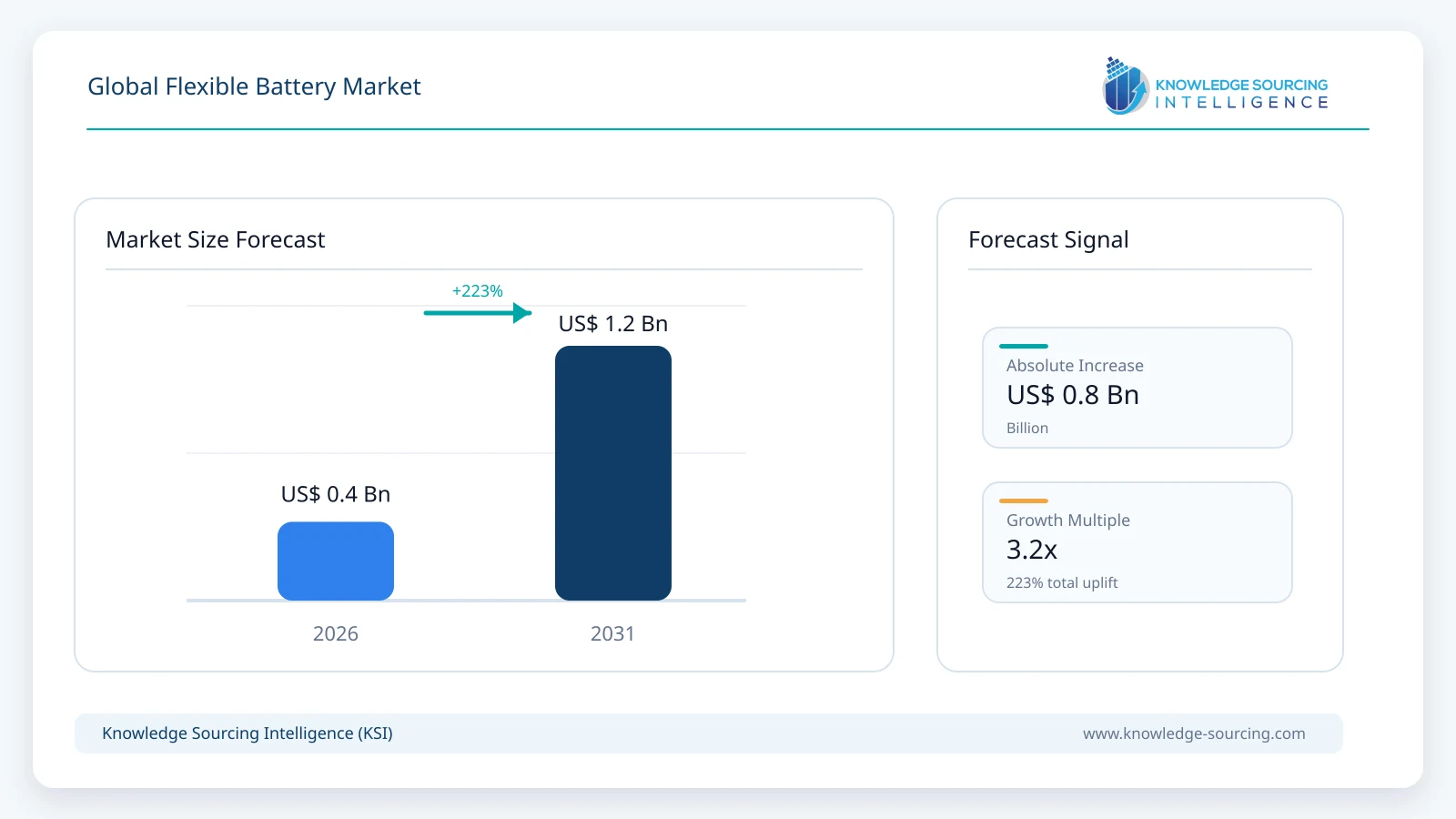
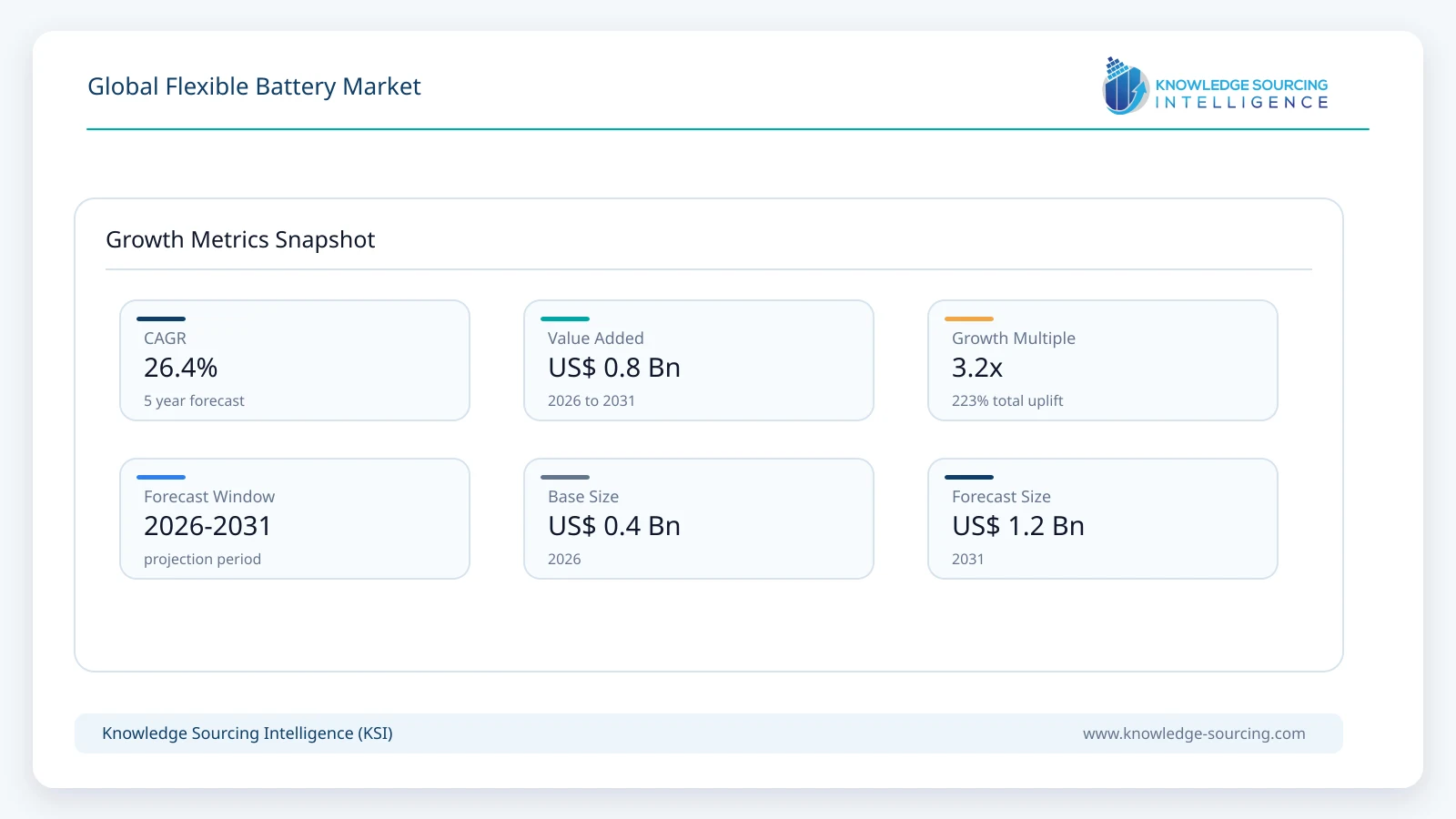
The global flexible battery market is estimated at USD 0.365 billion in 2026 and is forecast to reach USD 1.18 billion in 2031, representing a CAGR of 26.45% during the forecast period.
Highlights:
- 1Rechargeable flexible batteries account for approximately 66.0% of 2026 market revenue.
- 2Flexible and curved lithium-ion or lithium-polymer architectures represent approximately 41.0% of 2026 revenue.
- 3Wearable electronics account for approximately 34.0% of global flexible-battery revenue in 2026.
- 4North America represents approximately 34.0% of 2026 revenue, supported by medical wearables, printed electronics, and IoT development.
- 5Printed zinc batteries are moving from demonstration projects toward commercial smart-label, logistics, and disposable medical applications.
- 6The competitive field is narrower than legacy market lists because several historically cited flexible-battery programs are no longer sold as current commercial products.
Market Overview
Flexible batteries are electrochemical power sources engineered to operate in thin, curved, bent, conformal, or otherwise non-rigid form factors. The market includes printed zinc-manganese dioxide batteries, flexible thin-film primary batteries, curved and shape-adapted lithium-ion or lithium-polymer cells, flexible solid-state concepts that have reached credible near-commercial status, and specialized microbatteries intended for wearable, medical, smart-label, or embedded-electronics integration. The defining criterion is functional mechanical conformity, not simply small size.
This scope excludes conventional coin cells, cylindrical cells, and ordinary flat pouch batteries that are mechanically flexible only at the package level but are not designed or marketed for repeated bending, curved integration, printed electronics assembly, or shape-specific deployment. It also excludes supercapacitors and energy harvesting devices. The distinction is necessary because published market estimates vary by several hundred million dollars depending on whether standard thin batteries are included. A strict flexible-product definition produces a smaller but more technically coherent market.
Commercial evidence has improved materially. CCL Design currently manufactures ultrathin flexible printed zinc batteries based on technology acquired from Imprint Energy; Enfucell markets its printed SoftBattery platform; Zinergy operates continuous roll-to-roll printed-battery production; Molex sells flexible disposable thin-film batteries for medical, IoT, and smart-label applications; VARTA offers printed batteries; and emerging companies such as BTRY, Routejade, NavaFlex, Printed Energy, and Grepow are developing or selling thin, curved, bendable, or shape-adapted cells. This confirms that the market is no longer purely experimental, although volume remains small relative to conventional batteries.
The forecast assumes rapid adoption in medical patches, wearables, smart logistics, active labels, low-power IoT, and compact consumer devices, along with gradual commercialization of higher-performance rechargeable and solid-state designs. Growth is moderated by low energy density at extreme thinness, qualification requirements, moisture-barrier and packaging challenges, limited manufacturing scale, and the lower unit cost of incumbent coin and pouch cells where flexibility is not essential.
Flexible Battery Market Trends
Printed Zinc Batteries Move Into Commercial IoT and Medical Applications
Printed zinc-based batteries have become one of the clearest commercial segments because they can be manufactured in very thin, flexible formats without lithium, making them suitable for active labels, cold-chain monitoring, disposable diagnostics, and medical patches. CCL Design, Enfucell, Zinergy, Molex, VARTA, and CMI/Demmel all provide current evidence of thin printed batteries or integrated printed-power solutions.
The chemistry trades high energy density for manufacturability, safety, and form-factor freedom. For devices that operate only for days, weeks, or a defined logistics journey, those attributes can be more valuable than the energy density of a rechargeable lithium cell.
Battery Integration Shifts From Component Selection to Co-Manufacturing
Flexible batteries increasingly become part of the printed-electronics stack rather than a separately packaged component. CCL Design describes co-manufacturing batteries with sensors, circuitry, and antennas, while Zinergy supports batteries on rolls and direct-print formats. This allows product designers to optimize the battery footprint around the device rather than designing the device around a standard cell.
Integration reduces thickness and assembly steps but raises qualification complexity because the battery, substrate, adhesive, sensor, antenna, and barrier materials must survive the same converting and packaging process. Suppliers with both battery chemistry and manufacturing-integration expertise therefore gain an advantage.
Wearables Push Rechargeable Cells Toward Curved and Shape-Specific Designs
Smart rings, wrist devices, hearables, medical wearables, and other body-worn products often contain more energy-demanding electronics than disposable labels. These applications favor rechargeable lithium-ion or lithium-polymer cells, but the battery must fit increasingly curved or irregular internal spaces. Suppliers such as Routejade, Grepow, and specialist flexible-cell developers are responding with curved, arc, ultra-thin, and custom-shaped cells.
The commercial opportunity is measured less by absolute cell volume than by the premium value of enabling smaller and more comfortable products. Battery geometry, swelling control, safety, and cycle life therefore become design criteria alongside capacity.
Solid-State Thin-Film Technology Targets Extreme Miniaturization
Thin-film solid-state batteries promise improved safety, very low thickness, and integration into microsystems, medical devices, sensors, and next-generation wearables. BTRY is developing a 0.1 mm-class thin-film solid-state battery platform and received major commercialization support in 2026. Other solid-state microbattery companies remain adjacent to the flexible market even where the cell itself is not designed for repeated bending.
The segment remains constrained by manufacturing cost and scale. Through 2031, solid-state thin-film batteries are expected to contribute more strongly to premium microdevices than to high-volume commodity labels, while printed zinc remains more attractive for low-cost disposable applications.
Non-Lithium Safety and Disposal Become Competitive Differentiators
Disposable IoT labels and medical patches create a different safety and end-of-life problem from smartphones or electric vehicles. Printed zinc batteries can be shipped and disposed of with fewer thermal-runaway concerns than lithium cells. Zinergy emphasizes that its cells contain no lithium or mercury, while Molex positions its thin-film batteries as a disposable alternative that avoids heavy metals.
These attributes can simplify product design and logistics, especially for devices that are distributed in large numbers and are not economically recoverable after use. Sustainability pressure is also encouraging suppliers to reduce plastics and integrate battery capacity more closely with the actual lifetime requirement of the device.
Segment Analysis
By Battery Architecture - Flexible and Curved Lithium-Ion / Lithium-Polymer
Flexible and curved lithium-ion or lithium-polymer batteries are estimated at approximately USD 149.7 million in 2026, representing about 41.0% of market revenue. These cells capture a high share of value because rechargeable wearable and consumer devices require greater energy density, higher voltage, and longer operating life than disposable printed labels. Curved and shape-adapted cells can also command higher unit prices because they are customized around device geometry.
Printed zinc batteries account for a smaller share of current value but are expanding rapidly in unit volume. Their low thickness, safe chemistry, and suitability for roll-to-roll production make them well matched to smart labels, patches, and disposable sensors where total energy demand is modest.
By Chargeability - Rechargeable Batteries
Rechargeable flexible batteries are estimated at approximately USD 240.9 million in 2026, or about 66.0% of market revenue. The segment includes flexible and curved lithium-based cells, shape-specific polymer batteries, and emerging rechargeable thin-film or solid-state products. Rechargeable batteries command higher average selling prices and are used in wearables, consumer devices, medical electronics, and other products expected to operate for months or years.
Primary flexible batteries remain strategically important because they enable applications conventional rechargeable cells cannot address economically. Smart labels, single-use diagnostic patches, logistics sensors, and promotional electronics often require only a short service life and benefit from low-profile zinc chemistry.
By Capacity - 10 to 100 mAh
Batteries in the 10 to 100 mAh range are estimated at approximately USD 164.3 million in 2026, representing about 45.0% of market revenue. This capacity band spans many wearable sensors, medical patches, smart labels, asset trackers, and compact connected devices. It provides a compromise between usable operating time and the thickness constraints that define flexible electronics.
Below-10 mAh cells serve ultra-low-power tags and microsystems, while above-100 mAh designs are more common in rechargeable wearables and shaped consumer devices. Growth at the high end depends on maintaining safety and cycle life as capacity rises without losing mechanical conformity.
By Application - Wearable Electronics
Wearable electronics are estimated at approximately USD 124.1 million in 2026, representing about 34.0% of market revenue. The segment includes wrist-worn devices, smart rings, patches, hearables, healthcare monitors, sports sensors, and other products where a rigid battery can reduce comfort or limit industrial design.
Medical and health-monitoring devices overlap strongly with wearables but form a distinct commercialization pathway because product qualification, biocompatibility, shelf life, and predictable discharge can matter more than peak energy density. Smart packaging and logistics are expected to be among the fastest-growing applications as printed battery cost falls and active RFID or sensor labels move into broader deployment.
By Geography - North America
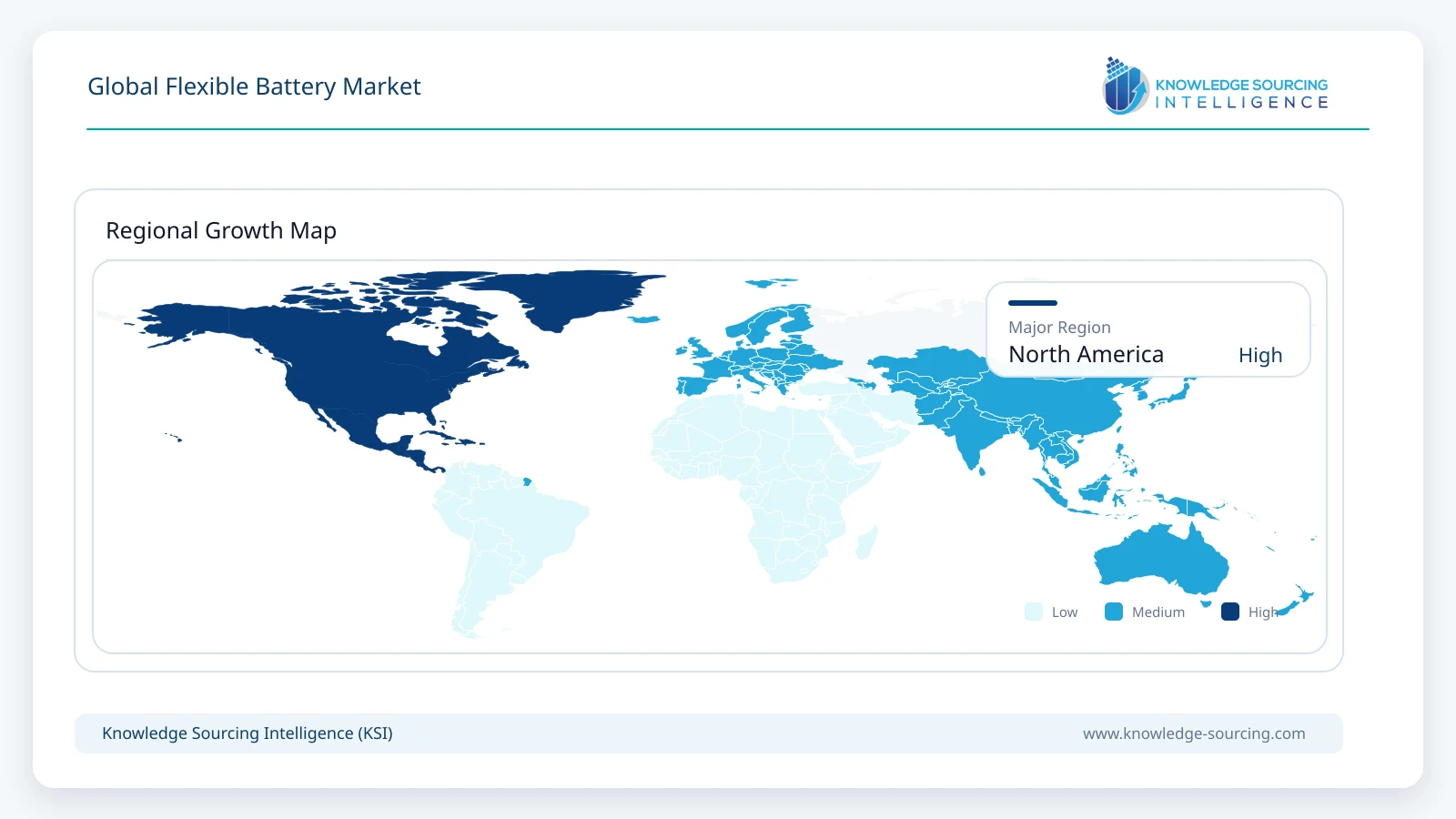
North America is estimated at approximately USD 124.1 million in 2026, or about 34.0% of the global market. The region benefits from medical-device development, printed-electronics integration, IoT and logistics applications, and commercialization activity from companies such as CCL Design and NavaFlex. It is also a major design market for wearable and consumer-electronics products that source cells globally.
Asia Pacific is a close second and has the strongest manufacturing base for lithium-ion and consumer electronics. South Korea, China, Japan, and Taiwan are important for shaped rechargeable cells and flexible-electronics development. Europe has a strong specialist ecosystem in printed zinc and thin-film technology, including Enfucell, Zinergy, VARTA, BTRY, and other printed-electronics suppliers.
Market Drivers
Wearable and Medical Electronics: Body-worn products benefit directly from thinner and conformable batteries because the cell often determines device thickness, curvature, comfort, and available sensor area.
Smart Labels and Logistics Visibility: Active RFID, temperature monitoring, condition sensing, and pharmaceutical cold-chain applications create demand for inexpensive batteries that can be laminated into labels and used for a defined journey or shelf-life period.
Miniaturization of Consumer Devices: Smart rings, hearables, compact accessories, and other small electronics require batteries that can occupy irregular internal volumes rather than standard rectangular spaces.
Printed-Electronics Manufacturing: Roll-to-roll processing, screen printing, and co-manufacturing with sensors and antennas can lower assembly complexity and enable form factors that are impractical with conventional batteries.
Safety and Disposal Requirements: Non-lithium printed chemistries offer advantages in disposable products where thermal-runaway risk, transport restrictions, and end-of-life handling can outweigh the need for high energy density.
Growth of Low-Power IoT: Lower-power radios, sensors, and microcontrollers allow useful connected products to operate from thin batteries that would previously have been insufficient for wireless applications.
Market Restraints
Lower Energy Density at Extreme Thinness: Reducing battery thickness limits active-material volume and current capability. A flexible battery may enable a product form factor but still require duty-cycle optimization or larger surface area.
Cost Versus Coin and Standard Pouch Cells: Mature battery formats benefit from enormous manufacturing scale. Flexible cells must justify a premium through product design, safety, integration, or application requirements that rigid cells cannot meet.
Mechanical Durability: Repeated bending, twisting, and flexing can damage electrodes, separators, current collectors, seals, and electrical connections. Products marketed as flexible therefore require clear bend-radius and cycle-life specifications.
Barrier and Moisture Protection: Thin printed and solid-state structures are sensitive to packaging quality. Achieving long shelf life while preserving flexibility can add material and manufacturing cost.
Scale and Yield: Many advanced flexible-battery architectures remain at pilot or early commercial scale. Moving to high-volume roll-to-roll or thin-film manufacturing requires consistent coating, registration, sealing, testing, and quality control.
Qualification and Safety Certification: Medical, wearable, and consumer products require battery reliability across temperature, pressure, storage, and transport conditions. Qualification cycles can delay adoption even when the battery technology is technically suitable.
Competitive Environment
The flexible-battery market is fragmented across several technology families. Printed-zinc specialists compete on thinness, safe chemistry, roll-to-roll manufacturability, and direct integration with labels or sensors. Flexible and shaped lithium-cell suppliers compete on energy density, cycle life, custom geometry, and consumer-device qualification. Thin-film solid-state developers compete on extreme miniaturization, safety, and integration with microsystems.
Current commercial evidence is strongest for a smaller group than many legacy market lists imply. CCL Design acquired Imprint Energy's intellectual property and R&D team in 2023, so Imprint is represented through CCL Design rather than as an independent current participant. Several large conventional cell manufacturers have historic flexible-battery demonstrations, but they are not automatically profiled here unless there is current product or commercialization evidence specific to flexible or shape-adapted cells.
Scale is beginning to matter. Zinergy states that it manufactures printed batteries in volume on continuous roll-to-roll lines, while CCL Design combines battery technology with a global printed-electronics and converting footprint. Molex can integrate thin-film batteries into a broader electronics-component ecosystem. At the other end of the market, BTRY, NavaFlex, Printed Energy, Routejade, and other specialists compete by pushing thickness, bendability, solid-state construction, or custom cell geometry.
The winning model through 2031 is likely to be application-led rather than chemistry-led. Suppliers that can co-design the battery with a medical patch, smart label, wearable, or IoT device and can prove shelf life, safety, manufacturability, and cost at the finished-product level will be better positioned than companies offering technically flexible cells without a scalable integration pathway.
Recent Developments
July 2026: Zinergy announced participation at IOTE Expo 2026 in Shenzhen, highlighting flexible printed batteries for connected IoT applications and continued expansion of its commercial printed-battery platform.
June 2026: BTRY received approximately EUR 2.2 million in EIC Accelerator grant support to scale its thin-film solid-state battery technology toward industrial production.
April 2026: BTRY won the HERMES Startup Award 2026 for its thin-film solid-state battery technology, reinforcing commercial interest in ultra-thin solid-state power for microsystems.
April 2026: Zinergy announced that it would showcase what it describes as the thinnest volume-manufactured flexible batteries at Sensors Converge 2026, including printed cells for IoT and sensor applications.
2026: CCL Design continued commercialization of ultrathin flexible printed zinc batteries based on Imprint Energy technology, supported by a dedicated California R&D facility and manufacturing operations in Strongsville, Ohio.
2026: Grepow presented next-generation shaped battery solutions for wearables, AI devices, and compact consumer electronics at Viva Technology 2026, reflecting growing demand for non-standard rechargeable cell geometries.
2026: Thin-film and microbattery developers expanded work with medical and wearable-device companies, illustrating the convergence between flexible power sources, solid-state cells, and extremely compact healthcare electronics.
Market Outlook
The flexible-battery market is expected to expand from a niche component category into a broader enabling layer for wearable, medical, logistics, and low-power IoT products. Growth will be rapid because the starting revenue base is small and because flexible batteries unlock applications that standard coin or pouch cells cannot serve without compromising form factor.
Rechargeable curved and shape-adapted lithium cells will remain the largest value pool through much of the forecast period, while printed zinc batteries are expected to grow rapidly in unit volume. Smart labels and disposable medical patches are particularly attractive because their power requirements are compatible with printed batteries and the value of thinness can exceed the value of maximum energy density.
The market will remain definition-sensitive. Investors and customers should distinguish truly flexible, printed, curved, or shape-adapted products from ordinary thin batteries. Commercial progress should be evaluated through production scale, qualified customer deployments, manufacturing yield, shelf life, bend specifications, and application integration rather than laboratory energy-density records alone.
Global Flexible Battery Market Scope:
| Report Metric | Details |
|---|---|
| Total Market Size in 2026 | USD 0.365 billion |
| Total Market Size in 2031 | USD 1.18 billion |
| Forecast Unit | USD Billion |
| Growth Rate | 26.45% |
| Study Period | 2021 to 2031 |
| Historical Data | 2021 to 2024 |
| Base Year | 2025 |
| Forecast Period | 2026 – 2031 |
| Segmentation | Battery Architecture, Chargeability, Capacity, Application, Geography |
| Companies |
|
| Customization Scope | 15% Free Customization included with purchase — Request Custom Breakdown → |
| Sample & Data Access | PDF Sample, Excel Databook & Analyst Briefing — Download Free Sample → |
Market Segmentation
By Battery Architecture
Flexible and Curved Lithium-Ion / Lithium-Polymer
Printed Zinc-Based Batteries
Thin-Film Solid-State and Microbatteries
Paper and Other Flexible Chemistries
By Chargeability
Rechargeable Batteries
Primary / Single-Use Batteries
By Capacity
Below 10 mAh
10 to 100 mAh
Above 100 mAh
By Application
Wearable Electronics
Medical and Health-Monitoring Devices
Smart Labels, Packaging, and Logistics
IoT and Consumer Electronics
Smart Cards and Others
By Geography
North America
United States
Canada
Mexico
South America
Brazil
Argentina
Others
Europe
Germany
United Kingdom
Finland
Switzerland
Others
Middle East and Africa
UAE
Saudi Arabia
South Africa
Others
Asia Pacific
China
Japan
South Korea
India
Australia
Others
Table of Contents
1. INTRODUCTION
1.1. Market Overview
1.2. Market Definition
1.3. Scope of the Study
1.4. Market Segmentation
1.5. Currency
1.6. Assumptions
1.7. Base and Forecast Years Timeline
2. RESEARCH METHODOLOGY
2.1. Research Design
2.2. Secondary Research
2.3. Primary Validation
2.4. Market Estimation and Forecasting
2.5. Data Triangulation and Quality Control
3. EXECUTIVE SUMMARY
3.1. Key Findings
3.2. Global Market Size, 2026-2031
3.3. Segment Summary
3.4. Regional Summary
4. MARKET DYNAMICS
4.1. Market Drivers
4.1.1. Wearable and Medical Electronics
4.1.2. Smart Labels and Logistics Visibility
4.1.3. Miniaturization of Consumer Devices
4.1.4. Printed-Electronics Manufacturing
4.1.5. Safety and Disposal Requirements
4.2. Market Restraints
4.2.1. Lower Energy Density at Extreme Thinness
4.2.2. Cost Versus Coin and Standard Pouch Cells
4.2.3. Mechanical Durability
4.2.4. Barrier and Moisture Protection
4.2.5. Scale and Yield
4.2.6. Qualification and Safety Certification
5. FLEXIBLE BATTERY MARKET BY BATTERY ARCHITECTURE
5.1. Flexible and Curved Lithium-Ion / Lithium-Polymer
5.2. Printed Zinc-Based Batteries
5.3. Thin-Film Solid-State and Microbatteries
5.4. Paper and Other Flexible Chemistries
6. FLEXIBLE BATTERY MARKET BY CHARGEABILITY
6.1. Rechargeable Batteries
6.2. Primary / Single-Use Batteries
7. FLEXIBLE BATTERY MARKET BY CAPACITY
7.1. Below 10 mAh
7.2. 10 to 100 mAh
7.3. Above 100 mAh
8. FLEXIBLE BATTERY MARKET BY APPLICATION
8.1. Wearable Electronics
8.2. Medical and Health-Monitoring Devices
8.3. Smart Labels, Packaging, and Logistics
8.4. IoT and Consumer Electronics
8.5. Smart Cards and Others
9. FLEXIBLE BATTERY MARKET BY GEOGRAPHY
9.1. North America
9.1.1. United States
9.1.2. Canada
9.1.3. Mexico
9.2. South America
9.2.1. Brazil
9.2.2. Argentina
9.2.3. Others
9.3. Europe
9.3.1. Germany
9.3.2. United Kingdom
9.3.3. Finland
9.3.4. Switzerland
9.3.5. Others
9.4. Middle East and Africa
9.4.1. UAE
9.4.2. Saudi Arabia
9.4.3. South Africa
9.4.4. Others
9.5. Asia Pacific
9.5.1. China
9.5.2. Japan
9.5.3. South Korea
9.5.4. India
9.5.5. Australia
9.5.6. Others
10. COMPETITIVE ENVIRONMENT AND ANALYSIS
10.1. Major Players and Technology Positioning
10.2. Printed Zinc and Disposable Battery Platforms
10.3. Rechargeable Curved and Shape-Adapted Cells
10.4. Thin-Film Solid-State Commercialization
10.5. Recent Developments
10.6. Competitive Dashboard
11. COMPANY PROFILES
11.1. CCL Design
11.2. Enfucell Oy
11.3. Zinergy UK Limited
11.4. Molex, LLC
11.5. VARTA AG
11.6. Printed Energy Pty Ltd.
11.7. BTRY AG
11.8. Routejade Inc.
11.9. NavaFlex LLC
11.10. Grepow
11.11. Jenax Inc.
11.12. AMOGREENTECH Co., Ltd.
11.13. CMI / DEMMEL Group
12. APPENDIX
12.1. Currency
12.2. Assumptions
12.3. Base and Forecast Years Timeline
12.4. Abbreviations





Frequently asked questions
What is the flexible battery market's forecasted value by 2031?
The report provides detailed forecasts on the market's value and growth through 2031.
What is the Compound Annual Growth Rate (CAGR) outlook?
The report outlines the market's projected CAGR for the 2026-2031 forecast period.
What are the primary growth drivers for flexible batteries?
Key drivers like miniaturization, IoT, and wearable electronics adoption are analyzed.
Which regions exhibit significant growth opportunities?
The report details regional market share and growth opportunities across key geographies.
What are the key application segments covered?
Key segments include wearables, medical devices, IoT, and smart cards applications.
What strategic insights are provided for 2026-2031?
The Global Flexible Battery Market offers strategic insights, competitive landscape analysis, and future market trends.
Cite this report
Knowledge Sourcing Intelligence. (Oct 2026). Global Flexible Battery Market - Strategic Insights and Forecasts (2026-2031). https://www.knowledge-sourcing.com/report/flexible-battery-market