
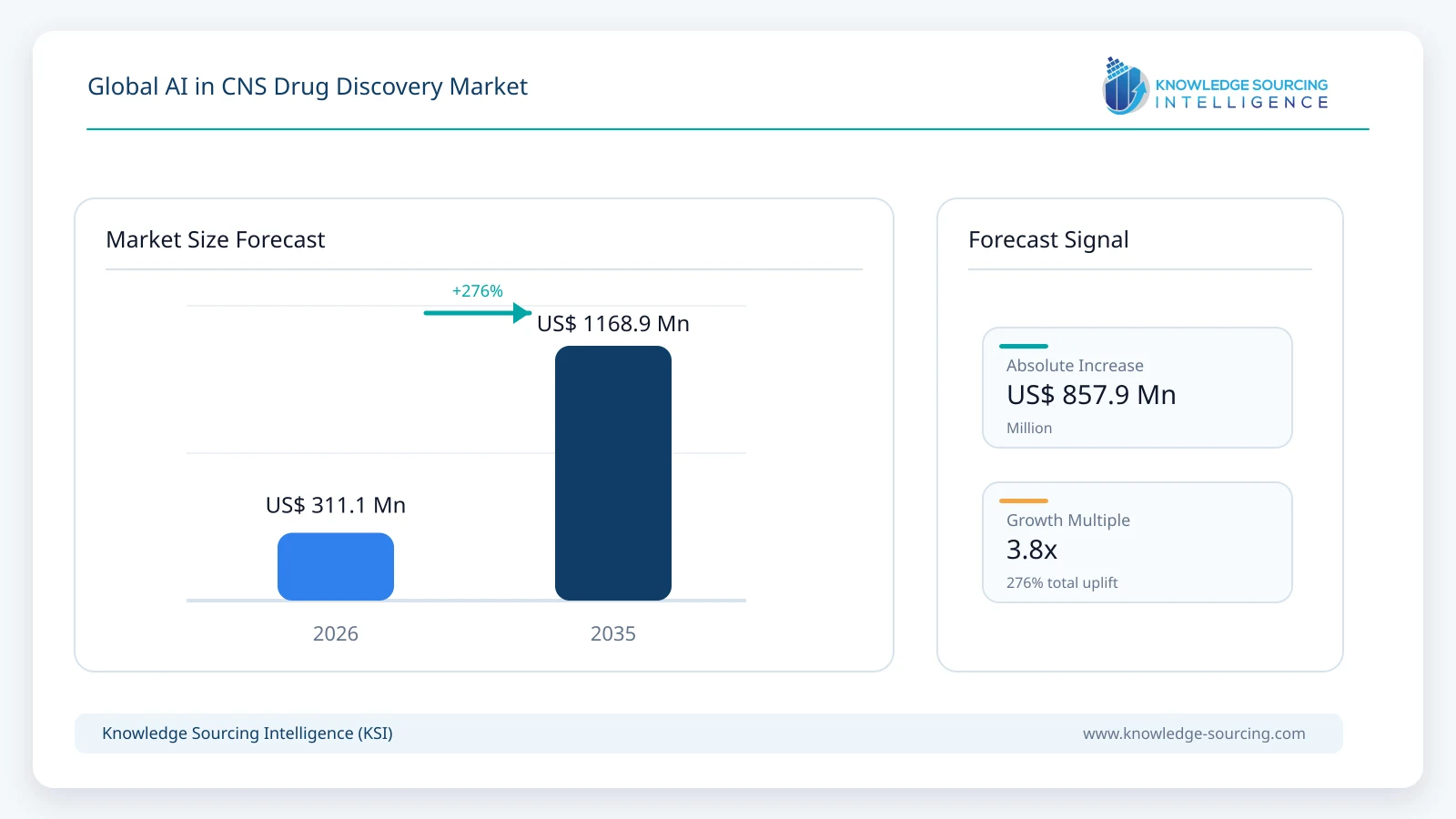
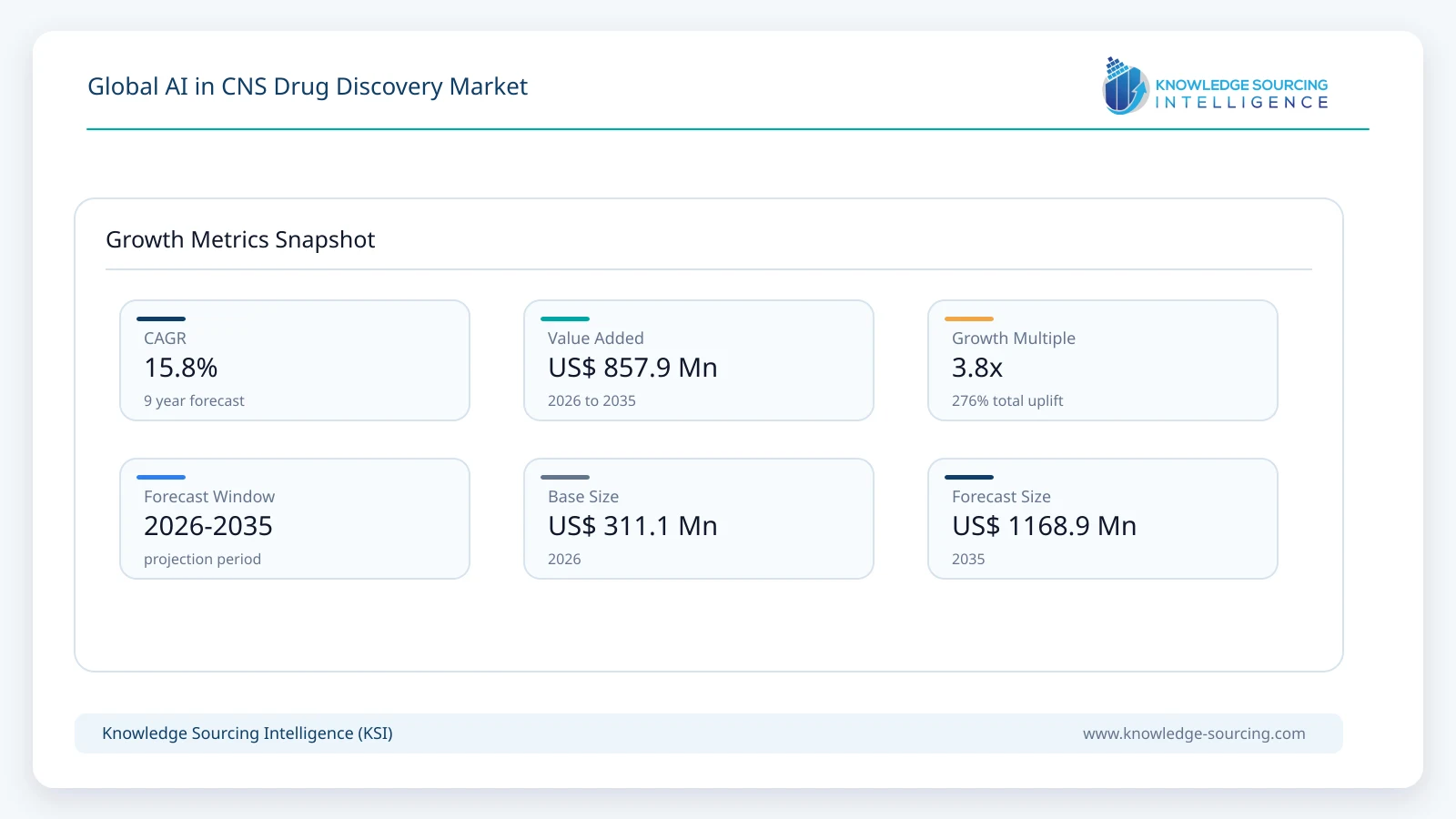
The Global AI in CNS Drug Discovery Market is projected to grow at a CAGR of 15.8% during the forecast period, increasing from USD 311.05 million in 2026 to USD 1,168.94 million by 2035.
Highlights:
- 1Rising CNS disease burden is increasing demand for AI-enabled target identification because conventional discovery approaches continue to face biological complexity challenges.
- 2High failure rates in neurological drug development are driving adoption of computational discovery platforms because pharmaceutical companies seek improved research productivity.
- 3Expansion of multi-omics datasets is increasing demand for machine learning technologies because biological data volumes continue growing rapidly.
- 4Strategic collaborations between pharmaceutical and AI companies are expanding because multidisciplinary expertise increasingly influences discovery success.
Central nervous system disorders represent one of the largest areas of unmet medical need within healthcare. Disease prevalence continues to increase as populations age and neurological disease awareness expands. Traditional drug discovery approaches remain challenged because CNS disorders frequently involve multifactorial biological pathways and heterogeneous patient populations. Pharmaceutical developers are seeking more efficient discovery methodologies because historical CNS development programs continue demonstrating lower success rates than many other therapeutic areas. The outcome is growing adoption of AI-driven discovery platforms.
Artificial intelligence enables analysis of complex biological relationships through advanced computational models. Demand is increasing for machine learning-driven target identification because conventional experimental approaches often require substantial time and resource investment. Biological complexity continues to constrain therapeutic innovation because disease mechanisms remain incompletely understood across many CNS disorders. Technology providers are developing integrated discovery ecosystems because combining computational prediction with biological validation may improve development outcomes. The market therefore increasingly supports computational neuroscience innovation.
Regulatory agencies are strengthening focus on AI governance because computational tools are becoming more influential throughout pharmaceutical development. Drug developers require robust validation frameworks because regulatory acceptance increasingly depends on transparency, reproducibility, and evidence generation. Organizations are investing in explainable AI capabilities because confidence in algorithmic outputs remains essential for broader adoption. The market therefore increasingly emphasizes validated and regulatory-aligned AI platforms.
Market Dynamics
Market Drivers
Rising Burden of CNS Disorders: Neurological and psychiatric disorders represent a major healthcare challenge because prevalence continues increasing across global populations. Demand is increasing for innovative therapeutic development because existing treatments frequently provide limited disease modification. Traditional discovery workflows remain constrained because biological mechanisms often remain poorly characterized. Pharmaceutical companies are expanding investment in computational neuroscience because AI may improve target identification efficiency. The market therefore increasingly supports AI-enabled CNS research.
High Attrition Rates in CNS Drug Development: CNS drug development experiences lower success rates than many therapeutic areas because disease biology remains highly complex. Demand is increasing for predictive discovery technologies because pharmaceutical companies seek to reduce development risk. Conventional development approaches create substantial financial pressure because clinical failures remain costly. Organizations are deploying AI-driven discovery platforms because improved biological insight may strengthen candidate selection. The market therefore increasingly prioritizes computational innovation.
Expansion of Biological Data Availability: Drug discovery increasingly depends on access to large-scale biological datasets. Demand is growing for artificial intelligence technologies because multi-omics data generation continues expanding. Traditional analytical approaches remain limited because data complexity exceeds conventional processing capabilities. Research organizations are implementing machine learning workflows because advanced analytics improve knowledge extraction. The market therefore increasingly supports data-intensive pharmaceutical research.
Growth of Precision Neuroscience: Personalized medicine increasingly influences CNS therapeutic development because patient populations exhibit significant biological variability. Demand is increasing for advanced computational modeling because disease subtypes often respond differently to treatment interventions. Conventional development strategies constrain precision medicine because broad patient categorization reduces biological specificity. Companies are integrating AI-enabled patient stratification approaches because precision targeting may improve clinical outcomes. The market therefore increasingly aligns with individualized treatment development.
Market Restraints
Limited availability of high-quality and standardized CNS datasets reduces predictive accuracy and slows model validation.
Regulatory uncertainty surrounding AI-generated discoveries increases development complexity and evidence requirements.
Explainability challenges within advanced machine learning models limit confidence among researchers and regulatory stakeholders.
Market Opportunities
Generative AI for Molecule Design: Drug discovery depends heavily on efficient lead generation and optimization processes. Demand is increasing for generative AI technologies because traditional medicinal chemistry workflows require extensive iterative experimentation. Conventional molecule design remains resource intensive because candidate optimization frequently requires multiple development cycles. Technology providers are advancing generative models because computational design may accelerate therapeutic innovation. The market therefore increasingly supports AI-generated molecular discovery.
AI-Driven Biomarker Discovery: Precision medicine requires reliable biomarkers that improve disease characterization and treatment selection. Demand is increasing for biomarker identification platforms because CNS disorders often exhibit significant biological heterogeneity. Conventional biomarker discovery remains challenging because disease progression frequently involves multiple biological pathways. Organizations are applying machine learning to large-scale datasets because advanced analytics may identify previously unrecognized biomarkers. The market therefore increasingly supports biomarker-driven innovation.
Drug Repurposing Applications: Many approved therapeutics possess biological characteristics that may support additional indications. Demand is increasing for AI-enabled repurposing platforms because traditional drug development remains costly and time consuming. Existing compounds create strategic opportunities because safety profiles are often already established. Companies are applying computational screening technologies because identifying alternative therapeutic applications may improve development efficiency. The market therefore increasingly supports AI-driven repurposing strategies.
Digital Twin Technologies: Drug development increasingly requires advanced predictive modeling capabilities. Demand is increasing for digital twin technologies because simulation-based approaches may improve understanding of disease progression and treatment response. Traditional experimental methods remain resource intensive because biological validation often requires lengthy research programs. Organizations are investing in virtual modeling frameworks because predictive simulation may accelerate discovery. The market therefore increasingly supports computational experimentation.
Government Regulations
Region | Regulatory Authority | Regulatory Focus |
United States | FDA | AI in Drug Development, Data Integrity, Clinical Validation |
Europe | EMA | AI Governance, Drug Development Oversight |
Japan | PMDA | Digital Innovation in Pharmaceutical Research |
India | CDSCO | Drug Development and Digital Health Frameworks |
China | NMPA | AI Adoption in Pharmaceutical Innovation |
Market Segmentation
By Technology Type
Machine learning and deep learning technologies represent core components of AI-enabled CNS drug discovery because biological data complexity continues increasing. Demand is growing for generative AI because developers seek faster molecule design and optimization capabilities. Knowledge graph technologies remain important because biological relationships frequently involve interconnected pathways. Natural language processing adoption is expanding because scientific literature and clinical data continue growing rapidly. Computer vision applications are increasing because imaging analysis increasingly supports neurological research. The segment therefore continues evolving toward integrated AI ecosystems.
By Indication
Alzheimer's disease and Parkinson's disease represent major discovery priorities because aging populations continue increasing disease prevalence. Demand is growing for psychiatric therapeutic innovation because major depressive disorder and schizophrenia remain associated with substantial unmet medical needs. Epilepsy and multiple sclerosis continue attracting discovery investment because disease complexity limits treatment optimization. ALS research remains strategically important because effective therapeutic options remain limited. The segment therefore increasingly supports diversified CNS innovation.
By End-User
Pharmaceutical companies represent the largest adopters because AI increasingly influences internal discovery workflows. Demand is increasing among biotechnology companies because computational approaches improve development efficiency. Contract research organizations continue expanding AI capabilities because pharmaceutical outsourcing remains common. Academic institutions are increasing adoption because large-scale biological data analysis increasingly supports scientific research. The segment therefore continues supporting broad-based AI integration across pharmaceutical ecosystems.
Regional Analysis
North America
North America leads AI adoption in CNS drug discovery because the region combines advanced biotechnology infrastructure, strong pharmaceutical R&D investment, and a highly developed artificial intelligence ecosystem. Demand is increasing as pharmaceutical companies seek more efficient approaches to address historically high CNS drug development failure rates. Traditional neuroscience research continues facing productivity challenges because neurological disorders involve complex and poorly understood biological mechanisms. Organizations are expanding AI-enabled discovery programs because computational platforms improve target identification and candidate optimization efficiency. The outcome is strong regional demand supported by technological leadership and extensive research capabilities.
Europe
European pharmaceutical and biotechnology companies emphasize innovation in neuroscience research because CNS disorders continue creating significant healthcare and economic burden. Demand is increasing for AI-driven drug discovery platforms because research organizations seek to improve development productivity and reduce attrition rates. Regulatory and scientific complexity continues constraining conventional CNS development because disease heterogeneity limits therapeutic success. Companies are strengthening partnerships between AI developers and pharmaceutical organizations because collaborative innovation supports more efficient discovery processes. The result is increasing integration of artificial intelligence across European neuroscience research ecosystems.
Asia Pacific
Asia Pacific demonstrates significant growth potential because pharmaceutical innovation, biotechnology investment, and artificial intelligence adoption continue expanding across major markets. Demand is increasing as governments and research institutions prioritize neurological disease research due to aging populations and rising disease prevalence. Traditional drug discovery capabilities remain uneven across several countries because research infrastructure development continues progressing at different rates. Organizations are adopting AI-enabled discovery technologies because computational approaches may accelerate innovation while reducing development costs. The outcome is accelerating market expansion across the region.
Rest of the World
Latin America, the Middle East, and Africa continue strengthening pharmaceutical research capabilities because neurological disorders increasingly affect healthcare systems across these regions. Demand is increasing for AI-assisted drug discovery because access to advanced research technologies remains limited compared to established pharmaceutical markets. Research organizations face development constraints because specialized neuroscience expertise and infrastructure remain concentrated within select institutions. Governments and industry stakeholders are exploring collaborative innovation models because international partnerships improve access to computational drug discovery capabilities. The result is growing interest in scalable AI-enabled pharmaceutical research platforms.
Regulatory Landscape
The regulatory environment for AI in CNS drug discovery continues evolving because neurological and psychiatric disorders remain among the most challenging therapeutic areas for pharmaceutical innovation. Regulatory agencies require robust validation of AI-generated targets, biomarkers, and candidate molecules because CNS drug development historically experiences high clinical attrition rates. Pharmaceutical companies are increasing investment in explainable AI frameworks because regulatory acceptance increasingly depends on transparency, reproducibility, and scientific rigor. The market therefore increasingly emphasizes validated AI-assisted discovery platforms.
The FDA continues expanding discussions around artificial intelligence in drug development because machine learning models are increasingly supporting target identification, lead optimization, and clinical trial design. The EMA maintains strong focus on algorithm governance and data integrity because AI-driven drug discovery increasingly relies on large-scale biological and patient datasets. PMDA, NMPA, and CDSCO continue strengthening digital innovation frameworks because computational approaches are becoming more important within pharmaceutical R&D ecosystems. Regulatory oversight therefore increasingly supports innovation while maintaining patient safety and scientific accountability.
AI-enabled discovery programs remain closely linked to regulatory evolution because computationally identified drug candidates must ultimately satisfy the same efficacy and safety requirements as conventionally discovered therapies. Drug developers are strengthening validation procedures because confidence in AI-derived outputs increasingly influences investment and partnership decisions. The regulatory landscape therefore continues supporting the integration of artificial intelligence into CNS drug discovery while reinforcing evidence-based development practices.
Pipeline Analysis
The AI in CNS drug discovery pipeline increasingly focuses on target identification because conventional CNS drug development continues experiencing high failure rates. Demand is increasing for computational discovery approaches because neurological disorders involve complex biological pathways that are difficult to characterize using traditional methods. Historical development inefficiencies constrain innovation because large-scale experimental screening requires significant time and financial resources. Technology companies are deploying machine learning and deep learning platforms because biological datasets increasingly contain actionable insights that support target discovery. The pipeline therefore increasingly supports data-driven neuroscience innovation.
Generative AI is gaining importance because pharmaceutical companies increasingly seek faster methods for molecular design and lead optimization. Demand is increasing for AI-generated candidate molecules because traditional medicinal chemistry workflows often require multiple iterative development cycles. CNS drug discovery remains constrained by disease heterogeneity because neurological and psychiatric disorders frequently involve diverse biological mechanisms. Developers are integrating multi-omics, genomic, proteomic, and imaging datasets because improved biological understanding may strengthen candidate selection. The pipeline therefore increasingly aligns with precision neuroscience strategies.
Strategic partnerships continue expanding because AI developers require pharmaceutical expertise while pharmaceutical companies require advanced computational capabilities. Demand is increasing for collaborative discovery programs because successful CNS innovation increasingly depends on multidisciplinary integration. Independent platform development creates scalability challenges because CNS drug discovery requires extensive biological validation. Organizations are establishing long-term alliances because shared expertise improves development efficiency and reduces discovery timelines. The pipeline therefore increasingly reflects partnership-driven innovation ecosystems.
Competitive Landscape
Recursion Pharmaceuticals
Recursion Pharmaceuticals remains strategically differentiated because its platform combines large-scale biological experimentation with machine learning-enabled analysis. Demand is increasing for data-intensive CNS research because neurological disorders involve complex biological mechanisms that require deeper scientific understanding. Traditional discovery approaches create development inefficiencies because target validation often requires extensive laboratory resources. Recursion is expanding computational discovery capabilities because pharmaceutical organizations increasingly prioritize scalable AI-enabled research systems. The company therefore benefits from integrated biological and computational infrastructure.
Insilico Medicine
Insilico Medicine remains highly differentiated because generative artificial intelligence serves as the foundation of its discovery platform. Demand is increasing for AI-enabled target identification because pharmaceutical companies continue seeking shorter development timelines and improved research productivity. CNS drug development remains challenging because disease biology frequently limits conventional innovation approaches. Insilico is strengthening pharmaceutical collaborations because partnership-driven development accelerates therapeutic translation. The company therefore benefits from strong positioning within next-generation AI-driven drug discovery.
Exscientia plc
Exscientia maintains strong positioning because its AI-driven design platform supports rapid molecule generation and optimization. Demand is increasing for computational chemistry solutions because pharmaceutical organizations continue seeking more efficient discovery workflows. Traditional lead optimization approaches create resource-intensive development cycles because iterative laboratory testing remains costly. Exscientia is strengthening AI-assisted design capabilities because discovery productivity increasingly influences competitive differentiation. The company therefore benefits from expertise in AI-supported medicinal chemistry.
BenevolentAI
BenevolentAI remains strategically important because its knowledge graph platform supports identification of novel biological relationships. Demand is increasing for advanced target discovery capabilities because CNS disorders involve highly interconnected molecular pathways. Conventional hypothesis-generation methods constrain innovation because biological complexity often limits target identification. BenevolentAI is expanding computational discovery capabilities because integrated biological datasets improve research efficiency. The company therefore benefits from specialization in AI-enabled target discovery.
Schrödinger, Inc.
Schrödinger remains differentiated because physics-based computational modeling complements AI-driven discovery approaches. Demand is increasing for predictive molecular simulation because drug developers increasingly prioritize efficient candidate optimization. Experimental screening alone creates development bottlenecks because large-scale laboratory testing requires significant resources. Schrödinger is strengthening computational design capabilities because virtual screening improves discovery productivity. The company therefore benefits from combining advanced simulation technologies with AI-driven workflows.
Relay Therapeutics
Relay Therapeutics maintains competitive relevance because its platform focuses on protein dynamics and structural biology. Demand is increasing for precision-targeted therapies because CNS disorders frequently involve highly specific biological mechanisms. Conventional static protein analysis limits therapeutic insight because molecular structures remain dynamic. Relay is expanding computational discovery initiatives because structural biology increasingly influences targeted drug development. The company therefore benefits from expertise in protein motion analysis.
Neumora Therapeutics
Neumora Therapeutics remains strategically relevant because its neuroscience-focused pipeline directly addresses unmet CNS treatment needs. Demand is increasing for targeted psychiatric and neurological therapies because treatment response remains inconsistent across many patient populations. Conventional CNS drug development experiences significant attrition because disease heterogeneity complicates therapeutic design. Neumora is incorporating advanced discovery technologies because precision neuroscience increasingly shapes future therapeutic strategies. The company therefore benefits from focused CNS specialization.
Evotec SE
Evotec maintains competitive importance because its discovery and development infrastructure supports pharmaceutical and biotechnology partners globally. Demand is increasing for outsourced research capabilities because AI-enabled drug development requires specialized expertise. Internal discovery programs often face scalability limitations because technological complexity continues increasing. Evotec is strengthening collaborative research models because integrated partnerships improve development efficiency. The company therefore benefits from broad discovery capabilities and established industry relationships.
Key Developments
February 2026: Insilico Medicine, a clinical-stage biotechnology company driven by generative artificial intelligence (AI), China Medical System Holdings Limited, an open-platform innovative company linking pharmaceutical innovation and commercialization with strong product lifecycle management capability, announced a series of AI?empowered drug discovery collaborations across multiple projects in the fields of central nervous system and autoimmune diseases.
Strategic Insights and Future Market Outlook
The AI in CNS drug discovery market is transitioning toward data-centric pharmaceutical research because conventional CNS drug development continues experiencing high failure rates and extended development timelines. Demand is increasing for computational target discovery because pharmaceutical organizations increasingly prioritize productivity, efficiency, and capital optimization. Technology developers are expanding AI platform capabilities because biological datasets continue growing in scale and complexity. The market therefore increasingly supports AI-native discovery models.
Precision neuroscience is becoming strategically important because CNS disorders exhibit significant biological variability across patient populations. Drug developers are integrating genomic, proteomic, imaging, and clinical datasets because multimodal analysis improves disease understanding. AI platform providers are strengthening predictive modeling capabilities because personalized therapeutic development requires deeper biological insights. The market therefore increasingly aligns with precision medicine frameworks.
Partnership-driven innovation continues expanding because pharmaceutical companies require computational expertise while AI developers require clinical development capabilities. Organizations capable of combining validated AI platforms, high-quality biological datasets, regulatory readiness, and strong pharmaceutical partnerships are strengthening long-term competitive positioning because CNS innovation increasingly depends on multidisciplinary integration.
The Global AI in CNS Drug Discovery Market therefore continues evolving toward generative AI-enabled molecule design, precision neuroscience, biomarker-driven development, and data-centric pharmaceutical innovation as healthcare systems increasingly prioritize more effective therapies for neurological and psychiatric disorders.
Market Segmentation
By Geography
Key Countries Analysis
Regulatory & Policy Landscape
Table of Contents
1. EXECUTIVE SUMMARY
1.1 Market Overview
1.2 Key Findings
1.3 Market Snapshot
1.4 Executive Insights
1.5 Strategic Recommendations
1.6 Future Market Outlook
2. DISEASE & EPIDEMIOLOGY ANALYSIS
2.1 Overview of Central Nervous System (CNS) Disorders
2.1.1 Alzheimer's Disease
2.1.2 Parkinson's Disease
2.1.3 Major Depressive Disorder (MDD)
2.1.4 Bipolar Disorder
2.1.5 Schizophrenia
2.1.6 Epilepsy
2.1.7 Multiple Sclerosis
2.1.8 Amyotrophic Lateral Sclerosis (ALS)
2.1.9 Huntington's Disease
2.1.10 Autism Spectrum Disorder (ASD)
2.2 Global Burden of CNS Disorders
2.3 Epidemiology by Indication
2.3.1 Alzheimer's Disease Prevalence and Incidence
2.3.2 Parkinson's Disease Patient Population
2.3.3 Depression Patient Population
2.3.4 Schizophrenia Patient Population
2.3.5 Epilepsy Patient Population
2.3.6 Multiple Sclerosis Patient Population
2.4 Disease Burden by Age Group
2.5 Disease Burden by Gender
2.6 Economic Burden of CNS Disorders
2.7 Unmet Needs in CNS Drug Development
2.8 Clinical Trial Failure Rates in CNS Therapeutics
2.9 Role of AI in Addressing CNS Drug Discovery Challenges
3. MARKET DYNAMICS
3.1 Market Overview
3.2 Market Drivers
3.2.1 Rising CNS Disease Burden
3.2.2 High Attrition Rates in CNS Drug Development
3.2.3 Increasing Adoption of AI-Based Drug Discovery Platforms
3.2.4 Growth in Multi-Omics and Real-World Data Availability
3.2.5 Rising Investment in Precision Neuroscience
3.3 Market Restraints
3.3.1 Limited Availability of High-Quality CNS Datasets
3.3.2 Regulatory Uncertainty Around AI Models
3.3.3 Validation Challenges for AI-Generated Targets
3.3.4 Data Privacy and Security Concerns
3.4 Market Opportunities
3.4.1 AI-Driven Target Identification
3.4.2 Biomarker Discovery Platforms
3.4.3 Drug Repurposing Applications
3.4.4 Generative AI for Molecule Design
3.4.5 Digital Twin Technologies in CNS Research
3.5 Market Challenges
3.5.1 Biological Complexity of CNS Disorders
3.5.2 Explainability of AI Algorithms
3.5.3 Integration of Multi-Modal Data Sources
3.6 Porter's Five Forces Analysis
3.7 PESTLE Analysis
3.8 Value Chain Analysis
3.9 AI Drug Discovery Ecosystem Analysis
4. COMMERCIAL & MARKET ACCESS
4.1 Commercial Landscape Overview
4.2 CNS Drug Development Economics
4.2.1 Research and Development Costs
4.2.2 Clinical Trial Cost Optimization Through AI
4.2.3 Productivity Gains from AI Integration
4.3 Strategic Partnerships and Licensing Models
4.4 Venture Capital and Private Equity Activity
4.5 Pharmaceutical-AI Collaboration Landscape
4.6 Commercialization Challenges
4.7 Stakeholder Analysis
4.7.1 Pharmaceutical Companies
4.7.2 Biotechnology Companies
4.7.3 AI Technology Providers
4.7.4 Academic Research Institutes
4.7.5 Regulatory Authorities
5. INNOVATION & PIPELINE LANDSCAPE
5.1 Innovation Landscape Overview
5.2 AI Technologies Used in CNS Drug Discovery
5.2.1 Machine Learning Platforms
5.2.2 Deep Learning Models
5.2.3 Generative AI Platforms
5.2.4 Graph Neural Networks
5.2.5 Natural Language Processing Applications
5.2.6 Knowledge Graph-Based Discovery Platforms
5.3 CNS Drug Discovery Pipeline by Development Stage
5.3.1 Discovery Stage Programs
5.3.2 Preclinical Stage Programs
5.3.3 Phase I Clinical Programs
5.3.4 Phase II Clinical Programs
5.3.5 Phase III Clinical Programs
5.4 Pipeline Analysis by Indication
5.4.1 Alzheimer's Disease
5.4.2 Parkinson's Disease
5.4.3 Major Depressive Disorder
5.4.4 Schizophrenia
5.4.5 Epilepsy
5.4.6 Multiple Sclerosis
5.4.7 ALS
5.4.8 Other CNS Disorders
5.5 Pipeline Analysis by Mechanism of Action
5.5.1 Amyloid Beta Targeting Therapies
5.5.2 Tau Protein Modulators
5.5.3 Neuroinflammation Modulators
5.5.4 Synaptic Plasticity Regulators
5.5.5 Neuroprotective Agents
5.5.6 Dopaminergic Pathway Modulators
5.6 Pipeline Analysis by Modality
5.6.1 Small Molecules
5.6.2 Biologics
5.6.3 Gene Therapies
5.6.4 RNA-Based Therapeutics
5.6.5 Cell Therapies
5.7 Patent Landscape Analysis
5.8 Clinical Trial Landscape
5.9 Strategic Collaborations and Licensing Agreements
5.10 Funding and Investment Trends
6. TREATMENT LANDSCAPE
6.1 Current CNS Treatment Paradigm
6.2 Approved Therapies by Indication
6.2.1 Alzheimer's Disease Treatments
6.2.2 Parkinson's Disease Treatments
6.2.3 Depression Treatments
6.2.4 Schizophrenia Treatments
6.2.5 Epilepsy Treatments
6.2.6 Multiple Sclerosis Treatments
6.3 Challenges in Conventional CNS Drug Discovery
6.4 AI-Enabled Drug Discovery Workflow
6.5 Comparative Analysis: Traditional vs AI-Driven Drug Discovery
6.6 Precision Medicine and CNS Therapeutics
6.7 Future Treatment Development Models
7. MARKET SIZE & FORECAST
7.1 Global Market Overview
7.2 Historical Market Analysis (2021–2025)
7.3 Market Forecast (2026–2033)
7.4 Forecast by Technology Type
7.5 Forecast by Application
7.6 Forecast by End User
7.7 Forecast by Drug Modality
7.8 Market Attractiveness Analysis
8. MARKET SEGMENTATION
8.1 By Technology Type
8.1.1 Machine Learning
8.1.2 Deep Learning
8.1.3 Generative AI
8.1.4 Natural Language Processing
8.1.5 Knowledge Graphs
8.1.6 Computer Vision
8.2 By Indication
8.2.1 Alzheimer's Disease
8.2.2 Parkinson's Disease
8.2.3 Major Depressive Disorder
8.2.4 Schizophrenia
8.2.5 Epilepsy
8.2.6 Multiple Sclerosis
8.2.7 ALS
8.2.8 Other CNS Disorders
8.3 By End User
8.3.1 Pharmaceutical Companies
8.3.2 Biotechnology Companies
8.3.3 Contract Research Organizations (CROs)
8.3.4 Academic and Research Institutes
9. GEOGRAPHICAL ANALYSIS
9.1 North America
9.1.1 Market Size and Growth Analysis
9.1.2 Demand Drivers
9.1.3 Regional Regulatory Overview
9.1.4 Competitive Intensity Analysis
9.2 Europe
9.2.1 Market Size and Growth Analysis
9.2.2 Demand Drivers
9.2.3 Regional Regulatory Overview
9.2.4 Competitive Intensity Analysis
9.3 Asia-Pacific
9.3.1 Market Size and Growth Analysis
9.3.2 Demand Drivers
9.3.3 Regional Regulatory Overview
9.3.4 Competitive Intensity Analysis
9.4 Latin America
9.4.1 Market Size and Growth Analysis
9.4.2 Demand Drivers
9.4.3 Regional Regulatory Overview
9.4.4 Competitive Intensity Analysis
9.5 Middle East & Africa
9.5.1 Market Size and Growth Analysis
9.5.2 Demand Drivers
9.5.3 Regional Regulatory Overview
9.5.4 Competitive Intensity Analysis
10. KEY COUNTRIES ANALYSIS
10.1 United States
10.2 Canada
10.3 Germany
10.4 United Kingdom
10.5 France
10.6 Italy
10.7 Spain
10.8 China
10.9 Japan
10.10 India
10.11 South Korea
10.12 Australia
10.13 Brazil
10.14 Mexico
10.15 Saudi Arabia
10.16 South Africa
11. REGULATORY & POLICY LANDSCAPE
11.1 Global Regulatory Overview
11.2 United States Regulatory Framework (FDA)
11.2.1 AI in Drug Development Guidance
11.2.2 Drug Discovery and Clinical Development Regulations
11.2.3 Data Integrity and Validation Requirements
11.3 Europe Regulatory Framework (EMA)
11.3.1 AI Act and Healthcare Implications
11.3.2 Drug Development Regulations
11.3.3 Data Governance Requirements
11.4 Japan Regulatory Framework (PMDA)
11.4.1 AI-Enabled Drug Development Policies
11.4.2 Clinical Development Requirements
11.5 India Regulatory Framework (CDSCO)
11.5.1 Drug Development Regulations
11.5.2 Digital Health and AI Policies
11.6 China Regulatory Framework (NMPA)
11.6.1 AI and Pharmaceutical Innovation Policies
11.6.2 Clinical Development Requirements
11.7 Data Privacy and AI Governance Regulations
11.8 Intellectual Property and Patent Frameworks
11.9 Future Regulatory Trends for AI Drug Discovery
12. COMPETITIVE LANDSCAPE
12.1 Market Share Analysis
12.2 Competitive Benchmarking
12.3 Strategic Positioning Analysis
12.4 Pharmaceutical-AI Partnerships
12.5 Mergers and Acquisitions
12.6 Licensing and Co-Development Agreements
12.7 Funding and Investment Analysis
12.8 Competitive Dashboard
13. COMPANY PROFILES
13.1 Recursion Pharmaceuticals
13.2 Insilico Medicine
13.3 Exscientia plc
13.4 BenevolentAI
13.5 Schrödinger, Inc.
13.6 Relay Therapeutics
13.7 Neumora Therapeutics
13.8 Evotec SE
13.9 NVIDIA Corporation
13.10 Alphabet Inc.
14. FUTURE OUTLOOK
14.1 Future Evolution of AI in CNS Drug Discovery
14.2 Generative AI and Foundation Models in Drug Development
14.3 AI-Driven Precision Neuroscience
14.4 Digital Biomarkers and Multi-Omics Integration
14.5 AI-Enabled Clinical Trial Optimization
14.6 Future Partnership Models Between Pharma and AI Companies
14.7 Long-Term Growth Opportunities Through 2033
15. METHODOLOGY
15.1 Research Methodology Overview
15.2 Primary Research Framework
15.3 Secondary Research Framework
15.4 Epidemiology Data Collection Methodology
15.5 Pipeline Validation Methodology
15.6 Clinical Trial Verification Approach
15.7 Market Size Estimation Methodology
15.8 Forecasting Approach
15.9 Data Validation and Triangulation
15.10 Assumptions and Limitations
Navigate
Trusted by the world's leading organizations











