
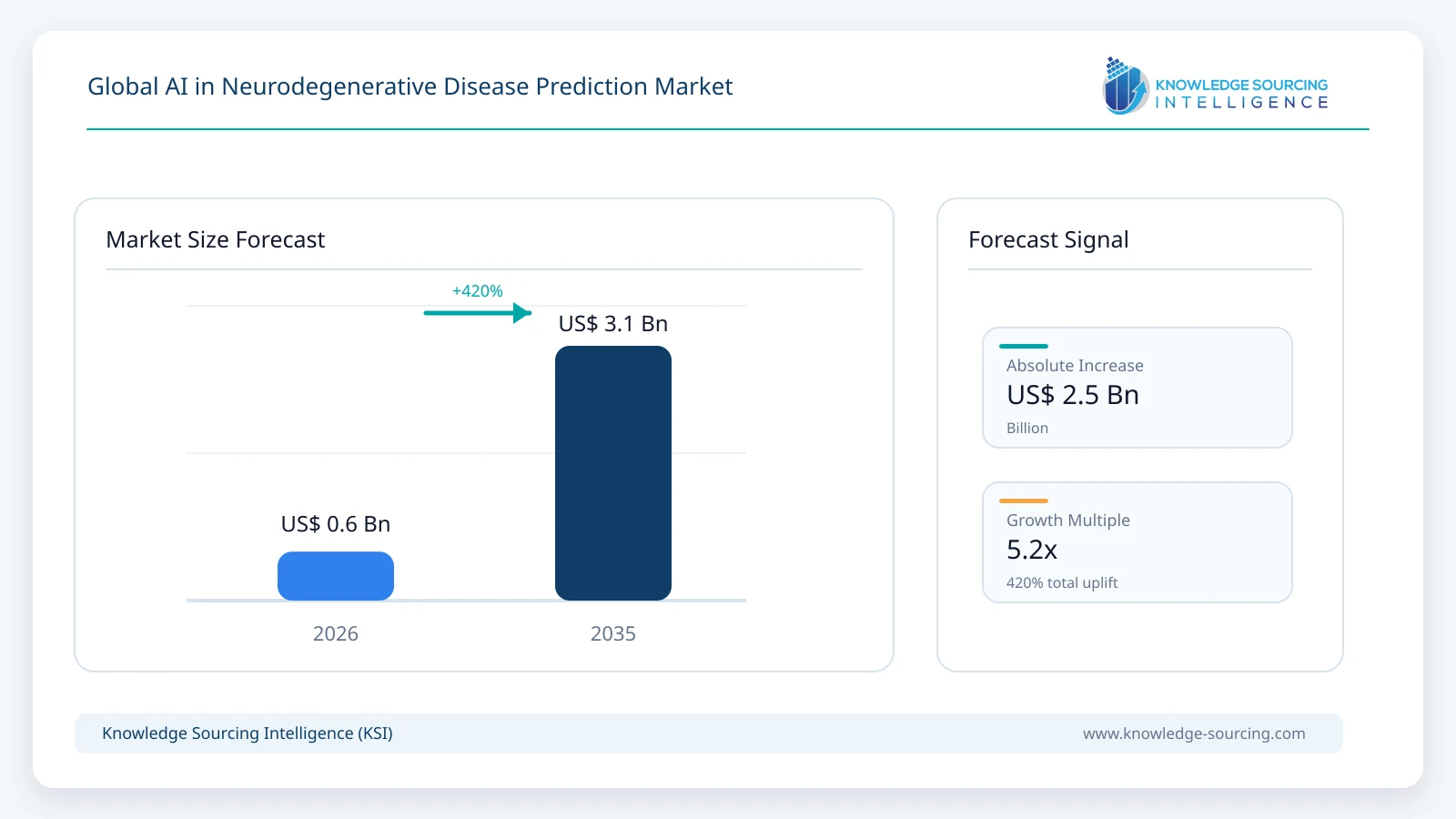
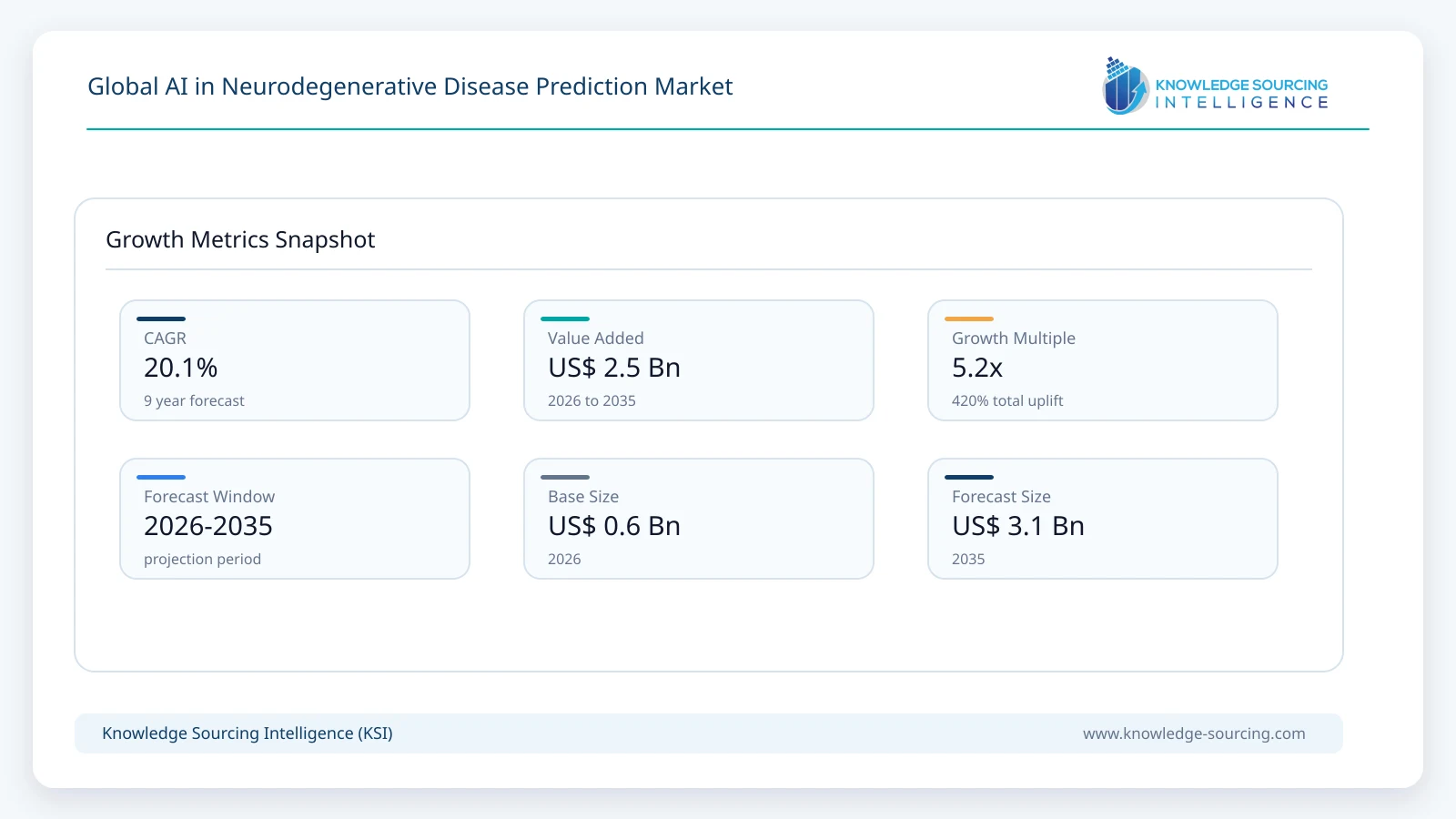
The Global AI in Neurodegenerative Disease Prediction Market is projected to grow at a CAGR of 20.1% the forecast period, increasing from USD 0.59 billion in 2026 to USD 3.07 billion by 2035.
Highlights:
- 1Aging populations are increasing dementia incidence, which raises demand for predictive algorithms capable of identifying disease before significant cognitive decline occurs.
- 2Disease-modifying therapies are expanding clinical interest in earlier patient identification, which increases adoption of AI-based risk stratification systems.
- 3Multi-modal healthcare datasets are becoming more accessible, which supports development of predictive models with stronger clinical relevance.
- 4Regulatory agencies are strengthening AI governance frameworks, which increases demand for validated and explainable software platforms
Neurodegenerative diseases impose growing clinical and economic burdens because aging populations increase the prevalence of chronic neurological disorders. Healthcare systems require earlier detection mechanisms since therapeutic effectiveness often declines once extensive neuronal degeneration occurs.
Demand is increasing for predictive analytics because emerging Alzheimer's and Parkinson's therapies depend on accurate patient selection and early intervention pathways. This requirement elevates the value of AI systems capable of identifying subtle disease signatures from imaging and longitudinal clinical datasets.
Regulatory oversight increasingly influences market development because AI-enabled clinical tools require evidence of safety, reproducibility, transparency, and real-world performance. Regulatory agencies are strengthening lifecycle management expectations for AI-enabled medical devices, creating higher validation standards for commercial deployment. FDA guidance issued in 2025 emphasizes total product lifecycle management, transparency, bias mitigation, and documentation requirements for AI-enabled medical devices.
The market holds strategic importance because predictive neurology supports healthcare resource optimization, reduces diagnostic delays, and enables precision treatment pathways. These capabilities position AI as a foundational technology for future neurological care delivery.
Market Dynamics
Market Drivers
Expansion of Early Detection Requirements: Early intervention increasingly defines treatment success in neurodegenerative disorders. Demand is shifting toward predictive tools because clinicians require visibility into disease progression before irreversible neurological damage occurs. Traditional assessment approaches provide limited predictive capability, creating diagnostic uncertainty. Healthcare organizations are implementing AI-enabled imaging and biomarker analysis platforms to address this gap. The outcome is stronger demand for predictive analytics integrated into routine neurological workflows.
Growth of Multimodal Clinical Data: Neurodegenerative diseases involve complex biological pathways that single diagnostic modalities often fail to capture. Healthcare institutions are generating larger volumes of imaging, laboratory, genomic, and behavioral data. Data fragmentation limits clinical utility because independent datasets rarely provide comprehensive disease insight. AI developers are building multimodal architectures that combine diverse datasets into unified prediction models. The result is improved disease risk assessment and longitudinal monitoring capability.
Increasing Adoption of AI-Enabled Medical Devices: Healthcare providers require scalable clinical decision support tools as neurological caseloads increase. AI-enabled medical devices provide automated interpretation and prioritization capabilities. Clinical workloads create operational constraints that limit specialist availability. Device manufacturers are expanding AI functionality across radiology and neurological assessment platforms. FDA-authorized AI-enabled medical devices continue to increase across healthcare applications.
Emergence of Disease-Modifying Therapies: Therapeutic innovation changes diagnostic priorities because treatment eligibility depends on earlier disease recognition. Demand is shifting toward predictive patient stratification systems that identify candidates before advanced disease development. Clinical uncertainty reduces treatment efficiency. AI platforms are supporting more targeted screening and referral pathways. The outcome is greater integration of predictive analytics into treatment planning.
Market Restraints
Limited availability of standardized longitudinal neurological datasets restricts model generalizability across diverse populations.
Regulatory validation requirements increase development costs and extend commercialization timelines for AI-enabled medical software.
Clinical concerns regarding algorithm transparency and explainability slow physician adoption in high-stakes neurological decision-making.
Market Opportunities
AI-Enabled Biomarker Discovery: Biological complexity limits conventional biomarker identification strategies. Researchers are increasingly using AI to detect subtle molecular and imaging patterns associated with disease progression. Traditional analytical approaches struggle with high-dimensional datasets. Technology providers are developing advanced predictive biomarker platforms. This evolution supports new commercial opportunities in precision neurology.
Retinal and Digital Biomarker Analytics: Neurological assessment traditionally depends on expensive imaging infrastructure. Interest is increasing in non-invasive diagnostic approaches that enable broader population screening. Accessibility constraints limit early detection rates. AI developers are leveraging retinal imaging and digital behavioral biomarkers for predictive assessment. Emerging research demonstrates growing potential for AI-driven retinal analysis in dementia risk identification.
Federated Learning Deployment: Healthcare institutions require collaborative AI development while maintaining patient privacy. Data-sharing restrictions limit centralized model training. Privacy requirements create barriers to cross-institutional dataset integration. Organizations are adopting federated learning architectures that enable decentralized model development. The outcome is broader access to diverse training datasets without compromising compliance.
Community-Based Neurological Screening: Specialist shortages delay diagnosis in many healthcare systems. Demand is increasing for scalable screening mechanisms that support primary care and community settings. Capacity limitations reduce screening coverage. AI-enabled platforms are extending predictive assessment beyond tertiary care centers. This trend expands addressable market opportunities for software vendors and healthcare providers.
Disease & Epidemiology Analysis
Neurodegenerative disease prevalence increases with population aging, making early prediction a clinical priority. Dementia represents one of the largest neurological health burdens globally because disease progression often extends across many years before formal diagnosis.
Alzheimer's disease remains the dominant focus of AI development because large imaging and biomarker datasets support algorithm training. Research activity is increasingly targeting progression prediction rather than simple diagnosis. Disease heterogeneity creates prediction challenges. AI systems are incorporating multimodal data to improve individualized risk assessment. Academic studies increasingly highlight personalized prediction models, digital twins, and longitudinal disease forecasting approaches.
Parkinson's disease represents another high-growth area because subtle motor and non-motor symptoms often precede diagnosis. ALS and Huntington's disease attract specialized AI research because earlier identification supports clinical trial recruitment and disease monitoring. These conditions have smaller patient populations, yet unmet clinical needs sustain development activity.
Treatment Guidelines Landscape
Disease Area | Current Clinical Focus | AI Relevance |
Alzheimer's Disease | Early cognitive assessment, biomarker testing, imaging confirmation | Predictive risk stratification and progression modeling |
Parkinson's Disease | Clinical symptom evaluation and imaging support | Early pattern recognition and longitudinal monitoring |
ALS | Functional assessment and neurological evaluation | Disease progression forecasting |
Market Segmentation
By Component
Software Platforms & Services represent the primary demand center because predictive intelligence depends on algorithm performance rather than hardware ownership. Healthcare organizations increasingly require cloud-enabled analytics, workflow integration, and longitudinal patient monitoring capabilities. Clinical complexity limits manual interpretation of multimodal neurological datasets. Vendors are expanding software ecosystems that combine imaging analysis, predictive scoring, and clinical decision support. The segment benefits from recurring revenue structures and continuous algorithm updates. Hardware-Enabled AI Systems remain important because computational infrastructure supports advanced model execution. Demand increasingly concentrates on integrated solutions that combine software intelligence with scalable computing environments.
By Technology
Machine Learning & Deep Learning constitute the dominant technology segment because neurodegenerative prediction requires pattern recognition across large, heterogeneous datasets. Healthcare providers increasingly depend on these models to identify subtle disease indicators. Clinical variability constrains conventional statistical methods. Developers are deploying deep neural networks capable of extracting complex relationships from imaging and biomarker datasets. Natural Language Processing gains importance because neurological insights often reside within unstructured clinical records. Generative AI is emerging as a strategic technology because synthetic data generation helps address dataset imbalance and supports model development for rare neurological conditions.
By Disease Type
Alzheimer's Disease generates the greatest demand because global dementia burden continues expanding and therapeutic innovation increasingly depends on early identification. Healthcare systems require scalable prediction capabilities that support patient stratification and monitoring. Diagnostic delays reduce treatment opportunities. AI developers are prioritizing Alzheimer's-focused predictive platforms. Parkinson's Disease attracts strong investment because disease progression often begins years before formal diagnosis. ALS, Huntington's Disease, and other neurodegenerative disorders represent specialized opportunities where predictive analytics support clinical research, patient monitoring, and precision medicine initiatives.
Regional Analysis
North America Market Analysis
North America represents the most established market because advanced healthcare infrastructure supports large-scale AI deployment. Demand is increasing for predictive neurology platforms as healthcare systems pursue earlier intervention strategies. Clinical validation requirements create development complexity. Technology developers are investing heavily in regulatory-grade AI systems that meet FDA expectations. Academic research networks, imaging infrastructure, and digital health adoption strengthen commercialization pathways. The region maintains leadership because innovation ecosystems connect technology developers, healthcare providers, and research institutions within integrated neurological care frameworks.
Europe Market Analysis
Europe benefits from strong neuroscience research capabilities and expanding regulatory attention toward trustworthy AI. Demand is shifting toward explainable algorithms because healthcare providers require transparency in clinical decision support systems. Regulatory scrutiny increases evidence expectations for AI-enabled medical technologies. Companies are strengthening validation programs and real-world evidence generation. The region maintains momentum because public healthcare systems increasingly prioritize early diagnosis and resource optimization. Emerging breakthrough device initiatives further support innovation pathways.
Asia Pacific Market Analysis
Asia Pacific represents the fastest structural expansion opportunity because aging populations and healthcare digitization initiatives increase demand for scalable neurological assessment tools. Healthcare systems are generating larger datasets that support AI model development. Specialist shortages constrain traditional neurological care delivery. Governments and healthcare institutions are investing in digital health infrastructure and AI-enabled diagnostics. The region benefits from growing technology ecosystems, increasing research collaborations, and expanding precision medicine initiatives. These factors strengthen long-term adoption potential.
Rest of the World
The Rest of the World market remains at an earlier adoption stage because healthcare infrastructure varies significantly across countries. Demand is increasing for cost-effective screening technologies that extend specialist capabilities. Resource limitations restrict widespread deployment of advanced neurological diagnostics. Technology providers are developing cloud-based and scalable AI solutions that reduce infrastructure dependency. Adoption increasingly focuses on pilot programs, research collaborations, and targeted neurological care initiatives. The region presents long-term opportunities as healthcare digitization expands.
Regulatory Landscape
AI-enabled neurodegenerative prediction platforms increasingly fall within Software as a Medical Device frameworks because they influence clinical decision-making. Regulatory agencies require evidence demonstrating safety, effectiveness, data quality, and clinical relevance. This requirement increases emphasis on validation methodologies and post-market monitoring.
The FDA continues refining oversight of AI-enabled medical devices through lifecycle-based regulatory approaches. Guidance issued in 2025 highlights transparency, bias management, documentation, performance evaluation, and continuous lifecycle management requirements for AI-enabled products.
Global regulators increasingly emphasize explainability, cybersecurity, risk management, and human oversight because adaptive AI systems introduce unique clinical risks. These expectations are shaping future product development strategies and influencing investment priorities across the market.
Pipeline Analysis
The development pipeline increasingly focuses on predictive rather than diagnostic applications. Researchers are training models capable of forecasting disease progression, treatment response, and conversion from mild cognitive impairment to dementia. This shift reflects growing clinical demand for proactive intervention pathways.
Pipeline activity increasingly incorporates multimodal datasets because disease progression involves interconnected biological mechanisms. Imaging, genomics, fluid biomarkers, wearable sensor outputs, and electronic health records are becoming integrated components of next-generation predictive systems. Academic research continues highlighting multimodal AI architectures and personalized disease progression forecasting models.
Explainable AI, federated learning, synthetic data generation, and digital twin technologies are emerging across development programs because healthcare providers require transparency, scalability, and clinical trust. These capabilities are expected to define future competitive differentiation as commercialization expands.
Competitive Landscape
Siemens Healthineers
Siemens Healthineers maintains strategic distinction through deep integration of imaging infrastructure and AI-enabled clinical workflows. The company leverages MRI, PET, and advanced analytics capabilities to support neurological assessment. Its strength originates from combining hardware leadership with software-driven interpretation tools. Neurodegenerative disease applications increasingly benefit from quantitative imaging analytics, workflow automation, and longitudinal patient monitoring capabilities. Continued investment in digital health platforms and AI-enhanced radiology supports its position within predictive neurology.
GE HealthCare
GE HealthCare differentiates itself through broad imaging deployment across hospitals and diagnostic centers. The company increasingly integrates AI into imaging interpretation and clinical workflow optimization. Its installed base creates access to large clinical datasets that support algorithm refinement. Neurological imaging remains a strategic area because predictive disease assessment increasingly depends on advanced visualization and analytics capabilities.
Philips
Philips combines imaging, patient monitoring, and informatics capabilities within an integrated healthcare ecosystem. The company focuses on connected care models that support earlier disease identification. AI-driven imaging analysis and workflow enhancement strengthen neurological assessment applications. Its emphasis on interoperability supports adoption among healthcare systems pursuing enterprise-wide digital transformation.
Microsoft
Microsoft provides cloud infrastructure, AI development frameworks, and healthcare data management capabilities. The company occupies a strategic position because predictive neurology increasingly depends on scalable computing environments and secure data integration. Azure-based healthcare solutions support development, deployment, and monitoring of advanced predictive models.
IBM
IBM leverages enterprise AI expertise and healthcare analytics capabilities. The company focuses on extracting value from complex clinical datasets through machine learning and cognitive computing technologies. Neurological prediction initiatives benefit from its strengths in data integration, analytics, and clinical research collaboration.
NVIDIA
NVIDIA supplies computational infrastructure that enables large-scale AI model training and deployment. The company occupies a foundational position because advanced neurodegenerative prediction models require high-performance computing environments. Growth in multimodal AI development strengthens demand for accelerated computing platforms.
Fujitsu
Fujitsu differentiates itself through AI research, healthcare analytics, and digital transformation expertise. The company increasingly supports healthcare institutions seeking advanced data-driven clinical decision-making. Neurological prediction initiatives benefit from its capabilities in data management, AI model deployment, and enterprise healthcare integration.
Key Developments
November 2025: The Allen Institute unveiled the Brain Knowledge Platform, the most comprehensive AI-powered tool for neuroscience, which unifies data from over 34 million brain cells across 22 species (including humans, mice, chimpanzees, and rhesus macaques) into a standardized format, enabling seamless collaboration among global neuroscientists to accelerate breakthroughs in Alzheimer's, Parkinson's, and other brain diseases.
May 2025: UCL's Queen Square Institute of Neurology was awarded £5.1 million by the Reta Lila Weston Trust for Medical Research to establish the Reta Lila Weston BRAIN platform, a world-leading AI-centered brain tissue resource that will use machine learning to analyze clinical, genetic, pathological, and multi-omic data from 2,500 human brain and spinal cord tissue samples to predict disease onset, identify biomarkers, and discover new treatment mechanisms for Alzheimer's, Parkinson's, and other neurodegenerative diseases.
Strategic Insights and Future Market Outlook
The market increasingly aligns with the evolution of precision neurology because treatment pathways depend on earlier and more accurate patient identification. Demand is shifting toward predictive systems that integrate imaging, biomarkers, genomics, and clinical records into unified risk assessment frameworks. This transition strengthens the role of AI as a core clinical infrastructure rather than an optional analytical tool.
Regulatory expectations continue increasing because healthcare providers require trustworthy and clinically validated AI solutions. Developers are investing more heavily in explainability, lifecycle management, and real-world evidence generation. These investments create higher entry barriers while supporting long-term market credibility.
Competitive differentiation increasingly depends on access to multimodal datasets, clinical validation capabilities, and healthcare ecosystem integration. Companies that combine predictive accuracy with workflow integration and regulatory readiness are likely to secure stronger adoption across healthcare systems.
The market ultimately reflects a structural movement toward predictive healthcare. As neurological disease burden increases and earlier intervention becomes clinically necessary, AI-enabled prediction platforms are expected to become integral components of future neurodegenerative disease management strategies.
Global AI in Neurodegenerative Disease Prediction Market Scope:
| Report Metric | Details |
|---|---|
| Total Market Size in 2026 | USD 0.59 billion |
| Total Market Size in 2035 | USD 3.07 billion |
| Forecast Unit | USD Billion |
| Growth Rate | 20.1% |
| Study Period | 2021 to 2035 |
| Historical Data | 2021 to 2024 |
| Base Year | 2025 |
| Forecast Period | 2026 – 2035 |
| Segmentation | Component, Technology, Disease Type, Data |
| Companies |
|
Market Segmentation
By Geography
Key Countries Analysis
Regulatory & Policy Landscape
Table of Contents
1. EXECUTIVE SUMMARY
1.1 Market Overview
1.2 Key Findings
1.3 Executive Insights
1.3.1 Key Market Trends
1.3.2 Key Growth Opportunities
1.3.3 Strategic Recommendations
1.4 Market Snapshot
1.5 Analyst Perspective
2. DISEASE & EPIDEMIOLOGY ANALYSIS
2.1 Introduction to Neurodegenerative Diseases
2.2 Disease Burden and Public Health Impact
2.3 Epidemiology Overview
2.3.1 Prevalence Analysis
2.3.2 Incidence Analysis
2.3.3 Mortality Analysis
2.3.4 Disability and Healthcare Burden
2.4 Epidemiology by Disease Type
2.4.1 Alzheimer's Disease
2.4.2 Parkinson's Disease
2.4.3 Amyotrophic Lateral Sclerosis (ALS)
2.4.4 Huntington's Disease
2.4.5 Frontotemporal Dementia (FTD)
2.4.6 Lewy Body Dementia
2.4.7 Multiple System Atrophy (MSA)
2.4.8 Other Neurodegenerative Disorders
2.5 Epidemiology by Disease Stage
2.5.1 Preclinical Stage
2.5.2 Prodromal Stage
2.5.3 Early-Stage Disease
2.5.4 Moderate Disease
2.5.5 Advanced Disease
2.6 Risk Factor Assessment
2.6.1 Age-Related Risk
2.6.2 Genetic Risk Factors
2.6.3 Lifestyle and Environmental Factors
2.6.4 Comorbidity Assessment
2.7 Role of Artificial Intelligence in Early Disease Prediction
2.8 Unmet Needs in Neurodegenerative Disease Prediction
3. MARKET DYNAMICS
3.1 Market Definition
3.2 Market Scope
3.3 Market Drivers
3.3.1 Rising Global Burden of Neurodegenerative Disorders
3.3.2 Growing Adoption of AI-Based Diagnostic and Predictive Tools
3.3.3 Expansion of Digital Biomarker Research
3.3.4 Increasing Availability of Healthcare Data
3.3.5 Growing Investments in Precision Neurology
3.4 Market Restraints
3.4.1 Data Privacy and Security Concerns
3.4.2 Limited Clinical Validation of AI Models
3.4.3 Regulatory Uncertainties
3.4.4 Algorithm Bias and Generalizability Challenges
3.5 Market Opportunities
3.5.1 Integration of AI with Neuroimaging Platforms
3.5.2 AI-Enabled Drug Development Applications
3.5.3 Expansion of Remote Monitoring Technologies
3.5.4 Personalized Risk Prediction Models
3.6 Market Challenges
3.7 Porter's Five Forces Analysis
3.8 PESTLE Analysis
3.9 Value Chain Analysis
3.10 Stakeholder Ecosystem Analysis
4. COMMERCIAL & MARKET ACCESS
4.1 Reimbursement Landscape
4.2 Market Access Challenges
4.3 Health Technology Assessment (HTA) Considerations
4.4 Pricing Models for AI-Based Diagnostic Solutions
4.5 Coverage and Payment Frameworks
4.6 Adoption Trends Across Healthcare Settings
4.7 Procurement and Commercialization Models
4.8 Real-World Evidence Requirements
4.9 Healthcare Provider Adoption Assessment
5. INNOVATION & PIPELINE LANDSCAPE
5.1 Technology Innovation Overview
5.2 AI Technology Evolution
5.3 Pipeline Assessment by Development Stage
5.3.1 Research Stage
5.3.2 Pilot Stage
5.3.3 Clinical Validation Stage
5.3.4 Commercial Deployment Stage
5.4 Pipeline Analysis by Disease Focus
5.4.1 Alzheimer's Disease Prediction
5.4.2 Parkinson's Disease Prediction
5.4.3 ALS Prediction
5.4.4 FTD Prediction
5.4.5 Multi-Disease Prediction Platforms
5.5 Pipeline Analysis by Modality
5.5.1 Imaging-Based AI
5.5.2 Genomics-Based AI
5.5.3 Biomarker-Based AI
5.5.4 Digital Biomarker Platforms
5.5.5 Wearable Sensor Analytics
5.5.6 Multimodal AI Platforms
5.6 Pipeline Analysis by Mechanism
5.6.1 Pattern Recognition Models
5.6.2 Predictive Risk Scoring Algorithms
5.6.3 Deep Learning Models
5.6.4 Generative AI Applications
5.6.5 Federated Learning Systems
5.7 Patent Landscape Analysis
5.8 Research Collaborations and Strategic Partnerships
5.9 Emerging Technologies Assessment
5.10 Future Innovation Roadmap
6. TREATMENT LANDSCAPE
6.1 Current Standard of Care Overview
6.2 Treatment Landscape for Alzheimer's Disease
6.2.1 Symptomatic Therapies
6.2.2 Disease-Modifying Therapies
6.3 Treatment Landscape for Parkinson's Disease
6.4 Treatment Landscape for ALS
6.5 Treatment Landscape for Huntington's Disease
6.6 Treatment Landscape for FTD
6.7 Impact of AI on Clinical Decision-Making
6.8 AI-Enabled Patient Stratification
6.9 AI Integration in Clinical Trials
7. GLOBAL AI IN NEURODEGENERATIVE DISEASE PREDICTION MARKET SIZE & FORECAST
7.1 Market Size Overview (Historical)
7.2 Market Forecast Methodology
7.3 Market Revenue Forecast
7.3.1 By Component
7.3.2 By Deployment Model
7.3.3 By Disease Type
7.3.4 By End User
7.3.5 By Geography
7.4 Market Attractiveness Analysis
7.5 Opportunity Assessment
7.6 Scenario Analysis
7.6.1 Base Case Scenario
7.6.2 Optimistic Scenario
7.6.3 Conservative Scenario
8. GLOBAL AI IN NEURODEGENERATIVE DISEASE PREDICTION MARKET SEGMENTATION
8.1 By Component
8.1.1 Software Platforms & Services
8.1.2 Hardware-Enabled AI Systems
8.2 By Technology
8.2.1 Machine Learning & Deep Learning
8.2.2 Natural Language Processing
8.2.3 Generative AI
8.2.4 Others
8.3 By Disease Type
8.3.1 Alzheimer's Disease
8.3.2 Parkinson's Disease
8.3.3 Amyotrophic Lateral Sclerosis (ALS)
8.3.4 Huntington's Disease
8.3.5 Other Neurodegenerative Disorders
8.4 By Data
8.4.1 Neuroimaging Data
8.4.2 Genomic Data
8.4.3 Clinical Data
8.4.4 Biomarker Data
8.4.5 Others
8.5 By End User
8.5.1 Hospitals
8.5.2 Neurology Centers
8.5.3 Diagnostic Centers
8.5.4 Others
9. GEOGRAPHICAL ANALYSIS (REGIONAL LEVEL)
9.1 North America
9.1.1 Market Size and Growth
9.1.2 Demand Drivers
9.1.3 Regional Regulatory Overview
9.1.4 Competitive Intensity
9.2 Europe
9.2.1 Market Size and Growth
9.2.2 Demand Drivers
9.2.3 Regional Regulatory Overview
9.2.4 Competitive Intensity
9.3 Asia-Pacific
9.3.1 Market Size and Growth
9.3.2 Demand Drivers
9.3.3 Regional Regulatory Overview
9.3.4 Competitive Intensity
9.4 Latin America
9.4.1 Market Size and Growth
9.4.2 Demand Drivers
9.4.3 Regional Regulatory Overview
9.4.4 Competitive Intensity
9.5 Middle East & Africa
9.5.1 Market Size and Growth
9.5.2 Demand Drivers
9.5.3 Regional Regulatory Overview
9.5.4 Competitive Intensity
10. KEY COUNTRIES ANALYSIS
10.1 United States
10.1.1 Market Size
10.1.2 Epidemiology
10.1.3 Regulatory Framework
10.1.4 Reimbursement Landscape
10.1.5 Key Company Presence
10.2 Canada
10.3 Germany
10.4 United Kingdom
10.5 France
10.6 Italy
10.7 Spain
10.8 China
10.9 Japan
10.10 India
10.11 South Korea
10.12 Australia
10.13 Brazil
10.14 Mexico
10.15 Saudi Arabia
10.16 South Africa
11. REGULATORY & POLICY LANDSCAPE
11.1 Global Regulatory Overview
11.2 United States Regulatory Framework
11.2.1 FDA Software as a Medical Device (SaMD)
11.2.2 AI/ML Medical Device Guidance
11.3 Europe Regulatory Framework
11.3.1 European Medicines Agency (EMA)
11.3.2 Medical Device Regulation (MDR)
11.3.3 EU Artificial Intelligence Act
11.4 Japan Regulatory Framework
11.4.1 PMDA Requirements
11.4.2 AI-Based Medical Software Approval Pathways
11.5 India Regulatory Framework
11.5.1 CDSCO Regulations
11.5.2 Medical Device Rules
11.6 China Regulatory Framework
11.6.1 NMPA Regulations
11.6.2 AI Healthcare Software Requirements
11.7 Data Privacy and Cybersecurity Requirements
11.8 Clinical Validation Standards
11.9 Ethical AI Frameworks
11.10 Future Regulatory Developments
12. COMPETITIVE LANDSCAPE
12.1 Market Structure Analysis
12.2 Competitive Benchmarking
12.3 Market Share Analysis
12.4 Strategic Initiatives
12.4.1 Collaborations
12.4.2 Partnerships
12.4.3 Acquisitions
12.4.4 Licensing Agreements
12.5 Funding and Investment Analysis
12.6 Startup Ecosystem Assessment
12.7 Competitive Positioning Matrix
13. COMPANY PROFILES
13.1 Siemens Healthineers
13.1.1 Company Overview
13.1.2 AI Portfolio Relevant to Neurodegenerative Disease Assessment
13.1.3 Approved Products and Software Solutions
13.1.4 Key Clinical Applications
13.1.5 Pipeline and R&D Programs
13.1.6 Strategic Developments
13.2 GE HealthCare
13.3 Philips
13.4 Microsoft
13.5 IBM
13.6 NVIDIA
13.7 Fujitsu
13.8 Roche
13.9 Eli Lilly
13.10 Icometrix
14. FUTURE OUTLOOK
14.1 Market Evolution Outlook
14.2 Emerging Business Models
14.3 AI Adoption Outlook
14.4 Future Technology Trends
14.5 Precision Neurology Market Outlook
14.6 Strategic Recommendations
14.7 Long-Term Market Forecast
15. METHODOLOGY
15.1 Research Methodology
15.2 Data Collection Framework
15.3 Primary Research
15.4 Secondary Research
15.5 Market Estimation Methodology
15.6 Forecasting Methodology
15.7 Epidemiology Assessment Methodology
15.8 Regulatory Assessment Methodology
15.9 Competitive Intelligence Framework
15.10 Data Validation and Triangulation
15.11 Assumptions and Limitations
15.12 Abbreviations and Definitions
15.13 References and Data Sources
Navigate
Trusted by the world's leading organizations











