
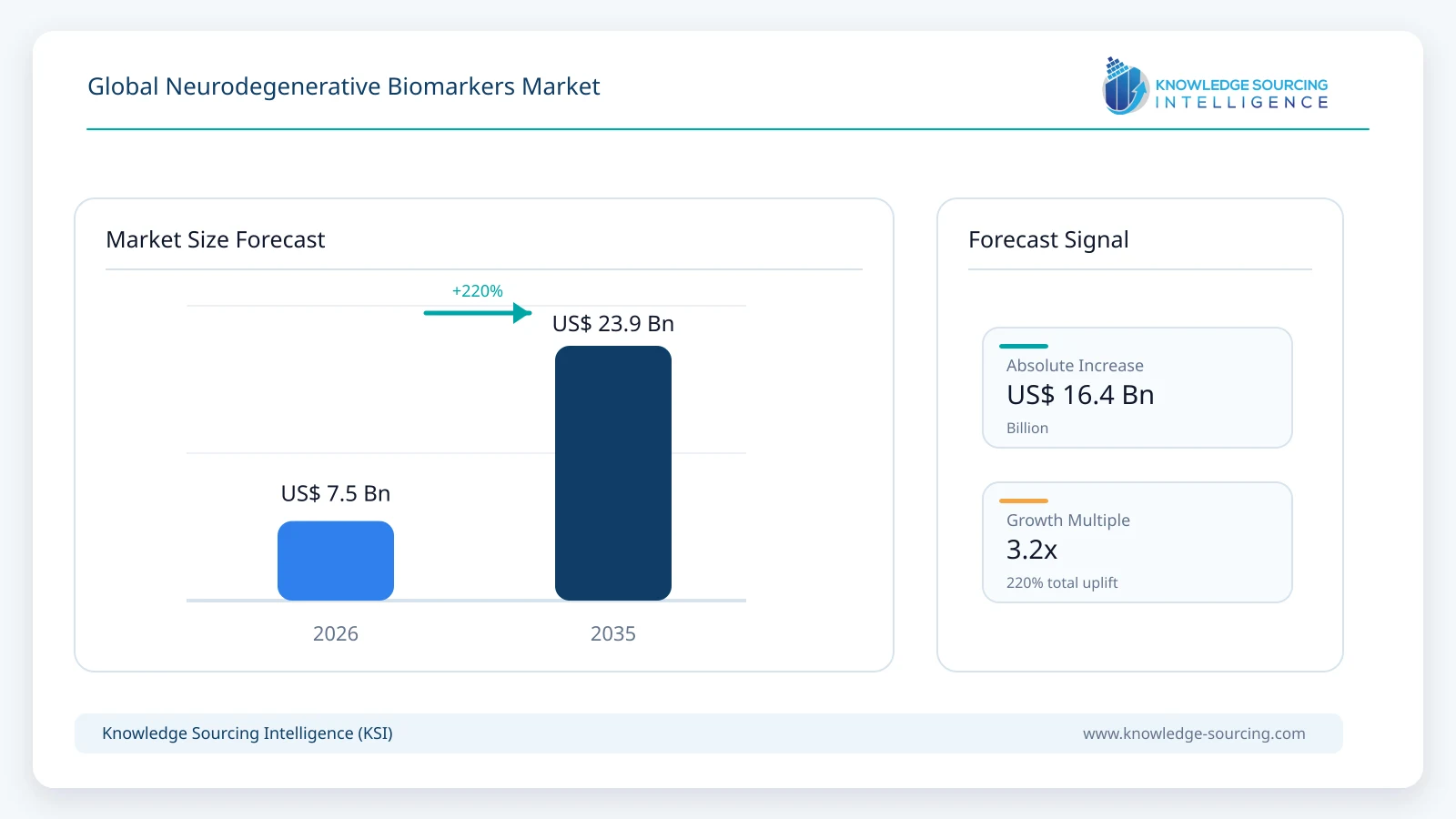
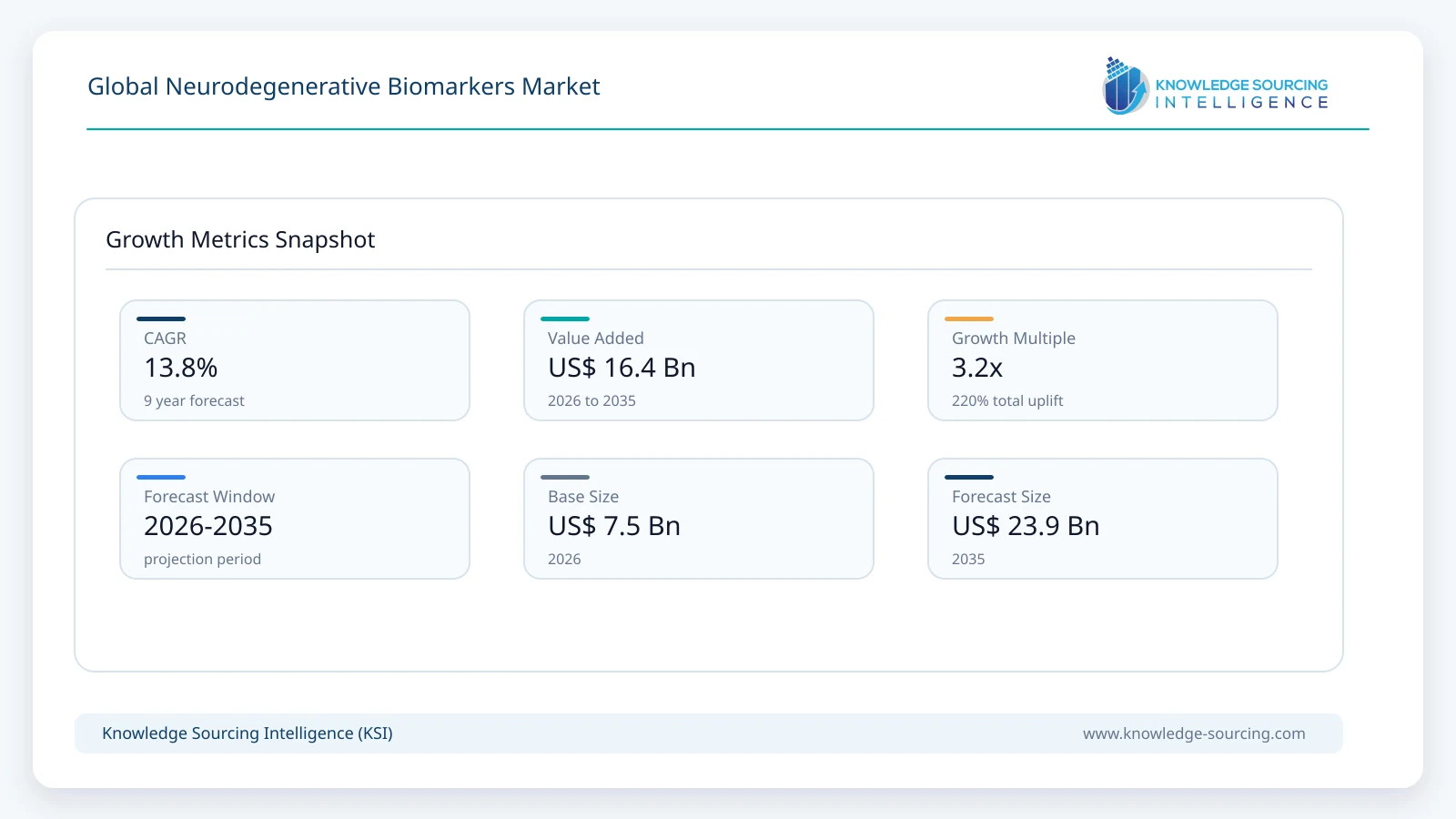
The Global Neurodegenerative Biomarkers Market is expected to increase at a CAGR of 13.8% the forecast period, growing from USD 7.45 billion in 2026 to USD 23.87 billion by 2035.
Highlights:
- 1FDA clearance of blood-based Alzheimer's diagnostic assays is increasing demand for accessible testing because clinicians require alternatives to PET imaging and cerebrospinal fluid analysis.
- 2Disease-modifying neurodegenerative therapies increase biomarker utilization because treatment eligibility increasingly depends on pathology confirmation.
- 3Healthcare systems are expanding interest in blood biomarkers because dementia prevalence continues to rise across aging populations.
- 4Pharmaceutical companies are increasing biomarker investments because clinical trial efficiency depends on earlier patient identification.
Neurodegenerative diseases create substantial healthcare burdens because neuronal damage progresses long before clinical symptoms become apparent. Demand for biomarkers therefore increases as healthcare systems seek measurable indicators capable of detecting pathology during earlier disease stages.
Therapeutic innovation depends on accurate patient stratification because disease-modifying treatments require confirmation of underlying pathology. Blood-based biomarker adoption is expanding because healthcare providers require scalable alternatives to positron emission tomography (PET) imaging and lumbar puncture procedures.
Regulatory influence remains significant because biomarker adoption increasingly depends on clinical validation and diagnostic standardization. Recent regulatory clearances are accelerating physician confidence because approved assays establish clearer pathways for routine clinical implementation.
Strategically, biomarkers support both healthcare delivery and pharmaceutical development. Clinical trial sponsors increasingly rely on biomarker-driven enrollment because disease heterogeneity reduces therapeutic response predictability. This dependence is strengthening investment across proteomics, genomics, imaging technologies, and multiplex diagnostic platforms.
Market Dynamics
Market Drivers
Expansion of Blood-Based Alzheimer's Diagnostics: Neurodegenerative diagnosis traditionally depends on invasive or expensive procedures. Demand is shifting toward blood-based assays because healthcare providers require scalable testing solutions suitable for broader patient populations. Diagnostic manufacturers are expanding commercial platforms as regulatory clearances validate clinical utility. This transition reduces diagnostic barriers and supports earlier intervention strategies. The outcome is stronger adoption of laboratory-based neurodegenerative biomarker testing.
Growth of Disease-Modifying Therapeutics: Biomarkers enable confirmation of underlying pathology before treatment initiation. Therapeutic pipelines are increasingly targeting amyloid and tau mechanisms because precision medicine approaches require biological validation. Healthcare providers face greater pressure to identify eligible patients accurately. Diagnostic developers are expanding assay portfolios to address this requirement. The result is increasing integration of biomarkers into treatment pathways.
Rising Burden of Neurodegenerative Disorders: Neurodegenerative diseases create long-term clinical and economic burdens. Aging populations are increasing patient volumes across major healthcare systems because life expectancy continues to rise. Diagnostic uncertainty constrains effective disease management. Healthcare organizations are adopting biomarker-supported assessments to improve diagnostic confidence. The outcome is sustained demand for validated biomarker technologies.
Biomarker-Driven Clinical Trials: Drug development requires objective measures of disease progression. Clinical trial sponsors are increasingly incorporating biomarker endpoints because conventional clinical assessments often require extended observation periods. Research organizations face recruitment challenges without pathology confirmation. Biomarker platforms are supporting patient enrichment strategies. The result is expanding industry investment in assay development.
Market Restraints
Limited reimbursement coverage for advanced biomarker testing restricts adoption across several healthcare systems.
Clinical variability among patient populations creates standardization challenges for biomarker interpretation.
Regulatory evidence requirements increase development timelines and commercialization costs.
Market Opportunities
Multi-Analyte Diagnostic Panels: Single biomarkers provide limited disease characterization. Demand is shifting toward multi-analyte panels because clinicians require higher diagnostic precision. Diagnostic companies are integrating proteomic and genetic markers into unified platforms. This approach improves risk stratification and supports broader clinical utilization.
Parkinson's Disease Biomarker Commercialization: Alzheimer's disease currently dominates biomarker adoption. Research activity is increasingly targeting Parkinson's disease because unmet diagnostic needs remain substantial. Developers are advancing alpha-synuclein and neurodegeneration-associated biomarkers. This trend expands commercial opportunities beyond dementia-focused testing.
Companion Diagnostics Development: Precision therapeutics require patient selection tools. Pharmaceutical companies are increasingly collaborating with diagnostics firms because treatment effectiveness depends on biological confirmation. Biomarker developers are aligning assay programs with therapeutic pipelines. The outcome is stronger long-term market integration.
Emerging Market Diagnostic Access: Diagnostic infrastructure remains uneven across global healthcare systems. Laboratory modernization is increasing across developing regions because governments seek earlier disease identification. Biomarker companies are introducing automated testing platforms. This expansion creates new commercialization opportunities.
Disease & Epidemiology Analysis
Alzheimer's disease represents the largest biomarker opportunity because it accounts for the majority of dementia diagnoses globally. Diagnostic demand is increasing as healthcare systems prioritize earlier identification of amyloid pathology. Regulatory acceptance of blood-based testing is supporting this shift because clinicians require practical screening and referral tools.
Parkinson's disease remains a major unmet need because diagnosis largely depends on clinical evaluation. Research efforts are increasingly focusing on alpha-synuclein and neurofilament-based markers as disease heterogeneity complicates therapeutic development. The outcome is growing investment in biomarker discovery programs.
ALS and Huntington's disease create specialized opportunities because disease progression monitoring remains clinically important. Biomarker adoption is expanding within research and clinical trial environments as pharmaceutical developers seek measurable indicators of therapeutic response.
Treatment Guidelines Landscape
Disease Area | Current Diagnostic Approach | Biomarker Role | Clinical Impact |
Alzheimer's Disease | Cognitive assessment, PET, CSF | Amyloid, pTau, NfL | Early diagnosis and treatment eligibility |
Parkinson's Disease | Clinical examination | Emerging alpha-synuclein biomarkers | Improved disease characterization |
ALS | Neurological evaluation | Neurofilament biomarkers | Disease progression monitoring |
Market Segmentation
By Product Type
Proteomic biomarkers represent the most commercially advanced segment because they directly measure disease-associated proteins linked to neurodegeneration. Demand is shifting toward phosphorylated tau, amyloid-beta, and neurofilament light chain markers because clinicians require biologically relevant indicators that support routine testing. Imaging biomarkers continue serving confirmatory roles as pathology visualization remains clinically valuable. Cost and accessibility constraints limit widespread imaging utilization. Blood-based proteomic platforms are expanding because laboratories can integrate them into existing workflows. The outcome is stronger market preference for scalable proteomic diagnostics.
By Technology Platform
Immunoassays form the leading technology category because automated laboratory systems support high-throughput clinical implementation. Demand is increasing for ultrasensitive detection platforms as biomarker concentrations often remain extremely low during early disease stages. Mass spectrometry provides analytical precision but requires specialized infrastructure. Diagnostic providers are expanding immunoassay-based solutions because healthcare systems prioritize accessibility and workflow efficiency. The result is broader adoption of automated biomarker testing platforms.
By Indication
Alzheimer's disease dominates biomarker demand because therapeutic decision-making increasingly requires pathology confirmation. Blood-based testing adoption is accelerating as healthcare providers seek efficient diagnostic pathways. Parkinson's disease research activity is expanding because biomarker availability remains limited. ALS and Huntington's disease continue generating specialized demand through clinical trials and disease monitoring applications. The outcome is a market structure heavily anchored in Alzheimer's diagnostics while gradually diversifying into additional neurodegenerative conditions.
Regional Analysis
North America Market Analysis
North America represents the most advanced neurodegenerative biomarker market because regulatory frameworks increasingly support clinical biomarker adoption. Demand is shifting toward blood-based diagnostics as healthcare providers seek alternatives to PET imaging and cerebrospinal fluid testing. Rising utilization of disease-modifying Alzheimer's therapies increases the requirement for pathology confirmation. Diagnostic companies are expanding commercialization efforts following FDA clearances. Academic institutions, biotechnology firms, and pharmaceutical companies maintain strong collaborative ecosystems. The outcome is continued leadership in biomarker validation, clinical adoption, and commercialization.
Europe Market Analysis
Europe maintains a strong position because translational neuroscience research remains highly developed. Demand is increasing for standardized biomarker testing as healthcare systems pursue earlier dementia identification. Regulatory and reimbursement assessments create adoption constraints. Diagnostic companies are expanding evidence-generation activities to support broader implementation. CE Mark approvals are strengthening market confidence in blood-based biomarker technologies. The result is growing integration of biomarkers into clinical pathways.
Asia Pacific Market Analysis
Asia Pacific represents the fastest-evolving opportunity because aging populations continue expanding across major economies. Demand is increasing for scalable diagnostics as dementia prevalence rises. Healthcare infrastructure variability creates implementation challenges. Governments and healthcare organizations are investing in laboratory modernization and neurological disease management programs. Regional diagnostics manufacturers are strengthening capabilities through partnerships and technology adoption. The outcome is increasing market penetration for biomarker-based testing solutions.
Rest of the World
Rest of the World markets remain underpenetrated because advanced neurological diagnostics are concentrated in urban healthcare centers. Demand is increasing as awareness of neurodegenerative disease burden expands. Resource limitations constrain widespread adoption. International diagnostic providers are introducing accessible testing approaches through laboratory partnerships. Healthcare systems are gradually incorporating biomarker-supported assessments into specialist care settings. The result is steady long-term market development.
Regulatory Landscape
The regulatory environment increasingly recognizes biomarkers as essential components of neurodegenerative disease management. FDA clearance of blood-based Alzheimer's diagnostics establishes an important precedent because regulatory acceptance historically focused on imaging and cerebrospinal fluid approaches. Clinical validation requirements remain rigorous as diagnostic accuracy directly influences treatment decisions.
Breakthrough Device pathways are supporting biomarker innovation because regulators seek technologies that address significant unmet clinical needs. Developers increasingly pursue regulatory engagement earlier in development programs as evidence expectations become more clearly defined. This approach reduces commercialization uncertainty and supports investment.
European regulatory authorities are emphasizing analytical validity, clinical utility, and reproducibility. Diagnostic companies are generating larger real-world evidence datasets because healthcare adoption increasingly depends on demonstrated clinical impact. The outcome is a more structured pathway for biomarker commercialization.
Pipeline Analysis
The biomarker pipeline increasingly focuses on blood-based assays because healthcare systems require scalable diagnostic solutions. Research activity is expanding around pTau217, pTau181, amyloid-beta ratios, neurofilament light chain, and alpha-synuclein markers as developers seek earlier disease detection capabilities.
Pipeline programs increasingly combine multiple biomarkers because single-marker approaches face sensitivity and specificity limitations. Companies are integrating proteomic, genomic, and imaging data into multimodal diagnostic frameworks. Artificial intelligence applications are supporting biomarker interpretation because disease progression patterns remain complex.
Commercial pipelines are also expanding beyond Alzheimer's disease. Parkinson's disease, ALS, and other neurodegenerative disorders are attracting greater biomarker investment because therapeutic development requires objective disease characterization. The result is a broader diagnostic ecosystem capable of supporting precision neurology.
Competitive Landscape
Fujirebio Holdings
Fujirebio holds a strategically distinct position because it achieved a major regulatory milestone in blood-based Alzheimer's diagnostics. The company commercializes biomarker solutions focused on amyloid and tau pathology detection. Demand for accessible diagnostics is increasing because healthcare providers require scalable alternatives to PET imaging.
Roche
Roche remains strategically differentiated through its extensive diagnostics infrastructure and global laboratory footprint. Demand for Alzheimer's testing is increasing because disease-modifying therapies require earlier diagnosis. Roche is expanding blood-based biomarker offerings through Elecsys pTau181 and pTau217 programs.
Quanterix
Quanterix differentiates itself through ultra-sensitive biomarker detection technologies. The company focuses on measuring low-abundance neurological proteins that support early disease identification. Research demand continues to increase because biomarker concentrations remain challenging to detect with conventional methods.
Abbott
Abbott leverages extensive diagnostics expertise and global laboratory access. Neurodegenerative biomarker demand is increasing because healthcare systems require scalable testing solutions. The company maintains strategic flexibility through broad assay development capabilities and integrated diagnostics infrastructure.
Siemens Healthineers
Siemens Healthineers benefits from advanced diagnostic technologies and strong healthcare provider relationships. Demand for precision diagnostics is increasing because neurological disease management increasingly depends on measurable biological indicators.
Beckman Coulter Diagnostics
Beckman Coulter Diagnostics maintains a strong position through automated testing systems and clinical laboratory penetration. Biomarker adoption is increasing because laboratories require standardized workflows. The company benefits from established diagnostic networks and assay development capabilities.
Bio-Techne
Bio-Techne focuses on research and translational biomarker applications. Demand is increasing for validated biomarker reagents because assay development depends on reliable biological tools. The company supports both discovery-stage and commercial diagnostic initiatives.
C2N Diagnostics
C2N Diagnostics specializes in Alzheimer's disease biomarker innovation. The company benefits from strong scientific expertise in amyloid and tau assessment. Demand for pathology-confirming diagnostics is increasing because treatment decisions increasingly depend on biological evidence. Its specialized focus strengthens relevance within precision neurology.
Key Developments
March 2026: Alamar Biosciences launched the NULISAseq Neuro 220 Panel, a precision proteomics platform enabling multiplexed measurement of 220 biomarkers from a single 25 µL sample with ultra-high sensitivity and specificity, including 15 new biomarkers developed with support from The Michael J. Fox Foundation for Alzheimer's, Parkinson's, multiple sclerosis, frontotemporal dementia, ALS, and other neurodegenerative diseases.
March 2026: Siemens Healthineers launched its brain health research portfolio with fully automated Atellica IM pTau217 and BDTau blood-based immunoassays for research use, offering a less-invasive alternative to cerebrospinal fluid testing that requires lumbar puncture and providing quantitative measurements of brain-derived phosphorylated tau 217 and brain-derived tau on widely installed Atellica analyzers.
August 2025: Quanterix launched the first-to-market commercial p-Tau 205 and p-Tau 212 assays, two novel phospho-tau blood biomarkers that enable precise detection of tau phosphorylation sites increasingly associated with early and progressive stages of Alzheimer's disease, available for use on HD-X or SR-X instruments or through Quanterix's CLIA-licensed Accelerator Lab.
June 2025: Fujirebio expanded its neuro testing portfolio with the launch of the fully automated Lumipulse G pTau 217 CSF assay for Research Use Only, adding to its comprehensive neurodegenerative disease testing capabilities for cerebrospinal fluid analysis.
Strategic Insights and Future Market Outlook
The market increasingly depends on blood-based biomarkers because healthcare systems require scalable methods for identifying neurodegenerative disease earlier. Therapeutic innovation creates additional pressure for diagnostic precision since treatment effectiveness increasingly depends on pathology confirmation. Diagnostic developers therefore continue expanding assay sensitivity, automation, and clinical validation programs.
Competitive differentiation increasingly centers on regulatory success, clinical evidence generation, and laboratory integration. Companies are strengthening partnerships across diagnostics, pharmaceuticals, and academic research because biomarker adoption requires broad ecosystem support. This collaboration model accelerates translation from discovery to clinical practice.
Long-term growth potential depends on expansion beyond Alzheimer's disease. Parkinson's disease, ALS, Huntington's disease, and mixed dementias are creating opportunities for next-generation biomarker development. Multimodal testing approaches combining proteomic, genomic, and imaging information are likely to define future diagnostic standards.
The Global Neurodegenerative Biomarkers Market is moving from biomarker discovery toward routine clinical implementation. Regulatory validation, therapeutic advancement, and growing demand for earlier diagnosis are establishing biomarkers as a foundational component of precision neurology, positioning the sector for sustained strategic importance through 2035.
Global Neurodegenerative Biomarkers Market Scope:
| Report Metric | Details |
|---|---|
| Total Market Size in 2026 | USD 7.45 billion |
| Total Market Size in 2035 | USD 23.87 billion |
| Forecast Unit | USD Billion |
| Growth Rate | 13.8% |
| Study Period | 2021 to 2035 |
| Historical Data | 2021 to 2024 |
| Base Year | 2025 |
| Forecast Period | 2026 – 2035 |
| Segmentation | Biomarker Type, Technology Platform, Indication, Geography |
| Companies |
|
Market Segmentation
By Geography
Key Countries Analysis
Regulatory & Policy Landscape
Table of Contents
1. EXECUTIVE SUMMARY
1.1 Market Overview
1.2 Key Findings
1.3 Market Snapshot
1.4 Key Growth Opportunities
1.5 Strategic Recommendations
1.6 Executive Insights on Neurodegenerative Biomarkers
1.6.1 Biomarker Adoption Trends
1.6.2 Emerging Diagnostic Technologies
1.6.3 Precision Medicine and Companion Diagnostics Trends
1.6.4 Future Outlook
2. DISEASE & EPIDEMIOLOGY ANALYSIS
2.1 Introduction to Neurodegenerative Disorders
2.2 Disease Burden and Public Health Impact
2.3 Epidemiology Overview
2.3.1 Prevalence of Neurodegenerative Disorders
2.3.2 Incidence Trends
2.3.3 Mortality and Disability Burden
2.3.4 Aging Population Impact
2.4 Epidemiology by Disease Type
2.4.1 Alzheimer's Disease
2.4.2 Parkinson's Disease
2.4.3 Amyotrophic Lateral Sclerosis (ALS)
2.4.4 Frontotemporal Dementia (FTD)
2.4.5 Huntington's Disease
2.4.6 Dementia with Lewy Bodies (DLB)
2.4.7 Multiple System Atrophy (MSA)
2.4.8 Other Neurodegenerative Disorders
2.5 Biomarker Relevance Across Disease Stages
2.5.1 Preclinical Disease Detection
2.5.2 Mild Cognitive Impairment (MCI)
2.5.3 Early Disease Diagnosis
2.5.4 Disease Progression Monitoring
2.5.5 Treatment Response Assessment
2.6 Patient Population Analysis
2.6.1 Age-Based Distribution
2.6.2 Gender-Based Distribution
2.6.3 Genetic Risk Population
2.6.4 Sporadic versus Familial Disease Cases
3. MARKET DYNAMICS
3.1 Market Overview
3.2 Market Drivers
3.2.1 Rising Prevalence of Neurodegenerative Disorders
3.2.2 Growing Adoption of Early Diagnostic Testing
3.2.3 Expansion of Disease-Modifying Therapies
3.2.4 Increasing Biomarker-Based Clinical Trials
3.2.5 Advancements in Liquid Biopsy Technologies
3.3 Market Restraints
3.3.1 High Cost of Advanced Biomarker Testing
3.3.2 Limited Reimbursement Coverage
3.3.3 Variability in Biomarker Standardization
3.3.4 Regulatory Challenges
3.4 Market Opportunities
3.4.1 Blood-Based Biomarker Expansion
3.4.2 Companion Diagnostic Development
3.4.3 AI-Enabled Biomarker Interpretation
3.4.4 Emerging Market Penetration
3.5 Market Challenges
3.5.1 Clinical Validation Requirements
3.5.2 Data Harmonization Issues
3.5.3 Healthcare Infrastructure Limitations
3.6 Porter’s Five Forces Analysis
3.7 PESTLE Analysis
3.8 Value Chain Analysis
3.9 Stakeholder Ecosystem Analysis
4. COMMERCIAL & MARKET ACCESS
4.1 Reimbursement Landscape
4.2 Market Access Framework
4.3 Health Technology Assessment (HTA) Considerations
4.4 Pricing Analysis
4.5 Payer Perspectives
4.6 Diagnostic Coding and Coverage Policies
4.7 Adoption Barriers and Access Challenges
5. INNOVATION & PIPELINE LANDSCAPE
5.1 Biomarker Innovation Overview
5.2 Pipeline Biomarker Development Landscape
5.3 Biomarker Categories Under Development
5.3.1 Amyloid Biomarkers
5.3.2 Tau Biomarkers
5.3.3 Neurofilament Light Chain (NfL)
5.3.4 ?-Synuclein Biomarkers
5.3.5 Neuroinflammation Biomarkers
5.3.6 Genetic Biomarkers
5.3.7 Multi-Omics Biomarkers
5.4 Pipeline Analysis by Clinical Development Stage
5.4.1 Discovery and Preclinical
5.4.2 Phase I
5.4.3 Phase II
5.4.4 Phase III
5.5 Pipeline Analysis by Modality
5.5.1 Blood-Based Biomarkers
5.5.2 Cerebrospinal Fluid (CSF) Biomarkers
5.5.3 Imaging Biomarkers
5.5.4 Digital Biomarkers
5.5.5 Genetic and Genomic Biomarkers
5.6 Pipeline Analysis by Mechanism
5.6.1 Amyloid Pathology Detection
5.6.2 Tau Pathology Detection
5.6.3 Neurodegeneration Monitoring
5.6.4 Synucleinopathy Detection
5.6.5 Neuroinflammation Assessment
5.7 Emerging Technologies and Innovation Trends
5.8 Patent Landscape Analysis
5.9 Clinical Trial Landscape
6. TREATMENT LANDSCAPE
6.1 Current Treatment Paradigm
6.2 Role of Biomarkers in Clinical Decision-Making
6.3 Companion Diagnostics in Neurodegenerative Diseases
6.4 Biomarker Integration in Disease-Modifying Therapy Selection
6.5 Approved Biomarker-Assisted Therapeutic Pathways
6.5.1 Alzheimer's Disease
6.5.2 Parkinson's Disease
6.5.3 ALS
6.6 Emerging Precision Medicine Approaches
6.7 Treatment Guidelines and Biomarker Recommendations
7. GLOBAL NEURODEGENERATIVE BIOMARKERS MARKET SIZE & FORECAST
7.1 Market Size Overview (Historical and Forecast)
7.2 Market Forecast Assumptions
7.3 Revenue Forecast by Biomarker Type
7.4 Revenue Forecast by Disease Indication
7.5 Revenue Forecast by Technology Platform
7.6 Revenue Forecast by End User
7.7 Revenue Forecast by Distribution Channel
7.8 Scenario Analysis
7.8.1 Conservative Scenario
7.8.2 Base Scenario
7.8.3 Optimistic Scenario
8. GLOBAL NEURODEGENERATIVE BIOMARKERS MARKET SEGMENTATION
8.1 By Biomarker Type
8.1.1 Proteomic Biomarkers
8.1.2 Imaging Biomarkers
8.1.3 Genomic Biomarkers
8.1.4 Metabolomic Biomarkers
8.1.5 Other Biomarkers
8.2 By Technology Platform
8.2.1 Immunoassays
8.2.2 Mass Spectrometry
8.2.3 Molecular Diagnostics
8.2.4 Others
8.3 By Indication
8.3.1 Alzheimer's Disease
8.3.2 Parkinson's Disease
8.3.3 ALS
8.3.4 Huntington’s Disease
8.3.5 Others
8.4 By Sample Type
8.4.1 Blood & Plasma
8.4.2 Cerebrospinal Fluid
8.4.3 Saliva
8.4.4 Urine
8.5 By End User
8.5.1 Hospitals
8.5.2 Neurology Clinics
8.5.3 Diagnostic Laboratories
8.5.4. Others
9. GEOGRAPHICAL ANALYSIS (REGIONAL LEVEL)
9.1 North America
9.1.1 Market Size and Forecast
9.1.2 Disease Burden Overview
9.1.3 Demand Drivers
9.1.4 Regulatory Environment
9.1.5 Reimbursement Landscape
9.1.6 Competitive Intensity
9.2 Europe
9.2.1 Market Size and Forecast
9.2.2 Disease Burden Overview
9.2.3 Demand Drivers
9.2.4 Regulatory Environment
9.2.5 Reimbursement Landscape
9.2.6 Competitive Intensity
9.3 Asia-Pacific
9.3.1 Market Size and Forecast
9.3.2 Disease Burden Overview
9.3.3 Demand Drivers
9.3.4 Regulatory Environment
9.3.5 Reimbursement Landscape
9.3.6 Competitive Intensity
9.4 Latin America
9.4.1 Market Size and Forecast
9.4.2 Disease Burden Overview
9.4.3 Demand Drivers
9.4.4 Regulatory Environment
9.4.5 Reimbursement Landscape
9.4.6 Competitive Intensity
9.5 Middle East & Africa
9.5.1 Market Size and Forecast
9.5.2 Disease Burden Overview
9.5.3 Demand Drivers
9.5.4 Regulatory Environment
9.5.5 Reimbursement Landscape
9.5.6 Competitive Intensity
10. KEY COUNTRIES ANALYSIS
10.1 United States
10.1.1 Market Size
10.1.2 Epidemiology
10.1.3 Regulatory Framework
10.1.4 Reimbursement Landscape
10.1.5 Key Companies and Products Presence
10.2 Canada
10.2.1 Market Size
10.2.2 Epidemiology
10.2.3 Regulatory Framework
10.2.4 Reimbursement Landscape
10.2.5 Key Companies and Products Presence
10.3 Germany
10.3.1 Market Size
10.3.2 Epidemiology
10.3.3 Regulatory Framework
10.3.4 Reimbursement Landscape
10.3.5 Key Companies and Products Presence
10.4 United Kingdom
10.5 France
10.6 Italy
10.7 Spain
10.8 China
10.9 Japan
10.10 India
10.11 South Korea
10.12 Australia
10.13 Brazil
10.14 Mexico
10.15 Saudi Arabia
10.16 South Africa
11. REGULATORY & POLICY LANDSCAPE
11.1 Global Regulatory Overview
11.2 United States Regulatory Framework
11.2.1 FDA Biomarker Qualification Program
11.2.2 FDA In Vitro Diagnostic Regulations
11.2.3 Companion Diagnostic Requirements
11.3 Europe Regulatory Framework
11.3.1 EMA Biomarker Utilization Framework
11.3.2 In Vitro Diagnostic Regulation (IVDR)
11.3.3 CE Marking Requirements
11.4 Japan Regulatory Framework
11.4.1 PMDA Approval Pathways
11.4.2 Clinical Evidence Requirements
11.5 India Regulatory Framework
11.5.1 CDSCO Diagnostic Regulations
11.5.2 Medical Device Rules
11.5.3 Import and Registration Requirements
11.6 China Regulatory Framework
11.6.1 NMPA Approval Framework
11.6.2 Clinical Evaluation Requirements
11.7 Biomarker Validation Standards
11.8 Data Privacy and Patient Data Regulations
11.9 Regulatory Trends Impacting Market Growth
12. COMPETITIVE LANDSCAPE
12.1 Market Structure Analysis
12.2 Competitive Benchmarking
12.3 Market Share Analysis
12.4 Strategic Developments
12.4.1 Collaborations and Partnerships
12.4.2 Mergers and Acquisitions
12.4.3 Licensing Agreements
12.4.4 Product Launches
12.5 Innovation Leadership Assessment
12.6 SWOT Analysis
13. COMPANY PROFILES
13.1 Fujirebio Holdings
13.1.1 Company Overview
13.1.2 Approved Products
13.1.3 Key Indications
13.1.4 Pipeline Biomarker Programs
13.1.5 Strategic Developments
13.2 Roche
13.2.1 Company Overview
13.2.2 Approved Products
13.2.3 Key Indications
13.2.4 Pipeline Programs
13.2.5 Strategic Developments
13.3 Quanterix
13.3.1 Company Overview
13.3.2 Commercialized Biomarker Platforms
13.3.3 Key Indications
13.3.4 Pipeline Programs
13.4 Abbott
13.5 Siemens Healthineers
13.6 Beckman Coulter Diagnostics
13.7 Bio-Techne
13.8 C2N Diagnostics
13.9 ALZpath
13.10 Sysmex Corporation
14. FUTURE OUTLOOK
14.1 Market Growth Outlook
14.2 Future Biomarker Adoption Trends
14.3 Blood-Based Biomarker Market Evolution
14.4 Digital Biomarker Integration
14.5 AI and Machine Learning Impact
14.6 Precision Neurology Outlook
14.7 Future Regulatory Evolution
14.8 Investment and Funding Trends
14.9 Analyst Recommendations
15. METHODOLOGY
15.1 Research Methodology Overview
15.2 Primary Research
15.3 Secondary Research
15.4 Data Collection Sources
15.5 Epidemiology Modelling Approach
15.6 Market Estimation Methodology
15.7 Forecasting Methodology
15.8 Data Triangulation
15.9 Assumptions and Limitations
15.10 Quality Control and Validation Framework
15.11 Abbreviations and Definitions
15.12 Disclaimer and Legal Notice
Navigate
Trusted by the world's leading organizations











