
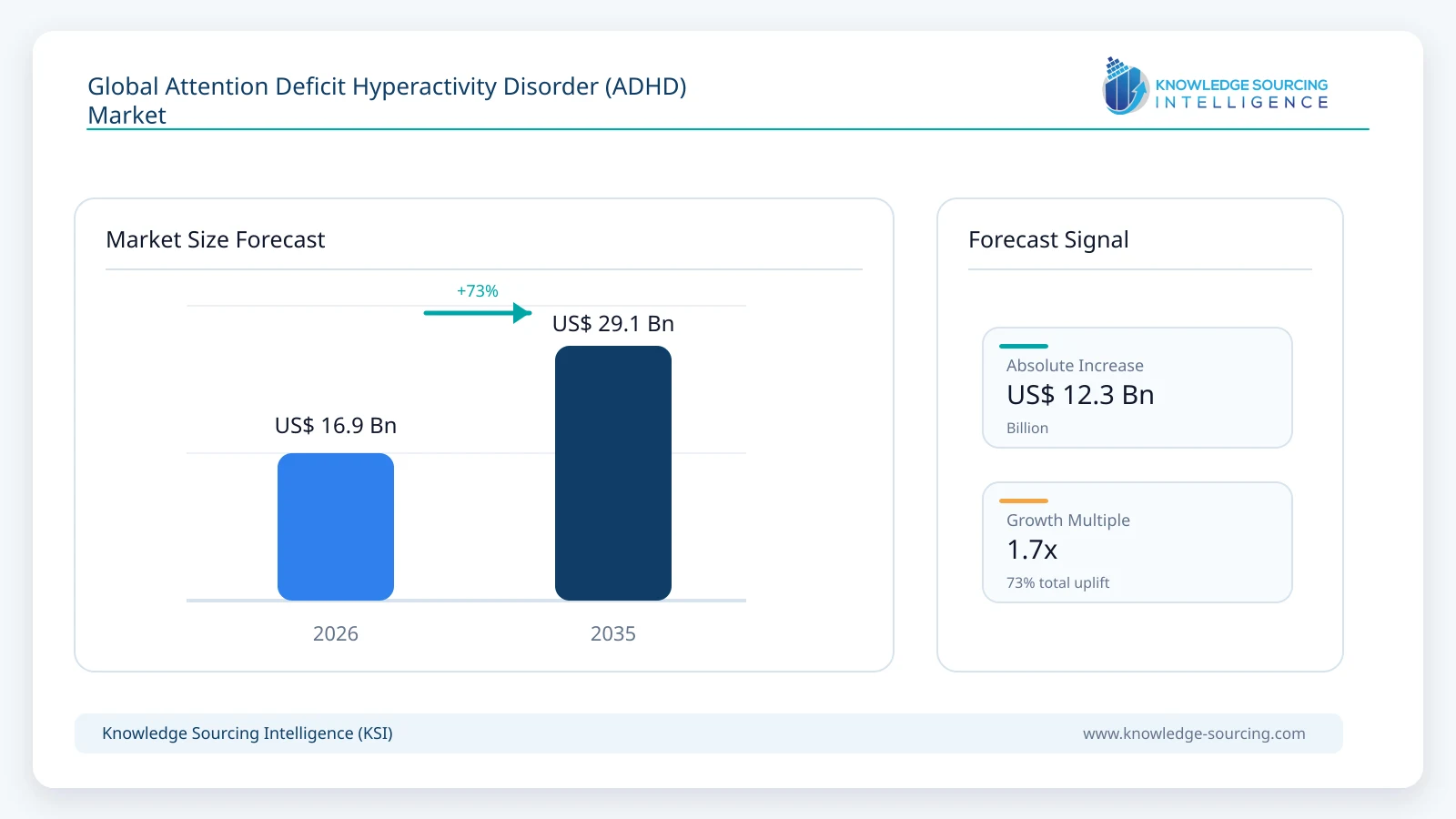
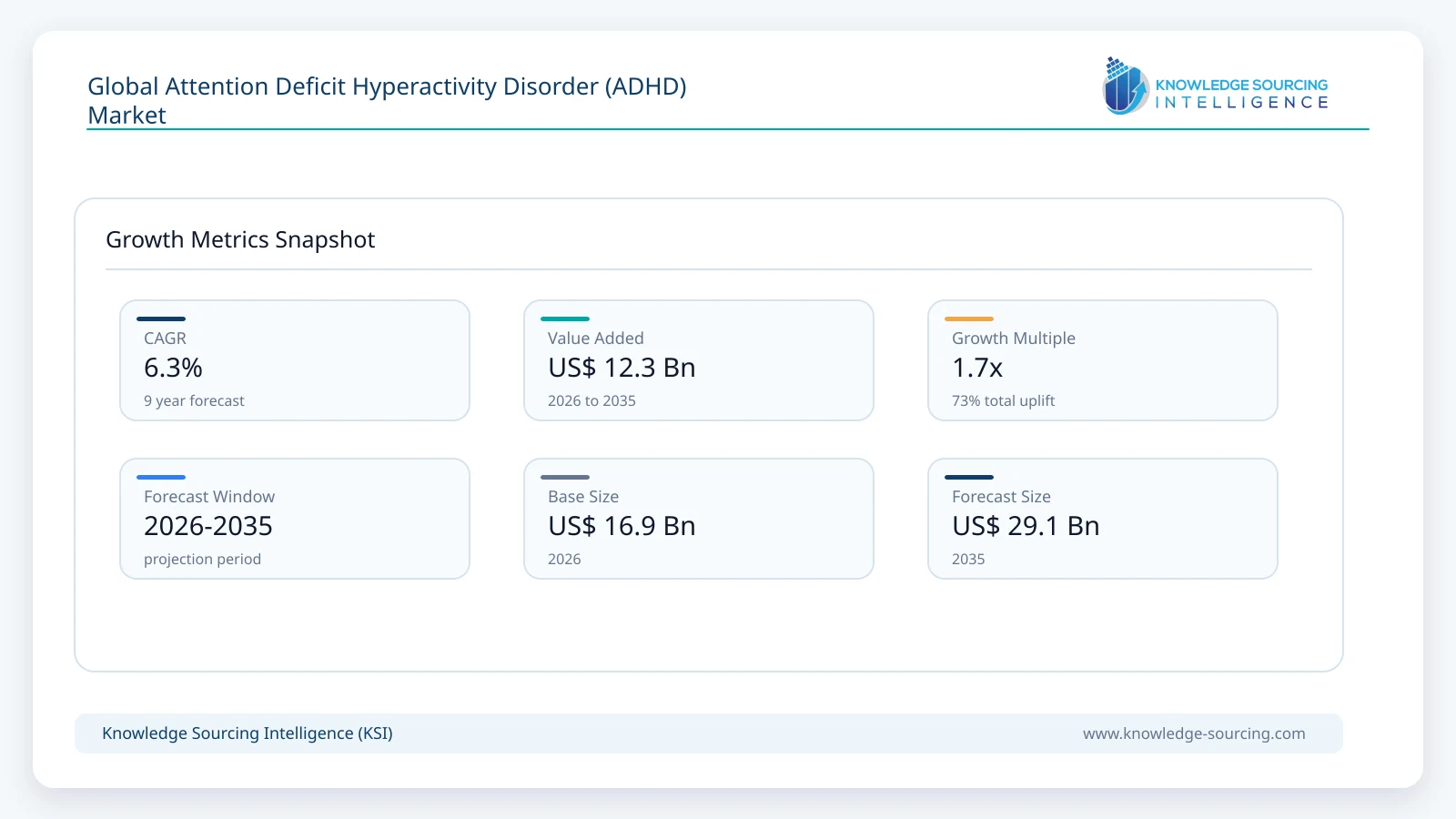
The Global Attention Deficit Hyperactivity Disorder (ADHD) Market is expected to grow from USD 16.86 billion in 2026 at a 6.3% CAGR to a market value of USD 29.13 billion in 2035.
Highlights:
- 1Rising diagnosis rates are increasing long-term medication demand across pediatric and adult populations.
- 2Adult ADHD recognition is expanding treatment duration and creating demand for non-stimulant therapies.
- 3Extended-release formulations are improving adherence and shifting prescribing patterns toward once-daily products.
- 4Regulatory scrutiny of stimulant misuse is encouraging investment in alternative mechanisms and controlled delivery systems.
ADHD represents one of the most prevalent neurodevelopmental disorders worldwide and creates sustained demand for long-term pharmacotherapy. The market depends on increasing disease awareness, earlier diagnosis, and broader recognition of adult ADHD. Clinical practice increasingly emphasizes individualized therapy selection because symptom severity, comorbidities, and treatment adherence vary substantially across patients.
Regulatory agencies are encouraging the development of alternative non-stimulant options and abuse-deterrent formulations because stimulant misuse remains a public health concern. Manufacturers are responding by investing in extended-release technologies, transdermal systems, and novel non-stimulant mechanisms that improve convenience and safety.
Market Dynamics
Market Drivers
Increasing ADHD Diagnosis Rates: ADHD diagnosis rates continue to rise because healthcare systems are improving screening practices and expanding awareness campaigns. Demand is increasing across both pediatric and adult populations as physicians recognize previously undiagnosed cases. Treatment adoption remains closely linked to early intervention because unmanaged ADHD affects academic achievement, employment, and social functioning. Pharmaceutical companies are expanding commercial investments as the diagnosed patient pool continues to widen. The market, therefore, maintains a structurally growing demand base.
Expansion of Adult ADHD Treatment: Adult ADHD represents a major growth segment because symptoms frequently persist beyond childhood. Demand is shifting toward therapies with lower abuse potential and improved tolerability as adult patients seek long-term treatment. Diagnostic practices are evolving because psychiatric clinics increasingly screen for ADHD alongside anxiety and depression. Manufacturers are developing differentiated products that address these broader treatment needs. Adult treatment, therefore, becomes a strategic growth engine.
Innovation in Drug Delivery: Drug delivery technology increasingly influences prescribing decisions because adherence remains critical for symptom control. Demand is shifting toward once-daily oral formulations and transdermal systems that reduce dosing burden. Manufacturers are investing in extended-release platforms because sustained symptom control improves patient satisfaction. These innovations strengthen product differentiation and support longer commercial lifecycles.
Market Restraints
Generic competition reduces pricing flexibility for established stimulant brands.
Stimulant misuse concerns limit prescribing in certain patient populations.
Drug shortages periodically disrupt supply chains and reduce treatment continuity.
Market Opportunities
Novel Non-Stimulant Therapies: Non-stimulant therapies address patients who cannot tolerate stimulants or require lower abuse-risk options. Demand is increasing as clinicians diversify treatment approaches. Companies are advancing norepinephrine modulators and alternative mechanisms because treatment personalization is becoming clinically important. The segment offers substantial innovation opportunities.
Adult ADHD Awareness: Adult ADHD awareness is expanding across healthcare systems. Demand is increasing for therapies designed specifically for working-age adults because symptom persistence affects productivity and quality of life. Companies are investing in education and commercial expansion strategies that support long-term treatment adoption. The market benefits from a widening patient base.
Digital Patient Support: Digital adherence tools are improving treatment persistence because ADHD patients often experience medication discontinuation. Manufacturers are integrating patient engagement platforms with therapy management. This trend supports stronger outcomes and increases long-term product utilization.
Disease & Epidemiology Analysis
ADHD is characterized by persistent inattention, hyperactivity, and impulsivity that impair daily functioning. The disorder typically begins in childhood, although symptoms often persist into adulthood. Epidemiological trends indicate increasing diagnosis rates because awareness campaigns and improved screening are expanding disease recognition.
The pediatric segment remains the largest treatment population because diagnosis usually occurs during school years. Demand is increasing among adolescents as educational systems prioritize behavioral assessment and early intervention. Adult diagnosis is also increasing because clinicians are recognizing previously untreated patients who experience occupational and social impairment.
CDC data indicate that approximately 10.5% of U.S. children had current ADHD in 2022. Among these patients, 58.1% exhibited moderate or severe disease, and nearly 78% experienced at least one co-occurring disorder. These findings demonstrate the complexity of treatment and support continued demand for diversified therapeutic options.
Treatment Guidelines Landscape
Category | Current Recommendation |
Preschool Children | Behavioral therapy as first-line treatment |
Children & Adolescents | Behavioral therapy plus medication |
Adults | Pharmacotherapy with stimulants or non-stimulants |
Non-Responders | Alternative stimulants or non-stimulant therapies |
Market Segmentation
By Drug Class
Stimulants remain the dominant therapy class because they provide rapid symptom control and extensive clinical evidence. Demand is shifting toward extended-release amphetamine and methylphenidate formulations because patients prefer once-daily dosing and consistent efficacy. Non-stimulants are gaining relevance as clinicians seek alternatives for patients with cardiovascular concerns, anxiety, or misuse risk. Companies are investing in selective norepinephrine reuptake inhibitors and alpha-2 adrenergic agonists because treatment personalization increasingly influences prescribing behavior. The segment, therefore, balances established efficacy with expanding therapeutic diversity.
By Age Group
Pediatric and adolescent patients account for the majority of prescriptions because ADHD diagnosis typically occurs during childhood. Demand is increasing among adults as awareness campaigns and psychiatric screening expand disease recognition. Adult patients often require individualized treatment because comorbid anxiety, depression, and sleep disorders influence medication selection. Pharmaceutical companies are adapting commercial strategies as adult ADHD becomes a larger contributor to prescription growth. This demographic transition broadens long-term market opportunities.
By Route of Administration
Oral therapies dominate the market because they provide convenience, flexible dosing, and broad reimbursement support. Demand is shifting toward extended-release oral products because they improve adherence and reduce dosing frequency. Transdermal systems offer an alternative for patients with swallowing difficulties or gastrointestinal intolerance. Manufacturers are refining delivery technologies because differentiated administration routes strengthen brand positioning and extend product lifecycles.
Regional Analysis
North America Market Analysis
North America represents the largest ADHD treatment market because diagnosis rates remain high and healthcare systems support long-term pharmacotherapy. Demand is increasing as pediatric screening expands and adult ADHD awareness improves. Physicians increasingly prescribe extended-release therapies because patients seek consistent symptom control with a lower dosing burden. Regulatory agencies maintain strict oversight of stimulant prescribing, which encourages investment in non-stimulant alternatives and differentiated delivery systems. Companies are expanding lifecycle management strategies as generic competition intensifies. The region, therefore, remains the primary center for commercial innovation, clinical research, and regulatory approvals.
Europe Market Analysis
Europe maintains strong ADHD treatment demand because healthcare systems increasingly recognize the long-term socioeconomic burden of untreated disease. Diagnosis practices are evolving as clinicians improve adult ADHD screening and multidisciplinary care. Demand is shifting toward individualized therapies because treatment guidelines emphasize patient-specific risk-benefit evaluation. Pharmaceutical companies are strengthening regional partnerships and educational initiatives as awareness expands. The market continues to evolve toward broader treatment access and diversified therapeutic approaches.
Asia Pacific Market Analysis
Asia Pacific is experiencing expanding ADHD diagnosis rates because urbanization, educational pressures, and healthcare modernization are increasing disease recognition. Demand is rising across major economies as physicians adopt standardized diagnostic criteria. Governments are improving mental health infrastructure, which supports earlier intervention and broader treatment availability. Companies are expanding regional commercialization strategies because the patient population continues to grow. The region represents a significant long-term growth opportunity.
Rest of the World
The Rest of the World market remains comparatively underpenetrated because awareness and diagnostic infrastructure vary widely. Demand is increasing as healthcare systems improve mental health services and physician education. International pharmaceutical companies are expanding geographic reach because emerging markets offer substantial, untapped patient populations. Treatment access gradually improves across these regions.
Regulatory Landscape
ADHD therapies operate within a highly regulated environment because stimulant medications carry misuse and dependence risks. Regulatory agencies require extensive clinical evidence that demonstrates efficacy, safety, and appropriate risk management before approving.
Authorities are increasingly supporting non-stimulant therapies because they provide alternatives for patients who cannot tolerate stimulants or require lower abuse-risk treatments. Companies are adapting development strategies as regulators place greater emphasis on long-term safety monitoring and post-marketing surveillance.
The regulatory framework encourages innovation while maintaining strict controls over prescribing and distribution practices.
Pipeline Analysis
The ADHD pipeline increasingly focuses on differentiated formulations rather than entirely novel stimulant mechanisms. Companies are developing extended-release products that improve adherence because patients prefer simplified dosing schedules.
Non-stimulant development is gaining momentum as manufacturers pursue therapies with improved safety profiles and reduced abuse potential. This shift reflects changing physician preferences and increasing demand from adult patients who require long-term treatment strategies.
Pipeline activity also includes alternative delivery technologies such as transdermal systems and orally disintegrating formulations. These innovations improve patient convenience and strengthen commercial differentiation within an increasingly competitive market.
Reimbursement Landscape
Reimbursement policies strongly influence ADHD treatment adoption because therapy frequently continues for many years. Public and private insurers generally cover generic stimulants, which supports broad access but intensifies pricing pressure on branded products.
Coverage for premium formulations depends on demonstrated clinical advantages, such as improved adherence or lower misuse potential. Manufacturers are generating additional evidence because payers increasingly require differentiated outcomes before expanding reimbursement.
Competitive Landscape
Takeda Pharmaceutical Company
Takeda remains strategically distinct because Vyvanse established one of the most recognized ADHD brands globally. The company benefits from strong clinical evidence, extensive physician familiarity, and experience managing lifecycle transitions. Its strategy increasingly focuses on sustaining brand value while adapting to generic competition and evolving treatment preferences.
Supernus Pharmaceuticals
Supernus differentiates itself through Qelbree, a non-stimulant therapy that addresses the growing demand for alternatives to controlled substances. The company continues expanding clinical evidence and commercial reach because physicians increasingly seek individualized treatment approaches.
Johnson & Johnson
Johnson & Johnson maintains a strong presence through Concerta, which remains an established methylphenidate extended-release therapy. The company benefits from long-standing physician trust and continues supporting lifecycle management strategies that preserve market relevance.
Eli Lilly and Company
Eli Lilly transformed ADHD treatment with Strattera by establishing the non-stimulant category. The company's historical innovation continues to influence treatment paradigms because clinicians increasingly value alternatives with lower misuse potential.
Tris Pharma
Tris Pharma specializes in extended-release technologies and differentiates itself through proprietary delivery platforms. The company focuses on improving adherence and patient convenience because dosing simplicity increasingly influences prescribing decisions.
Otsuka Pharmaceutical
Otsuka emphasizes neuroscience innovation and strategic partnerships that expand its neuropsychiatric portfolio. The company remains positioned to benefit as demand grows for differentiated therapies that address complex patient needs.
Key Developments
June 2026: Cingulate received its first U.S. patent (No. 12,653,791) wholly owned by the company for CTx-1301, a novel once-daily dexmethylphenidate formulation using the proprietary Precision Timed Release™ (PTR™) platform technology that provides triple-pulse drug release. The patent protects the formulation and method of use through December 2042, strengthening Cingulate's intellectual property portfolio with CTx-1301's patent protection covering over 90 countries globally, including the UK, 30 European regions, Australia, Canada, and Israel.
January 2026: China's National Medical Products Administration (NMPA) approved Shanghai Ark Biopharmaceutical's New Drug Application for Aizhida (serdexmethylphenidate chloride and dexmethylphenidate hydrochloride capsules) for the treatment of ADHD in patients 6 years of age and older in China. Aizhida was previously approved by the US FDA in July 2021 and is the first ADHD medication in China to deliver both rapid onset and sustained all-day symptom control, filling a key clinical gap with its prodrug-serdexmethylphenidate and immediate-release dexmethylphenidate combination.
November 2025: Otsuka Pharmaceutical submitted a New Drug Application (NDA) to the US FDA for centanafadine, an investigational once-daily extended-release capsule and first-in-class norepinephrine, dopamine, and serotonin reuptake inhibitor (NDSRI) for ADHD in children, adolescents, and adults. The NDA was supported by data from four pivotal Phase 3 clinical trials enrolling pediatric and adult ADHD populations, demonstrating statistically significant and clinically meaningful reductions in core ADHD symptoms compared with placebo.
Strategic Insights and Future Market Outlook
The ADHD market is transitioning from a predominantly stimulant-driven environment toward a broader therapeutic ecosystem that includes non-stimulants, differentiated formulations, and personalized treatment strategies. Demand is increasing because diagnosis rates continue rising across both pediatric and adult populations. Companies are adapting commercial and development priorities as patient expectations shift toward long-term safety, convenience, and individualized care.
Innovation increasingly centers on formulation science, delivery technologies, and alternative mechanisms because these approaches provide clearer differentiation than traditional stimulant products. Regulatory agencies continue encouraging safer and more diverse treatment options, which supports sustained pipeline investment and competitive expansion.
The market, therefore, remains structurally resilient and clinically relevant. Demand continues evolving as diagnosis expands, treatment expectations change, and manufacturers develop therapies that address increasingly diverse patient needs.
Market Segmentation
By Geography
Key Countries Analysis
Regulatory & Policy Landscape
Table of Contents
1. EXECUTIVE SUMMARY
1.1 Market Overview
1.2 Key Findings
1.3 ADHD Market Snapshot
1.4 Major Growth Drivers
1.5 Emerging Trends and Innovations
1.6 Strategic Recommendations
1.7 Analyst Perspective
2. DISEASE & EPIDEMIOLOGY ANALYSIS
2.1 Introduction to Attention Deficit Hyperactivity Disorder (ADHD)
2.1.1 Definition and Clinical Characteristics
2.1.2 Disease Burden and Public Health Impact
2.1.3 ADHD Across Age Groups
2.2 Etiology and Risk Factors
2.2.1 Genetic Factors
2.2.2 Neurobiological Mechanisms
2.2.3 Environmental and Lifestyle Factors
2.3 Pathophysiology of ADHD
2.4 Signs and Symptoms
2.5 ADHD Classification and Subtypes
2.5.1 Predominantly Inattentive Presentation
2.5.2 Predominantly Hyperactive-Impulsive Presentation
2.5.3 Combined Presentation
2.6 Diagnostic Guidelines and Assessment Tools
2.6.1 Clinical Assessment
2.6.2 DSM-Based Diagnostic Criteria
2.6.3 Rating Scales and Screening Tools
2.7 Epidemiology Analysis
2.7.1 Prevalence by Age Group
2.7.2 Prevalence by Gender
2.7.3 Diagnosed versus Undiagnosed Population
2.7.4 Incident Cases
2.7.5 Treated Patient Population
2.8 Epidemiology Forecast (2025–2035)
3. MARKET DYNAMICS
3.1 Market Overview
3.2 Market Drivers
3.2.1 Increasing ADHD Diagnosis Rates
3.2.2 Rising Awareness and Early Screening Programs
3.2.3 Expanding Adult ADHD Treatment Market
3.2.4 Novel Drug Formulations and Extended-Release Therapies
3.3 Market Restraints
3.3.1 Safety Concerns Associated with Stimulants
3.3.2 Drug Abuse and Diversion Risks
3.3.3 Pricing and Reimbursement Challenges
3.4 Market Opportunities
3.4.1 Non-Stimulant Drug Development
3.4.2 Digital Therapeutics and Combination Care Models
3.4.3 Expansion in Emerging Markets
3.5 Market Challenges
3.6 Porter’s Five Forces Analysis
3.7 PESTLE Analysis
3.8 Value Chain Analysis
4. COMMERCIAL & MARKET ACCESS
4.1 Commercial Landscape Overview
4.2 Pricing Analysis
4.2.1 Branded Products Pricing Trends
4.2.2 Generic Competition Impact
4.3 Reimbursement Landscape
4.4 Payer Strategies
4.5 Market Access Challenges
4.6 Prescription Trends
4.7 Generic Penetration Analysis
4.8 Distribution and Supply Chain Trends
5. INNOVATION & PIPELINE LANDSCAPE
5.1 Innovation Overview
5.2 Emerging Drug Development Trends
5.3 Pipeline Overview
5.4 Pipeline Analysis by Clinical Stage
5.4.1 Phase I Candidates
5.4.2 Phase II Candidates
5.4.3 Phase III Candidates
5.5 Pipeline Analysis by Mechanism of Action
5.5.1 Dopamine and Norepinephrine Reuptake Inhibitors
5.5.2 Selective Norepinephrine Reuptake Inhibitors
5.5.3 Monoamine Modulators
5.5.4 Novel Neurotransmitter Targets
5.6 Pipeline Analysis by Modality
5.6.1 Small Molecules
5.6.2 Digital Therapeutics
5.6.3 Combination Therapies
5.7 Clinical Trial Landscape
5.8 Licensing, Collaborations, and Strategic Partnerships
5.9 Patent Analysis and Exclusivity Trends
6. TREATMENT LANDSCAPE
6.1 Current Treatment Paradigm
6.2 Pharmacological Treatment Overview
6.3 Stimulant Therapies
6.3.1 Amphetamine-Based Therapies
6.3.2 Methylphenidate-Based Therapies
6.4 Non-Stimulant Therapies
6.4.1 Atomoxetine-Based Therapy
6.4.2 Viloxazine-Based Therapy
6.4.3 Alpha-2 Adrenergic Agonists
6.5 Behavioral and Psychological Therapies
6.6 Combination Therapy Approaches
6.7 Treatment Guidelines and Clinical Recommendations
6.8 Unmet Medical Needs
7. GLOBAL ATTENTION DEFICIT HYPERACTIVITY DISORDER (ADHD) MARKET FORECAST REPORT SIZE & FORECAST
7.1 Global Market Overview
7.2 Historical Market Size Analysis (2021–2024)
7.3 Market Forecast (2025–2035)
7.4 Absolute Dollar Opportunity
7.5 Incremental Growth Opportunity
7.6 Year-on-Year Growth Analysis
7.7 Market Attractiveness Analysis
8. GLOBAL ATTENTION DEFICIT HYPERACTIVITY DISORDER (ADHD) MARKET FORECAST REPORT SEGMENTATION
8.1 By Drug Class
8.1.1 Stimulants
8.1.1.1 Amphetamine-Based Drugs
8.1.1.2 Methylphenidate-Based Drugs
8.1.2 Non-Stimulants
8.1.2.1 Selective Norepinephrine Reuptake Inhibitors
8.1.2.2 Alpha-2 Adrenergic Agonists
8.1.2.3 Other Non-Stimulant Therapies
8.2 By Age Group
8.2.1 Pediatric & Adolescent
8.2.3 Adult
8.3 By Route of Administration
8.3.1 Oral
8.3.2 Transdermal
8.4 By End User
8.4.1 Hospitals
8.4.2 Specialty Clinics
8.4.3 Psychiatric Centers
8.4.4 Homecare Settings
8.5 By Distribution Channel
8.5.1 Hospital Pharmacies
8.5.2 Retail Pharmacies
8.5.3 Online Pharmacies
9. GEOGRAPHICAL ANALYSIS (REGIONAL LEVEL)
9.1 North America
9.1.1 Market Size and Growth
9.1.2 Demand Drivers
9.1.3 Regulatory Overview
9.1.4 Competitive Intensity
9.2 Europe
9.2.1 Market Size and Growth
9.2.2 Demand Drivers
9.2.3 Regulatory Overview
9.2.4 Competitive Intensity
9.3 Asia-Pacific
9.3.1 Market Size and Growth
9.3.2 Demand Drivers
9.3.3 Regulatory Overview
9.3.4 Competitive Intensity
9.4 Latin America
9.4.1 Market Size and Growth
9.4.2 Demand Drivers
9.4.3 Regulatory Overview
9.4.4 Competitive Intensity
9.5 Middle East & Africa
9.5.1 Market Size and Growth
9.5.2 Demand Drivers
9.5.3 Regulatory Overview
9.5.4 Competitive Intensity
10. KEY COUNTRIES ANALYSIS
10.1 United States
10.1.1 Market Size
10.1.2 Epidemiology
10.1.3 Regulatory Framework
10.1.4 Reimbursement Landscape
10.1.5 Key Companies and Products Presence
10.2 Canada
10.3 Germany
10.4 United Kingdom
10.5 France
10.6 Italy
10.7 Spain
10.8 China
10.9 Japan
10.10 India
10.11 South Korea
10.12 Australia
10.13 Brazil
10.14 Mexico
10.15 Saudi Arabia
10.16 South Africa
11. REGULATORY & POLICY LANDSCAPE
11.1 Regulatory Overview
11.2 United States Regulatory Framework
11.2.1 FDA Approval Pathways
11.2.2 Controlled Substance Regulations
11.3 Europe Regulatory Framework
11.3.1 EMA Approval Process
11.3.2 Controlled Medicines Regulations
11.4 Japan Regulatory Framework
11.4.1 PMDA Approval Process
11.5 India Regulatory Framework
11.5.1 CDSCO Approval Process
11.6 China Regulatory Framework
11.6.1 NMPA Approval Process
11.7 Pharmacovigilance Requirements
11.8 Prescription and Controlled Drug Policies
12. COMPETITIVE LANDSCAPE
12.1 Market Share Analysis
12.2 Competitive Benchmarking
12.3 Product Portfolio Comparison
12.4 Strategic Developments
12.4.1 Product Launches
12.4.2 Label Expansions
12.4.3 Mergers and Acquisitions
12.4.4 Collaborations and Licensing Agreements
12.5 SWOT Analysis
12.6 Competitive Dashboard
13. COMPANY PROFILES
13.1 Takeda Pharmaceutical Company
13.1.1 Company Overview
13.1.2 Approved ADHD Drugs: Vyvanse (lisdexamfetamine dimesylate)
13.1.3 Key Indications
13.1.4 Verified Pipeline and Strategic Developments
13.1.5 Financial Performance
13.2 Supernus Pharmaceuticals
13.2.1 Company Overview
13.2.2 Approved ADHD Drugs: Qelbree (viloxazine extended-release)
13.2.3 Key Indications
13.2.4 Verified Pipeline
13.2.5 Financial Performance
13.3 Johnson & Johnson
13.3.1 Company Overview
13.3.2 Approved ADHD Drugs: Concerta (methylphenidate extended-release)
13.3.3 Key Indications
13.3.4 Lifecycle Management and Pipeline
13.3.5 Financial Performance
13.4 Eli Lilly and Company
13.4.1 Company Overview
13.4.2 Approved ADHD Drugs: Strattera (atomoxetine)
13.4.3 Key Indications
13.4.4 Pipeline and Strategic Initiatives
13.4.5 Financial Performance
13.5 Noven Pharmaceuticals
13.5.1 Company Overview
13.5.2 Approved ADHD Drugs: Daytrana (methylphenidate transdermal system)
13.5.3 Key Indications
13.5.4 Product Strategy
13.5.5 Financial Performance
13.6 Tris Pharma
13.6.1 Company Overview
13.6.2 Approved ADHD Drugs: Dyanavel XR (amphetamine extended-release)
13.6.3 Key Indications
13.6.4 Pipeline and R&D Activities
13.6.5 Financial Performance
13.7 Azurity Pharmaceuticals
13.7.1 Company Overview
13.7.2 Approved ADHD Drugs: Adzenys XR-ODT (amphetamine), Cotempla XR-ODT (methylphenidate)
13.7.3 Key Indications
13.7.4 Pipeline and Lifecycle Management
13.7.5 Financial Performance
13.8 Collegium Pharmaceutical
13.8.1 Company Overview
13.8.2 Approved ADHD Drugs: Jornay PM (methylphenidate extended-release)
13.8.3 Key Indications
13.8.4 Commercial Strategy
13.8.5 Financial Performance
13.9 Corium
13.9.1 Company Overview
13.9.2 Approved ADHD Drugs: Adhansia XR (methylphenidate extended-release)
13.9.3 Key Indications
13.9.4 Pipeline and Development Strategy
13.9.5 Financial Performance
13.10 Otsuka Pharmaceutical
13.10.1 Company Overview
13.10.2 ADHD Development Programs and Strategic Initiatives
13.10.3 Clinical Pipeline Overview
13.10.4 R&D Strategy
13.10.5 Financial Performance
14. FUTURE OUTLOOK
14.1 Future Market Scenario
14.2 Emerging Treatment Paradigms
14.3 Innovation Opportunities
14.4 Digital Health Integration
14.5 Forecast of Competitive Dynamics
14.6 Long-Term Growth Outlook
15. METHODOLOGY
15.1 Research Methodology
15.2 Primary Research
15.3 Secondary Research
15.4 Data Validation and Triangulation
15.5 Forecasting Model
15.6 Assumptions and Limitations
15.7 Abbreviations and Definitions
Navigate
Trusted by the world's leading organizations











