
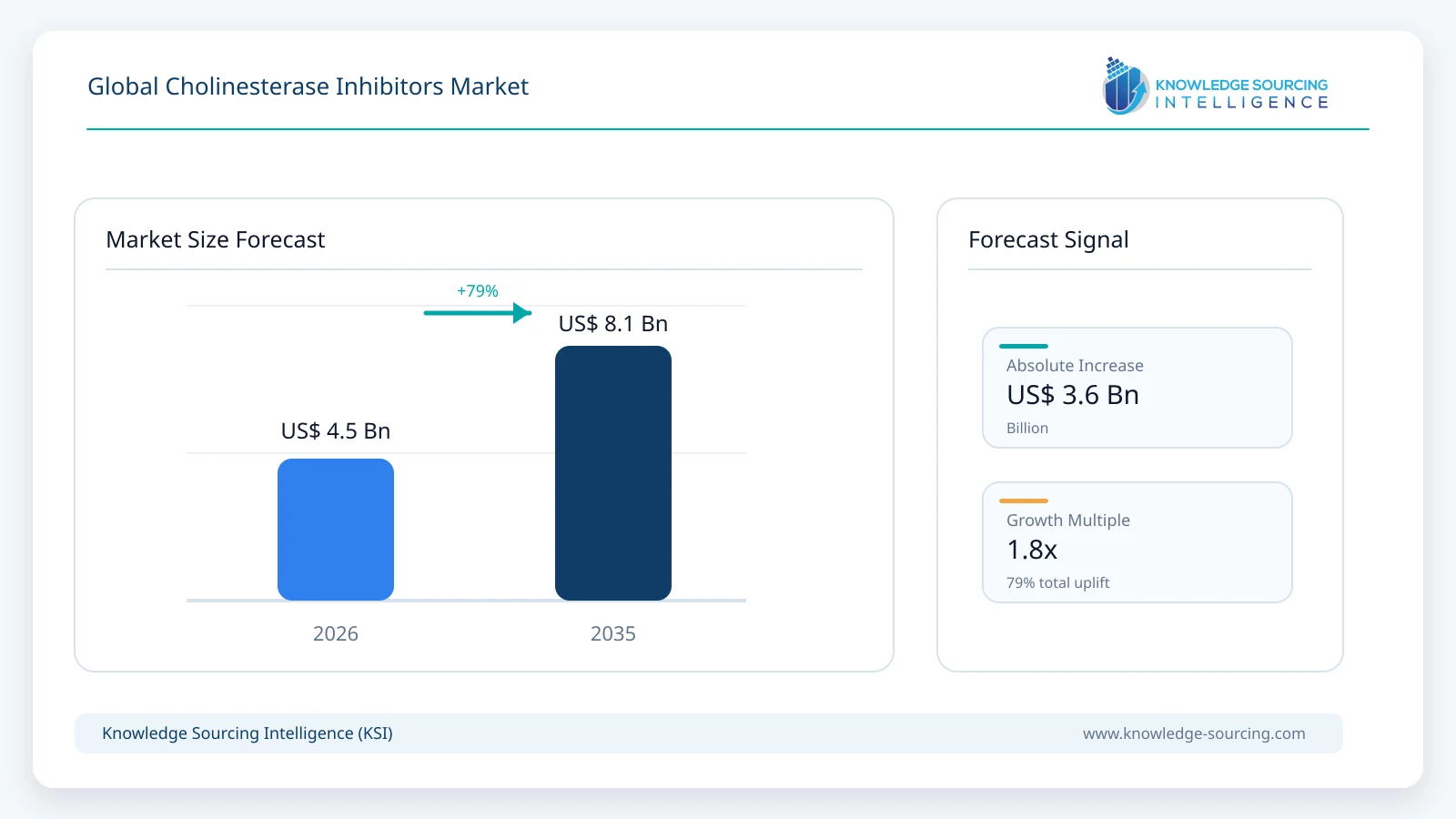
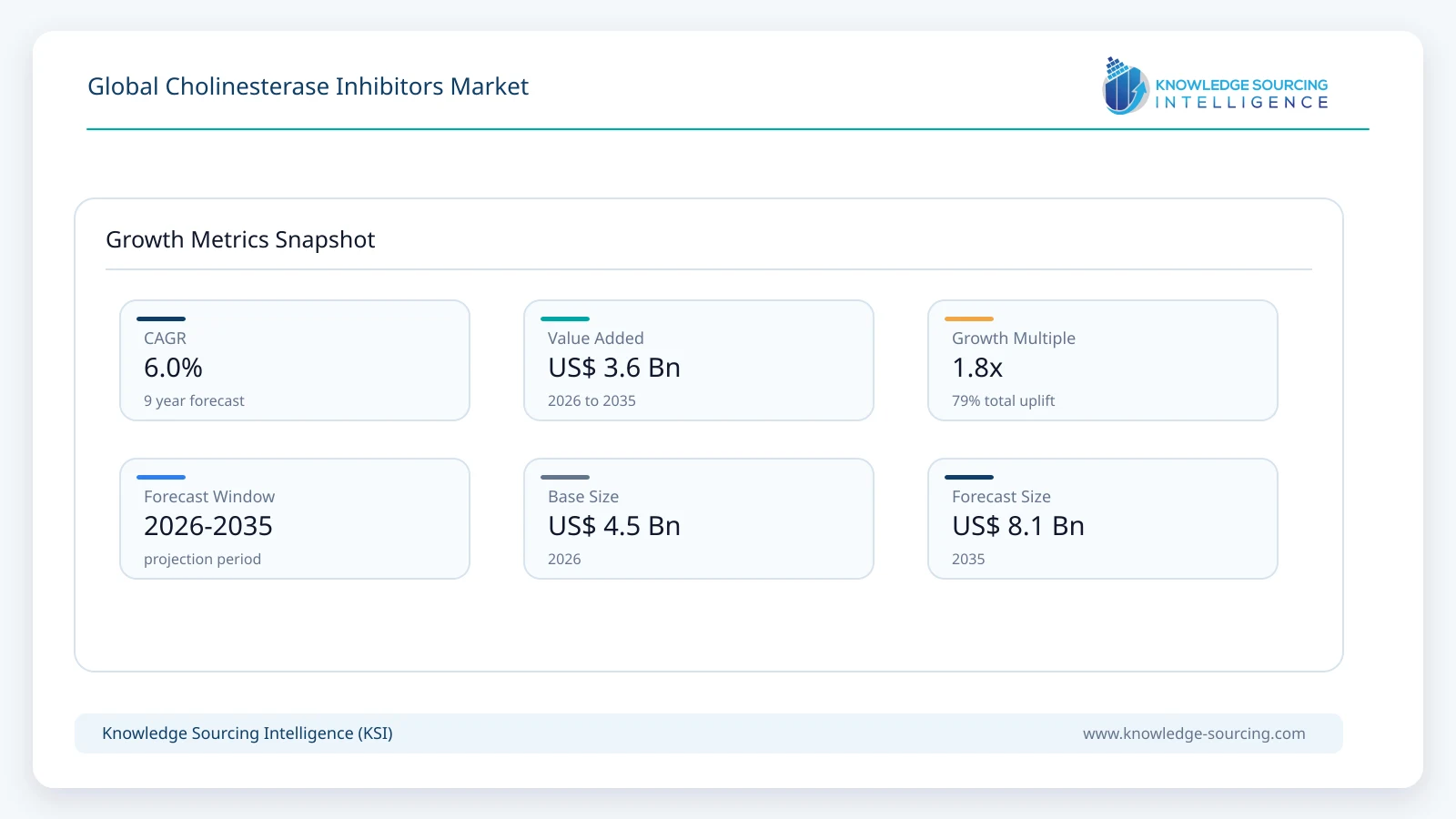
The Global Cholinesterase Inhibitors Market is projected to grow at a CAGR of 6.0% the forecast period, increasing from USD 4.51 billion in 2026 to USD 8.09 billion by 2035.
Highlights:
- 1Dementia prevalence continues to increase because population aging is expanding the cognitive disorder patient pool, which sustains cholinesterase inhibitor demand.
- 2Earlier diagnosis rates are improving treatment initiation because healthcare systems increasingly emphasize cognitive screening and intervention.
- 3Rivastigmine transdermal adoption is increasing because gastrointestinal tolerability concerns continue affecting oral treatment persistence.
- 4Generic penetration remains high because major cholinesterase inhibitors have lost exclusivity, which supports prescription access but limits branded revenue growth.
Cholinesterase inhibitors increase acetylcholine availability because they inhibit acetylcholinesterase activity within the central nervous system. Cognitive disorders continue generating sustained prescription demand because cholinergic neurotransmission declines as neurodegeneration progresses. Physicians are maintaining utilization of cholinesterase inhibitors while attempting to preserve cognition, daily functioning, and behavioral stability. This therapeutic role sustains demand despite limited disease-modifying activity.
The market depends heavily on Alzheimer's disease prevalence because approved cholinesterase inhibitors remain concentrated within dementia treatment pathways. Diagnostic rates are increasing as healthcare systems continue expanding cognitive screening initiatives. Treatment initiation therefore continues to occur earlier within disease progression. This trend supports longer treatment duration and greater cumulative prescription exposure.
Donepezil, rivastigmine, and galantamine remain the primary approved cholinesterase inhibitors used in dementia management. Clinical utilization persists because these therapies continue demonstrating modest cognitive and functional benefits across approved patient populations.
Market Dynamics
Market Drivers
Expanding Global Dementia Burden: Dementia prevalence remains the largest market driver because neurodegenerative disease incidence continues rising alongside population aging. Healthcare systems are diagnosing cognitive disorders earlier while awareness campaigns continue increasing clinical identification rates. Treatment demand therefore expands beyond historical specialist neurology settings. This trend strengthens long-term cholinesterase inhibitor utilization.
Sustained Role in Alzheimer's Disease Management: Alzheimer’s disease treatment continues relying on symptomatic cognitive support because disease-modifying therapies remain limited in eligible patient populations. Physicians are maintaining cholinesterase inhibitor prescribing while broader treatment strategies continue evolving. Cognitive stabilization therefore remains a primary treatment objective. This dynamic preserves therapeutic relevance.
Growth in Parkinson’s Disease Dementia Treatment: Parkinson’s disease dementia continues generating treatment demand because progressive cognitive decline increasingly affects long-term neurological outcomes. Rivastigmine utilization remains clinically important while neurologists continue seeking symptom-management approaches. This expansion broadens demand beyond Alzheimer's disease populations.
Increased Cognitive Screening Activity: Healthcare systems increasingly prioritize dementia diagnosis because delayed intervention worsens patient management complexity. Screening initiatives are expanding while referral pathways continue improving. Earlier identification therefore increases treatment eligibility. This environment supports prescription growth.
Market Restraints
Generic competition limits branded revenue expansion because major cholinesterase inhibitors face widespread generic availability.
Clinical efficacy remains modest because available therapies primarily provide symptomatic benefit rather than disease modification.
Gastrointestinal adverse events affect treatment persistence because nausea, vomiting, and appetite loss continue influencing discontinuation rates.
Market Opportunities
Expansion of Transdermal Delivery Systems: Treatment adherence remains a challenge because oral cholinesterase inhibitors frequently produce gastrointestinal intolerance. Physicians are increasing transdermal rivastigmine utilization while patients continue requiring long-term therapy. Improved tolerability therefore supports persistence. This trend strengthens differentiated formulation demand.
Combination Therapy Utilization: Alzheimer’s disease progression creates multidimensional treatment needs because cognitive decline continues advancing despite symptomatic therapy. Clinicians are increasingly combining cholinesterase inhibitors with memantine while seeking broader functional stabilization. This approach expands lifecycle management opportunities.
Earlier Intervention Strategies: Healthcare providers increasingly emphasize early cognitive intervention because treatment benefit appears greater during earlier disease stages. Diagnosis rates are improving while awareness programs continue expanding. Earlier prescribing therefore increases cumulative treatment exposure. This environment supports sustained prescription volume.
Emerging Market Access Expansion: Neurological care infrastructure continues improving across developing healthcare systems because aging populations increasingly require dementia management. Generic cholinesterase inhibitors are expanding accessibility while affordability remains a central prescribing factor. This trend supports volume growth across emerging regions.
Government Regulations
Regulatory Authority | Regulatory Focus | Market Impact |
FDA | Dementia drug approval and safety monitoring | Supports cognitive therapy access |
EMA | Centralized approval and pharmacovigilance | Expands European treatment availability |
PMDA | Neurology drug review | Supports Japanese dementia management |
NMPA | Drug registration and approval | Increases cognitive therapy accessibility in China |
CDSCO | Generic and branded drug regulation | Supports treatment availability in India |
Market Segmentation
By Molecule
Donepezil maintains substantial prescription share because broad labeling and long-standing physician familiarity continue supporting utilization. Rivastigmine remains differentiated because transdermal administration addresses adherence and tolerability challenges. Galantamine retains clinical relevance where clinicians seek alternative cholinergic mechanisms involving nicotinic receptor modulation. Tacrine remains historically important because it established the early cholinesterase inhibitor treatment category despite eventual commercial decline driven by safety concerns. Prescription demand increasingly concentrates around donepezil because generic availability and broad indication coverage support sustained utilization.
By Indication
Alzheimer’s disease dominates demand because cholinergic dysfunction remains central to approved treatment pathways. Parkinson’s disease dementia continues supporting rivastigmine utilization because cognitive decline increasingly affects long-term neurological outcomes. Dementia with Lewy bodies remains an important off-label and guideline-supported treatment area because cholinergic deficits contribute substantially to symptom burden. This indication diversification supports prescription stability despite competitive therapeutic evolution.
By Route of Administration
Oral administration remains the dominant route because donepezil and galantamine maintain extensive tablet-based utilization. Transdermal administration continues expanding because long-term dementia management requires improved adherence and tolerability. Rivastigmine patches therefore are strengthening treatment persistence in patients unable to maintain oral therapy. This shift supports formulation-based differentiation within a largely genericized market.
Regional Analysis
North America
North America maintains significant cholinesterase inhibitor utilization because Alzheimer's disease diagnosis rates remain comparatively high. Cognitive screening activity continues expanding while neurologists and geriatric specialists increasingly emphasize earlier intervention. Generic availability constrains branded revenue because payer systems prioritize cost-efficient dementia treatment. Physicians continue prescribing cholinesterase inhibitors because symptomatic cognitive stabilization remains clinically valuable despite emerging disease-modifying therapies. Anti-amyloid adoption is increasing while treatment eligibility remains dependent on biomarker confirmation and monitoring infrastructure. This environment preserves demand for cholinesterase inhibitors because many patients remain outside biologic eligibility pathways. Long-term dementia prevalence therefore continues supporting prescription volume.
Europe
Europe supports sustained cholinesterase inhibitor demand because public healthcare systems maintain broad dementia treatment access. Generic penetration remains extensive while reimbursement authorities continue emphasizing affordability. Physicians are maintaining utilization because symptomatic management remains central across many dementia populations. Anti-amyloid therapies are receiving attention while access constraints continue limiting immediate widespread adoption. This dynamic supports continued reliance on established cholinesterase inhibitor therapies.
Asia Pacific
Asia Pacific is becoming a major demand center because aging populations continue increasing dementia prevalence. Healthcare systems are improving diagnostic capabilities while cognitive disorder awareness continues expanding. Generic medicines dominate prescribing because affordability strongly influences treatment access. Governments increasingly recognize dementia burden while neurological infrastructure continues developing. This combination supports long-term prescription growth.
Rest of the World
Emerging healthcare systems continue expanding dementia treatment access because cognitive disorders remain underdiagnosed across many regions. Generic cholinesterase inhibitors support affordability while treatment awareness gradually improves. Demand is increasing because population aging continues raising neurological disease burden. This environment supports steady prescription expansion despite limited specialty care infrastructure.
Regulatory Landscape
Regulatory agencies continue emphasizing pharmacovigilance because long-term dementia treatment requires sustained exposure monitoring. Cholinesterase inhibitors maintain established regulatory positions because safety and efficacy profiles are extensively characterized through decades of clinical use. This regulatory stability supports ongoing utilization.
Treatment guidelines increasingly incorporate disease-modifying therapies because Alzheimer's disease management is evolving. Cholinesterase inhibitors remain foundational because most patients continue requiring symptomatic cognitive support. Regulatory frameworks therefore continue supporting broad accessibility across dementia populations.
Pipeline Analysis
Pipeline activity within cholinesterase inhibitors increasingly focuses on formulation optimization because core mechanisms are already well established. Developers are exploring adherence-enhancing delivery technologies while seeking improved tolerability profiles. Innovation therefore concentrates more on lifecycle extension than entirely novel cholinergic mechanisms.
Combination strategies continue attracting interest because dementia progression requires multidimensional treatment approaches. Cholinesterase inhibitors are increasingly evaluated alongside complementary therapies while cognitive management frameworks continue evolving. This direction supports continued therapeutic relevance.
Competitive Landscape
Eisai
Eisai remains strategically distinct because it developed Aricept, one of the most recognized Alzheimer's disease therapies globally. Demand continues to benefit from physician familiarity while long-term clinical experience supports treatment confidence. The company’s historical leadership in cognitive disorders continues shaping market perception. This position sustains relevance despite broader therapeutic evolution.
Pfizer
Pfizer maintains importance through its historical Aricept co-commercialization role because large-scale commercialization expanded global treatment access. Demand remains influenced by established prescribing patterns while extensive physician exposure continues supporting molecule familiarity. This legacy preserves strategic visibility.
Novartis
Novartis differentiates itself through Exelon because rivastigmine transdermal systems address tolerability and adherence barriers. Demand is shifting toward patient-friendly administration while long-term dementia management increasingly requires persistence-focused approaches. This formulation advantage strengthens competitive positioning.
Johnson & Johnson
Johnson & Johnson maintains relevance through galantamine commercialization history because alternative cholinergic approaches continue supporting therapeutic diversity. Demand persists where clinicians seek molecule-specific tolerability or response advantages. This positioning supports continued market participation.
Shionogi & Co., Ltd.
Shionogi remains relevant within regional cognitive disorder treatment markets because Japanese dementia management continues expanding alongside population aging. Demand increasingly reflects demographic pressure. This environment supports ongoing neurological market participation.
Teva Pharmaceutical Industries
Teva benefits from generic leadership because affordability increasingly determines treatment accessibility. Demand continues expanding where healthcare systems prioritize low-cost dementia therapies. This structure strengthens generic market influence.
Sun Pharmaceutical Industries
Sun Pharmaceutical Industries supports market expansion through generic availability because emerging healthcare systems require scalable treatment access. Demand increasingly depends on affordability and distribution reach. This position strengthens presence across developing markets.
Dr. Reddy's Laboratories
Dr. Reddy’s Laboratories remains important within generic cognitive disorder treatment because dementia prevalence continues increasing globally. Demand supports large-volume generic utilization while healthcare systems prioritize accessible long-term therapy. This dynamic reinforces competitive relevance.
Key Developments
May 2026: argenx SE, a global immunology company committed to improving the lives of people suffering from severe autoimmune diseases, announced that the U.S. Food and Drug Administration (FDA) approved a label expansion for VYVGART® (efgartigimod alfa-fcab) and VYVGART Hytrulo® (efgartigimod alfa and hyaluronidase-qvfc) for the treatment of adult patients with generalized myasthenia gravis (gMG).
March 2025: Alpha Cognition Inc., a biopharmaceutical company dedicated to advancing treatments for neurodegenerative diseases, announced the official commercial launch of ZUNVEYL, a new treatment for mild to moderate Alzheimer’s disease.
Strategic Insights and Future Market Outlook
The cholinesterase inhibitor market increasingly depends on dementia prevalence because population aging continues expanding the addressable treatment population. Demand is shifting toward earlier intervention while healthcare systems increasingly prioritize cognitive screening and diagnosis. This trend supports sustained prescription utilization.
Competitive pressure from disease-modifying therapies is increasing because Alzheimer's treatment paradigms continue evolving. Cholinesterase inhibitors remain clinically relevant while biologic eligibility limitations preserve large symptomatic-treatment populations. This coexistence supports continued utilization rather than immediate displacement.
Future growth increasingly centers on treatment accessibility, adherence optimization, and combination therapy strategies because core cholinergic mechanisms are already well established. Manufacturers continue focusing on lifecycle management while dementia care pathways increasingly integrate multiple therapeutic approaches. This environment supports stable long-term demand despite broader neurological innovation.
The Global Cholinesterase Inhibitors Market remains anchored by symptomatic cognitive management, expanding dementia prevalence, and broad generic accessibility. Treatment demand continues growing because healthcare systems require scalable cognitive-support therapies even as disease-modifying Alzheimer's interventions gradually reshape the neurological treatment landscape.
Cholinesterase Inhibitors Market Scope:
| Report Metric | Details |
|---|---|
| Total Market Size in 2026 | USD 4.51 billion |
| Total Market Size in 2035 | USD 8.09 billion |
| Forecast Unit | USD Billion |
| Growth Rate | 6.0% |
| Study Period | 2021 to 2035 |
| Historical Data | 2021 to 2024 |
| Base Year | 2025 |
| Forecast Period | 2026 – 2035 |
| Segmentation | Molecule, Indication, Route of Administration, Geography |
| Companies |
|
Market Segmentation
By Geography
Key Countries Analysis
Table of Contents
1. EXECUTIVE SUMMARY
1.1 Strategic Overview
1.1.1 Cholinesterase Inhibitors Market Definition and Scope
1.1.2 Drug-Class Overview
1.1.3 Key Clinical Insights
1.1.4 Key Commercial Insights
1.1.5 Regulatory Milestones
1.1.6 Innovation Highlights
1.1.7 Strategic Opportunities and Risks
1.2 Market Snapshot
1.2.1 Global Revenue Overview
1.2.2 Prescription Volume Overview
1.2.3 Treated Patient Overview
1.2.4 Forecast Summary
1.3 Executive Conclusions
1.3.1 Market Evolution Outlook
1.3.2 Competitive Positioning Summary
1.3.3 Innovation Outlook
2. DISEASE & PATIENT POPULATION INTELLIGENCE
2.1 Disease Landscape Overview
2.1.1 Alzheimer's Disease
2.1.2 Parkinson’s Disease Dementia (PDD)
2.1.3 Dementia with Lewy Bodies (DLB)
2.1.4 Vascular Dementia (Off-Label Utilization Assessment)
2.1.5 Mild Cognitive Impairment Evaluation
2.2 Epidemiology Assessment
2.2.1 Global Dementia Prevalence
2.2.2 Alzheimer's Disease Incidence
2.2.3 Disease Burden Assessment
2.2.4 Mortality and Disability Burden
2.3 Patient Funnel Modeling
2.3.1 Total Cognitive Disorder Population
2.3.2 Diagnosed Population
2.3.3 Pharmacologically Treated Population
2.3.4 Cholinesterase Inhibitor Eligible Population
2.3.5 Advanced Therapy Eligible Population
2.4 Alzheimer's Disease Severity Segmentation
2.4.1 Mild Alzheimer's Disease
2.4.2 Moderate Alzheimer's Disease
2.4.3 Severe Alzheimer's Disease
2.5 Biomarker-Based Patient Segmentation
2.5.1 Amyloid PET Positive Population
2.5.2 CSF Amyloid Biomarker Population
2.5.3 Tau Biomarker Population
2.6 Comorbidity Assessment
2.6.1 Depression
2.6.2 Anxiety Disorders
2.6.3 Cardiovascular Disease
2.6.4 Sleep Disorders
2.6.5 Parkinsonism
2.7 Treatment Journey Analysis
2.7.1 Diagnosis and Cognitive Assessment
2.7.2 Initial Pharmacological Intervention
2.7.3 Combination Therapy Utilization
2.7.4 Transition to Advanced Therapies
2.7.5 Long-Term Maintenance and Persistence
3. PHARMACOLOGICAL & MECHANISTIC LANDSCAPE
3.1 Cholinesterase Inhibitor Class Overview
3.1.1 Historical Evolution of Cholinesterase Inhibitors
3.1.2 Current Treatment Paradigm
3.1.3 Future Therapeutic Positioning
3.2 Cholinergic Neurotransmission Biology
3.2.1 Acetylcholine Signaling Pathway
3.2.2 Acetylcholinesterase Activity
3.2.3 Butyrylcholinesterase Activity
3.2.4 Cognitive Function Pathways
3.3 Mechanism of Action Landscape
3.3.1 Aricept (Donepezil) – Donepezil Hydrochloride
3.3.2 Exelon (Rivastigmine) – Rivastigmine
3.3.3 Razadyne/Reminyl (Galantamine) – Galantamine
3.3.4 Cognex (Tacrine) – Tacrine Historical Assessment
3.4 Biological Pathway Assessment
3.4.1 Cholinergic Deficiency Hypothesis
3.4.2 Neurotransmitter Restoration Pathway
3.4.3 Cognitive Function Preservation
3.4.4 Neurodegeneration Progression Pathways
3.5 Competitive Mechanism Benchmarking
3.5.1 Cholinesterase Inhibitors vs NMDA Receptor Antagonists
3.5.2 Cholinesterase Inhibitors vs Anti-Amyloid Monoclonal Antibodies
3.5.3 Cholinesterase Inhibitors vs Disease-Modifying Alzheimer's Therapies
3.5.4 Monotherapy vs Combination Therapy Assessment
3.6 Pharmacokinetic and Pharmacodynamic Assessment
3.6.1 Oral Formulations
3.6.2 Transdermal Formulations
3.6.3 Immediate-Release Formulations
3.6.4 Extended-Release Formulations
4. CLINICAL OUTCOMES & EVIDENCE BENCHMARKING
4.1 Clinical Endpoint Framework
4.1.1 Alzheimer's Disease Assessment Scale-Cognitive Subscale (ADAS-Cog)
4.1.2 Mini-Mental State Examination (MMSE)
4.1.3 Clinical Dementia Rating Scale (CDR)
4.1.4 Activities of Daily Living (ADL)
4.1.5 Neuropsychiatric Inventory (NPI)
4.2 Landmark Clinical Trial Assessment
4.2.1 Donepezil Pivotal Alzheimer's Disease Studies
4.2.2 Rivastigmine Alzheimer's Disease Clinical Program
4.2.3 Rivastigmine Parkinson’s Disease Dementia Studies
4.2.4 Galantamine Alzheimer's Disease Clinical Program
4.2.5 Tacrine Historical Clinical Program
4.3 Head-to-Head Comparative Evidence
4.3.1 Donepezil vs Rivastigmine
4.3.2 Donepezil vs Galantamine
4.3.3 Rivastigmine vs Galantamine
4.3.4 Cholinesterase Inhibitors vs Memantine
4.4 Safety and Tolerability Assessment
4.4.1 Gastrointestinal Adverse Events
4.4.2 Cardiovascular Safety
4.4.3 Weight Loss Risk
4.4.4 Neuropsychiatric Events
4.4.5 Treatment Discontinuation Analysis
4.5 Real-World Evidence Assessment
4.5.1 Registry-Based Evidence
4.5.2 Claims Database Analysis
4.5.3 Long-Term Treatment Persistence
4.5.4 Healthcare Resource Utilization
5. PIPELINE & INNOVATION LANDSCAPE
5.1 Pipeline Overview
5.1.1 Pipeline by Development Stage
5.1.2 Pipeline by Mechanism
5.1.3 Pipeline by Formulation Type
5.2 Preclinical Pipeline Assessment
5.3 Phase I Pipeline Assessment
5.4 Phase II Pipeline Assessment
5.5 Phase III Pipeline Assessment
5.6 Next-Generation Innovation Assessment
5.6.1 Extended-Release Cholinesterase Inhibitors
5.6.2 Transdermal Delivery Optimization
5.6.3 Combination Therapy Development
5.6.4 Digital Therapeutic Integration
5.7 Innovation Benchmarking
5.7.1 Cognitive Benefit Enhancement Strategies
5.7.2 Adherence Improvement Technologies
5.7.3 Tolerability Optimization
5.8 Probability of Success Modeling
5.8.1 Preclinical to Phase I
5.8.2 Phase I to Phase II
5.8.3 Phase II to Phase III
5.8.4 Phase III to Approval
5.9 Launch Timeline Assessment
6. REGULATORY & MARKET ACCESS INTELLIGENCE
6.1 Regulatory Framework Assessment
6.1.1 FDA Regulatory Landscape
6.1.2 EMA Regulatory Landscape
6.1.3 PMDA Regulatory Landscape
6.1.4 NMPA Regulatory Landscape
6.1.5 CDSCO Regulatory Landscape
6.2 Historical Approval Timeline Analysis
6.3 Post-Marketing Safety Surveillance
6.4 Reimbursement Intelligence
6.4.1 Public Reimbursement Systems
6.4.2 Private Reimbursement Systems
6.4.3 Health Technology Assessment Trends
6.5 Pricing and Market Access Assessment
6.5.1 Generic Competition Impact
6.5.2 Cost-Effectiveness Evaluation
6.5.3 Access Barriers and Facilitators
7. MARKET SIZE, UTILIZATION & FORECAST
7.1 Market Modeling Framework
7.2 Revenue Analysis (USD)
7.2.1 Historical Revenue
7.2.2 Current Revenue
7.2.3 Forecast Revenue
7.3 Prescription Volume Analysis
7.3.1 Historical Prescription Trends
7.3.2 Current Prescription Volume
7.3.3 Forecast Prescription Volume
7.4 Treated Patient Analysis
7.5 Adoption Curve Assessment
7.6 Pricing Analysis
7.7 Forecast Assumptions
7.7.1 Epidemiology Assumptions
7.7.2 Clinical Practice Assumptions
7.7.3 Regulatory Assumptions
7.7.4 Commercial Assumptions
8. SEGMENTATION ANALYSIS
8.1 By Molecule
8.1.1 Donepezil
8.1.2 Rivastigmine
8.1.3 Galantamine
8.1.4 Tacrine (Historical Market Assessment)
8.2 By Indication
8.2.1 Alzheimer's Disease
8.2.2 Parkinson’s Disease Dementia
8.2.3 Dementia with Lewy Bodies
8.2.4 Other Cognitive Disorders
8.3 By Route of Administration
8.3.1 Oral
8.3.2 Transdermal
9. GEOGRAPHIC INTELLIGENCE
9.1 North America
9.1.1 Market Size
9.1.2 Adoption Trends
9.1.3 Regulatory Environment
9.1.4 Pricing Dynamics
9.2 Europe
9.2.1 Market Size
9.2.2 Adoption Trends
9.2.3 Regulatory Environment
9.2.4 Pricing Dynamics
9.3 Asia-Pacific
9.3.1 Market Size
9.3.2 Adoption Trends
9.3.3 Regulatory Environment
9.3.4 Pricing Dynamics
9.4 Latin America
9.4.1 Market Size
9.4.2 Adoption Trends
9.4.3 Regulatory Environment
9.4.4 Pricing Dynamics
9.5 Middle East & Africa
9.5.1 Market Size
9.5.2 Adoption Trends
9.5.3 Regulatory Environment
9.5.4 Pricing Dynamics
10. KEY COUNTRIES ANALYSIS
10.1 United States
10.2 Canada
10.3 Germany
10.4 United Kingdom
10.5 France
10.6 Italy
10.7 Spain
10.8 China
10.9 Japan
10.10 India
10.11 South Korea
10.12 Australia
10.13 Brazil
10.14 Mexico
10.15 Saudi Arabia
10.16 South Africa
11. COMPETITIVE LANDSCAPE
11.1 Market Share Assessment
11.1.1 Company-Level Market Share
11.1.2 Molecule-Level Market Share
11.2 Competitive Benchmarking
11.2.1 Clinical Efficacy
11.2.2 Safety and Tolerability
11.2.3 Pricing
11.2.4 Adoption Trends
11.3 Strategic Activity Assessment
11.3.1 Licensing Agreements
11.3.2 Partnerships
11.3.3 Acquisitions
11.4 Company Profiles and Molecule Mapping
11.4.1 Eisai
11.4.2 Pfizer
11.4.3 Novartis
11.4.4 Johnson & Johnson
11.4.5 Shionogi & Co. Ltd.
11.4.6 Teva Pharmaceutical Industries
11.4.7 Sun Pharmaceutical Industries
11.4.8 Dr. Reddy's Laboratories
12. DRUG-LEVEL COMMERCIAL INTELLIGENCE
12.1 Aricept (Donepezil)
12.1.1 Brand and Generic Overview
12.1.2 Developer and Commercial Rights
12.1.3 Mechanism of Action
12.1.4 Clinical Performance
12.1.5 Pricing and Access
12.1.6 Sales Performance
12.1.7 Lifecycle Management
12.1.8 Forecast Outlook
12.2 Exelon (Rivastigmine)
12.2.1 Product Overview
12.2.2 Oral and Transdermal Formulations
12.2.3 Clinical Evidence Assessment
12.2.4 Pricing and Access
12.2.5 Commercial Performance
12.2.6 Lifecycle Strategy
12.3 Razadyne/Reminyl (Galantamine)
12.3.1 Product Overview
12.3.2 Mechanism and Pharmacology
12.3.3 Clinical Benchmarking
12.3.4 Pricing Analysis
12.3.5 Commercial Evolution
12.3.6 Forecast Outlook
12.4 Cognex (Tacrine)
12.4.1 Historical Product Overview
12.4.2 Clinical Development History
12.4.3 Safety Challenges
12.4.4 Market Withdrawal and Lessons Learned
13. INVESTMENT & DEAL LANDSCAPE
13.1 Venture Capital and Private Equity Activity
13.2 Licensing and Commercialization Agreements
13.3 Strategic Partnerships
13.4 Mergers and Acquisitions
13.5 Investment Attractiveness Assessment
14. FUTURE OUTLOOK & STRATEGIC RECOMMENDATIONS
14.1 Future Market Evolution
14.2 Competitive Outlook
14.3 Alzheimer's Disease Treatment Paradigm Outlook
14.4 Pricing and Reimbursement Outlook
14.5 Strategic Recommendations
14.5.1 Pharmaceutical Manufacturers
14.5.2 Investors
14.5.3 Healthcare Providers
14.5.4 Payers
15. METHODOLOGY & DATA FRAMEWORK
15.1 Research Methodology
15.2 Epidemiology Modeling Framework
15.3 Clinical Evidence Assessment Framework
15.4 Forecasting Methodology
15.5 Competitive Intelligence Framework
15.6 Data Sources
15.6.1 FDA
15.6.2 EMA
15.6.3 PMDA
15.6.4 NMPA
15.6.5 CDSCO
15.6.6 ClinicalTrials.gov
15.6.7 EU Clinical Trials Register
15.6.8 Company Annual Reports
15.6.9 Peer-Reviewed Publications
15.7 Assumptions and Limitations
15.8 Abbreviations and Definitions
Navigate
Trusted by the world's leading organizations











