
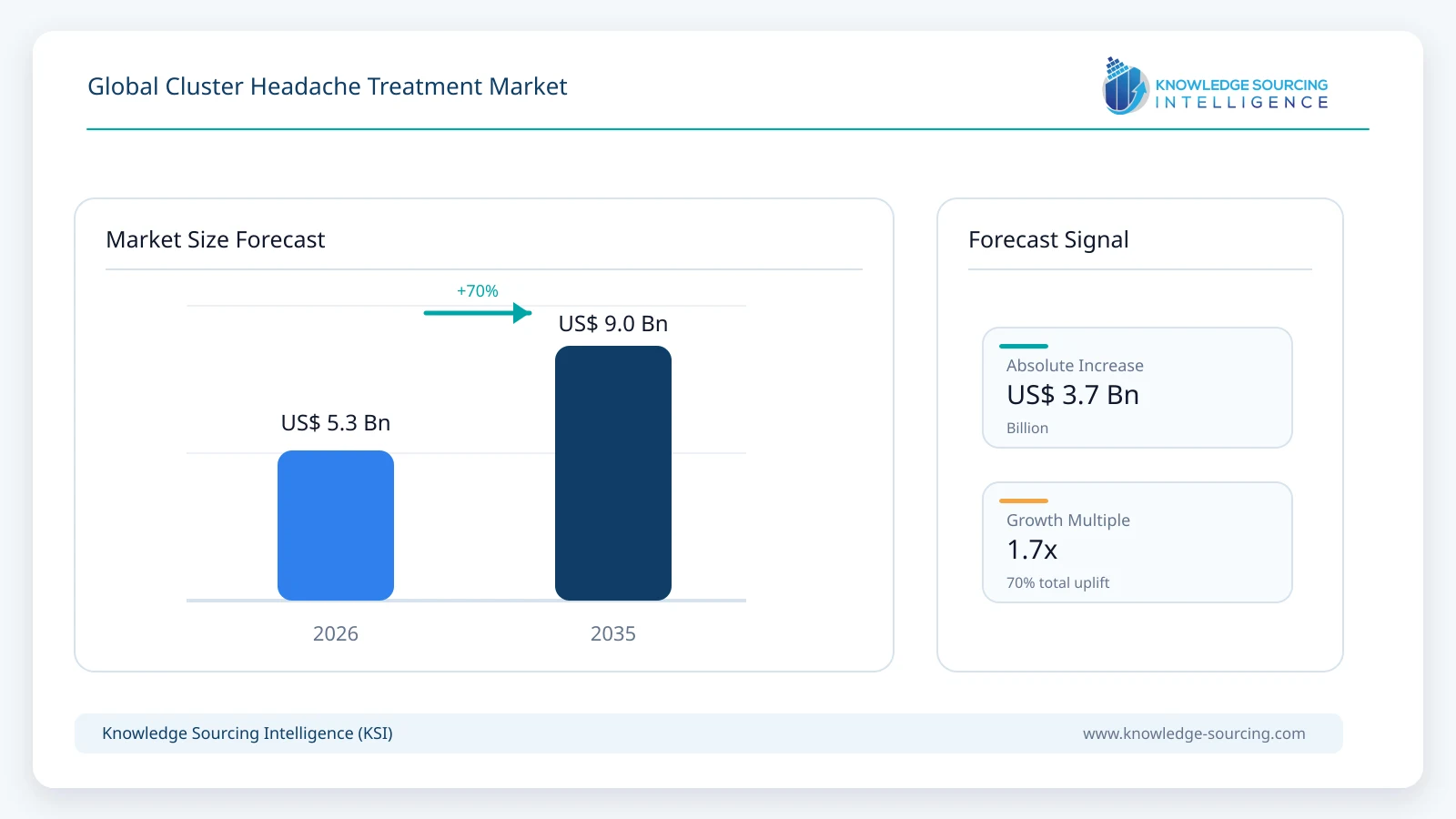
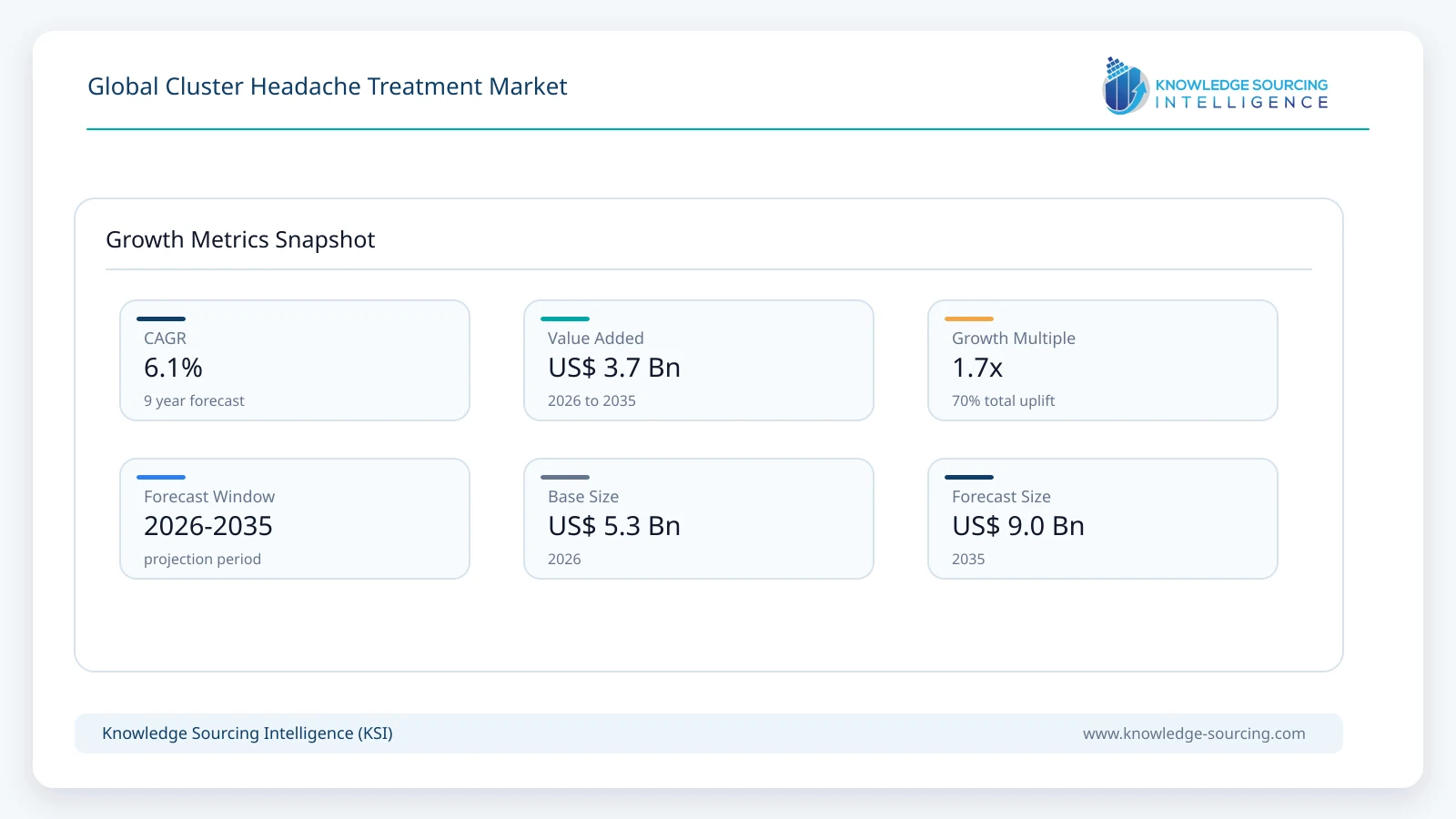
The Global Cluster Headache Treatment Market is expected to grow from USD 5.31 billion in 2026 at a 6.1% CAGR to USD 9.01 billion in 2035.
Highlights:
- 1High disease burden is increasing demand for preventive therapies because recurrent attacks significantly impair patient quality of life.
- 2Expansion of CGRP-targeted therapies is improving treatment specificity because neuropeptide modulation directly addresses headache pathophysiology.
- 3Neuromodulation adoption is increasing because patients and physicians are seeking non-pharmacological alternatives with home-use capability.
- 4Regulatory recognition of rare neurological disorders is encouraging pipeline investment because sponsors are pursuing differentiated treatment strategies.
Cluster headache is a rare neurological disorder characterized by severe unilateral headache attacks associated with autonomic symptoms. The treatment ecosystem consists of acute therapies such as triptans and oxygen, preventive therapies including calcium channel blockers and CGRP inhibitors, and bridge therapies based on corticosteroids and nerve blocks. The disease affects approximately 0.1% of the global population, creating a small but clinically significant patient pool that requires specialized care.
Demand is increasing for therapies that reduce attack frequency while maintaining rapid symptom control because existing therapies often present limitations related to cardiovascular safety, treatment adherence, or incomplete response. Regulatory agencies are supporting innovation through orphan disease frameworks and expedited pathways, which are encouraging sponsors to pursue differentiated therapies and device-based approaches.
Market Dynamics
Market Drivers
Increasing Adoption of CGRP-Targeted Therapies: Preventive therapy remains a major unmet need in cluster headache because conventional agents often show variable efficacy and tolerability. Demand is shifting toward CGRP-targeted therapies as clinical evidence continues supporting their role in neurovascular modulation. This transition increases investment in biologics because sponsors seek differentiated products with longer treatment duration and better adherence. The outcome is a treatment landscape that increasingly emphasizes mechanism-based therapies.
Growing Use of Neuromodulation Devices: Device-based interventions represent an important treatment alternative because many patients require non-drug options or adjunctive therapies. Adoption is increasing as portable vagus nerve stimulation devices are demonstrating effectiveness in episodic cluster headache and improving home-based disease management. Physicians are integrating these devices earlier in treatment algorithms because patients seek therapies with fewer systemic adverse effects. The result is a broader role for neuromodulation across specialized headache centers.
Improving Diagnosis and Specialist Referral: The market depends heavily on diagnosis rates because cluster headache remains underrecognized in primary care. Referral volumes are increasing as awareness programs and updated clinical guidelines are improving disease recognition. This trend expands the addressable treatment population because patients gain earlier access to specialty neurology services. The outcome is a stronger demand for both acute and preventive therapies.
Market Restraints
A limited number of approved preventive therapies restricts treatment options.
Rare disease prevalence reduces commercial attractiveness for some sponsors.
High biologic and device costs limit reimbursement coverage across several healthcare systems.
Market Opportunities
Expansion of Precision Neurology: Cluster headache management increasingly focuses on biological mechanisms because treatment response varies across patient populations. Precision neurology approaches are emerging as biomarkers and disease phenotyping continue improving. This trend encourages the development of targeted therapies because sponsors seek greater clinical differentiation. The outcome is a pipeline increasingly centered on personalized treatment strategies.
Development of Novel Neuromodulation Platforms: Current neuromodulation therapies address only a subset of patients because efficacy varies according to disease subtype. Innovation is expanding as companies continue developing implantable and non-invasive stimulation technologies. This shift creates opportunities for device manufacturers because patients increasingly prefer minimally invasive therapies. The result is a broader competitive landscape.
Integration of Digital Monitoring: Treatment outcomes depend on attack frequency and symptom tracking because cluster headache exhibits cyclical disease patterns. Digital monitoring platforms are gaining attention as healthcare providers increasingly emphasize remote disease management. This evolution improves treatment optimization because physicians receive better longitudinal patient data. The outcome is greater demand for integrated digital therapeutic ecosystems.
Disease & Epidemiology Analysis
Cluster headache belongs to the group of trigeminal autonomic cephalalgias and represents one of the most painful neurological disorders. The disease usually presents as unilateral orbital or temporal pain accompanied by ipsilateral autonomic symptoms, including lacrimation, rhinorrhea, and conjunctival injection. Disease activity follows circadian and seasonal patterns because hypothalamic dysfunction plays a central role in disease pathophysiology.
The prevalence of cluster headache is estimated at approximately 0.1% to 0.2% of the general population, which corresponds to roughly one affected individual per 500 to 1,000 people. Epidemiological studies show that men remain more frequently affected than women, although the gender gap is narrowing because diagnostic awareness is improving. Familial clustering is also evident because first-degree relatives demonstrate substantially higher risk than the general population.
Demand for preventive therapies is increasing because chronic and episodic forms of the disease continue causing significant disability. Patients increasingly require long-term management strategies because recurrent attacks affect productivity, mental health, and healthcare utilization.
Treatment Guidelines Landscape
Organization | Acute Treatment | Preventive Treatment | Bridge Treatment |
European Academy of Neurology | High-flow oxygen, subcutaneous sumatriptan | Verapamil, galcanezumab, lithium, topiramate | Oral or IV corticosteroids |
American Headache Society | Oxygen and triptans | Verapamil and CGRP therapies | Corticosteroids |
National Institute for Health and Care Excellence | Oxygen therapy and triptans | Verapamil-based prevention | Corticosteroid transition |
Organization | Acute Treatment | Preventive Treatment | Bridge Treatment |
Market Segmentation
By Treatment Type
Acute treatment remains the foundation of cluster headache management because patients require immediate symptom relief during attacks. Demand is shifting toward injectable triptans, oxygen therapy, and rapid-onset formulations as treatment effectiveness increasingly depends on speed of action. Preventive therapies are expanding because patients seek reduced attack frequency and longer remission periods. Bridge therapies continue supporting disease management because corticosteroids provide temporary control while preventive agents achieve therapeutic effect.
By End User
Hospitals remain major treatment centers because severe cluster headache often requires specialist neurological care and access to oxygen therapy. Demand is shifting toward specialty clinics as headache centers continue expanding expertise in biologics and neuromodulation. Home care settings are gaining importance because portable devices and self-administered therapies increasingly enable long-term disease management outside hospitals.
By Distribution Channel
Hospital pharmacies dominate distribution because biologics and specialized therapies often require institutional prescribing. Retail pharmacies continue supporting conventional therapies because triptans and preventive agents remain widely utilized. Online pharmacies are expanding because chronic patients increasingly prefer convenient refill options and home delivery services.
Regional Analysis
North America Market Analysis
North America represents the most advanced treatment market because specialty neurology networks and strong reimbursement systems support the adoption of innovative therapies. Demand is shifting toward biologics and neuromodulation as clinicians increasingly prioritize preventive management and personalized treatment pathways. Regulatory clarity encourages pipeline development because orphan disease incentives improve commercial viability. The United States remains the largest regional market because patients benefit from access to specialty headache centers and the rapid introduction of new therapies.
Europe Market Analysis
Europe maintains a strong clinical foundation because standardized treatment guidelines and universal healthcare systems improve treatment accessibility. Demand is increasing for CGRP inhibitors and neuromodulation as healthcare providers continue adopting evidence-based innovations. Budget pressures remain important because biologics require careful reimbursement evaluation. The market, therefore, balances innovation with cost-effectiveness, creating opportunities for therapies demonstrating superior outcomes.
Asia Pacific Market Analysis
Asia Pacific remains an emerging market because diagnosis rates continue improving, and healthcare expenditure is increasing. Demand is shifting toward specialist neurological services as awareness of rare headache disorders expands. Access disparities remain evident because biologics and advanced devices are not uniformly reimbursed across countries. The region nevertheless offers long-term growth potential because healthcare infrastructure continues to develop.
Rest of the World
The Rest of the World market remains constrained by diagnostic challenges and limited specialist availability. Demand is increasing gradually as neurological care infrastructure expands and awareness campaigns improve disease recognition. Access to advanced therapies remains uneven because reimbursement systems vary substantially across countries. The market, therefore, continues relying heavily on conventional pharmacological therapies.
Regulatory Landscape
The regulatory environment increasingly recognizes cluster headache as a rare and disabling neurological disorder. Authorities are supporting innovation because unmet clinical needs remain substantial and treatment options are limited. Sponsors, therefore, pursue orphan disease strategies and targeted regulatory pathways to accelerate development.
Guideline updates are influencing prescribing behavior because clinicians increasingly rely on evidence-based recommendations for oxygen therapy, verapamil, corticosteroids, CGRP inhibitors, and neuromodulation. This framework improves treatment consistency because healthcare providers adopt standardized clinical approaches.
Pipeline Analysis
Pipeline activity remains focused on CGRP modulation, neuromodulation, and novel neuropeptide targets because current therapies do not adequately address all patient populations. Sponsors are prioritizing preventive therapies as long-term disease control increasingly influences treatment selection.
Biologics continue attracting investment because targeted mechanisms provide opportunities for clinical differentiation. Neuromodulation platforms are also expanding because patients increasingly prefer non-invasive therapies that reduce medication burden. The pipeline, therefore, reflects a transition from symptomatic relief toward disease-specific and patient-centered treatment approaches.
Reimbursement Landscape
Reimbursement remains favorable for conventional therapies because oxygen, triptans, and verapamil are well established within clinical practice. Coverage for biologics and neuromodulation varies because payers require evidence demonstrating meaningful clinical benefit and cost-effectiveness.
Demand for reimbursed preventive therapies is increasing because chronic disease management reduces healthcare utilization and improves patient outcomes. Payers are therefore evaluating innovative therapies according to long-term economic and clinical value rather than acquisition cost alone.
Competitive Landscape
Eli Lilly and Company
The company remains strategically distinct because it commercialized galcanezumab for episodic cluster headache and established a strong position in CGRP-targeted neurology. Demand is increasing for mechanism-based preventive therapies as physicians increasingly seek alternatives to traditional calcium channel blockers. Lilly continues leveraging migraine expertise because shared biological pathways create commercial and scientific synergies.
electroCore, Inc.
electroCore differentiates itself through non-invasive vagus nerve stimulation technology. Demand is increasing for home-based neuromodulation because patients increasingly prefer non-pharmacological interventions with minimal systemic side effects. The company continues expanding clinical evidence because long-term adoption depends on demonstrating sustained efficacy and healthcare value.
Pfizer Inc.
Pfizer maintains strategic relevance through its neurology expertise and broad pharmaceutical portfolio. Demand for innovative headache therapies continues to increase because preventive treatment options remain limited. The company evaluates opportunities across neuroinflammation and pain management, which positions it to participate in future therapeutic advancements.
GlaxoSmithKline plc
GSK benefits from extensive neuroscience capabilities and global commercial infrastructure. Demand is shifting toward targeted neurological therapies as clinicians increasingly seek treatments with improved safety and efficacy. The company continues emphasizing specialty medicine because rare neurological disorders provide opportunities for differentiated innovation.
Medtronic
Medtronic remains strategically important because neuromodulation increasingly influences headache management. Demand for minimally invasive interventions continues to expand as patients seek alternatives to chronic pharmacotherapy. The company leverages extensive device expertise because neurological stimulation technologies require sophisticated engineering and long-term clinical validation.
Autonomic Technologies Inc.
Autonomic Technologies focuses on implantable neuromodulation systems targeting headache disorders. Demand is increasing for advanced stimulation technologies because refractory patients often require alternatives beyond conventional pharmacological therapy. The company continues pursuing innovation in autonomic nervous system modulation because targeted neural pathways may provide durable therapeutic benefit.
Key Developments
October 2025: Amneal launched Brekiya, the first and only ready-to-use DHE autoinjector for the acute treatment of migraine with or without aura and cluster headaches in adults, now available exclusively through Walgreens Specialty Pharmacy and Sterling Specialty Pharmacy. The self-administered device provides sustained headache relief lasting approximately 24–72 hours, with a Boxed Warning for peripheral ischemia following coadministration with strong CYP3A4 inhibitors, and dosage limits of no more than 3 mg per 24 hours and 6 mg per week.
May 2025: The FDA approved Brekiya (dihydroergotamine [DHE] mesylate) autoinjector, the first and only FDA-approved DHE autoinjector for the acute treatment of migraine with and without aura and cluster headache in adults, expanding treatment options for patients needing non-oral delivery routes. The single-dose autoinjector delivers 1 mg DHE subcutaneously into the center of the thigh for at-home treatment using the same hospital-grade medication, requiring no priming, assembly, or refrigeration, with availability expected in the second half of 2025.
Strategic Insights and Future Market Outlook
The future market increasingly depends on preventive therapies because long-term disease control is becoming a major treatment objective. Demand is shifting toward biologics and neuromodulation as clinicians seek therapies that combine efficacy, safety, and patient convenience. This transition favors companies with differentiated mechanisms of action because competition increasingly centers on clinical value rather than broad portfolio scale.
Pipeline innovation remains concentrated in targeted neurological pathways because disease biology is becoming better understood. Sponsors are investing in CGRP modulation, neurostimulation, and precision medicine approaches because treatment personalization increasingly influences clinical decision-making. The market, therefore, continues evolving from symptomatic intervention toward integrated and mechanism-driven care.
Cluster headache therapeutics remain a specialized segment of neurology, yet the treatment paradigm is changing rapidly as innovation expands across biologics and neuromodulation. Demand increasingly favors therapies that improve long-term outcomes while preserving rapid symptom relief, which positions targeted therapies and advanced devices as the principal drivers of future market evolution.
Cluster Headache Treatment Market Scope:
| Report Metric | Details |
|---|---|
| Total Market Size in 2026 | USD 5.31 billion |
| Total Market Size in 2035 | USD 9.01 billion |
| Forecast Unit | USD Billion |
| Growth Rate | 6.1% |
| Study Period | 2021 to 2035 |
| Historical Data | 2021 to 2024 |
| Base Year | 2025 |
| Forecast Period | 2026 – 2035 |
| Segmentation | Treatment Type, Drug Class, Indication, Geography |
| Companies |
|
Market Segmentation
By Geography
Key Countries Analysis
Regulatory & Policy Landscape
Table of Contents
1. EXECUTIVE SUMMARY
1.1 Market Snapshot
1.2 Key Findings
1.3 Epidemiology Highlights
1.4 Commercial Landscape Overview
1.5 Pipeline and Innovation Highlights
1.6 Key Growth Opportunities
1.7 Future Outlook
2. DISEASE & EPIDEMIOLOGY ANALYSIS
2.1 Introduction to Cluster Headache
2.1.1 Disease Definition
2.1.2 Disease Burden and Unmet Needs
2.1.3 Clinical Presentation and Symptoms
2.2 Disease Classification
2.2.1 Episodic Cluster Headache
2.2.2 Chronic Cluster Headache
2.3 Etiology and Risk Factors
2.3.1 Genetic Factors
2.3.2 Neurovascular Mechanisms
2.3.3 Environmental and Lifestyle Factors
2.4 Disease Pathophysiology
2.4.1 Hypothalamic Dysfunction
2.4.2 Trigeminal Autonomic Reflex Activation
2.4.3 Calcitonin Gene-Related Peptide (CGRP) Pathway
2.4.4 Other Emerging Molecular Pathways
2.5 Diagnosis and Clinical Assessment
2.5.1 Diagnostic Criteria
2.5.2 Differential Diagnosis
2.5.3 Imaging and Diagnostic Procedures
2.5.4 Patient Journey and Time to Diagnosis
2.6 Epidemiology Analysis
2.6.1 Global Prevalence
2.6.2 Global Incidence
2.6.3 Epidemiology by Disease Type
2.6.4 Epidemiology by Gender
2.6.5 Epidemiology by Age Group
2.6.6 Treated Patient Population
2.6.7 Diagnosed Patient Population
3. MARKET DYNAMICS
3.1 Market Overview
3.2 Market Drivers
3.2.1 Rising Disease Awareness and Diagnosis
3.2.2 Increasing Adoption of Targeted Therapies
3.2.3 Advancements in Neuromodulation Technologies
3.3 Market Restraints
3.3.1 Underdiagnosis and Misdiagnosis
3.3.2 High Treatment Costs
3.3.3 Limited Availability of Approved Therapies
3.4 Market Opportunities
3.4.1 Expansion of CGRP-Based Therapies
3.4.2 Development of Novel Neuromodulation Devices
3.4.3 Emerging Markets Expansion
3.5 Market Challenges
3.5.1 Reimbursement Barriers
3.5.2 Clinical Trial Recruitment Challenges
3.5.3 Long-Term Treatment Compliance
4. COMMERCIAL & MARKET ACCESS
4.1 Commercial Landscape Overview
4.2 Pricing Analysis
4.3 Reimbursement Scenario
4.4 Health Technology Assessment Trends
4.5 Patient Assistance Programs
4.6 Market Access Challenges
4.7 Stakeholder Analysis
5. INNOVATION & PIPELINE LANDSCAPE
5.1 Innovation Trends
5.2 Emerging Therapeutic Targets
5.2.1 CGRP Pathway
5.2.2 PACAP Pathway
5.2.3 Serotonin Receptor Targets
5.2.4 Neuromodulation Approaches
5.3 Pipeline Landscape Overview
5.4 Pipeline Analysis by Clinical Phase
5.4.1 Phase I
5.4.2 Phase II
5.4.3 Phase III
5.5 Pipeline Analysis by Mechanism of Action
5.6 Pipeline Analysis by Modality
5.6.1 Small Molecules
5.6.2 Monoclonal Antibodies
5.6.3 Medical Devices
5.6.4 Combination Therapies
5.7 Clinical Trial Landscape
5.7.1 Ongoing Trials
5.7.2 Completed Trials
5.7.3 Trial Outcomes and Trends
6. TREATMENT LANDSCAPE
6.1 Current Treatment Paradigm
6.2 Acute Treatments
6.2.1 Oxygen Therapy
6.2.2 Triptans
6.2.3 Other Acute Therapies
6.3 Preventive Treatments
6.3.1 Calcium Channel Blockers
6.3.2 Corticosteroids
6.3.3 CGRP Monoclonal Antibodies
6.3.4 Other Preventive Therapies
6.4 Neuromodulation Therapies
6.4.1 Non-invasive Vagus Nerve Stimulation
6.4.2 Sphenopalatine Ganglion Stimulation
6.4.3 Deep Brain Stimulation
6.4.4 Occipital Nerve Stimulation
6.5 Treatment Algorithm
6.6 Unmet Needs and Future Treatment Trends
7. GLOBAL CLUSTER HEADACHE TREATMENT LANDSCAPE REPORT SIZE & FORECAST
7.1 Global Market Size Analysis
7.2 Global Market Forecast
7.3 Market Forecast by Treatment Type
7.4 Market Forecast by Route of Administration
7.5 Market Forecast by End User
7.6 Market Forecast by Distribution Channel
7.7 Market Attractiveness Analysis
8. GLOBAL CLUSTER HEADACHE TREATMENT LANDSCAPE REPORT SEGMENTATION
8.1 By Treatment Type
8.1.1 Acute Treatment
8.1.2 Preventive Treatment
8.1.3 Bridge Treatment
8.2 By Drug Class
8.2.1 Triptans
8.2.2 CGRP Monoclonal Antibodies
8.2.3 Calcium Channel Blockers
8.2.4 Corticosteroids
8.2.5 Other Drug Classes
8.3 By Indication
8.3.1 Episodic Cluster Headache
8.3.2 Chronic Cluster Headache
8.4 By Route of Administration
8.4.1 Oral
8.4.2 Injectable
8.4.3 Intranasal
8.5 By End User
8.5.1 Hospitals
8.5.2 Speciality Clinics
8.5.3 Home Care Settings
8.6 By Distribution Channel
8.6.1 Hospital Pharmacies
8.6.2 Retail Pharmacies
8.6.3 Online Pharmacies
9. GEOGRAPHICAL ANALYSIS (REGIONAL LEVEL)
9.1 North America
9.1.1 Market Size & Growth
9.1.2 Demand Drivers
9.1.3 Regulatory Overview
9.1.4 Competitive Intensity
9.2 Europe
9.2.1 Market Size & Growth
9.2.2 Demand Drivers
9.2.3 Regulatory Overview
9.2.4 Competitive Intensity
9.3 Asia-Pacific
9.3.1 Market Size & Growth
9.3.2 Demand Drivers
9.3.3 Regulatory Overview
9.3.4 Competitive Intensity
9.4 Latin America
9.4.1 Market Size & Growth
9.4.2 Demand Drivers
9.4.3 Regulatory Overview
9.4.4 Competitive Intensity
9.5 Middle East & Africa
9.5.1 Market Size & Growth
9.5.2 Demand Drivers
9.5.3 Regulatory Overview
9.5.4 Competitive Intensity
10. KEY COUNTRIES ANALYSIS
10.1 United States
10.2 Canada
10.3 Germany
10.4 United Kingdom
10.5 France
10.6 Italy
10.7 Spain
10.8 China
10.9 Japan
10.10 India
10.11 South Korea
10.12 Australia
10.13 Brazil
10.14 Mexico
10.15 Saudi Arabia
10.16 South Africa
11. REGULATORY & POLICY LANDSCAPE
11.1 Global Regulatory Overview
11.2 United States Regulatory Framework (FDA)
11.3 European Regulatory Framework (EMA)
11.4 Japan Regulatory Framework (PMDA)
11.5 India Regulatory Framework (CDSCO)
11.6 China Regulatory Framework (NMPA)
11.7 Drug Approval Pathways
11.8 Medical Device Approval Pathways
11.9 Reimbursement and Market Access Policies
11.10 Emerging Regulatory Trends
12. COMPETITIVE LANDSCAPE
12.1 Market Share Analysis
12.2 Competitive Benchmarking
12.3 Product Portfolio Analysis
12.4 Pipeline Competitiveness
12.5 Strategic Collaborations and Partnerships
12.6 Licensing Agreements
12.7 Mergers and Acquisitions
12.8 Recent Developments
13. COMPANY PROFILES
13.1 Eli Lilly and Company
13.1.1 Company Overview
13.1.2 Approved Products for Cluster Headache and Related Neurology Indications
13.1.3 Key Indications
13.1.4 Pipeline Portfolio (Phase I/II/III)
13.1.5 Recent Developments
13.1.6 Strategic Outlook
13.2 electroCore, Inc.
13.2.1 Company Overview
13.2.2 Approved Products and Devices
13.2.3 Key Indications
13.2.4 Pipeline Portfolio
13.2.5 Recent Developments
13.2.6 Strategic Outlook
13.3 Pfizer Inc.
13.3.1 Company Overview
13.3.2 Approved Products
13.3.3 Key Indications
13.3.4 Pipeline Portfolio
13.3.5 Recent Developments
13.3.6 Strategic Outlook
13.4 GlaxoSmithKline plc
13.4.1 Company Overview
13.4.2 Approved Products
13.4.3 Key Indications
13.4.4 Pipeline Portfolio
13.4.5 Recent Developments
13.4.6 Strategic Outlook
13.5 Medtronic
13.5.1 Company Overview
13.5.2 Approved Devices
13.5.3 Key Indications
13.5.4 Pipeline Portfolio
13.5.5 Recent Developments
13.5.6 Strategic Outlook
13.6 Grünenthal GmbH
13.6.1 Company Overview
13.6.2 Approved Products
13.6.3 Key Indications
13.6.4 Pipeline Portfolio
13.6.5 Recent Developments
13.6.6 Strategic Outlook
13.7 Zosano Pharma Corp.
13.7.1 Company Overview
13.7.2 Approved Products
13.7.3 Key Indications
13.7.4 Pipeline Portfolio
13.7.5 Recent Developments
13.7.6 Strategic Outlook
13.8 Bausch Health Companies Inc.
13.8.1 Company Overview
13.8.2 Approved Products
13.8.3 Key Indications
13.8.4 Pipeline Portfolio
13.8.5 Recent Developments
13.8.6 Strategic Outlook
13.9 Viatris Inc.
13.9.1 Company Overview
13.9.2 Approved Products
13.9.3 Key Indications
13.9.4 Pipeline Portfolio
13.9.5 Recent Developments
13.9.6 Strategic Outlook
13.10 Autonomic Technologies Inc.
13.10.1 Company Overview
13.10.2 Approved Products and Devices
13.10.3 Key Indications
13.10.4 Pipeline Portfolio
13.10.5 Recent Developments
13.10.6 Strategic Outlook
14. FUTURE OUTLOOK
14.1 Future Market Trends
14.2 Emerging Technologies
14.3 Pipeline Commercialization Outlook
14.4 Competitive Evolution
14.5 Investment Opportunities
14.6 Scenario Analysis
14.7 Long-Term Market Forecast
15. METHODOLOGY
15.1 Research Objectives
15.2 Research Design
15.3 Secondary Research Sources
15.4 Primary Research Methodology
15.5 Market Size Estimation
15.6 Forecasting Methodology
15.7 Data Validation and Triangulation
15.8 Assumptions and Limitations
15.9 Abbreviations and Definitions
Navigate
Trusted by the world's leading organizations











